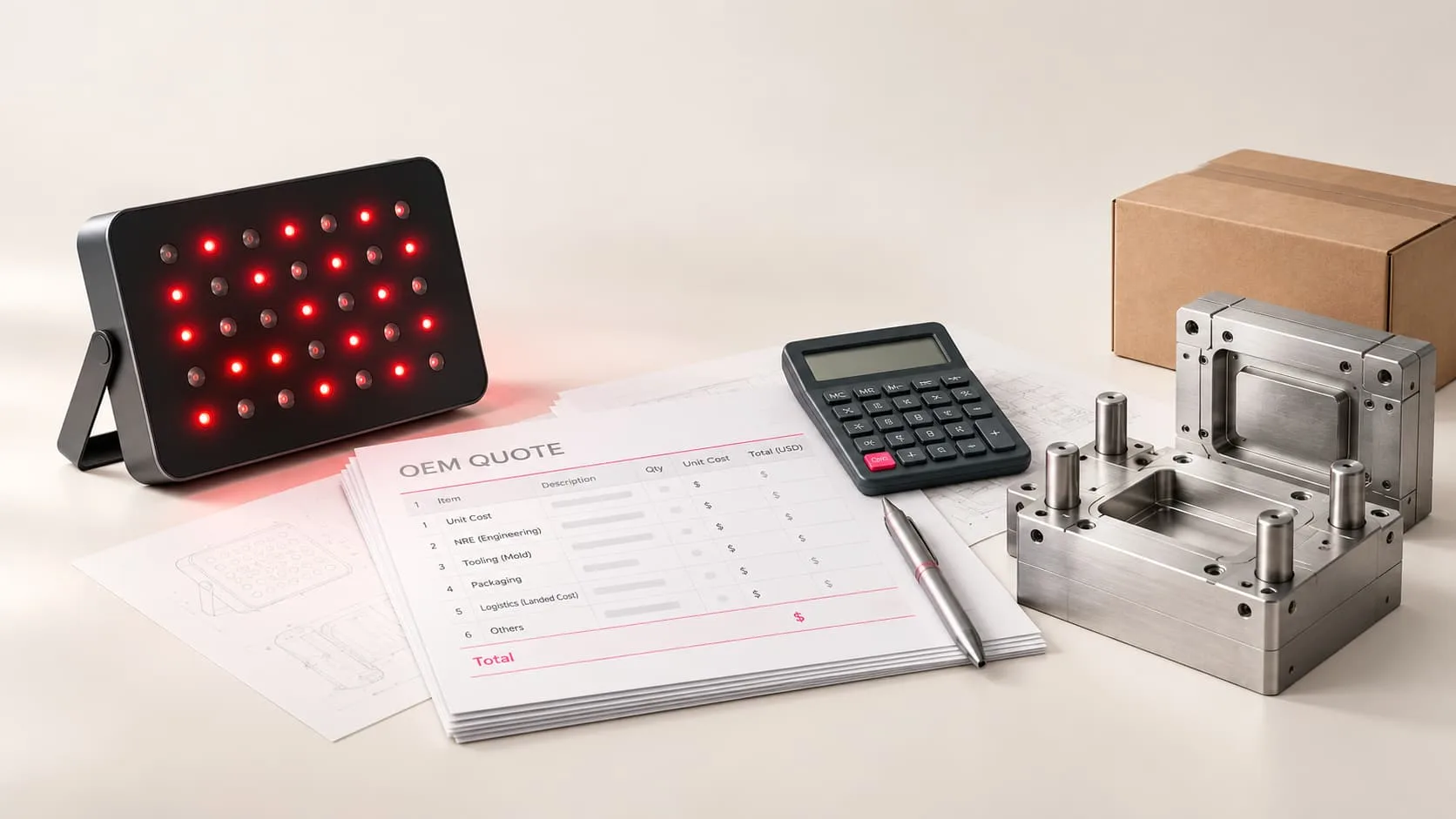
TL;DR: There is no useful standard OEM price or MOQ without a defined product, quantidade, scope and delivery basis. Normalize every quote against the same configuration, SKU mix, trade term, development stage and evidence scope. Then calculate total first-launch commitment, peak pre-sale cash exposure, first-run cash burden and modeled business-case cost, and approve spending only when the resulting base and adverse cases meet the brand’s decision limits. Keep engineering, tooling and recurring costs separate.
For brand product managers and sourcing teams, a useful red light therapy OEM cost estimate begins with a defined product configuration, quantidade, packaging scope, evidence scope, development route and delivery basis. Without those inputs, a headline unit price or MOQ answers the wrong question. This guide turns the variables into a comparable budget so finance, procurement and product teams can decide what to approve next.
The OEM Budget in One View
Use four decision metrics. They answer four different questions: What are we committing? How much cash is at risk before sales? How heavy is the first run? Can the product support the required ongoing economics?
1. Total first-launch commitment
Total first-launch commitment = non-recurring project costs + recurring first-order costs + first-order logistics/import cash items + buyer-side launch costs + non-overlapping contingency
Every term in this formula is a project total in the same currency. Contingency covers residual, unpriced uncertainty only; it must not duplicate a sample round, return allowance, freight risk or other amount already entered elsewhere.
2. Peak pre-sale cash exposure
Peak pre-sale cash exposure = the highest cumulative net cash outflow due before the first sale under the agreed milestone schedule
This can differ from the total commitment. A deposit, engineering milestone, tooling payment, production balance, freight charge and import payment can fall on different dates. Record whether each payment is refundable, creditable or at risk.
3. First-run cash burden per sellable unit
First-run cash burden per sellable unit = total first-launch commitment ÷ expected sellable units in the first run
Use expected sellable units after planned evaluation units, service stock and other inventory not intended for first-run sale—not automatically the purchase-order quantity.
4. Modeled business-case cost per unit
Modeled business-case cost per unit = recurring landed cost per sellable unit + (approved non-recurring recovery amount ÷ approved recovery volume) + buyer-side variable costs per unit
Keep the first-run cash burden separate from the business-case allocation: the brand may pay all development costs before launch but plan to recover an approved amount across more than one order.
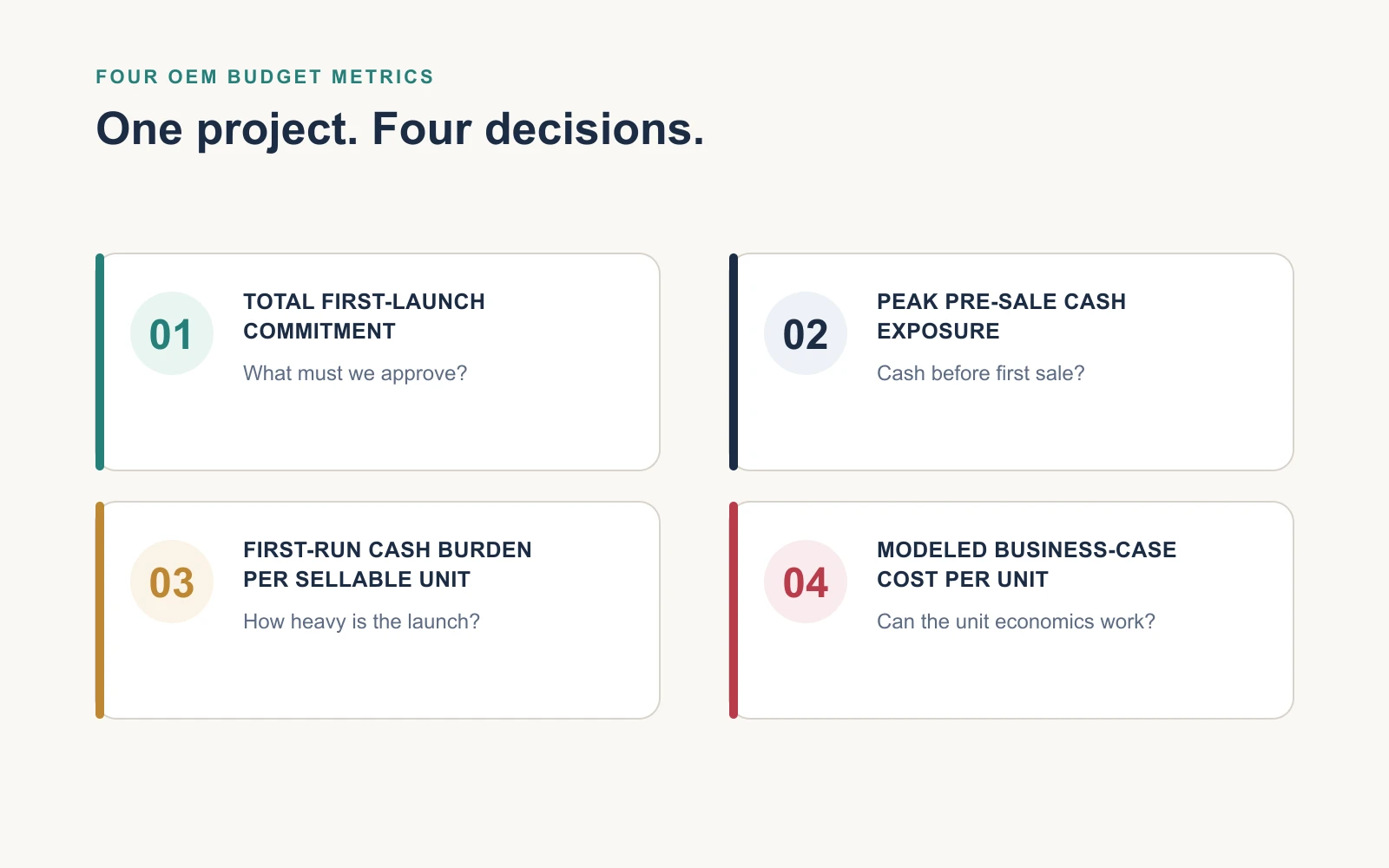
Four metrics answer four different approval questions; none substitutes for another.
| Role | Measure | What it includes | What decision it supports |
|---|---|---|---|
| Input | Quoted unit price | The supplier-defined device scope at a named quantity and commercial basis | Comparing suppliers only after configuration and inclusions are normalized |
| Intermediate value | Recurring landed cost | Recurring product, packaging and lot costs plus freight, seguro, obrigações, brokerage and non-recoverable import charges allocated to sellable units as applicable | Target-cost and replenishment planning |
| Decision metric | Total first-launch commitment | All non-duplicated first-launch cash requirements, with recoverable items identified separately | Overall project approval |
| Decision metric | Peak pre-sale cash exposure | Highest cumulative net cash outflow before the expected first-sale date | Cash-flow and funding approval |
| Decision metric | First-run cash burden | Total first-launch commitment divided by expected first-run sellable units | Whether the initial commitment is supportable at the launch volume |
| Decision metric | Modeled business-case cost | Recurring landed cost, allocated non-recurring recovery and buyer-side variable costs | Whether the planned product can meet the required ongoing economics |
Antes de entrar em contato com um fabricante, work backward from one non-overlapping revenue waterfall. If the brand manages contribution margin as a rate:
Maximum recurring landed device cost per unit = net realized revenue per unit × (1 − required contribution margin rate) − other variable costs per unit
Define net realized revenue once—for example, the actual per-unit revenue after the brand’s planned discounts or distributor transfer price. “Other variable costs” can include channel commissions, payment fees, fulfillment and an expected service/return reserve only when those amounts have not already been netted from revenue. If the company instead uses a required contribution amount per unit, subtract that amount rather than a percentage. This is an internal planning ceiling, not a manufacturer quote.
Copyable budget model
Copy this table into a spreadsheet. Use one currency and one tax treatment per scenario.
| Budget line | Base case | Adverse case | Fonte / status | Payment trigger |
|---|---|---|---|---|
| Engineering and other project work | - | - | Supplier quote / internal estimate / open | - |
| Ferramentas, fixtures and test assets | - | - | Itemized quote / open | - |
| Samples and prototypes | - | - | Incluído / excluded / provisional | - |
| One-time testing, evidence and document work | - | - | Named configuration and market / open | - |
| One-time packaging and artwork setup | - | - | Incluído / excluded / provisional | - |
| Finished units: quantity × recurring unit price | - | - | Quote revision and quantity tier | - |
| Recurring packaging, accessories and lot costs | - | - | Incluído / excluded / provisional | - |
| Freight and insurance | - | - | Carrier or supplier basis | - |
| Duty, brokerage and non-recoverable import charges | - | - | Broker/finance estimate | - |
| Recoverable VAT/GST or other import-tax cash-flow item | - | - | Finance/broker classification required | - |
| Buyer-side launch costs | - | - | Internal budget / open | - |
| Contingency for residual unpriced risks only | - | - | Named risk and owner | Approval milestone |
| Total first-launch commitment | - | - | Sum non-duplicated cash requirements; flag recoverable items separately | - |
| Peak pre-sale cash exposure | - | - | Sum payments by date; take the highest cumulative net cash outflow before first sale | - |
| Expected first-run sellable units | - | - | Approved planning input | - |
| First-run cash burden per sellable unit | - | - | Commitment ÷ sellable units | - |
| Recurring landed total | - | - | Excludes recoverable tax and non-recurring costs | - |
| Recurring landed cost per sellable unit | - | - | Recurring landed total ÷ sellable units | - |
| Approved non-recurring recovery amount | - | - | Internal approval; may differ from cash paid | - |
| Approved recovery volume for non-recurring costs | - | - | Internal approval | - |
| Allocated non-recurring recovery per unit | - | - | Approved amount ÷ approved recovery volume | - |
| Buyer-side variable costs per unit | - | - | Only costs not already in landed cost or net revenue | - |
| Net realized revenue per unit | - | - | Defined once; no duplicated deductions | - |
| Modeled business-case cost per unit | - | - | Recurring landed + allocated non-recurring + buyer-side variable costs | - |
| Modeled contribution amount per unit | - | - | Net realized revenue − modeled business-case cost | - |
| Modeled contribution margin rate | - | - | Contribution amount ÷ net realized revenue | - |
| Non-refundable / otherwise at-risk amount | - | - | Sum from contract and payment schedule | - |
Whether an import tax is recoverable, creditable or a true economic cost depends on the buyer’s circumstances. Keep it visible as a cash-flow line until the brand’s finance team or customs adviser confirms the treatment.
Milestone cash schedule
Use a separate row for every payment or confirmed recovery. Add the expected first-sale date as its own row; peak pre-sale cash exposure is the highest cumulative net cash outflow before that date. Calculate each row as prior cumulative net cash outflow + cash out − cash recovery or applied credit. Do not offset a possible refund until its amount and timing are contractually defined, or an order credit until it is contractually defined and applied in that scenario.
| Date / trigger | Cash out | Cash recovery or applied credit | Refundable, creditable or at risk? | Cumulative net cash outflow |
|---|---|---|---|---|
| - | - | - | - | - |
| - | - | - | - | - |
| - | - | - | - | - |
| Expected first-sale date | - | - | - | - |
Decision-limit check
The budget owner sets the limits; the model supplies the results.
| Decision limit | Base approved limit | Base result | Base pass/fail | Adverse approved limit | Adverse result | Adverse pass/fail |
|---|---|---|---|---|---|---|
| Total first-launch commitment: máximo | - | - | - | - | - | - |
| Peak pre-sale cash exposure: máximo | - | - | - | - | - | - |
| Contribution margin rate: mínimo | - | - | - | - | - | - |
| Non-refundable / otherwise at-risk amount: máximo | - | - | - | - | - | - |
Fictional Worked Example: Why Cash Burden and Business-Case Cost Differ
Illustrative only—entirely fictional. This is not a Wakelife quote or an industry benchmark. All amounts below are hypothetical USD figures created only to demonstrate the model. They do not represent any supplier, produto, market price, MOQ or commercial term.
For arithmetic demonstration only, assume a hypothetical 2,000-unit first order. This quantity is not an MOQ recommendation. The fictional base case expects 1,880 sellable units after evaluation, service and other non-sellable stock; the fictional adverse case expects 1,800. The hypothetical inputs and calculated outputs are:
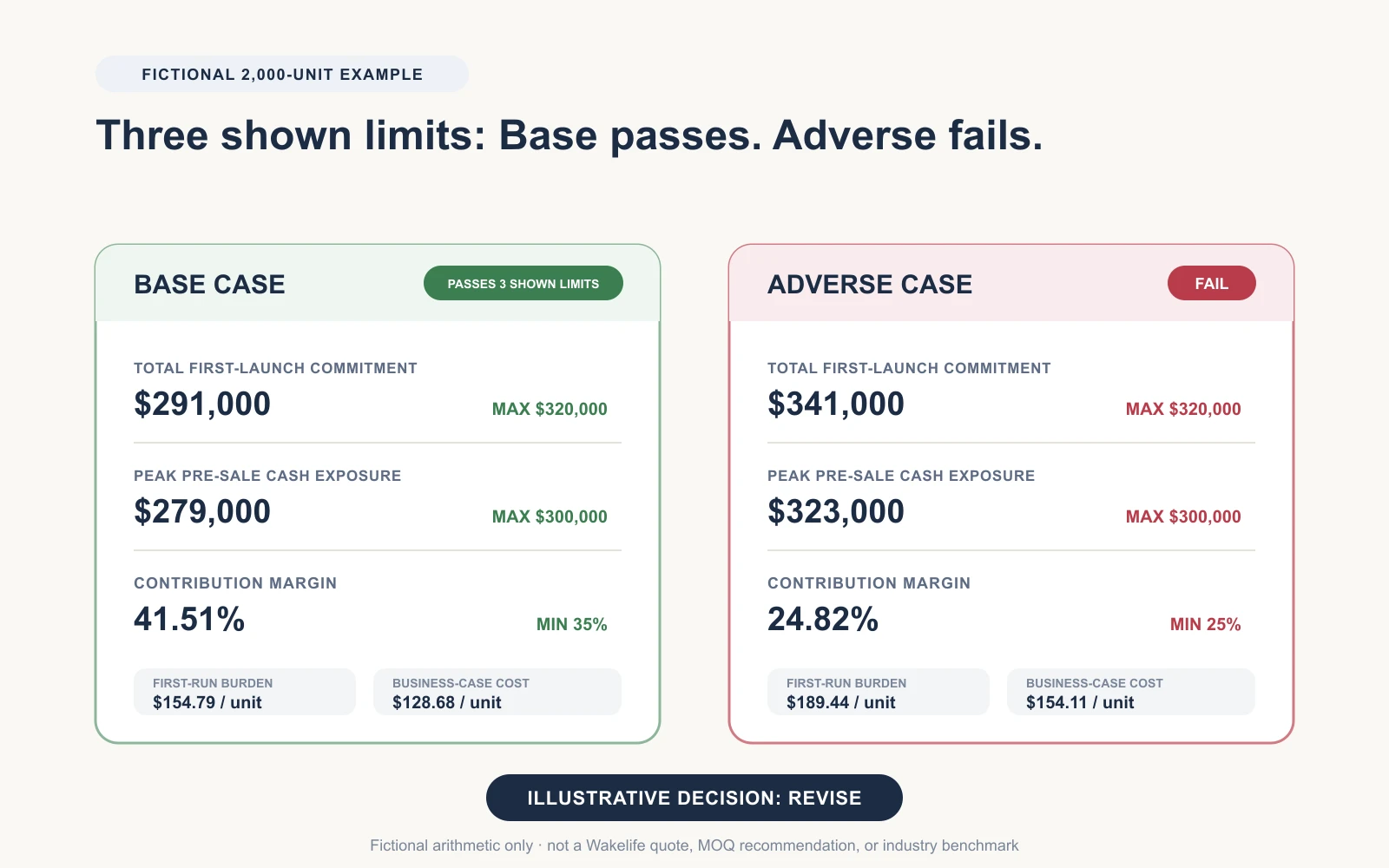
Fictional arithmetic only—not a Wakelife quote, MOQ recommendation or industry benchmark. Three limits are shown; the separate non-refundable / at-risk gate still requires the actual contract terms.
| Hypothetical input or result | Fictional base case (USD unless noted) | Fictional adverse case (USD unless noted) |
|---|---|---|
| Non-recurring project cash: engenharia, ferramentas, amostras, one-time evidence and packaging setup | $73,000 | $89,000 |
| Recurring landed total: finished units, recurring packaging, freight and non-recoverable import charges | $178,000 | $200,000 |
| Recoverable import-tax cash item | $18,000 | $22,000 |
| Buyer-side fixed launch costs | $10,000 | $12,000 |
| Residual-risk contingency reserve, approved but not assumed spent | $12,000 | $18,000 |
| Total first-launch commitment | $291,000 | $341,000 |
| Peak pre-sale cash exposure | $279,000 | $323,000 |
| Expected first-run sellable units | 1,880 | 1,800 |
| First-run cash burden per sellable unit | $154.79 | $189.44 |
| Approved non-recurring recovery amount / recovery volume | $60,000 / 6,000 unidades | $70,000 / 5,000 unidades |
| Recurring landed cost per sellable unit | $94.68 | $111.11 |
| Buyer-side variable cost per unit | $24.00 | $29.00 |
| Modeled business-case cost per unit | $128.68 | $154.11 |
| Net realized revenue per unit | $220.00 | $205.00 |
| Modeled contribution margin rate | 41.51% | 24.82% |
The base calculations are:
- Total first-launch commitment: $73,000 + $178,000 + $18,000 + $10,000 + $12,000 = $291,000.
- First-run cash burden: $291,000 ÷ 1,880 = $154.79 per sellable unit.
- Modeled business-case cost: $178,000 ÷ 1,880 + $60,000 ÷ 6,000 + $24.00 = $128.68 por unidade.
- Modeled contribution margin: ($220.00 − $128.68) ÷ $220.00 = 41.51%.
O $154.79 first-run cash burden and $128.68 modeled business-case cost are not competing answers. The first spreads the entire approved launch commitment—including the recoverable import-tax cash item and contingency reserve—over first-run sellable units. The second excludes recoverable tax, buyer-side fixed launch costs and the contingency reserve, then allocates only the approved non-recurring recovery amount across its approved recovery volume.
In this example, every non-contingency amount is paid before the first sale, and the recoverable import-tax cash item is recovered only after that date. The unused contingency reserve is not a dated cash outflow, so peak pre-sale exposure is lower than total commitment. If any of that reserve is spent before the first sale, the draw belongs in the milestone schedule and increases the peak.
Suppose the fictional approval limits are $320,000 for total commitment, $300,000 for peak pre-sale exposure, at least 35% contribution margin in the base case and at least 25% in the adverse case. The base case passes those limits. The adverse case fails all three, including the margin limit by 0.18 percentage points, so the illustrative result is Revise, not Go. A separate non-refundable / at-risk limit still requires the actual contract and payment terms.
Classify Every Cost by Workstream and Economic Behavior
A cost needs both a workstream and an economic behavior. The supplier’s label can differ; the buyer’s normalized model should not.
| Workstream | Non-recurring examples | Recurring examples | Open trigger to track |
|---|---|---|---|
| Engineering and project work | Requisitos, industrial/mechanical/electronic design, firmware setup, DFM | Licenses, cloud services or support where they repeat | Exigência, interface or revision change |
| Tooling and production assets | Molds, dies, jogos, gauges and test assets | Armazenar, maintenance or calibration when charged by period or run | Reparar, modification or replacement |
| Samples and prototypes | Planned builds for a named development stage | None unless the commercial model explicitly repeats them | Additional iteration after a design change or failed acceptance |
| Teste, evidence and documents | Initial project-specific work and report creation | Batch, periodic or market-maintenance work where applicable | Configuração, uso pretendido, claim or market change |
| Product and production | Initial setup when separately charged | Componentes, conjunto, in-process checks, final inspection and licensed features | Yield, retrabalhar, substitution or process change |
| Packaging and launch configuration | Artwork, dielines, print plates and setup | Boxes, trays, rótulos, manuais, cartons, accessories and spares | SKU, linguagem, artwork or material change |
| Logistics and import | Route or warehouse setup when separately charged | Freight, seguro, brokerage, obrigações, handling and warehousing | Rota, peso, volume, tariff or delivery-basis change |
| Buyer-side operations | Launch setup and initial training | Incoming inspection, cumprimento, service stock, warranty handling and returns | Sales mix, defeito, return or delay assumption |
Assign each expected amount to one budget row. If a supplier bundles several items, split them internally where possible or mark the bundle as unresolved.
For every line, also mark incluído, excluded, provisional ou open. That status is different from whether the cost repeats.
Normalize NRE and Tooling, Even When the Quote Bundles Them
Supplier labels vary. For budget comparison, separate engineering deliverables from tangible production assets even when both appear under “NRE,” “setup” or one package fee.
NRE usually refers to non-recurring engineering, but a supplier may use the label more broadly. The buyer should normalize the economic content rather than assume the label defines what is included.
For every NRE line, registro:
- the starting inputs and the named deliverable;
- the product revision or design scope covered;
- the number and type of sample iterations included, se houver;
- the review and acceptance point;
- excluded work, third-party fees and buyer responsibilities;
- ownership or permitted use of design files and source materials;
- the payment trigger and change-request rule;
- whether any amount is refundable or creditable against production.
Never assume that an engineering charge includes tooling, laboratory testing, certification work, packaging design or unlimited revisions. Never assume it will be refunded or credited to an order. Those are project terms that should be written into the proposal.
A low NRE figure can mean an efficient platform-based project. It can also mean important work has been left outside the quote. The number becomes meaningful only when the deliverables are visible.
New housing dimensions, integral mounts, an integral wearable structure or a new optical/mechanical layout can require a new mold or other production tooling. A change that stays inside an existing platform may avoid a new structural mold while still requiring engineering, amostras, jogos, artwork setup or re-evaluation of tests and documents.
Before releasing tooling, ask for a written tooling register:
| Tooling question | Why it belongs in the budget review |
|---|---|
| What exact part or operation does the tool produce? | Prevents one vague “mold fee” from hiding multiple assets or missing items |
| Is it prototype, soft or production tooling? | Clarifies what output and expected use the fee is meant to support |
| Is the asset dedicated to the buyer or shared? | Affects exclusivity, access and future manufacturing options |
| Who owns it after payment? | Payment alone does not define ownership or transfer rights |
| Where will it be stored, and for how long? | Armazenar, access and later retrieval may carry conditions |
| Who pays for maintenance, repair or modification? | These costs can appear after the first production run |
| Which design revision and approval authorize tooling to begin? | Prevents a tool from being made against an unsettled design |
| Which dimensional or functional criteria release tooling acceptance, final payment and production use? | Separates authorization to make the tool from acceptance of its output |
| What happens if the design changes? | Shows whether the tool can be modified or must be replaced |
| Can it be transferred, and under what documented conditions? | Prevents the team from assuming portability that was never agreed |
These are commercial and contract questions, not conclusions that can be inferred from a quotation total. For a product-specific example of the boundary between platform changes and new structural molds, ver Personalizando um dispositivo para crescimento de cabelo sem novas ferramentas.
Why MOQ Is Not One Number
The useful MOQ is the minimum for your exact sellable configuration—not the smallest number shown on a supplier page. A project can have several minimums at the same time:
| Constraint | Quoted unit or basis | What to convert or record | Cash question |
|---|---|---|---|
| Finished-product minimum | Total devices or one production run | Exact configuration, included QC and permitted model mix | How many finished units must the purchase order fund? |
| Per-SKU minimum | Units per color, tamanho, firmware, plug or accessory bundle | Sum the chosen SKU mix; do not compare one SKU minimum with the total order minimum | Which variants create separate purchase commitments? |
| Component purchase minimum | Componentes, reels, lots or supplier packs | Finished-goods equivalent where possible; keep unavoidable excess separate | Who funds, owns, stores and may reuse unused material? |
| Material or finish batch | Peso, área, color batch or process lot | Supported units under the chosen SKU mix and expected excess | Can the balance carry into a reorder, and under what record? |
| Packaging minimum | Printed boxes, trays, manuais, labels or inserts | Packaging versions and finished-goods equivalent; keep excess visible | Is excess packaging paid now, stored and usable for later orders? |
| Pilot-build quantity | Named controlled build | Propósito, configuration and whether it is separate from production MOQ | Is this a learning build, sellable stock or both? |
| Reorder minimum | Later replenishment quantity | Conditions that change after materials or packaging already exist | Which first-order constraints disappear, remain or reset? |
The effective launch commitment is the smallest order and purchase plan that satisfies every binding constraint. Do not take the largest number across unlike units. Convert finished-product and per-SKU minima into one fixed SKU mix; record excess components, materials and packaging as separate inventory and cash lines unless the supplier confirms how they are included, credited or carried forward.
How to reduce cash exposure without asking for an impossible MOQ
The cleanest levers are usually scope levers:
- use an established platform for the first launch;
- keep one common core configuration across early SKUs;
- reduce color, tamanho, firmware and accessory variants;
- use standard packaging with controlled labels or sleeves where appropriate;
- separate must-have differentiation from features that can wait for the next version;
- quote a pilot and a production order as different stages;
- ask whether excess custom materials can be documented and carried into a reorder.
Lower quantity does not automatically mean lower project cost. It can increase the unit price, leave packaging or components unused, or fail to generate meaningful production evidence. The goal is not the lowest MOQ; it is the smallest controlled commitment that can answer the next business and production question.
Route the Project by Work Required, Not by the OEM/ODM Label
Suppliers use “private label,” “OEM” and “ODM” differently. For budgeting, describe the actual work instead.
| Development route | What is already known | Budget emphasis | Cost-confidence warning |
|---|---|---|---|
| Existing platform | Core design, tooling and production process already exist; branding or packaging may change | Amostras, obra de arte, embalagem, exact-configuration review, first order and logistics | The catalog price is not automatically the price for your branding, embalagem, documents or destination |
| Controlled platform customization | The base architecture exists, but selected components, controles, óptica, materials or accessories change | Engineering review, changed-part samples, possible fixtures/tooling, re-evaluation and configuration-specific production cost | The original platform's price and evidence cannot simply be carried across the change |
| New product development | Important product architecture or structure must be created | NRE, prototypes, ferramentas, verificação, produção piloto, design changes and launch reserve | A firm mass-production price is least credible before the design and process are stable |
This classification does not decide the regulatory path and does not guarantee that an existing platform is suitable. It gives the finance and product teams a clearer budget starting point than a label alone.
Cost Confidence Should Increase by Stage
Do not ask an early concept quote to behave like a production quote. Ask what can be responsibly committed at the current stage. Stage names differ across companies, so define the evidence rather than relying on the label.
| Project point | What can normally become clearer | What should still be marked provisional |
|---|---|---|
| Conceito / first inquiry | Product route, major cost drivers, broad quantity scenarios and obvious tooling direction | Final BOM, engineering effort, test burden, trabalho, yield and production unit cost |
| Viabilidade / quote-ready scope | Included deliverables, NRE categories, likely tooling, sample plan and quotation assumptions | Changes discovered through engineering and prototype work |
| Protótipo de engenharia / EVT-type work | Chosen architecture, high-risk components, prototype effort and early supplier quotations | Production-intent materials, stable assembly time, reliability findings and yield |
| Design freeze / DVT-type work | Near-final BOM, released tooling scope, verification plan, packaging and most external quotations | Rework, process tuning and actual pilot-production losses |
| Pilot / PVT-type work | Observed cycle time, first-pass yield, defect/rework patterns, production controls and shipment configuration | Future demand changes, supplier changes and later engineering revisions |
| Repeat production | Actual order, qualidade, logistics and after-sales data | New volumes, mercados, configurations or component changes |
O Processo de desenvolvimento de dispositivo de terapia de luz vermelha explains the wider Go, Segurar, Revise and Stop gates around these investments. This page stays focused on the economic evidence needed for those decisions.
Use This Quote-Normalization Worksheet
Put every supplier on the same rows before ranking prices. If a row is blank, the quote is incomplete—not automatically cheap.
| Normalize this field | What every supplier response should state | Comparison rule |
|---|---|---|
| Quote identity | Supplier, quote number, data, revisão, currency and validity | Compare the latest controlled revision only |
| Identidade do produto | Model/platform, dimensões, Materiais, light-source/optical configuration, eletrônica, firmware, accessories and BOM/specification revision | No price comparison across unidentified configurations |
| Development route | Existing platform, controlled customization or new development, described by work included | Do not rely on OEM/ODM wording alone |
| Quantity scenarios | Amostra, piloto, launch order, reorder and annual estimate; quantity by SKU | Request the same tiers and same SKU mix |
| Unit price basis | Included device, acessórios, Controle de qualidade, packaging and spare parts | Mark every inclusion and exclusion |
| Trade basis | Complete Incoterms® rule, version and named place/port; origin, destino, mode and shipment assumption | Do not compare EXW, FOB and delivered prices as if equivalent |
| Import and tax basis | Importer of record; included/excluded freight, seguro, export/import clearance, duty, brokerage, VAT/GST and other taxes | Separate economic cost from recoverable-tax cash flow; buyer finance/broker confirms treatment |
| NRE | Deliverables, milestones, revisions, acceptance and change rules | Separate engineering work from production units |
| Tooling/assets | Itemized asset, purpose, propriedade, armazenar, maintenance and modification terms | Separate dedicated assets from shared platform tools |
| Samples/prototypes | Quantidade, configuração, método, deliverables, shipping and whether fees are credited | A catalog sample and engineering prototype are not the same purchase |
| Testing/evidence | Exact work, configuração, mercado, responsible party and excluded third-party fees | “Certification included” is not an itemized scope |
| Packaging/artwork | Estrutura, Materiais, print method, inserções, manuais, setup charge and separate MOQ | Normalize one approved packaging specification |
| Controles de produção | Inspection scope, acceptance criteria, traceability and records delivered | Compare the evidence supplied with the batch, not only slogans |
| Tempo de espera | Start trigger, sample/tooling/production stages, buyer approvals and excluded transit time | Compare timelines from the same release point |
| Payment exposure | Deposit, milestone payments, balance trigger and non-refundable items | Compare cash timing as well as total amount |
| Forecast and firm commitment | Forecast versus binding order, long-lead or non-cancellable/non-returnable materials, cancellation/delay liability and excess-inventory treatment | Do not treat a forecast as a purchase obligation—or overlook one hidden in the proposal |
| Price-adjustment mechanism | Currency, material/index, validade, annual review and requote triggers | Separate a current quote from a guaranteed future price |
| Warranty/service | Cobertura, exclusões, claim process, spare strategy and cost allocation | Include the brand's remaining service exposure |
| Change triggers | Inputs that would reopen cost, MOQ or timeline | Rank the visibility of uncertainty, not just the current total |
Send each supplier the same controlled scope and the same blank supplier-response fields. In the buyer’s internal copy, add Evidence received / proprietário / due date plus the decision limits and scoring; do not send internal owners, thresholds or competitor comparisons to suppliers.
Decide: Go, Segurar, Revise or Stop
The budget review should authorize a defined next step, not vaguely “approve the project.”
Before the review, the buyer should approve four thresholds:
- maximum total first-launch commitment;
- maximum peak pre-sale cash exposure;
- minimum contribution-margin rate in the base case and the adverse-case limit;
- maximum non-refundable or otherwise at-risk amount before the next gate.
Then run at least a base case and an adverse case. Change the variables that can still move the decision: sellable quantity, SKU split, recurring landed cost, freight or duty assumptions, exchange rate, unquoted tooling or evidence work, repeat samples and launch delay.
| Decisão | Economic trigger | O que gravar |
|---|---|---|
| Go | The approved scope has been quoted on a consistent basis; the base case meets its approved thresholds; the adverse case meets its approved adverse-case thresholds; remaining uncertainty is owned | Decision/date/approver, released scope and amount, open risks, owner and next gate |
| Segurar | A critical input, quote, responsibility or threshold decision is missing, but the concept should not yet change | Decision/date/approver, missing item, proprietário, due date and spending that must not begin |
| Revise | The opportunity remains valid, but commitment, cash exposure, contribution margin, variant count or development burden misses a threshold and can be changed | Decision/date/approver, scope change, affected assumptions and requote plan |
| Stop | No credible scope or business-model change can meet the approved thresholds without removing a critical product, market or evidence requirement | Decision/date/approver, stop reason, reusable work and disposition of tooling, samples or materials |
A common Revise decision is more valuable than a forced Go: launch one configuration instead of four, retain an existing housing, postpone an app, standardize packaging, or validate demand before releasing dedicated tooling.
What to Send for a Costed Feasibility Discussion
You do not need every engineering detail to start. You do need enough information to stop the supplier from pricing the wrong project.
Send one controlled input set and the same blank supplier-response template to each shortlisted manufacturer:
- mercado-alvo, canal de vendas, user and use environment;
- product format or reference platform;
- must-have requirements, optional requirements and known open decisions;
- requested changes to structure, óptica, eletrônica, firmware, accessories or packaging;
- intended-use and claim direction that may affect the evidence plan—use the Guia de certificação de dispositivos de terapia LED to map which records need exact-model and market review;
- launch quantity, SKU split, reorder scenario and annual planning range;
- target launch date and the decision that the current quote must support;
- embalagem, manual, rótulo, spare and after-sales assumptions;
- delivery destination, proposed importer of record and requested Incoterms® comparison;
- the team’s target cost ceiling, if it is approved for supplier discussion;
- existing drawings, requisitos, test information or IP constraints;
- a request to separate unit price, NRE, ferramentas, amostras, testing/evidence work, packaging setup and logistics.
Mark unknowns as unknown. Ask the manufacturer to quote the assumed option and identify what evidence is needed to replace the assumption. Keep this input set focused on variables that change cost, MOQ or quote confidence.
The Practical Next Step
Primeiro, complete the base and adverse cases, approve the four decision thresholds and calculate total first-launch commitment, peak pre-sale cash exposure, first-run cash burden and modeled business-case cost. Then send the same controlled scope and quantity scenarios to each shortlisted supplier.
If Wakelife is on your shortlist, use o Wakelife OEM/ODM service page to submit the target market, formato do produto, must-have changes, quantity scenarios, packaging and destination, evidence needs and decision deadline. Ask the project team to identify what can be quoted now, which assumptions remain open and which decision would change the cost or MOQ.
For related decisions:
- use o OEM Qualification Checklist before relying on a supplier’s certificates or factory claims;
- use o Lista de verificação de aprovação de amostra de dispositivo de terapia com LED before treating a sample as the production baseline;
- use o Guia de certificação de dispositivos de terapia LED when market, intended-use or evidence responsibilities could change the project scope.
The goal is not to obtain the smallest number quickly. It is to make the next financial commitment against a defined product, a visible scope and a budget that can survive the next stage of evidence.

Sources and Scope
This article presents a buyer budgeting and decision framework. It is not an accounting standard, legal opinion, tax ruling or universal industry price schedule.
-
1
Câmara de Comércio Internacional. Regras Incoterms® . Used for the role of named trade terms; the buyer must still identify the full rule, version and named place/port and obtain project-specific customs and tax advice. Accessed September 24, 2026.
-
2
Wakelife. Processo de desenvolvimento de dispositivo de terapia de luz vermelha . Wakelife editorial guidance used for stage-based cost confidence and investment gates; not an industry accounting standard. Accessed September 24, 2026.
-
3
Wakelife. Personalizando um dispositivo para crescimento de cabelo sem novas ferramentas . Product-category example used to show why avoiding a new structural mold does not eliminate engineering, sampling or file-review work; not a universal rule for every platform. Accessed September 24, 2026.
-
4
Wakelife. Serviços OEM/ODM e Private Label Services . First-party commercial pages describing Wakelife's current service routes and project-specific MOQ/tooling approach; not independent evidence of industry-wide prices or minimums. Accessed September 24, 2026.