Não qualifique um OEM de terapia de luz vermelha contando logotipos de certificados. Verifique quem detém cada registro, qual site e escopo ele cobre, e se alguma autorização em nível de produto realmente corresponde ao dispositivo e às afirmações que você planeja vender.
ISO 13485, MDSAP e FDA 510(k) registros não provam a mesma coisa. ISO 13485 diz respeito a um sistema de gestão da qualidade. O MDSAP diz respeito a uma auditoria regulatória desse sistema em relação aos critérios e escopo declarados. A FDA 510(k) está vinculado ao envio de um dispositivo específico e ao uso pretendido liberado. Um OEM confiável deve ser capaz de mostrar como essas camadas se conectam sem fingir que uma substitui a outra..
TL B2B;DR
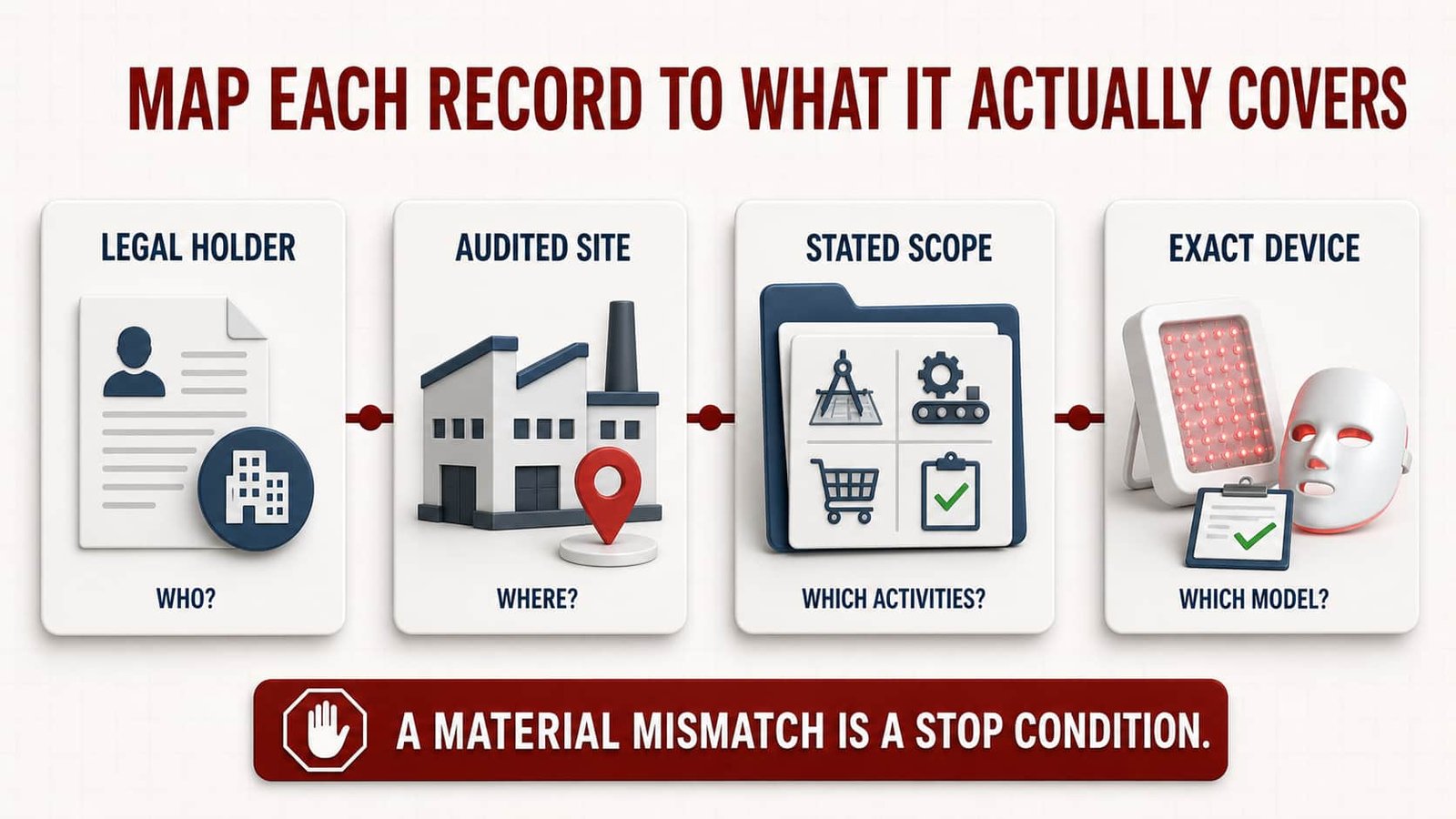
- Comece com um mapa da entidade ao escopo, não é uma contagem de crachás. Registrar cada certificado ou autorização contra seu titular legal ou requerente, site auditado, escopo declarado, produto alvo e os relacionamentos documentados entre as partes responsáveis.
- Verifique ISO 13485 e MDSAP através do emissor ou registro oficial do programa. Eles são evidências do sistema de qualidade, não aprovações gerais de produtos ou acesso automático ao mercado.
- Verifique todas as reivindicações da FDA pelo número K. Verifique o requerente, nome do dispositivo, código do produto, modelos nomeados e indicações antes de decidir se o registro é relevante para o seu projeto.
- Se um fornecedor depende de um 510(k) como autorização para o produto proposto, uma incompatibilidade de dispositivo exato ou de uso pretendido é um sinal de parada. De outra forma, tratar o registro apenas como experiência regulatória anterior e avaliar o novo caminho separadamente.
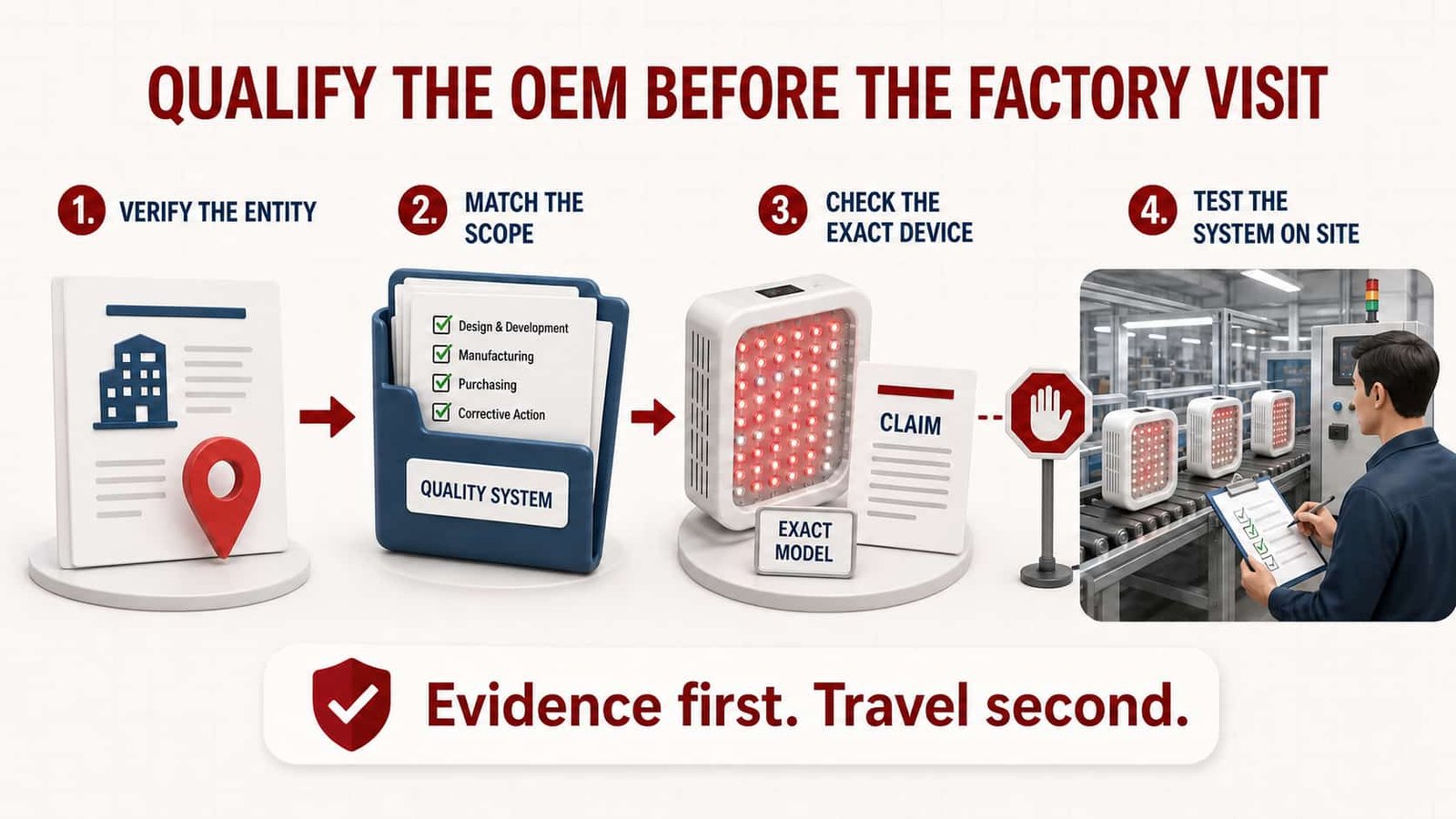
- Conclua a revisão mínima de identidade e escopo antes de comprometer uma amostra significativa, testes ou custos de viagem. Em seguida, use a visita à fábrica para testar se os controles documentados estão visíveis na compra, produção, teste, rastreabilidade, tratamento de não conformidades e controle de mudanças.
Por que você deve examinar as evidências regulatórias antes do preço?
O preço só se torna significativo depois que o fornecedor passou no teste de evidência mínima.
Uma cotação baixa não pode compensar um certificado expirado, uma pessoa jurídica diferente, um escopo que exclui seu produto, ou um registro da FDA que pertence a outra família de dispositivos. Essas lacunas podem surgir mais tarde, à medida que testes repetidos, retrabalho de embalagem, entrada atrasada no mercado ou um produto que não pode suportar as reivindicações que seu plano comercial assumiu.
O primeiro objetivo da qualificação não é, portanto, encontrar a fábrica “mais certificada”. É para remover fornecedores cujas evidências não possam ser conectadas ao seu projeto exato.
Use esta sequência:
- Verifique quem possui as evidências.
- Verifique quais sites e atividades foram auditados.
- Verifique qual família de dispositivos e reivindicações um registro no nível do produto cobre.
- Verifique se a fábrica pode reproduzir a configuração necessária sob produção controlada.
- Só então compare o preço, MOQ, prazo de entrega e personalização.
O que ISO faz 13485, MDSAP e FDA 510(k) Cada Prova?
A maneira mais rápida de evitar listas de crachás enganosas é separar as três camadas de evidências.
| Camada de evidências | O que isso pode mostrar | O que não mostra | Verificação mínima do comprador |
|---|---|---|---|
| ISO 13485 Certificado | O sistema de gestão da qualidade de uma organização nomeada foi avaliado de acordo com a ISO 13485 para um site declarado, atividade e escopo | Aprovação do produto, autorização para um modelo específico, ou acesso automático a todos os mercados | Número do certificado, nome legal, local físico, padrão, escopo, emissor, data de emissão/revisão, expiração e status de verificação |
| Certificado MDSAP | O SGQ de uma organização de dispositivos médicos nomeada foi auditado por uma organização de auditoria reconhecida ou autorizada pelo MDSAP de acordo com a ISO 13485 e os critérios regulatórios aplicáveis listados no certificado | Uma autorização de comercialização do produto, uma inspeção da FDA, ou prova de que todas as jurisdições do MDSAP se aplicam a todos os dispositivos | Número do certificado, nome legal, sites auditados, ID da instalação onde mostrado, Organização de Auditoria, critérios, escopo do dispositivo/atividade, limitações e validade |
| FDA 510(k) registro | A FDA considerou o dispositivo submetido substancialmente equivalente para as indicações no registro de autorização | Aprovação da FDA, um certificado para toda a fábrica, autorização para modelos não relacionados, ou prova de conformidade com todos os outros requisitos da FDA | Número K, requerente, nome do dispositivo, código do produto, regulamento, decisão, modelos nomeados, indicações e correspondência de dispositivo/rotulagem controlada |
A distinção tornou-se ainda mais importante quando o Regulamento do Sistema de Gestão da Qualidade da FDA entrou em vigor em fevereiro. 2, 2026. O QMSR incorpora ISO 13485:2016 por referência e adiciona requisitos específicos da FDA. O Perguntas frequentes sobre QMSR da FDA afirma que a FDA não exige uma ISO 13485 Certificado, que tal certificado não isenta um fabricante da inspeção da FDA, e que as inspeções da FDA não seguem os procedimentos de auditoria do MDSAP. Uma ISO 13485 certificado é evidência relevante do SGQ, mas não é uma prova automática de conformidade total com o QMSR.
De forma similar, o Visão geral do MDSAP da FDA descreve o MDSAP como uma auditoria regulatória única que pode satisfazer os requisitos relevantes das autoridades participantes. A palavra “relevante” importa: os critérios aplicáveis, dispositivos, sites e limitações ainda devem ser lidos no certificado e no contexto do projeto.
O MDSAP não substitui a avaliação de conformidade do MDR da UE ou os requisitos de marcação CE. O visão geral oficial do programa MDSAP lista a União Europeia como observador oficial, não como um dos cinco membros do Conselho da Autoridade Reguladora.
A primeira bandeira vermelha: um selo está sendo usado para responder a uma pergunta diferente
Pare e peça esclarecimentos se um fornecedor usar:
- ISO 13485 reivindicar que um determinado produto é aprovado;
- MDSAP afirma que um dispositivo pode ser vendido automaticamente em todas as jurisdições participantes;
- um registro de estabelecimento da FDA ou uma lista de dispositivos como se fosse 510(k) autorização;
- um número K para cobrir todos os modelos fabricados na fábrica;
- uma folga de máscara facial para apoiar um painel, cinto, dispositivo de cabelo ou outra categoria de produto.
Etapa 1: Você pode verificar o fabricante legal, Local e Escopo?
Comece com identidade, não a arte do certificado.
Para cada ISO 13485 ou documento MDSAP, registro:
- o nome completo do fabricante legal;
- o endereço físico de fabricação;
- cada site ou subsite auditado mostrado;
- o número do certificado;
- o organismo de certificação emissor ou Organização de Auditoria MDSAP;
- os critérios padrão e regulatórios declarados;
- as atividades abrangidas, como projeto, fabricação ou distribuição;
- as categorias de dispositivos no escopo;
- quaisquer exclusões, limitações ou condições específicas da jurisdição;
- o eficaz, datas de revisão e expiração;
- a rota de verificação oficial.
Este não é um detalhe administrativo. O actual Requisitos do documento de certificação MDSAP exigir o nome legal do fabricante, endereços físicos auditados, critérios de certificação, escopo do dispositivo/atividade, informações de validade e um método de verificação. Eles também exigem o escopo para identificar limitações onde os critérios não são universalmente aplicáveis.
Uma verificação prática da entidade ao escopo
Use uma linha para cada registro:
| Registro | Titular legal | Site | Escopo da atividade | Escopo do dispositivo | Status | Correspondência de projeto |
|---|---|---|---|---|---|---|
| ISO 13485 | Verificado / não resolvido | Sim / condicional / não | ||||
| MDSAP | Verificado / não resolvido | Sim / condicional / não | ||||
| FDA 510(k) | Endereço do requerente | Função de envio | Dispositivos/modelos nomeados | Verificado / não resolvido | Sim / condicional / não | |
| Relatório de teste do produto | Fabricante e requerente | Exemplo de identidade | Configuração testada | Modelo exato/acessórios | Verificado / não resolvido | Sim / condicional / não |
Não “calcule a média” de uma incompatibilidade de identidade. Diferentes entidades não estão desqualificando automaticamente, mas seus papéis devem ser explícitos. Identifique o 510(k) proprietário ou desenvolvedor de especificações, fabricante legal, fabricante contratado, titular do certificado e entidade de vendas, quando aplicável. Em seguida, documente qual parte controla o design, produção, rotulagem, reclamações, aprovação de alterações e responsabilidades pós-comercialização.
Etapa 2: O registro da FDA corresponde ao dispositivo exato?
Pesquise você mesmo o banco de dados da FDA. Uma carta recortada, O logotipo da FDA ou gráfico em estilo de certificado não é suficiente.
O FDA 510(k) visão geral explica que um 510(k) demonstra equivalência substancial a um predicado comercializado legalmente e libera o dispositivo para distribuição comercial. Ele também observa que a FDA normalmente não realiza uma inspeção de instalações de pré-liberação. UM 510(k), portanto, é uma evidência significativa do dispositivo – mas não é prova de que toda a fábrica ou cada produto tenha sido inspecionado e aprovado pela FDA.
Verifique estes campos:
- Número K: O registro do banco de dados existe?
- Requerente ou 510(k) proprietário: Esta parte tem autoridade legal sobre o dispositivo enviado? Se for diferente da fábrica de produção, a relação desenvolvedor-especificação ou fabricante contratado está documentada?
- Nome do dispositivo: É a mesma categoria de produto que você planeja comprar?
- Código e regulamento do produto: Eles estão alinhados com o uso pretendido proposto?
- Decisão: O registro mostra uma determinação substancialmente equivalente?
- Modelos nomeados: O modelo exato está incluído onde o registro público nomeia os modelos?
- Indicações de uso: As reivindicações planejadas permanecem dentro do escopo liberado?
- Controle de configuração: Faça hardware, modos de luz, programas, acessórios, a rotulagem e as instruções ainda correspondem ao dispositivo controlado?
Sob 21 CFR 807.97, uma determinação de equivalência substancial não denota aprovação oficial da FDA. A redação correta é FDA 510(k)-limpo, não Aprovado pela FDA.
Quando uma incompatibilidade exata de dispositivos é uma condição de parada
Se um fornecedor ou comprador pretender confiar num número K existente como autorização de comercialização para o produto proposto, uma incompatibilidade no formato do produto, uso pretendido, modelo nomeado ou configuração controlada é uma condição de parada. Não prossiga com base nessa autorização até que a lacuna seja resolvida.
Se o projeto espera uma nova submissão ou segue um caminho diferente, registrar a incompatibilidade como uma lacuna regulatória em vez de uma falha automática do fornecedor. A autorização existente pode ser tratada como um sinal de execução regulamentar prévia em nível de produto, mas o novo caminho, responsabilidades, evidência, cronograma e orçamento ainda exigem avaliação separada.
Essa distinção é especialmente importante para painéis de terapia de luz vermelha. Uma fábrica pode ter levado uma máscara de LED através de um 510(k) enquanto seus painéis seguem um EUA diferente. posicionamento ou exigir uma avaliação regulatória separada. Não transfira o número K da máscara para o painel.
Etapa 3: O que você deve solicitar antes de uma visita à fábrica?
Um fornecedor confiável deve ser capaz de organizar um pacote de evidências em torno do produto e mercado selecionado – e não enviar uma pasta de certificados não relacionados.
Solicite esses itens antes de reservar a viagem:
| Solicitar | O que você está testando | Resposta incompleta |
|---|---|---|
| ISO atual 13485 e documentos de certificação MDSAP | Titular, site, escopo, critérios, limitações e validade | Logotipo, imagem ou certificado recortado sem rota de verificação |
| Mapa de registros regulatórios públicos | Número K ou outra autorização vinculada ao requerente, dispositivo, modelos e reivindicações | “Certificado pela FDA” sem número ou explicação exata do dispositivo |
| Folha de produto e configuração | Modelo exato, comprimentos de onda/modos, método de saída, acessórios, software e uso pretendido | Catálogo genérico que não consegue identificar a configuração proposta |
| Índice de teste específico do produto | Quais relatórios se aplicam a qual modelo, configuração e mercado | Relatórios de teste de um modelo diferente, adaptador, material ou configuração |
| Lista de personalização/alteração proposta | Seja marca, hardware, firmware, acessórios, instruções ou reivindicações mudarão | “Toda a personalização é coberta” sem avaliação documentada |
| Matriz de responsabilidade | Quem controla o design, fabricação, rotulagem, reclamações, vigilância e decisões regulatórias | Nenhum proprietário nomeado para tarefas pós-comercialização ou controle de alterações |
| Lista de lacunas abertas | Qual evidência está completa, condicional, indisponível ou ainda em análise | Uma afirmação de que todo documento está “disponível” sem nomes de arquivo ou status |
A melhor resposta não é necessariamente a pasta mais grossa. É aquele que mostra a relação exata entre o modelo selecionado, configuração controlada, mercado-alvo e evidências disponíveis.
A disponibilidade e o escopo do documento são mais importantes do que a velocidade de resposta. Registros confidenciais podem ser editados, revisado sob um NDA ou reservado para revisão no local. A recusa de um fornecedor em fornecer até mesmo um índice de documentos, identificar o proprietário responsável ou explicar a rota de revisão é um sinal de alerta mais forte do que um processo razoável de controle de acesso.
Solicitação de pré-auditoria copiável
Forneça um mapa de evidências em nível de modelo para o dispositivo proposto. Para cada ISO 13485, MDSAP, FDA 510(k), segurança, Emc, fotobiológico, saída óptica ou outro registro de teste, identificar o titular legal ou requerente, organismo emissor ou laboratório, número do documento, modelo/configuração exato, mercado aplicável, escopo, validade atual e qualquer lacuna criada pela personalização solicitada ou reivindicações planejadas.
Etapa 4: O Sistema de Qualidade Chega à Linha de Produção?
As etapas 1 a 3 determinam se o fornecedor mereceu uma visita à fábrica. Etapa 4 é a lista de verificação da fase de visita: testa se o sistema documentado é visível em registros e decisões de produção.
O actual Abordagem de Auditoria MDSAP segue processos primários para gerenciamento, medição/análise/melhoria, design e desenvolvimento, e controles de produção/serviço, com compras vinculadas a esses processos. Use a mesma lógica durante a qualificação do fornecedor: siga um produto desde os requisitos até os componentes adquiridos, produção, verificação, liberação e ação corretiva.
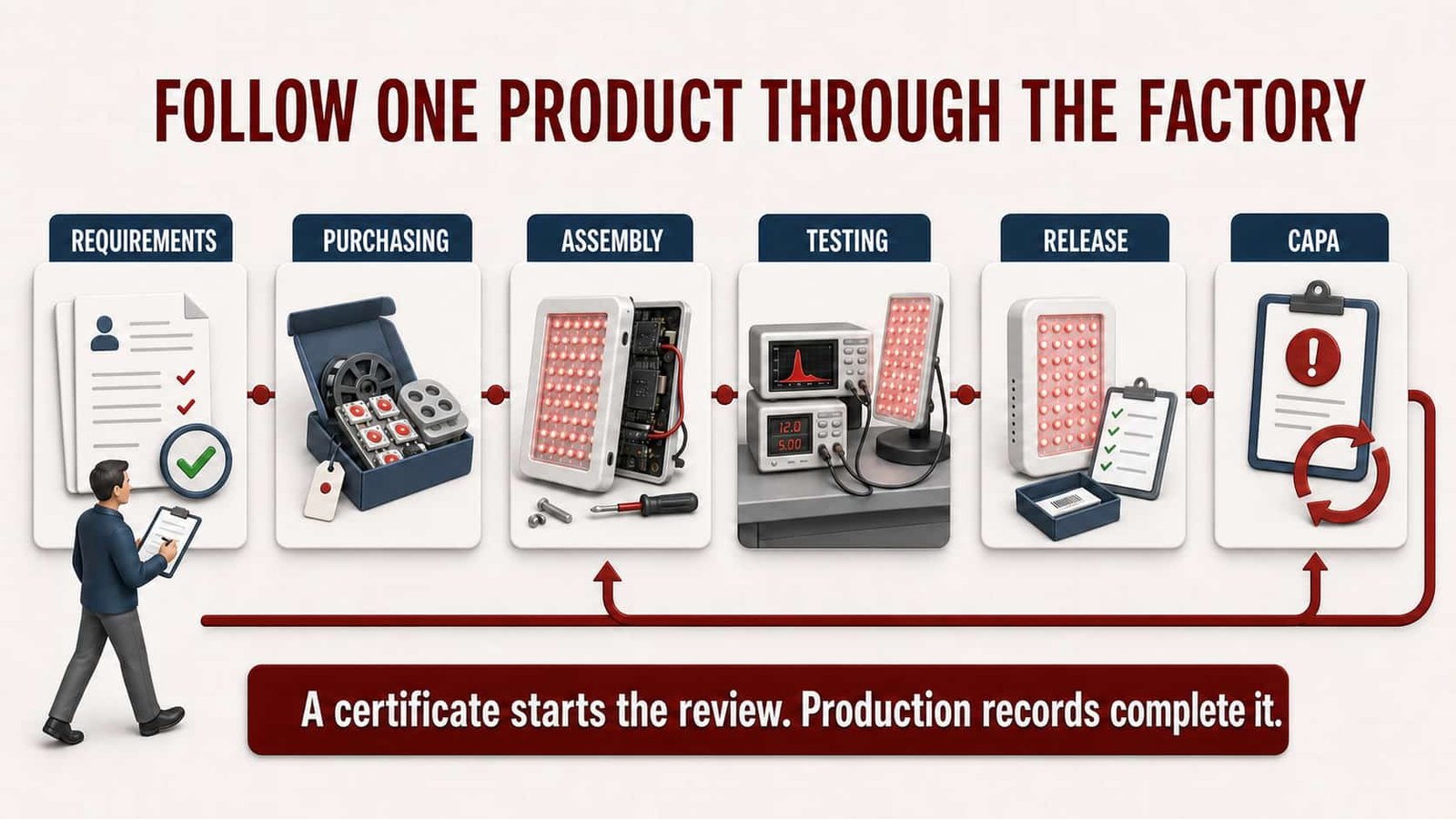
Para um dispositivo de terapia de luz vermelha, examinar:
1. Entrada de materiais e controle de fornecedores
- São LEDs críticos, componentes ópticos, fontes de alimentação, baterias, PCBs e materiais de contato com a pele vinculados a especificações aprovadas?
- Como os fornecedores críticos são selecionados, monitorado e reavaliado?
- Quais registros de aceitação mostram que os componentes recebidos atenderam aos requisitos definidos?
- O que acontece quando um fornecedor ou componente muda?
2. Controle de produção e processo
- A instrução de trabalho atual corresponde exatamente ao modelo e revisão da linha??
- São ferramentas, jogos, versões de software e parâmetros de processo controlados?
- Os operadores são treinados para a operação atual??
- As decisões de retrabalho e concessão são autorizadas e rastreáveis??
3. Medição e verificação óptica
- Quais instrumentos medem o comprimento de onda, irradiância, saída elétrica e outras características de liberação?
- A identificação do instrumento e o status da calibração estão visíveis??
- A distância do teste, geometria, modo, condição de aquecimento, plano de amostragem e critérios de aprovação/reprovação definidos?
- O fornecedor pode conectar a especificação de marketing ao método de teste real e ao registro de produção??
4. Envelhecimento, inspeção final e liberação
- Se for alegado envelhecimento ou queimadura, o que faz o teste de etapa, por quanto tempo e em relação a quais critérios de aceitação?
- O “teste 100%” é suportado por um registro de unidade ou lote?, ou apenas declarado em uma apresentação de vendas?
- Quem autoriza a liberação final, e o que acontece quando uma unidade falha?
5. Rastreabilidade, não conformidade e CAPA
- Uma unidade ou lote acabado pode ser rastreado até lotes de materiais críticos?, revisão de produção, registros de teste e remessa?
- As unidades não conformes são segregadas e dispostas com autoridade documentada??
- A equipe pode mostrar uma ação corretiva fechada desde a definição do problema até a causa raiz?, verificação de implementação e eficácia?
- Uma ação corretiva ou mudança de projeto flui para a BOM, especificações, instruções de trabalho, validação e avaliação regulatória?
Não pergunte apenas se a fábrica “tem CAPA” ou “tem rastreabilidade”. Selecione um registro real e acompanhe-o em todos os departamentos. Um sistema utilizável deixa evidências conectadas.
Que bom fica no chão
- Os operadores podem explicar a etapa de inspeção ou montagem que estão realizando e apontar para a instrução atual.
- Os registros preenchidos contêm dados específicos do produto, em vez de modelos em branco ou valores de espaço reservado repetidos.
- As etiquetas de calibração no equipamento estão de acordo com a identificação do instrumento e os registros de calibração.
- O pessoal da qualidade pode explicar a não conformidade, liberar e alterar decisões sem encaminhar todas as questões técnicas de volta às vendas.
Um exemplo transparente: O que cobrem os registros públicos de Wakelife
Divulgação comercial: Wakelife's Sobre a página identifica Wakelife como a divisão de beleza profissional da Shenzhen Sungrow LED Technology Co., Ltda. Esse relacionamento é uma divulgação da empresa. Os registros BSI e FDA abaixo verificam de forma independente os certificados da entidade legal nomeada e o envio do dispositivo – e não o relacionamento da marca em si. Usamos nossos próprios registros aqui para mostrar como funciona o método de qualificação quando os documentos de origem e suas limitações são públicos.
Camada do sistema de qualidade
O Perfil do diretório de clientes BSI para Shenzhen Sungrow LED Technology Co., Ltda. mostra:
- ISO 13485 / EM ISO 13485 Certificado Médico 800872;
- Certificado MDSAP MDSAP 800873;
- o mesmo endereço de fabricação em Shenzhen;
- um escopo que cobre o design, fabricação e distribuição de luzes LED de terapia para tratamento da pele e alívio da dor, e máscaras de terapia de luz LED para rugas e acne leve a moderada;
- vencimento em maio 13, 2027.
Esta é uma evidência verificável do SGQ para o titular nomeado, site e escopo declarado. Não é uma afirmação de que todos os produtos nesse âmbito tenham uma autorização de comercialização.
Camada de liberação de dispositivo
O FDA Registro do banco de dados K250830 identifica o requerente como Shenzhen Sungrow LED Technology Co., Ltda. no mesmo site de Shenzhen. Ele identifica o dispositivo como “Máscara de terapia de luz LED,”nomes 13 designações de modelo e registra uma decisão substancialmente equivalente datada de junho 9, 2025.
O Carta de liberação K250830 e indicações de uso liste a família de máscaras nomeada e as indicações em nível familiar para rugas faciais ou acne inflamatória leve a moderada, dependendo do modo de luz declarado.
Os registros públicos, portanto, apoiam esta conclusão precisa sobre a entidade jurídica nomeada:
Tecnologia Co. do diodo emissor de luz de Shenzhen Sungrow., Ltda. tem ISO verificável 13485 e certificados do sistema de qualidade MDSAP para um escopo que inclui luzes de terapia LED e máscaras de LED, além de um FDA específico do dispositivo 510(k) registro de liberação para 13 modelos de máscara LED denominados sob K250830.
Eles fazem não apoiar esta reivindicação mais ampla:
Todos os produtos Wakelife – incluindo painéis de terapia de luz vermelha – são aprovados pela FDA.
Os painéis de luz vermelha do Wakelife não são cobertos pelo K250830. Para um projeto de painel, mapeamos o mercado alvo, uso pretendido, reivindicações planejadas e configuração exata separadamente. Essa limitação não é uma fraqueza na evidência. Declarar isso claramente é como um comprador pode confiar nas peças que se aplicam.
Use este scorecard de qualificação OEM de 12 pontos
Use uma decisão em duas etapas: primeiro aplique as condições de parada, em seguida, registre cada critério restante como Passar, Bandeira, Falhar ou N / D. Isso evita ocultar uma incompatibilidade fatal dentro de um total numérico.
Condições de parada
Não avance o fornecedor até que ele resolva qualquer um desses:
- o certificado ou registro regulatório não pode ser verificado de forma independente;
- o titular legal, a relação entre o candidato ou o local de fabricação é inexplicável;
- o escopo do certificado exclui a atividade necessária ou categoria de dispositivo;
- um número K existente está sendo considerado como autorização para o produto proposto, mas seu dispositivo, uso pretendido, modelo nomeado ou configuração controlada não corresponde;
- o fornecedor não identificará quais relatórios se aplicam à configuração exata;
- uma personalização solicitada não tem alteração documentada ou avaliação regulatória.
Registro de comparação
Copie ou adapte o modelo em branco abaixo. Para cada item, registrar as evidências revisadas e nomear a ação não resolvida. Usar N / D apenas com um motivo documentado.
| Item de qualificação | Status | Evidência revisada | Ação aberta |
|---|---|---|---|
| Fabricante legal, relacionamento entre parte responsável e local | Passar / Bandeira / Falhar / N / D | ||
| ISO 13485 validade e escopo | Passar / Bandeira / Falhar / N / D | ||
| Validade do MDSAP, critérios e escopo | Passar / Bandeira / Falhar / N / D | ||
| Correspondência exata do registro regulatório do dispositivo, quando necessário | Passar / Bandeira / Falhar / N / D | ||
| Uso pretendido e reivindicações adequadas | Passar / Bandeira / Falhar / N / D | ||
| Caminho e responsabilidades do mercado-alvo | Passar / Bandeira / Falhar / N / D | ||
| Identidade do relatório de teste e correspondência de configuração | Passar / Bandeira / Falhar / N / D | ||
| Controles de fornecedores e materiais recebidos | Passar / Bandeira / Falhar / N / D | ||
| Verificação óptica e controle de calibração | Passar / Bandeira / Falhar / N / D | ||
| Rastreabilidade de lote ou unidade | Passar / Bandeira / Falhar / N / D | ||
| Controle de mudanças, não conformidade e CAPA | Passar / Bandeira / Falhar / N / D | ||
| Qualidade do documento e transparência de lacunas | Passar / Bandeira / Falhar / N / D |
Não converta esses status em uma pontuação de aprovação universal. Qualquer Falhar vinculado a uma condição de parada bloqueia o avanço até ser resolvido. UM Bandeira requer um proprietário nomeado e a próxima ação; N / D requer uma justificativa específica do projeto. Se sua equipe precisa de uma classificação ponderada de fornecedores, definir os pesos para o dispositivo específico, mercado, reivindicações e papel na cadeia de abastecimento, em vez de adotar uma fórmula universal.
O que você deve enviar para uma revisão de evidências em nível de modelo?
Envie cinco entradas:
- mercado ou mercados-alvo;
- formato do produto e modelo preferido;
- reivindicações planejadas voltadas ao consumidor e uso pretendido;
- volume esperado e escopo de personalização;
- data prevista de lançamento.
Wakelife retornará um mapa de evidências em nível de modelo mostrando:
- quais registros públicos e arquivos controlados são relevantes para a configuração proposta;
- quais escopos ou reivindicações requerem esclarecimento;
- quais mudanças precisam de revisão técnica ou regulatória documentada;
- onde testes separados, trabalho de rotulagem ou um caminho regulatório diferente pode ser necessário.
Esta revisão não é uma promessa de acesso automático ao mercado. É uma forma de expor o limite da evidência antes da citação, ferramentas, compromissos de embalagem e lançamento tornam as mudanças caras.
Inclua seu mercado-alvo, formato do produto, reivindicações planejadas, volume esperado e data de lançamento.
Nenhum compromisso de compra é necessário nesta fase; esta é uma etapa de qualificação, não é um pedido de compra.
Se o seu projeto atual for uma linha de painel, avaliar Wakelife's opções OEM do painel de terapia de luz vermelha antes de enviar o modelo e os requisitos de personalização. Para um mapa de certificação mais amplo, use o Guia de certificação de dispositivos de terapia LED, o ISO 13485 comparação com MDSAP e o Registro FDA versus 510(k) guia.
Nota regulatória: Este guia é um recurso de qualificação de fornecedores, não é aconselhamento jurídico ou regulatório. Os requisitos variam de acordo com o mercado, classificação do dispositivo, uso pretendido, reivindicações, configuração e o papel de cada parte. Confirme o caminho aplicável com profissionais regulatórios qualificados antes da comercialização.
Referências
- Organização Internacional de Padronização. ISO 13485:2016—Dispositivos médicos—Sistemas de gestão da qualidade. Acessado em julho 27, 2026.
- NÓS. Food and Drug Administration. Regulamento do Sistema de Gestão da Qualidade. Em vigor em fevereiro 2, 2026.
- NÓS. Food and Drug Administration. Regulamentação do Sistema de Gestão da Qualidade – Perguntas Frequentes. Acessado em julho 27, 2026.
- NÓS. Food and Drug Administration. Programa de auditoria única de dispositivos médicos. Atualizado em dezembro 18, 2025.
- Programa de auditoria única de dispositivos médicos. Requisitos do documento de certificação MDSAP, MDSAP AU P0026.006. Versão datada de agosto 12, 2025.
- Programa de auditoria única de dispositivos médicos. Abordagem de auditoria, MDSAP AU P0002.010. Revisão datada de fevereiro 6, 2026.
- BSI. Perfil do diretório de clientes: Tecnologia Co. do diodo emissor de luz de Shenzhen Sungrow., Ltda. Acessado em julho 27, 2026.
- NÓS. Food and Drug Administration. 510(k) Notificação pré-comercialização K250830. Página do banco de dados atualizada pela última vez em julho 20, 2026.
- NÓS. Food and Drug Administration. Carta de autorização K250830 e indicações de uso. Decisão datada de junho 9, 2025.
- NÓS. Food and Drug Administration. Notificação pré-comercialização 510(k). Acessado em julho 27, 2026.
- Código Eletrônico de Regulamentações Federais. 21 CFR 807.97 — Marca incorreta por referência à notificação pré-comercialização. Acessado em julho 27, 2026.
- Wakelife. Sobre Wakelife. Divulgação da empresa identificando Wakelife como a divisão de beleza profissional da Shenzhen Sungrow LED Technology Co., Ltda. Acessado em julho 27, 2026.
- Programa de auditoria única de dispositivos médicos. O que é MDSAP? Acessado em julho 27, 2026.