TL;DR para compradores B2B
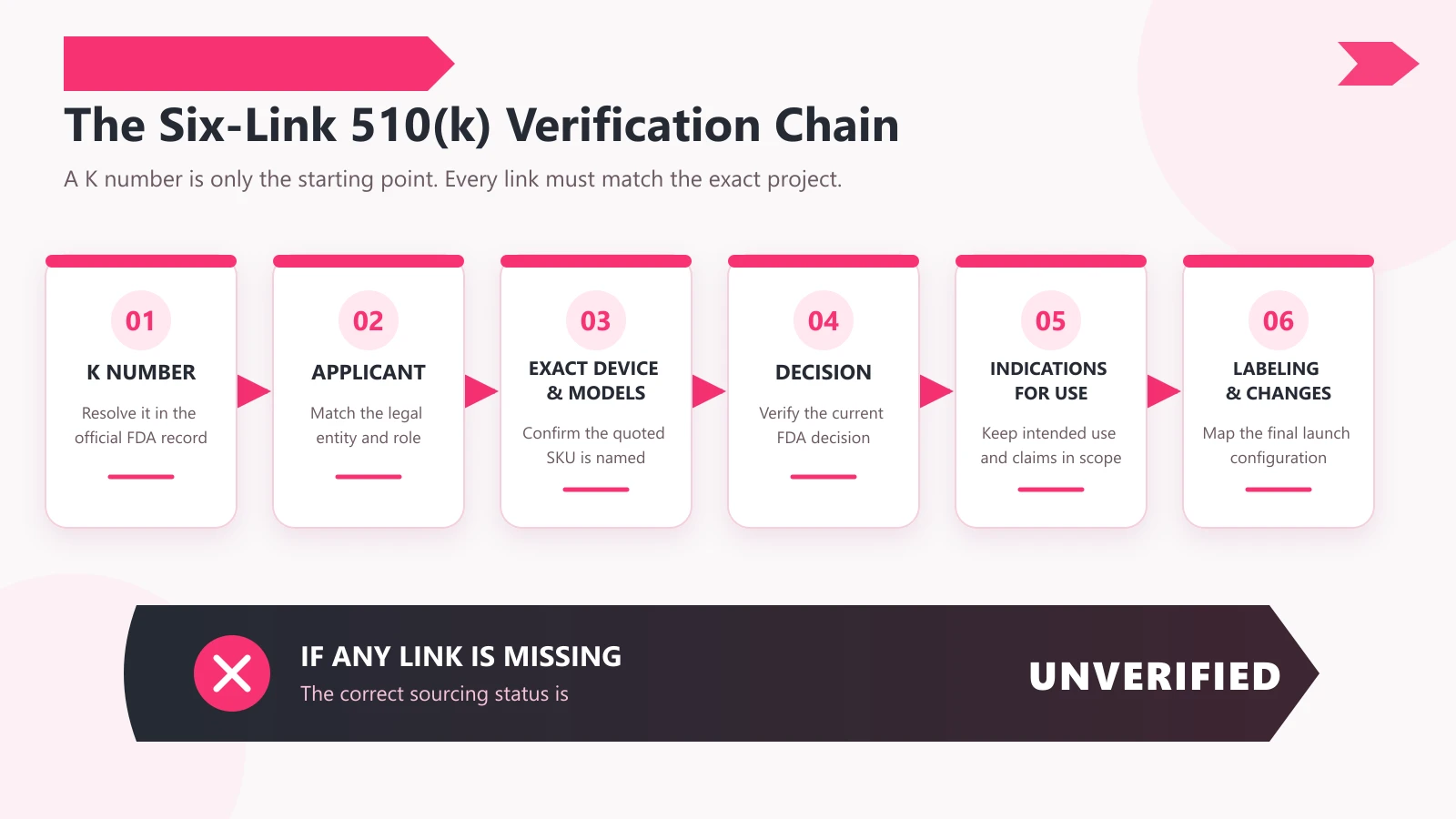
- Um número K não é suficiente por si só. Combine o registro da FDA com o requerente, dispositivo e modelos exatos, Indicações de uso, rotulagem, e a configuração que sua marca planeja vender.
- O registro de estabelecimento da FDA e a listagem de dispositivos não são 510(k) autorização. FDA não emite certificados de registro de dispositivos, e um registro ou entrada de listagem não mostra que a FDA foi autorizada, aprovado, ou autorizou o dispositivo.
- A autorização pertence a um escopo de dispositivo definido – não a uma fábrica, comprimento de onda, forma, ou código do produto em geral. Um boné semelhante, capacete, pentear, predicado, ou 650 A especificação nm não herda a autorização de outro produto.
- Um distribuidor pode não precisar de seu próprio 510(k) em alguns arranjos de dispositivos inalterados, mas a resposta depende do fabricante real, importador, distribuidor, rotulador, e funções de controle de especificação. Confirme quais EUA. distribuição ou rota de fabricante estrangeiro/importação se aplica, qual modelo exato é fornecido, e se o rótulo, uso pretendido, reivindicações, programas, acessórios, ou o design mudará.
- Um dispositivo a laser pode ter um segundo, trilha paralela de conformidade com a FDA. Os padrões de desempenho de produtos a laser aplicáveis, relatórios de produtos de radiação, rotulagem, certificação, registros de controle de qualidade, e as responsabilidades de importação não desaparecem porque um dispositivo tem um 510(k).
- Antes de aprovar os EUA. reivindicações, embalagem, ou um pedido OEM, salve o registro oficial do banco de dados e o PDF, preencha o mapa de evidências abaixo, e escalar cada incompatibilidade para revisão regulatória específica do projeto.
A frase “Dispositivo de crescimento de cabelo aprovado pela FDA” é útil apenas quando pode ser vinculado a um registro de produto verificável. Não deve ser tratado como um selo de qualidade geral para cada dispositivo fabricado por um fornecedor.
Para uma marca do mercado dos EUA, distribuidor, importador, ou canal da clínica, a questão prática não é simplesmente, “O fornecedor tem FDA?”A pergunta útil é:
Este registro da FDA apoia o dispositivo exato de crescimento capilar, rotulagem, uso pretendido, reivindicações, e configuração que planejamos colocar nos EUA. mercado?
Este guia mostra como responder a essa pergunta usando fontes da FDA. Não classifica dispositivos de consumo, compare os resultados do tratamento, ou declarar que qualquer modelo de crescimento capilar Wakelife é aprovado pela FDA.
O que significa aprovado pela FDA para um dispositivo de crescimento capilar?
Aprovado pela FDA normalmente significa que a FDA emitiu uma determinação de equivalência substancial para um dispositivo definido e submeteu uso através do 510(k) caminho; isso não significa que a FDA aprovou ou endossou o produto.
O FDA explica que um 510(k) o remetente compara um dispositivo com um ou mais dispositivos predicados comercializados legalmente. Antes de comercializar um dispositivo que exija 510(k), o remetente deve receber uma ordem da FDA concluindo que o dispositivo é substancialmente equivalente. Esse pedido libera o dispositivo para distribuição comercial, sujeito aos outros requisitos que ainda se aplicam.
Quatro termos devem permanecer separados:
| Termo da FDA | O que isso mostra | O que não mostra | Primeira ação do comprador |
|---|---|---|---|
| Cadastro de estabelecimento | Uma instalação preencheu um registro de registro aplicável da FDA | Liberação de produto, aprovação, autorização, ou inspeção da FDA de cada produto | Verifique a entidade legal e a atividade, em seguida, prossiga para o registro do produto |
| Listagem de dispositivos | Um dispositivo está associado a um estabelecimento no sistema de listagem da FDA | Que a FDA revisou e liberou aquele dispositivo exato | Procure um número de envio pré-comercialização aplicável |
| 510(k)-limpo | A FDA emitiu uma determinação de equivalência substancial para o dispositivo submetido e uso | Aprovação da FDA, endosso, cobertura de modelos não relacionados, ou liberdade para fazer qualquer reclamação | Verifique o número K e leia seu escopo |
| Aprovado pela FDA | Um termo regulatório diferente associado a um caminho de aprovação, não é comum 510(k) autorização | Um sinônimo para “510(k)-limpo” | Não use esta expressão para uma 510(k) dispositivo |
FDA lembrete de registro e listagem declara que a FDA não emite certificados de registro para instalações de dispositivos médicos e que as entradas de registro/listagem não indicam aprovação, autorização, ou autorização. Separadamente, 21 CFR 807.97 diz que submeter um 510(k) e receber uma determinação de equivalência substancial não denota aprovação oficial.
Regra do comprador: use “aprovado pela FDA” ou “510(k)-apagado” somente após verificar o registro exato. Não vire “registrado,”“ listado,” “substancialmente equivalente,” ou “limpo” em “aprovado,” “certificado,” ou “endossado”.
Qual registro da FDA você deve verificar primeiro?
Comece com o número K no documento liberável da FDA 510(k) banco de dados, então abra o PDF oficial; não comece com um logotipo, imagem do certificado, apresentação de vendas, ou listagem de mercado.
FDA 510(k) guia de banco de dados explica que o banco de dados público pode ser pesquisado pelo número K, código do produto, nome do dispositivo, ou painel. Um resultado pode exibir campos incluindo o nome do dispositivo, requerente, código do produto, data da decisão, decisão, e se um resumo está disponível.
Usar este pedido:
- Peça o número K. Normalmente começa com “K” seguido por seis dígitos.
- Pesquise no banco de dados da FDA. Confirme se o registro existe em uma página fda.gov ou accessdata.fda.gov.
- Confira a decisão. A data de recebimento ou o número de envio por si só não é uma decisão de autorização.
- Abra o PDF oficial. Leia a carta de decisão, Indicações de uso, e 510(k) Resumo quando disponível.
- Construa um mapa do projeto. Compare o registro com o modelo exato, rótulo, uso pretendido, reivindicações, acessórios, programas, e mudanças planejadas em seu projeto.
O padrão do FDA Página de classificação de dispositivos médicos OAP identifica o tipo genérico como “laser, pentear, cabelo” abaixo 21 CFR 890.5500. Sua definição genérica refere-se a homens com alopecia androgênica nas classes IIa-V de Norwood-Hamilton.. Essa definição é uma descrição em nível de classificação – e não um substituto para as indicações exatas de uso no arquivo de autorização do próprio dispositivo., que deve ser verificado para o modelo submetido e população.
A FDA também mantém um separado Página de código do produto emissor de radiação OAP. Essa página atualmente identifica um relatório de segurança radiológica do produto e relatórios anuais conforme necessário e lista 21 CFR 1040.10 e 1040.11 como padrões de desempenho aplicáveis. As duas páginas da FDA respondem a perguntas diferentes: ajuda a classificar o dispositivo médico e encontrar seu 510(k) rota; o outro sinaliza os requisitos de radiação laser paralela.
O que você deve verificar além do 510(k) para um dispositivo de crescimento capilar a laser?
Para um produto a laser, 510(k) a autorização e a conformidade com a radiação de produtos eletrônicos são pistas de evidências paralelas; nenhum substitui o outro.
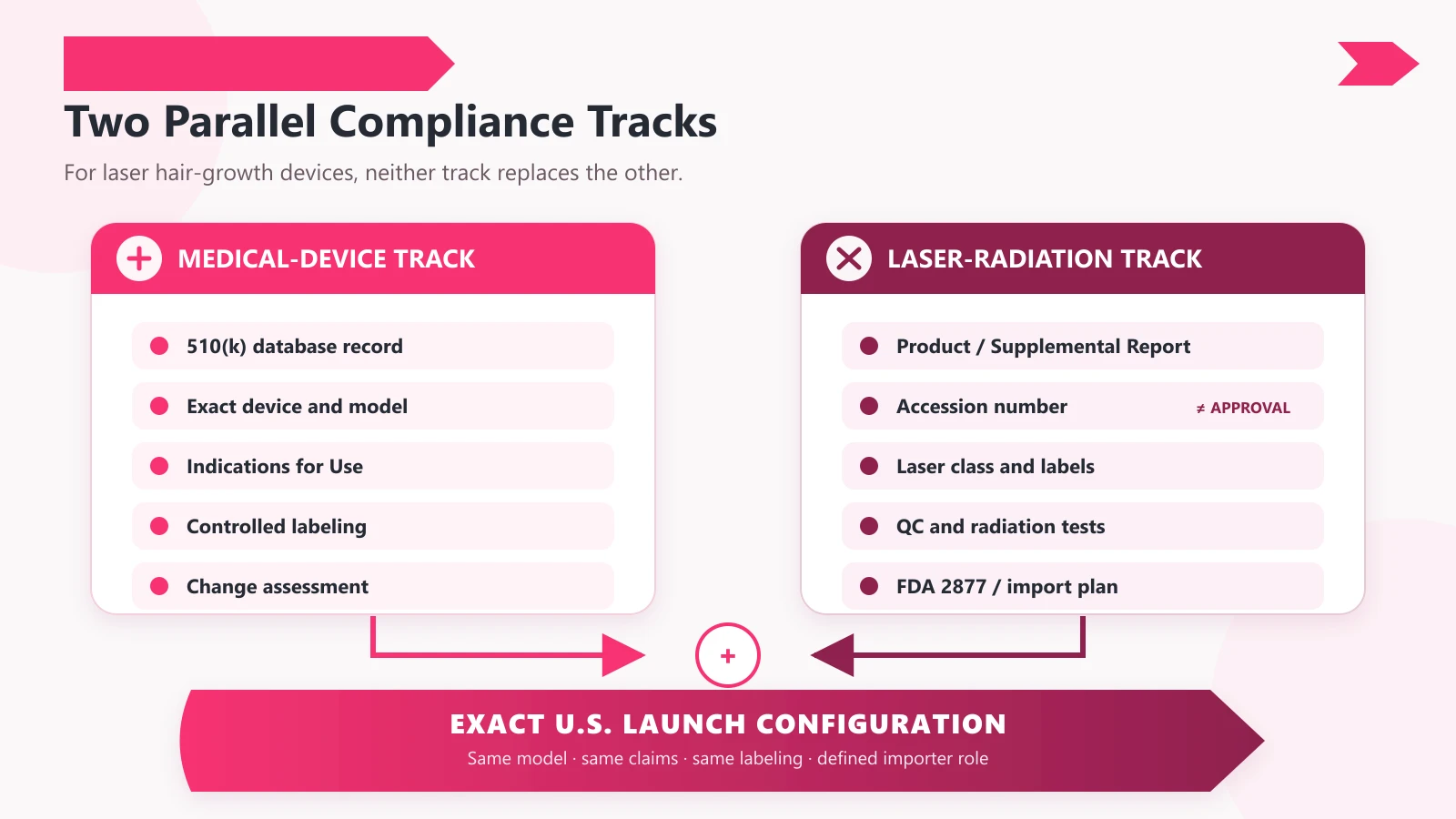
A FDA declara que os produtos a laser usados para aplicações médicas devem cumprir os requisitos aplicáveis de produtos a laser e os regulamentos de dispositivos médicos. As listas atuais de páginas de radiação OAP 21 CFR 1040.10 e 1040.11, um relatório de produto, e relatórios anuais. As perguntas frequentes sobre entrada no mercado da FDA dizem que os relatórios exigidos do produto devem ser enviados antes que o produto seja introduzido nos EUA. comércio. Para um produto importado, A FDA recomenda enviar o relatório pelo menos um mês antes de apresentá-lo para importação, para que o CDRH tenha tempo de emitir uma carta de confirmação e um número de acesso. Uma carta de confirmação ou número de acesso mostra apenas que o CDRH recebeu um relatório de radiação; não é a aprovação da FDA e não estabelece que o relatório é adequado.
Aviso de laser 56 descreve a abordagem de fiscalização da FDA para fabricantes que usam disposições específicas da IEC 60825-1 Edição 3 e IEC 60601-2-22 Edição 3.1 que a FDA identifica como comparável com partes de seus padrões de desempenho de laser. Um certificado IEC genérico não é, portanto, suficiente por si só. Os compradores devem mapear o modelo e a configuração exatos para a rota de conformidade selecionada, aula de laser, relatório ou suplemento do produto, rótulos, informações do usuário, testes de controle de qualidade, e EUA. responsabilidades de importação.
Regra do comprador: solicite o arquivo de radiação do modelo exato separadamente do 510(k) arquivo. Não trate um número de acesso de relatório de produto, etiqueta de classe laser, Relatório IEC, ou 510(k) como um substituto para as outras camadas de evidências.
A distinção entre relatórios de laser não deve ser copiada em todos os dispositivos baseados em luz. FDA Perguntas frequentes sobre entrada no mercado declara que os produtos LED e IPL não atendem à sua definição de laser e atualmente não estão sujeitos a um padrão de desempenho obrigatório da FDA ou a relatórios anuais/de produto sob 21 Parte CFR 1002. Continuam a ser produtos emissores de radiação sujeitos aos requisitos gerais aplicáveis em 21 Peças CFR 1000–1005, incluindo notificações de defeitos e radiação acidental. Para compradores, nenhum relatório de produto a laser é um sinal de alerta para um dispositivo a laser aplicável; sua ausência não é, por si só, uma lacuna para um dispositivo somente LED.
Como você combina um 510(k) para o dispositivo exato de crescimento do cabelo?
| Link para verificar | Onde verificar | Pergunta do projeto | Condição de parada |
|---|---|---|---|
| Número K e decisão | Banco de dados da FDA | O registro existe, e mostra uma decisão substancialmente equivalente? | Apenas uma captura de tela, reivindicação de aplicação, ou número de registro é fornecido |
| Requerente | Banco de dados e carta de decisão | Quem detém a submissão, e qual é o relacionamento documentado do fornecedor com essa parte? | O fornecedor não consegue explicar a relação com o candidato |
| Nome do dispositivo e modelos exatos | Banco de dados, A NUVEM, e 510(k) Resumo | O SKU em sua cotação tem um nome explícito ou é comprovadamente o mesmo dispositivo liberado? | Um boné diferente, capacete, pentear, sufixo do modelo, ou família de produtos aparece |
| Código e classificação do produto | Página de banco de dados e classificação | A categoria do dispositivo reivindicado é consistente com o registro? | O número K pertence a outra categoria de dispositivo |
| Indicações de uso | Gabinete PDF da FDA | Faça os EUA planejados. uso pretendido, população, área de tratamento, e tipo de usuário permanecem dentro do registro? | O plano de marketing adiciona uma condição diferente de queda de cabelo, população, ou usar |
| Rotulagem e configuração | Rotulagem limpa e arquivos de projeto controlados | Faça o manual, avisos, instruções, acessórios, programas, e a configuração física permanecem consistentes? | O desenvolvimento de embalagens ou produtos prossegue sem uma comparação documentada |
Este mapa separa um registro válido de uma conclusão de projeto válida. Encontrar um número K real responde apenas à primeira pergunta. O comprador ainda precisa estabelecer por que esse registro é relevante para o dispositivo na cotação e para o preço planejado da marca nos EUA.. apresentação.
O que não transfere um 510(k)?
Nenhum dos seguintes, por si só, transfere autorização de um dispositivo para outro:
- o mesmo comprimento de onda nominal;
- um boné semelhante, capacete, bandana, ou formato de pente;
- o mesmo código genérico do produto;
- uso do mesmo predicado;
- produção na mesma fábrica;
- um distribuidor ou relacionamento de marca própria;
- um nome de modelo que se assemelha a um modelo limpo;
- autorização de um requerente para outra categoria de produto.
Cada item pode ser um histórico relevante. Nenhum substitui o mapeamento exato do dispositivo.
Como é que um Real 510(k) Definir o escopo exato do dispositivo? Caso: K250830
O registro K250830 da Sungrow fornece um exemplo útil de limite: o histórico de envio bem-sucedido de um candidato não cria um dispositivo diferente, modelo, indicação, ou configuração aprovada pela FDA.
O oficial Registro do banco de dados K250830 identifica Shenzhen Sungrow LED Technology Co., Ltda. como o requerente e nomes 13 Modelos de máscara de terapia de luz LED. O Carta de decisão emitida pela FDA e indicações de uso definir vermelho, amarelo, e modos vermelho mais infravermelho para rugas em todo o rosto, e modos azul e vermelho-azul-infravermelho misto para acne inflamatória leve a moderada.
Essa é uma verdadeira decisão SE para o 13 modelos de máscara nomeados e seus usos definidos. Não é uma autorização da Wakelife como marca, Sungrow como empresa, ou a gama mais ampla de produtos da fábrica, e não cobre dispositivos de crescimento de cabelo.
| Campo de escopo | O que K250830 estabelece | Configuração de desenvolvimento T01-Ultra | Conclusão do comprador |
|---|---|---|---|
| Requerente / relacionamento da empresa | Tecnologia Co. do diodo emissor de luz de Shenzhen Sungrow., Ltda. é o requerente registrado | Materiais de desenvolvimento interno identificam uma configuração de capacete VCSEL multizona inédita dentro do sistema de produtos Sungrow/Wakelife; nenhum candidato, fabricante, Número K, ou a decisão da FDA ainda está confirmada para essa configuração | Uma relação produto-sistema comercial é um contexto relevante, não autorização em nível de modelo |
| Escopo exato do modelo | 13 modelos nomeados de máscara de terapia de luz LED | T01-Ultra não é um dos modelos nomeados | T01-Ultra não pode ser descrito como “sob K250830” |
| Fator de forma | Face, pescoço/peito, e modelos de máscara relacionados nomeados no registro | Dispositivo inédito em formato de capacete | Um formato diferente requer seu próprio mapeamento regulatório documentado |
| Indicações de uso | Rugas em todo o rosto e acne inflamatória leve a moderada, dependendo do modo | Nenhuma indicação de uso T01-Ultra emitida pela FDA foi identificada | Não transfira indicações da máscara – nem adicione indicações de crescimento capilar – para o T01-Ultra |
| Configuração do produto | O registro oficial se aplica à família de máscaras liberadas e rotulagem controlada | Uma configuração inédita de capacete VCSEL multizona está em desenvolvimento; a verificação do dispositivo concluído está pendente | Uma configuração de desenvolvimento não prova o resultado final, autorização, desempenho clínico, aula de laser, ou escopo de rotulagem |
| Decisão da FDA | Substancialmente equivalente em junho 9, 2025 | Nenhum número T01-Ultra K ou decisão da FDA é identificado nos materiais atuais | Trate a autorização T01-Ultra como não verificada até que exista um registro oficial exato |
Esta comparação produz duas regras práticas:
- Use o K250830 para demonstrar que o Sungrow tem um sucesso rastreável 510(k) histórico de envio; a autorização em si permanece limitada ao 13 modelos de máscara nomeados e seus usos definidos.
- Construa o arquivo de evidências T01-Ultra de forma independente. Seu comprimento de onda, contagem de emissores, método de irradiância, controles de segurança, uso pretendido, rotulagem, e a família do modelo exato deve se conectar à sua própria documentação controlada e a qualquer registro oficial futuro.
HC03 agora fornece uma conexão de produto em tempo real neste fluxo de trabalho. Os compradores podem revisar o Página do produto da tampa laser VCSEL de silicone HC03 e seu guia detalhado de fornecimento para avaliar a configuração publicada, exemplos de perguntas, e verificações de documentos. Estas páginas oferecem suporte à descoberta de produtos e à devida diligência; eles não estabelecem 510(k) autorização. Na data de revisão deste artigo, não há HC03 exato 510(k) registro foi identificado, e K250830 não cobre HC03.
Uma marca própria pode confiar na marca de um fabricante? 510(k)?
Um distribuidor pode comercializar um dispositivo inalterado do fabricante sob o nome de sua própria empresa sem apresentar seu próprio nome. 510(k), mas a rota e as responsabilidades aplicáveis diferem para distribuição doméstica e acordos de fabricante/importação estrangeiro; “marca própria” por si só não é a resposta.
FDA 510(k) Perguntas frequentes diz que quando um distribuidor comercializa o produto de um fabricante sob o nome de sua própria empresa, o fabricante submete o 510(k), se for necessário para o dispositivo. Ele também aponta para o texto do rótulo, como “Fabricado para” ou “Distribuído por” quando a empresa nomeada não é o fabricante. Mais amplo da FDA Notificação pré-comercialização 510(k) página descreve separadamente um distribuidor doméstico de um dispositivo fabricado nos EUA de outra empresa e um importador de um dispositivo estrangeiro cujo fabricante estrangeiro já possui a autorização aplicável. A mesma página diz que a maioria dos reembaladores ou reetiquetadores não precisa de um novo 510(k) quando não alteram significativamente a rotulagem existente ou a condição do dispositivo e a rotulagem permanece consistente com as indicações apagadas, avisos, e contra-indicações.
Isso não apoia um “sim” geral para todos os projetos OEM ou de marca própria. Primeiro classifique a função e as mudanças:
| Situação do projeto | Interpretação padrão do comprador | O que verificar antes do lançamento |
|---|---|---|
| Dispositivo limpo inalterado; nome do distribuidor adicionado com precisão | O distribuidor pode não precisar de seu próprio 510(k), mas a rota de distribuição nacional ou fabricante estrangeiro/importação deve ser identificada | Relação fabricante/titular/importador/distribuidor, modelo exato, texto qualificado do rótulo, responsabilidades de listagem/registro, tratamento de reclamações, rotulagem atual |
| A marca altera as declarações de marketing ou o uso pretendido | Não presuma que a autorização do fabricante ainda apoia o projeto | Mapeamento de reivindicação para IFU e avaliação regulatória documentada |
| Avisos de mudanças de marca, contra-indicações, instruções, ou protocolo de tratamento | Escalar antes da aprovação | Comparação controlada de rotulagem e justificativa de mudança |
| Marca especifica novo hardware, arranjo de fonte de luz, programas, acessório, material, sistema de energia, ou mudança de fabricação | Trate como uma avaliação de mudança de dispositivo, não é uma simples reetiquetagem | Comparação de projetos, análise de risco, impacto do teste, e se um novo 510(k) pode ser necessário |
| A marca ou outra parte é o desenvolvedor da especificação | A responsabilidade regulatória pode diferir de um acordo básico de distribuição | Identificar quem controla as especificações e quem deve manter/enviar o registro aplicável |
Regra do comprador: documentar a função real do negócio e as mudanças reais. Não use a frase “marca própria” para colapsar o distribuidor, renomear, desenvolvedor de especificações, fabricante contratado, e 510(k) detentor em uma categoria.
Para qualquer lançamento específico, qualificou-se nos EUA. consultor regulatório ou um profissional regulatório experiente confirmam a função final, rotulagem, listagem, e obrigações de submissão.
Quais mudanças exigem escalonamento antes dos EUA. Lançar?
Escalar qualquer alteração que possa afetar o uso pretendido, segurança, eficácia, rotulagem, ou a comparação tecnológica apurada; não deixe a aprovação comercial avançar mais rápido do que a avaliação da mudança.
FDA Notificação pré-comercialização 510(k) orientação diz um novo 510(k) é necessária quando uma alteração ou modificação pode afetar significativamente a segurança ou a eficácia, ou quando o dispositivo é comercializado para um uso pretendido novo ou diferente. O 510(k) o titular é responsável por avaliar e documentar alterações sob os controles do sistema de qualidade aplicáveis.
Use este portão de escalonamento:
Escale imediatamente quando o projeto mudar:
- uso pretendido, doença, população de usuários, área de tratamento, ou alegação clínica;
- avisos, contra-indicações, instruções, tempo de tratamento, ou frequência;
- fonte de energia, arquitetura de comprimento de onda, saída, óptica, ou layout do emissor;
- projeto elétrico, bateria, carregador, controlador, ou fonte de alimentação;
- programas, firmware, controle de aplicativos, temporizador, lógica de dose, ou interface de usuário;
- Materiais, componentes de contato biocompatíveis, ajustar, ou estrutura mecânica;
- acessórios que afetam o uso, saída, segurança, ou rotulagem;
- método de fabricação ou fornecedor de uma forma que possa afetar o desempenho do dispositivo;
- o modelo de identidade ou parentesco mostrado nos documentos de liberação.
Não faça o comprador decidir sozinho o resultado regulatório
A tarefa do comprador é identificar e documentar a mudança, não inventar uma conclusão legal a partir de uma postagem de blog. Pergunte ao 510(k) titular ou fabricante responsável pela comparação controlada e pela decisão documentada sobre se a autorização existente permanece aplicável ou se é necessária outra apresentação. Em seguida, revise a configuração de lançamento no contexto da função e das reivindicações reais da marca.
Quais documentos você deve solicitar antes de aprovar um dispositivo para crescimento de cabelo?
Solicite um conjunto de documentos rastreáveis que conecte o registro público da FDA à amostra exata, cotação, rótulo, e configuração comercial planejada.
| Documento ou registro | Por que isso importa | O que uma resposta útil contém |
|---|---|---|
| FDA 510(k) link de banco de dados | Confirma o registro público | URL oficial ativo, Número K, requerente, nome do dispositivo, código do produto, decisão |
| PDF oficial da FDA | Mostra carta de decisão, A NUVEM, e resumo quando disponível | Arquivo completo, páginas não cortadas |
| Mapa de modelo limpo | Conecta o SKU da cotação ao registro | Modelo exato e relacionamento familiar documentado |
| Indicações atuais de uso | Define o limite inicial da reivindicação | Redação exata e condições de usuário/uso aplicáveis |
| Rotulagem controlada atual / A NUVEM | Mostra avisos, contra-indicações, instruções, e partes nomeadas | Número do documento, revisão, data, modelo exato |
| Mapa de funções de marca própria | Fabricante separado, titular, distribuidor, renomear, importador, e desenvolvedor de especificações | Nomes de entidades legais e responsabilidades regulatórias |
| Avaliação de mudanças | Avalia diferenças da configuração limpa | Lista de alterações lado a lado, impacto de risco/teste, aprovação, e conclusão da submissão |
| Especificação do produto e matriz de teste | Conecta a configuração do dispositivo à evidência de verificação | ID exato do modelo/amostra, configuração, identificadores de relatório, revisão, condições de teste |
| Arquivo de conformidade com radiação laser, quando aplicável | Separa as obrigações de radiação de produtos eletrônicos da liberação de dispositivos médicos | Produto modelo exato ou relatório suplementar, número de acesso, selecionado 21 Rota CFR ou Laser Notice 56/IEC, classe de laser e etiquetas, informações do usuário, Registros de testes de CQ/radiação, status do relatório anual, FDA 2877/responsabilidades de importação, e cronograma de relatórios |
| Cadastro, listagem, NÓS. Agente, e plano de importação | Abrange responsabilidades administrativas e de entrada | Entidades corretas, atividades, nomes proprietários e listagens; função de importador; dispositivo médico dos EUA. Responsabilidades do agente; e o produto de radiação designado separadamente U.S.. Agente necessário para um fabricante estrangeiro sob 21 CFR 1005.25 |
| Reclamação e processo pós-comercialização | Mostra como as reclamações chegam ao fabricante responsável | Contatos, cronogramas, escalada, propriedade de registro, e responsabilidades de relatórios |
Não aceite “documentos FDA disponíveis” como resposta completa. Uma resposta útil nomeia o arquivo, número de registro, modelo, revisão, papel, e limite.
Quais sinais de alerta da FDA devem impedir uma aprovação?
Pausar amostra, embalagem, alegar, ou aprovação de compra quando a evidência não puder ser atribuída ao projeto exato.
As bandeiras vermelhas incluem:
- um “certificado de registro FDA,” Logotipo da FDA, número do proprietário/operador, ou a listagem de dispositivos é apresentada como 510(k) autorização;
- o fornecedor diz “aprovado pela FDA”, mas fornece uma 510(k) registro;
- nenhum número K é fornecido, ou o número não direciona para uma página oficial da FDA;
- o registro mostra um candidato diferente, e o fornecedor não pode documentar o relacionamento;
- o nome do dispositivo, modelo exato, ou formato diferente do produto na cotação;
- o número K pertence a uma máscara, dispositivo de dor, painel, ou outra categoria de produto em vez do dispositivo de crescimento capilar vendido;
- o fornecedor aponta para um predicado, código de produto compartilhado, comprimento de onda semelhante, ou mesma fábrica como comprovante de cobertura;
- um número de acesso ao relatório do produto, Relatório IEC, ou etiqueta de classe de laser é apresentada como autorização ou aprovação da FDA;
- o dispositivo usa lasers, mas nenhum escopo de relatório de radiação de modelo exato, aula de laser, rótulos, ou registros de teste de controle de qualidade de suporte podem ser mapeados para a configuração fornecida;
- um produto a laser importado sujeito a um padrão de desempenho não possui o FDA aplicável 2877 declaração ou etiqueta de certificação/identificação; A FDA declara que os produtos não conformes ou não rotulados cobertos terão a entrada recusada;
- um aplicativo “em processamento” é descrito como já liberado;
- o fornecedor não pode fornecer o PDF oficial, Indicações de uso, ou rotulagem controlada atual;
- a embalagem planejada adiciona queda de cabelo mais ampla, população de usuários, tratamento, ou reivindicações de desempenho;
- hardware, programas, acessórios, ou protocolo foram alterados sem uma avaliação de mudança documentada;
- o fornecedor diz que a marca própria permite que a marca faça qualquer afirmação que desejar.
Uma bandeira vermelha não prova automaticamente má conduta. Isso significa que o projeto não está pronto para aprovação.
Quais perguntas de RFQ você pode copiar?
Uma resposta útil do fornecedor deve retornar links oficiais, nomes exatos dos modelos, revisões controladas de documentos, definições de função, e mudar limites - não apenas emblemas.
| Pergunta de solicitação de cotação | O que uma resposta útil deve conter |
|---|---|
| O dispositivo exato para crescimento do cabelo nesta cotação é FDA 510(k)-limpo, ou apenas registrado/listado? | Uma declaração de status precisa e um link de banco de dados oficial |
| Qual é o número K, requerente, nome do dispositivo, código do produto, data da decisão, e decisão? | Campos correspondentes ao registro da FDA |
| Qual modelo liberado é nosso SKU cotado? | Mapa do modelo exato, incluindo sufixos e documentos familiares |
| Quais são as indicações oficiais de uso e status OTC/Rx? | Redação exata da FDA e página oficial em PDF |
| Qual entidade é a 510(k) titular, fabricante, desenvolvedor de especificações, distribuidor, importador, e rotulador? | Nomes legais, atividades, e mapa de responsabilidade |
| Qual texto do rótulo identificará o relacionamento da nossa marca com o fabricante? | Proposta de “Fabricado para” / Revisão de texto e rotulagem “Distribuído por” |
| Será que a nossa marca, embalagem, manual, avisos, instruções de tratamento, ou as reivindicações mudam? | Documentos redlineados e uma comparação entre reivindicação e IFU |
| Será que o produto, acessórios, programas, saída, Materiais, ou alteração na configuração de fabricação? | Lista de alterações controladas, testes afetados, e avaliação regulatória |
| Tem o 510(k) titular documentou se as alterações exigem um novo envio? | Avaliação de mudança assinada/aprovada e revisor responsável |
| Qual registro, listagem, NÓS. agente, importador, UDI, reclamação, e as responsabilidades de relatórios se aplicam a cada parte? | Tabela de responsabilidades específicas do projeto, não é uma promessa genérica de conformidade |
| Você pode fornecer a especificação atual, rotulagem/IFU, e relatórios de verificação relevantes para o modelo exato? | Arquivos controlados com modelo, revisão, amostra, data, e identificadores de teste |
| Se o dispositivo contiver lasers, qual relatório de produto de radiação e rota de conformidade cobrem o modelo exato? | Escopo do relatório do produto/suplementar, número de acesso, selecionado 21 Rota CFR ou Laser Notice 56/IEC, aula de laser, rótulos, informações do usuário, Testes de controle de qualidade, status do relatório anual, FDA 2877/plano de importação, cronograma de relatórios, e produto de radiação dos EUA. Agente, quando aplicável |
Envie as perguntas com o mercado-alvo, uso pretendido, reivindicações planejadas, modelo selecionado, canal de vendas, e personalização proposta. Sem esse breve, um fornecedor não pode mapear de forma confiável o conjunto de documentos correto para o projeto.
O que uma marca deve fazer a seguir?
Não comece com uma afirmação como “precisamos de uma touca de cabelo aprovada pela FDA”. Comece com um mapa do projeto.
- Escreva os EUA. uso pretendido e reivindicações planejadas em linguagem simples.
- Identifique o modelo exato do fornecedor e cada hardware planejado, programas, acessório, manual, embalagem, e mudança de marca.
- Peça o número K e o PDF oficial da FDA.
- Preencha o mapa de registro para projeto de seis links neste guia.
- Solicite a rotulagem controlada, mapa modelo, mapa de funções, e avaliação de mudanças.
- Para um produto a laser, mapear separadamente o modelo exato para seu relatório de radiação, rota padrão de desempenho, classificação e rótulos, Evidência de CQ, e responsabilidades de importação.
- Pausar reivindicações não suportadas e relacionamentos de modelo não resolvidos.
- Envie a configuração final para análise regulatória qualificada antes da embalagem e lançamento no mercado.
Para revisar uma plataforma de limite publicada atualmente, visite o Página do produto da tampa laser VCSEL de silicone HC03 e o Guia de fornecimento de HC03. Para comparar outros fatores de forma, ele está na casa de Wakelife linha de dispositivos para crescimento capilar a laser e LED e o guia de fornecimento de pente para crescimento de cabelo a laser. Estas páginas oferecem suporte à exploração de produtos e definição do escopo do projeto; eles não estabelecem autorização da FDA para um modelo, a menos que um registro oficial exato seja identificado e verificado separadamente.
Se você deseja que a Wakelife prepare uma lista de solicitação de documentos específica do projeto, envie o mercado-alvo, uso pretendido, reivindicações planejadas, modelo selecionado, canal, função do rótulo, e escopo de personalização com sua consulta. O primeiro resultado deve ser um mapa de lacunas de evidências – e não uma promessa não apoiada pela FDA.
Perguntas frequentes
O registro do FDA é igual ao FDA 510(k) autorização para um dispositivo de crescimento de cabelo?
Não. O registro do estabelecimento e a listagem de dispositivos são registros administrativos. Eles não mostram que a FDA foi autorizada, aprovado, ou autorizou o dispositivo exato de crescimento de cabelo. Peça o número K e verifique-o publicamente na FDA 510(k) banco de dados.
A FDA 510(k) autorização significa que o dispositivo de crescimento capilar é aprovado pela FDA?
Não. Uma determinação de equivalência substancial através 510(k) apoia a expressão “aprovado pela FDA” ou “510(k)-limpo,” não “aprovado pela FDA”. A folga ainda deve ser descrita dentro de seu dispositivo exato e escopo de uso.
O código do produto OAP prova um limite para o crescimento do cabelo, capacete, ou o pente está limpo?
Não. OAP é uma classificação genérica de produtos da FDA e uma rota útil de pesquisa em banco de dados. Não é um número K e não prova que um modelo específico tenha autorização. Sua definição genérica refere-se a uma população masculina com alopecia androgenética, mas a população exata liberada e o uso devem vir das próprias Indicações de Uso do dispositivo.
Um relatório de produto laser ou número de acesso substitui um 510(k)?
Não. A FDA trata os relatórios de radiação de produtos eletrônicos e a revisão pré-comercialização de dispositivos médicos aplicáveis como obrigações separadas. Um número de acesso identifica um relatório de radiação recebido pelo CDRH; não é a aprovação da FDA e não estabelece que o relatório é adequado. Para um dispositivo de crescimento capilar a laser, verifique o dispositivo exato 510(k) base e o arquivo de radiação laser de modelo exato aplicável.
Dois dispositivos com o mesmo comprimento de onda podem usar o mesmo 510(k)?
Não apenas no comprimento de onda. A autorização está vinculada a uma comparação de dispositivos enviada que inclui o uso pretendido e as características tecnológicas. Identidade do modelo, saída, óptica, projeto, rotulagem, avisos, protocolo, programas, e outros fatores podem diferir.
O número K de um dispositivo predicado é uma prova de que meu dispositivo está limpo?
Não. Um predicado faz parte da comparação de equivalência substancial do remetente. Sua autorização não é transferida para um dispositivo de terceiros não listado. Seu dispositivo precisa de uma base de marketing legal aplicável própria.
Um distribuidor de marca própria pode vender um dispositivo liberado inalterado sem o seu próprio 510(k)?
Potencialmente. A FDA diz que o fabricante submete o 510(k), se necessário, quando um distribuidor comercializa o produto desse fabricante sob o nome do distribuidor. A FDA aborda separadamente a distribuição doméstica e a importação de um dispositivo já liberado de um fabricante estrangeiro. As partes devem identificar a rota aplicável, declarar com precisão seu relacionamento no rótulo, e mantenha o dispositivo exato e a rotulagem dentro das condições aplicáveis. Alterações no uso pretendido, rotulagem, condição do dispositivo, especificações, ou funções regulatórias podem mudar a análise, então o projeto exato ainda precisa de revisão.
Um multimodelo 510(k) cobrir novos modelos adicionados posteriormente?
Não automaticamente. Um registro pode nomear vários modelos liberados, mas um modelo novo ou modificado ainda precisa de uma comparação documentada e avaliação de mudanças. Se a alteração puder afetar significativamente a segurança ou a eficácia ou introduzir um novo uso pretendido, FDA diz um novo 510(k) pode ser necessário.
São T01-Ultra, HC03, HT01, T02, ou dispositivos de crescimento capilar C02 aprovados pela FDA?
Na data de revisão deste artigo, sem FDA 510(k) registro foi identificado para esses modelos Wakelife, então o artigo não os descreve como aprovados pela FDA. K250830 pertence a uma família definida de máscaras de LED e não pode ser usado para T01-Ultra, HC03, ou outro dispositivo de crescimento de cabelo. Os compradores devem tratar a autorização no nível do modelo como não verificada, a menos que a Wakelife forneça um registro oficial exato que corresponda ao dispositivo, uso pretendido, rotulagem, e configuração do projeto.
Resumo
A maneira mais segura de verificar um dispositivo de crescimento capilar aprovado pela FDA é conectar o registro oficial ao projeto comercial:
Número K → requerente → dispositivo/modelos exatos → decisão → Indicações de uso → rotulagem e alterações planejadas
Se algum link estiver faltando, o status de fornecimento correto é não verificado, não “provavelmente coberto”. Cadastro, listagem, um código de produto compartilhado, o mesmo comprimento de onda, um formato semelhante, um predicado, ou um relacionamento de fábrica não pode substituir essa cadeia de evidências.
Para conectar esta verificação da FDA com a seleção do fabricante, aprovação de amostra e design de RFQ, continuar com o Fabricante de dispositivos de crescimento capilar & Guia OEM/ODM.
Para a diferença mais ampla entre os registros do mercado, sistemas de qualidade, segurança elétrica, testes ópticos, e fundo de fábrica, continuar com o Guia de certificação de dispositivos de terapia LED.
Nota regulatória: Este artigo é para educação e due diligence sobre sourcing B2B. Ele não substitui o conselho da FDA ou a revisão específica do projeto por parte qualificada dos EUA.. consultor regulatório para um produto, função da entidade, rótulo, alegar, mudar, acordo de importação, ou lançamento de marca própria.
Referências
-
1
NÓS. FDA. Notificação pré-comercialização 510(k).
-
2
NÓS. FDA. Pesquise o liberável 510(k) Banco de dados.
- 3
-
4
Código Eletrônico de Regulamentações Federais. 21 CFR 807.97 — Marca incorreta por referência à notificação pré-comercialização.
- 5
-
6
NÓS. FDA. K250830 510(k) Registro de banco de dados.
-
7
NÓS. FDA. Carta de decisão K250830 e indicações de uso.
-
8
NÓS. FDA. 510(k) Perguntas frequentes.
- 9
- 10
- 11
-
12
NÓS. FDA. Produtos e instrumentos a laser.
- 13
- 14
-
15
Código Eletrônico de Regulamentações Federais. 21 CFR 1040.10 – Produtos a laser e 21 CFR 1040.11 — Produtos a laser para fins específicos.
- 16
-
17
Código Eletrônico de Regulamentações Federais. 21 CFR 1005.25 - Designação dos EUA. Agente de um fabricante estrangeiro.