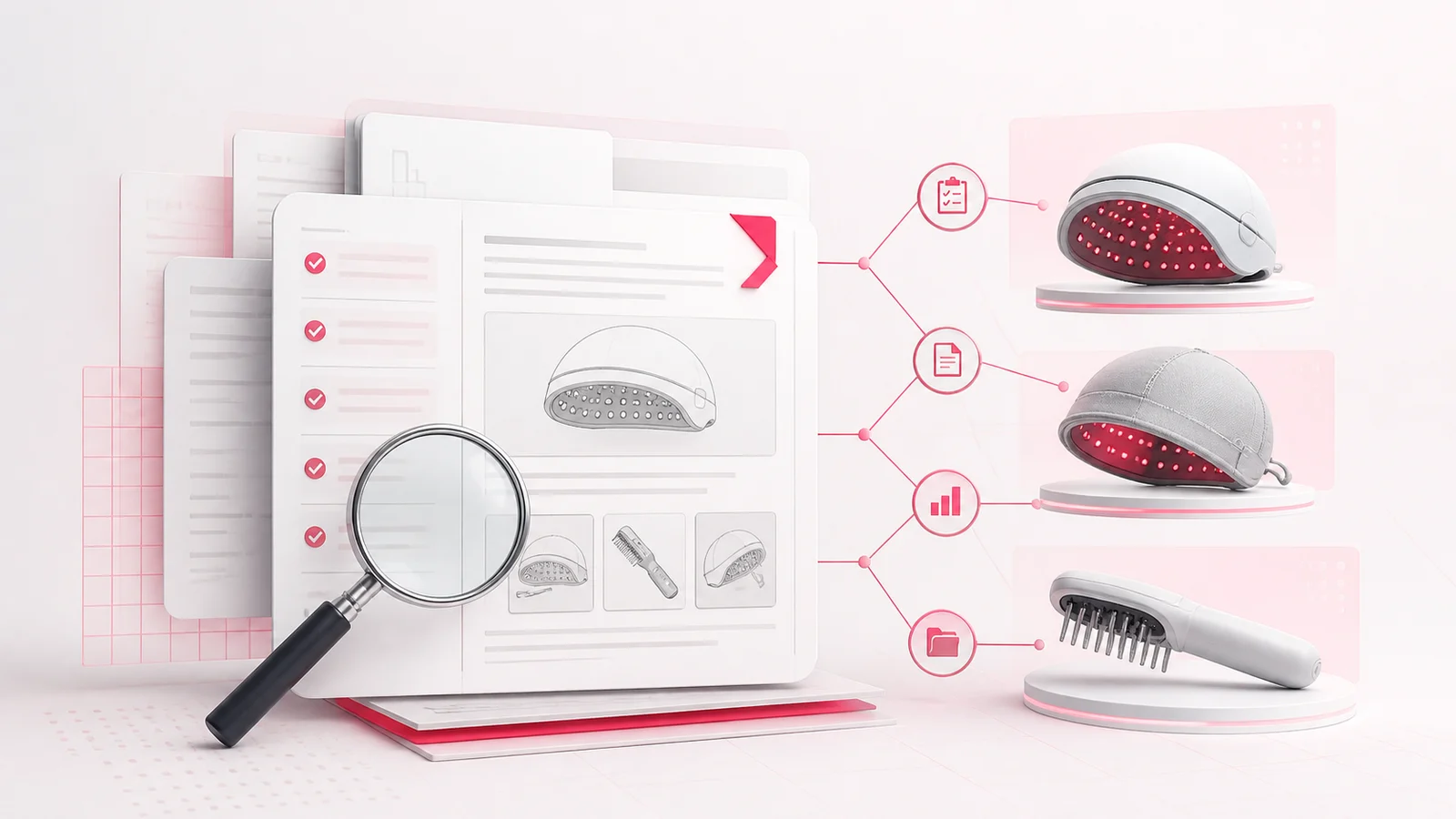
TL;DR para equipes de produtos e compras
- Um IEC 62471 relatório avalia riscos fotobiológicos para os modelos, modos de luz, configuração, e condições de teste indicadas no relatório. Não é evidência de eficácia clínica ou autorização de comercialização.
- Um relatório de comprimento de onda deve mostrar a saída espectral medida por modo, não apenas rótulos de catálogo como “vermelho 660 nm” ou “azul 415 nm.” Um comprimento de onda de pico é útil, mas não é o espectro completo.
- Um número de irradiância não é comparável até que o relatório indique a distância de medição, pontos de teste faciais, modo de luz, método média versus pico, instrumento, ID da amostra, e data do teste.
- Um relatório de terceiros sobre uma amostra de engenharia não prova que cada lote de produção tenha saída óptica idêntica. Os compradores ainda precisam de uma amostra de ouro, verificações de lote, limites de aceitação, e controle de mudança.
- Antes de aprovar um pedido OEM, solicite o IEC completo 62471 relatório, gráficos espectrais, um mapa de pontos de irradiância, escopo do modelo testado, e o plano de controle óptico em lote para a configuração exata da máscara.
Para quem é este guia: Proprietários de marcas B2B, compradores de marca própria, gerentes de produto, Equipes de controle de qualidade, distribuidores, e colegas regulatórios analisando amostras de máscaras faciais de LED ou documentos de fornecedores.
Para quem não é: consumidores que procuram aconselhamento sobre tratamento ou uma dose terapêutica recomendada. Este é um guia de fornecimento e verificação de evidências, não é conselho médico.
Um fornecedor de máscaras faciais de LED pode fornecer uma folha de especificações limpa: 415 nm azul, 660 nm vermelho, 850 nm próximo ao infravermelho, e 30 irradiância mW/cm². Esses números parecem precisos, mas eles ainda não informam como o produto foi medido.
Era 30 mW/cm² medido na superfície do LED ou no plano voltado para a pele? Foi o ponto mais alto ou uma média no rosto? Qual modo estava ativado? Qual instrumento foi usado? O IEC 62471 relatório cobre o controlador exato, difusor, Arranjo de LED, e tempo de tratamento na amostra que você está comprando?
Essas questões são importantes porque a IEC 62471, teste de comprimento de onda, teste de irradiância, e o controle de qualidade da produção são quatro camadas de evidências diferentes. Tratá-los como um “certificado óptico” esconde as lacunas que um comprador precisa encontrar antes de assinar.
Para um mapa mais amplo de autorização de comercialização e certificação, comece com o Guia de certificação de dispositivos de terapia LED. Este artigo se concentra apenas na camada de segurança óptica e de saída óptica.
São IEC 62471, Comprimento de onda, Irradiância, e controle de qualidade em lote a mesma evidência?
Não. IEC 62471 avalia riscos fotobiológicos, teste de comprimento de onda descreve a saída espectral, o teste de irradiância mede a potência óptica por unidade de área sob condições definidas, e o controle de qualidade do lote verifica se a produção permanece dentro dos limites acordados.
Use esta matriz de evidências antes de revisar qualquer crachá de fornecedor ou folha de especificações:
| Camada de evidências | Pergunta principal do comprador | O que isso pode mostrar | O que não pode mostrar por si só |
|---|---|---|---|
| IEC 62471 relatório | Esta fonte de luz foi avaliada quanto aos riscos fotobiológicos?? | Edição padrão, produto testado, modos, condições, avaliação de perigo, e resultado do grupo de risco | Eficácia clínica, Autorização da FDA, Autorização CE/MDR, ou consistência de lote |
| Comprimento de onda / relatório espectral | Qual espectro óptico cada modo realmente emite? | Distribuição espectral, picos medidos, saída específica do modo, informações do instrumento e da amostra | Uniformidade de irradiação, eficácia do tratamento, ou autorização de comercialização |
| Relatório de irradiância | Quanta potência óptica por unidade de área foi medida? | Um valor a uma distância definida, localização, modo, instrumento, e configuração de teste | O valor a outra distância, outro ponto facial, outro modo, ou outro lote |
| Registro óptico em lote | A produção permanece dentro da especificação óptica acordada? | Resultados de lote amostrados, limites de aceitação, equipamento, data, e decisão de liberação | Uma garantia universal de que todas as unidades futuras permanecerão inalteradas |
A regra de sourcing é simples: não deixe um documento substituir os outros três.
O que o IEC 62471 Prove uma máscara facial de LED?
IEC 62471 fornece uma estrutura padronizada para avaliar riscos fotobiológicos potenciais da radiação óptica não-laser sob condições específicas de medição e exposição.
O IEC 62471:2006 página oficial descreve o padrão como cobrindo fontes ópticas de banda larga incoerentes alimentadas eletricamente, incluindo LEDs, mas excluindo lasers, entre 200 nm para 3000 nm. Especifica limites de exposição, técnicas de medição de referência, e um esquema de classificação para avaliar e controlar perigos fotobiológicos.
Para um comprador de máscara facial LED, um relatório útil deve identificar o produto e depois mostrar como as emissões testadas foram avaliadas de acordo com o padrão. O relatório pode atribuir a fonte testada a um grupo de risco, mas o resultado pertence à configuração e às condições desse relatório.
Esse limite é importante. Um IEC 62471 o resultado não cobre automaticamente:
- Um modelo não listado no relatório
- Um novo layout de LED, difusor, lente, controlador, ou conduzir corrente
- Um modo de luz que não foi testado
- Um tempo de tratamento ou condição operacional diferente
- Uma fonte de laser dentro de um LED misto / dispositivo laser
- Cada alteração de marca própria que afeta as instruções, avisos, ou uso pretendido
Porque IEC 62471 exclui lasers, um dispositivo de fonte mista precisa de uma revisão separada da parte do laser e das evidências de segurança do laser aplicáveis. Os compradores devem pedir ao fornecedor que identifique qual padrão cobre cada fonte óptica, em vez de aceitar um logotipo para todo o sistema.
A partir de julho 2026, a página IEC lista os 2006 primeira edição, uma data de estabilidade de 2026, e a publicação como em desenvolvimento. Uma data de saldo não é um atalho para o comprador chamar um relatório de “expirado”. O passo prático é confirmar a edição utilizada no relatório, qualquer adoção regional, como EN 62471, e se o mercado-alvo ou o padrão do produto exige uma avaliação diferente ou adicional no momento do lançamento.
O reconhecimento da FDA torna a IEC 62471 obrigatório para todas as máscaras LED?
Não. O reconhecimento da FDA significa que o padrão pode ser relevante para evidências pré-comercialização; não cria uma regra de documento universal para cada máscara de LED.
O FDA Banco de dados de padrões de consenso reconhecidos reconhece o IEC completo 62471:2006 padrão e identifica vários exemplos de códigos de produtos baseados em luz de Classe II, incluindo OHS para redução de rugas sem prescrição médica. A mesma página descreve o uso de padrões de consenso voluntário em submissões pré-comercialização.
A aplicabilidade ainda depende do dispositivo, tipo de fonte, uso pretendido, código do produto, mercado-alvo, e estratégia de submissão. Se um fornecedor reivindicar a FDA 510(k) autorização, verifique o número K e o escopo do dispositivo separadamente. Um IEC 62471 relatório não substitui o FDA 510(k) registro.
Como você verifica um IEC 62471 Relatório?
Verifique o relatório como um documento técnico específico do modelo, não como um logotipo de certificado.
Solicite o PDF completo em vez de capturas de tela selecionadas. Então verifique:
| Campo de relatório | O que verificar | Por que os compradores devem se preocupar |
|---|---|---|
| Denunciar identidade | Número do relatório, revisão, data de emissão, contagem completa de páginas, anexos | Arquivos cortados ou de versão mista podem ocultar o escopo e as condições |
| Laboratório | Nome legal, detalhes de contato, assinaturas ou autorização, contexto de acreditação onde reivindicado | “Testado por terceiros” é muito vago sem um laboratório identificável |
| Requerente / fabricante | Nome e endereço da empresa | O detentor do relatório deve corresponder à cadeia de evidências do fornecedor |
| Identidade do produto | Nome do produto, marca quando relevante, principal modelo testado, modelos familiares | Um relatório de máscara não deve ser usado para um painel ou plataforma de máscara não relacionada |
| Padrão | IEC 62471 edição e qualquer adoção regional, como EN 62471 | “IEC testado” sem uma edição está incompleto |
| Configuração testada | Disposição dos LEDs, elementos ópticos, controlador, fonte de energia, hardware / versão do software onde listado | Alterações ópticas ou de unidade podem afetar o resultado |
| Modos de luz | Vermelho, azul, infravermelho próximo, misturado, esmaecido, pulsado, ou modos programados realmente avaliados | Um modo testado não cobre automaticamente todos os modos |
| Condições de medição | Distância, suposições de exposição, geometria de origem, pontos de emissão acessíveis | Os resultados do grupo de risco dependem da configuração da medição |
| Resultado | Avaliação de perigos e classificação de grupos de risco para os modos testados | “Aprovado” por si só não explica a classificação ou os limites |
Use palavras públicas cuidadosas. Se a evidência for um relatório de teste, dizer “testado de acordo com IEC 62471” ou “IEC 62471 relatório de teste disponível.” Não diga automaticamente “Dispositivo médico com certificação IEC 62471” a menos que haja uma rota de certificação e um certificado separados que apoiem esse texto exato.
Quais são as bandeiras vermelhas em uma IEC 62471 alegar?
- Um logotipo de site sem número de relatório
- Uma captura de tela de uma página sem lista de modelos ou condições de teste
- Um relatório para um componente ou adaptador de LED apresentado como evidência de máscara inteira
- Um relatório para um modo apresentado como cobertura para todos os modos
- Uma afirmação de família modelo sem explicação de equivalência
- “Grupo Isento” apresentado como prova clínica ou garantia incondicional de segurança ocular
- Uma data de relatório anterior às principais, controlador, ou alterações de LED sem avaliação de alteração
O que um relatório de comprimento de onda deve mostrar?
Um relatório de comprimento de onda deve mostrar a distribuição espectral medida para cada modo de luz relevante, junto com o instrumento, amostra, configuração, e data do teste.
O Página CIE para IEC 62471 / CIE S 009 explica por que o sistema completo é importante: lentes, difusores, óptica de projeção, e as condições de operação podem alterar a distribuição espectral acessível. O espectro visto fora da máscara acabada pode não ser idêntico à saída nominal de um componente LED.
NIST define irradiância espectral como potência óptica incidente por unidade de área por intervalo de comprimento de onda. É por isso que um gráfico espectral é mais informativo do que um nome de cor ou um número nominal.
Um relatório mínimo de comprimento de onda útil deve incluir:
- Modelo do produto e ID da amostra
- Modo de luz testado
- Faixa espectral digitalizada
- Gráfico de distribuição espectral
- Comprimento de onda de pico medido ou picos
- Identificação do instrumento ou espectrorradiômetro
- Contexto de calibração de comprimento de onda e irradiância, quando disponível
- Posição de teste ou plano de medição voltado para a pele
- Data do teste e número do relatório
Um comprimento de onda de pico é suficiente?
Não. Um comprimento de onda de pico é um ponto no espectro medido; não descreve a largura espectral, picos secundários, saída de cores misturadas, ou a saída relativa de vários comprimentos de onda.
Isto é especialmente importante para máscaras de vários comprimentos de onda. Um modo descrito como “amarelo," "roxo,” ou “misto” pode ser gerado por uma banda espectral estreita ou por várias bandas que se parecem com o olho. As equipes de compras devem comparar os espectros medidos, não apenas nomes de cores.
UM 2026 estudo de bancada revisado por pares mediu quatro máscaras LED não médicas disponíveis comercialmente e encontrou diferenças substanciais nas características espectrais, geometria, e irradiância. As descrições do comprimento de onda do fabricante também eram inconsistentes, e um manual listou uma faixa fisicamente implausível para uma cor visível. O estudo envolveu apenas quatro máscaras, portanto, não deve ser tratado como uma estimativa de prevalência da indústria ou como um estudo de eficácia clínica. Demonstra por que um comprador deve solicitar evidências espectrais medidas em vez de confiar nos rótulos do catálogo. Ver Baeza-Moyano, Bernadete, e Sola (2026).
O que um relatório de irradiância deve mostrar?
Resposta curta: Um relatório de irradiância deve indicar a potência óptica por unidade de área medida em um local definido, distância, modo, e configuração. Um número simples de mW/cm² não é suficiente.
NIST descreve irradiância como uma quantidade radiométrica expressa como potência óptica incidente por unidade de área. Para fornecimento de máscara LED, a unidade geralmente é mW/cm², mas a unidade por si só não torna dois valores comparáveis.
Use este registro de comparação mínimo:
| Campo obrigatório | Exemplo de uma entrada útil | Entrada fraca |
|---|---|---|
| Modelo exato / ID da amostra | Modelo X, SN da amostra ou ID da amostra de engenharia | “Máscara LED” |
| Modo claro | Vermelho + NIR em 100% saída | “Todas as luzes” |
| Distância de medição | Plano voltado para a pele, posição de contato, ou distância declarada em mm / cm | Sem distância |
| Pontos de teste faciais | Testa, ambas as bochechas, nariz, queixo, ou uma grade documentada | Um ponto não especificado |
| Definição de resultado | Valores de pontos mais média declarada; pico listado separadamente | Um valor “máximo” |
| Instrumento | Modelo e sensor do medidor ou espectrorradiômetro | “Equipamento profissional” |
| Calibração | Data de calibração, Certificado, ou declaração de rastreabilidade, quando disponível | Nenhuma informação de calibração |
| Condição operacional | Aquecimento, bateria / estado de energia, nível do controlador, condições ambientais quando relevante | Nenhuma descrição de configuração |
| Data e número do relatório | Relatório com data atual vinculado à amostra | Captura de tela sem data |
A questão chave não é “É 30 mW/cm² bom?" Isso é:
Onde, como, e em qual configuração foi 30 mW/cm² medido?
A irradiação também não é o mesmo que a energia fornecida durante uma sessão. A duração da exposição e o comportamento do modo são importantes. Um artigo de aquisição não deve transformar um valor de irradiância em uma reivindicação de dose terapêutica universal sem o protocolo e as evidências relevantes.
Por que fazer distância, Ajustar, e pontos de teste faciais são importantes?
A saída óptica que atinge a face pode mudar com a geometria da fonte, distância, ajuste da máscara, Espaçamento dos LEDs, elementos ópticos, e local de medição.
A CIE afirma que a avaliação fotobiológica pode precisar determinar como a irradiância e a radiância efetiva variam com a distância. Para uma máscara facial, este não é um detalhe teórico. Uma máscara de silicone flexível, uma concha rígida, e uma máscara com oculares levantadas pode colocar diferentes regiões faciais em diferentes distâncias do conjunto de LED.
O 2026 estudo de bancada com quatro máscaras usou um espectrorradiômetro calibrado e documentou diferentes geometrias de máscara e distâncias face a máscara. Medições adicionais de luz azul em diferentes locais faciais em duas máscaras mostraram grandes diferenças espaciais na irradiância. Porque o estudo testou apenas quatro produtos de consumo, suas descobertas numéricas não devem ser generalizadas para todas as máscaras de LED. A lição sobre compras ainda é clara: uma leitura favorável do ponto central não pode descrever a distribuição de toda a face.
Para aprovação de amostra, peça um mapa de pontos em vez de um número. O mapa deve mostrar:
- Onde cada ponto foi medido
- Se o sensor estava em contato com a pele ou a uma distância definida
- Qual modo e nível de controlador foram usados
- Os valores de pontos individuais
- Como a média relatada foi calculada
- Se os pontos mais altos e mais baixos são divulgados
Se conforto, geometria da ocular, ou mascarar alterações de curvatura durante a personalização, solicitar uma análise do impacto óptico antes de presumir que o relatório antigo ainda se aplica.
Um relatório de terceiros prova consistência óptica em nível de lote?
Não. Um relatório de terceiros caracteriza a amostra enviada e o escopo do modelo declarado; a consistência da produção requer um plano de controle e verificação separado.
Um comprador OEM deve conectar evidências de amostra a evidências de produção em massa:
| Estágio do projeto | Provas a solicitar | Decisão do comprador |
|---|---|---|
| Triagem de fornecedores | IEC 62471 relatório, relatório espectral, relatório de irradiância, escopo do modelo | A especificação do fornecedor é apoiada por documentos identificáveis?? |
| Aprovação de amostra | ID da amostra, gráfico de comprimento de onda, mapa de pontos de irradiância, controlador / configurações de modo | A amostra real corresponde à especificação óptica prometida? |
| Bloqueio de amostra dourada | Hardware aprovado, firmware, Configuração de LED, óptica, acessórios, e especificação assinada | Qual configuração exata se torna a referência de produção? |
| Controle de entrada de materiais | Fornecedor de LED / controles de peças, requisitos de comprimento de onda ou compartimento, registros de inspeção, quando aplicável | Como as alterações de material são detectadas antes da montagem? |
| Lançamento de produção | Número do lote, plano de amostragem, equipamento, status de calibração, resultados medidos, limites de aceitação | Este lote atende aos critérios ópticos acordados? |
| Controle de mudanças | Revisão do LED, controlador, difusor, lente, firmware, modo, temporizador, ou mudanças de poder | A mudança requer novos testes, documentação, ou aprovação do comprador? |
Os limites de aceitação não devem ser copiados de um blog genérico. Eles devem ser acordados para o produto exato, uso pretendido, caminho regulatório, método de medição, e especificação comercial.
Quais documentos ópticos os compradores devem solicitar antes de assinar?
Solicite um pacote de documentos correspondente para o modelo exato, não é uma pasta de certificados não relacionados.
O pacote mínimo é:
- IEC completo 62471 relatório — número do relatório, laboratório, requerente, edição padrão, modelo testado, âmbito familiar, modos, condições, classificação, assinaturas, e anexos.
- Comprimento de onda / relatório espectral — gráficos e picos medidos para cada modo relevante, com instrumento, contexto de calibração, ID da amostra, e data.
- Relatório de irradiância - distância, mapa de pontos faciais, valores individuais, média / definições de pico, instrumento, modo, ID da amostra, e data.
- Arquivo de controle de amostra para produção - especificação aprovada, amostra dourada, método de amostragem em lote, limites de aceitação, calibração de equipamentos, e processo de controle de mudanças.
Para posicionamento regulamentado ou de maior risco, o pacote óptico pode precisar ser conectado com segurança elétrica, Emc, biocompatibilidade, rotulagem, gestão de risco, e autorização específica do mercado. IEC 62471 não substitui essas camadas.
Se você ainda está comparando estruturas de máscaras e opções de personalização, use o Guia de fornecimento OEM de máscara facial LED antes de bloquear a especificação de aceitação óptica.
Quais perguntas de RFQ você deve enviar a um fornecedor de máscara facial de LED?
Faça perguntas que forcem a resposta a um relatório, configuração testada, e controle de produção.
Copie ou adapte essas perguntas:
| Pergunta de solicitação de cotação | O que uma resposta útil deve incluir |
|---|---|
| Você pode fornecer o IEC completo 62471 relatório para este modelo exato? | Número do relatório, laboratório, requerente, edição padrão, lista de modelos, modos, resultado, data de emissão, PDF completo |
| Qual configuração foi testada? | Disposição dos LEDs, elementos ópticos, controlador, fonte de energia, hardware / versão do firmware quando relevante |
| O relatório cobre todos os comprimentos de onda e modos de luz mista que planejamos vender?? | Escopo modo a modo ou uma lista clara de lacunas |
| Você pode fornecer a distribuição espectral medida para cada modo? | Gráficos espectrais, comprimentos de onda de pico, instrumento, ID da amostra, data do teste |
| Como a irradiância é medida? | Distância, mapa de pontos, sensor, modo, média / método de pico, calibração, data |
| A irradiância do catálogo é um pico, ponto central, ou média da área facial? | Um cálculo definido e os valores dos pontos subjacentes |
| Quais dados ópticos pertencem à amostra que recebemos? | ID da amostra vinculada às configurações do relatório e do controlador |
| Quais são os limites de aceitação de produção? | Critérios acordados de comprimento de onda e irradiância vinculados a um método repetível |
| Com que frequência os lotes são verificados? | Plano de amostragem, equipamento de teste, calibração, registros, liberar responsabilidade |
| Quais alterações acionam novos testes ou aprovação do comprador? | LIDERADO, óptica, controlador, firmware, temporizador, modo, poder, acessório, e rotular regras de controle de alterações |
Se o fornecedor responder a todas as perguntas com a mesma captura de tela do certificado, o pacote de evidências ainda não está pronto para aprovação da amostra.
Perguntas frequentes
É IEC 62471 uma certificação de produto?
Não necessariamente. IEC 62471 é um padrão usado para avaliação de segurança fotobiológica. Se o fornecedor tiver um relatório de teste, o texto preciso é “testado de acordo com IEC 62471” ou “IEC 62471 relatório de teste disponível.” Não presuma que existe um certificado de produto separado.
Um resultado de Grupo Isento significa que a máscara está livre de riscos?
Não. Significa que a fonte testada foi classificada no grupo isento sob as condições declaradas no relatório. Os compradores ainda devem verificar os modos testados, configuração, instruções, avisos, e condições de uso.
A IEC 62471 provar que uma máscara de LED funciona?
Não. IEC 62471 aborda avaliação de segurança fotobiológica, não eficácia clínica. Alegações de tratamento ou desempenho cosmético exigem evidências separadas e revisão específica do mercado.
É IEC 62471 o mesmo que um relatório de comprimento de onda?
Não. Um IEC 62471 avaliação pode usar medições espectrais, mas um relatório de comprimento de onda de fornecimento deve mostrar separadamente o espectro medido e os picos para os modos de produto relevantes.
Posso comparar duas máscaras pelos seus números de mW/cm²?
Somente depois de confirmar que os valores usam distâncias comparáveis, pontos faciais, modos, instrumentos, calibração, e média / definições de pico. Caso contrário, a comparação pode ser enganosa.
Pode um IEC 62471 relatório cobre uma família de modelos de máscaras?
Só pode sustentar uma família quando o relatório ou documentação técnica controlada identificar claramente os modelos abrangidos e a base para a sua equivalência. Os compradores não devem inferir a cobertura familiar apenas pelo nome da fábrica.
O reconhecimento da IEC pela FDA 62471 significa que todo envio ao FDA exige isso?
Não. O reconhecimento da FDA significa que o padrão pode ser usado quando relevante. O dispositivo, código do produto, fonte óptica, uso pretendido, e o caminho de submissão determinam a estratégia de evidências.
O que devo solicitar primeiro de um fornecedor OEM de máscara LED?
Comece com o IEC completo 62471 relatório para o modelo exato, em seguida, solicite gráficos espectrais específicos do modo, um mapa de pontos de irradiância com condições de teste, e o plano de controle óptico da amostra até a produção.
O que os compradores devem fazer a seguir?
Bloqueie o método de medição e o escopo da evidência antes de bloquear a especificação de marketing.
Antes de aprovar uma embalagem ou uma ordem de produção:
- Combine o IEC 62471 reportar ao modelo e modos exatos.
- Combine os relatórios de comprimento de onda e irradiância com a amostra física.
- Combine a localização dos pontos, distância, instrumento, média / método de pico, e limites de aceitação.
- Bloqueie uma amostra de ouro e regras de controle de alterações.
- Exigir registros ópticos em lote para liberação de produção.
Se você está avaliando a Wakelife como um parceiro OEM, envie o modelo de destino, mercado-alvo, reivindicações planejadas, modos de comprimento de onda, e especificação óptica necessária. Solicite o mapa do documento para essa configuração exata, em vez de uma lista genérica de certificação.
Resumo
IEC 62471, dados de comprimento de onda, dados de irradiância, e registros ópticos em lote respondem a diferentes questões de fornecimento. Um forte pacote de evidências de máscara facial de LED deve mostrar segurança fotobiológica para a configuração testada, saída espectral medida por modo, irradiância sob condições reproduzíveis, e um plano de controle de produção que mantém a especificação aprovada conectada a lotes futuros.
Para compradores, a regra prática é:
Não aprove uma especificação óptica até que você possa rastrear cada número até um modelo, modo, condição de medição, amostra, relatório, e método de controle de produção.
Para obter o mapa completo de evidências de certificação em autorizações de mercado, SGQ, segurança elétrica, segurança fotobiológica, e controle de qualidade óptico, voltar para o Guia de certificação de dispositivos de terapia LED.