Passer du dropshipping à la marque privée est logique lorsqu'un produit a généré une demande reproductible et que votre équipe est prête à assumer la responsabilité de l'expérience produit qui l'entoure.. La décision est plus grande que l’ajout d’un logo. Cela change la façon dont vous approuvez l'appareil, inventaire des fonds, gérer les emballages, planifier l'exécution et accompagner les clients après la livraison.
Un défaut de fonctionnement prudent pour un premier projet est une transition par étapes: garder le magasin actuel opérationnel uniquement pendant que son SKU exact, inscription, les instructions et l'exécution restent identifiables et supportables, puis vérifiez un échantillon de marque privée distinct et préparez une première commande limitée. Changez la liste seulement après le produit, conditionnement, la documentation et le chemin d'exécution sont approuvés ensemble.
Ce guide utilise « appareil pour la croissance des cheveux » comme expression de catégorie commerciale pour des produits tels que les coiffes pour le cuir chevelu., casques et peignes. Il n’établit pas qu’un dispositif particulier a une indication autorisée sur la pousse des cheveux ou que les preuves d’un produit s’appliquent à un autre..
Avant les sept étapes: Vérifiez votre préparation aux marques privées
Vous êtes prêt à évaluer les marques privées lorsque votre magasin peut répondre à cinq questions avec ses propres données et ses propriétaires nommés.. Une semaine virale ou une capture d’écran des ventes d’un fournisseur ne suffisent pas.
| Zone de préparation | Preuves à examiner | Pause quand |
|---|---|---|
| Demande | Commandes par semaine, chaîne et pays; conversion reproductible plutôt qu'une seule promotion | Les ventes dépendent d'un court pic ou ne peuvent pas être séparées par SKU |
| Ajustement du produit | Raisons de retour, questions d'assistance, avis et produits exacts reçus par les clients | Vous ne pouvez pas identifier l'appareil actuel ni expliquer les plaintes récurrentes |
| Trésorerie et inventaire | Fonds disponibles après la publicité, remboursements et frais de fonctionnement; exposition boursière réaliste | La première commande supprimerait les liquidités nécessaires au fonctionnement du magasin |
| Propriété de la marque | Un client clair, positionnement, promesse du produit et propriétaire pour l'emballage et le support | Le plan est uniquement de remplacer un logo générique par le vôtre |
| Opérations | Marchés cibles, lieu de stockage, itinéraire d'expédition, processus de garantie et propriétaire de commande | Personne n'est propriétaire de l'épanouissement, retours ou réapprovisionnement |
Il n’y a pas de seuil universel de ventes mensuelles ou de MOQ. Utilisez votre taux de vente réel, la quantité minimale indiquée, coût des stocks au débarquement, coût après l'atterrissage pour servir, délai de réapprovisionnement et réserve de trésorerie pour décider si la première commande est gérable.
Avant les sept étapes: Choisissez un modèle de transition
La marque privée et la réalisation sont des décisions distinctes. Un appareil de marque peut être expédié depuis votre propre entrepôt, un prestataire logistique tiers ou un autre accord d'exécution convenu. La possibilité pour un fabricant d'envoyer des commandes individuelles doit être confirmée séparément.; il ne faut jamais le déduire des mots « marque privée ».
| Modèle | Meilleur ajustement | Contrôle principal |
|---|---|---|
| Continuez le dropshipping tout en évaluant | Demande, les données sur les espèces ou la pension alimentaire sont incomplètes, mais le SKU actuel, configuration, inscription, les instructions et l'exécution restent identifiables et supportables | Continuez à collecter les ventes au niveau du SKU, données de retour et de livraison; conserver intact le dossier de produit actuel |
| Transition hybride | Un SKU a une demande reproductible et une configuration actuelle traçable, alors que le catalogue plus large utilise toujours le dropshipping | Empêcher que les versions génériques et de marque soient mélangées dans les listes, réclamations ou exécution |
| Inventaire complet de marque privée | La demande est stable, l'équipe peut financer et stocker l'inventaire, et le processus opérationnel est prêt | Approuver le produit, conditionnement, documentation, qualité et réapprovisionnement comme un seul système |
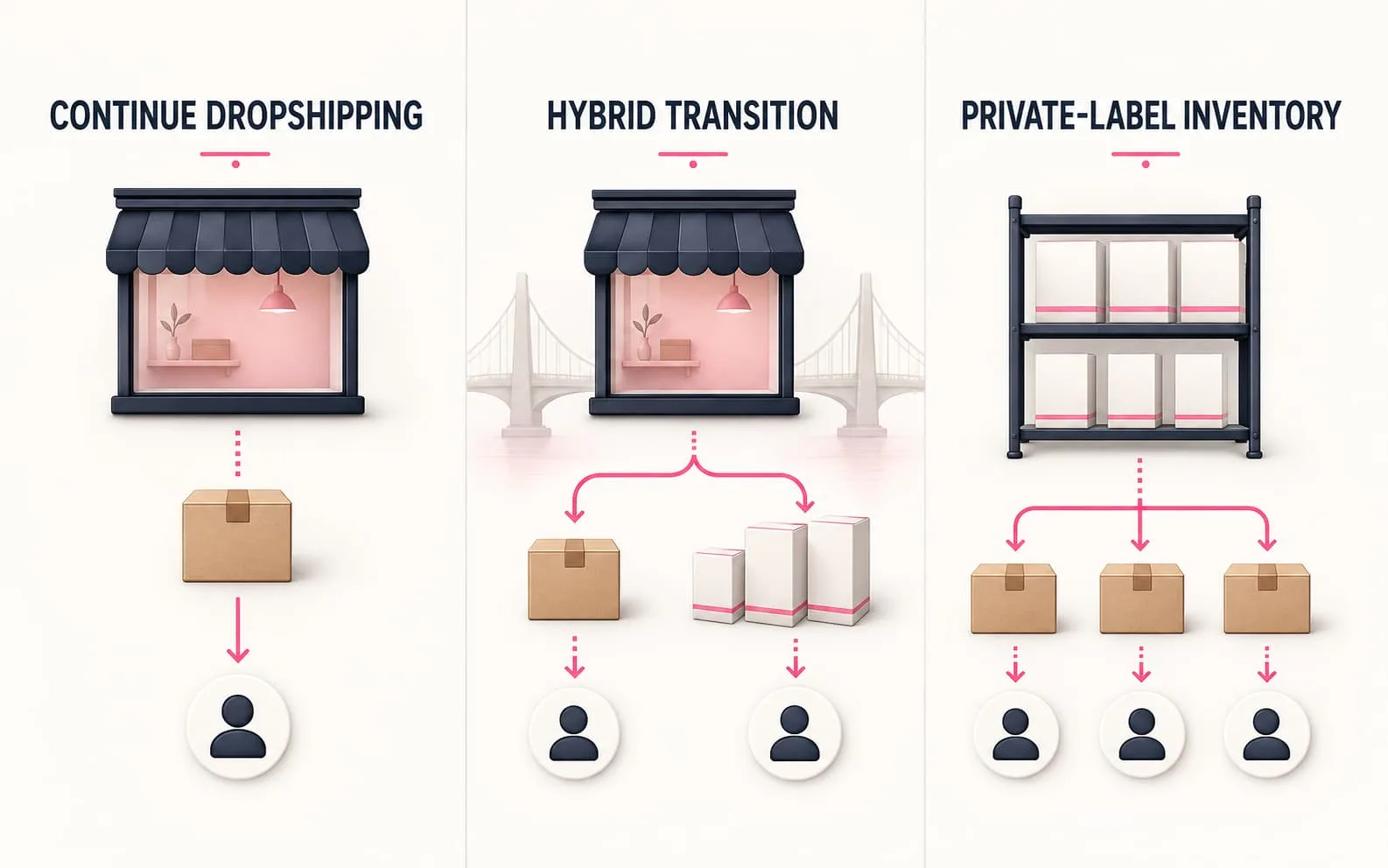
Si le produit actuel peut rester identifié et pris en charge avec précision, une transition hybride est une première option prudente. Il préserve les ventes actuelles pendant que la version de marque privée est échantillonnée et approuvée.. Cela permet également à la marque de tester son nouveau processus d'emballage et de support avant de s'appuyer sur un modèle d'inventaire complet.. Si vous ne parvenez pas à faire correspondre la liste actuelle et les instructions avec le produit que les clients reçoivent réellement, arrêtez de traiter cette route comme un pont valide et résolvez d'abord l'inadéquation du produit.
Étape 1: Transformez les données du magasin en une décision produit
Commencez par le SKU qui présente les preuves les plus claires, ce n'est pas le produit avec la présentation du fournisseur la plus impressionnante.
Revoir:
- commandes et conversion par semaine, pays et chaîne;
- remboursements, retours, rétrofacturations et réclamations de livraison;
- les questions que les clients posent avant et après l'achat;
- la variante du produit et les accessoires que chaque client a réellement reçus;
- quelles allégations ou images d'annonce ont influencé l'achat; et
- si la demande persiste à la fin d'une remise ou d'une campagne publicitaire.
Cet examen ne prouve pas que l'appareil fonctionne ou que la demande future est garantie. Il vous indique si le magasin a un problème commercial suffisamment stable pour justifier la prochaine évaluation.
Écrivez un rôle de produit avant de contacter une usine:
Nous voulons évaluer un [peigne/casquette/casque] en tant que notre première référence d'appareil pour le cuir chevelu de marque pour [client et canal]. Le premier échantillon doit nous aider à décider [le produit spécifique, questions d'emballage et d'exécution].
Si vous n'avez pas choisi le facteur de forme, comparer les rôles d'achat dans Wakelife's Guide OEM/ODM du dispositif de croissance des cheveux avant de demander les prix.
Étape 2: Identifiez le produit exact que vous remplacez
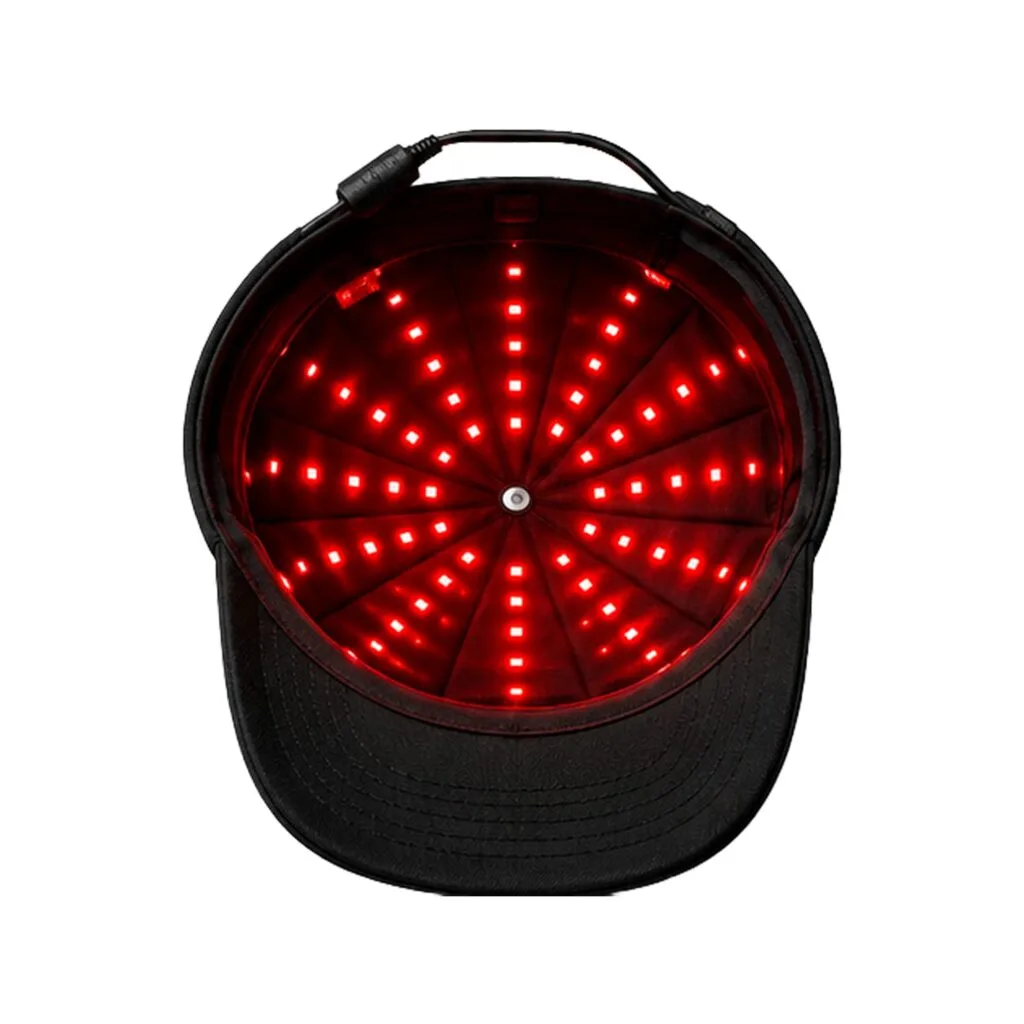
Ne demandez pas à un nouveau fournisseur de « faire le même » à partir d’un lien marketplace. Une annonce peut changer de fournisseur, combiner plusieurs variantes ou omettre des détails importants lors de l'échantillonnage.
Créer une référence de produit actuel:
| Champ de référence | Quoi enregistrer |
|---|---|
| Produit physique | Facteur de forme, dimensions, poids, contrôles, accessoires, chargeur ou adaptateur, matériaux et couleur |
| Flux de travail utilisateur | Comment le client se positionne, fonctionne, nettoie, charge et stocke le produit |
| Conditionnement | Boîte de vente au détail, inserts, emballage de protection et état dans lequel les commandes arrivent |
| Contenu destiné au client | Nom du produit, instructions, photos, réclamations, avertissements et réponses d'assistance |
| Accomplissement | Lieu d'expédition, plage de livraison, suivi, traitement des commandes endommagées et retours |
| Preuves disponibles | Documents qui nomment ou correspondent au produit exact plutôt qu'à une liste similaire |
L'objectif n'est pas de copier un appareil inconnu. Il s’agit d’exposer ce que vos clients attendent déjà, puis décidez de ce que l'échantillon de marque privée doit conserver, améliorer ou supprimer.
Étape 3: Séparer les changements de marque des changements de produits
Pour une première transition, une plateforme de produits existante est souvent plus facile à évaluer qu'un nouveau projet d'ingénierie. Wakelife service de marque privée commence par des plates-formes existantes sélectionnées et une portée définie pour la stratégie de marque, conditionnement, instructions, échantillons et documentation disponible.
Classez chaque demande avant de demander un devis:
| Demande | Discussion probable sur le projet |
|---|---|
| Logo, couleur disponible, boîte et manuel de marque | Portée des marques privées, sous réserve du modèle et du processus sélectionnés |
| Ensemble d'accessoires différent ou configuration disponible | Option plateforme à confirmer dans le devis et l'échantillon |
| Nouvelle configuration d'éclairage, contrôles, micrologiciel, structure ou utilisation prévue | Examen de l’ingénierie et de l’impact des preuves; peut aller au-delà de la marque privée standard |
| Un nouveau produit conçu autour d'un concept | Discussion sur le développement OEM/ODM |
L'étiquette utilisée par l'équipe commerciale compte moins que la liste de modifications. Demander au fournisseur d'identifier quelles demandes sont standards, qui nécessitent un examen technique et qui affectent les tests, documentation, prix ou délai.
Étape 4: Approuver l'échantillon en tant que système
Un échantillon n'est utile que lorsque vous savez ce qu'il représente. Enregistrez le modèle, configuration, accessoires, version du logiciel ou du micrologiciel, le cas échéant, et si l'échantillon est neutre, logo appliqué ou construit avec un emballage destiné à la production.
Comparez l'échantillon candidat avec le produit actuel:
- ajuster, étapes de confort et d'utilisation;
- contrôles, chargement et accessoires;
- construire une cohérence et des défauts visibles;
- séquence de protection de l'emballage et de déballage;
- instructions, avertissements et questions d'assistance;
- photographies de produits et exactitude des listes; et
- les documents exacts disponibles pour la configuration proposée et le marché cible.
Si le SKU validé est un peigne à main, utiliser le Guide d'approvisionnement en peignes laser pour la croissance des cheveux pour séparer le flux de travail de l'utilisateur du peigne des spécifications des composants et de la vérification exacte de l'appareil.
N'approuvez pas un échantillon car il semble proche du produit dropship. Approuvez-le sur la base d’une liste de contrôle écrite, et enregistrer les différences qui nécessitent une décision avant le début de l'illustration ou de la production..

Étape 5: Calculez la première commande avec le coût unitaire et le délai de vente
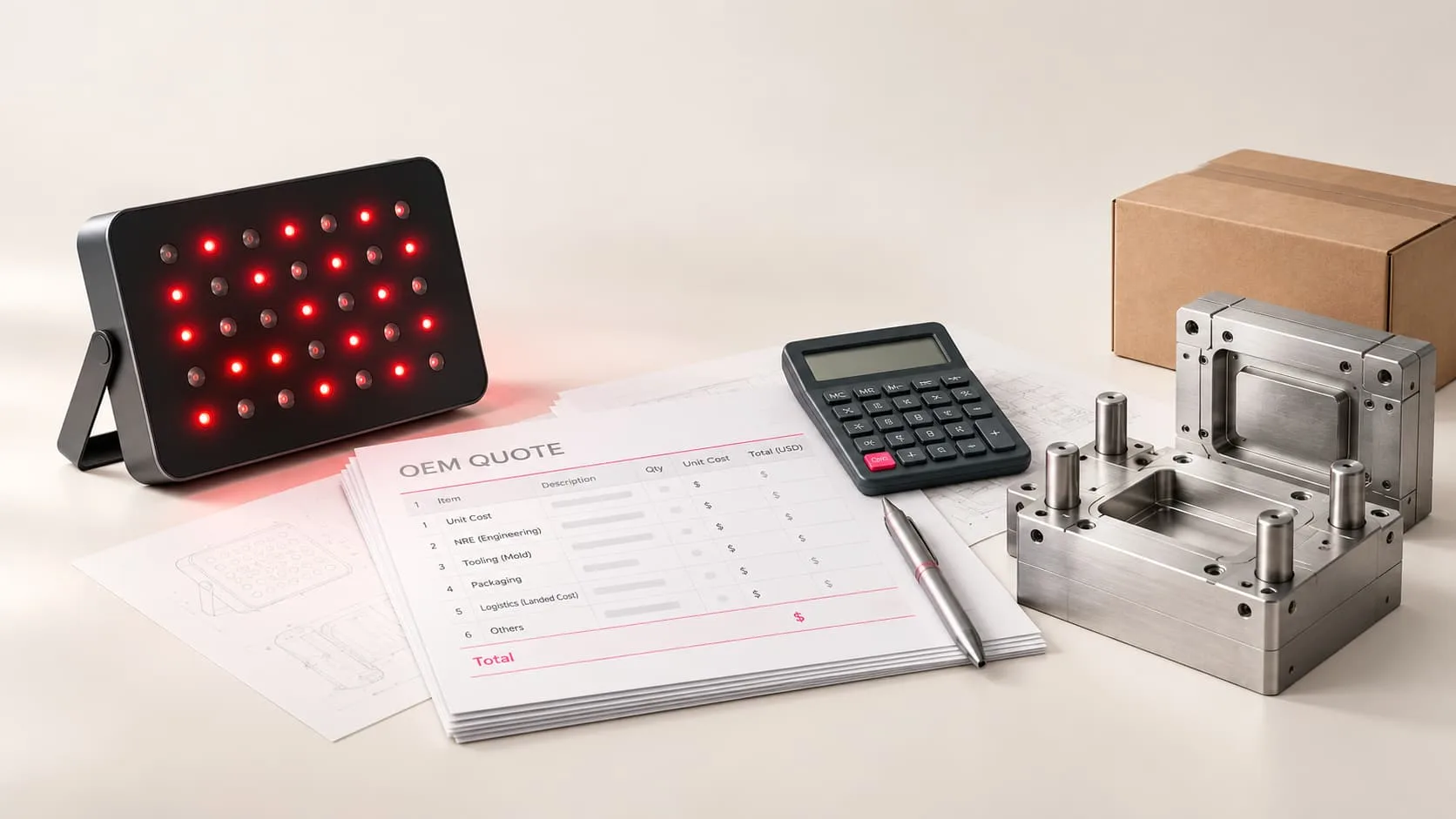
Le numéro pertinent n'est pas le prix unitaire d'usine en lui-même. Séparez le coût du stock au débarquement des coûts d'exécution et de support après le débarquement afin que la même dépense ne soit pas comptée deux fois.. Utiliser une seule devise, un lot proposé et le nombre attendu d'unités vendables tout au long du calcul.
| Couche de coût | Inclure dans l'estimation |
|---|---|
| Coût des stocks au débarquement par unité vendable | Produit et marque convenue; emballages et notices; inspection attribuée ou tests requis; fret entrant, devoir et manutention |
| Coût après atterrissage pour desservir chaque unité | Stockage et pick-and-pack; frais de livraison et de paiement sortants; dommages documentés, indemnité de retour et de remplacement |
Ajoutez ces deux chiffres seulement après avoir utilisé les mêmes hypothèses de lot.. Publicité, les frais de distribution et autres frais généraux du magasin peuvent ensuite être modélisés séparément selon la méthode comptable propre à la marque. Ce sont des estimations de planification, pas de définitions comptables universelles.
Lors de la comparaison des offres des fournisseurs, nécessitent un Incoterms® nommé 2020 règle et un lieu nommé plutôt que d'écrire uniquement « FOB," "CIF" ou "DDP". Le Chambre de Commerce Internationale explique que les Incoterms® clarifient les tâches de livraison, coûts et risques répartis entre vendeur et acheteur. Ils ne remplacent pas le produit, paiement, qualité, garantie ou autres conditions qui doivent encore être écrites dans l’accord.
Calculez ensuite: Mois de vente attendus = unités vendables de premier ordre ÷ ventes d'unités mensuelles prudentes.
Utilisez un taux de vente conservateur qui exclut les pics inhabituels. Comparez le résultat avec le délai de réapprovisionnement du produit, réserve de trésorerie et risque de cotation ou de changement de produit. Impôts, les droits et frais de livraison dépendent de la destination et des conditions d'expédition, obtenez donc les cotations actuelles plutôt que de copier un pourcentage générique d'un article.
Étape 6: Emballage de serrure, Réclamations et exécution avant la production
Trois approbations doivent être obtenues avant qu'un bon de commande soit considéré comme prêt à être lancé..
Approbation du produit: l'échantillon approuvé et les spécifications de commande se réfèrent au même modèle et à la même configuration.
Approbation face au client: la boîte, étiquette, manuel, les scripts de liste et de support décrivent ce produit de manière cohérente. Ne copiez pas les réclamations ou les instructions de l'ancienne liste de dropship sans vérifier l'appareil exact, preuves et marché cible.
Approbation de l'exécution: l'équipe sait où l'inventaire sera conservé, qui crée les étiquettes d'expédition, quels pays peuvent être servis, comment le suivi est renvoyé au magasin, et qui gère perdu, endommagé, unités retournées et sous garantie.
Si vous envisagez de vendre dans plus d'un pays, conserver une liste marché par marché du nom du produit final, configuration, conditionnement, instructions, informations sur l'importateur ou la partie responsable, le cas échéant, plus les réclamations finales et l'examinateur nommé responsable de l'approbation spécifique au marché. Une liste générale de certificats ne remplace pas la vérification du produit final de marque distributeur et de son rôle..
Étape 7: Changez de magasin par étapes contrôlées
Évitez un changement du jour au lendemain lorsque le produit de marque, l'emballage et le chemin d'exécution n'ont pas été testés ensemble.
- Congeler le produit approuvé, oeuvre d'art, emballage et spécification de la commande.
- Recevez et inspectez l'inventaire pilote avant de modifier la liste en direct.
- Créez une nouvelle photographie et des instructions à partir du produit de marque approuvé.
- Tester le routage des commandes, suivi, traitement des commandes endommagées et retours.
- Séparez l’inventaire générique restant du SKU de marque et attribuez les propres identifiants du produit de marque. Si votre chaîne utilise l'identification GS1, le Norme de gestion GS1 GTIN indique que la modification de la marque principale affichée sur un article commercial nécessite un nouveau GTIN.
- Mettre à jour les scripts de support client avec les accessoires réels, instructions et itinéraire de garantie.
- Surveiller les premières commandes pour déceler les défauts, écart de livraison, questions répétées et inadéquation des listes avant d'augmenter la commande suivante.
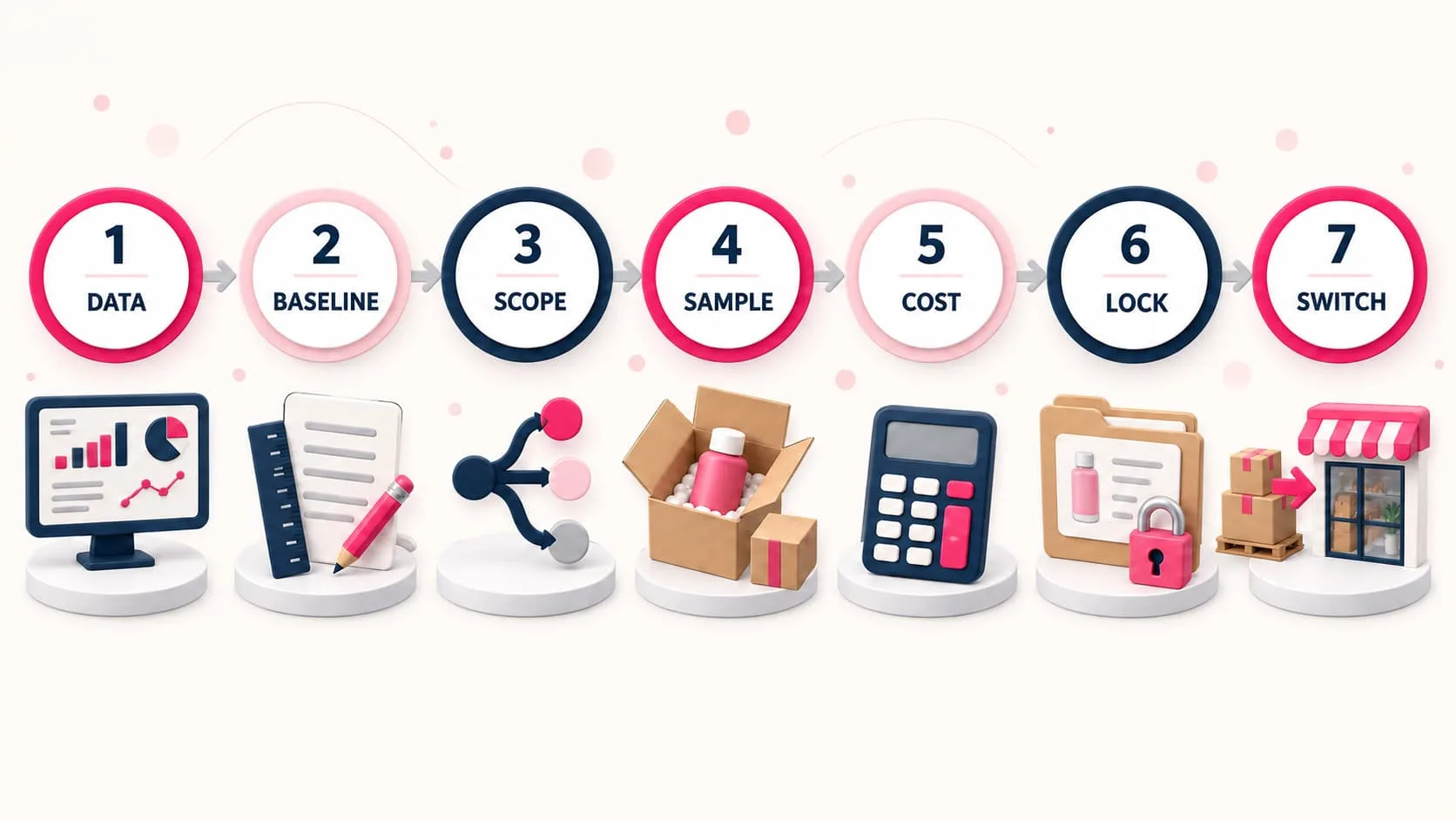
Gardez l'ancienne route de dropshipping disponible uniquement si les deux produits peuvent être clairement séparés. L'envoi d'une version générique à un client qui a commandé la version de marque bat le record du produit, attentes du client et processus de support.
Que devriez-vous mettre dans la première demande de prix?
Envoyer un mémoire d'une page donnant au fabricant suffisamment d'informations pour répondre au problème de transition.
- URL du magasin, entreprise et canaux de vente actuels
- Clientèle et pays cibles
- Forme actuelle du produit et problèmes exacts que vous souhaitez améliorer
- Plateforme existante ou facteur de forme préféré
- Plage de quantités de première commande pour le devis, sans le considérer comme un engagement
- Logo, couleur, conditionnement, demandes de manuels et d'accessoires
- Nom du produit prévu, utilisation et sinistres prévus
- Type d’échantillon et décisions que l’échantillon doit prendre en charge
- Documents requis pour la configuration exacte indiquée et le marché
- Niveaux de prix unitaires et ce que chaque niveau comprend
- Dimensions de l'emballage, données sur le carton principal et conditions d'expédition
- Hypothèses de calendrier de production et de réapprovisionnement
- Stockage, Exigences d’expédition en gros ou de traitement de commandes individuelles
- Inspection, défaut, remplacement, processus de garantie et de pièces de rechange
Demandez au fournisseur de marquer chaque réponse comme standard, facultatif, sujet à révision ou indisponible. C'est plus utile qu'une cotation qui cache des hypothèses derrière un prix unitaire..
Quelle est la prochaine étape pratique?
Ne commencez pas par une grosse commande ou un nouveau moule. Commencez par un briefing de transition, une proposition spécifique au modèle et un exemple de plan.
Si vous choisissez toujours un facteur de forme, explorez d’abord Wakelife Plateformes d'appareils LED et laser pour la pousse des cheveux. Si votre SKU actuel a une demande reproductible et que vous pouvez définir le produit, marque, exigences du marché et de réalisation, envoyer à Wakelife un demande de projet en marque privée. Incluez la référence actuelle du produit et les champs de la demande de prix ci-dessus. Wakelife peut ensuite séparer les options de plate-forme disponibles des demandes nécessitant une ingénierie ou un examen supplémentaire..
Si ces entrées ne sont toujours pas claires, continuer à collecter les données du magasin et du support avant de valider l'inventaire. Le but de la première étape de la marque privée est de créer un contrôle que vous pouvez exercer, et pas simplement de placer votre logo sur le prochain envoi..
Questions fréquemment posées
Puis-je continuer à faire du dropshipping tout en développant une version en marque privée?
Oui, si le SKU actuel, configuration, inscription, les instructions et l'exécution restent identifiables et supportables. Une transition hybride peut préserver les ventes actuelles pendant que vous évaluez l'échantillon de marque, processus d'emballage et d'exécution. Gardez les produits génériques et de marque séparés dans l'inventaire, annonces, réclamations et support client.
La marque privée signifie-t-elle que le fabricant exécutera les commandes individuelles?
Non. La personnalisation des produits et l'exécution des commandes sont des services distincts. Demandez qui détient l'inventaire, expédie chaque commande, assure le suivi et gère les retours. Tout service d'exécution au niveau du fabricant doit être confirmé dans la proposition écrite.
Comment dois-je choisir la quantité de première commande?
Utilisez des ventes mensuelles prudentes, MOQ cité, coût des stocks au débarquement, coûts d'exécution et de support après l'atterrissage, trésorerie disponible après charges d'exploitation, délai de réapprovisionnement et risque de stocks invendus. Il n’existe pas de quantité universelle fiable pour chaque magasin ou appareil.
La première version de marque devrait-elle inclure une personnalisation matérielle?
Généralement, la première évaluation est plus facile lorsqu'elle commence avec une plateforme existante et un périmètre de branding contrôlé. Ajoutez des modifications techniques uniquement lorsqu'elles résolvent un problème de client ou de canal défini et que l'équipe est prête à évaluer leur coût., timing, impact sur les tests et la documentation.
Sources externes utilisées
-
1
Shopify. Qu'est-ce qu'une marque privée? Comment fonctionnent les marques privées
La source est utilisée pour la distinction générale entre dropshipping et marque privée; les contrôles de transition de ce guide sont spécifiques à la tâche de sourcing d'appareils B2B. -
2
Chambre de Commerce Internationale. Règles Incoterms®
Utilisé pour le cadre des tâches de livraison, coûts et risques couverts par les Incoterms®. -
3
GS1. Norme de gestion GTIN: Marque principale
Utilisé pour l'implication sur l'identité du produit du changement de marque principale lorsque l'identification GS1 s'applique.