TL;DR pour les acheteurs
- HT01 est le mieux adapté aux marques qui souhaitent un portable, SKU démontrable pour les soins des cheveux et du cuir chevelu – il ne s'agit pas d'un appareil mains libres pour tout le cuir chevelu.. Son format de peigne portatif prend en charge le placement section par section mais nécessite que l'utilisateur le déplace dans les cheveux..
- La configuration standard combine 14 × nominal 655 laser à émission de surface à cavité verticale nm (VCSEL) puces, 14 × 660 nm LED rouges et 14 × 460 nm LED bleues dans 14 modules à trois puces, plus EMS à trois niveaux, vibration fixe et applicateur de sérum amovible.
- Le 5 Le chiffre en mW correspond à la puissance de sortie optique par puce VCSEL. Ce n'est pas de l'irradiation, influence, dose totale du cuir chevelu ou classification laser du dispositif fini.
- Recherches publiées sur d'autres 655 Les dispositifs à peigne laser et à casque nm fournissent un contexte de catégorie, mais cela n’établit pas de performances cliniques spécifiques au HT01 et ne justifie pas la copie du protocole d’un autre appareil.
- La catégorie des peignes se divise en deux écoles de design : le laser pur (diodes laser uniquement) et multifonction (laser + DIRIGÉ + EMS/sérum). Le choix de l’école est une décision de positionnement et de vérification, pas de classement d'efficacité prouvé.
- Avant d'approuver un échantillon ou une allégation marketing, demander les conditions exactes de test optique de la configuration, classification laser du produit fini, étiquettes, instructions et documents du marché cible.
Qu'est-ce que HT01 et qu'est-ce que ce n'est pas?
HT01 est une plate-forme portable OEM/ODM pour les soins des cheveux et du cuir chevelu qui combine la lumière, EMS, application de vibrations et de sérum dans un seul appareil. Sa page produit actuelle n'identifie pas de HT01 510(k) numéroter ou publier les résultats cliniques spécifiques au HT01, irradiation de l'appareil fini ou un rapport de classification laser. Les acheteurs doivent traiter chaque article comme non vérifié jusqu'à ce que l'enregistrement ou le rapport du modèle exact soit fourni..
Cette distinction est importante car un acheteur prend deux décisions à la fois:
- Est-ce que le format de peigne et ensemble de fonctionnalités s'adapter à la gamme de produits prévue?
- Est-ce que le configuration et documentation exactes soutenir le marché cible et les sinistres prévus?
La première décision peut être prise à partir des spécifications du produit et de la manipulation des échantillons. La seconde nécessite des rapports spécifiques au modèle et un examen réglementaire. Une longueur d'onde, un point de données de composant ou une recherche sur un autre appareil ne peut pas combler cet écart.
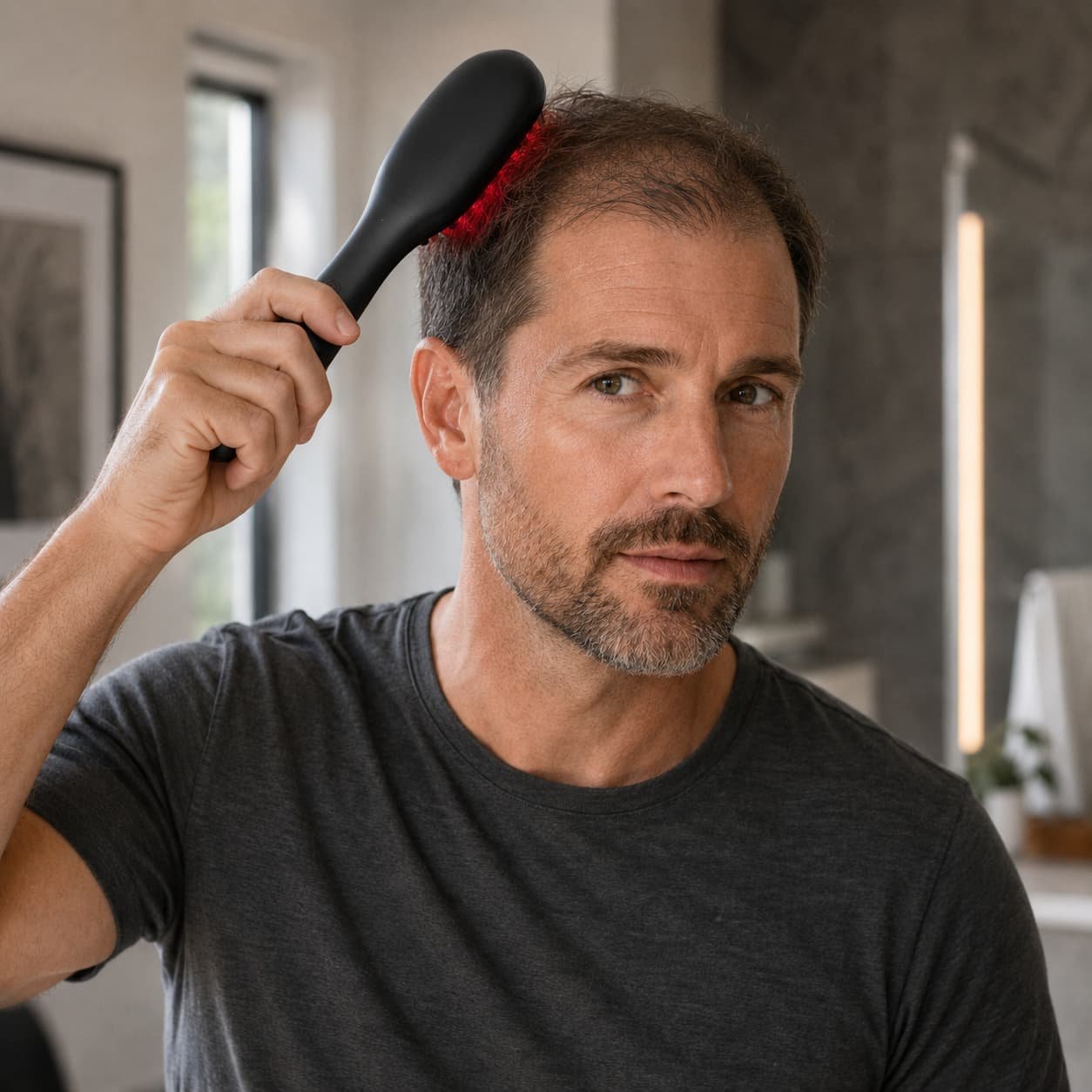
Le courant Page produit HT01 positionne l'appareil pour la beauté, cheveux-bien-être, soins du cuir chevelu, canaux de distribution et de marques propres. Ce guide utilise l'expression de catégorie de marché « peigne laser pour la croissance des cheveux » pour le contexte d'approvisionnement.; ce n'est pas une allégation selon laquelle HT01 a une indication autorisée pour la croissance des cheveux. Aux États-Unis, le dossier OAP de la FDA définit le laser, comb, hair catégorie autour de la promotion de la croissance des cheveux dans l'alopécie androgénique. Un nom de produit, une étiquette ou une publicité utilisant cet objectif nécessite donc un modèle exact de processus réglementaire et d'examen des allégations, et pas seulement un mot-clé de catégorie ou une déclaration du fournisseur..
Est-ce que publié 655 nm La recherche sur la croissance des cheveux prouve que HT01 fonctionne?
Non. Publié 655 La recherche nm prend en charge la catégorie plus large des appareils, mais cela ne prouve pas les performances d'un modèle exact non testé.
UN 2021 revue systématique et méta-analyse des appareils LLLT à usage domestique a regroupé sept essais contrôlés randomisés en double aveugle et a constaté une plus grande amélioration de la densité des cheveux avec les appareils étudiés qu'avec un traitement fictif. L'examen a évalué les produits à usage domestique nommés sélectionnés par leurs autorités américaines.. Statut de marché de la FDA (il ne s'agit pas d'une catégorie de longueur d'onde interchangeable), les résultats restent donc liés aux configurations étudiées.. Il comprenait à la fois les formats de peigne et de casque, mais il a également signalé une hétérogénéité significative, périodes de suivi courtes et aucune comparaison directe entre les appareils.
Un séparé multicentrique, randomisé, étude contrôlée de manière fictive évalué des modèles LaserComb spécifiques en utilisant 655 nm ou combiné 635/655 faisceaux laser nm. Il prend en charge un point plus étroit: des appareils à laser rouge au format peigne ont été étudiés chez des personnes souffrant de perte de cheveux. Cela ne montre pas qu'un produit ayant une longueur d'onde similaire, la valeur nominale de la diode ou la forme du peigne reproduiront ces résultats. Le document rapporte que le fabricant a partiellement financé l'étude et fourni des dispositifs et équipements actifs/simulés., y compris le système d'imagerie numérique. Il divulgue également les honoraires, des frais de consultation ou de participation impliquant deux auteurs et une bourse à un département universitaire pour une partie de l’étude.
Pour une décision d'approvisionnement, utiliser la recherche de cette façon:
| Couche de preuves | Ce que cela peut dire à un acheteur | Ce qu'il ne peut pas dire à un acheteur |
|---|---|---|
| Recherche de catégories publiées | Certains dispositifs spécifiques à lumière rouge/laser de faible niveau et formats de peigne ont des preuves humaines | HT01 a la même efficacité, dose ou profil de sécurité |
| Spécifications du produit HT01 | Quels composants, longueurs d'onde, les modes et les fonctionnalités utilisateur sont dans la configuration standard | Quelle quantité de lumière atteint le cuir chevelu ou quel résultat clinique en résulte |
| Rapports sur les appareils finis HT01 | Irradiance, émission accessible, classification et configuration testée, si fournie | Autorisation automatique pour chaque allégation commerciale ou marketing |
| Autorisation de mise sur le marché sur modèle exact | Quel est le modèle nommé, le titulaire et l'utilisation prévue peuvent soutenir sur ce marché | Autres modèles, configurations modifiées ou revendications plus larges |
Règle de l'acheteur: une longueur d'onde similaire est une raison pour enquêter sur un produit, ne remplace pas les preuves exactes de l'appareil.
Laser pur ou multifonction: Quelle école de conception de peignes correspond à votre marque?
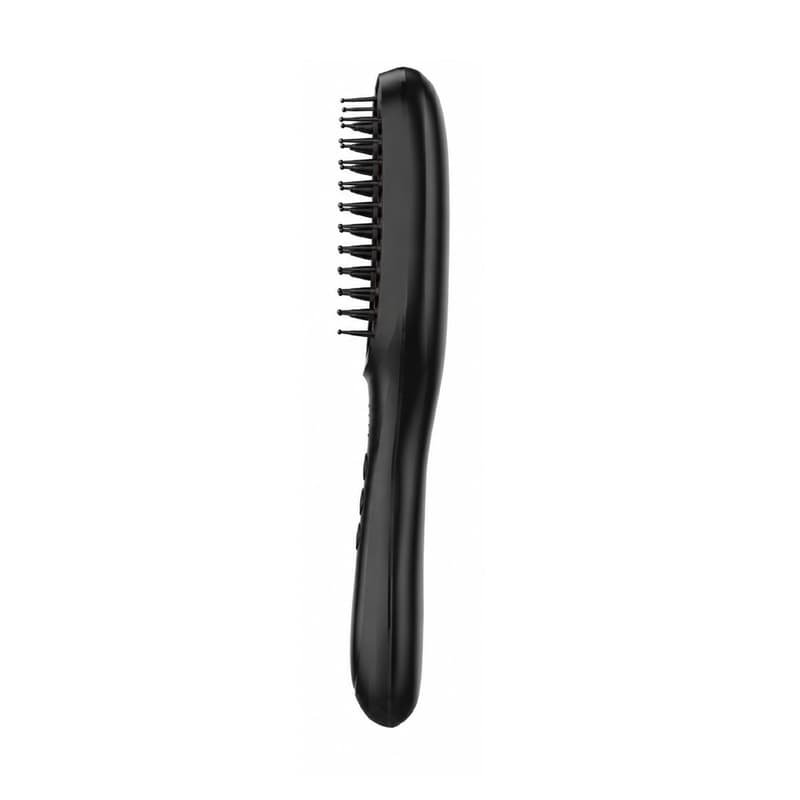
La catégorie des peignes laser comprend deux écoles de design distinctes: peignes construits autour de diodes laser uniquement, et des plates-formes de peigne qui combinent des lasers avec des LED et ajoutent des fonctions telles que l'EMS ou l'application de sérum. La scission est une décision de positionnement et de vérification : les preuves publiées ne classent pas une école au-dessus de l’autre..
| École du laser pur | École multifonctionnelle | |
|---|---|---|
| Sources lumineuses | Diodes laser uniquement; LED exclues par conception | Laser (ou VCSEL) combiné avec des LED rouges/bleues, souvent dans des modules partagés |
| Fonctions ajoutées | Action de peignage uniquement | Peut ajouter EMS, vibration, application sérum/liquide et modes d'éclairage sélectionnables |
| Histoire que la marque achète | Une revendication « 100 % laser » pour une seule technologie et une description simple des composants | Une routine de soin du cuir chevelu: modes, caractéristiques sensorielles et potentiel de paquet |
| Ancre de catégorie | CheveuxMax (commercialise les gammes Ultima et Actonis) | HT01, l'appareil examiné dans ce guide |
L’école du laser pur déclare explicitement son exclusion des LED. HairMax ULTIMA 12 fiche produit répertorie « 12 lasers de qualité médicale (Pas de LED),» décrit une séance de huit minutes trois jours par semaine, et sa FAQ explique: «Nous utilisons 100% technologie de lumière laser pour une stimulation maximale des follicules (contrairement aux marques qui mélangent les LED).» La même marque se décrit comme « la première marque de croissance des cheveux au laser approuvée par la FDA ». Ce sont les propres déclarations marketing du fabricant, cité ici comme positionnement de catégorie – et non comme une approbation ni comme preuve d’un autre appareil.
Les dossiers de la FDA ajoutent une leçon de vérification pour quiconque répète de telles déclarations: les noms de commercialisation et les noms de dossiers de la FDA divergent. Les appareils HairMax apparaissent dans le FDA 510(k) base de données sous le code produit OAP avec des noms d'enregistrement tels que « HAIRMAX LASERCOMB » (K060305) et « HAIRMAX DUAL 12 » (K111714)—ne correspond pas aux noms de modèles sur les pages de produits actuelles. La matrice de vérification des échantillons plus loin dans ce guide permet d'associer un modèle marketing à un enregistrement exact avant qu'une demande d'autorisation ne soit répétée..
L’école multifonctionnelle troque cette histoire de technologie unique contre une ampleur de routine. HT01 est un exemple: 14 modules tri-chip associant un 655 nm VCSEL avec 660 nm rouge et 460 nm LED bleues, trois modes d'éclairage sélectionnables, EMS, vibration et applicateur de sérum amovible. Cette architecture prend en charge le positionnement des soins du cuir chevelu, démonstration en magasin et gammes de produits à plusieurs niveaux de fonctionnalités, tandis que chaque sous-système ajouté comporte son propre fardeau de vérification. Notez que les preuves cliniques au format peigne examinées plus tôt dans ce guide ont étudié des modèles spécifiques de HairMax LaserComb (appareils uniquement laser), de sorte que la littérature existante sur le peigne humain correspond plus directement à la conception de l'école du laser pur..
Comment l'école change ce qu'un acheteur vérifie:
| Vérifiez d'abord | École du laser pur | École multifonctionnelle |
|---|---|---|
| Sources lumineuses | Nombre de diodes laser, sortie par diode et classe laser de périphérique fini | Chaque sous-système séparément: sortie laser/VCSEL ainsi que chaque longueur d'onde et mode LED |
| Revendications de conception | Tout « pas de LED » / Mention « 100 % laser » comparée à la nomenclature et à l'étiquetage | Noms de mode et revendications de combinaison correspondant aux configurations testées |
| Sous-systèmes supplémentaires | Aucun prévu : confirmez qu'il n'y a aucun mode LED masqué | Paramètres électriques EMS, vibrations et compatibilité liquide/sérum et nettoyage |
| Portée du document | Classement laser, labels et records de marché | Tous les articles laser plus LED, Documentation EMS et applicateur |
Quelle école correspond à quel projet: un design purement laser convient aux marques dont le plan de réclamation suit les précédents établis dans la catégorie des peignes laser et dont le canal vend un message ciblé « peigne laser ». Un design multifonction convient aux marques qui créent des routines de soins du cuir chevelu pour les chaînes de beauté et de bien-être, avoir besoin d'une différenciation au détail ou d'échelonner une gamme de produits, avec la capacité de vérifier chaque sous-système ajouté.
Deux limites rendent cette comparaison honnête. Aucune étude comparative publiée ne compare les résultats des deux écoles en matière de croissance des cheveux. Et une école de design n'est pas un statut réglementaire: « laser pur » ne signifie pas effacé, et « multifonction » ne signifie pas non éprouvé : chaque modèle exact a toujours besoin de ses propres enregistrements.
Que signifie réellement « 5 mW par puce VCSEL »?
Cela signifie la puissance de sortie optique nominale d'un émetteur VCSEL; il ne décrit pas l'exposition reçue par un centimètre carré de cuir chevelu.
Ces quatre termes doivent rester séparés dans une demande de prix et dans la copie destinée au consommateur.:
| Métrique | Ce que cela signifie | Statut HT01 tel qu'actuellement documenté |
|---|---|---|
| Puissance de sortie optique (MW) | Puissance lumineuse émise par une source individuelle ou un ensemble défini | 5 mW par puce VCSEL |
| Irradiance (MW / CM²) | Puissance arrivant par unité de surface sous une distance indiquée, mode et méthode de mesure | Non fourni |
| Exposition radiante / influence (J/cm²) | Énergie délivrée par unité de surface sur une durée d'exposition indiquée | Ne peut pas être calculé à partir des informations actuelles |
| Cours de laser | Classification des dangers du produit fini basée sur les émissions accessibles et les conditions d'essai spécifiées | Doit être confirmé par un rapport spécifique au modèle et un examen de l'étiquetage |
Ne pas réétiqueter 5 mW as 5 mW/cm². Ne multipliez pas 14 × 5 mW et appelez le résultat « puissance du cuir chevelu » ou « dose ». Les sources fonctionnent au sein de modules et de modes, tandis que la géométrie du faisceau, cycle de service, distance, obstruction des cheveux, le mouvement et l’ouverture de mesure affectent ce qu’un instrument de test – ou le cuir chevelu – reçoit.
La classification laser est aussi une question de produit fini. Le Aperçu de la sécurité des lasers de la FDA explique que les produits laser sont soumis à des contrôles techniques basés sur les classes et à une communication des risques. IEC 60825-1 fournit le cadre de classification des équipements pour les produits laser. L'évaluation d'un composant à elle seule n'établit pas la classe de produit HT01..
Pour un américain. projet, les contrôles de rayonnement des produits laser et l'autorisation des dispositifs médicaux sont des contrôles distincts. La FDA FAQ sur le marché des produits émetteurs de rayonnements explique que les rapports sur les produits applicables doivent être soumis avant les États-Unis. commerce; un numéro d'accession confirme la réception mais ne constitue pas une approbation. Il indique également que les importateurs de produits soumis à une norme de performance de la FDA doivent soumettre le formulaire FDA. 2877 et peut fournir le numéro d'accession d'un produit précédemment signalé. Sous Avis laser 56, La FDA déclare qu'elle n'a pas l'intention d'imposer certaines exigences dans 21 CFR 1040.10 et 1040.11 pour les fabricants certifiés selon la CEI pertinente 60825-1 Edition 3 Et IEC 60601-2-22 Edition 3.1 dispositions identifiées dans l'avis. Aucun de ces enregistrements ne remplace un 510(k), et un 510(k) ne remplace pas les contrôles de rayonnement des produits laser.
Que demander:
- le rapport optique du dispositif fini et le rapport d'émission/classification accessible;
- si 5 mW est mesuré au niveau de l'émetteur ou après l'optique, y compris le courant de fonctionnement, température et tolérance;
- le mode actif, instrument, méthode, ouverture, distance entre l'émetteur et le plan de mesure et irradiance sur un plan d'utilisation défini tel que le plan de la pointe de la dent/de contact, le cas échéant;
- étiquettes finales, contrôles et avertissements concernant l'exposition oculaire, instructions d'utilisation et enregistrements de rapports sur le marché cible pour la configuration proposée.
Qu'ajoutent les trois modes d'éclairage HT01?
Les trois modes ajoutent des options de matériel configurable et d'histoire de produit, mais chaque canal a besoin de sa propre limite de preuves.
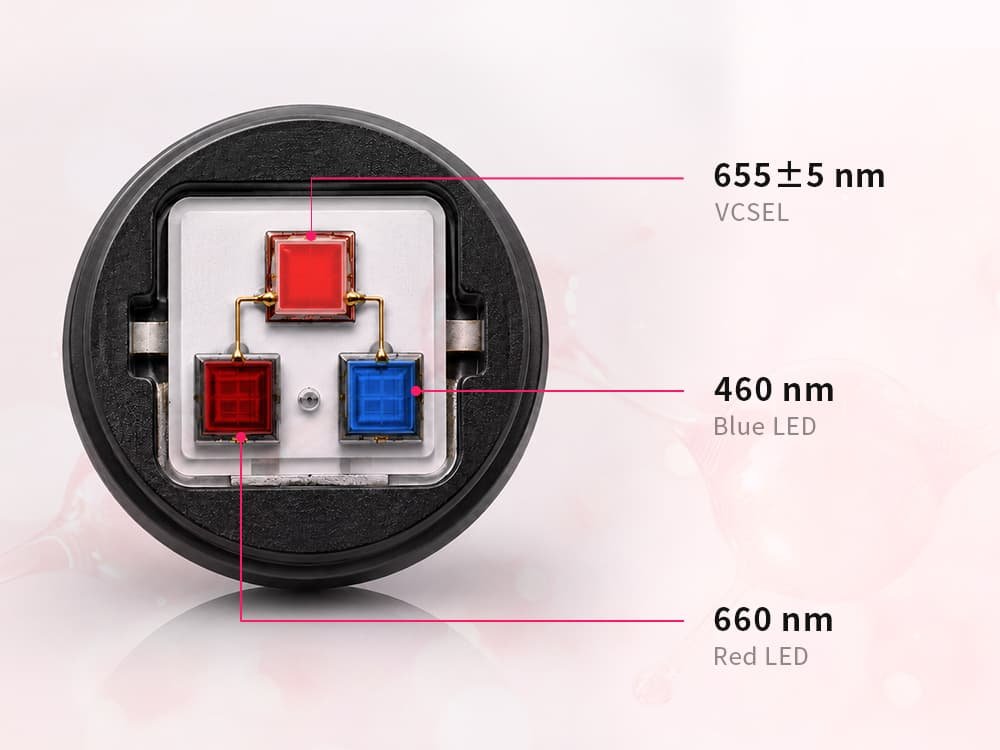
La configuration standard HT01 utilise 14 modules compacts à trois puces, pour 42 puces électroluminescentes au total:
| Mode | Sources lumineuses actives | Description du produit défendable | A éviter sans preuve directe |
|---|---|---|---|
| Mode 1 | 655 nm VCSEL + 660 nm LED rouge | Mode combiné VCSEL et LED rouge | Combinaison cliniquement optimisée; repousse des cheveux plus rapide ou plus profonde |
| Mode 2 | 660 nm LED rouge | Mode de soins du cuir chevelu à LED rouge | Dose ou résultat prouvé du traitement HT01 |
| Mode 3 | 460 nm LED bleue | Mode de soins du cuir chevelu à LED bleue | Antibactérien, anti-pelliculaire, allégations relatives au traitement de l'acné ou à la repousse des cheveux |
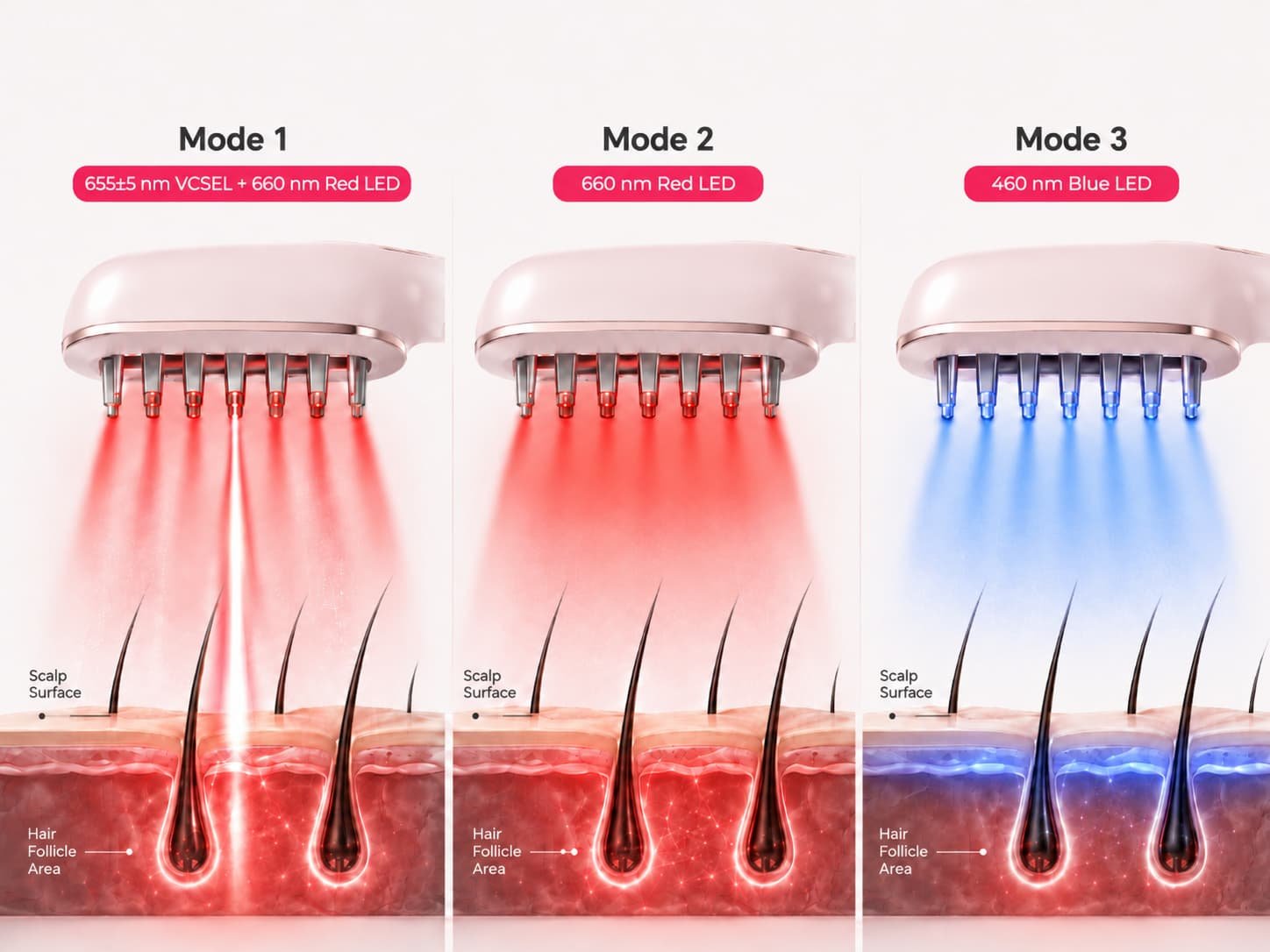
Le 655 La valeur nm est la longueur d'onde nominale du VCSEL; la spécification technique du produit indique 655±5 nm. La LED rouge est 660 nm, et la LED bleue est 460 nm. Les trois types de puces sont présents dans un 1:1:1 rapport.
La lumière bleue mérite une retenue particulière. UN 2017 étude en laboratoire sur les follicules pileux humains a rapporté que 453 nm lumière bleue à 3.2 Anagène prolongé J/cm² dans des follicules isolés ex vivo. Il s’agit là de premières preuves mécanistes – et non d’un essai clinique sur des humains – et la longueur d’onde, la dose et le protocole d'exposition ne constituent pas une étude de validation HT01. Jusqu'à ce qu'il existe des preuves directes, le 460 Le mode nm doit être décrit comme une option matérielle plutôt que comme une fonction éprouvée de croissance des cheveux ou de traitement du cuir chevelu..
Pour les canaux LED rouge et bleu, une évaluation de sécurité photobiologique applicable peut utiliser IEC 62471, qui couvre les sources incohérentes, y compris les LED, mais exclut les lasers. Les acheteurs doivent confirmer la norme de produit applicable, edition, modes testés, conditions d'exposition et modèle exact avec le laboratoire plutôt que de traiter un certificat LED générique comme preuve.
La même discipline s’applique à l’EMS, utilisation des vibrations et du sérum. HT01 fournit trois niveaux d'intensité EMS avec un état d'arrêt indépendant, une fréquence déclarée de 5 à 10 kHz, une fonction de vibration à intensité fixe et un applicateur magnétique amovible. Il s'agit de fonctionnalités d'expérience utilisateur et de regroupement de produits. Ils ne doivent pas se traduire par une meilleure absorption, résultats de circulation ou de croissance des cheveux sans test direct. La fréquence seule ne définit pas la puissance électrique: demander s'il s'agit d'une fréquence porteuse ou d'une fréquence de répétition d'impulsions, avec la forme d'onde, limites de tension/courant, configuration électrode/contact, évaluation des risques et des avertissements et contre-indications appuyés par la conception finale.
Quand un format de peigne s'adapte-t-il à la gamme de produits d'une marque?
Choisissez un peigne lorsque la portabilité, la coupe manuelle et une routine démontrable comptent plus que la couverture mains libres de tout le cuir chevelu.
Contrairement à une casquette ou un casque, un peigne à main ne fixe pas les sources lumineuses sur tout le cuir chevelu pendant toute la séance. L'utilisateur contrôle le placement, vitesse, chevauchement et contact. Cela crée à la fois un avantage commercial et une question d'ingénierie.
Un peigne est un choix pratique lorsque:
- la marque souhaite un SKU compact et plus facile à afficher, démontrer et expédier qu'un casque;
- la routine prévue utilise des coupes manuelles ou une attention particulière aux zones sélectionnées du cuir chevelu;
- la gamme de produits comprend déjà des liquides ou des routines compatibles pour le soin du cuir chevelu;
- EMS réglable, les vibrations et une expérience de peignage tactile ajoutent une différenciation significative;
- la marque peut donner un mouvement clair, contact, instructions de nettoyage et de compatibilité avec les liquides.
Un peigne peut être du mauvais format lorsque:
- le concept du produit dépend du passif, mains libres, couverture simultanée de tout le cuir chevelu;
- la marque a besoin d'une géométrie d'exposition verrouillée avec une variation minimale des mouvements de l'utilisateur;
- le lancement nécessite un protocole clinique de modèle exact existant ou une autorisation de la FDA;
- la chaîne ne peut pas prendre en charge les instructions détaillées, étiquettes d'avertissement ou éducation des clients;
- le sérum ou le liquide pour cuir chevelu prévu n'a pas été vérifié pour la compatibilité de l'applicateur et le nettoyage.
Les marques qui comparent encore les facteurs de forme peuvent utiliser celui de Wakelife guide d'approvisionnement casquette contre casque comme référence de format plus large. Pour HT01, l'ajout important est le mouvement manuel: une évaluation d'échantillon doit tester non seulement le confort, mais également si les utilisateurs peuvent suivre une routine de coupe reproductible.
Quelles sont les spécifications actuelles de la norme HT01?
Les valeurs suivantes décrivent la configuration standard actuelle; les projets personnalisés nécessitent une nouvelle revue de configuration.
| Spécification | Configuration standard HT01 |
|---|---|
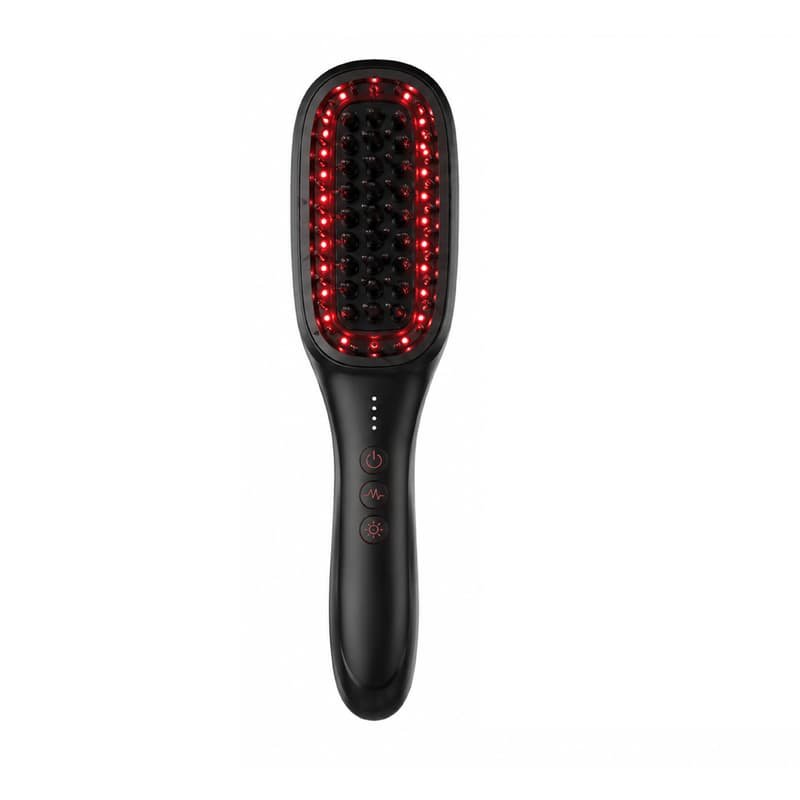
| Type de produit | Peigne laser portable VCSEL pour soins des cheveux et du cuir chevelu |
| Modules lumineux | 14 × 3030 modules à trois puces |
| Total des puces électroluminescentes | 42 |
| Rapport source lumineuse | 14 VCSEL : 14 LED rouge : 14 LED bleue (1:1:1) |
| Longueurs d'onde | 655±5 nm VCSEL + 660 nm LED rouge + 460 nm LED bleue |
| Sortie optique VCSEL | 5 mW par puce VCSEL |
| Intensité lumineuse | Fixé |
| Modes d'éclairage | VCSEL + LED rouge; LED rouge; LED bleue |
| EMS | Désactivé + trois niveaux réglables; 5–10 kHz |
| Vibration | Intensité fixe |
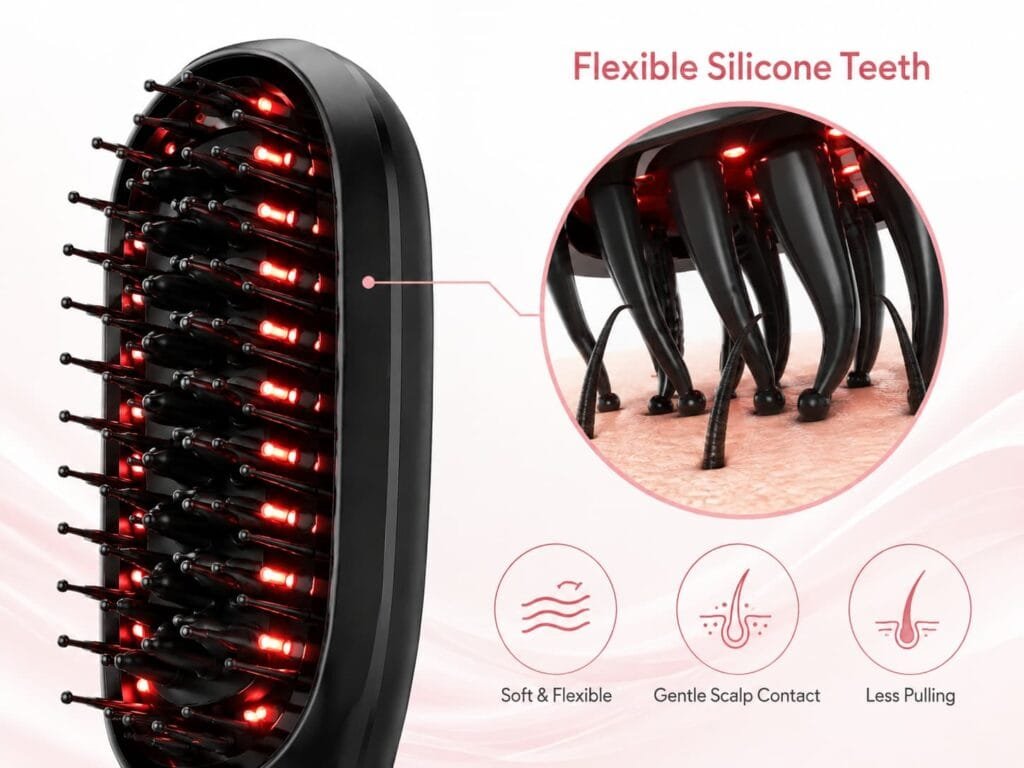
| Peigner les dents | Silicone conducteur souple |
| Applicateur de sérum | Conception magnétique détachable |
| Minuteur | 10 minutes avec arrêt automatique |
| Indicateurs | Indicateurs LED; pas d'écran d'affichage |
| Batterie | 1300 mah |
| Temps de fonctionnement | ≥60 minutes |
| Temps de charge | ≤2,5 heures |
| Dimensions du produit | L249,8 × L63,44 × T27,45 mm; Tolérance de ±0,5 mm |
Ce tableau est une référence d'achat, pas un protocole clinique. En particulier, la minuterie de 10 minutes indique à l'acheteur comment fonctionne la logique de contrôle actuelle; il n’établit pas en soi une fréquence ou une dose de traitement fondée sur des données probantes. La disponibilité des échantillons et le MOQ restent des conditions commerciales qui dépendent de la portée du projet plutôt que des spécifications techniques..
Que doivent vérifier les acheteurs avant d’approuver un échantillon HT01?
Approuver l'échantillon seulement après l'unité physique, révision des spécifications, les dossiers optiques/de sécurité et les sinistres planifiés font tous référence à la même configuration.
Utilisez cette matrice lors de l'examen des fournisseurs:
| Élément de vérification | Demander | Une réponse satisfaisante devrait montrer | Drapeau rouge |
|---|---|---|---|
| Contrôle des configurations | Spécification datée, Identifiant de nomenclature/configuration et fiche technique ou dessin du module | L'échantillon et le devis utilisent le même nombre de modules, architecture du paquet, longueurs d'onde, modes et logique du contrôleur | La fiche de vente et l'échantillon décrivent différents niveaux ou longueurs d'onde EMS |
| Sortie optique | Rapport avec instrument, méthode, mode actif, plan/distance de mesure, conditions opératoires et tolérance | La sortie par source à l'emplacement indiqué est séparée de l'irradiation de l'appareil fini sur un plan d'utilisation défini | Une seule valeur « 5 mW » est présentée sous forme de dose ou de mW/cm² |
| Distribution optique | Carte d'irradiance spatiale ou variation de module à module sur un plan d'utilisation et un mode actif définis | La variation de couverture et la tolérance d'acceptation sont visibles au lieu d'être réduites à une seule lecture maximale | Seul le point le plus élevé ou un émetteur est signalé pour l'ensemble de 14 modules |
| Comportement thermique et de contrôle | Record d'augmentation de la température des dents/zones de contact et du boîtier dans le mode actif le plus défavorable sur un cycle complet de 10 minutes, plus minuterie/arrêt automatique, contrôles de fonctionnement et de charge répétés | Conditions d'essai, emplacements, les limites et les critères de réussite/échec correspondent à l’échantillon final | La température de surface ou le comportement de contrôle sont supposés à partir des données des composants |
| Sécurité des lasers | Rapport de classification des appareils finis, contrôles techniques, avertissements concernant l'exposition oculaire, étiquettes et dossiers de marché applicables | Le modèle/configuration exact, les sources laser applicables et les conditions d'utilisation sont dans le champ d'application | Une fiche technique d'un composant ou d'un autre produit’Le rapport est proposé à la place |
| Sécurité photobiologique des LED | Évaluation applicable, comme la CEI 62471 le cas échéant, et configuration testée | Canaux rouge et bleu, les modes de fonctionnement et les conditions d’exposition sont identifiables | Un certificat LED générique sans portée de modèle/configuration |
| Sortie EMS | Forme d'onde, limites de tension/courant, définition de fréquence, contacter la conception et la documentation des risques | Les trois niveaux et l'état d'arrêt correspondent au contrôleur final et au manuel | « 5–10 kHz » est la seule information de sortie électrique fournie |
| Instructions | Manuel d'utilisation actuel, avertissements basés sur les risques, contre-indications et restrictions de nettoyage/liquides | Mouvement, contact, minuteur, EMS, chargement, les avertissements et la maintenance sont cohérents | Les promesses marketing dépassent les instructions ou une mauvaise utilisation prévisible est omise |
| Marché et réclamations | Dossiers exacts ou plan réglementaire écrit pour le pays cible | Modèle, titulaire, utilisation prévue, sinistres planifiés, les obligations relatives aux produits radioactifs et les relations avec les marques privées s'alignent | Inscription, un numéro d'accession ou un certificat d'usine est utilisé comme autorisation de produit |
| Liquide et enceinte | Matériels, preuve de compatibilité avec les liquides, méthode de nettoyage et tout indice de protection contre la pénétration revendiqué | Applicateur, dents, le logement et les zones de chargement sont évalués pour les liquides et le nettoyage prévus | « Utiliser avec du sérum » est revendiqué sans compatibilité ni examen d'entrée. |
| Impact de la personnalisation | Plan de contrôle des changements et de revalidation | Les changements de couleur/emballage sont séparés de la longueur d’onde, contrôle, changements structurels et de sécurité | Des changements techniques profonds sont promis sans tests ni impact sur les documents |
Aux États-Unis, la base de données de classification générique de la FDA comprend un laser, comb, hair catégorie sous code produit OAP. L'enregistrement associe la catégorie à 21 CFR 890.5500, un rapport de produit de radioprotection requis et les normes laser dans 21 CFR 1040.10 et 1040.11. C'est un itinéraire de recherche utile, mais cela ne prouve pas que HT01 ait un 510(k) ou qu'un rapport sur les produits radioactifs HT01 a été déposé. La FDA prévient également que l'enregistrement de l'établissement et la liste des appareils ne signifient pas l'approbation, autorisation ou autorisation. Demandez chaque enregistrement exact et vérifiez le modèle, fabricant déclarant, titulaire, utilisation prévue et portée de l'étiquetage.
Que devrait contenir une demande de prix HT01?
Un appel d'offres utile définit le marché, réclamations et configuration avant de demander le prix. Copiez cette liste de contrôle dans la demande:
- Pays cibles et canaux de vente prévus.
- Positionnement prévu: soins de beauté/cuir chevelu, bien-être des cheveux ou allégation de croissance des cheveux réglementée.
- Exemple de configuration requis et identifiant de révision.
- Longueurs d'onde standards ou personnalisées, architecture de module/paquet, modes et logique du contrôleur.
- Données optiques du périphérique fini, y compris l'emplacement de sortie, conditions de fonctionnement, tolérance, plan/distance de mesure, mode actif et une carte spatiale ou un résultat de variation de module.
- Forme d'onde EMS, limites de tension/courant, fréquence porteuse par rapport à la fréquence de répétition des impulsions et conception des contacts.
- Classification laser, contrôles/avertissements concernant l'exposition oculaire, Sécurité photobiologique des LED, EMC, batterie, sécurité électrique, thermique, minuterie/arrêt automatique, chargement, étiquettes et documents manuels requis pour l'examen.
- Pour les États-Unis. projets, rapport/adhésion sur les produits laser applicables, étiquettes de certification et d'identification, état du rapport annuel, FDA 2877 responsabilité et tout autre 510(k) chemin.
- Liquides ou paquet de sérum prévus, y compris la compatibilité des matériaux, méthode de nettoyage et preuve de protection contre la pénétration.
- Interface/entrée de chargement, poids du produit, matériaux du boîtier et des dents, exigences en matière de garantie et de remplacement des accessoires.
- Logo, couleur, conditionnement, langue, code à barres, accessoires, quantité d'échantillon, prévision du volume et du marché de livraison.
- Quels changements nécessitent une nouvelle validation, rapports supplémentaires, outillage ou révision réglementaire.
Les réponses doivent déterminer si le projet est à stock neutre, étiquette privée, OEM léger ou ODM plus profond. Ils doivent également déterminer quels documents peuvent rester valides et lesquels doivent être mis à jour après personnalisation..
Décision finale de l'acheteur
HT01 est un candidat crédible lorsque l'objectif commercial est un compact, appareil multifonction pour le soin du cuir chevelu et la marque est prête à valider la configuration finale avant de faire des réclamations de performance ou réglementaires. Sa plus forte différenciation actuelle est tangible: tri-puce 655/660/460 architecture légère nm, trois modes d'éclairage sélectionnables, EMS à trois niveaux, dents conductrices flexibles, vibration et applicateur amovible.
Ce n'est pas le bon raccourci pour un projet qui nécessite des preuves cliniques HT01 toutes faites., un protocole transférable ou une autorisation présumée de la FDA. Ce sont des questions précises sur l'appareil, pas d'avantages qui arrivent automatiquement avec une longueur d'onde ou un composant.
Pour une sélection plus large de fabricants, approbation des échantillons et flux de travail des demandes de prix pour tous les casques, casquettes et peignes, utiliser le Fabricant d'appareils pour la croissance des cheveux & Guide OEM/ODM.
Pour évaluer la configuration standard, visiter le Page produit HT01 ou consultez la version plus large de Wakelife gamme d'appareils laser et LED pour la pousse des cheveux. Lors d'une demande de devis, inclure le marché cible, sinistres planifiés, canal et portée de personnalisation afin que l'examen des échantillons et des documents commence à partir du même brief.
Questions fréquemment posées
Fait 5 mW L’irradiation moyenne HT01 est 5 MW / CM²?
Non. Le 5 La spécification mW correspond à la puissance de sortie optique par puce VCSEL. L'irradiance nécessite une mesure d'unité de surface dans des conditions de géométrie et de fonctionnement indiquées.
Le HT01 est-il autorisé par la FDA?
Pas HT01 510(k) le numéro est identifié sur la page produit actuelle. Traitez toute demande de dédouanement future comme non vérifiée jusqu'à ce que le modèle exact, titulaire, l'utilisation prévue et l'étiquetage correspondent dans la base de données publique de la FDA; enregistrement d'usine, un numéro d’accession ou l’autorisation d’un autre modèle ne constitue pas un substitut.
Si un. le lancement évite les allégations sur la croissance des cheveux, les obligations liées aux produits laser disparaissent-elles?
Non. Les contrôles de rayonnement des produits électroniques de la FDA constituent une couche distincte des réclamations relatives aux dispositifs médicaux et 510(k) revoir. Le rapport produit applicable, étiquetage de certification/identification, les normes de performance et les droits d'importation doivent encore être déterminés pour le produit laser exact; éviter une réclamation médicale ne signifie pas en soi y renoncer.
Une marque peut-elle prétendre que 460 le mode nm fait pousser les cheveux?
Pas d'après les preuves examinées ici. L'étude pertinente la plus proche utilisée 453 nm lumière bleue dans des follicules pileux humains isolés ex vivo, il ne s'agit pas d'un essai clinique humain HT01.
Les longueurs d'onde ou les paramètres EMS peuvent-ils être personnalisés?
Ils peuvent être évalués en tant que projet OEM/ODM, mais les changements techniques peuvent altérer les performances optiques, tests de sécurité, exigences réglementaires et d'étiquetage. Confirmer la faisabilité et le plan de revalidation avant d'approuver la spécification finale.
Références
- 1
-
2
Lueangarun S, et autres. Une revue systématique et une méta-analyse d'essais contrôlés randomisés approuvés par la Food and Drug Administration des États-Unis, Usage domestique, Appareils de thérapie par lumière/laser de faible intensité pour la perte de cheveux: Conception et technologie des appareils
J Clin Aesthet Dermatol. 2021;14(11):E64-E75. -
3
Jimenez JJ, et autres. Efficacité et sécurité d'un appareil laser de bas niveau dans le traitement de la chute de cheveux masculine et féminine: Un multicentre, Randomisé, Contrôlé par l'appareil, Étude en double aveugle
Am J Clin Dermatol. 2014;15(2):115–127. -
4
Buscone S, et autres. Une nouvelle voie dans la définition des paramètres de lumière pour la croissance des cheveux: Découverte et modulation de photorécepteurs dans le follicule pileux humain
Lasers Surg Med. 2017;49(7):705–718. -
5
NOUS. FDA. Code produit OAP: laser, peigne, cheveux
- 6
-
7
NOUS. FDA. Produits et instruments laser
- 8
- 9
- 10
- 11
-
12
CheveuxMax. ULTIMA 12 Page produit LaserComb
Déclarations marketing du fabricant citées uniquement à titre d'illustration du positionnement par catégorie.. -
13
NOUS. FDA. 510(k) Base de données
Les enregistrements au peigne laser HairMax sous le code de produit OAP incluent K060305 (« COMB LASER HAIRMAX ») et K111714 («HAIRMAX DOUBLE 12»).