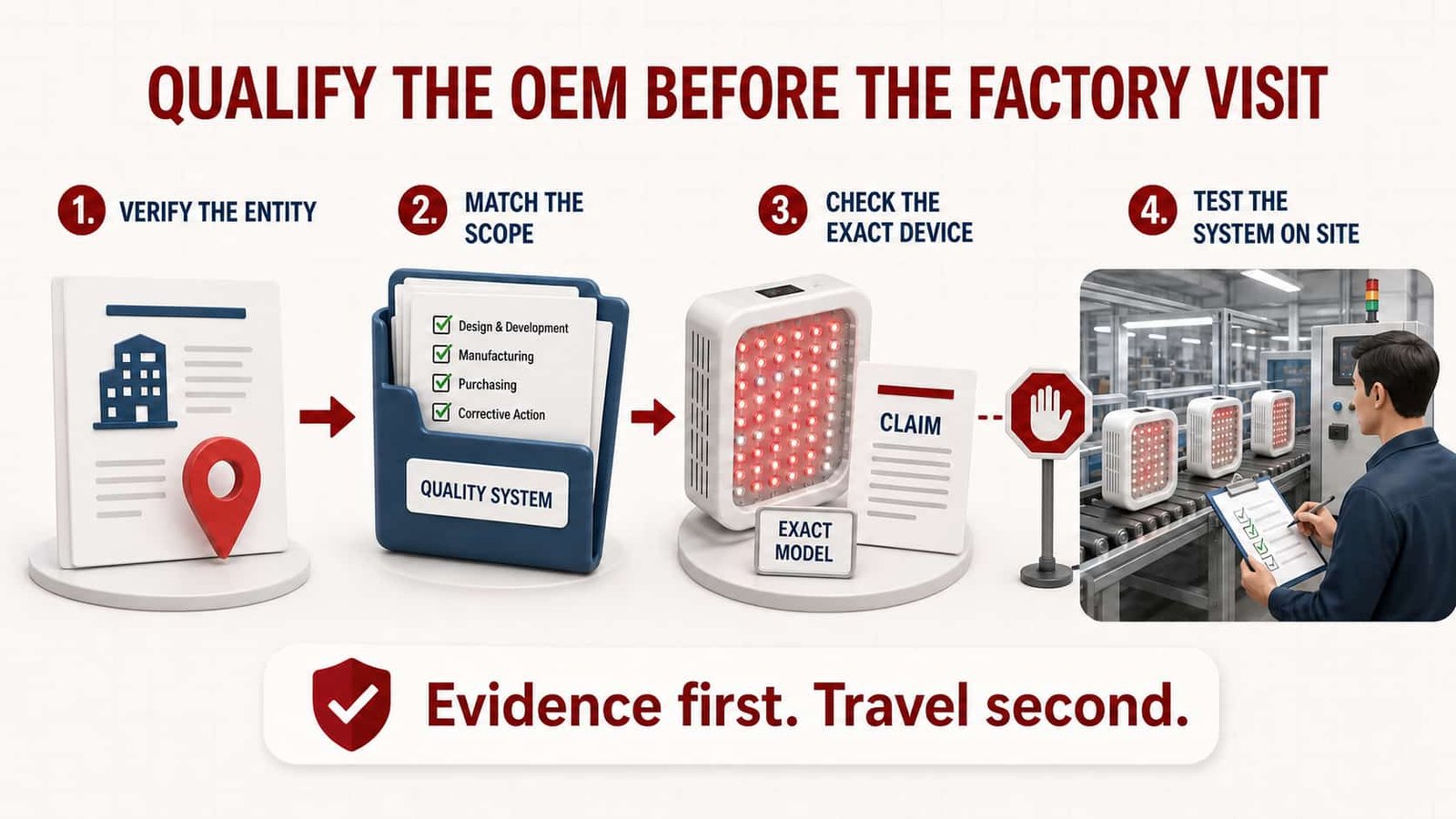
No califique a un OEM de terapia de luz roja contando los logotipos de los certificados. Verificar quién posee cada registro, qué sitio y alcance cubre, y si alguna autorización a nivel de producto realmente coincide con el dispositivo y afirma que planea vender.
ISO 13485, MDSAP y FDA 510(k) Los registros no prueban lo mismo.. ISO 13485 se refiere a un sistema de gestión de calidad. MDSAP se refiere a una auditoría regulatoria de ese sistema según los criterios y el alcance establecidos.. La FDA 510(k) está vinculado a la presentación de un dispositivo específico y al uso previsto aprobado. Un OEM confiable debería poder mostrar cómo se conectan estas capas sin pretender que una reemplace a otra..
B2B TL;DR
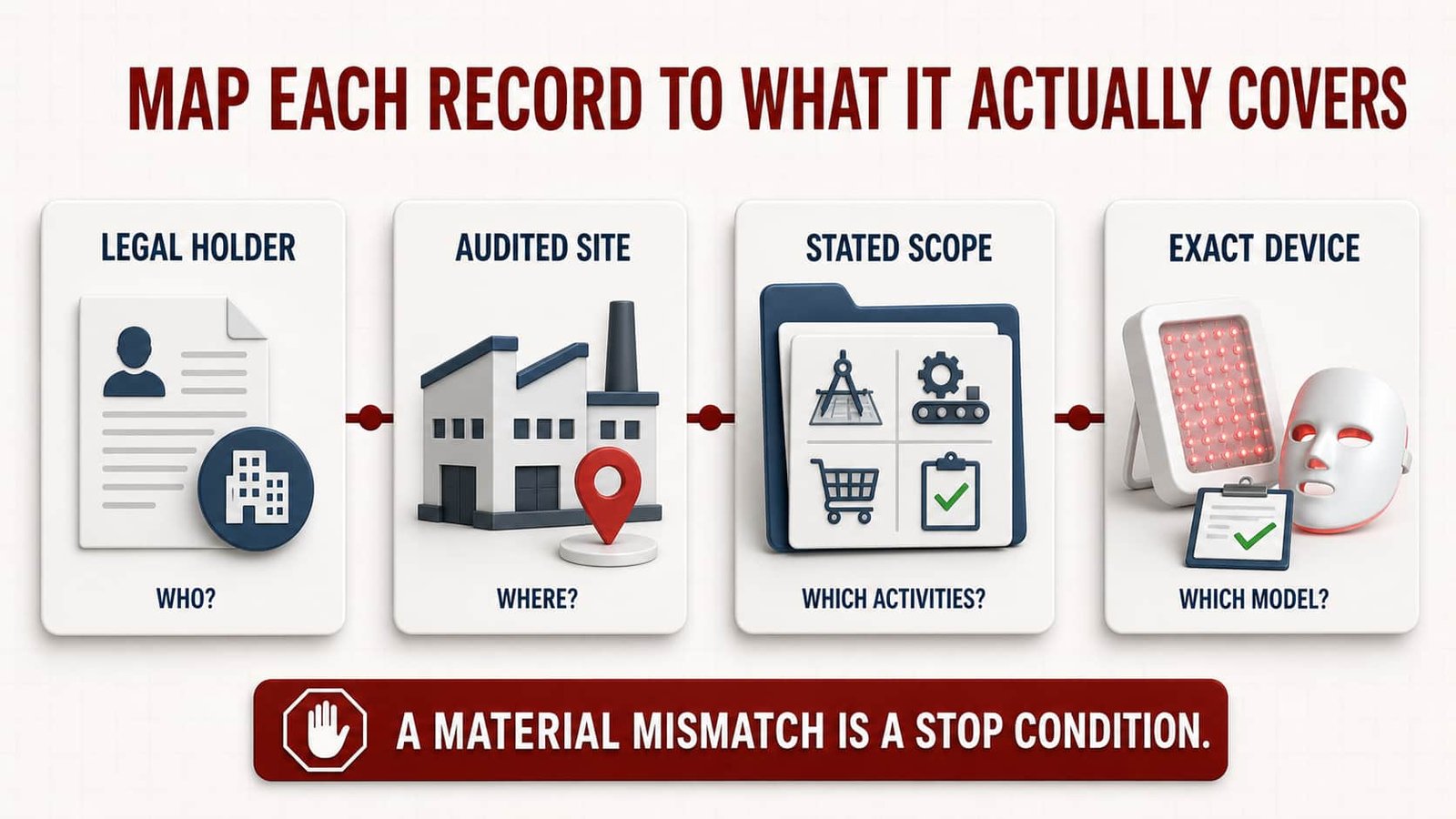
- Comience con un mapa de entidad a alcance, no es un recuento de insignias. Registrar cada certificado o autorización contra su titular legal o solicitante., sitio auditado, alcance declarado, producto objetivo y las relaciones documentadas entre las partes responsables.
- Verificar ISO 13485 y MDSAP a través del emisor o registro oficial del programa. Son evidencia del sistema de calidad., no aprobaciones generales de productos ni acceso automático al mercado.
- Verifique cada afirmación de la FDA mediante el número K. Verificar al solicitante, nombre del dispositivo, código de producto, Modelos nombrados e indicaciones antes de decidir si el registro es relevante para su proyecto..
- Si un proveedor depende de una empresa existente 510(k) como autorización para su producto propuesto, una discrepancia entre el dispositivo exacto o el uso previsto es una señal de parada. De lo contrario, Trate el registro solo como experiencia regulatoria previa y evalúe la nueva vía por separado..
- Complete la revisión mínima de identidad y alcance antes de comprometer una muestra significativa., costos de prueba o viaje. Luego utilice la visita a la fábrica para comprobar si los controles documentados son visibles en las compras., producción, pruebas, trazabilidad, manejo de no conformidades y control de cambios.
¿Por qué debería examinar la evidencia regulatoria antes que el precio??
El precio se vuelve significativo sólo después de que el proveedor haya pasado la prueba de evidencia mínima..
Una cotización baja no puede compensar un certificado caducado, una entidad legal diferente, un alcance que excluye su producto, o un registro de la FDA que pertenece a otra familia de dispositivos. Esas lagunas pueden surgir más adelante a medida que se realicen pruebas repetidas., reelaboración del embalaje, Entrada retrasada al mercado o un producto que no puede respaldar las afirmaciones que asumió su plan comercial..
Por tanto, el primer objetivo de la cualificación no es encontrar la fábrica “más certificada”. Es para eliminar proveedores cuyas pruebas no se pueden conectar con su proyecto exacto..
Usa esta secuencia:
- Verificar quién es el propietario de la evidencia.
- Verificar qué sitio y actividades fueron auditados.
- Verificar qué familia de dispositivos y reclamaciones cubre un registro a nivel de producto.
- Verificar si la fábrica puede reproducir la configuración requerida bajo producción controlada..
- Sólo entonces compara el precio., Moq, plazo de entrega y personalización.
¿Qué hace ISO? 13485, MDSAP y FDA 510(k) cada prueba?
La forma más rápida de evitar listas de credenciales engañosas es separar las tres capas de evidencia..
| Capa de evidencia | lo que puede mostrar | lo que no muestra | Cheque mínimo del comprador |
|---|---|---|---|
| ISO 13485 certificado | El sistema de gestión de calidad de una organización nombrada se evaluó según ISO 13485 para un sitio indicado, actividad y alcance | Aprobación del producto, autorización para un modelo en particular, o acceso automático a todos los mercados | Número de certificado, nombre legal, sitio fisico, estándar, alcance, editor, fecha de emisión/revisión, estado de caducidad y verificación |
| Certificado MDSAP | El sistema de gestión de la calidad de una determinada organización de dispositivos médicos fue auditado por una organización de auditoría reconocida o autorizada por el MDSAP según la norma ISO. 13485 y los criterios reglamentarios aplicables enumerados en el certificado | Una autorización de comercialización del producto., una inspección de la FDA, o prueba de que cada jurisdicción de MDSAP se aplica a cada dispositivo | Número de certificado, nombre legal, sitios auditados, ID de la instalación donde se muestra, Organización de auditoría, criterios, alcance del dispositivo/actividad, limitaciones y validez |
| FDA 510(k) registro | La FDA consideró que el dispositivo presentado era sustancialmente equivalente a las indicaciones del registro de autorización. | Aprobación de la FDA, un certificado de toda la fábrica, Liquidación para modelos no relacionados., o prueba de cumplimiento de cualquier otro requisito de la FDA | numero k, solicitante, nombre del dispositivo, código de producto, regulación, decisión, modelos nombrados, indicaciones y coincidencia controlada entre dispositivo y etiquetado |
La distinción se volvió aún más importante cuando el Reglamento del Sistema de Gestión de Calidad de la FDA entró en vigor en febrero. 2, 2026. El QMSR incorpora ISO 13485:2016 por referencia y agrega requisitos específicos de la FDA. El Preguntas frecuentes sobre QMSR de la FDA afirma que la FDA no requiere una certificación ISO 13485 certificado, que dicho certificado no exime a un fabricante de la inspección de la FDA, y que las inspecciones de la FDA no siguen los procedimientos de auditoría del MDSAP. Una ISO 13485 El certificado es evidencia relevante del SGC., pero no es una prueba automática del cumplimiento total de QMSR..
Similarmente, el Descripción general del MDSAP de la FDA describe el MDSAP como una auditoría regulatoria única que puede satisfacer los requisitos relevantes de las autoridades participantes. La palabra “relevante” importa: los criterios aplicables, dispositivos, Los sitios y las limitaciones aún deben leerse desde el certificado y el contexto del proyecto..
MDSAP no reemplaza la evaluación de conformidad MDR de la UE ni los requisitos de marcado CE. El descripción general oficial del programa MDSAP incluye a la Unión Europea como observador oficial, no como uno de los cinco miembros del Consejo de la Autoridad Reguladora.
La primera bandera roja: una insignia se utiliza para responder una pregunta diferente
Deténgase y pida aclaración si un proveedor utiliza:
- ISO 13485 para afirmar que un producto en particular está aprobado;
- MDSAP afirmará que un dispositivo se puede vender automáticamente en todas las jurisdicciones participantes;
- un registro de establecimiento de la FDA o una lista de dispositivos como si fuera 510(k) autorización;
- Un número K para cubrir todos los modelos fabricados en fábrica.;
- un espacio libre para la máscara facial para soportar un panel, cinturón, dispositivo para el cabello u otra categoría de producto.
Paso 1: ¿Puede verificar el fabricante legal?, Sitio y alcance?
Empezar con la identidad, no la obra de arte del certificado.
Para cada ISO 13485 o documento MDSAP, registro:
- el nombre legal completo del fabricante;
- la dirección física de fabricación;
- cada sitio o subsitio auditado mostrado;
- el número de certificado;
- el organismo de certificación emisor o la organización de auditoría MDSAP;
- los criterios estándar y reglamentarios establecidos;
- las actividades cubiertas, como el diseño, fabricación o distribución;
- las categorías de dispositivos en alcance;
- cualquier exclusión, limitaciones o condiciones específicas de la jurisdicción;
- el efectivo, fechas de revisión y caducidad;
- la ruta de verificación oficial.
Este no es un detalle administrativo.. La corriente Requisitos del documento de certificación MDSAP Requerir el nombre legal del fabricante., direcciones físicas auditadas, criterios de certificación, alcance del dispositivo/actividad, información de validez y un método de verificación. También requieren el alcance para identificar limitaciones cuando los criterios no son universalmente aplicables..
Una verificación práctica de entidad a alcance
Utilice una línea para cada registro:
| Registro | Titular legal | Sitio | Alcance de la actividad | Alcance del dispositivo | Estado | Coincidencia de proyecto |
|---|---|---|---|---|---|---|
| ISO 13485 | Verificado / irresoluto | Sí / condicional / No | ||||
| Mdsap | Verificado / irresoluto | Sí / condicional / No | ||||
| FDA 510(k) | Dirección del solicitante | Rol de presentación | Dispositivo/modelos nombrados | Verificado / irresoluto | Sí / condicional / No | |
| Informe de prueba del producto | Fabricante y solicitante | Identidad de muestra | Configuración probada | Modelo exacto/accesorios | Verificado / irresoluto | Sí / condicional / No |
No “promedie” una discrepancia de identidad. Las distintas entidades no se descalifican automáticamente, pero sus roles deben ser explícitos. Identificar el 510(k) propietario o desarrollador de especificaciones, fabricante legal, fabricante por contrato, titular del certificado y entidad de ventas cuando corresponda. Luego documente qué parte controla el diseño., producción, etiquetado, quejas, aprobación de cambios y responsabilidades posteriores a la comercialización.
Paso 2: ¿Coincide el registro de la FDA con el dispositivo exacto??
Busque usted mismo en la base de datos de la FDA. Una carta recortada, El logotipo de la FDA o un gráfico estilo certificado no es suficiente.
El FDA 510(k) descripción general explica que un 510(k) demuestra una equivalencia sustancial con un predicado comercializado legalmente y autoriza el dispositivo para su distribución comercial. También señala que la FDA no suele realizar una inspección previa a la autorización de las instalaciones.. A 510(k), por lo tanto, Es evidencia significativa del dispositivo, pero no es prueba de que toda la fábrica o cada producto haya sido inspeccionado y aprobado por la FDA..
Revisa estos campos:
- numero k: ¿Existe el registro de la base de datos??
- Solicitante o 510(k) dueño: ¿Tiene esta parte autoridad legal sobre el dispositivo enviado?? Si es diferente de la fábrica de producción., ¿Está documentada la relación especificación-desarrollador o contrato-fabricante??
- Nombre del dispositivo: ¿Es la misma categoría de producto que planeas comprar??
- Código de producto y regulación.: ¿Se alinean con el uso previsto propuesto??
- Decisión: ¿Muestra el expediente una determinación sustancialmente equivalente??
- Modelos nombrados: ¿Se incluye el modelo exacto donde los modelos de nombres de registros públicos??
- Indicaciones de uso: ¿Las reclamaciones planificadas se mantienen dentro del alcance autorizado??
- Control de configuración: hacer hardware, modos de luz, software, accesorios, el etiquetado y las instrucciones aún coinciden con el dispositivo controlado?
Bajo 21 CFR 807.97, una determinación de equivalencia sustancial no indica la aprobación oficial de la FDA. La redacción correcta es FDA 510(k)-despejado, no Aprobado por la FDA.
Cuando una discrepancia exacta del dispositivo es una condición de parada
Si un proveedor o comprador tiene la intención de confiar en un número K existente como autorización de comercialización para el producto propuesto, una falta de coincidencia en el formato del producto, uso previsto, El modelo con nombre o la configuración controlada es una condición de parada.. No proceder sobre la base de esa autorización hasta que se resuelva la brecha..
Si, por el contrario, el proyecto espera una nueva presentación o sigue un camino diferente, registrar el desajuste como una brecha regulatoria en lugar de una falla automática del proveedor. La autorización existente puede ser tratada como una señal de ejecución regulatoria previa a nivel de producto., pero el nuevo camino, responsabilidades, evidencia, el cronograma y el presupuesto aún requieren una evaluación por separado.
Esa distinción es especialmente importante para los paneles de terapia de luz roja.. Es posible que una fábrica haya llevado una máscara LED a través de un 510(k) mientras sus paneles siguen un modelo diferente de EE.UU.. posicionamiento o requerir una evaluación regulatoria separada. No transfiera el número K de la máscara al panel.
Paso 3: ¿Qué debe solicitar antes de una visita a la fábrica??
Un proveedor creíble debería poder organizar un paquete de pruebas en torno al producto y mercado seleccionados, no enviar una carpeta de certificados no relacionados..
Solicite estos artículos antes de reservar el viaje:
| Pedido | que estas probando | Respuesta incompleta |
|---|---|---|
| ISO actual 13485 y documentos de certificación MDSAP | Titular, sitio, alcance, criterios, limitaciones y validez | Logo, imagen recortada o certificado sin ruta de verificación |
| Mapa de registros regulatorios públicos | Número K u otra autorización vinculada al solicitante, dispositivo, modelos y afirmaciones | “Certificado por la FDA” sin número ni explicación exacta del dispositivo |
| Hoja de producto y configuración | Modelo exacto, longitudes de onda/modos, método de salida, accesorios, software y uso previsto | Catálogo genérico que no puede identificar la configuración propuesta. |
| Índice de prueba específico del producto | Qué informes se aplican a qué modelo, configuración y mercado | Informes de prueba de un modelo diferente., adaptador, material o configuración |
| Lista de cambios/personalización propuesta | Ya sea marca, hardware, firmware, accesorios, Las instrucciones o reclamos cambiarán. | “Toda la personalización está cubierta” sin evaluación documentada |
| Matriz de responsabilidad | ¿Quién controla el diseño?, fabricar, etiquetado, quejas, vigilancia y decisiones regulatorias | Sin propietario designado para tareas posteriores a la comercialización o de control de cambios |
| Lista de brechas abiertas | ¿Qué evidencia está completa?, condicional, no disponible o aún bajo revisión | Una afirmación de que todos los documentos están "disponibles" sin nombres de archivo ni estado |
La mejor respuesta no es necesariamente la carpeta más gruesa. Es el que muestra la relación exacta entre el modelo seleccionado., configuración controlada, Mercado objetivo y evidencia disponible..
La disponibilidad y el alcance de los documentos importan más que la velocidad de respuesta. Los registros confidenciales pueden ser redactados, Revisado bajo una NDA o reservado para revisión in situ.. La negativa de un proveedor a proporcionar siquiera un índice de documentos, Identificar al propietario responsable o explicar la ruta de revisión es una señal de advertencia más fuerte que un proceso de control de acceso razonable..
Solicitud de auditoría previa copiable
Proporcione un mapa de evidencia a nivel de modelo para el dispositivo propuesto.. Para cada ISO 13485, Mdsap, FDA 510(k), seguridad, EMC, fotobiológico, salida óptica u otro registro de prueba, identificar al titular legal o solicitante, organismo emisor o laboratorio, número de documento, modelo/configuración exacta, mercado aplicable, alcance, validez actual y cualquier brecha creada por nuestra personalización solicitada o reclamos planificados.
Paso 4: ¿El sistema de calidad llega a la línea de producción??
Los pasos 1 a 3 determinan si el proveedor se ha ganado una visita a la fábrica. Paso 4 es la lista de verificación de la etapa de visita: prueba si el sistema documentado es visible en los registros y decisiones de producción.
La corriente Enfoque de auditoría MDSAP sigue procesos primarios para la gestión, medición/análisis/mejora, diseño y desarrollo, y controles de producción/servicio, con compras vinculadas a través de esos procesos. Utilice la misma lógica durante la calificación de proveedores.: seguir un producto desde los requisitos hasta los componentes comprados, producción, verificación, liberación y acción correctiva.
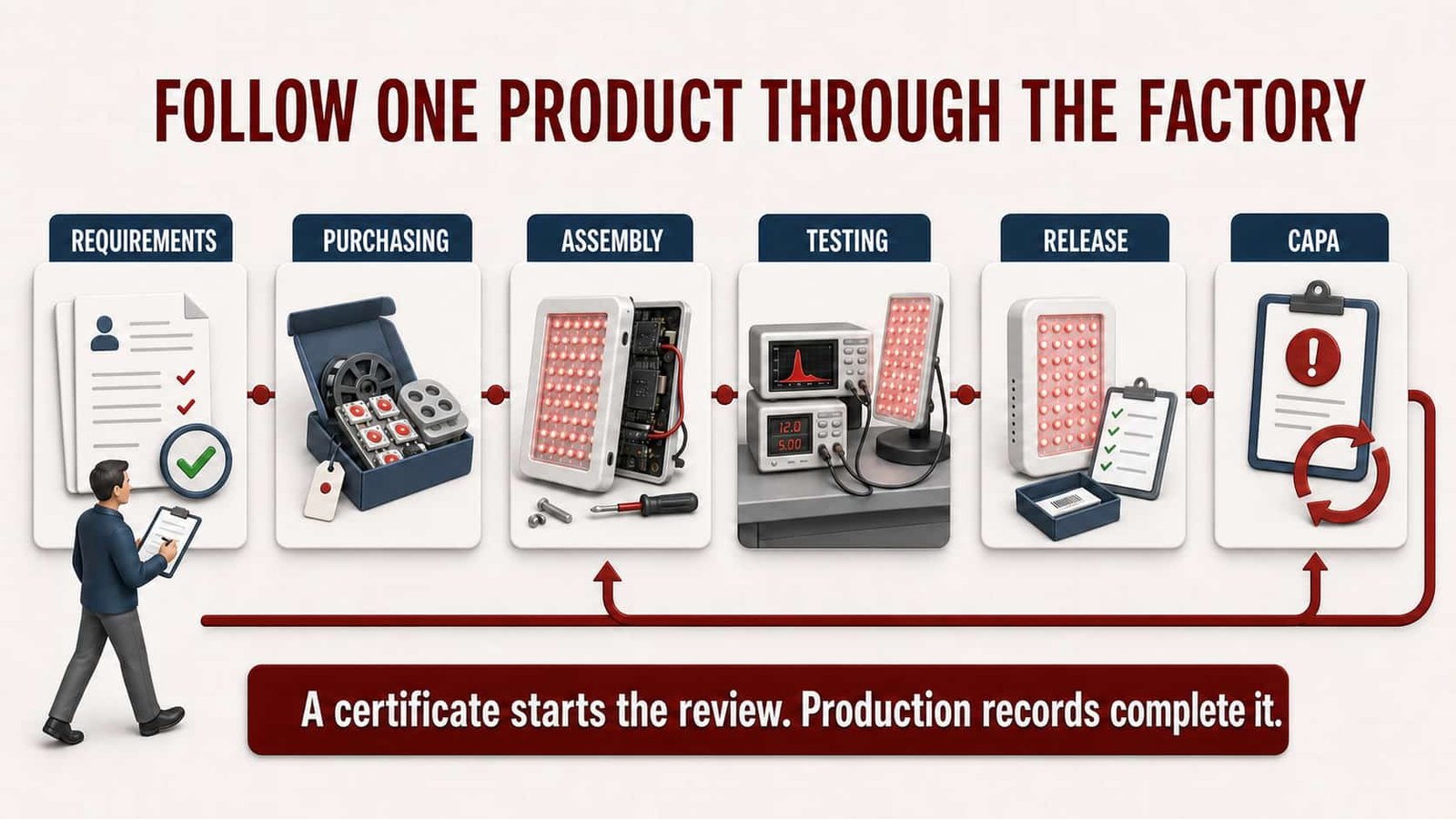
Para un dispositivo de terapia de luz roja, examinar:
1. Control de entrada de materiales y proveedores.
- ¿Son LED críticos?, componentes ópticos, fuentes de alimentación, baterias, PCB y materiales en contacto con la piel vinculados a especificaciones aprobadas?
- ¿Cómo se seleccionan los proveedores críticos?, monitoreado y reevaluado?
- ¿Qué registros de aceptación muestran que los componentes entrantes cumplieron con los requisitos definidos??
- ¿Qué sucede cuando un proveedor o componente cambia??
2. Control de producción y procesos.
- ¿La instrucción de trabajo actual coincide con el modelo exacto y la revisión en la línea??
- son herramientas, accesorios, Versiones de software y parámetros de proceso controlados.?
- ¿Están los operadores capacitados para la operación actual??
- ¿Están autorizadas y rastreables las decisiones de reelaboración y concesión??
3. Medición y verificación óptica.
- ¿Qué instrumentos miden la longitud de onda?, irradiancia, Salida eléctrica y otras características de liberación.?
- ¿Están visibles la identificación del instrumento y el estado de calibración??
- ¿La distancia de prueba?, geometría, modo, condición de calentamiento, plan de muestreo y criterios de aprobación/rechazo definidos?
- ¿Puede el proveedor conectar la especificación de marketing con el método de prueba real y el registro de producción??
4. Envejecimiento, inspección final y liberación
- Si se reclama envejecimiento o quemado, ¿Qué hace la prueba de paso?, durante cuánto tiempo y según qué criterios de aceptación?
- ¿Las “pruebas al 100%” están respaldadas por un registro de unidad o lote?, o sólo indicado en una presentación de ventas?
- ¿Quién autoriza la liberación final?, y que pasa cuando falla una unidad?
5. Trazabilidad, no conformidad y CAPA
- ¿Se puede rastrear una unidad o lote terminado hasta lotes de materiales críticos?, revisión de producción, registros de prueba y envío?
- ¿Las unidades no conformes están segregadas y dispuestas con autoridad documentada??
- ¿Puede el equipo mostrar una acción correctiva cerrada desde la definición del problema hasta la causa raíz?, control de implementación y eficacia?
- ¿Una acción correctiva o un cambio de diseño fluye hacia la lista de materiales?, presupuesto, instrucciones de trabajo, validación y evaluación regulatoria?
No preguntar sólo si la fábrica “tiene CAPA” o “tiene trazabilidad”. Seleccione un registro real y sígalo en todos los departamentos. Un sistema utilizable deja evidencia conectada.
Que bien se ve en el suelo
- Los operadores pueden explicar el paso de inspección o montaje que están realizando y señalar la instrucción actual..
- Los registros completos contienen datos específicos del producto en lugar de plantillas en blanco o valores de marcador de posición repetidos..
- Las etiquetas de calibración del equipo concuerdan con la identificación del instrumento y los registros de calibración..
- El personal de calidad puede explicar la no conformidad., Decisiones de lanzamiento y cambio sin enviar todas las preguntas técnicas a ventas..
Un ejemplo transparente: Lo que cubren los registros públicos de Wakelife
Divulgación comercial: Wakelife Acerca de la página identifica a Wakelife como la división de belleza profesional de Shenzhen Sungrow LED Technology Co., Limitado. Esa relación es una divulgación de la empresa.. Los registros de BSI y FDA a continuación verifican de forma independiente los certificados y el envío del dispositivo de la entidad legal nombrada, no la relación de marca en sí.. Usamos nuestros propios registros aquí para mostrar cómo funciona el método de calificación cuando los documentos fuente y sus limitaciones son públicos..
Capa del sistema de calidad
El Perfil del directorio de clientes de BSI para Shenzhen Sungrow LED Technology Co., Limitado. muestra:
- ISO 13485 / EN ISO 13485 certificado Maryland 800872;
- Certificado MDSAP Mdsap 800873;
- la misma dirección de fabricación de Shenzhen;
- un alcance que cubre el diseño, Fabricación y distribución de luces de terapia LED para tratamiento de la piel y alivio del dolor., y máscaras de terapia de luz LED para arrugas y acné leve a moderado;
- expira en mayo 13, 2027.
Esta es una evidencia verificable del SGC para el titular designado., sitio y alcance declarado. No es una declaración de que cada producto en ese alcance tenga una autorización de comercialización..
Capa de autorización del dispositivo
La FDA Registro de base de datos K250830 identifica al solicitante como Shenzhen Sungrow LED Technology Co., Limitado. en el mismo sitio de Shenzhen. Identifica el dispositivo como “Máscara de terapia de luz LED," nombres 13 designaciones de modelos y registros de una decisión sustancialmente equivalente de fecha de junio 9, 2025.
El Carta de autorización K250830 e indicaciones de uso enumere la familia de mascarillas nombrada y las indicaciones a nivel familiar para las arrugas de toda la cara o el acné inflamatorio de leve a moderado, dependiendo del modo de luz indicado.
Por lo tanto, los registros públicos respaldan esta conclusión precisa sobre la entidad jurídica nombrada.:
Tecnología Co. del LED de Shenzhen Sungrow., Limitado. tiene ISO verificable 13485 y certificados de sistema de calidad MDSAP para un alcance que incluye luces de terapia LED y máscaras LED, además de una FDA específica del dispositivo 510(k) registro de autorización para el 13 Modelos de máscara LED nombrados bajo K250830.
lo hacen no apoyar esta afirmación más amplia:
Todos los productos Wakelife, incluidos los paneles de terapia con luz roja, cuentan con la aprobación de la FDA.
Los paneles de luz roja de Wakelife no están cubiertos por K250830. Para un proyecto de panel, mapeamos el mercado objetivo, uso previsto, reclamaciones planificadas y configuración exacta por separado. Esa limitación no es una debilidad en la evidencia.. Declararlo claramente es la forma en que un comprador puede confiar en las piezas que sí se aplican..
Utilice este cuadro de mando de calificación OEM de 12 puntos
Utilice una decisión en dos etapas: Primero aplique las condiciones de parada., luego registre cada criterio restante como Aprobar, Bandera, Fallar o N / A. Esto evita ocultar un desajuste fatal dentro de un total numérico..
Condiciones de parada
No adelantar al proveedor hasta que resuelva cualquiera de estos:
- el certificado o registro reglamentario no se puede verificar de forma independiente;
- el titular legal, La relación entre el solicitante o el sitio de fabricación no se explica.;
- el alcance del certificado excluye la actividad requerida o la categoría de dispositivo;
- Se confía en un número K existente como autorización para el producto propuesto., pero su dispositivo, uso previsto, El modelo con nombre o la configuración controlada no coinciden.;
- El proveedor no identificará qué informes se aplican a la configuración exacta.;
- una personalización solicitada no tiene ningún cambio documentado o evaluación regulatoria.
Registro de comparación
Copie o adapte la plantilla en blanco a continuación. Para cada artículo, registrar la evidencia revisada y nombrar la acción no resuelta. Usar N / A solo con una razón documentada.
| Elemento de calificación | Estado | Evidencia revisada | acción abierta |
|---|---|---|---|
| Fabricante legal, relación entre responsable y sitio | Aprobar / Bandera / Fallar / N / A | ||
| ISO 13485 validez y alcance | Aprobar / Bandera / Fallar / N / A | ||
| Validez del MDSAP, criterios y alcance | Aprobar / Bandera / Fallar / N / A | ||
| Coincidencia exacta del registro regulatorio del dispositivo, cuando hace falta | Aprobar / Bandera / Fallar / N / A | ||
| Uso previsto y ajuste de afirmaciones | Aprobar / Bandera / Fallar / N / A | ||
| Ruta y responsabilidades del mercado objetivo | Aprobar / Bandera / Fallar / N / A | ||
| Coincidencia de configuración e identidad del informe de prueba | Aprobar / Bandera / Fallar / N / A | ||
| Controles de proveedores y materiales entrantes. | Aprobar / Bandera / Fallar / N / A | ||
| Control óptico de verificación y calibración. | Aprobar / Bandera / Fallar / N / A | ||
| Trazabilidad de lotes o unidades | Aprobar / Bandera / Fallar / N / A | ||
| control de cambios, no conformidad y CAPA | Aprobar / Bandera / Fallar / N / A | ||
| Calidad del documento y transparencia de las brechas | Aprobar / Bandera / Fallar / N / A |
No convierta estos estados en una puntuación de pase universal. Cualquier Fallar atado a una condición de parada bloquea el avance hasta que se resuelva. A Bandera requiere un propietario designado y la siguiente acción; N / A requiere una justificación específica del proyecto. Si su equipo necesita una clasificación ponderada de proveedores, establecer los pesos para el dispositivo específico, mercado, reclamaciones y papel en la cadena de suministro en lugar de adoptar una fórmula universal.
¿Qué debe enviar para una revisión de evidencia a nivel de modelo??
Enviar cinco entradas:
- mercado o mercados objetivo;
- formato del producto y modelo preferido;
- declaraciones planificadas de cara al consumidor y uso previsto;
- volumen esperado y alcance de personalización;
- fecha de lanzamiento objetivo.
Wakelife devolverá un mapa de evidencia a nivel de modelo que muestra:
- qué registros públicos y archivos controlados son relevantes para la configuración propuesta;
- qué alcances o reclamaciones requieren aclaración;
- qué cambios necesitan una revisión técnica o regulatoria documentada;
- donde pruebas separadas, Es posible que se necesite trabajo de etiquetado o una vía regulatoria diferente..
Esta revisión no es una promesa de acceso automático al mercado.. Es una forma de exponer el límite de la evidencia antes de la cita., estampación, Los compromisos de empaquetado y lanzamiento hacen que los cambios sean costosos..
Incluya su mercado objetivo, formato del producto, reclamaciones planificadas, volumen esperado y fecha de lanzamiento.
No se requiere ningún compromiso de compra en esta etapa.; este es un paso de calificación, no es una orden de compra.
Si su proyecto actual es una línea de paneles, revisa Wakelife Opciones OEM del panel de terapia de luz roja antes de enviar el modelo y los requisitos de personalización. Para un mapa de certificación más amplio, utilizar el Guía de certificación de dispositivos de terapia LED, el ISO 13485 Comparación con MDSAP y el Registro de la FDA vs. 510(k) guía.
Nota regulatoria: Esta guía es un recurso de calificación de proveedores., no asesoramiento legal o regulatorio. Los requisitos varían según el mercado., clasificación del dispositivo, uso previsto, reclamos, Configuración y rol de cada parte.. Confirme la ruta aplicable con profesionales regulatorios calificados antes de la comercialización..
Referencias
- Organización Internacional de Normalización. ISO 13485:2016—Dispositivos médicos—Sistemas de gestión de calidad. Consultado en julio. 27, 2026.
- A NOSOTROS. Administración de Alimentos y Medicamentos. Reglamento del Sistema de Gestión de la Calidad. A partir de febrero 2, 2026.
- A NOSOTROS. Administración de Alimentos y Medicamentos. Reglamento del sistema de gestión de calidad: preguntas frecuentes. Consultado en julio. 27, 2026.
- A NOSOTROS. Administración de Alimentos y Medicamentos. Programa de auditoría única de dispositivos médicos. Actualizado en diciembre 18, 2025.
- Programa de auditoría única de dispositivos médicos. Requisitos del documento de certificación MDSAP, MDSAP ES P0026.006. Versión de agosto 12, 2025.
- Programa de auditoría única de dispositivos médicos. Enfoque de auditoría, MDSAP AU P0002.010. Revisión de febrero 6, 2026.
- BSI. Perfil del directorio de clientes: Tecnología Co. del LED de Shenzhen Sungrow., Limitado. Consultado en julio. 27, 2026.
- A NOSOTROS. Administración de Alimentos y Medicamentos. 510(k) Notificación previa a la comercialización K250830. Página de base de datos actualizada por última vez en julio 20, 2026.
- A NOSOTROS. Administración de Alimentos y Medicamentos. K250830 Carta de autorización e indicaciones de uso. Decisión de junio 9, 2025.
- A NOSOTROS. Administración de Alimentos y Medicamentos. Notificación previa a la comercialización 510(k). Consultado en julio. 27, 2026.
- Código Electrónico de Regulaciones Federales. 21 CFR 807.97—Error de marca por referencia a notificación previa a la comercialización. Consultado en julio. 27, 2026.
- Wakelife. Acerca de Wakelife. Divulgación de la empresa que identifica a Wakelife como la división de belleza profesional de Shenzhen Sungrow LED Technology Co., Limitado. Consultado en julio. 27, 2026.
- Programa de auditoría única de dispositivos médicos. ¿Qué es MDSAP?? Consultado en julio. 27, 2026.