respuesta corta: Una lista de especificaciones 415, 590, 633 y 850 nm identifica cuatro canales de longitud de onda nominal en el diseño del producto declarado. no lo hace, por sí mismo, probar el espectro medido del dispositivo terminado, la contribución óptica de cada canal, una dosis igual, un efecto sinérgico, seguridad fotobiológica, autorización reglamentaria o coherencia de la producción.
Esa distinción importa cuando una marca, El importador o distribuidor está comparando dispositivos LED de múltiples longitudes de onda.. Una lista de longitudes de onda es útil, pero sólo en el primer nivel de una cadena de evidencia..
Antes de aprobar una especificación o solicitar una muestra, haz tres preguntas:
- que se declara? La arquitectura LED, proporción de canales, modos de funcionamiento y controles de usuario.
- Lo que se ha medido en el dispositivo terminado? El espectro y la irradiancia para cada modo y configuración relevante., bajo condiciones establecidas.
- ¿Qué evidencia separada respalda la seguridad y las afirmaciones previstas?? Evaluación de seguridad óptica, Documentación específica del mercado y evidencia relevante para las reclamaciones para la ruta exacta del producto..
Esta guía muestra cómo mantener esas tres preguntas separadas.. Está escrito para productos B2B., abastecimiento, equipos de calidad y cumplimiento, no como una guía de tratamiento o una recomendación de una dosis terapéutica.

¿Qué puede probar realmente una especificación de cuatro longitudes de onda??
Puede definir la configuración declarada del proveedor.. Cada conclusión más sólida necesita otra capa de evidencia.
Utilice esta tabla como verificación de especificaciones de primer paso:
| Campo de especificación | Lo que puede establecer | Lo que no establece por sí solo |
|---|---|---|
| 415, 590, 633 y 850 Nuevo Méjico | En el diseño se prevén cuatro canales de longitud de onda nominal. | Longitudes de onda máximas reales, tolerancias, ancho espectral, emisión secundaria o salida a nivel del dispositivo terminado |
| Paquete de LED de cuatro canales o diseño de chip | La arquitectura fuente planificada., si está respaldado por una lista de materiales controlada | Salida óptica igual de los cuatro canales. |
| 1:1:1:1 relación | Una relación declarada solo después de que se define la base de la relación. | Igual potencia radiante, irradiancia, Aporte de energía o dosis a nivel de piel. |
| Modo 1, Modo 2, Modo 3 y modo 4 | La lógica del controlador prevista y las combinaciones de canales. | Que cada canal nombrado esté operando según las especificaciones o contribuyendo igualmente en cada modo |
| 50%, 75% y 100% brillo | Tres configuraciones de interfaz de usuario | Una relación lineal entre el porcentaje mostrado y la salida óptica |
| 5–Temporizador de 30 minutos | Controles de tiempo de sesión disponibles | Dosis administrada sin medida, irradiancia estable para el modo seleccionado y el plano de prueba |
| irradiancia en 0 centímetro | Un valor en la superficie emisora., si su modo, Se indican el entorno y el método. | Irradiancia en otro plano de trabajo., uniformidad espacial, contribución por banda o dosis clínica |
| IEC 62471 informe | Una evaluación de riesgos fotobiológicos para la muestra y las condiciones nombradas. | Eficacia clínica, autorización general de comercialización o coherencia de lotes futuros |
La regla práctica es simple.: tratar una especificación de catálogo como una declaración de diseño, no como sustituto de las mediciones del dispositivo terminado.
¿Qué hacer? 415, 590, 633 y 850 nm Media en la hoja de especificaciones?
Son identificadores de canal nominales, no una descripción medida de la emisión del dispositivo terminado..
Cada número es un identificador de longitud de onda nominal., expresado en nanómetros. Ayuda a los equipos de ingeniería y abastecimiento a distinguir los canales ópticos previstos y asignarlos a la lista de materiales de LED., Diseño del controlador y modos de funcionamiento..
El número no es una descripción completa de la luz que sale del dispositivo terminado..
Los LED reales emiten en una banda espectral en lugar de en una longitud de onda matemáticamente exacta. Por lo tanto, un registro útil del dispositivo terminado puede incluir la longitud de onda máxima medida., tolerancia permitida, distribución espectral y ancho total a la mitad del máximo (FWHM) para cada modo aplicable. A 2025 MÁS uno Un artículo sobre cuestiones metodológicas en la investigación de la terapia con LED visibles también advirtió que una longitud de onda central no describe la emisión espectral completa de un LED. (Grimes, 2025). Ese artículo examinó dispositivos de alcance visible; su análisis no cubrió una 850 Canal infrarrojo de nm, y se cita aquí solo para fines de medición e informes.; No hay evidencia de que este dispositivo de cuatro longitudes de onda sea efectivo o ineficaz..
También existe una importante trampa de visibilidad.. el citado Revisión del NIST sobre radiometría y fotometría trata la fotometría como una medición ponderada por el ojo dentro del rango visible y proporciona ese rango entre 360 y 830 nm.. Un 850 Por lo tanto, el canal nm no se puede evaluar comparando su brillo con el 415, 590 o 633 canales nm. El brillo visual no es una medida de potencia radiométrica, incluso para los canales visibles.
Para fines de abastecimiento, los cuatro numeros responden qué canales nominales se declaran. Un registro espectral de modo específico responde lo que realmente emitió el dispositivo ensamblado durante la prueba.
¿Por qué una longitud de onda nominal no es un espectro completo??
Dos LED vendidos con la misma etiqueta de longitud de onda nominal pueden diferir en el pico medido, ancho espectral y salida. El dispositivo terminado también puede agregar variables como la corriente del variador., capas ópticas, construcción del difusor, Condiciones térmicas y lógica de control de canales..
Por eso una revisión óptica completa separa al menos estos campos:
- longitud de onda nominal en la especificación del producto controlado;
- número de pieza LED exacto, proveedor y regla de agrupación cuando corresponda;
- Gráfico espectral medido para cada modo relevante del dispositivo terminado.;
- pico medido y tolerancia acordada;
- ancho de banda espectral o FWHM cuando es un requisito del proyecto;
- identidad de muestra, instrumento, fecha de prueba y condición de funcionamiento.
Descripción general de la espectrorradiometría del NIST define la irradiancia espectral en términos de potencia óptica por unidad de área por intervalo de longitud de onda y analiza la trazabilidad de la calibración según los estándares SI. El CIE S 025/E:2015 página estándar También muestra por qué las condiciones de medición normalizadas y los informes específicos de la configuración son importantes para mediciones LED reproducibles..
CIE S 025 cubre lámparas LED, Módulos y luminarias para medición fotométrica y colorimétrica.. No es una clínica., Norma de seguridad fotobiológica o autorización de comercialización para un dispositivo terapéutico., y esta guía no afirma que todos los dispositivos LED flexibles deban probarse para S 025. La lección relevante aquí es más limitada.: un resultado de medición necesita una configuración definida y condiciones reproducibles.
Para obtener una lista de verificación detallada para compradores que cubra el espectro, distancia de prueba, mapas de puntos, instrumentos, ejemplo de identidad y alcance del informe, él está en Wakelife's IEC 62471, guía de informes de irradiancia y longitud de onda. Este artículo se queda en el nivel de especificación-interpretación..
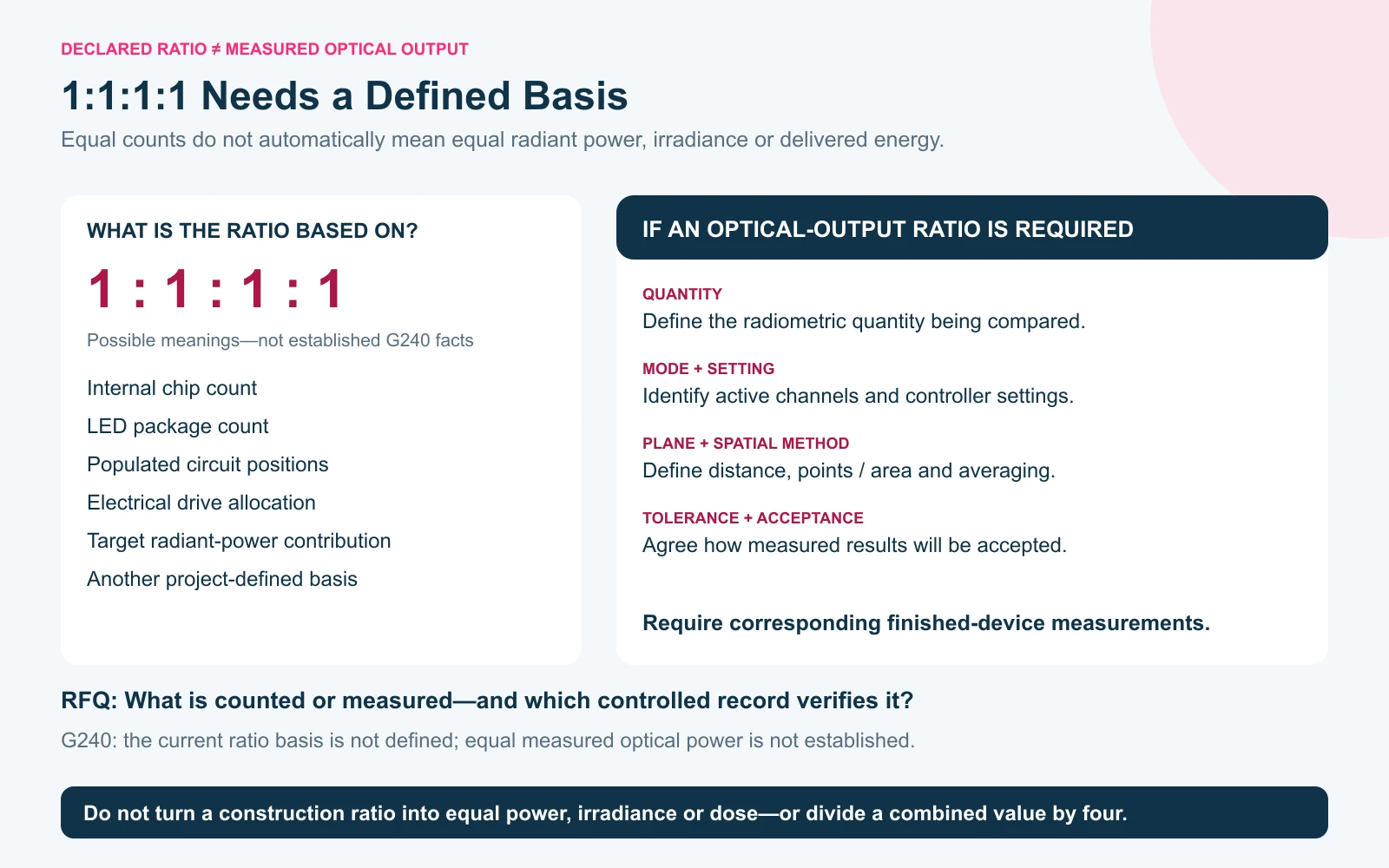
hace un 1:1:1:1 Relación de longitud de onda Salida óptica igual media?
No. No hasta que el proveedor defina el denominador y proporcione la medida correspondiente..
Una proporción de cuatro partes podría referirse a:
- recuento de chips interno;
- Recuento de paquetes de LED;
- posiciones del circuito poblado;
- asignación de accionamiento eléctrico;
- una contribución objetivo de potencia radiante;
- otra base específica del proyecto.
Esos significados no son intercambiables.. Un número igual de chips no produce automáticamente la misma potencia radiante porque las longitudes de onda, LED muere, Las condiciones de la unidad y las rutas ópticas pueden diferir.. La misma potencia a nivel de fuente aún no significaría automáticamente la misma irradiancia en un área de tratamiento flexible o la misma energía entregada durante cada modo de funcionamiento..
La pregunta correcta de RFQ no es “¿Es la relación 1:1:1:1?" Es:
¿Qué se cuenta o mide exactamente en el 1:1:1:1 relación, y qué documento controlado o prueba de dispositivo terminado lo verifica?
Si la respuesta es recuento de fichas, regístrelo como una relación de construcción. Si el proyecto requiere una relación de salida óptica, definir la cantidad de medición, modo, configuración, avión de prueba, método espacial, regla de tolerancia y aceptación por separado. No convierta silenciosamente una proporción de construcción en una afirmación de igual potencia o dosis igual.
¿Qué prueban los cuatro modos de funcionamiento??
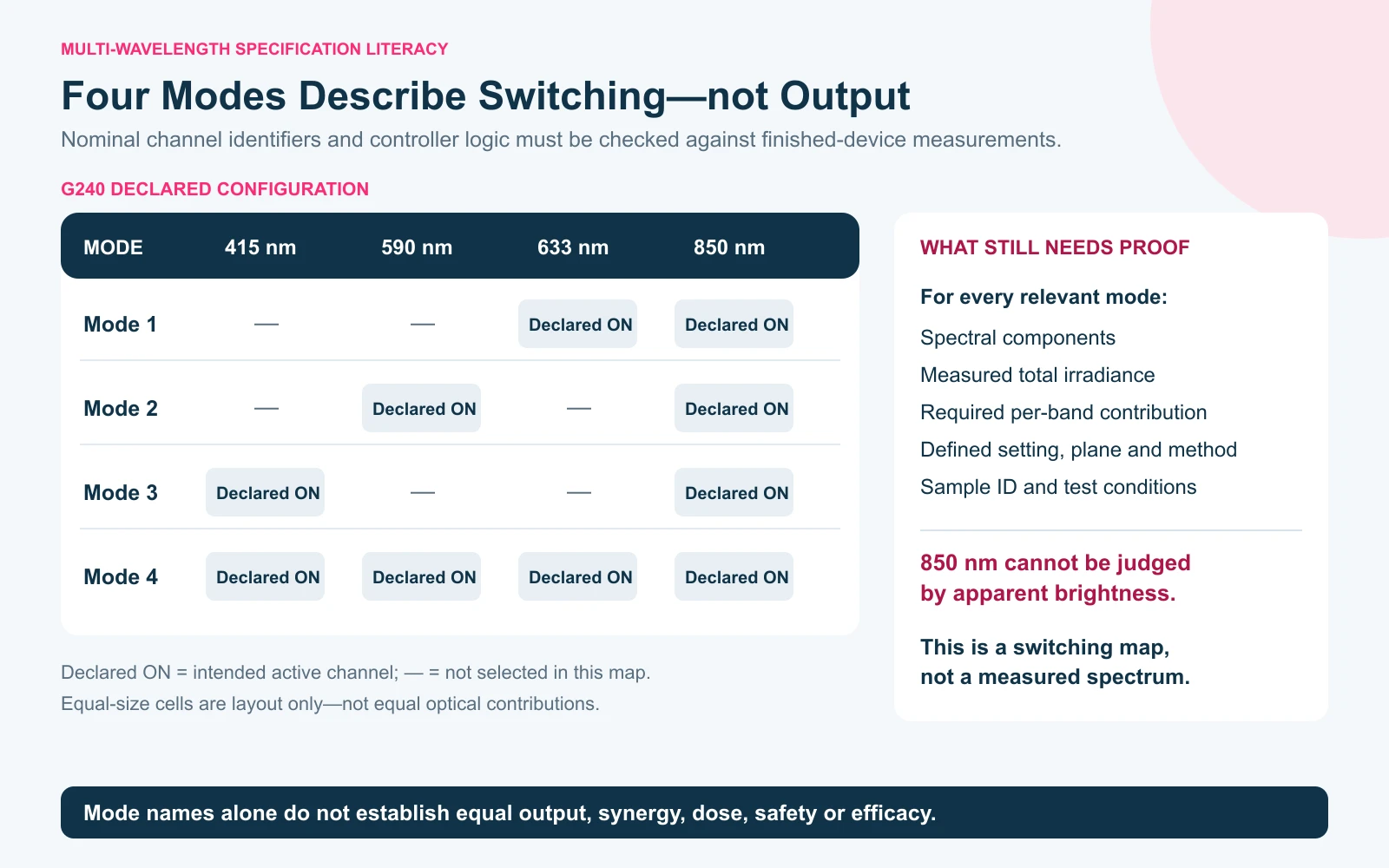
Demuestran el comportamiento previsto del controlador, no la salida medida en cada modo.
Una tabla de modos de funcionamiento documenta el comportamiento previsto del controlador.. No reemplaza la verificación óptica específica del modo..
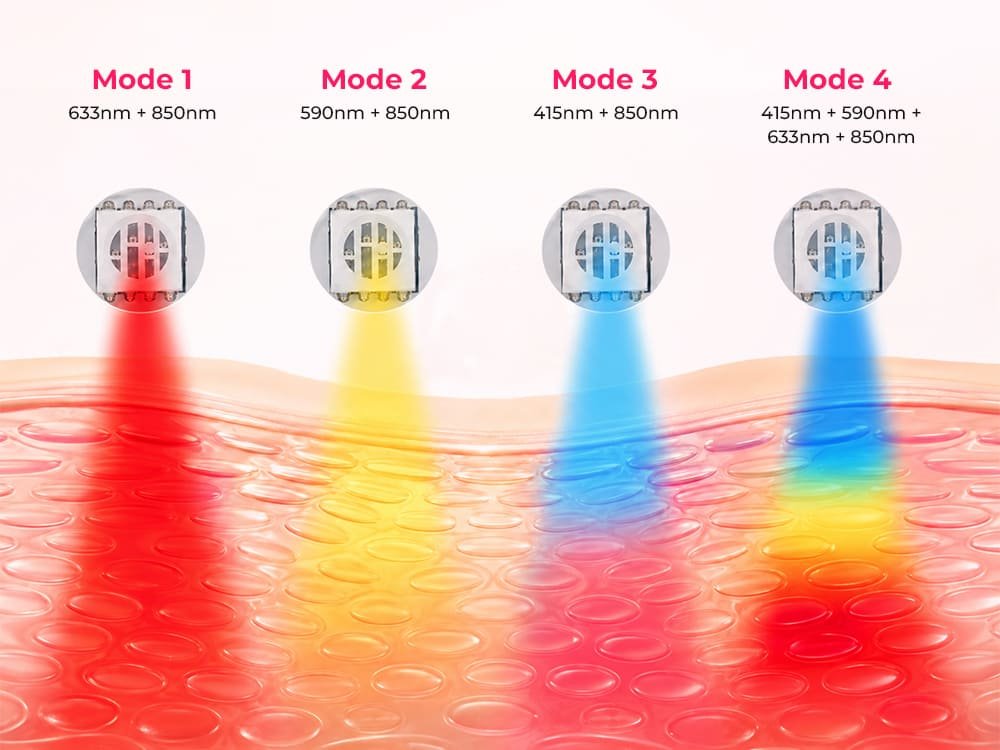
Considere esta arquitectura de modo declarado para una plataforma de cuatro longitudes de onda.:
| Modo | Canales activos declarados | Lo que aún necesita verificación |
|---|---|---|
| Modo 1 | 633 + 850 Nuevo Méjico | Ambos componentes espectrales, irradiancia total y cualquier contribución requerida por banda |
| Modo 2 | 590 + 850 Nuevo Méjico | Ambos componentes espectrales, irradiancia total y cualquier contribución requerida por banda |
| Modo 3 | 415 + 850 Nuevo Méjico | Ambos componentes espectrales, irradiancia total y cualquier contribución requerida por banda |
| Modo 4 | 415 + 590 + 633 + 850 Nuevo Méjico | Los cuatro componentes espectrales., irradiancia total y cualquier contribución requerida por banda |
Esta tabla demuestra lo que el controlador debe encender. No prueba que la producción medida cumpla con las especificaciones acordadas., que el 850 La contribución de nm es la misma en los modos 1 a 4., o que la combinación de canales produce un resultado sinérgico.
Para revisión de muestra, activar todos los modos y confirmar el flujo de trabajo del usuario. Para aprobación óptica, Haga coincidir cada modo requerido con un registro espectral del dispositivo terminado y un resultado de irradiancia.. Si un reclamo depende de un canal o combinación, identificar la evidencia de la reclamación por separado en lugar de inferirla del nombre del modo.
La misma precaución se aplica a una especificación sin pulso.. "Sin pulso" puede definir el modo de salida deseado, pero un comprador aún necesita el método de prueba acordado si el comportamiento temporal de la producción es un parámetro crítico.
¿Los ajustes de brillo y un temporizador definen la dosis administrada??
Definen controles de usuario, no se dosifican solos.
La exposición radiante se expresa comúnmente como energía por unidad de área.. Bajo un definido, condición estable, Relaciona la irradiancia con el tiempo de exposición.. Pero un cálculo significativo aún requiere la irradiancia correcta para la combinación de longitudes de onda seleccionada, ajuste de brillo, Plano de medición y método espacial..
Por ejemplo, un valor declarado por el proveedor de “al menos 40 en mW/cm² 0 cm” (la misma forma de declaración utilizada en el ejemplo G240 más adelante en esta guía) permanece incompleta si no indica también:
- el modo activo y la configuración de brillo;
- si el valor es un solo punto, máximo, mínimo o promedio de área;
- el mapa de puntos o área representada;
- El instrumento de medición y el estado de calibración.;
- tiempo de funcionamiento y condición térmica;
- identidad de muestra, unidades y tolerancia.
Sería incorrecto dividir un número de irradiancia combinado por cuatro y asignar un cuarto a cada longitud de onda.. También sería incorrecto utilizar un valor de superficie como valor a otra distancia o a través de una condición óptica/de contacto diferente sin medición..
El informe de enero de la FDA 2023 Proyecto de orientación para determinados dispositivos de fotobiomodulación. trata la longitud de onda, fluencia, tamaño del punto, modo de salida, potencia radiante o irradiancia, y parámetros pulsantes como características separadas del dispositivo. Esto es Borrador: no apto para implementación, proporciona recomendaciones no vinculantes, y se aplica únicamente a los dispositivos médicos PBM de clase II dentro de su alcance establecido. No rige automáticamente un producto de belleza o bienestar no médico.. Se cita aquí sólo como un ejemplo claro de por qué la longitud de onda por sí sola no es una descripción completa del dispositivo o de la dosis..
Hacer más longitudes de onda demuestra mejores resultados o sinergia?
No. El recuento de canales es una característica de diseño., no es una conclusión de eficacia.
Una arquitectura de múltiples longitudes de onda puede brindarle a un equipo de producto modos más seleccionables o respaldar un concepto de producto particular.. Esa flexibilidad comercial no establece que cuatro longitudes de onda sean mejores que una, que la operación simultánea es superior a la operación separada, o que la combinación crea un efecto biológico sinérgico.
Cada etiqueta de longitud de onda tiene su propio límite de evidencia.:
- A 415 La etiqueta nm por sí sola no prueba el tratamiento del acné..
- A 590 La etiqueta nm por sí sola no demuestra la reducción del enrojecimiento ni la reparación acelerada..
- A 633 La etiqueta nm por sí sola no demuestra un aumento del colágeno o una reducción de las arrugas..
- Un 850 nm la etiqueta por sí sola no prueba el tratamiento del dolor, inflamación o afecciones del tejido profundo.
Esas pueden ser direcciones de reclamos encontradas en el mercado., pero un reclamo público debe evaluarse contra el dispositivo exacto, uso previsto, población objetivo, parámetros de funcionamiento, evidencia y ruta de mercado aplicable. Las cuatro etiquetas de longitud de onda nominal no son esa evidencia..
Esta es también la razón por la que un producto comercializado bajo un nombre de categoría industrial que contenga "PDT" no hereda las afirmaciones de la terapia fotodinámica médica.. El uso previsto, presencia o ausencia de un fármaco fotosensibilizante, La ruta del dispositivo y la evidencia de respaldo deben evaluarse de forma independiente..
¿Qué evidencia debería respaldar un dispositivo LED de longitud de onda múltiple??
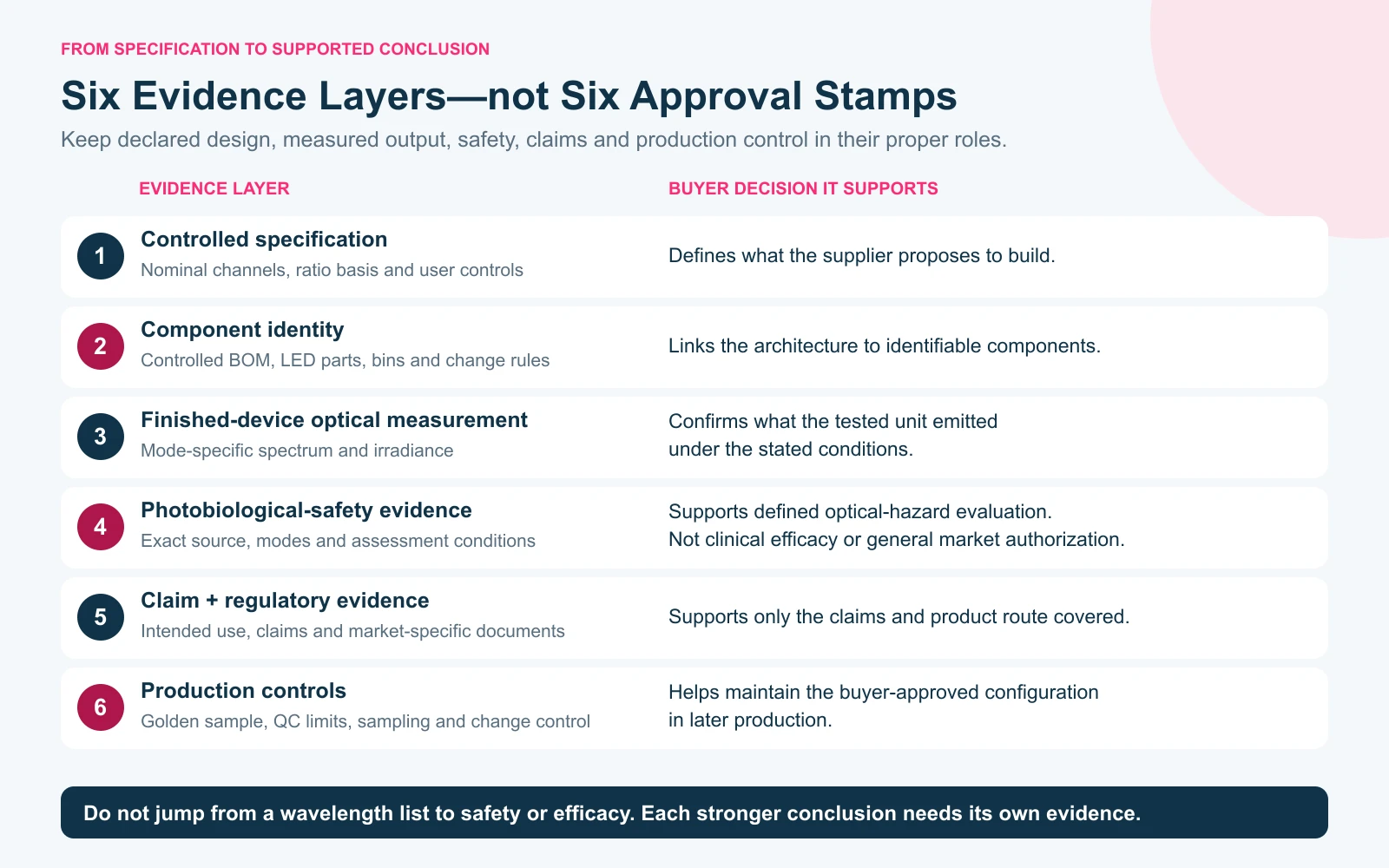
Utilice una escalera de evidencia de seis niveles. No saltes de nivel 1 a una conclusión de seguridad o eficacia.
| Nivel | Evidencia | Decisión del comprador que apoya |
|---|---|---|
| 1. Especificación controlada | Longitudes de onda nominales, definición de proporción, modos, brillo, temporizador y estado sin pulso/pulso | Confirma lo que el proveedor propone construir. |
| 2. Identidad del componente | Lista de materiales controlada, Números de pieza de LED, controles de proveedor/contenedor y reglas de cambio | Vincula la arquitectura propuesta a componentes identificables. |
| 3. Medición óptica del dispositivo terminado | Espectro e irradiancia específicos del modo en condiciones definidas. | Confirma lo que emitió la unidad ensamblada probada |
| 4. Evidencia de seguridad fotobiológica | Evaluación aplicable que cubre la fuente exacta, modos y condiciones | Respalda la evaluación de riesgo óptico definida, no la eficacia |
| 5. Reclamación y evidencia regulatoria | Uso previsto, documentación relevante para la reclamación y específica del mercado | Soporta únicamente los reclamos y la ruta realmente cubierta |
| 6. Controles de producción | muestra de oro, límites de aceptación, método de control de calidad calibrado, muestreo y control de cambios | Ayuda a mantener la configuración aprobada en producción posterior. |
IEC 62471 pertenece al nivel 4: aborda los peligros fotobiológicos de las lámparas y los sistemas de lámparas, incluyendo fuentes LED, bajo condiciones definidas. No es un certificado de eficacia clínica ni una autorización general de comercialización.. Para una distinción más amplia entre autorización de producto, certificados del sistema de calidad, informes de seguridad y registros ópticos, ver el Guía de certificación de dispositivos de terapia LED.
Ejemplo resuelto: Lo declarado para el G240 y lo que aún debe verificarse?
La especificación G240 controlada actual de Wakelife proporciona un ejemplo útil del límite entre el diseño declarado y el rendimiento medido..
| Campo | Especificaciones declaradas actuales | Límite de evidencia |
|---|---|---|
| Construcción de fuente | 240 pedazos de 5050 paquetes de LED; 960 chips internos | Declaración de construcción; salida óptica no por banda |
| Longitudes de onda | 415, 590, 633 y 850 Nuevo Méjico | Lista nominal de canales; no es un espectro medido |
| Relación | Nominal 1:1:1:1 | La especificación controlada actual no define el denominador o la base de la relación y no establece la potencia óptica medida igual. |
| Modos | 633+850; 590+850; 415+850; las cuatro longitudes de onda | Mapa de controlador declarado; cada modo todavía necesita la verificación óptica acordada |
| Brillo | 50%, 75% y 100% | Configuraciones de usuario; La linealidad óptica no ha sido establecida por las etiquetas. |
| Minutero | 5–30 minutos | Rango de control de sesión; no se dosifica solo |
| modo temporal | Sin pulso | Característica operativa declarada |
| Irradiancia | Especificado como ≥40 mW/cm² en la superficie de emisión, 0 centímetro | La declaración actual no proporciona el modo completo., red, instrumento, promedio/pico, Campos térmicos y de tolerancia necesarios para una comparación independiente o un cálculo de dosis por banda. |
| Ruta de reclamo prevista | Alcance de belleza y bienestar no médico | No autoriza un reclamo de tratamiento de enfermedad o resultado clínico numérico. |

Este ejemplo no debe leerse como un informe de rendimiento óptico verificado.. Gráficos espectrales específicos del modo, picos y tolerancias medidos, FWHM u otros registros de ancho espectral acordados, contribución por banda, comportamiento de ajuste de brillo, método de irradiancia espacial, detalles del instrumento, Las condiciones térmicas y la variación de unidad a unidad siguen siendo elementos de nivel de solicitud para un proyecto exacto..
Esa transparencia es el punto: un proveedor puede definir una plataforma antes de que se complete cada paquete de evidencia específico del proyecto, siempre y cuando el comprador y el proveedor no presenten los campos declarados como prueba más contundente de lo que son.
Qué cambia cuando un comprador OEM cambia la configuración de longitud de onda?
La personalización de la longitud de onda no es sólo una elección de color.. Dependiendo del diseño, puede afectar:
- la lista de materiales LED, números de pieza, controles de contenedores y proveedores aprobados;
- conductor actual, carga eléctrica y comportamiento térmico;
- firmware del controlador y mapeo de modos;
- distribución espectral e irradiancia por modo;
- Rendimiento del difusor o de la capa óptica.;
- alcance de la evaluación de seguridad fotobiológica;
- etiquetado, instrucciones, Advertencias y reclamos públicos.;
- documentación reglamentaria y aplicabilidad de pruebas;
- definición de muestra dorada, Límites de control de calidad y control de cambios de ingeniería.
Por lo tanto, la revisión del cambio debe comenzar antes de que se prometa la nueva relación de longitud de onda en un catálogo o especificación de compra.. Pregunte qué registros siguen siendo aplicables, que necesitan una actualización de ingeniería y que deben repetirse en la configuración finalizada.
¿Qué deberían incluir los compradores en la solicitud de cotización??
Para un dispositivo LED de cuatro longitudes de onda, solicitar una tarjeta de evidencia específica del modo en lugar de una colección suelta de afirmaciones de longitud de onda.
Incluir:
- Modelo exacto, mercado previsto, uso previsto y reclamaciones públicas propuestas.
- Longitudes de onda nominales y regla de tolerancia esperada para cada canal..
- Definición de la relación de longitud de onda.: lo que se cuenta o mide.
- Mapa de modo completo, incluyendo ajustes de brillo y comportamiento de pulso/sin pulso.
- Campos espectrales requeridos por modo: gráfico, pico medido, ancho espectral si es necesario, ID de muestra e instrumento.
- Campos de irradiancia requeridos por modo y configuración: plano/distancia, mapa de puntos, definición promedio/pico/mínimo, instrumento, condición térmica y tolerancia.
- Seguridad fotobiológica y alcance del documento de mercado para la configuración exacta.
- Cantidad de muestra, proceso de muestra dorada, límites de aceptación de producción y reglas de notificación de cambios.
Si el proyecto aún está en etapa de concepto, marcar campos no verificados como ser medido. No los rellenes con valores copiados de un modelo diferente., Hoja de datos de LED o lote anterior.
Wakelife puede comparar un requisito de cuatro longitudes de onda con el disponible plataforma flexible de terapia de luz LED PDT e identificar qué elementos son especificaciones estándar versus verificación específica del proyecto. Para preparar una solicitud de cotización, enviar el mercado objetivo, reclamaciones previstas, Requisitos de longitud de onda y modo., cantidad de muestra y los campos de evidencia óptica que su equipo necesita a través de la página de contacto.
Conclusión
La especificación “415, 590, 633 y 850 nm” demuestra un diseño declarado de cuatro canales, no un espectro completo, igual salida, dosis, seguridad, eficacia o autorización.
Para una decisión OEM, avanzar a través de la evidencia en orden: congelar la especificación controlada, identificar los componentes, medir el dispositivo terminado por modo, Revisar la seguridad y reclamar evidencia para la ruta prevista., luego bloquear los controles de producción. Si un campo no ha alcanzado su nivel de evidencia, etiquetarlo como no verificado en lugar de permitir que cuatro números que parecen precisos lleven una conclusión que no pueden respaldar.
Referencias
- 1
- 2
- 3
-
4
Comisión Electrotécnica Internacional. IEC 62471:2006 — Seguridad fotobiológica de lámparas y sistemas de lámparas
-
5
A NOSOTROS. Administración de Alimentos y Medicamentos. Dispositivos de fotobiomodulación: Notificación previa a la comercialización [510(k)] Envíos (Borrador de orientación)
- 6