Your brand has an existing beauty device or a defined product brief. A prospective manufacturing partner proposes an existing platform, an adaptation, or a development route—but parts of the proposal differ from what you intended.
Start by asking which user and product outcomes must survive the change. A different implementation may be acceptable. A missing capability may require a defined modification or rule out the proposal. An unclear description needs evidence before you can decide.
The proposed review approach below helps you make that decision before agreeing a configuration or commissioning representative samples. Accepting a difference at this stage means proceeding with stated conditions; it does not approve production.
Separate a different implementation from a different product requirement
For each material difference, write down what the requirement is meant to preserve. “Use the same controls” is less informative than “users must be able to select either function independently.” The first describes an implementation; the second identifies an operating capability you can check. Keep any explicitly fixed layout or interface requirements visible alongside that operating requirement.
Then distinguish three situations:
- The implementation changes, but the required outcome may remain. A different button arrangement may still let users run LED light with vibration off, or vibration with the LEDs off. Check the available controls against the operating requirement and any fixed interface requirements.
- The proposal changes or removes the required outcome. Define the modification needed, or explicitly reconsider the product objective.
- The description is insufficient. “LED light + vibration” alone does not establish whether users can select them separately or only run them together. Request a version-specific operating description or demonstration of the controls and available operating paths. Keep the point unresolved until you can establish a fit or a gap.
Use these distinctions to choose among four practical decisions:
| Решение | When to use it | What happens next |
|---|---|---|
| Accept the difference with conditions | The proposal preserves the required outcome, with identified checks still to complete | Record the accepted implementation and remaining verification |
| Request a bounded modification | A required outcome is missing, and the change needed can be described | Obtain a feasibility assessment for that change and define how it would be verified |
| Keep unresolved | Evidence does not establish whether the requirement is met | Request the specific description, demonstration, or other evidence that would resolve it |
| Rule out this proposal | A hard requirement cannot be met, or the necessary change will not be pursued | Record the reason and assess another proposal |
Ruling out the current proposal does not rule out the manufacturer. If you consider another platform from the same firm, evaluate it as a new proposal against the brief.
A shorter lead time or lower cost can help choose between viable alternatives. Neither silently removes a hard requirement. If the brand decides that requirement should change, approve the revised scope first and assess the proposal against it.
One proposal can lead to two justified decisions
Consider this entirely fictional example. It is not an anonymized customer case.
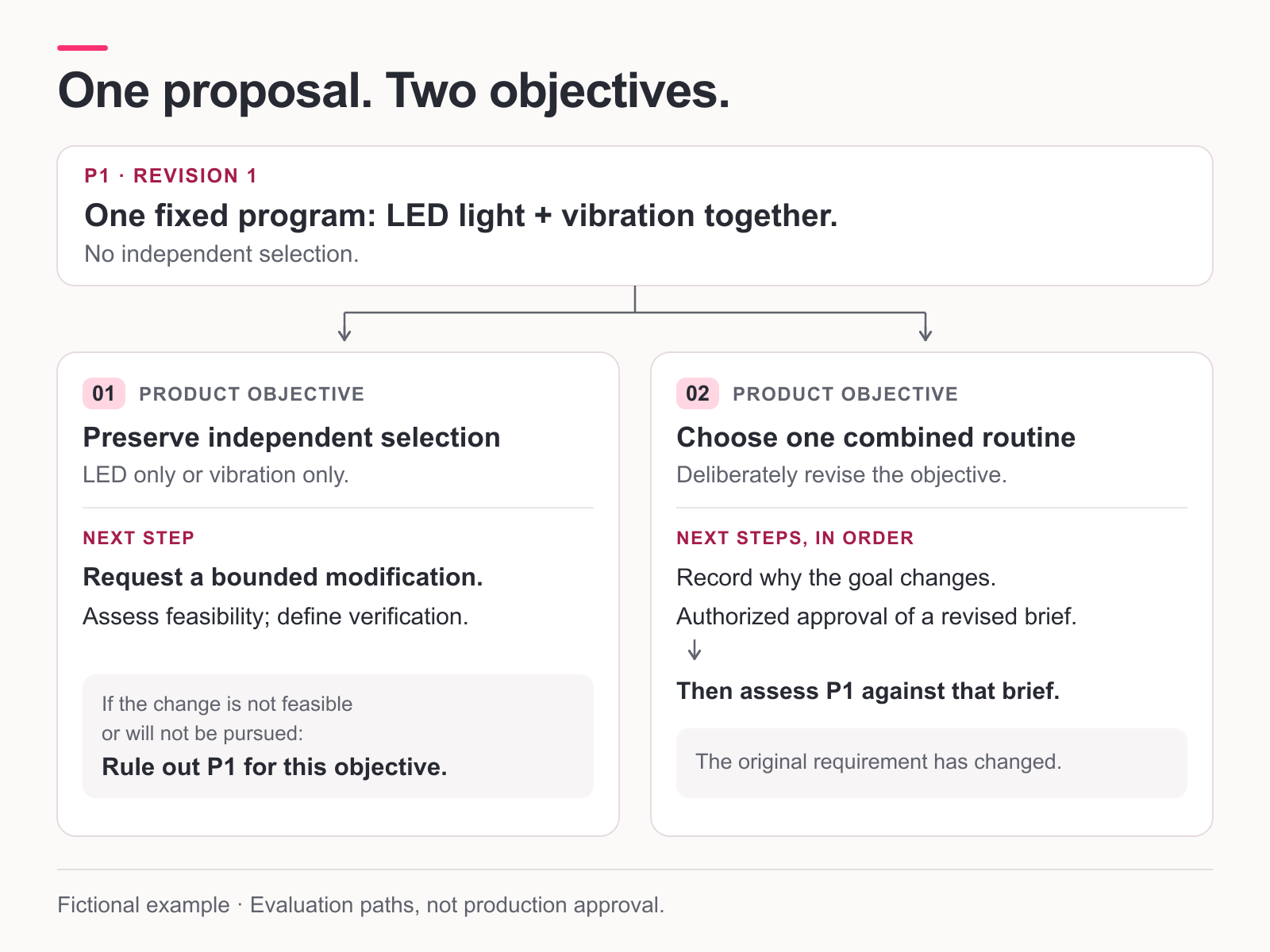
A handheld beauty device concept requires users to be able to run LED light with vibration off, or vibration with the LEDs off. The operating description for Proposal P1, пересмотр 1 confirms that LED light and vibration run only in a single fixed combined program. Users cannot select either function separately.
Objective 1: Preserve the existing choice of routines
The brand is evaluating a manufacturing route for a product whose intended experience includes choosing LED light without vibration or vibration without LED light. Keeping those separate user paths is part of the brief.
P1 removes both paths. Listing both functions does not satisfy the requirement, and rewriting the instructions cannot restore a capability the device lacks.
The next step is a feasibility assessment for a specific change: enable users to run LED light with vibration off and vibration with the LEDs off, with controls that clearly communicate the selection. Engineering must assess what that requires and define verification for the resulting configuration. The description alone does not establish feasibility or implementation effort.
If the required operation cannot be delivered, or the modification will not be pursued, rule out P1 for this objective.
Objective 2: Develop a product around one guided routine
The brand may instead decide that this version should offer one combined LED light and vibration routine without individual function selection. Independent operation is no longer the intended experience.
That can justify considering P1, but only as a deliberate change from the original concept. Record why the combined routine now fits the product objective and what the brand is giving up: LED-light-only and vibration-only operation. Platform availability, время, or cost may inform that choice, but the revised objective and its rationale must be explicit.
The revised brief needs approval from whoever is authorized to change the brand’s product scope. It should specify the combined routine, its operation, интерфейс, инструкции, customer-facing materials, and corresponding testing. P1 can then be assessed against that version of the brief. The original requirement has changed; it has not been met by P1.
The decision is to proceed with evaluating a different product concept. It does not establish safety, эффективность, or technical equivalence to the original device.
The same proposal therefore receives different decisions because the brand’s intended user outcome has changed.
Leave a decision record the team can use
Capture the decision against a named proposal and requirement version. For the first objective above, a useful internal record could look like this:
| Поле | Fictional example entry |
|---|---|
| Proposal reviewed | P1, пересмотр 1; operating description confirms one fixed combined LED light and vibration program |
| Requirement being preserved | Product brief, пересмотр 1: users can select LED light with vibration off or vibration with the LEDs off |
| Established difference | Neither independent operating path is available in P1 |
| Current decision | Request a bounded modification; feasibility remains unresolved |
| Defined change | Add selectable LED-light-only and vibration-only operation, with a clear indication of the selected function |
| Affected interface, инструкции, and copy | Requested configuration: controls must distinguish LED-light-only and vibration-only choices. Instructions and customer-facing product descriptions must describe those choices. |
| Next evidence and owner | Manufacturer engineering to assess feasibility, describe the proposed configuration and affected elements, and propose verification; brand product lead to review against the brief |
| Condition for proceeding | A documented feasible route to the required operation and an agreed verification plan; otherwise rule out the proposal for this brief |
| Sample boundary | Any current stock sample represents the existing configuration; it cannot demonstrate the unimplemented change |
Update the record when a revised proposal arrives so the team can see which differences have been resolved and which remain open. If the brand changes its objective, identify the approved new brief rather than treating the old requirement as satisfied.
Once a viable scope is defined, compare its расходы, Могил, and tooling implications. Before evaluating samples, agree which configuration each sample represents and what it can verify. A stock sample may help evaluate other identified aspects of a proposal while a modification is being assessed; it cannot prove the missing function has been implemented.
Bring a defined difference to the manufacturing discussion
Wakelife’s published OEM/ODM services include existing-platform customization and development support from product definition through optical and electronic engineering, прототипирование, проверка, и массовое производство. Bring the proposal version, the outcome you need to retain, and the difference you need resolved. The candidate platform, change feasibility, документация, and verification scope require project-specific confirmation; the fictional modification above is not a statement of availability.