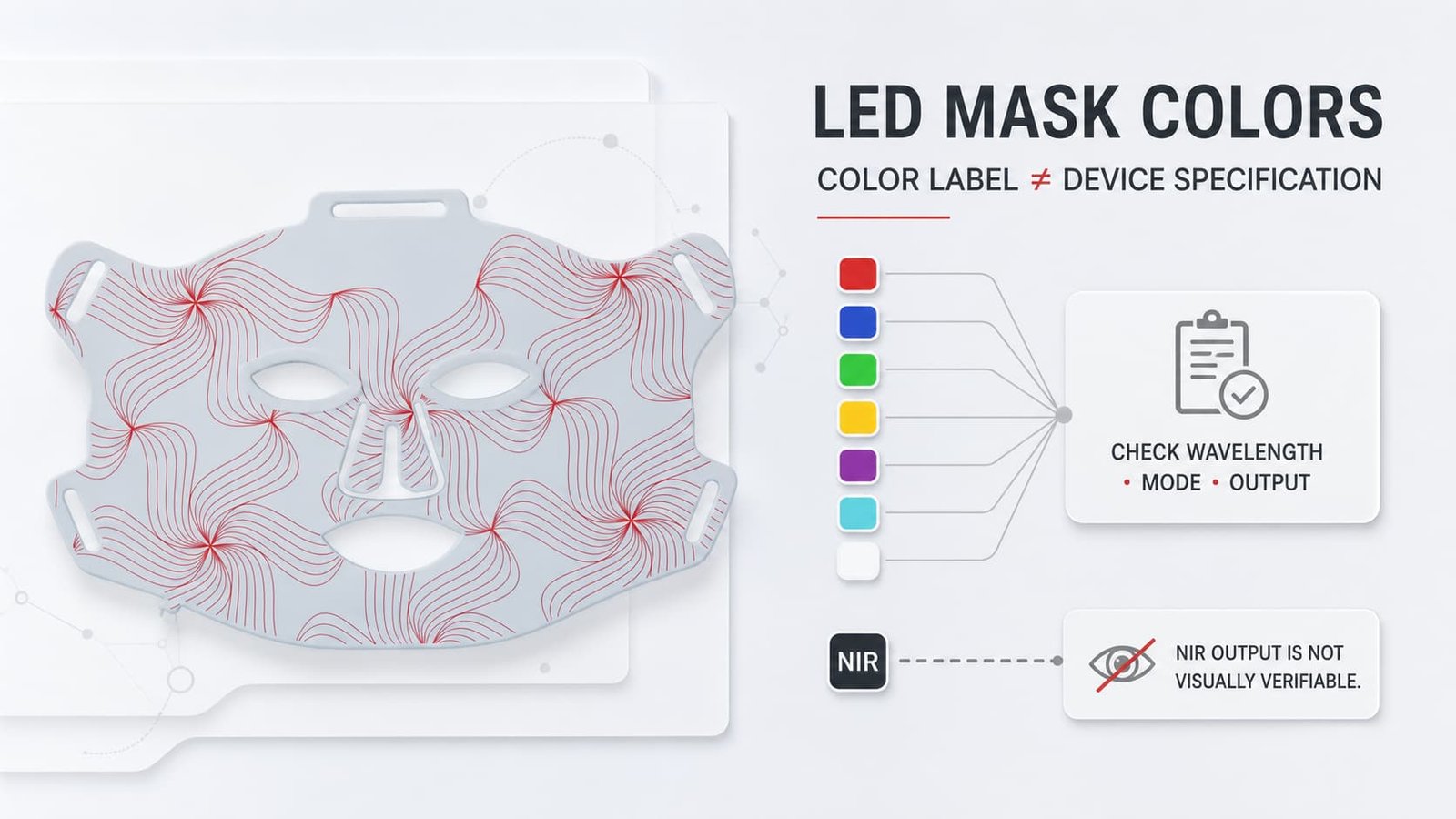
Resposta curta: Um gráfico de máscara LED de 7 cores pode ajudar a decodificar os rótulos dos produtos, mas esses nomes não são regras de tratamento padronizadas. Vermelho e/ou azul têm evidências mais amplas para aplicações específicas estudadas, incluindo certos estudos de dispositivos domésticos sobre acne inflamatória leve a moderada; estudos selecionados de luz vermelha também abordam o envelhecimento visível da pele. O NIR é listado separadamente porque não é um dos sete rótulos de cores visíveis e geralmente está fora do que os usuários podem ver. Verifique o comprimento de onda do seu modelo, emissores ativos, saída, uso pretendido, instruções, e evidências de apoio.
Nota médica: Este artigo fornece educação geral ao consumidor, não é conselho médico. As máscaras de LED variam de acordo com o uso pretendido, estatuto regulamentar, saída, avisos, requisitos de proteção ocular, e protocolo de tratamento. Siga a rotulagem do seu dispositivo. Procure orientação médica qualificada para medicamentos que aumentem a sensibilidade à luz, condições de pele sensíveis à luz ou ativas, procedimentos recentes, acne incerta ou grave, ou reações adversas.
O que uma tabela de cores de máscara facial de LED pode realmente dizer a você?
Uma tabela de cores pode organizar os rótulos que você vê, mas não pode dizer a saída de luz completa, protocolo, ou resultado esperado de uma máscara específica. A cor que uma pessoa vê está relacionada ao comprimento de onda, ainda assim, os limites das faixas de cores são aproximados e não universais. O Definição de radiação visível da Comissão Internacional de Iluminação observa que não há limites precisos do espectro visível, e Visão geral da espectroscopia do NIST explica que a cor reflete a frequência e o comprimento de onda da luz.
Essa relação física não faz do rótulo de um produto uma especificação de tratamento. Um botão vermelho não revela o valor exato do nanômetro, quão ampla é a banda emitida, quanta luz atinge a pele, ou qual protocolo de sessão foi estudado. Um roxo, ciano, ou o botão branco pode nem representar um comprimento de onda distinto.
Use uma tabela de cores para responder a duas perguntas:
- O que este rótulo pode descrever fisicamente?
- Quais informações ainda devo verificar para este modelo?
Não use-o para atribuir uma condição a si mesmo, crie uma dose, ou copie as instruções de outra máscara.
Tabela de cores da máscara facial LED: Significado, Comprimento de onda, e status da evidência
O gráfico mais útil separa um rótulo visual do comprimento de onda medido e do status da evidência, então permite que você abra os detalhes da sua cor. Não existe um limite interdisciplinar único para o “infravermelho próximo”. O CIE coloca sua banda IR-A relacionada em 780–1.400 nm e observa que quase, meio-, e os limites do infravermelho distante variam de acordo com a aplicação. Os números abaixo são exemplos realmente relatados na pesquisa citada sobre pele facial ou dispositivos faciais domésticos – não especificações para cada máscara com o mesmo nome de cor ou uma afirmação de que cada comprimento de onda em uma ampla faixa física é usado para tratamento facial.
A tabela tem oito linhas porque adiciona NIR como um modo separado cuja saída geralmente não pode ser verificada visualmente. NIR não é um dos sete rótulos de cores visíveis no título.
| Etiqueta que você pode ver | Exemplos de comprimento de onda em pesquisas citadas | Instantâneo de evidências para uso da pele facial |
|---|---|---|
| Vermelho | 630–670 nm na revisão de acne caseira citada; 633 e 660 nm em testes de rejuvenescimento da pele com luz vermelha | Pesquisa de categoria mais ampla para fotobiomodulação (PBM, o uso de luz de baixo nível para influenciar a atividade biológica) e sinais visíveis selecionados de envelhecimento da pele; resultados e parâmetros variam |
| Azul | 414–445 nm na revisão de acne caseira citada | Aplicações caseiras selecionadas estudadas principalmente em acne leve a moderada, muitas vezes usando azul sozinho ou com vermelho; nem todas as lesões ou diagnósticos de acne são cobertos |
| Verde | 505 nm no estudo citado | Emergentes e específicos de protocolo; um protocolo de comprimento de onda e máscara não estabelece uma regra universal de luz verde |
| Amarelo ou âmbar | 570 e 590 nm no estudo exploratório citado; ambos combinados com 620 nm vermelho e 850 nm infravermelho | Limitado e dependente do dispositivo; o estudo de combinação citado não pode isolar um efeito apenas amarelo |
| Roxo ou violeta | Nenhum valor único pode ser inferido do rótulo | O rótulo por si só não tem significado de evidência para toda a categoria porque sua implementação física pode diferir |
| Ciano | Nenhum valor único pode ser inferido do rótulo | O nome não estabelece um protocolo facial padronizado |
| Branco | Nenhum comprimento de onda terapêutico único pode ser inferido a partir do rótulo | “Branco” não estabelece um benefício padrão |
| Infravermelho próximo (Nir) | Sem fronteira universal; banda CIE IR-A relacionada: 780–1.400 nm; exemplo de estudo de dispositivo facial: 850 nm | História substancial de pesquisa PBM, incluindo estudos de pele, mas o suporte permanece no comprimento de onda-, dose-, e específico do modelo |
Este gráfico rápido intencionalmente não oferece a cada cor o benefício prometido. Isso esconderia a distinção mais importante: uma cor nomeada, um comprimento de onda medido, uma dose completa, um protocolo estudado, e uma declaração de produto são cinco coisas diferentes. Abra a cor relevante abaixo para ver o que o rótulo pode descrever fisicamente e o que ainda precisa ser verificado na sua máscara exata.
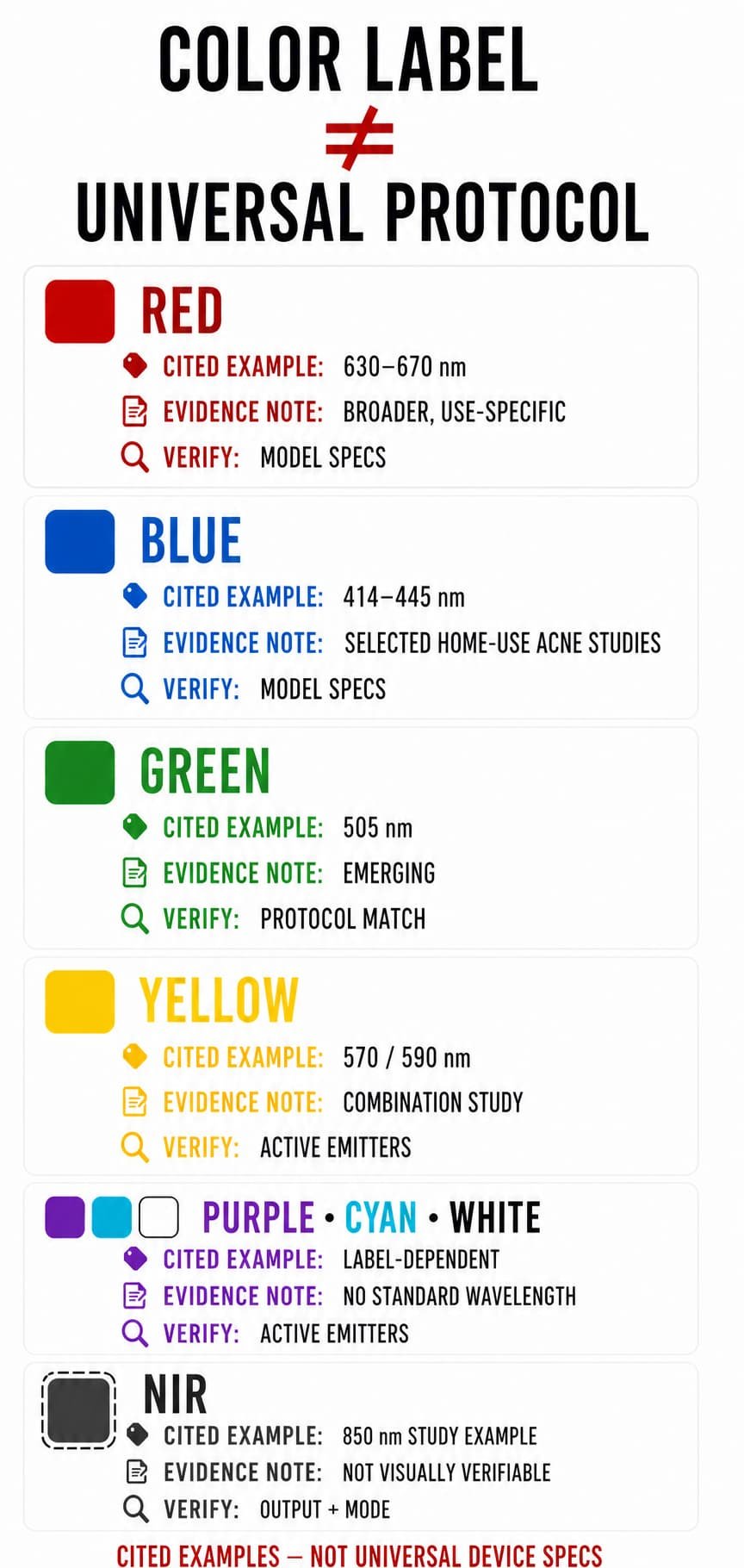
O que cada etiqueta de cor pode descrever – e o que você deve verificar?
Vermelho - exemplos citados: 630–670nm, 633 nm, e 660 nm
O que o rótulo pode descrever: Um emissor vermelho visível. Um produto pode usar outro comprimento de onda vermelho.
O que verificar: Comprimento de onda exato, irradiância (potência luminosa fornecida por unidade de área), exposição radiante (energia luminosa total entregue por unidade de área) ou sessão programada, uso pretendido, avisos, e evidências para o modelo.
Azul - exemplos citados: 414–445nm
O que o rótulo pode descrever: Um emissor visível mais curto. A pesquisa e a documentação do produto podem chamar os valores próximos do azul violeta de “azul”.
O que verificar: Comprimento de onda, indicação de acne, orientação ocular, avisos de fotossensibilidade, protocolo, e se a evidência cobre seu modelo.
Verde - exemplo citado: 505 nm
O que o rótulo pode descrever: Um emissor de região verde ou uma configuração com rótulo verde.
O que verificar: Comprimento de onda exato, desenho do estudo, saída, resultado desejado, população de pele, e se o produto corresponde ao protocolo estudado.
Amarelo ou âmbar — exemplos citados: 570 e 590 nm em um estudo de luz combinada
O que o rótulo pode descrever: Um emissor amarelo/âmbar ou um modo nomeado contendo outros emissores. No citado estudo exploratório, ambos os comprimentos de onda amarelos foram combinados com 620 nm vermelho e 850 nm infravermelho.
O que verificar: Se o modo é amarelo sozinho ou combinado, seus comprimentos de onda, saída, uso pretendido, e suporte para esse modelo.
Roxo ou violeta – nenhum comprimento de onda único pode ser inferido do rótulo
O que o rótulo pode descrever: Um emissor discreto de faixa violeta, uma combinação vermelho-mais-azul, ou outra mistura definida pelo fabricante.
O que verificar: Quais comprimentos de onda e emissores são ativados, se eles operam simultaneamente ou sequencialmente, e quais evidências se aplicam a essa combinação.
Ciano – nenhum comprimento de onda único pode ser inferido do rótulo
O que o rótulo pode descrever: Um emissor azul esverdeado discreto, uma mistura de azul e verde, ou outra configuração definida pelo fabricante.
O que verificar: Espectro exato ou combinação de emissor, saída, uso pretendido, instruções, e evidência do dispositivo.
Branco – nenhum comprimento de onda terapêutico único pode ser inferido do rótulo
O que o rótulo pode descrever: Vários emissores visíveis operando juntos, uma fonte de amplo espectro, ou um modo misto definido pelo fabricante.
O que verificar: Saída espectral, emissores ativos, dose, uso pretendido, protocolo, e evidências específicas do dispositivo.
Infravermelho próximo (Nir) - banda IR-A relacionada: 780–1.400 nm; exemplo de dispositivo citado: 850 nm
O que o rótulo pode descrever: Radiação além do vermelho visível que geralmente está fora da faixa visível, usado como modo próprio ou combinado com luz visível. Uma máscara pode usar um comprimento de onda NIR específico; a banda IR-A é uma classificação espectral, não é uma faixa de tratamento facial.
O que verificar: Comprimento de onda NIR, se está ativo em cada modo, saída, protocolo, orientação ocular, e escopo da evidência.
Por que fazer roxo, Ciano, e branco significam coisas diferentes nas máscaras?
Esses nomes descrevem a aparência de um modo ou é comercializado, não necessariamente um emissor padronizado. Duas máscaras podem exibir a mesma palavra colorida enquanto ativam LEDs diferentes.
| Etiqueta de modo | Possível interpretação técnica | A questão que resolve a ambiguidade |
|---|---|---|
| Roxo | Um LED violeta, LEDs vermelhos e azuis operando juntos, ou outra mistura | Quais comprimentos de onda e emissores exatos estão ativos? |
| Ciano | Um emissor azul esverdeado discreto ou uma mistura de LEDs azuis e verdes | É um comprimento de onda medido ou um modo combinado? |
| Branco | Vários LEDs visíveis juntos, uma fonte ampla, ou uma sequência programada | O que mostra a saída espectral ou tabela de modo? |
| 7-ciclo de cores | Sete seleções separadas, várias misturas, ou uma sequência automática | Os modos são simultâneos, sequencial, ou selecionável independentemente? |
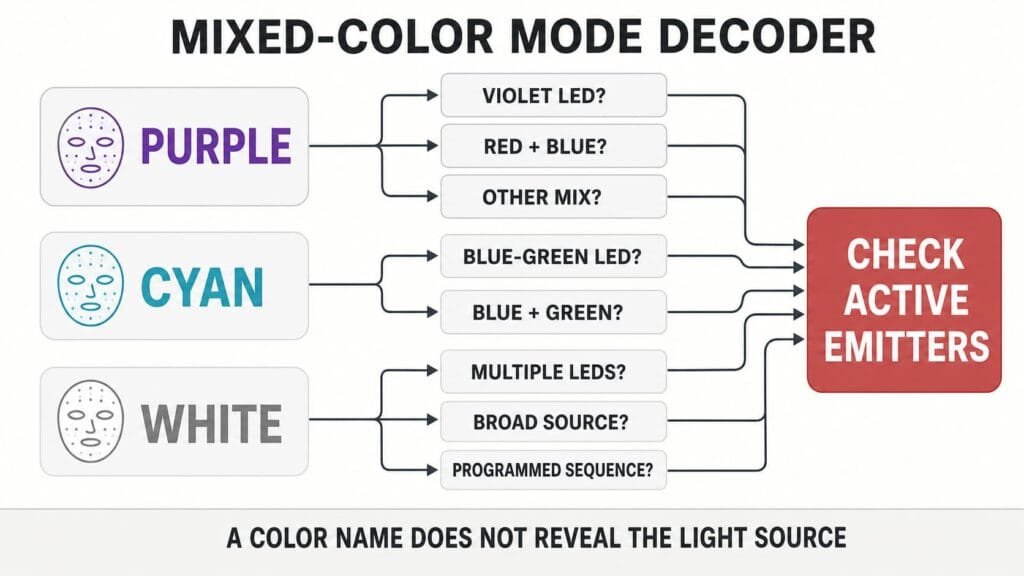
Uma cor de tela, ícone, ou uma foto brilhante do produto não pode responder a essas perguntas. Procure uma tabela de modos nas instruções ou no material de suporte oficial que identifique os emissores ativos. Se a documentação repetir apenas “roxo para acalmar” ou “branco para renovação” sem identificar a luz, descreveu uma finalidade de marketing em vez de um protocolo técnico reproduzível.
Quais cores de LED têm evidências mais fortes de uso na pele facial?
Vermelho e azul têm suporte mais amplo em nível de categoria do que a maioria dos rótulos de cores visíveis extras, mas mesmo a sua evidência é condicional e não universal. UM revisão sistemática de 31 ensaios randomizados de LED deu à acne vulgar uma recomendação de grau B, enquanto outros usos dermatológicos receberam grau C ou D; os autores também notaram pequenas amostras, cegueira inconsistente, faltando controles falsos, e parâmetros de tratamento variados em partes da literatura. A revisão revelou que Jared Jagdeo e Daniel Siegel atuaram no conselho consultivo científico da Global Med Technologies e que Jagdeo recebeu honorários da empresa; esta divulgação não determina as conclusões, mas é relevante ao pesar as recomendações da revisão.
Para acne especificamente, um 2025 revisão sistemática e meta-análise de seis estudos de LED em casa dispositivos avaliados usando luz vermelha e/ou azul. Isso apoia um conjunto definido de evidências para certas aplicações domésticas de acne. Isso não significa que todo botão azul seja apropriado para cada breakout, que vermelho e azul compartilham o mesmo papel, ou que uma cartela de cores pode diagnosticar acne.
O Orientação da Academia Americana de Dermatologia sobre lasers e luzes para acne torna o limite prático mais claro: luz visível pode tratar espinhas, mas não cravos, espinhas, cistos, ou nódulos, e os resultados variam. Para dispositivos de luz vermelha, o AAD também aconselha escolher um dispositivo destinado à preocupação que você deseja abordar e seguir suas instruções.
Verde e amarelo não devem ser descartados como automaticamente inúteis, mas a sua evidência deve ser descrita ao nível em que realmente existe:
- UM 2025 estudo de 505 nm LED verde incluiu experimentos com células e modelos de pele 3D, além de um pequeno, intervenção cega do avaliador em 15 mulheres saudáveis com idade entre 45 e 57 anos. Os participantes usaram a máscara YA-MAN 23F1XX para 10 minutos, seis vezes por semana, por oito semanas. UM 2026 correção esclareceu o relatório estatístico e acrescentou que quatro autores eram funcionários da YA-MAN Ltd. e o estudo foi conduzido sob um acordo de pesquisa colaborativa com a empresa. É uma evidência emergente relevante para esse comprimento de onda, dispositivo, população, e protocolo – não permissão para transferir a conclusão para todos os ambientes verdes.
- UM pequeno 2025 estudo exploratório randomizado matriculado 30 participantes, de quem 28 completou o estudo, e comparado 570 nm com 590 nm luz amarela. Ambos os grupos também receberam 620 nm vermelho e 850 luz infravermelha nm. Porque não havia braço apenas amarelo, o estudo não pode estabelecer um efeito de categoria somente amarelo.
As listagens regulatórias não estão necessariamente limitadas a vermelho e azul. O FDA K250830 510(k) registro de banco de dados links para seu resumo oficial, cuja carta de autorização e indicações de uso nome vermelho, amarelo, vermelho mais infravermelho, azul, e um modo misto vermelho-mais-azul-mais-infravermelho para indicações específicas em toda a família de dispositivos listada. Este é um 510(k) determinação de equivalência substancial e escopo regulatório exato do dispositivo – não prova independente de que cada modo listado tenha a mesma base de evidências clínicas. Ele não transforma “amarelo” em uma categoria de comprimento de onda aprovada pela FDA nem prova que outro modo amarelo tem o mesmo uso pretendido.
A lição não é “cores extras nunca funcionam”. Isso é:
Quanto menos padronizado for o rótulo e mais fina for a evidência da categoria, as especificações e o suporte exatos mais importantes do dispositivo se tornam.
Por que o infravermelho próximo é diferente das cores visíveis?
A saída NIR pode estar ativa mesmo quando nenhuma luz é visivelmente aparente. A luz visível é apenas uma parte do espectro eletromagnético, e o A CIE observa que a visibilidade humana não tem um limite exato. NIR fica além do vermelho visível, brilho tão visível, cor, ou uma imagem da câmera do telefone não pode verificar sua saída.
Uma máscara pode oferecer NIR como:
- um modo selecionável separado;
- um emissor que liga automaticamente em vermelho;
- parte de um protocolo misto de acne ou rejuvenescimento; ou
- uma configuração opcional controlada independentemente dos LEDs visíveis.
Você não pode dizer qual arranjo se aplica olhando para a máscara. Verifique a tabela de comprimento de onda e as instruções de modo. Uma revisão de parâmetros de luz e eficácia de fotobiomodulação enfatiza por que isso é importante: comprimento de onda, irradiância, exposição radiante, tempo de tratamento, estrutura de pulso, área do feixe, e as condições de medição afetam se os estudos e dispositivos podem ser comparados de forma significativa.
Como você verifica os modos de cores em sua máscara LED?
Transforme a tabela de cores em uma verificação de dispositivo de seis campos antes de confiar em um modo.
| Campo a verificar | Uma resposta útil parece | Que resposta vaga deixa desconhecido |
|---|---|---|
| Uso pretendido | A preocupação exata e o grupo de usuários para o qual o modo foi projetado ou rotulado | Se uma lista geral de benefícios se aplica a você |
| Comprimento de onda exato | Um valor nanométrico ou banda espectral medida para cada emissor | Que luz física o nome da cor representa |
| Emissores ativos | Uma tabela de modo mostrando quais LEDs operam juntos e se são simultâneos ou sequenciais | Seja roxo, ciano, ou branco é um comprimento de onda distinto ou uma mistura |
| Saída e dose | Irradiância (potência luminosa fornecida por unidade de área) em mW/cm² sob condições declaradas, mais tempo de sessão e exposição radiante (energia luminosa total entregue por unidade de área) em J/cm² quando fornecido | Quanta luz atinge uma área e se um protocolo de estudo é comparável |
| Instruções e avisos | Freqüência, curso, orientação ocular, preparação, contra-indicações, condições de parada, e requisitos de limpeza | Se o modo é prático ou apropriado para uso conforme rotulado |
| Evidência do dispositivo e escopo regulatório | Um estudo, autorização, ou teste que nomeie o modelo ou defina claramente a família aplicável, modo, e uso pretendido | Se as evidências de outro dispositivo foram emprestadas |
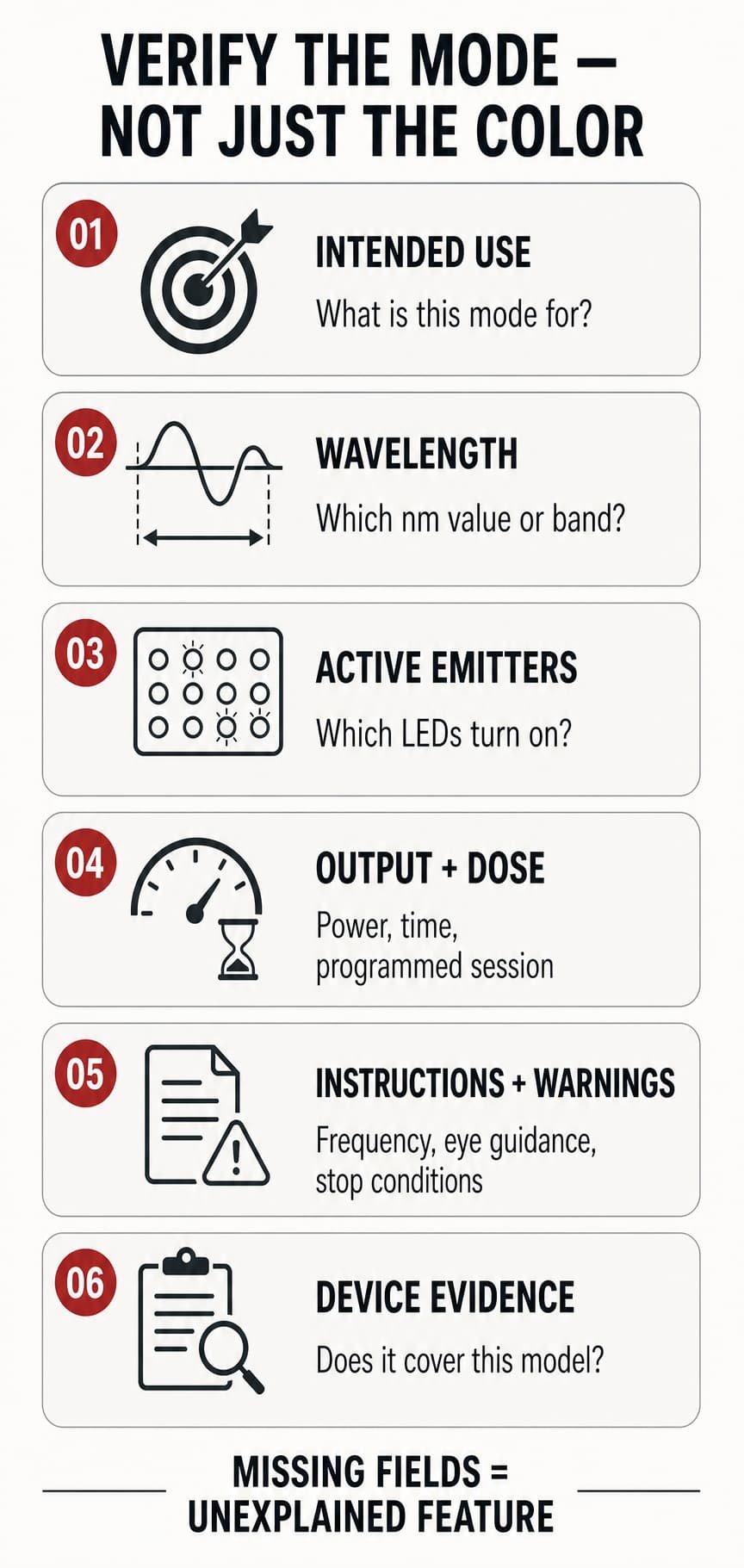
Se o vendedor fornecer apenas um gráfico de arco-íris e uma lista de benefícios, trate os modos como recursos inexplicáveis – não como sete programas de tratamento verificados. Procure as instruções oficiais atuais ou peça à marca as informações que faltam sobre o modo de acordo com as especificações. Não preencha as lacunas com o gráfico de outra empresa.
Para a questão de compra separada - se uma configuração vermelha / azul focada ou uma máscara multimodo se adapta melhor ao seu objetivo - use o Wakelife's 7-comparação de máscara de LED colorida versus vermelha e azul. Essa página compara configurações; esta página explica os rótulos de cores.
Para uma verificação mais ampla do dispositivo exato além dos modos de cores, continue com Wakelife guia de seleção de máscara facial LED de seis pontos.
Quando uma questão de cores se torna uma questão médica?
Uma tabela de cores não pode determinar qual condição você tem ou se a exposição à luz é apropriada para você. Pause a autosseleção e busque orientação qualificada quando:
- acne é grave, cístico, nodular, doloroso, cicatrizes, ou incerto;
- você usa um medicamento ou tópico prescrito associado à sensibilidade à luz;
- você tem uma condição sensível à luz, uma erupção cutânea ativa, pigmentação inexplicável, ou uma lesão cutânea variável;
- você fez um procedimento recentemente ou está seguindo o plano de cuidados posteriores de um médico; ou
- uma sessão causa dor persistente, queimando, inchaço, sintomas oculares, bolhas, ou outra reação adversa.
Não interrompa um medicamento ou substitua uma máscara para diagnóstico ou cuidados prescritos com base em um rótulo colorido.
O resultado final
Leia uma tabela de cores de máscara facial de LED como auxílio à tradução, não como um menu de tratamento universal. Vermelho e azul têm evidências de categoria comparativamente mais amplas para aplicações faciais específicas. Verde e amarelo têm evidências emergentes ou de protocolo exato que não devem ser generalizadas. Roxo, ciano, e branco requerem decodificação em nível de emissor. O NIR pode estar ativo mesmo quando nenhuma luz é visivelmente aparente.
Para cada modo, retornar à mesma verificação prática: comprimento de onda, emissores ativos, saída, dose ou protocolo programado, uso pretendido, avisos, e evidências para esse modelo. Se esses detalhes estiverem faltando, o nome da cor não pode fornecê-los.
Para marcas e equipes de produtos
A confusão do consumidor em torno das máscaras multicoloridas costuma ser um problema de documentação. Um mapa útil de modo para evidência deve identificar cada cenário selecionável, combinação de emissor ativo, comprimento de onda, saída medida, sessão programada, uso pretendido, avisos, e escopo da evidência. Os modos mistos devem ser descritos pelos seus emissores, em vez de depender apenas de nomes como roxo ou branco..
Se você estiver desenvolvendo uma máscara multimodo ou melhorando suas instruções ao consumidor, explorar Wakelife Plataformas de máscara facial LED e Capacidades OEM e ODM depois de definir o uso pretendido e o plano de evidências para cada modo.
Referências
Padrões, Orientação Profissional, e pesquisa revisada por pares
| Não. | Fonte Oficial |
|---|---|
| 1 | Comissão Internacional de Iluminação. Radiação Visível. Vocabulário Internacional de Iluminação, CIE S 017:2020. Acessado em julho 21, 2026. |
| 2 | Instituto Nacional de Padrões e Tecnologia. Espectroscopia: Uma central de medição. Acessado em julho 21, 2026. |
| 3 | Comissão Internacional de Iluminação. Radiação infravermelha. Vocabulário Internacional de Iluminação. Acessado em julho 21, 2026. |
| 4 | Academia Americana de Dermatologia. A terapia da luz vermelha é adequada para a sua pele?. Última atualização em setembro 13, 2024. Acessado em julho 21, 2026. |
| 5 | Academia Americana de Dermatologia. Lasers e Luzes: Quão bem eles tratam a acne?. Acessado em julho 21, 2026. |
| 6 | Ershadi S., Barbieri JS. Dispositivos LED domésticos para o tratamento da acne vulgar: Uma revisão sistemática e meta-análise. Dermatologia Jama. 2025;161(5):552–555. faça:10.1001/jamadermatol.2025.0019. |
| 7 | Jagdeo J, Austin E., Mamíferos A, Wong C., eu tenho D, Selo DM. Diodos emissores de luz em dermatologia: Uma revisão sistemática de ensaios clínicos randomizados. Lasers em Cirurgia e Medicina. 2018;50(6):613–628. faça:10.1002/lsm.22791. |
| 8 | Zein R., Selting W, Hamblin MR. Revisão dos parâmetros de luz e eficácia da fotobiomodulação: Mergulhe na complexidade. Jornal de Óptica Biomédica. 2018;23(12):120901. faça:10.1117/1.JBO.23.12.120901. |
| 9 | Mima Y, Yamada T., Omatsu J., Yamashita T., Suzuki S, Takechi T., Ichikawa M., Yamazaki K., Sato S., Yoshizaki A. Efeito Inibitório de 505 nm Diodo emissor de luz verde na síntese de melanina em experimentos celulares e um estudo de intervenção humana. Acta Dermato-Venereológica. 2025;105:adv43441. faça:10.2340/actadv.v105.43441. |
| 10 | Mima Y. Errata: Efeito Inibitório de 505 nm Diodo emissor de luz verde na síntese de melanina em experimentos celulares e um estudo de intervenção humana. Acta Dermato-Venereológica. 2026;106:adv45681. faça:10.2340/actadv.v106.45681. |
| 11 | Yi S, Ding J., Li X, e outros. Eficácia e segurança de 570/590 nm Luz amarela combinada com luz vermelha e LED infravermelho no tratamento do fotoenvelhecimento da pele facial. Lasers na Ciência Médica. 2025;40(1):435. faça:10.1007/s10103-025-04659-6. |
Exemplo de regulamentação de dispositivo exato
Esta fonte documenta apenas a família de dispositivos listada, modos, e indicações de uso. Não há evidência de que todos os produtos que usam a mesma palavra de cor tenham o mesmo status ou finalidade.
| Não. | Fonte Oficial |
|---|---|
| 12 | NÓS. Food and Drug Administration. K250830 510(k) Registro de banco de dados de notificação pré-comercialização. Data da decisão: Junho 9, 2025. O resumo oficial do registro contém a carta de autorização e as indicações de uso para a família de dispositivos listada. Acessado em julho 21, 2026. |