TL;DR for product and claims teams
- Human studies support a potential improvement in hair density from specific low-level light or laser devices used mainly in androgenetic alopecia (pattern hair loss). That is narrower than saying red light treats every cause of hair loss.
- Um comprimento de onda como 650 ou 655 nm does not establish a clinical result by itself. The studied device, delivered output, spatial coverage, protocolo, população, endpoint and follow-up all matter.
- Current reviews do not establish that laser is clinically superior to LED, that one form factor is best, or that a research protocol can be copied to an unstudied product.
- FDA clearance is tied to a specific device record and scope. It is not a clearance of “LLLT technology,” every similar-looking device or every private-label configuration.
- Before approving a product claim, build an evidence chain from the target condition and exact device to the protocol, measured outcome, labeling and target-market record.
This article is an evidence and claims guide for hair-growth device brands, product teams and OEM buyers. It is not personal medical advice and does not provide a universal treatment schedule. People experiencing hair loss need an appropriate clinical assessment because different causes do not share the same evidence base or management pathway.
What Does Current Human Evidence Support?
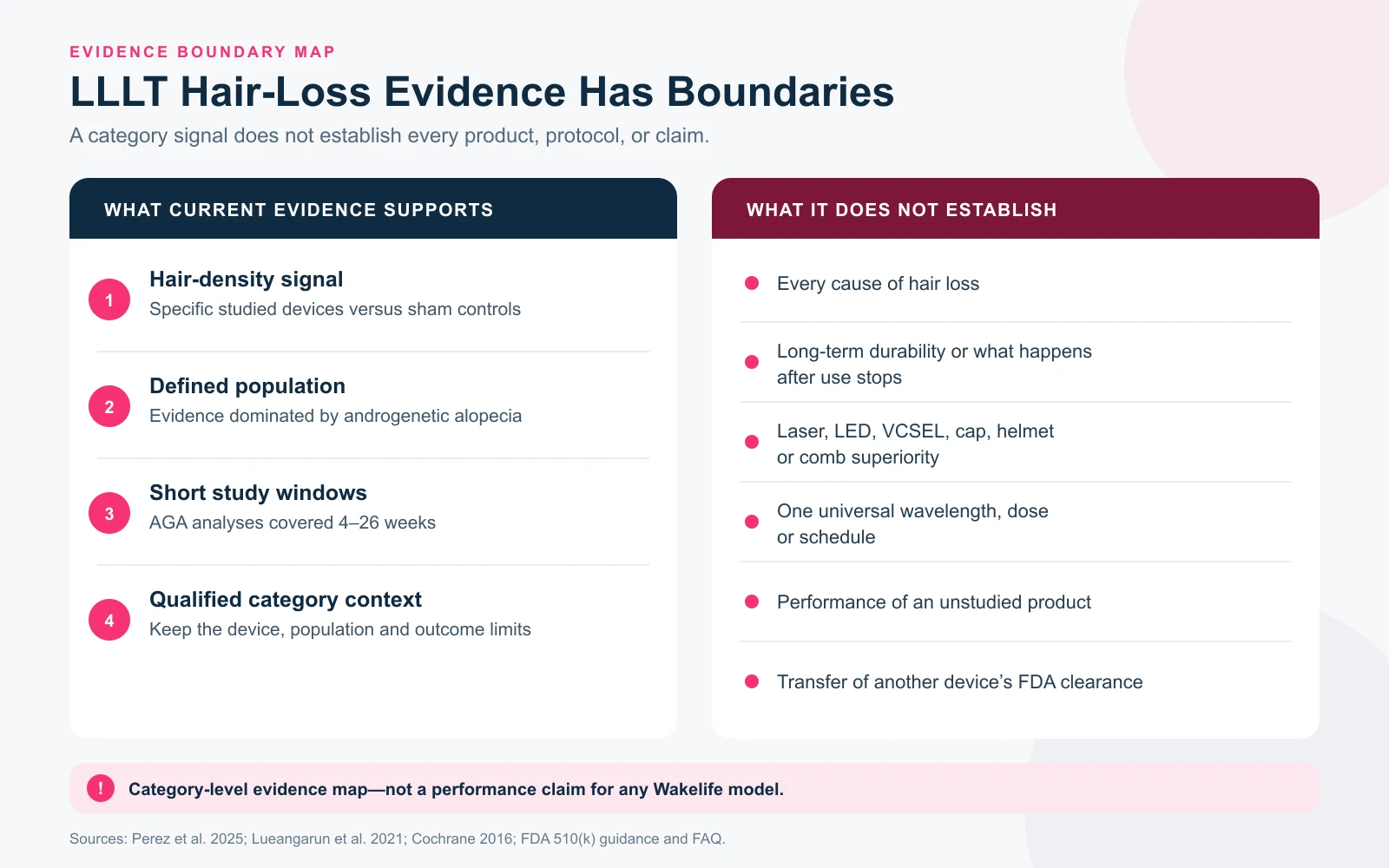
The most defensible conclusion is that specific low-level light or laser devices have shown hair-density benefits in studied populations dominated by androgenetic alopecia. The conclusion becomes less certain when it is extended to another hair-loss cause, another device, another protocol or a broader marketing claim.
The evidence has developed over time:
| Evidence source | What it found | What limits the conclusion |
|---|---|---|
| Perez et al. 2025 revisão sistemática e meta-análise | The review included 38 studies describing 3,098 participantes. In its pooled androgenetic-alopecia analyses, hair-density change favored low-level laser or LED therapy over placebo | The published abstract reports that 2,930 de 3,098 participants had androgenetic alopecia and that statistical information for the other alopecia types was insufficient for meta-analysis. Statistical heterogeneity was high, so the pooled result should not be treated as one predictable product outcome |
| Lueangarun et al. 2021 revisão sistemática e meta-análise | Seven double-blind randomized trials involving 607 participants found a hair-density advantage for the specific home-use devices studied versus sham controls | Devices and protocols varied, follow-up was no longer than 26 semanas, severe pattern hair loss was not represented, and there was no direct device-to-device trial |
| 2016 Cochrane review of treatments for female pattern hair loss | In two laser-comb studies with 141 participantes, participant-reported improvement was not significantly better than sham, while change from baseline in hair count favored the laser comb | The participant-reported result was moderate-quality evidence; the hair-count result was low-quality evidence. Quality of life was not assessed, and adverse events were reported only generically rather than by treatment arm |
These sources are not contradictory. They show why a positive pooled signal and a high-certainty, product-specific claim are different things. Broader and newer evidence can support continued interest in the category while important uncertainty remains about devices, protocols, durability and generalizability.
The full funding and conflict-of-interest disclosures for the 2025 review have not been verified for this page. A product claim file should review the complete publication and its disclosures rather than rely on the abstract alone.
Effect sizes from a meta-analysis should also not be converted into a promised percentage of new hair for an individual user. A pooled standardized mean difference combines study results measured under defined conditions; it is not a consumer guarantee or an exact-model performance specification.
Why Does “Hair Loss” Need a Diagnosis Boundary?
Hair loss describes an observation, not one condition. Androgenetic alopecia, alopecia areata, telogen effluvium, scarring alopecia, treatment-related hair loss and other causes involve different biological and clinical questions.
That distinction is especially important here. The published abstract for the 2025 meta-analysis reports that 2,930 de 3,098 participants—about 94.6%—had androgenetic alopecia. It states that statistical information for the other alopecia types was insufficient for meta-analysis. The study therefore supports a cautious AGA-focused category statement; it does not establish a common result across every cause of hair loss.
O American Academy of Dermatology’s consumer guidance on red-light therapy similarly notes that hair-growth research has focused on hereditary or hormonal hair loss and that effectiveness for other causes remains uncertain. For a consumer, this is a reason to seek an appropriate diagnosis. Para uma marca, it is a reason not to replace a defined study population with the phrase “anyone with hair loss.”
A useful claims rule is:
Keep the condition and population at least as specific as the supporting human evidence. Do not broaden “studied in androgenetic alopecia” into “treats hair loss” without suitable additional support and market review.
What Do the Studies Not Establish?
Current category evidence leaves several questions open. A responsible evidence page should make those gaps visible instead of presenting only positive endpoints.
- Long-term durability: o 2025 AGA analysis covered 4 para 26 semanas, e o 2021 home-use review included trials lasting 16 para 26 semanas. Neither establishes how an effect changes with longer use or after use stops.
- Severe pattern hair loss: the reviewed randomized trials focused on mild-to-moderate pattern hair loss. Results should not be assumed to be identical at other stages.
- Other causes of hair loss: the latest broad meta-analysis did not have enough data to pool most non-AGA conditions.
- User-perceived benefit and quality of life: in the older Cochrane review, the two laser-comb studies did not show a statistically significant participant-reported advantage over sham even though hair-count change favored the device. Quality of life was not assessed.
- Technology superiority: cross-study subgroup results do not prove that laser, LIDERADO, VCSEL or a laser-plus-LED combination is clinically superior. That requires an appropriately designed direct comparison.
- Form-factor superiority: a comb, cap or helmet changes placement and user workflow, but its shape alone does not prove a better biological result.
- One universal protocol: comprimento de onda, irradiância, distribuição espacial, session pattern and study duration varied. There is no single schedule in these reviews that can be transferred safely and effectively to every device.
- Safety certainty: the Cochrane laser-comb studies reported adverse events only generically, not by treatment arm. More broadly, tolerability findings from studied products do not replace the optical, elétrica, térmico, usabilidade, labeling and market-specific safety assessment of a different finished device.
These are boundaries, not a statement that the category has no value. They identify what requires exact-device evidence or a narrower claim.
How Should Mechanisms Be Described?
Photobiomodulation mechanisms should be written as proposed biological explanations—not as proof of a finished product’s clinical performance. Proposed mechanisms can help explain why researchers study the category, but they do not establish a clinical outcome.
They do not answer the commercial question: did this finished device, used in this population and protocol, produce a defined human outcome?
This distinction prevents a common claim error:
| Tipo de evidência | Appropriate use | Inappropriate leap |
|---|---|---|
| Mechanistic or laboratory evidence | Explain a proposed pathway and justify further study | “This mechanism proves our device regrows hair” |
| Human study of a named device | Describe the reported outcome for its population, protocol and endpoint | Transfer the result to any device using a similar color of light |
| Exact-device performance report | Establish measured optical or safety characteristics under stated conditions | Treat irradiance or wavelength as a clinical outcome |
| Registo de autorização de introdução no mercado | Verify the named device and authorized scope in the identified market | Present authorization as independent proof of superior efficacy |
Mechanism language should remain brief and subordinate to human outcome evidence. Phrases such as “activates follicles,” “restores blood flow,” “switches on Wnt signaling” or “pushes follicles into anagen” are too certain unless the precise statement, context and product relevance are properly supported.
Why Are Wavelength and Emitter Count Not Enough?
A wavelength is one input to a finished optical system, not a clinical claim. Two devices can both list 650 ou 655 nm and still differ in delivered power, beam or emission pattern, distance from the scalp, spatial coverage, ciclo de trabalho, comportamento térmico, fit and user protocol.
The evidence chain needs more than a specification headline:
| Technical item | What it can describe | What it cannot prove by itself |
|---|---|---|
| Comprimento de onda ou espectro | Where the device emits within the optical spectrum | Scalp exposure, cobertura, clinical outcome or market status |
| Saída por emissor | Optical output of one source under defined test conditions | Finished-device irradiance, fluence or spatial uniformity |
| Irradiância | Power per area at a defined plane, distance and mode | Total session exposure across the scalp or a hair-growth result |
| Fluência | Energy per area under defined measurement and time conditions | Biological equivalence when geometry, protocol or device behavior differs |
| Contagem de emissores | Number of sources in an array | Useful scalp coverage, uniformidade, safety or efficacy |
| Session timer | One part of the operating protocol | Why the same duration is appropriate for a different device or user group |
An optical report should therefore state the measurement instrument and calibration, plane or distance, aperture or sampling method, modo de operação, min/max/average values, spatial map and output stability over a full session. Even a strong report remains a performance document; it is not a clinical trial.
The same boundary applies to terms such as laser, LED and VCSEL. They describe source architectures. They can change the engineering questions and applicable safety work, but they do not create a clinical ranking on their own.
How Should a Brand Translate Evidence Into a Claim?
A defensible claim should preserve the chain between the research question and the marketed product. Before approving copy, map seven elements:
- Condition and population: What exact condition was studied, at what severity, and in whom?
- Exact device: Was the final product studied? Se não, what documented bridge connects it to the research device?
- Optical delivery: Do spectrum, irradiância, distribuição, geometria, modes and full-session behavior match?
- Protocolo: Do placement, duração da sessão, frequency and study period match the planned instructions?
- Resultado: Was the endpoint hair density, hair count, investigator photography, user perception or only a proposed mechanism?
- Time and durability: When was the outcome measured, and was maintenance after the study assessed?
- Market and labeling: Does the target-market record and final labeling support the intended use and wording?
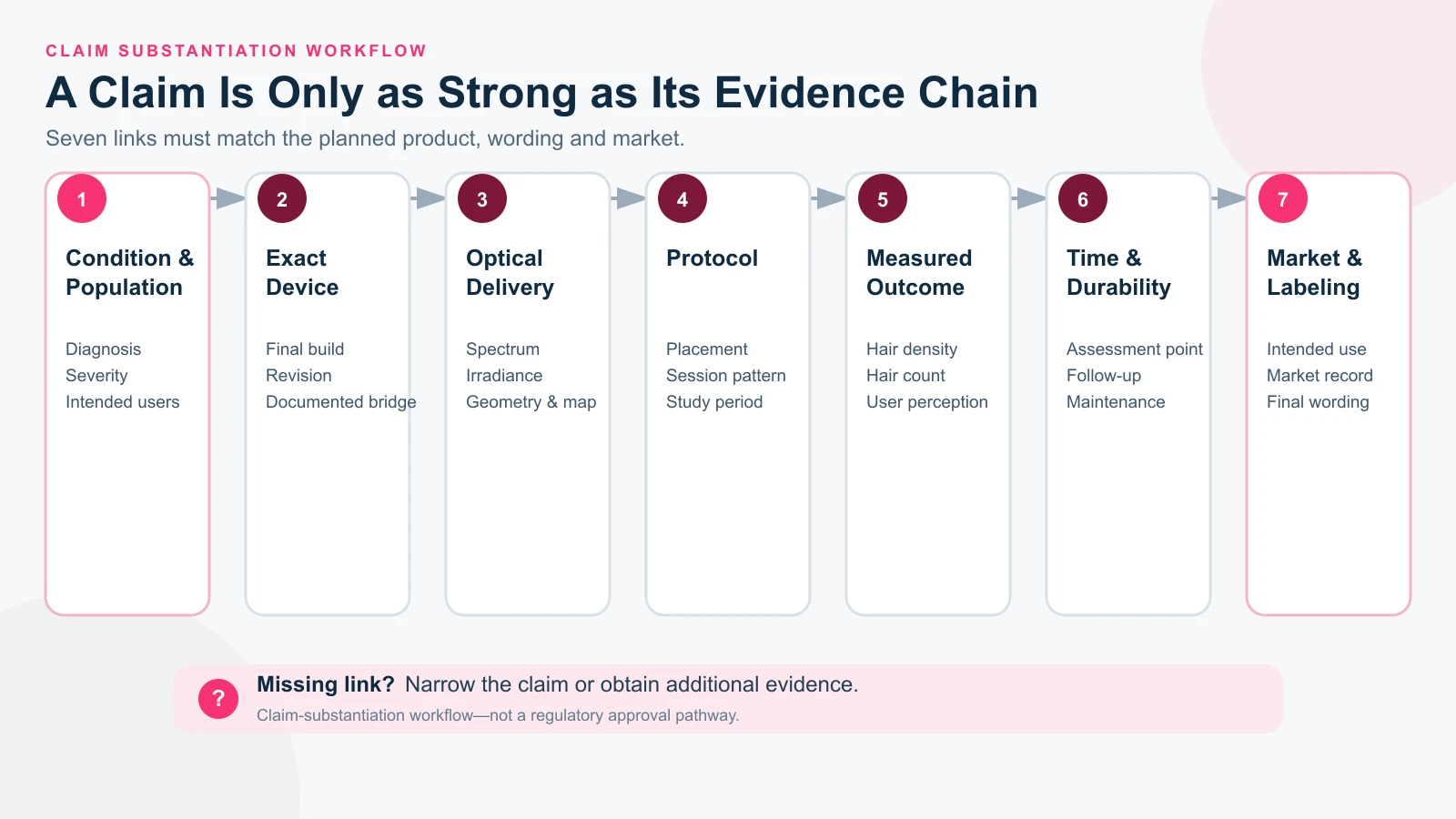
If one of these links is missing, narrow the claim or obtain additional evidence. Similar color, emitter count or external appearance is not a substitute for this bridge.
Examples of safer and riskier wording
| Proposed statement | Default assessment | Por que |
|---|---|---|
| “Studies of specific LLLT devices in androgenetic alopecia have reported improvements in hair density.” | Usable as carefully qualified category context | It keeps the device and condition boundary, provided the page also explains limitations |
| “LLLT is clinically proven to treat hair loss.” | Too broad | It expands AGA-dominated, heterogeneous evidence to all conditions, products and treatment contexts |
| “650 nm is clinically proven to regrow hair.” | Unsupported shortcut | Wavelength alone omits device delivery, protocolo, population and outcome |
| “Our device is clinically proven.” | Requires exact-product support | The study must be relevant to the final configuration, instruções, target population and exact claimed outcome |
| “Laser works better than LED.” | Not established by this evidence set | Indirect subgroup differences are not a direct technology comparison |
| “A drug-free replacement for minoxidil or finasteride.” | Not established by this evidence set | Sham-controlled and category-level evidence does not demonstrate replacement or non-inferiority to a named standard treatment; that wording requires relevant direct comparative evidence and qualified medical/regulatory review |
| “Use for 10–20 minutes, two or three times each week.” | Not a universal protocol | Instructions must come from the exact device’s evidence, risk assessment, labeling and applicable market requirements |
| “Blue light prepares the scalp and improves hair growth.” | Not supported by the current evidence chain | It combines microbiological, scalp-condition and hair-growth conclusions without suitable human product evidence |
O Orientação de conformidade de produtos de saúde da FTC also emphasizes that express and implied health claims should be truthful, not misleading and supported by evidence relevant to the specific product and claim. A technically accurate sentence can still create a broader implied message when combined with product images, percentages, testimonials or nearby calls to action.
Does FDA Clearance Transfer to Similar Red-Light Devices?
Não. FDA clearance belongs to a specific record, device identity and scope—not to a wavelength, an emitter type or the entire LLLT category. A brand should check the K number and decision record, applicant or holder, device and model names, indicações de uso, resumo, labeling and any private-label mapping.
Descriptions such as “FDA-cleared technology,” “FDA-registered device” or “made in an FDA-registered factory” can obscure different evidence layers. Establishment registration and device listing are not substitutes for an exact clearance record. UM 510(k)-cleared device should also not be described generically as “FDA approved.”
Para um EUA. projeto de marca própria, responsibility follows the firm’s actual role and the changes made—not the sales label “private label.” FDA states that a distributor can, under specified labeling conditions, distribute another firm’s domestically manufactured device under its own name without submitting a separate 510(k). Em contraste, a specification developer submits the 510(k), and a repackager or relabeler may need one when its changes significantly affect the labeling or device. Review the FDA 510(k) responsabilidades e distributor FAQ against the final roles, dispositivo, labeling and changes; the phrase “private label” alone does not decide the answer.
Other markets require their own classification, autorização, labeling and evidence review. Um EUA. 510(k) record does not substitute for the destination market’s requirements.
For the complete record-checking workflow, ele está na casa de Wakelife Guia de verificação de dispositivos de crescimento capilar aprovado pela FDA. This evidence page does not repeat that database tutorial because scientific support and market authorization answer different questions:
- Clinical evidence asks: what happened in a defined study of a defined device and population?
- A market record asks: what device and intended-use scope did the named authority record for the identified holder and market?
Neither layer automatically replaces the other.
What Evidence Should an OEM Buyer Request?
Ask the supplier to map every file to the exact quoted configuration and planned claim. A folder titled “clinical documents” is not enough.
Use this minimum review list:
- Modelo exato, revisão, light-source bill of materials, firmware, modos, controlador, accessories and final private-label mapping.
- Full optical report with the instrument, calibração, measurement plane or distance, modo de operação, spatial map and full-session stability.
- A written comparison between the research device and quoted device, including every hardware, óptico, firmware and protocol difference.
- The complete study—not only a sales slide—with population, projeto, comparador, endpoint, follow-up, limitations, funding and conflict-of-interest disclosures.
- Finished-device optical/laser or photobiological, elétrica, térmico, battery and usability safety evidence as applicable to the exact product and market, including accessible-emission or laser-class information where relevant.
- Final instructions, usuário pretendido, operating protocol, avisos, contra-indicações, limites de limpeza, required eye protection and labeling. Eye-protection wording must follow the exact device instructions; it should not be copied from another product.
- Exact target-market records and a clear separation among product authorization, establishment records, QMS certificates and test reports.
- A claim-to-source table showing which publication or record supports each express and implied message.
- Written change control for any optical, firmware, material, acessório, protocol or labeling change after testing.
Red flags include a study of another model presented as proof for the quoted device, a per-diode mW value presented as finished-product irradiance, an unlabeled output map, a universal protocol copied from a competitor, or an FDA badge without an exact searchable record.
How Does This Evidence Guide Fit a Product-Sourcing Decision?
This page answers what the science can and cannot support. It does not select the best product architecture for a brand.
For the next step, ele está na casa de Wakelife Fabricante de dispositivos de crescimento capilar & Guia OEM/ODM to compare user workflow, form factor, source architecture, sample approval and RFQ requirements. Product teams can then explore a rigid T01 VCSEL helmet platform ou a C01 dual-wavelength LED cap platform as configuration paths.
Those product links are starting points for technical and commercial due diligence. They do not mean that category-level research, another device’s protocol or another holder’s market record has been transferred to either model. Request the exact configuration and evidence package for the destination market and planned claim.
Perguntas frequentes
Does LLLT work for every type of hair loss?
The strongest current category evidence is concentrated in androgenetic alopecia or pattern hair loss. Evidence for other causes is much smaller and was insufficient for separate meta-analysis in the 2025 análise. A broad “all hair loss” claim is therefore not supported by that review.
Is laser better than LED for hair growth?
The current evidence set does not provide an adequate direct comparison proving that one source architecture is clinically superior. Cross-study subgroup results can be influenced by different devices, protocols and participants and should not be treated as a head-to-head test.
Is 650 ou 655 nm enough to predict hair-growth performance?
Não. Wavelength is only one variable. Finished-device output, spatial delivery, ajustar, modo, session protocol, target population and evidence relevance also matter.
Can a brand copy the schedule from a published study?
Not as a universal instruction. A research protocol belongs to the studied device and conditions. The final schedule must be supported for the exact product and aligned with its risk assessment, rotulagem, intended use and target-market requirements.
Does an FDA-cleared hair-growth device prove similar devices are cleared?
Não. Verify the exact K number, applicant or holder, device/model identity, indicações, summary and labeling. Similar wavelength, shape or supplier does not transfer clearance.
Build the Evidence Chain Before You Build the Claim
LLLT and red-light research provides a credible reason to investigate hair-growth devices, particularly for androgenetic alopecia. It does not remove the need to identify the condition, exact product, delivered optical performance, protocolo, outcome and market scope.
Before approving a sample or claim, send Wakelife your target market, uso pretendido, planned wording and proposed configuration. The useful first response is not a generic efficacy promise; it is a gap list showing which specifications, relatórios, estudos, labels and market records still need to match.
Referências
-
1
Perez S. M., Vattigunta M, Kelly C., Éber A. Laser de baixa intensidade e terapia LED na alopecia: Uma revisão sistemática e meta-análise. Cirurgia Dermatológica. 2025;51(2):179–183. Epub 2024 Oct 15. faça:10.1097/DSS.0000000000004442.
-
2
Lueangarun S., Visutjindaporn P, Parcharoen Y, Jamparuang P., Tempark T. Uma revisão sistemática e meta-análise de ensaios clínicos randomizados aprovados pela Food and Drug Administration dos Estados Unidos, Uso doméstico, Dispositivos de terapia com luz/laser de baixo nível para queda de cabelo padrão: Design e tecnologia de dispositivos. Revista de Dermatologia Clínica e Estética. 2021;14(11):E64–E75. Observação: the publication title uses “FDA-approved”; current U.S. record wording should be verified as clearance, not generalized approval.
-
3
van Zuuren EJ, Fedorowicz Z., Schoones J. Intervenções para queda de cabelo de padrão feminino. Banco de Dados Cochrane de Revisões Sistemáticas. 2016;(5):CD007628. faça:10.1002/14651858.CD007628.pub4.
-
4
Academia Americana de Dermatologia. Is red light therapy right for your skin?. Accessed 2026-08-19.
-
5
Comissão Federal de Comércio. Orientação sobre conformidade de produtos de saúde. Accessed 2026-08-19.
-
6
NÓS. Food and Drug Administration. Notificação pré-comercialização 510(k). Accessed 2026-08-19.
-
7
NÓS. Food and Drug Administration. 510(k) Perguntas frequentes. Accessed 2026-08-19.