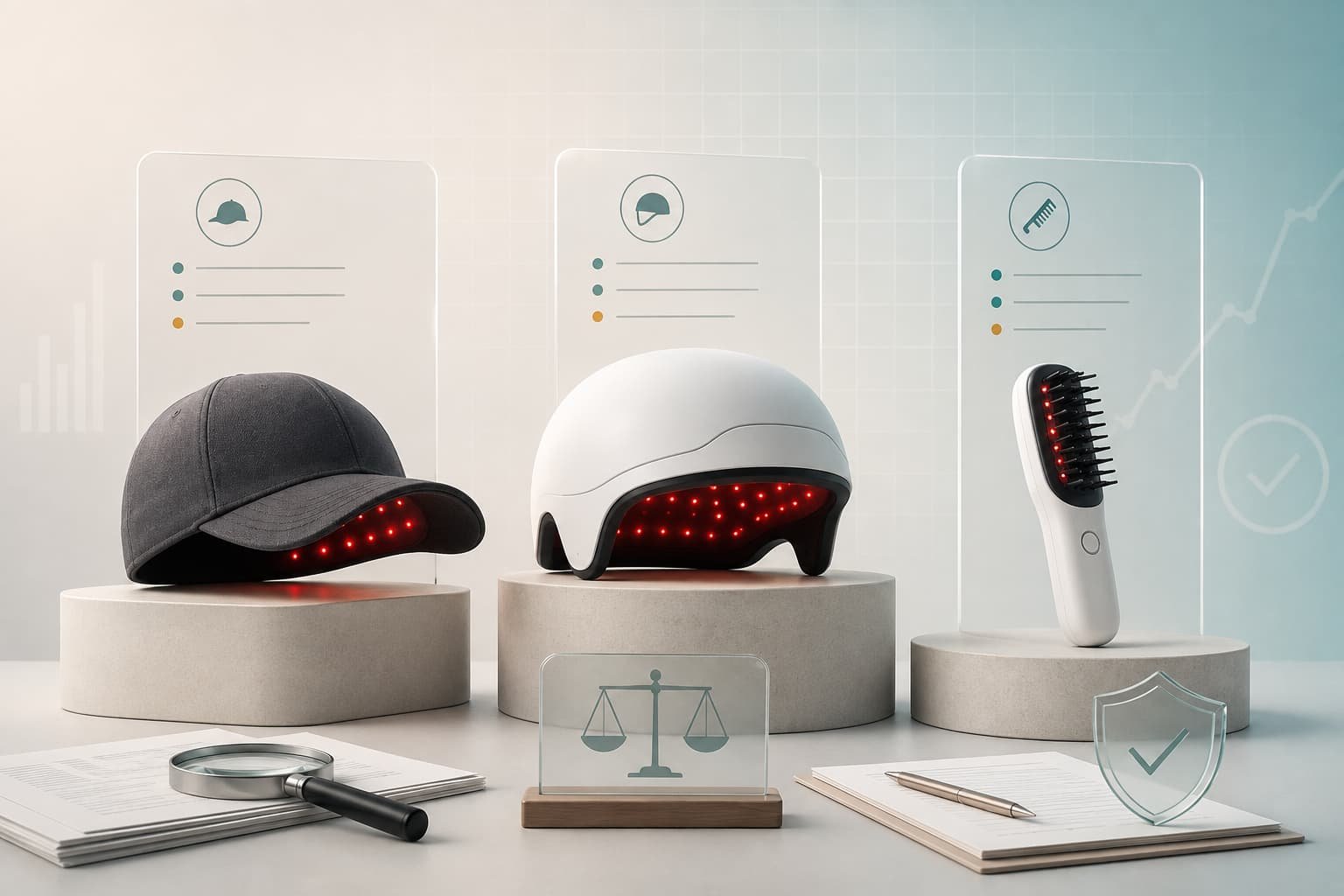
Think in months, not days—but do not treat a calendar date as a promise of regrowth. In the specific laser-comb and helmet trials discussed below, researchers assessed hair changes at follow-ups including 16 A 26 settimane, roughly four to six months. Those are research observation points for people with pattern hair loss, not a deadline by which every user should see fuller hair. Laser-comb trial, helmet trial.
If you have just started, establish a useful baseline and follow the instructions for your exact device. If you have used it consistently through your agreed review period without a worthwhile change, review the plan rather than simply adding more sessions or waiting indefinitely. New scalp symptoms or sudden changes in hair loss deserve attention sooner.
What Does a Hair-Growth Timeline Actually Measure?
Three different questions are often squeezed into “When will I see results?"
- When did researchers measure a change? A trial examines participants at scheduled visits. A difference at a visit does not identify the first day a device began to help.
- When did someone notice a cosmetic difference? A measured change in a small scalp area is not the same outcome as visibly fuller hair across the head.
- When should you reassess your own plan? That depends on the diagnosis, dispositivo, actual use and goals discussed with your clinician—not just the longest timeline on a sales page.
Low-level light or laser therapy, often shortened to LLLT, has been studied mainly for androgenetic alopecia: male and female pattern hair loss. UN 2025 revisione sistematica found much less usable evidence for other types of hair loss and substantial variation between studies. A timeline for pattern hair loss should not be borrowed for unexplained shedding, patchy loss or a different scalp condition.
What Have Studies Measured, and When?
These examples show how follow-up was organized. They are not instructions for using your device, and they do not rank combs against helmets.
| Study and participants | Measurement window | What the result can tell you |
|---|---|---|
| Jimenez et al., 2014 : four randomized, in doppio cieco, sham-controlled trials of three HairMax laser-comb models in men and women with pattern hair loss; 269 randomizzato, 225 in the efficacy analysis | Target-area terminal hair density assessed at baseline, 16 E 26 settimane | Density gains favored the studied combs at 26 settimane. This does not establish an individual's first visible result. The manufacturer partly funded the research and supplied equipment; some authors disclosed company fees. |
| Suchonwanit et al., 2019 : randomizzato, double-blind RAMACAP helmet trial in 40 Thai men and women with pattern hair loss; 36 completed | Density and diameter measured at baseline, 8, 16 E 24 settimane | The studied helmet outperformed its sham comparator on density and diameter at 24 settimane. Small sample size and an imperfect sham control limit interpretation. |
| Shin et al., 2026 : prospective study of the LG Pra.L MediHair HGN1 device in people with pattern hair loss; 68 iscritto, 64 completed | Repeated assessments during 48 settimane di utilizzo | Hair measurements improved during continued use. This was an open-label study without a sham control and was funded by LG Electronics; it cannot establish how much change was caused by the device alone. |
The longer study adds information about continued use. It does not mean everyone should wait a year before asking for help, nor does it establish what happens after stopping. None of these studies supplies a personal schedule for a different product, including an unstudied cap or a general-purpose red-light panel.
Why Better Hair Counts May Not Look Like Obvious Regrowth
Research can count hairs in a defined area under controlled conditions. Your mirror shows a broader cosmetic impression. These outcomes can differ without either observation being dishonest.
The distinction appears in a Cochrane review of female pattern hair loss. Across two laser-comb studies involving 141 partecipanti, hair-count change favored the device, but participant-reported improvement was not significantly better than sham. The review rated those outcomes as low- and moderate-quality evidence, respectively.
That review was published in 2016 and is not a summary of every later device study. Its useful lesson here is narrower: a statistically better hair count does not guarantee a noticeable cosmetic improvement for each person.
Before starting, identify the change that would matter to you—such as better coverage in a particular thinning area—and discuss whether that goal is realistic. Keep “the photographs look different,” “the measured density changed” and “I am satisfied with the result” as separate observations.
How to Track Progress Without Checking the Mirror Every Day
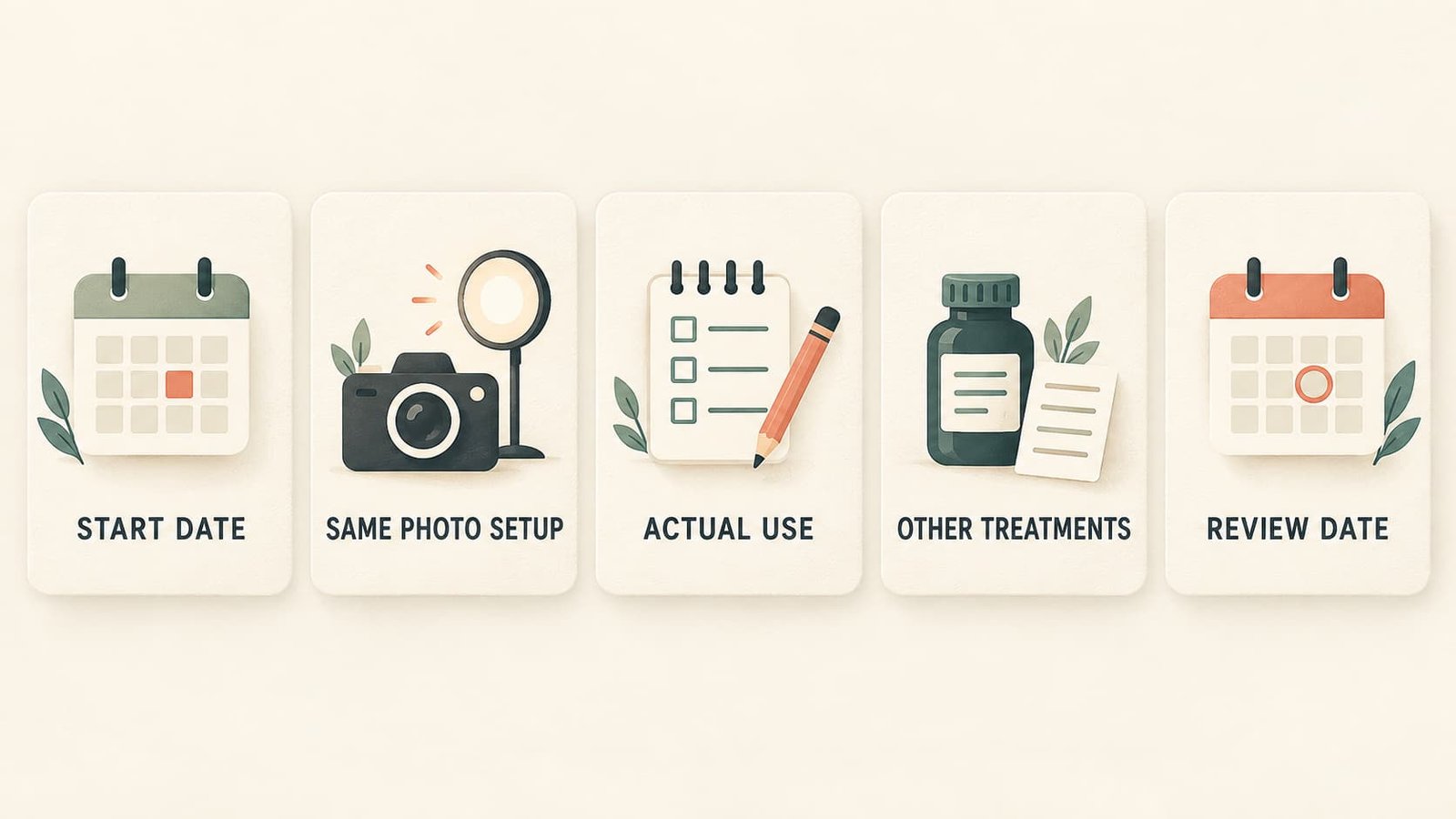
Use a simple record that you can bring to a review. It does not need to become a daily hair-counting project.
- Record your starting point. Note the start date, exact device and any diagnosis or treatment plan. If you have already begun, record the earliest reliable information instead of reconstructing missing results from memory.
- Make photographs comparable. Use the same view, parting, camera distance and lighting. Keep hair condition similar, and note a haircut, color change or use of concealing fibers. Standardized photographs were part of the RAMACAP trial’s assessment; home photographs are a practical record, not a substitute for its clinical measurements.
- Keep a brief use log. Note completed sessions, gaps and device problems. Record what you actually did, rather than only the routine you intended to follow.
- Record other changes. If medication, scalp treatment or another part of your care changes, note the date. A personal before-and-after comparison cannot isolate the device’s contribution when several things change together. Do not stop prescribed treatment to create a cleaner comparison.
- Set a review date. Agree when to reassess with the clinician managing your hair loss. If you bought directly, clarify the manufacturer’s documented assessment guidance and seek clinical advice about whether the device fits your diagnosis.
For organizing photographs, a monthly reminder can be convenient. That is a record-keeping suggestion, not a treatment interval or a promise that each month should reveal new growth.
What If You Still Cannot See a Difference?
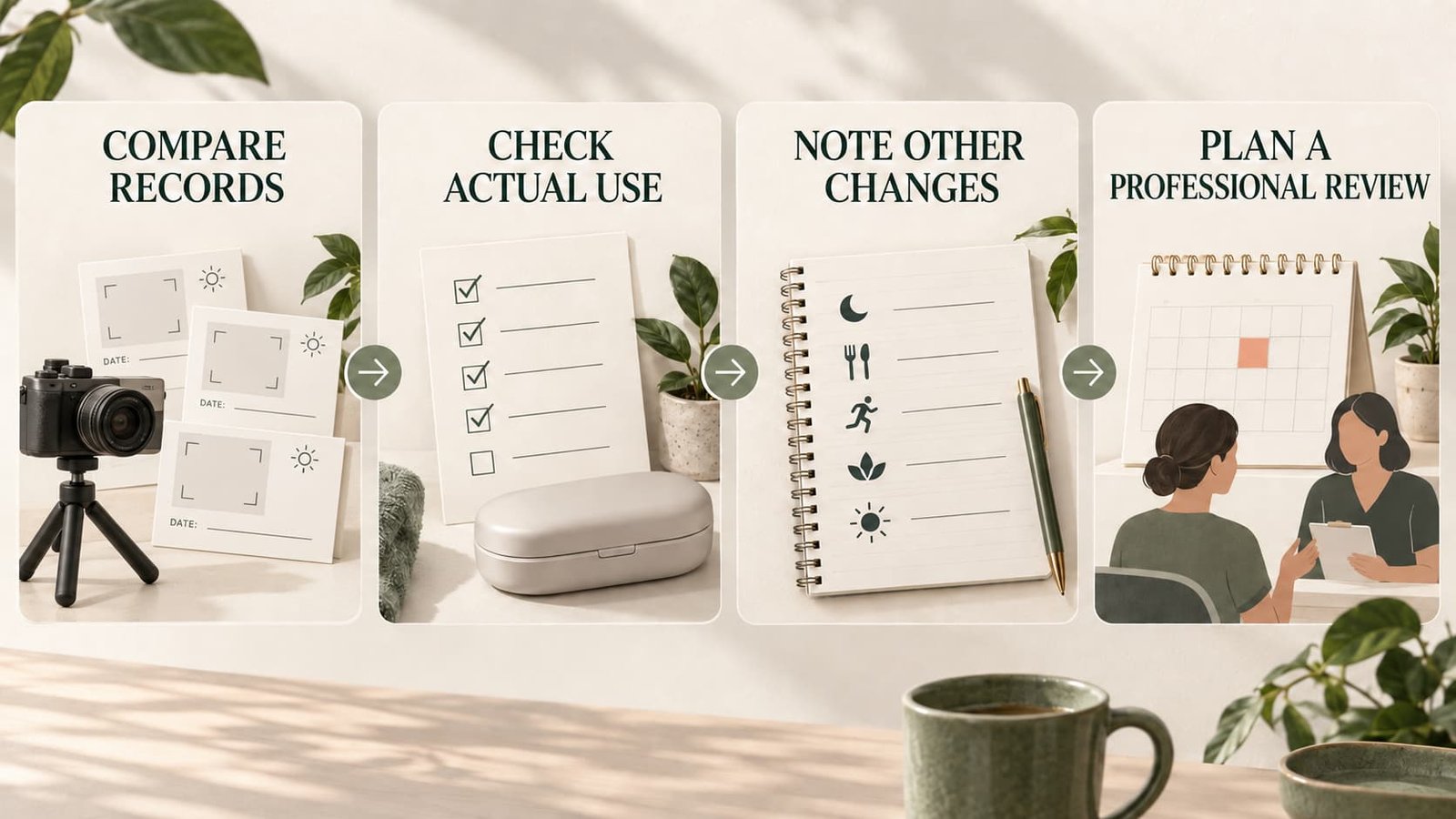
First ask what kind of uncertainty you have.
You have only a short or inconsistent record. Avoid treating that as a reliable test of success or failure. Check setup against the exact instructions, document any missed use and discuss how those gaps affect the planned review. Do not copy another brand’s session length or add sessions to “catch up.”
You have reached the planned review point with no worthwhile change. Bring your photographs and log to a dermatologist. Ask whether the original diagnosis still fits, whether there is a measurable change you cannot judge at home, and whether continuing the same approach makes sense. IL Accademia americana di dermatologia emphasizes that treatment depends on the cause and that not everyone using a home laser device sees regrowth.
The device is difficult to use or may not be working properly. Contact the manufacturer about fit, operation and service. A technical support answer can resolve an equipment question; it cannot diagnose why your hair is thinning.
You notice sudden patchy loss, significant burning, tenderness, sores or persistent scalp irritation. Seek medical assessment rather than waiting for a results milestone. IL AAD’s guide to hair-loss signs and symptoms explains that accompanying symptoms can point to different causes. If device use causes discomfort or a reaction, pause it and obtain advice rather than trying to push through.
Keep the return-policy calendar separate from the clinical review calendar. Before buying, read the seller’s actual deadline and conditions. A return window is a commercial term, not evidence of when your hair should respond.
Can You Stop Once You See an Improvement?
A study that follows people while they keep using a device cannot tell you exactly how long any benefit lasts after they stop. IL 48-week LG-device study was not a withdrawal study. It does not establish a universal maintenance frequency or a countdown to losing results.
If you are pleased with a change, discuss ongoing use and reassessment with your clinician and consult your exact device’s instructions. Do not infer a permanent result—or invent a reduced schedule—from the fact that a trial has ended.
A Useful Next Step
Write down your start date, dispositivo, actual use, other treatments and the change you hope to evaluate. Add comparable photographs and a planned review date. That gives you a basis for a decision beyond “I have waited long enough” or “the website says to keep going.”
For a broader explanation of what published research can support, read our guide to LLLT hair-loss evidence and its limits.
This article provides general education, not a diagnosis or an individualized treatment plan.
Riferimenti
-
1
Jimenez JJ, et al. Efficacia e sicurezza di un dispositivo laser a bassa potenza nel trattamento della caduta dei capelli maschile e femminile: Un multicentro, Randomizzato, Sham Controllato dal dispositivo, Studio in doppio cieco . American Journal of Clinical Dermatology. 2014;15:115–127.
-
2
Suchonwanit P, Chalermroj N, Khunkhet S. Low-level laser therapy for the treatment of androgenetic alopecia in Thai men and women: a 24-week, randomizzato, in doppio cieco, sham device-controlled trial . Laser nella scienza medica. 2019;34:1107–1114.
-
3
Shin JW, et al. Long-Term Efficacy and Safety of Low-Level Laser Therapy for Androgenetic Alopecia: A 12-Month Prospective Trial . Dermatologic Therapy. 2026;6621458. Nonrandomized, uncontrolled study; manufacturer-funded.
-
4
van Zuuren EJ, Fedorowicz Z, Schoones J. Interventi per la caduta dei capelli femminile . Database Cochrane di revisioni sistematiche. 2016;(5):CD007628.
-
5
Accademia americana di dermatologia. Perdita dei capelli: Diagnosis and treatment . Professional-association patient education.
-
6
Accademia americana di dermatologia. Perdita dei capelli: Signs and symptoms . Professional-association patient education.
-
7
Perez S.M., et al. Terapia laser e LED a basso livello nell'alopecia: Una revisione sistematica e una meta-analisi . Chirurgia dermatologica. 2025;51(2):179–183. Abstract used for evidence scope.