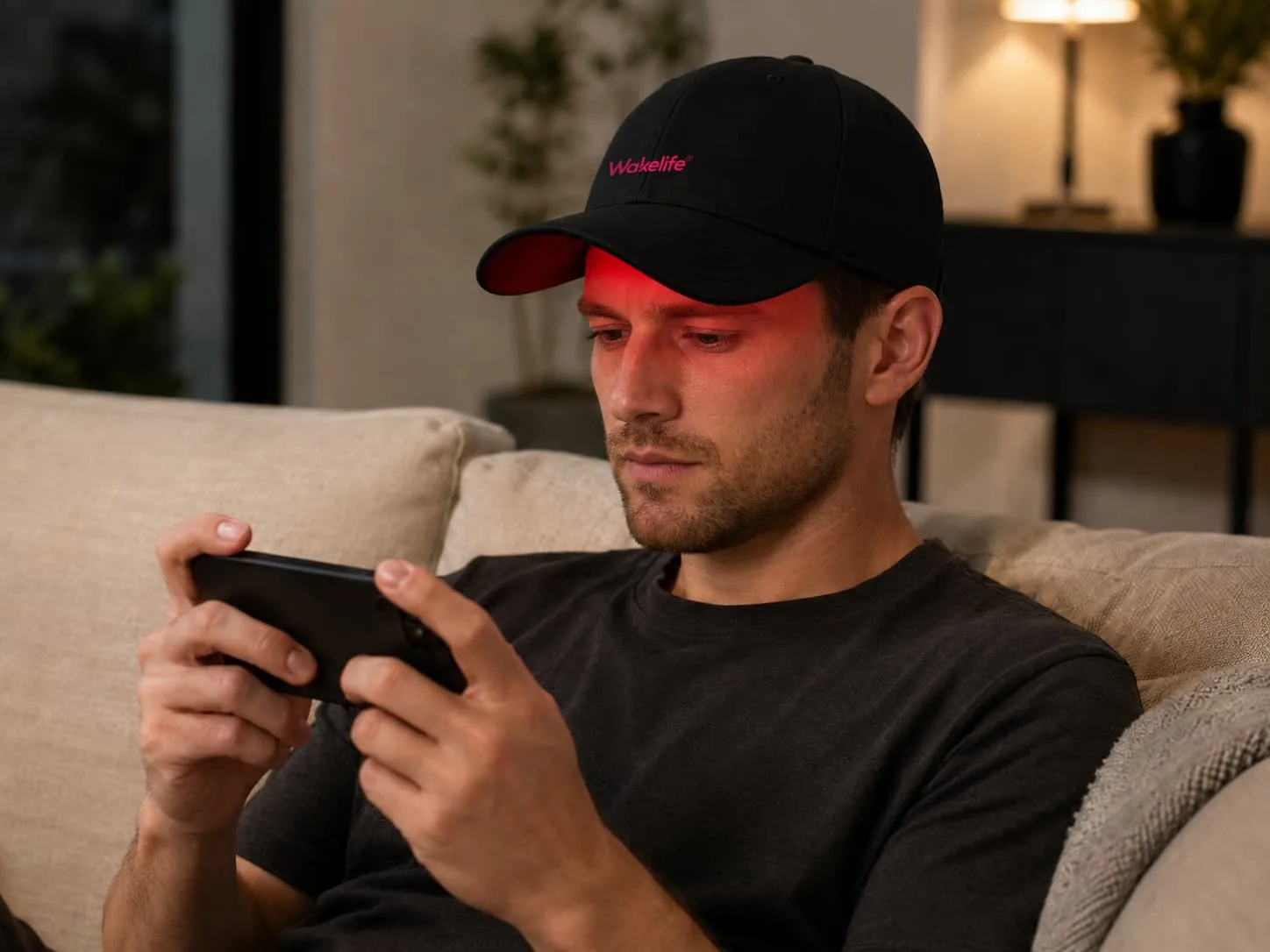
Diode électroluminescente (DIRIGÉ) la photothérapie est passée de la dermatologie clinique aux soins de beauté professionnels et aux soins de la peau à domicile. Pourtant, derrière chaque masque facial à LED, panneau, ou l'appareil portable se trouve sur un seul, choix d'ingénierie décisif: longueur d'onde. Le nanomètre (nm) la valeur imprimée sur une fiche technique n'est pas un numéro marketing - elle détermine la profondeur de pénétration de la lumière, quelles voies cellulaires il active, et si un dispositif est admissible à une autorisation médicale telle que la FDA 510(k).
Cet article de référence explique les dix longueurs d'onde étudiées cliniquement et utilisées dans les appareils de thérapie LED modernes., les preuves évaluées par les pairs derrière chaque, et quelle FDA 510(k) autorisation - y compris l'autorisation récemment émise K250830 - signifie en fait pour les marques qui s'approvisionnent en produits OEM/ODM. Il est écrit pour les chefs de produit, équipes réglementaires, distributeurs, et les professionnels de l'esthétique qui ont besoin d'une maîtrise pratique de la science, pas d'allégations marketing.
1. La science: Comment la lumière LED interagit avec la peau
Photothérapie LED – également connue sous le nom de photobiomodulation (PBM) ou luminothérapie de faible intensité (Lllt) — fonctionne par absorption non thermique des photons. Lorsqu'un photon de longueur d'onde correcte est absorbé par un chromophore à l'intérieur du tissu cutané (plus important encore, la cytochrome c oxydase dans la chaîne respiratoire mitochondriale), il déclenche une cascade d'événements intracellulaires: augmentation de la synthèse d'ATP, espèces réactives de l'oxygène modulées (ROS), et altération de l'expression des gènes liée à l'inflammation, prolifération, et remodelage de la matrice extracellulaire.1
Trois principes régissent chaque décision de longueur d'onde dans la conception d'appareils LED:
- Spécificité d'absorption — différents chromophores (porphyrines, mélanine, hémoglobine, eau, cytochrome c oxydase) absorber la lumière aux pics caractéristiques.
- Profondeur de pénétration — des longueurs d'onde plus longues dans le rouge et le proche infrarouge (Nir) la gamme pénètre plus profondément dans le derme et les tissus sous-cutanés que les longueurs d'onde bleues plus courtes.2
- Réponse à la dose — les effets biologiques suivent une courbe de dose biphasique: trop peu d'énergie ne produit aucun effet, tandis qu'une énergie excessive peut inhiber la réponse souhaitée.
Ces trois principes expliquent pourquoi la sélection de la longueur d’onde ne s’improvise pas. Chaque plage nanométrique est adaptée à un objectif clinique spécifique.
2. Longueur d'onde par longueur d'onde: Ce que montrent réellement les preuves
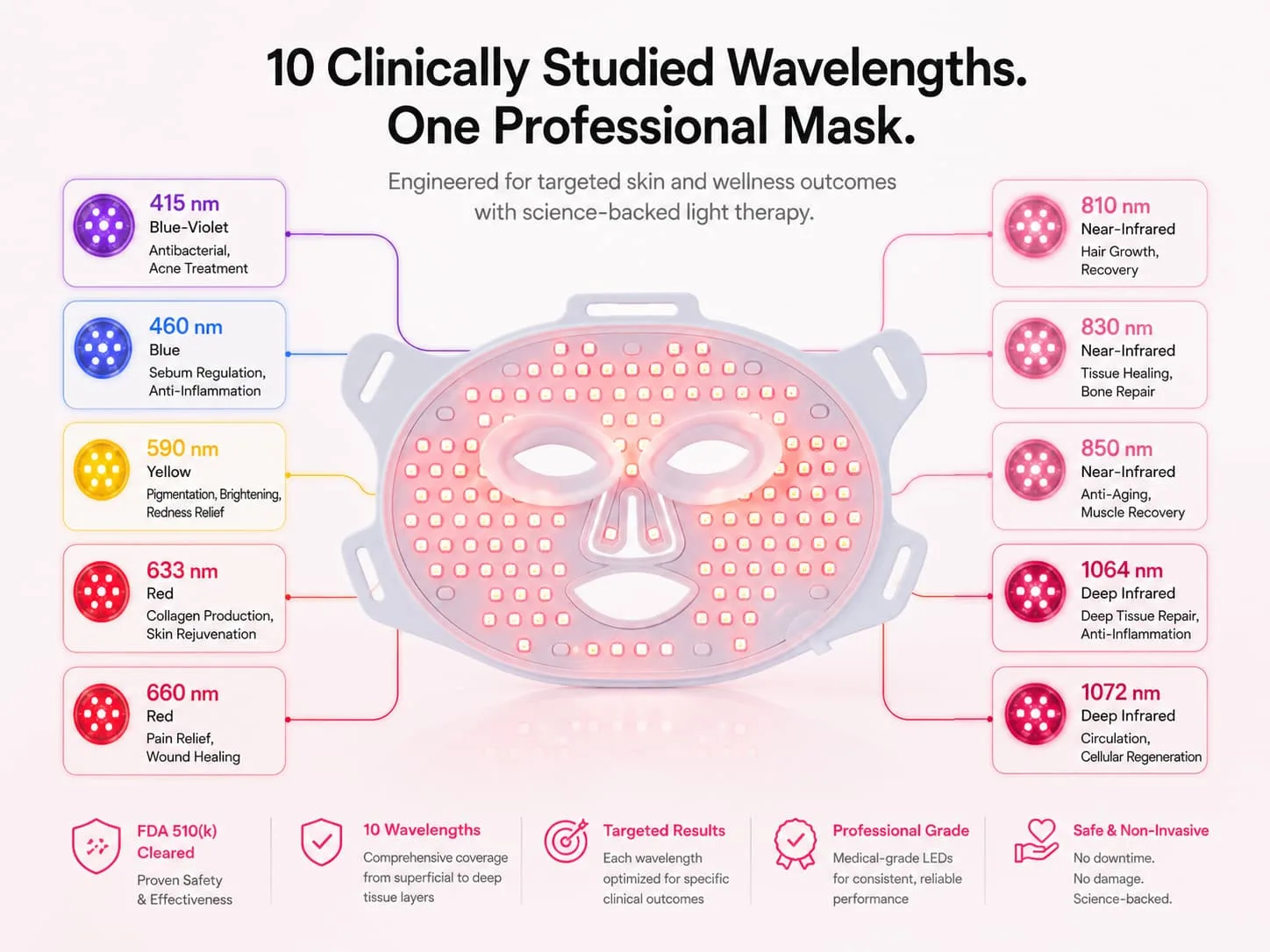
415 nm — Bleu-Violet (Antibactérien, Acné)
Le 415 La bande nm est absorbée par les porphyrines endogènes (principalement la coproporphyrine III) produit par Cutibactérie acnés (anciennement Propionibacterium acnes). L'absorption génère de l'oxygène singulet qui perturbe la bactérie de l'intérieur, produisant un effet antimicrobien non antibiotique.3 Des essais cliniques de 415 nm monothérapie et 415 nm + 633 Les protocoles de combinaison nm ont démontré des réductions significatives du nombre de lésions inflammatoires d'acné sur une période de 4 à 12 semaines..4 5 UN 2019 revue systématique dans Annales de médecine familiale a conclu que la photothérapie à la lumière bleue est un complément cliniquement viable pour l'acné vulgaire légère à modérée.6
Pénétration: ~1 mm (épiderme et derme papillaire supérieur uniquement).
460 nm — Bleu (Régulation du sébum, Anti-inflammatoire)
Un peu plus long que 415 nm, 460 nm pénètre légèrement plus profondément tout en conservant les propriétés antibactériennes. Il est souvent utilisé pour réguler le sébum et comme longueur d’onde apaisante pour les peaux enflammées.. Parce que les deux 415 nm et 460 nm se situe dans la plage bleue visible, dispositifs destinés aux zones ophtalmiques adjacentes (masques, masques pour les yeux) doit contrôler soigneusement l'irradiation pour rester dans les seuils de sécurité de la lumière bleue rétinienne définis par la CEI 62471.
590 nm — Jaune (Pigmentation, Éclaircissement, Rougeur)
Feu jaune à 590 nm est absorbé par l'hémoglobine et est largement utilisé pour réduire l'érythème post-inflammatoire, rougeur diffuse, et des irrégularités mineures de pigmentation. Il a également un rôle documenté dans l'apaisement des peaux sensibilisées après l'intervention et est fréquemment incorporé dans la PDT. (thérapie photodynamique) protocoles pour la kératose actinique comme longueur d'onde supplémentaire.7
633 nm — Rouge (Collagène, Rajeunissement de la peau)
633 nm est la longueur d’onde la plus étudiée en dermatologie LED. Weiss et coll.. démontré que 633 La photomodulation LED nm régule positivement l'activité des fibroblastes et la synthèse du pro-collagène tout en réduisant simultanément la métalloprotéinase-1 matricielle (MMP-1) expression - l'enzyme responsable de la dégradation du collagène.8 Ce double mécanisme est à la base de presque toutes les allégations « anti-âge » associées à la thérapie par la lumière rouge..9
Pénétration: ~ 2–3 mm (derme réticulaire).
660 nm — Rouge (Soulagement de la douleur, Guérison des plaies)
660 nm partage beaucoup de 633 Les effets du nm mais pénètrent légèrement plus profondément et sont plus fréquemment cités dans la littérature sur la cicatrisation des plaies et les douleurs musculo-squelettiques.. Des études in vitro montrent 660 nm module la prolifération des fibroblastes et influence la signalisation des ROS à des fluences cliniquement pertinentes.10 La plupart des appareils modernes au format panneau et ceinture combinent 660 nm avec une longueur d'onde NIR telle que 850 nm pour traiter à la fois les couches de tissus superficiels et profonds en une seule séance.
810 nm — Proche infrarouge (Croissance des cheveux, Récupération)
810 nm pénètre au-delà du derme dans la couche sous-cutanée et est largement utilisé dans la thérapie laser de faible intensité (Lllt) protocoles de récupération après un traumatisme, modulation neuronale, et stimulation folliculaire. C'est également l'une des longueurs d'onde standard pour la recherche sur la photobiomodulation transcrânienne..
830 nm — Proche infrarouge (Guérison des tissus, Réparation osseuse)
830 nm a des effets documentés sur l'activité des ostéoblastes, drainage lymphatique, et récupération post-chirurgicale. C'est la longueur d'onde la plus fréquemment citée dans les protocoles LED périopératoires utilisés dans les cliniques de chirurgie plastique pour la réduction des ecchymoses et la fermeture accélérée des plaies..
850 nm — Proche infrarouge (Anti-âge, Récupération musculaire)
850 nm est la longueur d'onde NIR la plus populaire dans les panneaux grand public à lumière rouge en raison de son équilibre favorable entre la profondeur de pénétration (~5 à 6 mm dans le tissu sous-cutané) et efficacité des LED au niveau de la puce. L’essai contrôlé de Wunsch et Matuschka a démontré des améliorations mesurables de la rugosité de la peau, profondeur des rides, et la densité intradermique du collagène lorsque 850 nm a été combiné avec des longueurs d'onde rouges dans un protocole polychromatique.11
1064 nm — Infrarouge profond (Pigment, Modulation adipeuse)
1064 nm atteint la longueur d'onde la plus profonde de toutes les LED non thermiques en utilisation clinique et est associé à la modulation adipeuse et au ciblage sélectif des pigments dans les protocoles laser. Au format LED (non cohérent), 1064 nm est utilisé à une irradiation plus faible pour le conditionnement général des tissus profonds.
1072 nm — Infrarouge profond (Barrière cutanée, Anti-rides)
1072 nm a une empreinte de recherche spécifique dans la gestion de l'herpès simplex et la récupération de la barrière cutanée. Il s'agit de l'une des longueurs d'onde les plus spécialisées et elle est généralement configurée dans des systèmes professionnels à plusieurs longueurs d'onde plutôt que dans des appareils grand public à longueur d'onde unique..
3. Pourquoi les appareils à plusieurs longueurs d'onde surpassent les appareils à longueur d'onde unique
UN 2008 une étude menée par Sadick a démontré que la combinaison des longueurs d'onde rouges et infrarouges produit des améliorations mesurables plus importantes des ridules et de la texture de la peau que l'une ou l'autre longueur d'onde seule.12 Ceci est cohérent avec la littérature plus large sur la photobiomodulation: différentes longueurs d'onde atteignent différentes profondeurs de tissus et activent différents chromophores, donc un protocole polychromatique couvre plus de terrain biologique par séance.13
Cependant, « plus de longueurs d’onde » n’est pas automatiquement meilleur. Trois compromis techniques s'appliquent:
- L'irradiation totale doit rester dans des plages sûres et efficaces — généralement 30 à 100 mW/cm² à la surface de la peau.
- Chaque longueur d'onde doit délivrer une dose cliniquement significative — l'ajout d'un nombre symbolique de LED à une longueur d'onde « bonus » produit rarement la dose requise pour l'effet biologique.
- Le pilote et l'architecture thermique doivent prendre en charge la configuration — les appareils multi-longueurs d'onde nécessitent un contrôle de canal indépendant pour éviter de mélanger les longueurs d'onde dans des moyennes inefficaces.
C'est pourquoi deux appareils commercialisés avec des étiquettes de longueur d'onde identiques peuvent produire des résultats cliniques très différents.. La parité des fiches techniques n'est pas la même chose que la parité des performances.
4. Profondeur de pénétration: Une référence pratique
| Longueur d'onde | Profondeur de pénétration approximative | Couche cible principale |
|---|---|---|
| 415 nm | ~1 mm | Épiderme |
| 460 nm | ~1 à 1,5 mm | Épiderme |
| 590 nm | ~1,5 à 2 mm | Derme papillaire |
| 633 nm | ~ 2–3 mm | Derme réticulaire |
| 660 nm | ~3mm | Derme réticulaire |
| 810 nm | ~4 à 5 mm | Sous-cutané |
| 830 nm | ~5mm | Sous-cutané |
| 850 nm | ~5-6 mm | Sous-cutané |
| 1064 nm | ~6 à 8 mm | Sous-cutané profond |
| 1072 nm | ~6 à 8 mm | Sous-cutané profond |
Les valeurs de pénétration sont approximatives et dépendent du type de peau, hydratation, irradiance, et géométrie des poutres.2
5. Irradiance, Dose, et la courbe biphasique
La longueur d’onde seule ne détermine pas le résultat. Deux paramètres supplémentaires ont le même poids:
- Irradiance (MW / CM²) — la densité de puissance à la surface de la peau. La plupart des protocoles cliniques de LED fonctionnent entre 30 et 100 MW / CM². Les masques LED grand public de Wakelife offrent 60+ mW/cm² à la surface faisant face à la peau, mesuré à une distance de travail calibrée.
- Maîtrise (J/cm²) — l'énergie totale fournie par unité de surface, calculé comme irradiance × temps. Les protocoles les plus publiés se regroupent entre 3 et 60 J/cm² selon indication et profondeur cible.
Le dose-réponse biphasique décrit par Hamblin et d'autres signifie que doubler le temps d'exposition ne double pas le résultat.14 Au-delà d'une fenêtre optimale, une exposition supplémentaire peut supprimer la voie même que le traitement est censé activer. C'est pourquoi la conception responsable des appareils inclut des minuteries et des plafonds d'irradiation intégrés plutôt que des commandes ouvertes « plus c'est mieux ».
6. Indications cliniques et logique de sélection de la longueur d'onde
| Indication | Longueur d'onde primaire | Longueur d'onde complémentaire |
|---|---|---|
| Acné inflammatoire | 415 nm | 633 nm |
| Préchauffage / ridules | 633 nm | 850 nm |
| Érythème post-opératoire | 590 nm | 633 nm |
| Irrégularités pigmentaires | 590 nm | 633 nm |
| Guérison des plaies | 660 nm | 830 nm |
| Repousse des cheveux | 650 nm | 850 nm |
| Récupération articulaire et musculaire | 660 nm | 850 nm |
| Ridules périorbitaires | 633 nm | 850 nm |
Cette matrice n'est pas un protocole de traitement — c'est une carte longueur d'onde-indication pour la planification du produit. Les protocoles cliniques finaux doivent toujours être validés par rapport aux preuves publiées et, le cas échéant, portée de l'autorisation réglementaire.
7. Quelle FDA 510(k) Le dédouanement signifie en réalité
FDA 510(k) l'autorisation est une soumission préalable à la commercialisation démontrant qu'un appareil est substantiellement équivalent à un dispositif principal commercialisé légalement. Il ne s'agit pas d'une preuve d'efficacité au sens familier du terme ; il s'agit d'une constatation réglementaire selon laquelle le dispositif est aussi sûr et efficace que son prédicat pour l'indication autorisée..
Pour les appareils de photothérapie LED, les indications effacées sous 510(k) correspondent généralement au code produit RHN (lampe infrarouge à usage médical) ou ILI (instrument chirurgical laser alimenté par la lumière), en fonction de la classification de l'appareil.
Une autorisation récente représentative - FDA 510(k) K250830 — illustre la structure d'une soumission de masque facial LED: longueurs d'onde définies, plages d'irradiation définies, durées de traitement définies, et une indication étiquetée cohérente avec le prédicat. Les marques qui s'approvisionnent en produits OEM/ODM doivent vérifier trois points avant de s'appuyer sur une autorisation:
- Le titulaire de l'autorisation enregistré — le fabricant légal nommé dans le 510(k) est l'entité que la FDA tient pour responsable. Les clients OEM bénéficient d'une relation d'approvisionnement structurée séparément qui doit être documentée.
- L’indication d’utilisation autorisée — les allégations marketing doivent rester dans les limites de l'indication autorisée. Allégations hors AMM (Par exemple, « traite la rosacée » alors que seules les « affections dermatologiques générales » ont été éliminées) créer une exposition réglementaire.
- La configuration testée — nombre de longueurs d'onde, Comptage des LED, irradiance, et la durée du traitement soumis dans le 510(k) définir le périphérique effacé. Des changements importants peuvent nécessiter un nouveau 510(k) sous la FDA 2017 conseils.16 17
Il convient également de noter qu'à compter de février 2026, Règlement sur le système de gestion de la qualité de la FDA (QMSR) remplacera l'héritage 21 Partie CFR 820, harmoniser les exigences américaines avec celles de l'ISO 13485.15 Les fabricants opérant déjà sous ISO 13485 (Wakelife inclus) sont structurellement positionnés pour cette transition.
8. De la spécification à la production: Quelles marques devraient vérifier
Avant d'approuver un Projet OEM/ODM pour la production, les marques doivent demander – et examiner – la documentation suivante:
- Rapports de mesures spectrales — longueur d'onde maximale, pleine largeur à moitié maximum (FWHM), et pureté spectrale par bac LED.
- Rapports photométriques — irradiation à distance de travail, uniformité sur toute la surface de traitement, et angle de faisceau.
- Rapports de sécurité photobiologique — CEI 62471 classification du groupe de risque, en particulier pour les appareils à longueur d'onde bleue.
- Rapports CEM et sécurité électrique — CEI 60601-1 Et IEC 60601-1-2 pour appareils de qualité médicale, IEC 62368-1 pour les appareils grand public.
- Rapports de biocompatibilité -ISO 10993 pour tous les matériaux en contact avec la peau, surtout les masques en silicone.
- Documentation du système qualité -ISO 13485 portée de la certification et couverture MDSAP applicable.
Wakelife fournit chacun de ces rapports sous forme de livrables standard pour les partenaires OEM/ODM, à côté de l'appareil lui-même. Il s'agit de la couche de documentation qui distingue un partenaire de fabrication réglementé d'un fournisseur générique..
9. Résumé: Un cadre de travail pour les décisions en matière de longueur d'onde
Lors de l'évaluation d'un Produit de thérapie LED — qu'il s'agisse de sourcing pour une marque, préciser pour une clinique, ou concevoir un nouvel appareil - appliquez ce cadre en cinq étapes:
- Définir d’abord l’objectif clinique. La longueur d'onde suit l'indication, pas l'inverse.
- Sélectionnez des longueurs d'onde avec des preuves évaluées par des pairs à la profondeur du tissu cible. La profondeur de pénétration doit correspondre à la couche où vit le chromophore.
- Vérifier l'irradiation et la fluence sur la surface faisant face à la peau. Le « nombre de LED » à lui seul ne constitue pas une mesure de performance.
- Confirmer que la portée réglementaire correspond aux allégations marketing. Indication effacée, pas une copie ambitieuse, définit ce qui peut licitement être dit.
- Exiger une documentation complète du fabricant. Spectral, photométrique, photobiologique, EMC, et les rapports de biocompatibilité ne sont pas négociables.
Appliqué de manière cohérente, ce cadre sépare les produits fondés sur des preuves des produits de qualité marketing et protège à la fois les utilisateurs finaux et les marques qui les servent..
10. À propos de Wakelife
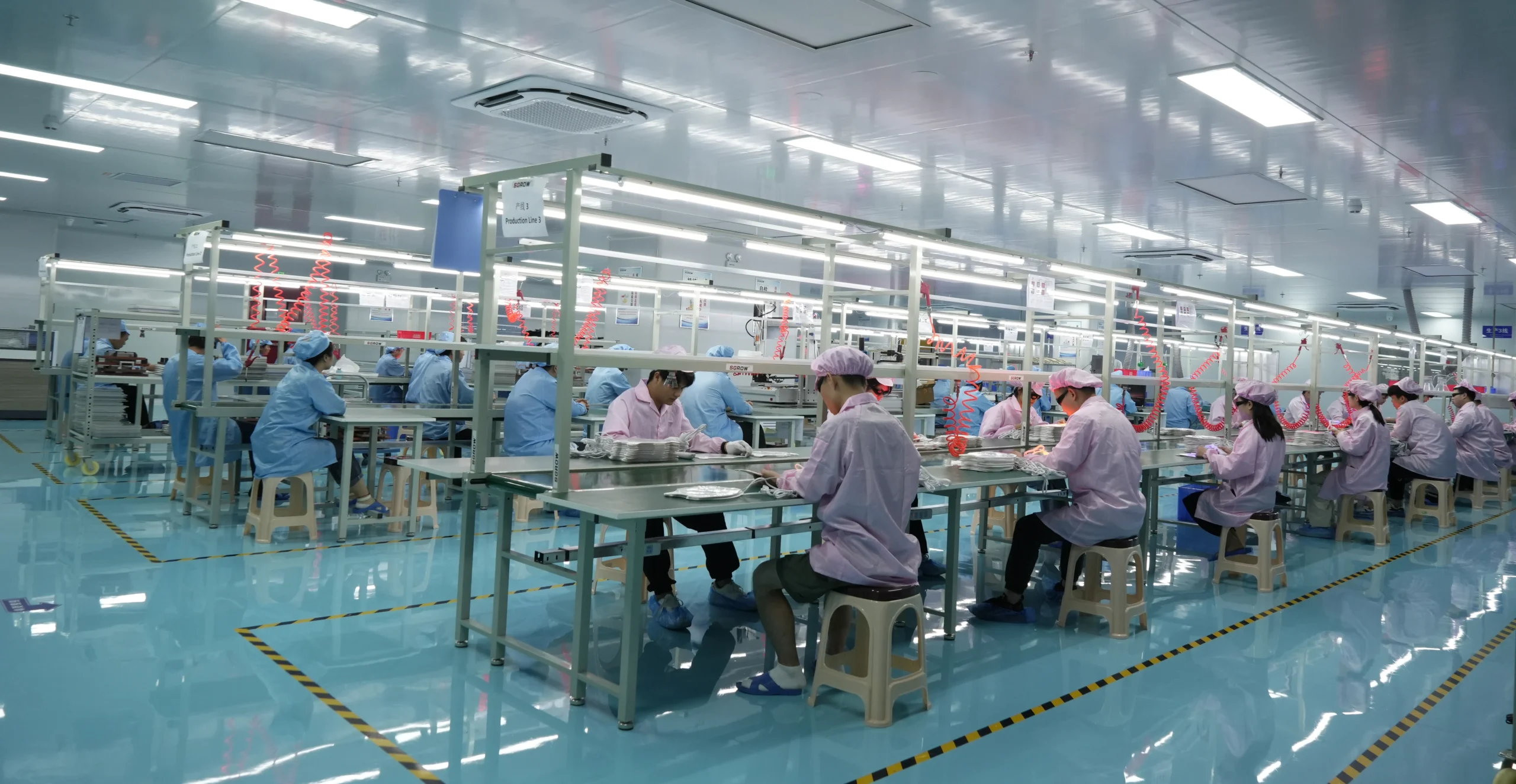
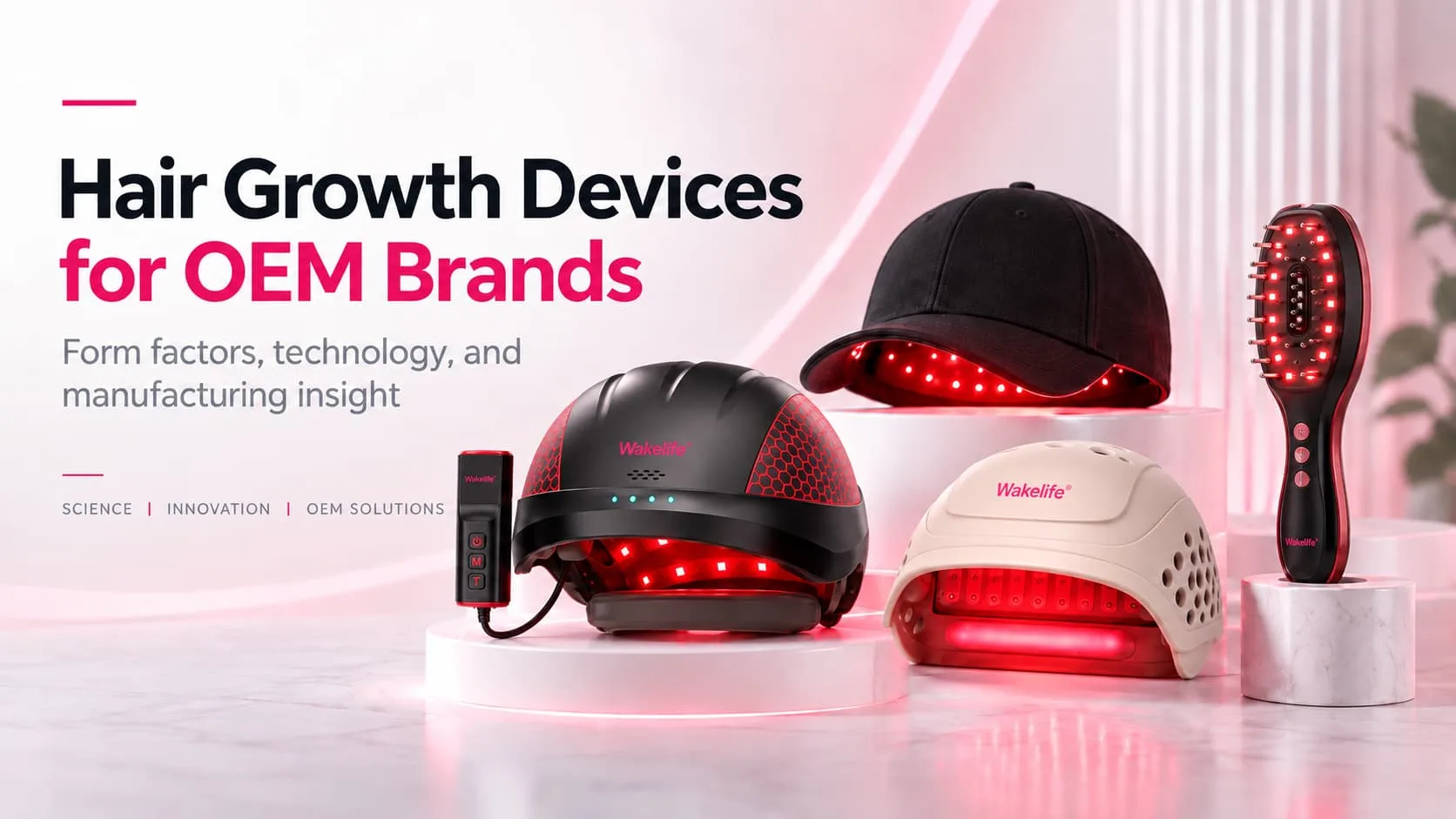
Wakelife est la division de beauté professionnelle de Shenzhen Sungrow LED Technology Co., Ltd., un fabricant dédié à la thérapie par la lumière rouge fondé en 2015. Fonctionnant à partir de deux ISO 13485 et des installations certifiées MDSAP totalisant 20,000 m² à Shenzhen, Wakelife développe et produit des masques LED, panneaux de lumière rouge, Systèmes PDT, masques pour les yeux, appareils pour la pousse des cheveux, dispositifs de soins ciblés, appareils de thérapie par la lumière rouge et ceintures de thérapie pour les marques de beauté professionnelles dans plus de 100 pays.
Pour les spécifications techniques, rapports photométriques, ou demandes de renseignements OEM/ODM, voir notre fabrication et R&Capacités D ou contactez directement notre équipe d'ingénierie. Informations supplémentaires sur les produits Wakelife dans tous 9 Les gammes de produits de thérapie LED sont disponibles sur notre page de présentation du produit.
Références
1. Karu T.I.. Signalisation mitochondriale dans les cellules de mammifères activée par le rayonnement rouge et proche IR. Photochem Photobiol. 2008;84(5):1091-1099.
2. Cendre C, Dubec M., Donne K., Bashford T.. Effet de la longueur d'onde et de la largeur du faisceau sur la pénétration dans l'interaction lumière-tissu à l'aide de méthodes informatiques. Lasers Med Sci. 2017;32(8):1909-1918.
3. Ashkénaze H, Malik Z, Harth Y., Nitzan Y.. Eradication de Propionibacterium acids par ses porphyrines endogènes après illumination par lumière bleue de haute intensité. FEMS Immunol Med Microbiol. 2003;35(1):17-24.
4. DJ Goldberg, Russell BA. Combinaison bleue (415 nm) et rouge (633 nm) Photothérapie LED dans le traitement de l'acné vulgaire légère à sévère. J Cosmet Laser Ther. 2006;8(2):71-75.
5. Lee SY, Vous CE, Garer MON. Photothérapie LED combinée à lumière bleue et rouge pour l'acné vulgaire chez les patients présentant un phototype cutané IV. Lasers Surg Med. 2007;39(2):180-188.
6. Scott AM, Stehlik P., Clark J, et autres. Thérapie à la lumière bleue pour l'acné vulgaire: une revue systématique et une méta-analyse. Ann Fam Med. 2019;17(6):545-553.
7. Opel DR, Hagstrom E., Rythme et, et autres. Diodes électroluminescentes: Un bref examen et une expérience clinique. J Clin Aesthet Dermatol. 2015;8(6):36-44.
8. Weiss RA, McDaniel DH, Géronemus RG, Weiss MA. Expérience clinique avec les diodes électroluminescentes (DIRIGÉ) photomodulation. Chirurgie Dermatol. 2005;31(9 Pt 2):1199-1205.
9. Barolet D. Diodes électroluminescentes (LEDS) en dermatologie. Chirurgie médicale semi-coupée. 2008;27(4):227-238.
10. Lev-Tov H, Mammifères A, Brody N., Joint D, Jagdeo J.. Inhibition de la prolifération des fibroblastes in vitro à l'aide de diodes électroluminescentes rouges. Chirurgie Dermatol. 2013;39(8):1167-1170.
11. Souhait A, Matuschka K.. Un essai contrôlé pour déterminer l'efficacité du traitement par la lumière rouge et proche infrarouge sur la satisfaction des patients, réduction des ridules, rides, rugosité de la peau, et augmentation de la densité intradermique du collagène. Chirurgie Laser Photomed. 2014;32(2):93-100.
12. Sadick N.-É.. Une étude visant à déterminer l'efficacité d'un nouveau dispositif portatif à diode électroluminescente dans le traitement de la peau photovieillie. J Cosmet Dermatol. 2008;7(4):263-267.
13. Avc P, Gupta A., Sadasivam M, et autres. Laser de bas niveau (lumière) thérapie (Lllt) dans la peau: stimulant, guérison, restauration. Chirurgie médicale semi-coupée. 2013;32(1):41-52.
14. Hamblin MR. Mécanismes et applications des effets anti-inflammatoires de la photobiomodulation. AIMS Biophysique. 2017;4(3):337-361.
15. NOUS. Food and Drug Administration. Dispositifs médicaux; Modifications du règlement sur le système qualité (Règle finale du QMSR), 89 FR 7496. En vigueur en février 2, 2026.
16. NOUS. Food and Drug Administration. Décider quand soumettre un 510(k) pour une modification d'un dispositif existant — Conseils destinés à l'industrie et au personnel de la FDA. Octobre 25, 2017.
17. NOUS. Food and Drug Administration. Décider quand soumettre un 510(k) pour une modification logicielle d'un appareil existant — Conseils destinés à l'industrie et au personnel de la FDA. Octobre 25, 2017.