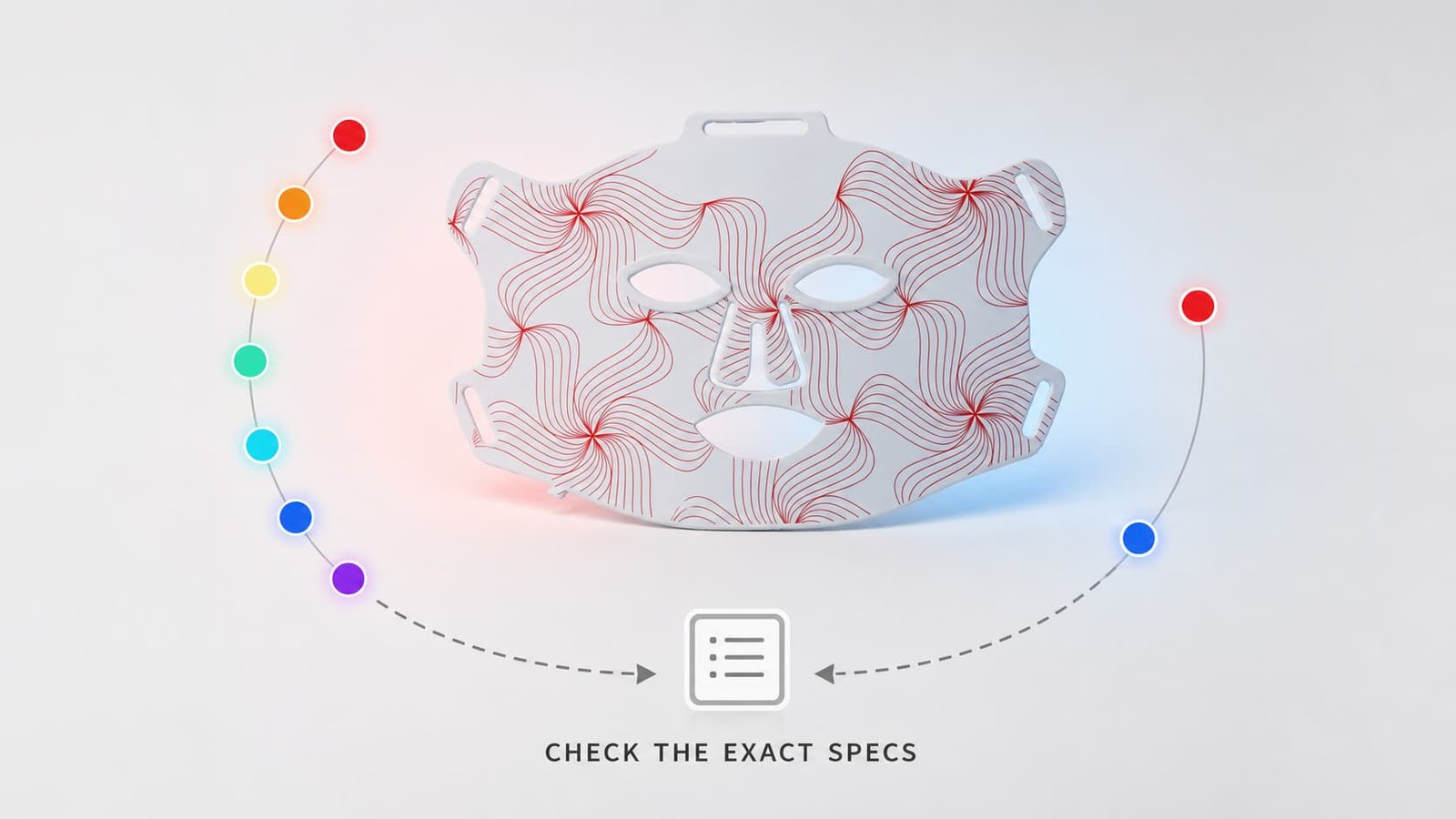
Réponse courte: Un masque LED à 7 couleurs n'est pas automatiquement meilleur et ce n'est pas l'opposé d'un masque rouge et bleu, parce que le rouge et le bleu peuvent être deux de ses sept modes. Choisissez en fonction de votre préoccupation principale et en fonction de l'étiquetage et des preuves de l'appareil exact. Un masque rouge/bleu focalisé peut être plus facile à évaluer lorsque ce sont les seuls modes dont vous avez besoin. Choisissez un modèle à 7 couleurs uniquement lorsque ses modes supplémentaires ont des spécifications claires, instructions, et une prise en charge spécifique à l'appareil, pas seulement un nuancier attrayant.
Note médicale: Cet article fournit une éducation générale aux consommateurs, pas un avis médical. Les masques LED varient dans l'utilisation prévue, statut réglementaire, sortir, avertissements, exigences en matière de protection oculaire, et protocole de traitement. Suivez l'étiquetage de votre appareil exact. Demandez des conseils médicaux qualifiés pour les médicaments qui augmentent la sensibilité à la lumière, affections cutanées sensibles à la lumière ou actives, procédures récentes, acné incertaine, ou des effets indésirables.
Un masque à 7 couleurs est-il vraiment différent d'un masque rouge et bleu?
Les étiquettes se chevauchent: un masque à 7 couleurs peut déjà contenir des modes rouge et bleu. « 7 couleurs » décrit le nombre de noms de couleurs ou de modes qu'un vendeur présente. "Rouge et bleu" décrit deux longueurs d'onde ou modes inclus dans l'appareil. Il ne s’agit pas de deux catégories technologiques clairement séparées.
| Etiquette sur le produit | Ce que l'étiquette peut vous dire | Ce que cela ne prouve pas |
|---|---|---|
| 7-masque LED couleur | L'interface ou les instructions présentent sept modes de couleur ou de lumière mixte | Sept longueurs d'onde vérifiées indépendamment, sortie égale dans tous les modes, ou sept résultats cliniquement étayés |
| Masque LED rouge et bleu | L'appareil comprend une lumière rouge et bleue, séparément ou dans un protocole combiné | Les longueurs d'onde exactes, si le proche infrarouge est inclus, quelle quantité de lumière atteint la peau, ou pour lequel l'appareil est étiqueté pour |
| Violet, blanc, cyan, ou un autre mode nommé | Le fabricant a attribué un nom à un paramètre | Quels émetteurs sont actifs, si le mode est une couleur mélangée ou une longueur d'onde distincte, ou quelle preuve s'applique |
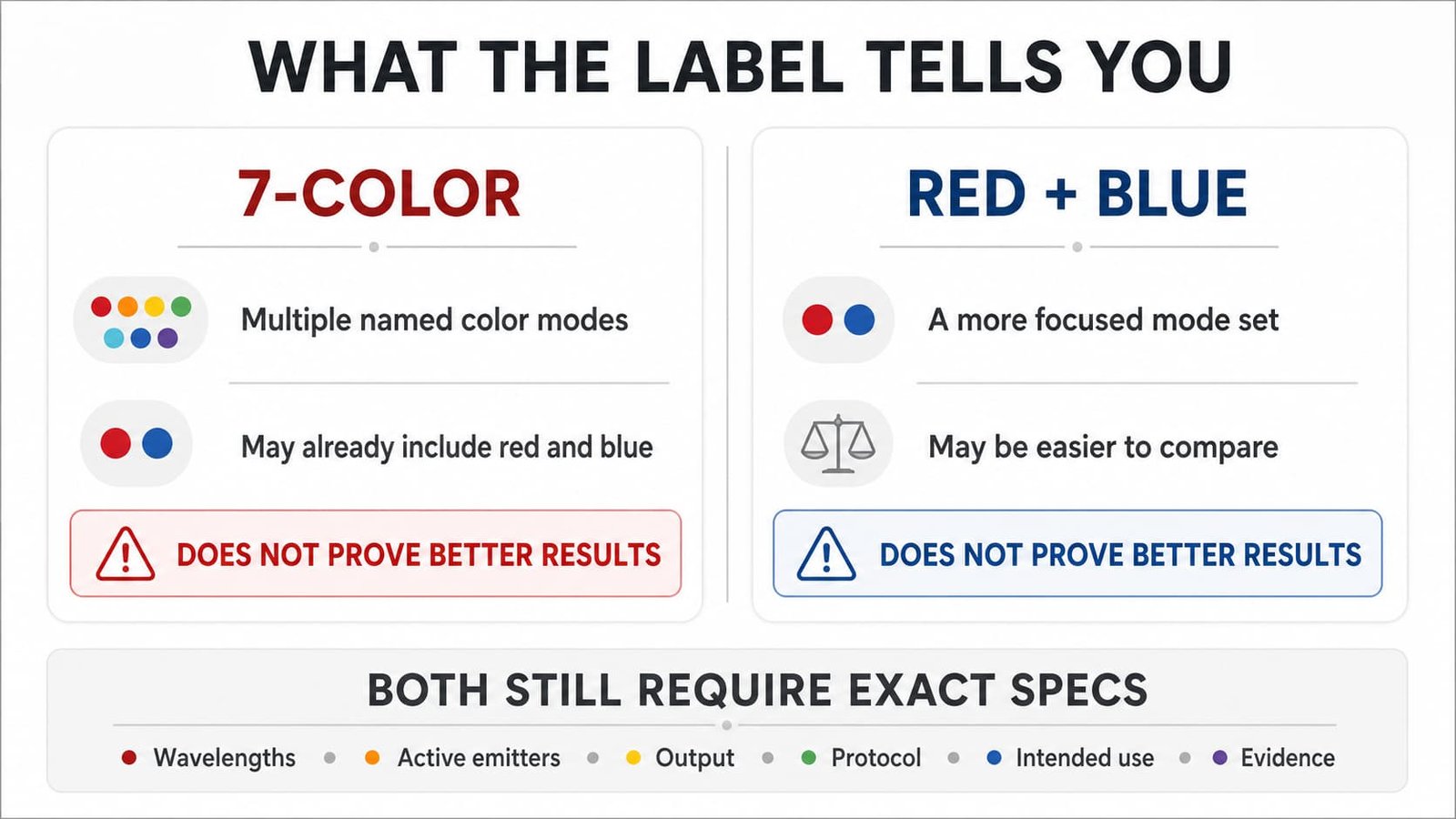
Cette distinction est importante car un nom de mode n'est pas une spécification technique. Un produit peut utiliser « violet » pour le rouge et le bleu fonctionnant ensemble; un autre peut utiliser le même mot différemment. « Blanc » peut décrire plusieurs LED visibles fonctionnant ensemble plutôt qu'une seule longueur d'onde thérapeutique.. La documentation du produit (et non la vignette de couleur dans une publicité) doit identifier ce que le mode émet réellement..
Quelle configuration correspond à votre objectif principal?
Choisissez le plus petit ensemble de modes bien documentés qui correspond à votre objectif principal. Des modes supplémentaires peuvent être utiles, mais seulement lorsque vous savez de quoi il s'agit et que vous avez une raison réaliste de les utiliser.
| Votre principale priorité | Que chercher | Comment l'étiquette affecte le choix |
|---|---|---|
| Signes visibles du vieillissement cutané, comme les ridules | Un appareil spécifiquement destiné à ce souci, avec un protocole rouge ou rouge plus proche infrarouge documenté et des instructions claires | Vous n'avez pas besoin de sept couleurs simplement pour obtenir un mode de lumière rouge bien défini |
| Acné inflammatoire légère à modérée | Un appareil clairement destiné à cet usage, avec un protocole bleu ou rouge-plus-bleu documenté; n'utilisez pas de masque pour auto-diagnostiquer une maladie grave, cystique, ou acné peu claire | Un appareil focalisé rouge/bleu peut être plus simple à évaluer, mais un appareil à 7 couleurs pourrait être admissible si son mode et ses preuves pertinents sont tout aussi clairs |
| Problèmes liés au vieillissement et imperfections inflammatoires | Modes séparés ou combinés étiquetés pour les deux utilisations prévues, avec des instructions expliquant comment les sélectionner ou les alterner | Les deux étiquettes de produits peuvent fonctionner; les modes et instructions exacts décident, pas le chiffre sept |
| Intérêt pour le jaune, vert, cyan, violet, ou modes blanc | Combinaison exacte de longueur d'onde ou d'émetteur, sortie mesurée, utilisation prévue, protocole de traitement, et une prise en charge spécifique à l'appareil pour l'avantage revendiqué | Traitez une couleur inexpliquée comme une fonctionnalité facultative, pas une raison pour payer plus |
Le Conseils de feu rouge de l’American Academy of Dermatology conseille de choisir un appareil créé pour le problème que vous souhaitez résoudre et de suivre ses instructions. Pour l'acné, l'AAD prévient également que le traitement à la lumière visible ne traite pas tous les types de lésions et que les résultats varient. Si vous n'êtes pas sûr de ce que vous essayez de traiter, Il est plus utile d'identifier la condition que de choisir une liste de couleurs plus longue..
Que disent les preuves sur la lumière rouge et bleue?
La lumière rouge et la lumière bleue disposent d’une base de données probantes plus développée sur les utilisations courantes des masques à domicile., mais cette preuve appartient toujours aux appareils testés, longueurs d'onde, doses, et participants. Cela ne transforme pas chaque LED rouge ou bleue en un produit équivalent.
UN 2025 revue systématique et méta-analyse des appareils LED à domicile pour le traitement de l'acné inclus six essais cliniques randomisés. Les appareils à lumière bleue inclus fonctionnaient à partir de 414 à 445 nm et les appareils aux feux rouges de 630 à 670 nm. L'analyse a révélé des résultats favorables pour les appareils rouges et/ou bleus dans les contextes d'acné légère à modérée étudiés., tandis que les appareils, horaires, et les durées d'études variaient. Les auteurs ont également averti qu'une hétérogénéité modérée à élevée et une généralisabilité limitée empêchent de considérer ces résultats comme une preuve pour chaque produit.. Cela soutient une catégorie de preuves pertinente; il n'identifie pas une longueur d'onde universelle, dose, ou protocole de masque.
Les preuves du rajeunissement de la peau sont moins uniformes. UN revue systématique des essais LED randomisés en dermatologie a donné à l'acné une note de recommandation plus élevée que le rajeunissement de la peau. Dans le cadre des essais de rajeunissement, certains protocoles rouge ou rouge plus proche infrarouge ont amélioré les résultats mesurés, tandis qu'un autre essai aux feux rouges n'a révélé aucune amélioration significative de l'élasticité ou de l'hydratation.. L'examen a également documenté une grande variation de longueur d'onde, irradiance, exposition radiante, durée de la séance, et conception de l'étude.
Cette variation est la raison pour laquelle l'AAD note que les résultats d'études utilisant différents appareils et durées de traitement ne peuvent pas simplement être comparés.. « Rouge » ou « bleu » est le début d'une spécification, pas la fin d'une décision d'achat.
Sept couleurs signifient-elles sept avantages prouvés?
Non. Le nombre de couleurs sélectionnables ne vous indique pas combien d’avantages ont été établis pour ce masque précis. Cela ne signifie pas non plus que chaque couleur supplémentaire est inutile..
Si vous recherchez un 7-Tableau de luminothérapie LED couleur ou signification des couleurs individuelles des masques LED, utilisez le guide expliqué des couleurs des masques LED de Wakelife. Cette page reste axée sur la comparaison d'une configuration à 7 couleurs avec un masque rouge et bleu ciblé..
Un enregistrement de la FDA montre à quel point la réponse peut être spécifique à l'appareil. Le fonctionnaire K250830 510(k) entrée de base de données identifie une famille nommée de masques LED, son demandeur, ses codes produits, et une décision substantiellement équivalente. Le lié Document d'autorisation K250830 et annexe d'indications d'utilisation définir différentes utilisations prévues pour des modes spécifiques, comprenant un mode lumière jaune pour les rides du visage complet et un mode mixte rouge-bleu-infrarouge pour l'acné inflammatoire légère à modérée.
C'est une preuve des modèles et des indications du K250830.. Ce n'est pas une preuve que chaque masque LED jaune a le même rendement, protocole, utilisation prévue, ou statut réglementaire. La FDA évalue les appareils via des voies réglementaires définies; il n'accorde pas de « longueur d'onde approuvée par la FDA » autonome que tout vendeur peut appliquer à un produit différent. La FDA aperçu des approbations et des autorisations des appareils explique la différence entre 510(k) autorisation et approbation préalable à la commercialisation, tandis que ses enregistrements consultables identifient l'appareil réel et la décision.
Utilisez la même règle de portée pour chaque couleur supplémentaire:
Un mode pris en charge est un appareil exact + émetteurs ou longueur d'onde définis + livraison mesurée + protocole déclaré + utilisation prévue + portée des preuves ou de la réglementation. Un nom de couleur à lui seul ne fournit aucune de ces connexions.
Quelles spécifications comptent plus que le nombre de couleurs?
Utilisation prévue, paramètres de lumière exacts, protocole, avertissements, et les preuves au niveau de l'appareil comptent plus que le nombre de boutons ou de couleurs. Utilisez cette liste de contrôle avant de comparer les prix ou les accessoires.
| Champ à vérifier | À quoi ressemble une réponse utile | Pourquoi cela change la décision |
|---|---|---|
| Utilisation prévue | Une préoccupation spécifique pour laquelle le modèle exact est conçu et étiqueté | Vous empêche de supposer que chaque mode traite chaque problème |
| Longueur d'onde exacte pour chaque mode | Valeurs en nanomètres, avec une explication des LED qui fonctionnent ensemble | Distingue une spécification physique d'un nom de couleur |
| Irradiation sur la zone de traitement | Puissance par zone, communément rapporté en mW/cm², avec une condition de mesure | Le nombre de LED ou la puissance totale ne permettent pas à eux seuls de déterminer la quantité de puissance atteignant une zone donnée. |
| Exposition radiante et protocole de séance | Énergie par surface en J/cm² lorsqu'elle est fournie, plus le temps de la séance, fréquence, et instructions de cours | Une dose dépend de la livraison et du moment; ce n'est pas interchangeable avec l'irradiance |
| Couverture et ajustement | La zone de traitement, distance faciale ou conception de contact, ouvertures des yeux, et comment le masque reste positionné | Une spécification forte est moins utile si le domaine visé n'est pas couvert de manière cohérente |
| Avertissements et protection des yeux | Contre-indications, conseils sur la photosensibilité, instructions de protection des yeux, conditions d'arrêt, et instructions de nettoyage | Vous indique si l'appareil est pratique et approprié à utiliser comme indiqué |
| Preuves sur les appareils et portée réglementaire | Une étude, autorisation, ou test qui nomme le modèle exact ou explique clairement la famille applicable et l'utilisation prévue | Empêche les preuves d'un produit ou d'un mode d'être empruntées pour un autre |
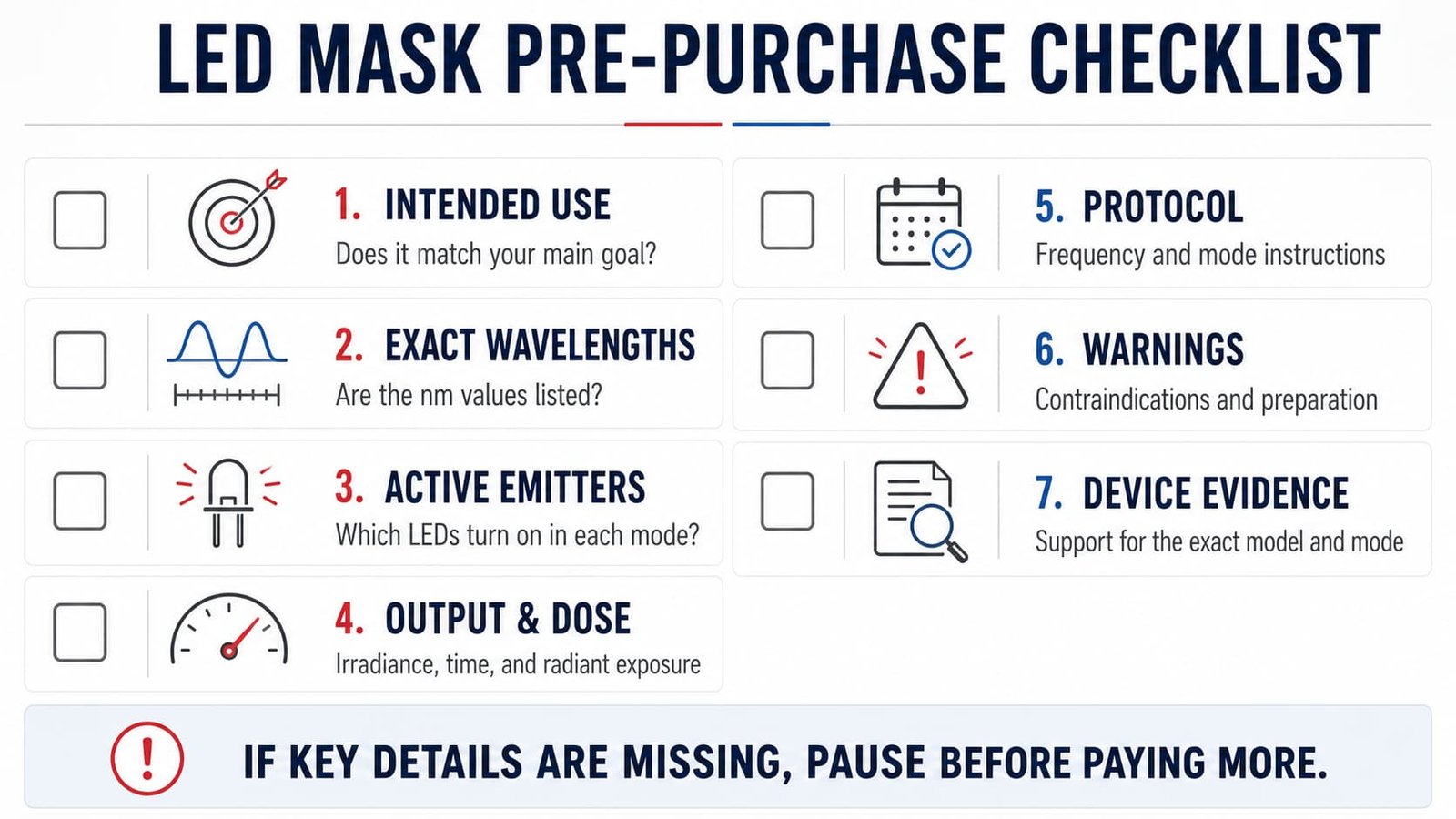
Les unités méritent une attention particulière. UN revue des paramètres de photobiomodulation distingue l'irradiation, mesuré en puissance par surface, de la fluence ou de l'exposition radiante, mesuré en énergie par zone. Ces termes et unités ne sont pas interchangeables. Plus important encore, ni une longueur d'onde ni un nombre élevé dans un champ ne garantissent un meilleur résultat pour le consommateur. Le protocole de livraison complet et les preuves de l'utilisation exacte comptent toujours.
Quels sont les signaux d'alarme dans une liste de masques multicolores?
Pause lorsqu'un vendeur donne des étiquettes d'avantages mais retient les spécifications et la portée nécessaire pour les vérifier. Les signaux d’alarme courants incluent:
- « Sept couleurs cliniquement prouvées » sans étude au niveau de l'appareil, autorisation, ou une preuve réclamation par réclamation.
- « Longues d'onde approuvées par la FDA » au lieu d'un enregistrement exact de l'appareil, nombre, portée du modèle, et l'utilisation prévue.
- Une liste de longueurs d'onde sans irradiation, temps de traitement, logique de mode, ou mode d'emploi.
- Puissance totale, Comptage des LED, ou luminosité présentée comme preuve des résultats cutanés.
- Une étude sur un autre appareil, système professionnel, combinaison de longueurs d'onde, ou protocole présenté comme preuve du masque vendu.
- Violet, blanc, cyan, ou un autre mode décrit uniquement par un nom d'avantage, sans identifier les émetteurs actifs.
- Pas de manuel accessible, section d'avertissement, instructions de protection des yeux, ou chemin d'assistance avant l'achat.
Aucune de ces lacunes ne prouve qu’un masque ne peut pas fonctionner. Cela signifie que vous ne disposez pas encore de suffisamment d’informations pour les comparer de manière responsable..
Comment faites-vous le choix final?
Quand deux masques correspondent à votre budget et à vos besoins de confort, choisissez celui qui rend le mode pertinent plus facile à vérifier et à suivre. Un modèle focalisé rouge/bleu peut être l'option la plus simple à évaluer lorsque vous n'avez besoin que de ces modes. Un modèle à 7 couleurs peut être raisonnable lorsque ses paramètres supplémentaires sont techniquement définis, pris en charge pour l'appareil exact, et pertinent par rapport aux objectifs que vous utiliserez réellement.
Utilisez cette comparaison de cinq minutes:
- Écrivez un objectif principal et, au plus, un objectif secondaire.
- Rayer les modes qui ne servent pas ces objectifs; ne leur donnez pas de valeur simplement parce qu'ils sont inclus.
- Comparez les modes restants à l'aide de la liste de contrôle des spécifications ci-dessus.
- Confirmez que le manuel explique comment et quand ces modes sont utilisés, y compris si les combinaisons fonctionnent ensemble ou séparément.
- Si un vendeur ne peut pas fournir la documentation exacte de l'appareil, choisissez l’option la mieux documentée ou suspendez l’achat.
Pour une vérification plus large du produit au-delà de la configuration des couleurs, il est dans Wakelife’s guide de sélection des masques à LED en six points pour comparer le modèle exact, utilisation prévue, emplacement de l'émetteur, Comptage des LED, preuve d'irradiation, ajuster, et construire.
Après avoir acheté, ne copiez pas un planning d'un autre produit. Utilisez le protocole fourni avec votre masque exact. Wakelife Guide de fréquence des masques LED explique comment trouver le programme complet sans transformer les minutes ou la fréquence hebdomadaire d'un appareil en règle de catégorie.
Quand devriez-vous consulter un dermatologue avant de choisir?
Obtenez des conseils professionnels lorsque la décision dépend du diagnostic, médicament, une condition sensible à la lumière, une procédure récente, ou une réaction, pas seulement les spécifications du produit. Cela inclut l’acné incertaine ou grave, des antécédents de problèmes de peau déclenchés par la lumière, médicament qui peut augmenter la photosensibilité, une éruption cutanée active ou une peau endommagée, et inquiétude concernant les changements de pigmentation.
Le Aperçu d’AAD sur les lasers et les lumières pour l’acné explique que la lumière visible ne traite pas tous les types de lésions acnéiques et que personne ne peut prédire exactement qui y réagira. Arrêtez d'utiliser un appareil et demandez des conseils qualifiés si vous ressentez de la douleur, une éruption cutanée persistante, rougeur marquée, cloquant, symptômes visuels, ou un autre effet indésirable.
L'essentiel
Ne choisissez pas un masque en vous demandant si sept est supérieur à deux. Demandez si les modes exacts dont vous avez besoin sont clairement définis, correctement livré, pris en charge pour l'utilisation prévue, et pratique à suivre.
Le rouge et le bleu ont une piste de recherche plus solide pour plusieurs utilisations courantes des masques, mais une étiquette rouge/bleue n'est pas un certificat de qualité. Les couleurs supplémentaires ne constituent pas automatiquement une preuve d’avantages supplémentaires, pourtant, un mode non rouge/bleu peut avoir une prise en charge valide spécifique à l'appareil. Quand les revendications sont similaires, une meilleure documentation vaut un menu couleur plus long.
Pour les marques et les équipes produits
La confusion des consommateurs autour des « 7 couleurs » commence généralement par une carte incomplète des modes et des preuves.. La documentation du produit doit connecter chaque mode sélectionnable à ses émetteurs actifs, longueur d'onde, éclairement énergétique mesuré, exposition radiante ou séance programmée, utilisation prévue, avertissements, et portée des preuves exactes de l'appareil. Les modes de lumière mixte doivent identifier les LED qui fonctionnent ensemble au lieu de se fier à des noms tels que violet ou blanc..
Si vous définissez une plateforme rouge/bleue ciblée ou un masque multimode documenté, explorez Wakelife Plateformes de produits pour masques faciaux LED et Capacités de développement OEM/ODM.
Références
Sources indépendantes et faisant autorité
| Non. | Source officielle |
|---|---|
| 1 | NOUS. Food and Drug Administration. Approbations et autorisations des appareils. Consulté en juillet 20, 2026. |
| 2 | Académie américaine de dermatologie. La thérapie par la lumière rouge est-elle adaptée à votre peau ??. Dernière mise à jour en septembre 13, 2024. Consulté en juillet 20, 2026. |
| 3 | Académie américaine de dermatologie. Lasers et lumières: Dans quelle mesure traitent-ils l’acné?. Consulté en juillet 20, 2026. |
| 4 | Ershadi S., Barbieri JS. Appareils LED à domicile pour le traitement de l'acné vulgaire: Une revue systématique et une méta-analyse. JAMA Dermatologie. 2025;161(5):552–555. est-ce que je:10.1001/jamdermatol.2025.0019. |
| 5 | Jagdeo J., Austin E., Mammifères A, Wong C., j'ai D, Sceau DM. Diodes électroluminescentes en dermatologie: Une revue systématique des essais contrôlés randomisés. Lasers en chirurgie et en médecine. 2018;50(6):613–628. est-ce que je:10.1002/lsm.22791. |
| 6 | Zein R., Selting W, Hamblin MR. Examen des paramètres de lumière et de l'efficacité de la photobiomodulation: Plongez dans la complexité. Journal d'optique biomédicale. 2018;23(12):120901. est-ce que je:10.1117/1.JBO.23.12.120901. |
Exemple de réglementation des appareils exacts
Cette source documente uniquement la famille d'appareils nommée, décision, et domaine d'utilisation prévu associé. Il n’est pas utilisé pour prétendre que chaque masque de même couleur a le même statut.
| Non. | Source officielle |
|---|---|
| 7 | NOUS. Food and Drug Administration. 510(k) Notification préalable à la commercialisation K250830: Masque de luminothérapie LED. Date de la décision juin 9, 2025. Consulté en juillet 20, 2026. |
| 8 | NOUS. Food and Drug Administration. K250830 Lettre d'autorisation et indications d'utilisation. Juin 9, 2025. Consulté en juillet 20, 2026. |