The short version
- If you need the stand-mounted, non-contact format, plan for a custom development project — as of this writing, we could not find it as a catalog product in public sourcing channels.
- Most products marketed as “non-contact” LED face masks are hollow wearable masks: the light body hovers a short distance above the skin, but the device is still worn. That is a different product from the stand-mounted format, and the two do not substitute for each other in procurement.
- The path to the format runs through a development brief (óptico, mecánico, cumplimiento, and commercial fields) and a manufacturer that can execute the full program: estructura, electrónica, óptica, pruebas, proceso de dar un título, producción.
- A new format earns its own testing and certification in each target market. Certificates from “similar” devices do not transfer to it — treat any supplier who says otherwise as a red flag.
Who this is for: brands, importadores, distribuidores, and salon or SPA groups sourcing the stand-mounted format for a venue concept, a professional line, or a retail product. What this article is not: a treatment or efficacy guide — it covers sourcing and development only. This guide is published by Wakelife, which manufactures LED face mask products and takes on development programs like the one described here.
Two different products are both called “non-contact”
“Non-contact” in this category currently describes two different constructions: a wearable mask with a gap, and a freestanding mask on a stand. Only the second one matches the format you likely saw at a venue or a trade show.
Hollow wearable masks. These are shells worn on the head, positioned so the light body hovers a short distance above the skin — their marketing usually cites a gap of roughly ten to fifteen millimeters as the feature that makes them “non-contact.” The light surface indeed does not touch the face, but the product is still a wearable. It straps on, covers the face, and sells like any other LED mask.
Stand-mounted units. This is a rigid shell suspended on a stand or arm. The client sits down, the shell is positioned over the face, and nothing is worn — no straps, no device on the head. You see this format in premium venue and flagship beauty concepts rather than in catalog listings, which is exactly why it is hard to source.
Both are described as “non-contact,” but for procurement they are different products: different structure, different room setup, different tooling, different cost structure. Which one you need depends on where it will be used:
- Usable (hollow or standard): portable use, consumer product lines, retail shelf presence, lower unit cost structure.
- Stand-mounted: professional in-room use, hands-free operation, consistent client positioning, nothing worn by the client, a flagship visual for the room.
One terminology note: in premium venue circles, the stand format is sometimes nicknamed a “collagen bar.” It is a colloquial name, not a product category — and not a term that returns supply results in sourcing channels today. Describe the format itself when you search or brief suppliers: stand-mounted, sin contacto, positioned over the face.
If you are still comparing the basic professional formats — flexible pad, mascarilla, panel — see our comparison: Flexible LED light therapy pad vs mask vs panel. The stand-mounted mask is effectively a fourth format, and it is the one with no off-the-shelf supply.
Why venues adopt the stand-mounted format
The appeal is operational: it changes the flow of a treatment room. Nothing is worn, nothing is fitted, and the client sits back while the device holds position.
- No fitting or sizing. One unit serves every client without straps to adjust or mask-fit to check.
- Nothing on the client. Clients keep hair and makeup arrangements; there is no sensation of wearing equipment and no pressure on the face.
- Repeatable positioning. A stand with height and angle adjustment lets the operator place the device the same way, session after session.
- Simpler shared-use hygiene routine. A device that never touches skin reduces the number of contact surfaces to clean between clients — but it does not remove the need to clean it. Controles, the stand, and any positioning handles still follow the manufacturer’s cleaning instructions, the same way any shared professional equipment does (CDC environmental cleaning procedures).
- Room presence. A freestanding piece reads differently in a premium room than a wearable device kept in a drawer; venue concepts built around this format make it the visual center of the experience.
This is a room-flow and experience decision. It says nothing about clinical outcomes — optical performance is a separate specification, and the two can be conflated when buyers first encounter the format.
The sourcing reality: this is not a shelf product
As of this writing, we could not find the stand-mounted hard-shell format available as an off-the-shelf purchase — not on major B2B marketplaces, and not through English- or Chinese-language sourcing channels. What you will find when you search:
- Hollow wearable masks using “non-contact” as a feature term — the first category above.
- LED panels with stands — the stand holds a flat panel; nothing about the pairing produces a face-shaped, suspended shell.
- Charging or storage bases that hold a wearable mask when it is not in use.
- Overhead treatment arches — arched or U-shaped light units on adjustable stands or arms, sold in salon equipment catalogs as PDT or LED light therapy machines. They are built for overhead coverage of a treatment area, not as a shell positioned around the face.
None of these is the format, and none substitutes for it in procurement. If you send a catalog inquiry for “a non-contact LED face mask” today, the quotes that come back will be for one of these — none of which is the product you are trying to buy.
The closest look-alike: overhead arches. Arched or U-shaped light units on adjustable stands are common salon equipment, and they are the nearest off-the-shelf thing to “suspended, non-contact light for the face.” The differences that matter in procurement are geometry, posicionamiento, and optics. Geometría: an arch presents its light from above across a treatment area; this format is a shell shaped and positioned around the face, so what the light reaches, and from where, differs by design. Posicionamiento: an arch is adjusted to the room and the treatment area; the shell format is built around one fixed client position, session after session, and that repeatability is the point of the format. Optics: an arch’s specifications describe its own field at its own distance; they do not describe the face-level configuration at this format’s intended use distance. A seated, face-in-the-shell concept is also a different room flow from an overhead treatment setup. None of this makes an arch a poor device; it makes it a different product for a different job. When a supplier answers your inquiry with one, you are being shown the adjacent category, not the format.
Supply can change, and this is a snapshot rather than a permanent fact. The practical implication is stable, though: today, the stand-mounted format is a development project, no es una orden de compra. If someone offers it to you off the shelf, look closely at what they are actually shipping — you are probably being offered a hollow wearable, a panel on a stand, or an overhead arch under a convenient name.
A common shortcut is worth addressing up front: asking a wearable mask factory to “just add a stand.” In practice, that path forces a new optical design (the use distance changes, so output and uniformity have to be re-engineered), plus a new structure and new tooling — it converges on the same development project, with unnecessary legacy constraints attached.
What a custom development project actually includes
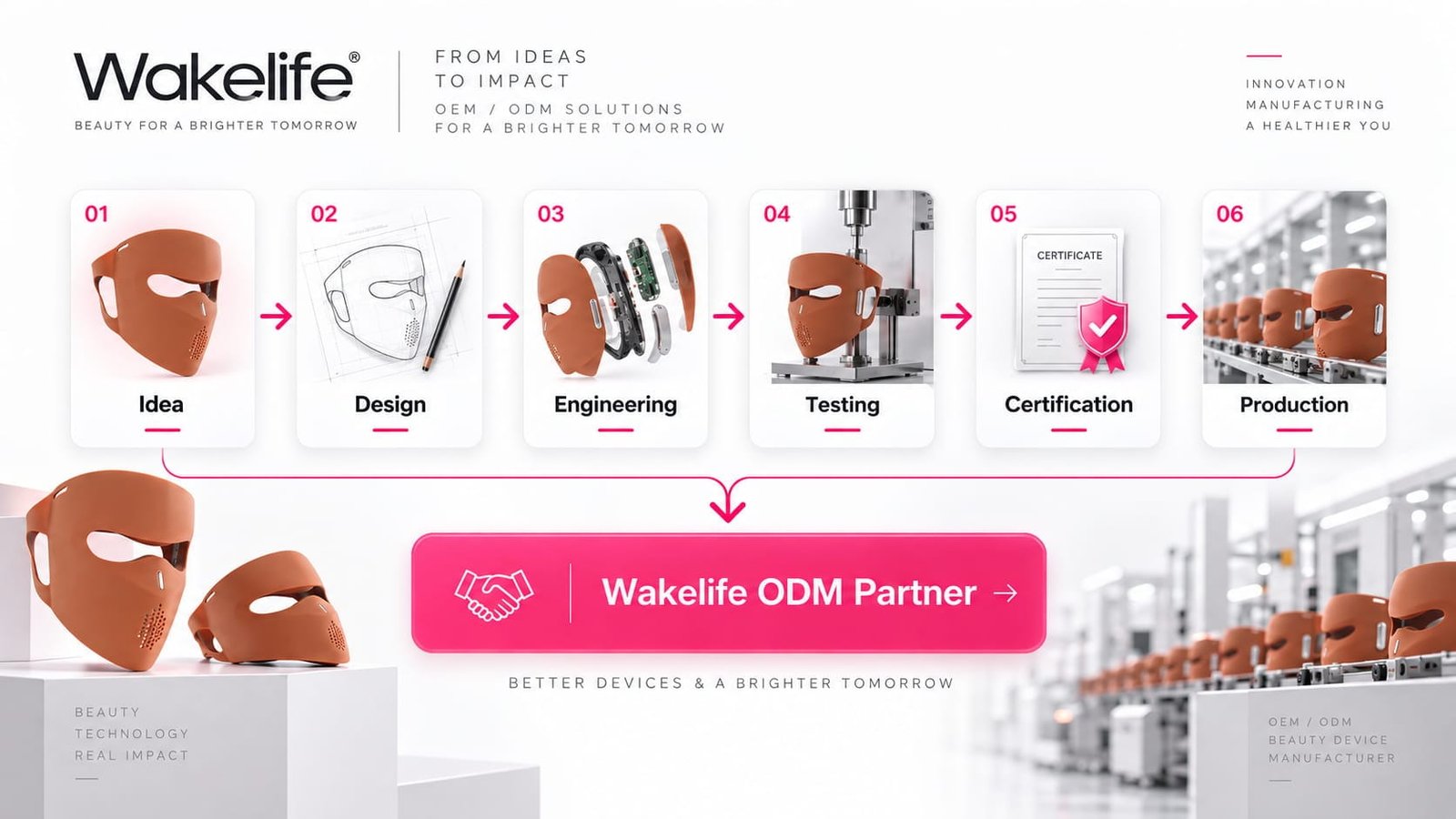
A new-format device is built through a full development program — industrial design, structure and tooling, electrónica, óptica, firmware, pruebas, proceso de dar un título, then production. It is not “a mask plus a stand” assembled from parts. The typical stages:
- Industrial design and structure. Shell geometry, the adjustment mechanics, the stand interface, and the positioning system that makes sessions repeatable.
- Estampación. Molds for the shell and mechanical parts. This is product-specific, one-time investment — the main reason “just make one like this” does not have a quick price.
- Electrónica. LED driver, fuente de alimentación, control board, protections — designed around the optical target rather than picked off a shelf.
- Optics. Diseño de LED, light spreading and uniformity across the face area, and the optical design that delivers the irradiance you specified at the intended use distance. At a non-contact distance, the optical design carries more of the product than it does on a wearable.
- Firmware and controls. Temporizadores, modos, controles del operador, and the safety behavior of the device when no one is in position.
- Testing and validation. Optical measurement, comportamiento térmico, seguridad electrica, and the photobiological safety assessment that light-emitting products are generally expected to carry in IEC-adopting markets — more on the document set below.
- Proceso de dar un título. Per target market, on the final configuration.
- Pilot production and mass production. First-article approval, then the line — including the production-stage testing the device needs at your volumes.
Two commercial facts of life, stated plainly:
- Development work and tooling are quoted separately from unit cost. Tooling is one-time investment tied to the structure you freeze; development is engineering effort. Unit price comes after scope freeze, when the bill of materials and the test plan are real.
- No credible partner quotes firm numbers before scope is understood. A price named before your market, reclamos, optical target, and quantities are known is a guess. A partner who cannot tell you which decisions change the price cannot price the project.
Timelines depend on design iterations, tooling lead time, and the scope of certification testing for your markets — all of which follow from the brief you write, which is the next section.
The development brief: what to freeze before you approach a manufacturer
Write a one-page brief before you send inquiries. Every field you can fill removes a round of guessing, and every field you leave blank becomes a surprise later. This checklist is yours to copy into your own template:
A. Product and market
- Target country or market for sale
- Canal: professional in-room device, retail product, o ambos
- Venue flow: how long a session runs, how many clients per day the device must support
- Posicionamiento: premium venue equipment or consumer product — this changes materials, embalaje, y documentación
B. Óptico
- The wavelength set you intend to specify — decide this yourself; it is your product position, not the supplier’s choice
- Target irradiance at the intended use distance
- A requirement that test reports state the measurement distance and conditions — radiometric values are only comparable when the measurement conditions are defined (NIST, Radiometry and Photometry Review)
- How the light is distributed across the face area (single zone or multi-zone)
do. Mecánico
- Adjustment range you need: height, inclinación, and distance to the face
- Stability and footprint in the room
- How the operator positions a client the same way each time
- Materials and cleaning requirements for a shared-use device
- Expected service life
D. Controles
- Timer and preset behavior
- Who operates it — staff or client
- What the device does when no one is in position (safety behavior)
- How any firmware updates are delivered
mi. Electrical and region
- Voltage and plug standard for the target market
- Cable routing and stand-integrated power
F. Compliance and claims
- Target market or markets, because certification scope follows them
- Posicionamiento previsto: general wellness/consumer route or medical device route — the next section explains why this must be decided before design freeze
- The claims you intend to make, because they determine what evidence you will need
GRAMO. Commercial and IP
- Pilot quantity and rollout target
- Branding and packaging needs
- Who owns tooling and design files after the project
On originality: describe the experience and performance you need; do not send a competitor’s product photos as a build instruction. “Make it like this one” invitations expose you to IP claims, and they tend to produce a lookalike with unresolved design rights — a liability that outlives the launch. Suppliers who promise to clone a specific branded device are a risk, not a shortcut. The format you saw somewhere is someone’s design; your version should be yours, built to your specification.
The documents to expect — and what each one proves
A new device gets its own documents. No existing certificate from a different product covers it, and the document set follows from decisions you make before design freeze. Three layers matter for a light device like this:
Layer one: seguridad fotobiológica (IEC 62471:2006). This is the assessment of the light source’s photobiological risk — eye and skin — under stated measurement conditions. It shows that the emitted light was evaluated against the photobiological safety standard for the tested configuration. It does not show efficacy, clinical benefit, or that the device is appropriate for any medical use. How to verify: the report should name the tested configuration, the conditions, and the distances. Ask for those, not just a logo. For a detailed walkthrough, ver IEC 62471 irradiance and wavelength reports for LED face masks.
Layer two: electrical safety and EMC for the target market. As with the light assessment, the scope is limited to what was tested. Where a medical route applies, the IEC 60601 family of standards — beginning with IEC 60601-1 — defines the medical electrical safety expectations; EMC requirements follow the market’s scheme. Verify which standard, which configuration, and which market — and ask who holds the report.
Layer three: the market route decision. In the US, whether a device is regulated as a medical device depends on its intended use and the claims made for it; el FDA’s framework for determining whether a product is a medical device y su general wellness policy are the starting points. En la UE, el Regulación de dispositivos médicos sets the medical route. This decision must happen before design freeze, because a medical route changes the documentation, sistema de calidad, and testing burden — and retrofitting it late is expensive. This article does not classify your product; classification depends on your intended use, reclamos, mercado, y configuración. For the layers in detail, ver nuestro certification guide y claims guide.
The red flag to watch is a supplier who says: “We already have CE / FDA for similar products, and it covers this.” Certificates are issued for a defined product, configuración, y uso previsto. A new structure, a new light engine, or a new claims set needs its own testing, in each market. Plan the testing budget and schedule into the project from day one. When a supplier waves existing certificates at a new format, preguntar: which configuration was tested, under which standard, for which market, and whose name is on the certificate.
How to evaluate a development partner
Evaluate on full-execution ability, not price. The format is a whole-product program, and the most expensive outcome is discovering mid-project that no one owns the optical performance or the certification plan. Questions to send before you commit:
- Who does the structure and mechanical design — in-house or subcontracted? Who owns the tooling after the project?
- Are the electronics and light engine designed in-house? Who measures the optical output, and how are measurement conditions reported?
- Can they measure irradiance at stated distances? A partner who cannot measure the core specification cannot validate it.
- Which certification paths have they executed, for which markets, and with which labs? Who holds the document set at the end — you or them?
- What testing runs during production (optical test, safety test, envejecimiento), and what does first-article approval look like?
- How are your design files, exclusivity, and confidentiality handled?
Red flags: quoting a hollow wearable when you specified a stand format; claiming existing certificates cover a new design; offering to copy a branded device from photos; no in-house optical measurement; vague answers about tooling or document ownership; firm pricing before scope freeze.
Where Wakelife fits
We build LED face mask products at scale, and our current mask line is wearable. We do not have a stand-mounted format as a catalog item, and we will not present one of our wearable masks as if it were the format you are looking for.
That is exactly why we take on programs like this as ODM development. From your brief, we can run the full path: diseño industrial, structure and tooling, electrónica, óptica, firmware, pruebas, proceso de dar un título, and mass production — with development investment and tooling quoted as separate line items. Our production already includes optical and safety testing on the line, because the optical specification is the product, and it should be verified at the end of the line rather than trusted from a datasheet.
If the stand-mounted format has been sitting in your concept deck, the fastest way to move it is to write the brief above and send it for a development assessment. You will get questions back — the ones that close scope — and a path forward, not a guess.
- Sourcing standard wearable masks? Start with the LED face mask OEM sourcing guide.
- Need the certificate layers first? Ver el certification guide y el claims guide.
- Comparing professional device formats? Ver el PDT LED light therapy machine category.
¿Qué hacer a continuación?
- Decide which “non-contact” you actually need — wearable or stand-mounted. They are different products with different supply realities.
- Write the one-page brief from the checklist above. It works with any manufacturer you approach, not just us.
- Shortlist partners on full-execution ability: estructura, óptica, pruebas, proceso de dar un título, and production in one chain of responsibility.
- Budget for new testing and certification from the start: a new format earns its own documents in each market.
Referencias
-
1
A NOSOTROS. Administración de Alimentos y Medicamentos. Cómo determinar si su producto es un dispositivo médico. https://www.fda.gov/medical-devices/classify-your-medical-device/how-determine-if-your-product-medical-device (accessed August 31, 2026)
-
2
A NOSOTROS. Administración de Alimentos y Medicamentos. Bienestar General: Política para dispositivos de bajo riesgo (Enero 2026). https://www.fda.gov/regulatory-information/search-fda-guidance-documents/general-wellness-policy-low-risk-devices (accessed August 31, 2026)
-
3
unión Europea. Regulación (UE) 2017/745 on medical devices — consolidated text (version of 1 Enero 2026). EUR-Lex. https://eur-lex.europa.eu/legal-content/EN/TXT/?uri=CELEX:02017R0745-20260101 (accessed July 13, 2026)
-
4
Comisión Electrotécnica Internacional. IEC 62471:2006 — Seguridad fotobiológica de lámparas y sistemas de lámparas.. https://webstore.iec.ch/en/publication/7076 (accessed September 16, 2026)
-
5
Comisión Electrotécnica Internacional. IEC 60601-1:2005+AMD1:2012+AMD2:2020 (consolidated version) — Medical electrical equipment, Parte 1: Requisitos generales para la seguridad básica y el rendimiento esencial.. https://webstore.iec.ch/en/publication/67497 (accessed September 16, 2026)
-
6
Instituto Nacional de Estándares y Tecnología. Radiometry and Photometry Review (Vision and Optics). https://www.nist.gov/publications/radiometry-and-photometry-review-vision-optics (accessed September 16, 2026)
-
7
A NOSOTROS. Centros para el Control y la Prevención de Enfermedades. Procedimientos de limpieza ambiental. https://www.cdc.gov/healthcare-associated-infections/hcp/cleaning-global/procedures.html (accessed August 31, 2026)