TL;DR para clínicas, marcas de bienestar, y pacientes
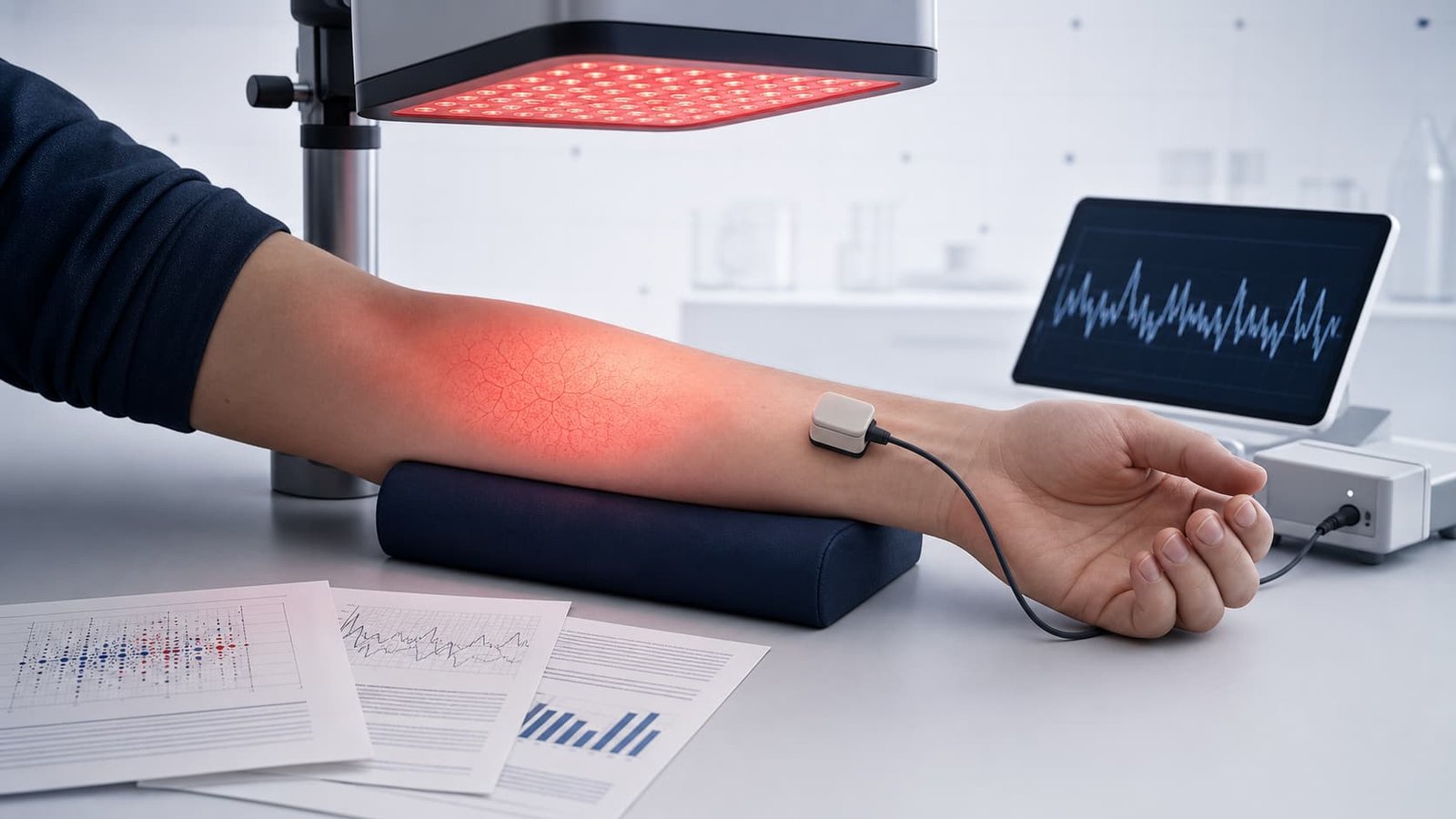
- Pequeños estudios controlados sugieren que cierta fotobiomodulación (Pbm) Los protocolos pueden aumentar temporalmente. mediciones locales del flujo sanguíneo capilar o cutáneo.
- El hallazgo es estrecho.. No significa automáticamente un mayor flujo sanguíneo en una arteria más grande, mejor circulación en todo el cuerpo, oxígeno tisular mejorado, o un beneficio clínico duradero.
- Los resultados varían según la longitud de onda., dosis óptica, área de tratamiento, método de medición, temperatura, y respuesta individual. Existen hallazgos humanos positivos y negativos..
- El óxido nítrico es un posible contribuyente a la vasodilatación., pero la vía fotosensible no está establecida y no debe presentarse como un mecanismo probado de un solo paso.
- Un dispositivo exacto puede tener una indicación autorizada para aumentar temporalmente la circulación sanguínea local., pero esa redacción no se transfiere a otro producto y no establece un tratamiento para la mala circulación crónica., enfermedad arterial periférica (ALMOHADILLA), enfermedad vascular diabética, o enfermedad cardiovascular.
- Las personas con sensación de protección reducida o con heridas necesitan una revisión exacta de la seguridad del dispositivo, mientras que las nuevas señales de advertencia vascular requieren evaluación médica en lugar de autotratamiento.
nota medica: Este artículo es educativo y no diagnostica ni trata una afección vascular.. Dolor recurrente en las piernas durante la actividad., un pie se enfría más que el otro, entumecimiento, cambio de color, dolor en reposo, o una herida de curación lenta puede requerir evaluación médica; el A NOSOTROS. Corazón Nacional, Pulmón, y Instituto de Sangre (NHLBI) los enumera entre los posibles síntomas de la EAP. El NHLBI guía para vivir con PAD recomienda atención de emergencia para una pérdida repentina de sensación o movimiento en un pie, especialmente cuando se vuelve azul o pálido y más frío que el otro pie. No demores la atención profesional para probar un dispositivo de luz..
¿La terapia con luz roja aumenta el flujo sanguíneo??
A veces, pero sólo de forma limitada, local, y sentido específico del protocolo.
Varios pequeños estudios en humanos han registrado un aumento a corto plazo en la perfusión de la piel., velocidad de las células sanguíneas capilares, u otra medida microcirculatoria local después de una exposición específica a PBM. Otros estudios no encontraron cambios en las mediciones de vasos más grandes, nitrito de plasma, oxígeno transcutáneo, o resultados relacionados.
Por lo tanto, la respuesta más precisa no es un “sí” o un “no” universal. Es:
Algunos protocolos rojos o de infrarrojo cercano han cambiado las mediciones de la microcirculación local en pequeños estudios en humanos.. Esos resultados no establecen una mejora sostenida de la circulación sistémica ni el tratamiento de una enfermedad vascular..
Esa distinción es importante para las clínicas porque un paciente puede escuchar "aumento del flujo sanguíneo" porque "esto tratará la causa de mis pies fríos"., dolor de pierna, úlcera, o PAD”. Los estudios no avalan ese salto.
El “flujo sanguíneo” no es un resultado
Un resultado en un nivel no puede sustituir la evidencia en otro.
| Nivel de evidencia | Medición de ejemplo | lo que puede mostrar | Lo que no puede establecer por sí solo |
|---|---|---|---|
| Microcirculación local cutánea o capilar. | Flujo de láser Doppler, fotopletismografía, velocidad de las células sanguíneas capilares | Un cambio a corto plazo en una pequeña zona iluminada. | Flujo de arteria más grande, circulación de todo el cuerpo, o mejora de la enfermedad |
| Oxígeno tisular local | Presión de oxígeno transcutáneo (TcPO₂) | Oxígeno medido a través de la piel en un sitio definido. | La causa de cualquier cambio o un beneficio duradero en la curación de heridas. |
| Hemodinámica de vasos más grandes | Velocidad o pulsatilidad de la arteria femoral. | Una medición vascular en una arteria con nombre | Respuesta piel-capilar, perfusión total de las extremidades, o beneficio clínico |
| Marcadores sistémicos | nitrito plasmático, presión arterial, pruebas de función endotelial | Un marcador vascular o corporal seleccionado | Alivio de los síntomas o modificación de la enfermedad a menos que el ensayo lo mida. |
| Resultados del paciente y de la enfermedad. | A poca distancia, curación de heridas, dolor, hospitalización, eventos de extremidades | Un resultado clínicamente relevante en un grupo de pacientes definido | Transferibilidad a otro diagnóstico., dispositivo, o protocolo |
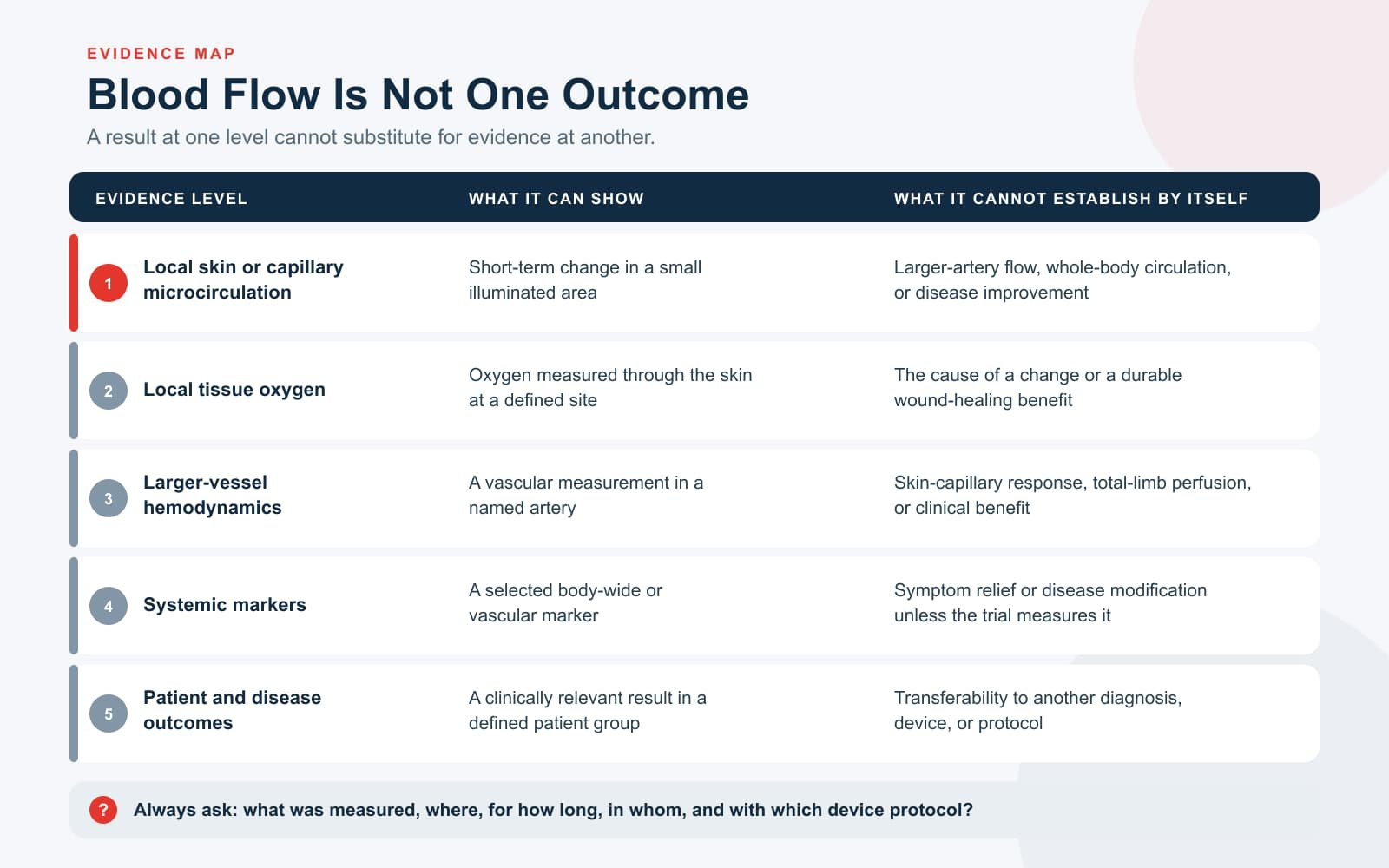
La “circulación” es un lenguaje cotidiano útil, pero es demasiado amplio para servir como criterio de valoración científico. Antes de repetir un reclamo, preguntar: lo que se midió, dónde, por cuánto tiempo, en quien, y con qué parámetros del dispositivo?
Los instrumentos no son intercambiables.. En el Estudio láser-Doppler de Riaz, la perfusión se informó en unidades relativas de perfusión sanguínea en lugar de un flujo absoluto como mililitros por minuto; el estudio gavish También se utiliza fotopletismografía., que registra una señal óptica relacionada con el pulso en lugar de un flujo volumétrico directo. Por lo tanto, un cambio dentro del estudio puede ser informativo., pero porcentajes de diferentes instrumentos, ajustes, y las zonas del cuerpo no deben agruparse como si midieran la misma cantidad.
¿Qué encontraron los estudios en humanos controlados??
La evidencia humana contiene señales positivas locales., resultados nulos, y límites sustanciales.
| Estudiar | Población y protocolo | Medición | Hallazgo principal | Lo que no prueba |
|---|---|---|---|---|
| Mak y Cheing, 2012 | 30 adultos sanos; aleatorizado a 890 nm energía infrarroja monocromática, impostor, o una compresa caliente en el pie para 30 minutos | Velocidad de las células sanguíneas capilares y flujo cutáneo superficial. | El grupo activo mostró mayores aumentos que la simulación y el calor. | Beneficio a largo plazo, circulación sistémica, o un efecto en PAD |
| Gavish et al., 2020 | 20 no fumadores sanos; aleatorizado a 633 nm rojo o 830 nm infrarrojo cercano en la muñeca para 5 minutos | Fotopletismografía, Doppler láser, y temperatura de la piel | El 830 El grupo nm mostró un aumento microcirculatorio medio durante y después de la exposición.; el 633 El grupo nm no mostró un aumento medio | Un efecto de tratamiento controlado de forma simulada; cada grupo de longitud de onda tenía sólo aproximadamente 10 gente, y los respondedores variaron |
| Dutra et al., 2021 | 13 hombres sanos y no entrenados; aleatorio, doble ciego, cruce controlado simuladamente usando combinado 630/850 nm PBM antes del ciclismo | Velocidad sistólica máxima femoral, índice de pulsatilidad, nitrito de plasma, y rendimiento del ejercicio | No hay diferencias significativas en las medidas vasculares., nitrito, o rendimiento | Que toda respuesta local de la piel está ausente.; el estudio abordó un protocolo y criterio de valoración diferentes |
| Franzen-Korzendorfer et al., 2008 | 18 personas con diabetes y pérdida de sensación protectora; un pie recibido 890 nm exposición activa y la otra simulación durante 11 a 12 sesiones | TcPO₂, sensación, y dolor | No hay diferencias significativas entre activo y simulado en los tres resultados | Un veredicto final para todos los protocolos vasculares o de pie diabético; la asignación fue cuasialeatoria y la muestra pequeña |
| Riaz et al., 2026 | 24 adultos sanos; 890 nm infrarrojo cercano después de una condición de placebo en la misma persona | Temperatura y flujo cutáneo con láser-Doppler local | El flujo local aumentó después de algunas exposiciones continuas o intermitentes., con gran variación individual | Un efecto aleatorio independiente del calor.; El placebo siempre fue lo primero., la exposición continua aumentó la temperatura de la piel en aproximadamente 6°C, y los pequeños controles de calor no se probaron de manera inferencial |
Estos estudios midieron diferentes partes del cuerpo y niveles vasculares y utilizaron diferentes longitudes de onda., densidades de potencia, tiempos de exposición, temperaturas, y resultados. La mayoría inscribió a adultos sanos y evaluó la respuesta durante la exposición., inmediatamente después, o dentro de un breve seguimiento de la misma sesión. No establecen persistencia al día siguiente ni un efecto acumulativo..
Estos estudios no establecen una jerarquía de longitudes de onda.. Entre los estudios aquí reseñados, sólo Gavish y sus colegas compararon directamente el rojo con la luz infrarroja cercana: en ese pequeño, estudio sin farsa, el 830 El grupo nm mostró un aumento microcirculatorio local mediano mientras que el grupo 633 nm grupo no lo hizo. Una comparación de longitudes de onda activa no puede establecer una ventaja general para la luz del infrarrojo cercano.
Contexto comercial: La participación comercial no valida ni invalida por sí sola un resultado., pero pertenece a la interpretación. En el estudio de Gavish, la afiliación indicada de un autor era una empresa comercial; el registro accesible no incluía una declaración separada de conflicto de intereses. Para el estudio de Franzen-Korzendorfer, Anodyne Therapy donó los dispositivos activos y simulados, y el primer autor fue gerente de American Medical Technologies. Estos hechos se combinan con las fortalezas y limitaciones del diseño de cada estudio..
¿Por qué difieren los resultados de los estudios??
Un resultado de PBM pertenece a la configuración completa de exposición y medición, no solo a la etiqueta de longitud de onda.
Las fuentes importantes de variación incluyen:
- Nivel vascular y sitio del cuerpo.. La perfusión de la piel en la muñeca o el pie no es la misma medida que la velocidad de la arteria femoral o el flujo sanguíneo total de la extremidad..
- Longitud de onda y salida espectral.. La “luz roja” puede referirse a diferentes bandas rojas visibles., mientras que los protocolos de infrarrojo cercano pueden utilizar 810, 830, 850, 890 Nuevo Méjico, u otra banda.
- Irradiancia y exposición radiante.. Potencia por área, tiempo de sesión, distancia, área del haz, ciclo de trabajo, y el patrón de pulso afectan la exposición administrada.
- Temperatura. El calentamiento de la piel puede por sí solo cambiar la perfusión local.. Un estudio necesita controles y registros de temperatura adecuados antes de atribuir toda la respuesta a una vía fotoquímica no térmica..
- Momento. Un cambio registrado durante la exposición o 20 minutos después no establece un efecto persistente a lo largo de días o meses.
- Características de los participantes. Edad, tono vascular basal, de fumar, medicamento, diabetes, ALMOHADILLA, neuropatía, y otras condiciones pueden cambiar tanto la respuesta como el riesgo..
- Diseño del estudio. Pequeñas muestras, orden de tratamiento fijo, ausencia de controles falsos, múltiples comparaciones sin corregir, y la presentación de informes selectivos puede hacer que un efecto aparente sea menos seguro.
Para equipos de dispositivos, la implicación práctica es simple: un estudio que utiliza una longitud de onda no puede validar un producto simplemente porque el catálogo de productos enumera la misma longitud de onda nominal. La salida exacta, geometría, área de tratamiento, cronograma, usuario previsto, comparador, y el punto final aún debe coincidir.
¿El óxido nítrico explica la respuesta del flujo sanguíneo??
El óxido nítrico es un posible contribuyente, pero el camino del PBM no está resuelto.
El óxido nítrico ayuda a regular el tono vascular, Por eso, los investigadores han investigado si la luz roja o infrarroja cercana puede hacer que el óxido nítrico almacenado biológicamente esté más disponible.. en el trabajo de laboratorio, Keszler y otros. encontró una liberación dependiente de la longitud de onda de S-nitrosotioles y complejos de dinitrosil hierro y observó relajación en arterias faciales aisladas de ratones.
Eso apoya la plausibilidad biológica.. No prueba que un dispositivo de consumo libere una cantidad clínicamente importante de óxido nítrico en una persona o que el óxido nítrico explique cada resultado de perfusión local..
Citocromo c oxidasa (director de operaciones) También se presenta frecuentemente como el fotoaceptor PBM establecido que libera óxido nítrico inhibidor.. La evidencia está menos consolidada de lo que sugiere la taquigrafía de marketing.. A 2020 revisión crítica cuestionó si es confiable, La evidencia reproducible fue suficiente para asignar a CCO ese papel central.. un mas tarde experimento de enzima aislada descubrió que 670 o 830 La luz nm no cambió el consumo de oxígeno CCO ni la inhibición inversa de un donante de óxido nítrico en las condiciones probadas..
La explicación de la clínica responsable es:
PBM puede influir en la señalización vascular a través de más de una vía secundaria o sensible a la luz, y el óxido nítrico puede contribuir. La vía humana exacta y su importancia clínica siguen bajo investigación.
¿Se aplica esta evidencia a la mala circulación?, ALMOHADILLA, o Pie Diabético?
No se puede llegar a ninguna conclusión directa sobre el tratamiento a partir de la evidencia actual..
“Mala circulación” es una descripción de los síntomas, ni un diagnóstico. enfermedad arterial, enfermedad venosa, neuropatía, efectos de la medicación, regulación de temperatura, y otras condiciones pueden producir quejas diferentes y requerir una evaluación diferente.
La evidencia más cercana de los pacientes sigue siendo pequeña y utiliza resultados que no responden directamente a la pregunta sobre la circulación.:
- A 2022 aleatorio, piloto doble ciego en 20 gente estudiado en casa 808 nm PBM más atención estándar en personas con úlceras graves del pie diabético y neuropatía; 18 también tenía PAD, y las comorbilidades importantes eran comunes. La reducción del área de la herida favoreció la PBM activa, pero el ensayo no estableció que la mejora de la perfusión provocara el resultado. El fabricante suministró los dispositivos activos y simulados., pagado por servicios estadísticos y de cuidado de terceros, y proporcionó la cámara de estudio.; un autor reveló consultoría pagada para el fabricante. Esas relaciones no invalidan por sí solas el resultado., pero añaden contexto a un pequeño piloto..
- A 2025 piloto en 11 personas con úlcera del pie diabético y PAD comparó PBM más ejercicio con ejercicio solo. Algunas medidas mejoraron desde el inicio, pero no se encontraron diferencias significativas entre los grupos. El método de muestra y asignación lo convierte en evidencia de viabilidad., no es una conclusión del tratamiento.
- A 2026 revisión sistemática de seis ensayos LED aleatorios informó posibles señales para el área de la herida, calidad del lecho de la herida, o microcirculación en heridas crónicas de miembros inferiores.. Los protocolos eran muy heterogéneos., no fue posible realizar un metanálisis cuantitativo, y la certeza general de GRADE fue muy bajo.
La curación de heridas y el flujo sanguíneo son temas clínicos relacionados, pero no son puntos finales intercambiables. Una herida más pequeña no prueba por sí sola que la PBM mejore la perfusión arterial; una lectura de perfusión local no establece la cicatrización de la herida; y ninguno establece tratamiento para PAD.
Esto no prueba que la PBM no tenga ningún papel en futuras investigaciones vasculares o sobre el cuidado de heridas.. Significa que la evidencia actual es insuficiente para un reclamo de tratamiento de un dispositivo de consumo o para reemplazar la evaluación y atención médica establecida..
¿Cuáles son los límites de seguridad para el uso relacionado con la circulación??
Una exposición de investigación no es una instrucción de uso doméstico., y la seguridad depende del dispositivo exacto y del usuario.
En el estudio de Riaz, uno continuo 890 La condición de exposición a nm aumentó la temperatura local de la piel en aproximadamente 6 °C en adultos sanos.. Esta es una observación específica del protocolo y un posible contribuyente térmico al cambio de flujo medido; no hay evidencia de que cada dispositivo PBM caliente la piel 6°C.. Muestra por qué las clínicas deberían verificar el comportamiento de la temperatura en lugar de asumir que cada modo rojo o infrarrojo cercano es no térmico..
La reducción de la sensación protectora cambia la cuestión del control de riesgos porque el usuario puede ser menos capaz de notar un calentamiento incómodo.. Para una persona con neuropatía diabética, una herida activa o de curación lenta, enfermedad vascular conocida, u otra condición que afecte el área tratada, su uso debe evaluarse frente a dispositivo exacto instrucciones, contraindicaciones, advertencias, comportamiento de la temperatura, límites de sesión, y requisitos de supervisión. No se puede derivar ningún límite de temperatura universal o dosis de tratamiento de los estudios revisados aquí..
No utilice un programa de luz de bienestar para autocontrolar un resfriado reciente, pálido, o pie azul, pérdida repentina de sensación o movimiento, dolor en reposo, o una herida que empeora o que cicatriza lentamente. Esos hallazgos necesitan evaluación médica.. Este artículo tampoco crea una lista universal de contraindicaciones de PBM.: La fotosensibilidad relacionada con los medicamentos y otras restricciones específicas de la condición deben compararse con el etiquetado del producto y el asesoramiento clínico calificado..
¿Qué pueden decir las clínicas sin exagerar la evidencia??
Describe el hallazgo medido y el límite en la misma oración..
| Lenguaje coincidente con la evidencia | Exageración para evitar |
|---|---|
| "Algunos pequeños estudios en humanos encontraron aumentos temporales en las mediciones locales del flujo sanguíneo capilar o de la piel después de protocolos específicos de PBM". | "La terapia con luz roja mejora la circulación". |
| “En una pequeña comparación de longitudes de onda activas sin un grupo simulado, 830 nm mostró un aumento microcirculatorio local mediano mientras que 633 nm no lo hizo; esto no establece una ventaja general en cuanto a longitud de onda”. | "Se ha demostrado que el infrarrojo cercano aumenta el flujo sanguíneo mejor que la luz roja". |
| “El óxido nítrico es un contribuyente propuesto a la vasodilatación relacionada con la PBM; el camino aún se está estudiando”. | “La luz roja libera óxido nítrico, abre los vasos sanguíneos, y restablece la circulación”. |
| "La microcirculación local no es el mismo criterio de valoración que el flujo de arterias más grandes o la mejora de la enfermedad". | "Una mejor perfusión de la piel significa una mejor salud cardiovascular". |
| "La evidencia actual no establece un tratamiento para la EAP u otra enfermedad vascular". | “Ayuda a la mala circulación en piernas y pies”. |
| Para un dispositivo exacto con coincidencia de EE. UU.. despacho y etiquetado: "aumentar temporalmente la circulación sanguínea local donde se aplique". | "Nuestro dispositivo puede mejorar la circulación porque otro producto con una longitud de onda similar tiene la aprobación de la FDA". |
| “Este modelo exacto recibió 510(k) autorización para las indicaciones de uso indicadas en su registro de la FDA”. | "La FDA aprobó o respaldó este dispositivo o su mecanismo de circulación propuesto". |
La redacción permitida depende del producto exacto., uso previsto, mercado objetivo, audiencia, evidencia, etiqueta, y la impresión general del consumidor. Para un flujo de trabajo de revisión más amplio, él está en Wakelife's Guía de reclamaciones de dispositivos de belleza LED. Separa un hecho de producto medido de una belleza., bienestar, terapéutico, o reclamo médico; No sustituye a la revisión legal o regulatoria específica del mercado..
¿Puede aparecer “aumentar temporalmente la circulación sanguínea local” en indicaciones aprobadas por la FDA??
Sí para algunos dispositivos exactos en los Estados Unidos, no para PBM como categoría genérica.
Por ejemplo, la FDA K240222 510(k) resumen para dispositivos LED Dermalux específicos incluye, para el 830 nm modo infrarrojo cercano, redacción sobre el aumento temporal de la circulación sanguínea local cuando se aplique. Esa indicación está ligada a los dispositivos nombrados., su uso previsto, comparación tecnológica, y etiquetado limpio. No autoriza a otro 830 nm producto para copiar el reclamo, y no establece tratamiento para PAD o mala circulación crónica.
Un registro de dispositivo anterior muestra un marco regulatorio diferente. El 2006 K060792 carta de autorización y anexos indique un número de reglamento: 21 CFR 890.5500, nombre del reglamento Infrared lamp—y ambos códigos de producto ILY y GEX. el solicitante 510(k) listas resumidas por separado 21 CFR 878.4810 y 890.5500. Dentro de ese resumen, el nombrado 660/940 Las configuraciones de nm rojo e infrarrojo cercano transportan el calor., calentamiento-tópico, temperatura del tejido, y redacción de circulación, mientras que las funciones de luz azul llevan la indicación de acné. separada de la FDA Registro de clasificación de productos ILY describe el tipo de dispositivo como lamp, infrared, therapeutic heating, lo ubica en Medicina Física, y vincula la guía de la FDA para dispositivos de calefacción y refrigeración. 510(k) aplicaciones. Esto hace no significa que cada reclamo de circulación de PBM es térmico. Muestra que K060792 no puede citarse como reconocimiento de la FDA de un mecanismo de óxido nítrico no térmico..
K060792 también ilustra por qué los equipos de reclamos deben usar las Indicaciones de uso formales y el etiquetado actual del dispositivo exacto en lugar de copiar una oración del documento del solicitante. 510(k) resumen. El resumen utiliza local blood circulation y declara que el remitente consideró que el dispositivo era adecuado para uso con y sin receta. Las Indicaciones de Uso adjuntas omiten local y marcas Uso con receta. Este contraste histórico no hace que todos los dispositivos relacionados con la circulación sean de venta únicamente con receta médica.. Los registros actuales de la FDA enumeran a ILY como Clase II, 510(K) Exempt tipo de presentación y GEX como Clase II con tipo de presentación 510(k); ambos registros dicen GMP Exempt? No. La exención ILY está sujeta a 21 CFR 890.9, incluidos límites que implican un uso previsto diferente o una tecnología científica fundamental diferente. Actual 21 CFR 890.5500, requisitos del código de producto, uso previsto, y, por lo tanto, se debe verificar el estado de Rx/OTC para cualquier dispositivo nuevo..
La redacción de la investigación y la redacción reglamentaria responden a diferentes preguntas. Un estudio puede medir un cambio fisiológico local sin autorizar una declaración de producto. En cambio, una indicación autorizada específica del dispositivo no prueba que todos los productos que utilizan una longitud de onda similar produzcan el mismo resultado.
La redacción utilizada para describir la autorización también es importante.. La carta K060792 de la FDA dice que su determinación de equivalencia sustancial no significa que la FDA haya determinado que el dispositivo cumple con otros requisitos de la Ley Federal de Alimentos., Droga, y Cosméticos o con estatutos y reglamentos administrados por otras agencias federales. Por separado, 21 CFR 807.97 establece que presentar una notificación previa a la comercialización y recibir posteriormente una determinación de equivalencia sustancial no denota aprobación oficial; Crear una impresión de aprobación debido al cumplimiento de la notificación previa a la comercialización es engañoso y constituye una marca errónea.. Utilice precisión 510(k) clearance y lenguaje exacto de indicaciones de uso; no lo conviertas en FDA approved, Respaldo de la FDA, o reconocimiento de la FDA de un mecanismo propuesto. La misma carta histórica también apunta al registro y cotización., etiquetado, sistema de calidad, y obligaciones aplicables en materia de control de las radiaciones; Los requisitos actuales deben verificarse por separado..
En la Unión Europea, el Regulación de dispositivos médicos define el propósito previsto a través de la etiqueta del fabricante, instrucciones de uso, materiales y declaraciones promocionales o de ventas, y evaluación clínica. Luego se aplican las reglas de clasificación de acuerdo con el propósito previsto.. Por lo tanto, una clínica o una marca privada debe asignar cada declaración relacionada con la circulación a la documentación exacta del dispositivo., uso previsto, mercado, y ruta de conformidad en lugar de tomar prestado el lenguaje de una autorización no relacionada.
¿Cómo debería una clínica evaluar un dispositivo para un programa de bienestar relacionado con la circulación??
Empezar por el ámbito clínico y de comunicación, luego trabaje hacia atrás hasta el dispositivo.
- Definir el uso previsto. ¿El programa describe una rutina de bienestar general?, medir una respuesta fisiológica local, apoyando la recuperación, o proponer abordar una condición diagnosticada? Esos no son alcances equivalentes..
- Nombre la población objetivo. Los adultos sanos no son intercambiables con los adultos mayores, personas con diabetes, personas que toman medicación vasoactiva, o pacientes con enfermedad vascular conocida.
- Elige el punto final. Decidir si la cuestión de la evidencia se refiere a la perfusión cutánea local., oxígeno tisular, una medida arterial, un síntoma, rendimiento de caminata, o un resultado clínico.
- Coincide con el protocolo completo. Comparar longitud de onda, ancho de banda espectral, irradiancia, exposición radiante, distancia, tiempo de sesión, área de tratamiento, modo de pulso, temperatura, cronograma, y seguimiento, no sólo la longitud de onda.
- Separe la evidencia de investigación de la evidencia del dispositivo exacto. Un estudio publicado puede respaldar una justificación científica. No valida automáticamente otro modelo.. Solicite registros espectrales y de irradiancia específicos del modo, condiciones de medición, identidad de muestra, informes de seguridad, y criterios de control de lotes. Wakelife IEC 62471, longitud de onda, y guía de irradiancia explica estas capas de evidencia.
- Alinear todas las declaraciones dirigidas al paciente. El sitio web, material de consentimiento, folleto, guión del personal, testimonial, instrucciones, advertencias, y el proceso de seguimiento debe permanecer dentro del mismo límite de uso previsto y evidencia.
- Construya un límite de referencia. Un dispositivo de bienestar no debe retrasar la evaluación vascular en busca de síntomas o heridas que puedan requerir diagnóstico y tratamiento..
Cómo revisamos la evidencia
Este es un resumen de evidencia enfocado, no es una revisión sistemática. La búsqueda y la verificación de fuentes se actualizaron hasta julio. 29, 2026. Priorizamos los estudios controlados en humanos que midieron directamente la perfusión local., oxígeno tisular, una arteria con nombre, u otro criterio de valoración vascular, y conservamos tanto los resultados positivos como los nulos. Los estudios de mecanismos de laboratorio se utilizaron sólo para explicar la plausibilidad biológica.. Se utilizaron estudios de PAD y de heridas para definir el límite entre una medición de la circulación y el resultado de la enfermedad., no crear recomendaciones de tratamiento.
Para las fuentes incluidas, verificamos los identificadores de artículos, resúmenes accesibles o texto completo, diseño del estudio, puntos finales relevantes, y declaraciones de financiación o conflictos cuando estén disponibles. Fabricante, detallista, y las páginas comerciales generales no fueron tratadas como evidencia clínica.. Nuevas pruebas o correcciones pueden cambiar este resumen., por lo que se debe volver a verificar el conjunto de fuentes antes de realizar afirmaciones importantes o tomar una decisión sobre el posicionamiento del producto..
La conclusión
La investigación en humanos proporciona una señal creíble pero limitada: Algunos protocolos de PBM pueden aumentar temporalmente las mediciones locales del flujo sanguíneo capilar o cutáneo.. La base de evidencia es pequeña., heterogéneo, y sensible al protocolo, temperatura, sitio de medición, y respuesta individual. No establece que una longitud de onda sea generalmente superior.
La misma investigación hace no establecer una mejora sostenida de la circulación en todo el cuerpo, un mecanismo confiable de óxido nítrico en humanos, o tratamiento para la mala circulación crónica, ALMOHADILLA, enfermedad vascular diabética, o enfermedad cardiovascular.
Para clínicas y marcas de bienestar., La pregunta más segura y útil no es "¿La luz roja mejora la circulación?"?" Es:
¿Qué población, protocolo del dispositivo, sitio anatómico, medición, ventana de tiempo, y la afirmación pretendida, ¿la evidencia realmente respalda?
Evaluación de un dispositivo PBM para una clínica o programa de bienestar regulado? Empiece por definir el uso previsto, población objetivo, y punto final de evidencia. Luego, Wakelife puede ayudar a mapear las especificaciones del dispositivo y la documentación disponible para ese alcance..
Referencias
- Máximo MC, Cheing GL. Efectos inmediatos de la energía infrarroja monocromática sobre la microcirculación en sujetos sanos.. Fotomedicina y Cirugía Láser. 2012;30(4):193–199. doi:10.1089/fo.2011.3012.
- Gavish L, Hoffer O., rabin n., et al. Respuesta microcirculatoria a la fotobiomodulación: por qué algunos responden y otros no. Láseres en Cirugía y Medicina. 2020;52(9):863–872. doi:10.1002/lsm.23225. Registro de prueba: NCT03357523.
- Dutra YM, Claus GM, Malta ES, et al. Fotobiomodulación 30 menor 6 h antes del ciclismo no altera la velocidad del flujo sanguíneo en reposo, respuestas fisiológicas inducidas por el ejercicio o tiempo hasta el agotamiento en hombres sanos. Fronteras en fisiología. 2021;11:607302. doi:10.3389/fphys.2020.607302.
- Franzen-Korzendorfer H., Blackinton M, Rone-Adams S, McCulloch J.. El efecto de la energía infrarroja monocromática en las mediciones transcutáneas de oxígeno y la sensación protectora.. Manejo de heridas de ostomía. 2008;54(6):16–31.
- riaz m, PC Bosch, Soy MK, et al. Efectos de la fotobiomodulación del infrarrojo cercano sobre el flujo sanguíneo local de la piel en sujetos sanos. fotónica. 2026;13(2):119. doi:10.3390/fotónica13020119.
- Keszler A, Lindemer B, Hogg n., Incienso D, Lohr NL. Dependencia de la longitud de onda de la vasodilatación y la liberación de NO de los S-nitrosotioles y complejos de dinitrosil hierro mediante luz roja lejana/infrarroja cercana. Archivos de Bioquímica y Biofísica. 2018;649:47–52. doi:10.1016/j.abb.2018.05.006.
- peculiaridad bj, Whelan HT. ¿Qué se encuentra en el corazón de la fotobiomodulación?: luz, citocromo c oxidasa, y óxido nítrico: revisión de la evidencia. Fotobiomodulación, Fotomedicina, y Cirugía Láser. 2020;38(9):527–530. doi:10.1089/fotob.2020.4905.
- peculiaridad bj, Whelan HT. Efecto de la luz roja a infrarroja cercana y un donante de óxido nítrico sobre el consumo de oxígeno de la citocromo c oxidasa aislada. Fotobiomodulación, Fotomedicina, y Cirugía Láser. 2021;39(7):463–470. doi:10.1089/fotob.2020.4978.
- Neblina A, Gavish L, Elishoov O., et al. Tratamiento de las úlceras del pie diabético en una población frágil con comorbilidades graves mediante terapia con láser de fotobiomodulación en el hogar. Láseres en la ciencia médica. 2022;37(2):919–928. doi:10.1007/s10103-021-03335-9.
- Chen Sz, Takahashi T., Lai H.J., Su HH, Cheng Y.J.. Efectos terapéuticos de la fotobiomodulación combinada con ejercicio en pacientes con enfermedad arterial periférica más úlcera del pie diabético. Vida. 2025;15(9):1391. doi:10.3390/vida15091391.
- Miranda MB, Barros ACS, por Paula AVL, et al. Dosimetría clínica y eficacia de la fotobiomodulación LED para la cicatrización de heridas crónicas en las extremidades inferiores.. Láseres en la ciencia médica. 2026;41(1):117. doi:10.1007/s10103-026-04928-y.
- Corazón Nacional, Pulmón, y Instituto de Sangre. Enfermedad de las arterias periféricas: síntomas. Consultado en julio. 28, 2026.
- Corazón Nacional, Pulmón, y Instituto de Sangre. Enfermedad de las arterias periféricas: viviendo con. Consultado en julio. 28, 2026.
- A NOSOTROS. Administración de Alimentos y Medicamentos. 510(k) resumen: Dermalux Tri-Wave MD MKII y Dermalux Compact MD, K240222. 2024. Consultado en julio. 29, 2026.
- Parlamento Europeo y Consejo. Regulación (UE) 2017/745 en dispositivos médicos. Diario Oficial de la Unión Europea. 2017. Consultado en julio. 29, 2026.
- A NOSOTROS. Administración de Alimentos y Medicamentos. 510(k) resumen, carta de equivalencia sustancial, e indicaciones de uso: illumiMed, K060792. 2006. Consultado en julio. 29, 2026.
- Oficina del Registro Federal, Administración Nacional de Archivos y Registros. 21 CFR 890.5500: lámpara infrarroja. eCFR. Consultado en julio. 29, 2026. Copia de seguridad de edición anual: Información gubernamental 2025.
- Oficina del Registro Federal, Administración Nacional de Archivos y Registros. 21 CFR 807.97: Etiquetado erróneo por referencia a notificación previa a la comercialización. eCFR. Consultado en julio. 29, 2026. Copia de seguridad de edición anual: Información gubernamental 2025.
- A NOSOTROS. Administración de Alimentos y Medicamentos. Entradas de la base de datos de clasificación de productos para ILY: lámpara, infrarrojo, calentamiento terapéutico y GEX: instrumento quirúrgico láser motorizado. Consultado en julio. 29, 2026.
- Oficina del Registro Federal, Administración Nacional de Archivos y Registros. 21 CFR 890.9: Limitaciones de las exenciones de la sección 510(k). eCFR. Consultado en julio. 29, 2026. Copia de seguridad de edición anual: Información gubernamental 2025, Parte 890.