TL;DR für B2B-Käufer
- Wählen Sie einen Lieferanten für UVB-Bräunungsplatten aus Verwendungszweck, Zielmarkt und genaue Konfiguration bevor Sie die Ausgabe vergleichen, Preis oder Mindestbestellmenge.
- Eine Werksregistrierung, Qualitätssystemzertifikat, Die CE-Kennzeichnung oder ein allgemeiner Prüfbericht belegen nicht, dass ein fertiges Modell in Ihrem Markt zugelassen oder konform ist.
- Erfordern ein vollständiges Spektrum, Wellenlängentoleranzen, Bestrahlungsstärkekarten unter definierten Bedingungen, Kontroll- und Fehlertests, Brillenbeweise, Etiketten und Anweisungen – keine einzige mW/cm²-Zahl.
- Behandeln Sie jede Wellenlänge, Treiber, Firmware, Sensor, Gehäuse, Montage oder voreingestellte Änderung als mögliches Revalidierungsereignis, bis die Beweisauswirkung dokumentiert ist.
- Genehmigen Sie das Projekt durch drei Tore: Konfiguration und Dokumentenprüfung, Probenprüfung, dann endgültiger Produktions-/Beweisstopp.
Beginnen Sie mit der beabsichtigten Verwendung und dem Markt – nicht mit der Funktionsliste eines Lieferanten
Die erste Beschaffungsentscheidung betrifft die Art des Produkts, wo es verkauft wird und wer es betreiben wird. Diese Entscheidungen bestimmen, welche Beweise wichtig sind und ob eine zitierte Plattform überhaupt für das Projekt geeignet ist.
Dieser Leitfaden richtet sich an Marken, Importeure, Vertriebshändler und professionelle Studios, die UVB-emittierende Panels für kommerzielle Bräunungs- oder Produktkonzepte mit kontrollierter Lichtbelichtung evaluieren. Es handelt sich nicht um einen persönlichen Bräunungsratgeber, ein Expositionsplan oder ein Ersatz für medizinische oder behördliche Beratung. Es wird auch nicht nachgewiesen, dass ein Bräunungsprodukt als Schmalband-UVB-Phototherapiegerät vermarktet werden kann.
Bevor Sie ein Angebot anfordern, Vervollständigen Sie diese Projektdefinitionskarte:
| Entscheidung | Vor der Ausschreibung definieren | Warum es das Projekt verändert |
|---|---|---|
| Verwendungszweck | Kommerzielles Bräunen, nicht krankheitsbezogenes Lichtbelichtungskonzept oder regulierter medizinischer Zweck | Die gleiche Wellenlänge kann unterschiedlichen Erkenntnissen und Marktpfaden unterliegen, wenn sich der Verwendungszweck ändert |
| Zielmarkt | Spezifische Länder – nicht „global“ | Einstufung, Etiketten, Standards, Die Zölle und Einreichungen des Importeurs unterscheiden sich je nach Gerichtsbarkeit |
| Vertriebs- und Nutzungskanal | Heimprodukt, professionelles Studio, Verteilerausrüstung oder integriertes System | Installation, Bedienersteuerung, Reinigung, Schulungs- und Benutzerzugriffszuständigkeiten ändern sich |
| Genaues Produktformat | Kompaktes Panel, längeres Panel, zoniertes großflächiges Panel oder individuelle Montage | Geometrie, Montage, Ausgabeverteilung und vorhersehbarer Missbrauch sind konfigurationsspezifisch |
| Geplante Ansprüche | Genaue Website, Verpackung, Handbuch- und Händlertexte | Ansprüche helfen bei der Definition des Verwendungszwecks und können den regulatorischen Weg ändern |
| Verantwortliche Parteien | Legaler Hersteller, Markeninhaber, Importeur, Verleiher und Studiobetreiber | Dokumente und nachbörsliche Pflichten können nicht durch Übernahme übertragen werden |
Wenn ein Lieferant die Wellenlänge besprechen möchte, Leistung und Preis, bevor diese sechs Felder definiert werden, Das Zitat beschreibt Hardware – kein kontrolliertes Marktprojekt.
Was sollte ein Lieferant von UVB-Bräunungsplatten nachweisen??
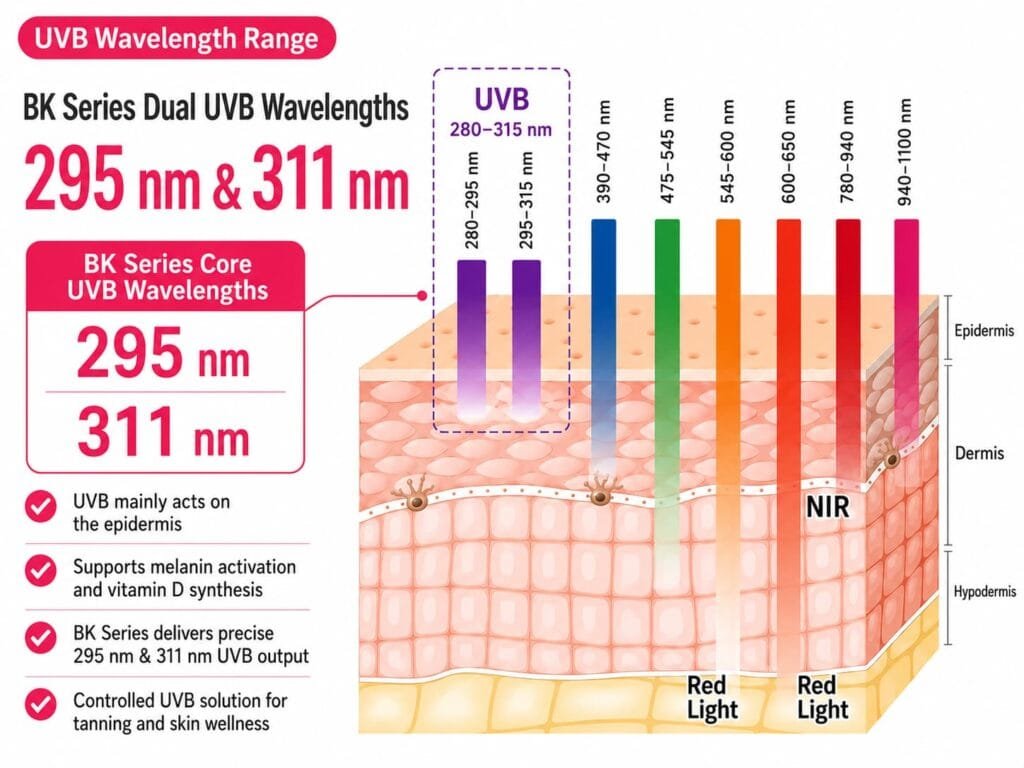
Ein qualifizierter Lieferant sollte in der Lage sein, sechs Beweisebenen zu trennen und jede dem von Ihnen gekauften Produkt zuzuordnen. Eine lange Zertifikatsliste ist weniger nützlich als eine kurze, nachvollziehbarer Dateiindex, der an das endgültige Modell und die endgültige Konfiguration gebunden ist.
| Beweisschicht | Was es zeigen kann | Was es nicht zeigt | Was Sie anfordern können |
|---|---|---|---|
| Marktpfad oder Zulassung | Einstufung, Vorlage, Erklärung oder legaler Weg für einen definierten Markt und Verwendungszweck | Leistung außerhalb seines Geltungsbereichs oder Autorisierung eines anderen Modells | Offizieller Rekord, Entscheidung oder Erklärung, die dem genauen Modell zugeordnet ist, Inhaber und Ansprüche |
| Produktsicherheit, Strahlung, elektrische und EMV-Prüfung | Wie sich eine benannte Konfiguration unter den angegebenen Standards und Akzeptanzkriterien verhielt | Klinischer Nutzen oder automatische Zulassung in jedem Markt | Vollständige Berichte zur Identifizierung der Probe, Konfiguration, Labor, Methoden, Termine und Ergebnisse |
| Optische Prüfung | Spektrum, Leistung und räumliche Verteilung unter definierten Betriebsbedingungen | Eine allgemein sichere Dosis, Belichtungsplan oder Bräunungsergebnis | Spektralbericht, Einstrahlungskarte, rohe Bedingungen, Kalibrierung und Unsicherheit |
| Qualitätsmanagementsystem | Geprüfte Prozesse bei einer benannten Organisation/Standort und innerhalb eines definierten Umfangs | Freigabe oder Konformität des fertigen Produkts | Aktuelles Zertifikat, Halter, Website, Umfang, Emittent und Gültigkeitsdaten |
| Anlagenregistrierung und Fabrikhintergrund | Anlagenidentität oder Fertigungskapazität | Produktzulassung, Abstand oder exakte Modellkonformität | Offizielle Betriebsaufzeichnung plus separate Nachweise auf Produktebene |
| Verkaufsseiten, Abzeichen und Broschüren | Was ein Lieferant derzeit sagt, ist verfügbar | Unabhängige Überprüfung | Der nummerierte Datensatz, Bericht, Hinter jeder Aussage steht eine Erklärung oder ein Zertifikat |
Die Standardkäuferregel ist einfach: wenn ein Dokument nicht mit dem endgültigen Modell verknüpft werden kann, Konfiguration, Verwendungszweck und Zielmarkt, Behandeln Sie es als Hintergrund – nicht als Beweis für die Projektgenehmigung.
Wie sperren Sie die genaue Konfiguration vor dem Testen??
Geben Sie jeder Probe und jedem Dokument dieselbe Konfigurationsidentität. Ohne Konfigurationskontrolle, Ein technisch beeindruckender Bericht beschreibt möglicherweise ein anderes LED-Array, Controller oder Firmware von der Einheit, die in die Produktion gelangt.
Ihre kontrollierte Konfiguration sollte mindestens identifizieren:
- Modellname und datierte Spezifikation oder Stückliste/Konfigurations-ID;
- Anordnung des LED-Pakets, nominale Wellenlängenkanäle, Wellenlängenbereiche oder Toleranzen;
- Treiber- und Netzteilkonfiguration;
- Firmware- und Benutzeroberflächenrevision;
- voreingestellte Namen, wählbare Kanäle, Helligkeit, Impuls, Timer- und Zonenlogik;
- Nähe, Temperatur- und andere Sicherheitskontrollimplementierung;
- Gehäuse, Kühlung, Stand, hängende oder wandmontierte Hardware;
- Modell und Menge der Schutzbrille;
- Etiketten, Handbuch, Verpackung, Sprachen und Zielmärkte;
- Eigenmarke, ggf. gesetzliche Hersteller- und Importeurinformationen.
Anschließend klassifizieren Sie jede gewünschte Änderung:
| Typ ändern | Beispiel | Minimale Beschaffungsreaktion |
|---|---|---|
| Nur Marke | Logo, Farbe, Karton-Artwork | Überprüfen Sie die Rückverfolgbarkeit, Etiketten, Deklarationen und Verpackungsdateien |
| Anleitung/Benutzeroberfläche | Sprache, Preset-Namen, Warn- oder Bedienbildschirm | Überprüfen Sie das Signal zur beabsichtigten Verwendung, Benutzerfreundlichkeit, Auswirkungen auf Software und Kennzeichnung |
| Optisch/elektrisch | Wellenlänge, LED-Layout, Treiber, Ausgang oder Stromversorgung | Optik wieder öffnen, Thermal-, Elektro-/EMV- und Marktdokumentenbewertung |
| Sicherheit/Kontrolle | Sensor, Timer, thermische Schwelle, Interlock- oder Firmware-Logik | Risikoanalyse und Normal-/Fehlerzustandsvalidierung erneut öffnen |
| Mechanisch | Gehäuse, Stand, Wandhalterung, Kühlpfad oder optisches Fenster | Mechanisch wieder öffnen, Thermal-, Reinigung und Validierung der Ausgabeverteilung |
Anpassung ist nicht automatisch ein Problem. Undokumentierte Anpassung ist. Im Angebot sollte angegeben werden, welche Datensätze weiterhin gültig sind, die eine Änderung oder neue Prüfung erfordern, Wer diese Arbeit ausführt und welche Revision zur Produktionsbasis wird.
Welche optischen Daten für eine Kaufentscheidung nützlich sind?
Eine Bestrahlungsstärkezahl reicht nicht aus, um die UVB-Leistung zu definieren, Abdeckung oder ein verwendbares Protokoll. Der Käufer muss wissen, was gemessen wurde, Wo, unter welcher Konfiguration und wie stark die Leistung im vorgesehenen Bereich variiert.
Für jeden gemeldeten Wert, fragen:
- Handelt es sich um eine reine UVB-Bestrahlungsstärke oder um eine kombinierte Breitbandleistung aller aktiven Wellenlängen??
- Was zeigt das gesamte Spektrum?, einschließlich nominaler Spitzen, Toleranzen und relative Kanalausgabe?
- Welcher Modus, Helligkeit, Impuls, Zone und Firmware-Revision waren aktiv?
- Wie groß war die Entfernung?, Orientierung, Messebene, Aufwärmen und thermische Bedingungen?
- Welches Instrument, Detektoröffnung, Kalibrierung und Unsicherheit wurden verwendet?
- Ist die Zahl ein Spitzenwert?, Center, Minimum oder räumlicher Durchschnitt?
- Gibt es eine vollständige Karte und eine Akzeptanzgrenze für die Einheitlichkeit??
- Wie viele Abweichungen treten bei mehreren Einheiten oder Produktionschargen auf??
- Sind unbewertete Bestrahlungsstärke und etwaige Gefahren- oder Erythem-gewichtete Werte klar getrennt?
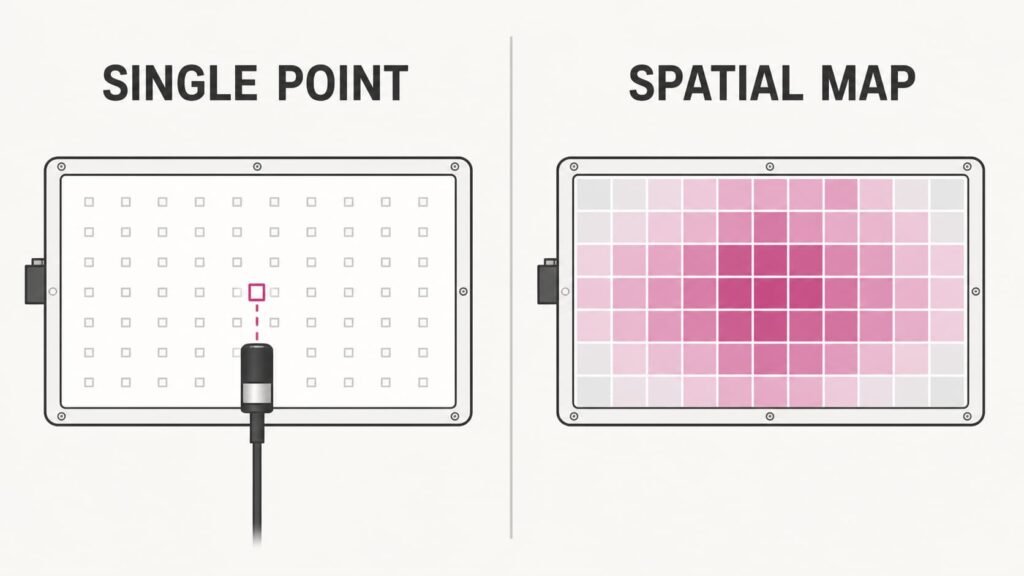
Nur Konzept – keine Testdaten. Ein einzelner Punkt kann keine räumliche Abdeckung oder Einheitlichkeit herstellen; Überprüfen Sie eine definierte Bedingungskarte, die mit der genauen Konfiguration verknüpft ist.
Elektrische Nennleistung, Die Anzahl der LED-Pakete und ein zentraler Breitbandwert bestimmen nicht die UVB-Bestrahlungsstärke. Für die Berechnung einer UVB-Dosis wäre zusätzlich eine definierte Messposition und -konfiguration erforderlich, eine entsprechende spektrale oder UVB-spezifische Messung und eine Belichtungszeit. Abdeckung und Einheitlichkeit sind separate Fragen, die eine räumliche Zuordnung erfordern; Dieser Leitfaden enthält keinen persönlichen Expositionsplan.
Ein brauchbarer optischer Bericht sollte daher anschließen:
- die Konfigurations-ID;
- aktive Kanäle und Steuerstatus;
- das gesamte Spektrum und die Messmethode;
- die räumliche Ausgabekarte und die Unsicherheit; Und
- Annahmegrenzen für Muster und Produktion.
Beschränken Sie jede Schlussfolgerung auf die tatsächlich vorgelegten Beweise. Wenn die Beispielidentität, Methode oder Kalibrierung ist unklar, Nennen Sie den Wert nicht unabhängig verifiziert. Eine Punktmessung ohne räumliche Karte stellt keine Abdeckung oder Gleichmäßigkeit dar, während ein getestetes Muster ohne Multi-Unit-Daten und Produktionsakzeptanzgrenzen keine Produktionskonsistenz herstellt.
Welche Sicherheitskontrollen erfordern eine genaue Modellüberprüfung??
Sicherheitsmerkmale sind nur dann sinnvoll, wenn sie ausgelöst werden, Antwort, Fehlerverhalten und Beschriftung wurden an der fertigen Konfiguration getestet. Das Vorhandensein eines Timers, Sensor oder Brille ist keine allgemeine Sicherheitsgarantie.
| Kontrollbereich | Überprüfen Sie das genaue Modell | Gemeinsame rote Fahne |
|---|---|---|
| Näherungs- oder Distanzkontrolle | Erkennungsfeld, Ansprechzeit, Körper-/Objektpositionen, Logik neu starten, Bypass- und Einzelfehlerverhalten | Ein Entfernungsschwellenwert erscheint nur in Verkaufsexemplaren |
| Timer und manueller Stopp | Genauigkeit, Maximaleinstellungslogik, Beendigung, Reset- und Spannungsausfallverhalten | Einstellbare Minuten werden als Belichtungsplan dargestellt |
| Wärmekontrolle | Worst-Case-Modus, wiederholte Sitzungen, Umgebungs-/Installationsgrenzen, Sensorstandort und Fehlerverhalten | Es wird ein interner Grenzwert ohne Testprotokoll angegeben |
| Schutzbrille | Genaues Modell, Menge, spektrale Durchlässigkeit, Anweisungen und Ersatzspezifikation | Herkömmliche Schutzbrillen verfügen über keine Spektraldaten |
| Mechanische Installation | Umkippen, laden, Verbindungselemente, Wanduntergrund, Belüftung und Wartungsfreiheit | Ein Stand- oder Wandfoto gilt als Installationsbeweis |
| Software und Benutzeroberfläche | Revision, Verifizierung/Validierung, Gefahrenanalyse, Voreinstellungen und vorhersehbarem Missbrauch | Eine therapeutisch klingende Voreinstellung wird als nachgewiesenes Ergebnis behandelt |
| Reinigung und Desinfektion | Materialverträglichkeit, validierte Methode, Grenzwerte für gemeinsam genutzte Arbeitsabläufe und Gehäuse | IP20 oder eine abwischbare Angabe werden zu einer Wasserbeständigkeitsaussage |
| Etiketten und Anweisungen | Warnungen, Kontraindikationen, Betriebsposition, Zeitplan, Reinigung und Benutzer-/Bedienersprache | Webseite, Etikett und Handbuch beschreiben unterschiedliche Verwendungszwecke |
UV-emittierende Bräunungsgeräte bergen ein festgestelltes Risiko auf Kategorieebene. Der Die Internationale Agentur für Krebsforschung stuft UV-emittierende Bräunungsgeräte als krebserregend für den Menschen ein. Die der Europäischen Kommission SCHEER-Meinung zu Sonnenbänken kamen zu dem Schluss, dass UV-Strahlung von Solarien Hautmelanome und Plattenepithelkarzinome verursacht und dass für ihre krebserregenden Wirkungen kein sicherer Expositionsgrenzwert festgelegt werden kann.
Diese Schlussfolgerungen beweisen nicht, dass jedes Panel den gleichen Output oder das gleiche Risiko hat. Sie legen fest, warum die Beschaffung Aussagen wie „risikofrei“ macht,„„sicheres Bräunen“ oder „sicher, weil es einen Sensor hat“ sind kein akzeptabler Ersatz für Technik, Kennzeichnung und Marktüberprüfung.
Was ändert sich, wenn der Zielmarkt die Vereinigten Staaten sind??
Für die USA. Bräunungsprodukte, Das Projekt muss sich sowohl mit der Ebene der medizinischen Geräte als auch mit der Ebene der elektronischen Strahlung befassen. Die Vermeidung von Schadensersatzansprüchen allein führt nicht dazu, dass diese Produktpflichten für Sonnenlampen aufgehoben werden.
Die FDA definiert ein Sonnenlampenprodukt als ein Gerät, das dazu bestimmt ist, den menschlichen Körper zwischendurch mit ultravioletter Strahlung zu bestrahlen 200 Und 400 nm, um die Bräunung zu induzieren. Es ist Übersicht über Sonnenlampen beschreibt diese Produkte sowohl als medizinische Geräte als auch als elektronische Produkte, einschließlich tragbarer Heim- und Tischmodelle – nicht nur Betten und Kabinen.
Die FDA Produktklassifizierungsdatensatz mit Schlüssel zum Produktcode REF identifiziert den generischen Typ „Sonnenbank“ unten 21 CFR 878.4635. Die aktuelle Verordnung klassifiziert Sonnenlichtprodukte als Klasse II mit besonderen Kontrollen, und die FDA identifiziert 510(k) als Premarket-Route für diese Kategorie. Der spezielle Kontrollen in 21 CFR 878.4635 Adressausgabe und Prüfung von Sicherheitsmerkmalen, Mechanik/Software/Biokompatibilität/Elektrik/EMV-Nachweis, Reinigungsanweisungen und spezifische Warnhinweise.
Abschnitt 878.4635 wird durch mehr als einen FDA-Produktcode repräsentiert. Aktuelle Aufzeichnungen umfassen REF für eine Sonnenliege oder eine andere Plattform, REH für ein Tischsystem, das in erster Linie zum Bräunen des Gesichts gedacht ist, Und SGZ für eine UV-Lampe oder ein Lichtpaneel, deren bestimmungsgemäßer Verwendungszweck die Produktion von Vitamin D ist. Diese Beispiele klassifizieren kein BK-Produkt. Der anwendbare Code muss anhand der endgültigen Konfiguration und des Verwendungszwecks ermittelt werden, dann anhand der genauen FDA-Aufzeichnung überprüft; es kann nicht allein aus der Panelform oder der Wellenlänge abgeleitet werden.
Separat, 21 CFR 1040.20 Enthält Anforderungen an die Leistung elektronischer Strahlung und Kennzeichnungsanforderungen, die Themen wie das Verhalten von Zeitgebern abdecken, manuelle Beendigung, Spektrale Durchlässigkeit von Schutzbrillen, Warnschilder, Belichtungspositionen und Zeitpläne, Anweisungen und Testbedingungen. Die FDA ist getrennt Aufzeichnung strahlungsemittierender elektronischer Produkte für REF identifiziert optische Strahlung, ein erforderlicher Produktbericht, jährliche Berichterstattung und 21 CFR 1040.20 als anwendbarer Leistungsstandard für diese REF-Kategorie. Dies veranschaulicht die parallele elektronische Strahlungsaufzeichnung; Es wird nicht der korrekte Produktcode oder Berichtsstatus für ein BK-Modell ermittelt.
Daraus ergeben sich vier praktische Käuferregeln:
- Behandeln Sie die Registrierung einer Einrichtung oder die Auflistung von Geräten nicht als Freigabe. Es handelt sich um unterschiedliche Datensätze mit unterschiedlichen Geltungsbereichen.
- Fragen Sie nach dem genauen 510(k) Aufzeichnung und Modell-/Kennzeichnungsbeziehung, wenn ein Lieferant US-Ansprüche geltend macht. Freigabe. Eine K-Nummer für eine andere Produktkategorie oder ein anderes Modell wird nicht übertragen.
- Behandeln Sie Strahlungsproduktberichte und Leistungsnachweise als separate Verifizierungsebene. Sie ersetzen nicht die Prüfung vor dem Inverkehrbringen, und die Überprüfung vor dem Inverkehrbringen ersetzt nicht die geltenden Pflichten zur elektronischen Strahlung.
- Überprüfen Sie Verkaufswebseiten im Rahmen der Etikettierungsarbeit. Abschnitt 878.4635 erweitert spezifizierte Kontraindikations- und Warnhinweise über das Handbuch hinaus auf verbraucherorientierte Kataloge, Spezifikationsblätter, beschreibende Broschüren und zum Verkauf angebotene Webseiten.
Stand August 12, 2026, Wakelife bestätigt, dass es keine modellspezifische FDA gibt 510(k) ist für BK300 verfügbar, BK900 oder BK1800. Käufer sollten den neuesten FDA-Datensatz und die geltend gemachte K-Nummer überprüfen, bevor sie sich auf diesen Status verlassen. Diese Modelle sollten daher als Entwicklungsplattformen bewertet und nicht als in den USA freigegeben dargestellt werden. Bräunungsgeräte. Ein US-Amerikaner. Das Projekt benötigt vor dem Start einen schriftlichen Regulierungsplan, einschließlich wem die Beiträge gehören, Berichte, Etiketten und Revalidierung nach Private-Label- oder technischen Änderungen.
Was ändert sich für ein EU- oder EWR-Projekt??
Für EU/EWR-Beschaffung, Reduzieren Sie das Projekt nicht auf die Erlangung eines „CE-Zertifikats“. Identifizieren Sie die anwendbare Gesetzgebung, die verantwortlichen Wirtschaftsakteure und die genaue technische Dokumentation des Endprodukts.
Die Europäische Kommission erklärt, dass der Hersteller für die Konformitätsbewertung verantwortlich sei, die technische Akte, der EU-Konformitätserklärung und Anbringung der CE-Kennzeichnung. Es ist offizielle Anleitung zur CE-Kennzeichnung besagt außerdem, dass die CE-Kennzeichnung keine Anerkennung der Produktsicherheit durch die EU oder eine andere Behörde darstellt.
Der Niederspannungsrichtlinie 2014/35/EU gilt für elektrische Geräte, die für den Einsatz mit einer Nennspannung zwischen 50 Und 1,000 V AC oder dazwischen 75 Und 1,500 In DC, vorbehaltlich der Ausnahmen in Anhang II. Dieser Umfang sollte anhand des Endprodukts überprüft und nicht für jedes UVB-Panel oder jede Niederspannungskomponente angenommen werden. Wo die Richtlinie gilt, Die technische Dokumentation muss eine Konformitätsbewertung ermöglichen und die entsprechenden Anforderungen enthalten, Design-/Herstellungsinformationen, angewendete Standards, Untersuchungen bzw. Berechnungen und Prüfberichte. Importeure sind außerdem verpflichtet, zu überprüfen, ob das Konformitätsverfahren und die erforderliche Dokumentation vorhanden sind, bevor das Produkt auf den Markt gebracht wird.
Private Labeling kann auch die rechtliche Rolle verändern. Unter Artikel 10, Ein Importeur oder Händler, der elektrische Geräte unter seinem eigenen Namen oder seiner eigenen Marke auf den Markt bringt, oder es in einer Weise ändert, die die Konformität beeinträchtigen könnte, wird als Hersteller für die Verpflichtungen der Richtlinie behandelt. Die der Europäischen Kommission Leitfaden für Importeure und Händler erklärt die gleiche Verantwortungsgrenze.
Für entsprechende Bräunungsgeräte, Standards müssen je nach Version und Markt überprüft werden:
- IEC 60335-2-27:2024 ist die siebte internationale Ausgabe für Geräte mit optischen Strahlungsemittern zur Hautexposition; Ausgenommen sind Geräte für medizinische Zwecke und andere UV-Anwendungen als die Bräunung.
- Wie im August überprüft 12, 2026, Die aktuelle konsolidierte EU-Normenliste listet EN auf 60335-2-27:2013 mit A1:2020, A2:2020 und AC:2021-11 mit einer Einschränkung.
- Durchführungsbeschluss der Kommission (EU) 2025/1457 beschränkt die Beschränkung auf die Anmerkung in Abschnitt 6.Z101 und Anmerkung 101 im Anhang BB, Abschnitt BB.2. Diese Hinweise begründen keine Konformitätsvermutung mit den entsprechenden Sicherheitszielen der Niederspannungsrichtlinie; Die Entscheidung hebt die Vermutung für die anderen abgedeckten Bestimmungen der Norm insgesamt nicht auf.
Die Schlussfolgerung aus der Beschaffung lautet nicht, dass eine Ausgabe allgemein „das richtige Zertifikat“ ist. Der Käufer sollte den Konformitätsweg beantragen, geltende Gesetzgebung, Für die genaue Konfiguration gelten die verwendeten EN/nationalen Ausgaben und Einschränkungen, zusammen mit dem DoC und den unterstützenden technischen Unterlagen. Die Veröffentlichung einer neueren IEC-Ausgabe allein ist kein Beweis für die nationale Übernahme oder die Konformität mit dem exakten Modell.
Was sollte ein professionelles Studio über die Gerätedatei hinaus validieren??
Beim Kauf eines Studios wird dem Produkt ein Betriebssystem hinzugefügt. Der Gerätenachweis und die Betriebskontrollen des Standorts müssen zueinander passen.
Ein professioneller Käufer sollte definieren:
- behoben, tragbar, hängende oder wandmontierte Installation und Zugangskontrolle;
- Stromversorgung, Belüftung, Servicefreigabe und Montageverantwortung;
- Personalschulung, Benutzerüberprüfung, Brillenkontrolle und Not-Aus-Verfahren;
- Reinigung oder Desinfektion zwischen Benutzern und Materialverträglichkeit;
- Sitzungs-/Setup-Datensätze, Beschwerden, Vorfälle und Eskalationsverantwortung;
- lokales Alter/Zugang, Einrichtung, Berufs- und Versicherungsanforderungen;
- Wer kann Presets ändern?, Firmware, Distanz, Zone oder andere Betriebsparameter.
Bei diesem Abschnitt handelt es sich nicht um ein Belichtungsprotokoll. Die zulässige Benutzerpopulation, Zeitplan und Betriebsanweisungen müssen aus dem validierten Produkt und den geltenden Markt- und Anlagenanforderungen stammen.
Welche Lieferantenansprüche sollten die Überprüfung stoppen oder eskalieren??
Nutzen Sie Warnsignale, um vor der Preisverhandlung Zeit zu sparen. Stoppen oder eskalieren Sie das Projekt, wenn ein Lieferant:
- nutzt die Einrichtungsregistrierung, Geräteliste, ISO/MDSAP oder ein anderes Produkt 510(k) als exakte Modellautorisierung;
- sagt, dass ein „nichtmedizinisches“ Etikett automatisch die US-Markierung entfernt. Bestrahlungspflicht trotz bestimmungsgemäßer Besonnung;
- stellt nur Zertifizierungslogos zur Verfügung, Verkaufsseiten oder eine einzelne Breitband-Bestrahlungsstärkenummer;
- Die Stückliste/Konfiguration und Firmware/UI-Revision des Beispiels kann nicht identifiziert werden;
- bezeichnet das Produkt als sicher, da es einen Timer enthält, Abstandssensor oder Brille;
- verspricht Wellenlänge, Treiber, Firmware, Sensor- oder Gehäuseänderungen ohne Revalidierungsplan;
- kann keine Deklarationen zuordnen, Testberichte, Etiketten und Anweisungen zur Private-Label-Konfiguration;
- verwandelt voreingestellte Etiketten in Krankheiten, Knochengesundheit, Kollagen, Akne oder Muskelregenerationsergebnisse;
- behauptet „globale Compliance“, ohne den Markt zu trennen, Modell, Verwendungszweck und Dokumentumfang.
Eine gute Lieferantenantwort muss nicht versprechen, dass jede Datei bereits vorhanden ist. Es sollte identifizieren, was verfügbar ist, Was fehlt, was entwickelt werden muss, wem die jeweilige Aktion gehört und welche Ansprüche bis zum Abschluss der Arbeiten nicht verfügbar bleiben.
Wie sollte die Mustergenehmigung erfolgen??
Verwenden Sie drei Genehmigungstore, damit eine überzeugende Stichprobe fehlende Beweise nicht umgehen kann.
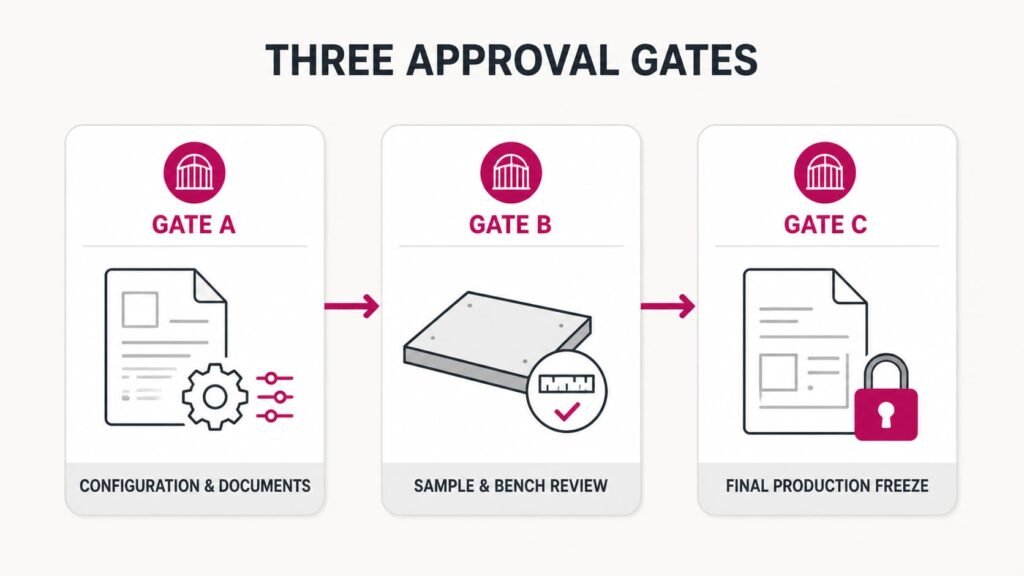
Beschaffungsworkflow – kein behördlicher Genehmigungsweg. Jedes Tor steuert eine andere Beschaffungsentscheidung; Keiner stellt unabhängig die Marktzulassung fest.
Tor A: Bevor Sie das Muster bestellen
Erfordern:
- die abgeschlossene Projektbeschreibung;
- eine datierte Standardkonfiguration und eine Liste der angeforderten Änderungen;
- ein vorläufiger Beweisindex mit Modell-/Konfigurationsumfang;
- eine Markt- und Anspruchslückenliste;
- Eigentum, Zeitplan und Kosten für die erforderliche Validierung oder Einreichung.
Das Passieren von Gate A bedeutet, dass der Käufer weiß, was die Probe darstellt. Das Produkt wird nicht zum Verkauf freigegeben.
Tor B: Proben- und Prüfstandsbewertung
Überprüfen:
- Identität anhand des Konfigurationsdatensatzes;
- Spektrum, Ausgabezuordnung und Einheitenvariation unter definierten Bedingungen;
- Sensor, Timer, manueller Stopp, thermisches und Softwareverhalten unter normalen und vorhersehbaren Fehler-/Missbrauchsbedingungen;
- Montage, Kühlung, Reinigung und mechanische Anforderungen;
- Brillen, Etiketten, Warnungen, Kontraindikationen und Anweisungen;
- Inkonsistenzen zwischen der physikalischen Einheit, Bericht, Verkaufsseite und Handbuch.
Durch das Passieren von Gate B wird bestätigt, ob die Probe die vereinbarten technischen Abnahmekriterien erfüllt. Die marktspezifische Dokumentation wird nicht automatisch geschlossen.
Tor C: Vor der Pilot- oder Massenproduktion
Einfrieren:
- Stückliste, Firmware, Benutzeroberfläche, Etiketten, Handbuch, Zubehör und Verpackung;
- Abschlussberichte, Erklärungen, Einreichungen und ungelöste Marktaktionen;
- Produktionsabnahmegrenzen und Chargenprotokolle;
- Änderungsmitteilung, Revalidierungs- und Dokumentaktualisierungsregeln;
- Garantie, Beschwerde, Verantwortlichkeiten für Vorfälle und Korrekturmaßnahmen.
Erst nach Gate C sollte ein Käufer die angebotene Konfiguration als das beabsichtigte Produktionsprodukt betrachten.
Was sollte in eine UVB-Bräunungspanel-Anfrage enthalten sein??
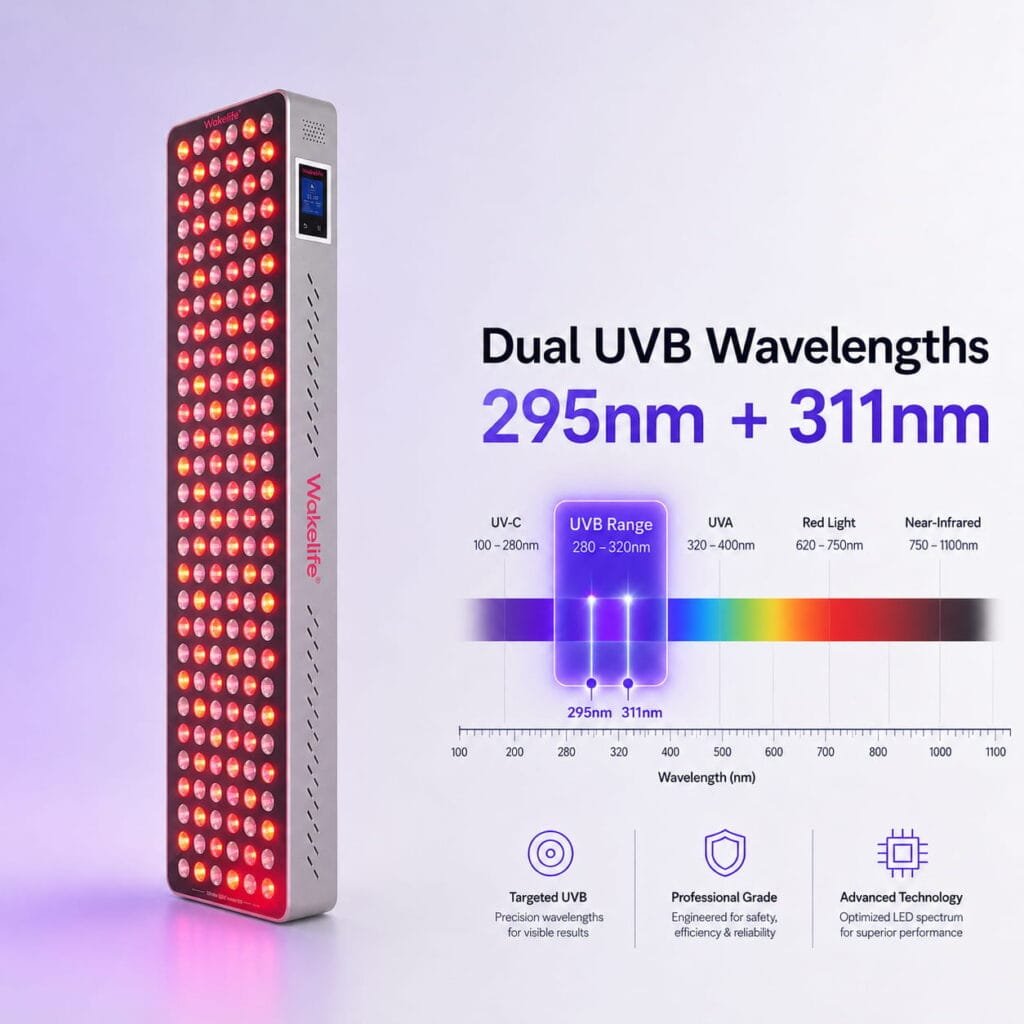
Eine nützliche Ausschreibung definiert das Projekt, bevor das kommerzielle Angebot angefordert wird. Kopieren Sie diese Checkliste in die Anfrage:
- Zielländer und geplante Vertriebskanäle.
- Verwendungszweck und genaue geplante Ansprüche, Trennung der kommerziellen Bräunung von allen regulierten medizinischen Verfahren.
- Heim, professionelles Studio oder andere Einsatzumgebung, einschließlich des Betreiber-/Benutzermodells.
- Basismodell und datierte Standardkonfiguration bitte angeben.
- Erforderliche Wellenlängen, Toleranzen, Kanalverhältnisse, Modi, Helligkeit, Impuls, Timer- und Zonenlogik.
- Erforderliches Spektrum, Strahlungskartierung, Messbedingungen, Unsicherheit und Produktionsakzeptanzkriterien.
- Sensor, Timer, manueller Stopp, Thermal-, Software, mechanische und Fehlertestbeweise.
- Modell mit Schutzbrille, Spektraltransmissionsdaten, Menge und Ersatzspezifikation.
- Erforderliche Warnungen, Kontraindikationen, Anweisungen, Reinigung/Desinfektion und Sprachversionen.
- Installationsroute, Ständer-/Hänge-/Wandmontage-Hardware, Spannungs-/Stecker- und Wartungsabstände.
- Marktgenaue Einreichungen, Erklärungen, technische Aktenberichte und verantwortliche juristische Personen.
- Logo, Benutzeroberfläche, Handbuch, Verpackungs- und Handelsmarkenänderungen, mit ihrer Revalidierungswirkung.
- Muster- und Pilotmenge, MOQ, Prognosevolumen, Vorlaufzeit, Garantie, Ersatzteile und After-Sales-Anforderungen.
- Produktionsabnahme, Chargenrückverfolgbarkeit, Änderungsmitteilung, Beschwerdebearbeitung und Unterstützung bei Korrekturmaßnahmen.
Bitten Sie den Lieferanten, auf jeden Punkt mit einem von vier Status zu antworten: „verfügbar und im Umfang,” „verfügbar, aber nicht im Umfang,” „zu entwickeln,“ oder „nicht angeboten“. Dieses Format ist entscheidungsnützlicher als ein allgemeines Versprechen, Zertifikate später bereitzustellen.
Wie kann Wakelife ein Projekt der BK-Serie unterstützen??
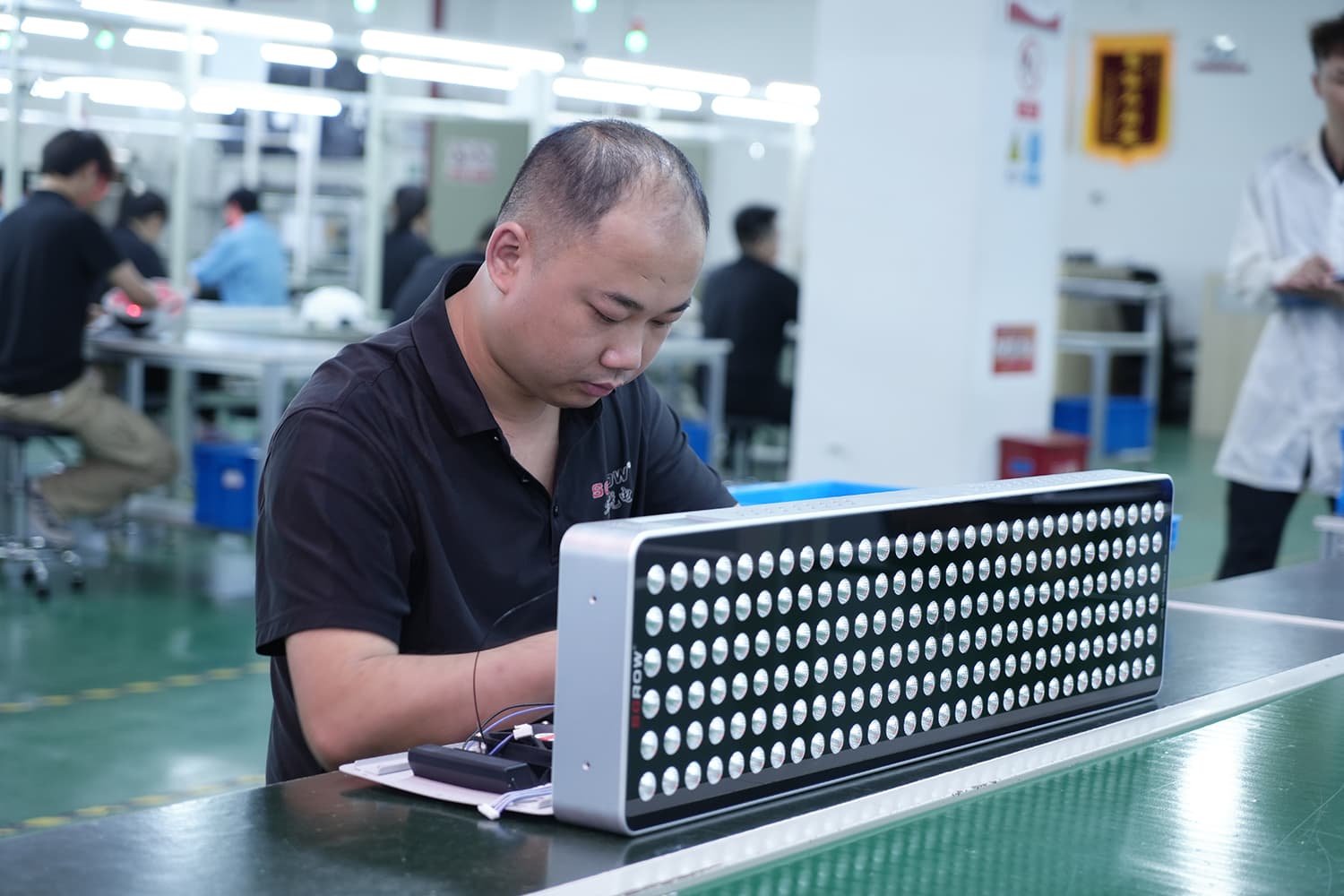
Die Produktionseinheit von Wakelife, Shenzhen Sungrow LED Technology Co., Ltd., operiert unter a BSI-zertifizierte ISO 13485:2016 Qualitätsmanagementsystem (Zertifikat MD 800872) und besitzt das MDSAP-Zertifikat MDSAP 800873. Das BSI gibt den Anwendungsbereich als Design an, Herstellung und Vertrieb von LED-Therapieleuchten zur Hautbehandlung und Schmerzlinderung, und LED-Lichttherapiemasken gegen Falten und leichte bis mittelschwere Akne. In seinem Verzeichnis werden weder UVB-Bräunungsgeräte noch die BK-Modelle in diesem Bereich genannt.
Shenzhen Sungrow LED Technology Co., Ltd. ist auch der eingetragene Antragsteller für die FDA-Zulassung 510(k) K250830, was abdeckt 13 benannte LED-Lichttherapie-Maskenmodelle. Die FDA-Aufzeichnung identifiziert 21 CFR 878.4810 und Hauptproduktcode OHS, mit OLP als nachfolgendem Code – ein anderer Klassifizierungsweg als der Sonnenlicht-Produktcode REF unten 21 CFR 878.4635.
Diese Aufzeichnungen belegen den Umfang des Qualitätssicherungssystems und die Erfahrung bei der Durchführung eines U.S.-Tests. behördliche Einreichung. Sie bieten keine FDA-Zulassung, Zertifizierung auf Produktebene oder Marktzulassung für BK300, BK900 oder BK1800. Jedes BK-Projekt erfordert weiterhin die in diesem Leitfaden beschriebene Überprüfung des genauen Modells und der Zielgruppendaten.
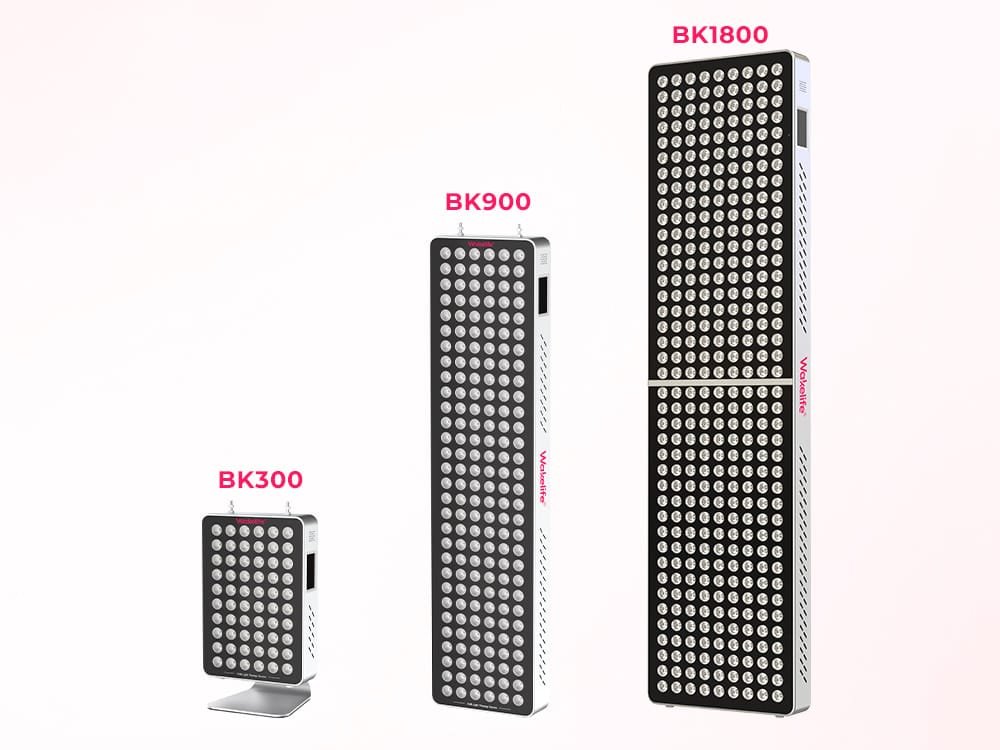
Wakelife bietet derzeit drei BK-Produktplattformen für die B2B-Evaluierung an: BK300 für kompakte Produktkonzepte, BK900 für ein längeres Plattenformat mit Stand- oder Hängeeinsatz, und BK1800 für ein großflächiges Format mit vollflächiger, obere- und Auswahl der unteren Zone.
Um die aktuellen Produktformate zu überprüfen, bevor Sie ein Modell in die engere Auswahl nehmen, Entdecken Sie das UVB-Bräunungspanel-Sortiment der Wakelife BK-Serie. Auf der Kategorieseite wird BK300 vorgestellt, BK900 und BK1800 nach Format, Steuerungsfunktionen und Projektpassung.
Für die Auswahl von Models, lies das Vergleich der UVB-Bräunungsplatten BK300 vs. BK900 vs. BK1800, was das Format vergleicht, Installations- und Zonenkontrollunterschiede, ohne die veröffentlichten Leistungszahlen als kontrollierte Leistungsbewertung zu behandeln.
Diese Beschreibungen identifizieren die aktuellen, vom Lieferanten deklarierten Plattformrollen. Es handelt sich dabei nicht um Angaben zur Vergleichsdosis, Sicherheit, klinische Leistung oder Marktzulassung. Der nächste Schritt besteht darin, ein physisches Format auszuwählen, Definieren Sie den Zielmarkt und die Ansprüche, und fordern Sie die genaue Konfiguration und den Dokumentenumfang an, die für das Projekt erforderlich sind.
Kontaktieren Sie Wakelife mit den ausgefüllten RFQ-Feldern oben, um ein Standardmuster zu besprechen, Private-Label-Konfiguration oder tiefer OEM/ODM-Projekt. Jede Leistung, Die Kennzeichnung oder die Schlussfolgerung zur Marktreife bleibt an die endgültige Konfiguration und die abgeschlossene Evidenzprüfung gebunden.
Häufig gestellte Fragen
Bedeutet eine von der FDA registrierte Fabrik, dass ein UVB-Bräunungspanel von der FDA zugelassen ist??
NEIN. Betriebsregistrierung und genaues Gerät 510(k) Bei der Freigabe handelt es sich um unterschiedliche behördliche Aufzeichnungen. Für einen US-amerikanischen. Bräunungsprodukt, Überprüfen Sie das genaue Modell, Halter, Verwendungszweck, 510(k) aufzeichnen, Kennzeichnung und die gesonderten Anforderungen an elektronische Strahlung.
Sind BK300, BK900 und BK1800 von der FDA zugelassen?
Stand August 12, 2026, Wakelife bestätigt, dass es keine modellspezifische FDA gibt 510(k) ist für BK300 verfügbar, BK900 oder BK1800. Käufer sollten die neuesten FDA-Daten und alle beanspruchten K-Nummern überprüfen. Die Modelle sollten nicht als in den USA zugelassen präsentiert werden. Bräunungsgeräte, Käufer können sie jedoch als Entwicklungsplattformen bewerten und gleichzeitig die geltenden Vorschriften festlegen und erfüllen, Prüf- und Kennzeichnungsarbeiten.
Reicht ein CE-Zertifikat für ein EU-Private-Label-Projekt??
NEIN. Identifizieren Sie zunächst alle geltenden EU-Rechtsvorschriften und die verantwortlichen Wirtschaftsakteure. Gemäß der Niederspannungsrichtlinie, Ein Importeur oder Händler, der Geräte unter seinem eigenen Namen oder seiner eigenen Marke vermarktet oder sie in einer Weise verändert, die die Konformität beeinträchtigen könnte, wird als Hersteller behandelt. Wenn das Ihre Rolle ist, Ein vom Werk ausgestelltes Zertifikat ersetzt nicht Ihre Verantwortung, die entsprechende Konformitätsbewertung durchzuführen, stellen Sie die EU-Konformitätserklärung für das endgültige Private-Label-Modell und die endgültige Konfiguration aus, und pflegen Sie die unterstützende technische Dokumentation, Normen und Prüfberichte. Gemäß der Richtlinie, Der Hersteller muss die Erklärung und die technischen Unterlagen für die Marktüberwachungsbehörden verfügbar halten 10 Jahre nachdem das Gerät auf den Markt gebracht wurde. Die CE-Kennzeichnung ist die Konformitätserklärung des Herstellers, keine Produktsicherheitszulassung einer EU-Behörde. Ob eine Konformitätsbewertung durch Dritte erforderlich ist, hängt von der geltenden Gesetzgebung ab; es kann nicht aus einem generischen CE-Zertifikat abgeleitet werden.
Welche optischen Daten sollte ein Käufer erfragen??
Fordern Sie das gesamte Spektrum an, Wellenlängentoleranzen, aktive Kanäle und Steuerungseinstellungen, Bestrahlungsstärkekarten für definierte Entfernungen, Geräte-/Kalibrierungsdetails, Unsicherheit, räumliche Akzeptanzgrenzen und Einheits-/Chargenvariation. Unbeschwert und gefahrlos aufbewahren- oder erythemgewichtete Werte trennen sich.
Macht ein Timer oder ein Abstandssensor ein UVB-Panel sicher??
NEIN. Dies können nützliche technische Kontrollen sein, Sie erfordern jedoch eine exakte Modellüberprüfung der Auslöser, Antwort, neu starten, Bypass, Fehlerverhalten und Anweisungen. Sie beseitigen weder die festgestellten Risiken von UV-emittierenden Bräunungsgeräten noch beweisen sie selbst die Einhaltung gesetzlicher Vorschriften.
Kann ein UVB-Bräunungspanel als Phototherapiegerät vermarktet werden??
Nicht automatisch. Eine medizinische Zweckbestimmung bedarf eines eigenen Nachweises, Produktklassifizierung, Marktzulassung, Etiketten und Qualitäts-/Regulierungsweg. Eine Wellenlänge wie z 311 nm oder die Forschung an anderen NB-UVB-Geräten überträgt diesen medizinischen Nutzen nicht auf das beschaffte Panel.
Referenzen
- 1
-
2
UNS. FDA — Produktklassifizierung: Produktcode REF
-
3
UNS. FDA — Produktklassifizierung: Produktcode REH
-
4
UNS. FDA — Produktklassifizierung: Produktcode SGZ
- 5
- 6
- 7
-
8
IARC — Sonnenbänke und UV-Strahlung
- 9
-
10
Europäische Kommission — CE -Markierung
-
11
Europäische Kommission — Importeure und Händler
- 12
-
13
IEC — IEC 60335-2-27:2024
- 14
- 15
- 16
-
17
UNS. FDA — 510(k) K250830: LED -Lichttherapiemaske