Short answer: Do not rank LED face masks by the number of colors, the advertised LED count, or the highest irradiance number. First define what you want to address. Then verify any U.S. FDA 510(k) clearance against the exact device or model and intended use. Check whether the relevant emitters cover the target area, ask how the LEDs are counted, compare irradiance only under disclosed test conditions, and inspect fit and assembly. A number becomes useful only when you know what was measured, where, and for which protocol.
Scope: This guide compares products. It does not diagnose a skin condition or replace the labeling and warnings for your exact device. If a condition, medication, or treatment could affect whether at-home light is appropriate for you, read the medical boundary under Point 6 before comparing devices.
Why “More” Is the Wrong Starting Point
Most first-time buyers compare three things: how many wavelength bands a mask lists, how many LEDs it claims to contain, and how high its irradiance appears to be. The natural assumption is that more colors, more LEDs, and more power must produce a better mask.
That shortcut fails because the three numbers answer different questions:
- A wavelength tells you what light is emitted, not whether the mode matches your goal or has evidence for that model.
- An LED count says something about the physical design only after the counting method and mask area are known.
- Irradiance describes light power per unit area under particular measurement conditions, not the complete dose or expected result.
From our manufacturing perspective, a better first question is not “Which mask has the biggest numbers?” It is:
Can I trace this device’s claimed purpose to a verifiable model, relevant light placement, reproducible output data, and a design I can use as instructed?
The following six checks turn that question into a practical buying process.
1. Define the Goal Before Comparing Features
Start with the concern you want the device to address, because the goal determines which evidence, mode, and target area matter. A mask with seven labeled colors is not automatically a better choice than one with two well-documented modes.
For example, the FDA indications for one named family of OTC LED masks under 510(k) K250830 distinguish among red, yellow, red-plus-infrared, blue, and mixed modes. The listed intended uses are also specific: full-face wrinkles or mild-to-moderate inflammatory acne, depending on the mode. That record does not prove that every mask using the same color word has the same purpose.
Write down four things before opening comparison tabs:
- the main concern you want to address;
- the facial area that matters most;
- whether you are choosing a general wellness product or a device with a specific regulated intended use in your market; and
- the time and frequency you can realistically follow under the device instructions.
If you are not sure what the concern is, whether it falls within the device’s labeled purpose, or whether light is appropriate for you, the next step is qualified assessment—not selecting a color from a product chart.
For a closer look at what color and mode labels do—and do not—tell you, use Wakelife’s 7-color versus red-and-blue LED mask comparison.
2. Verify the Exact Device When FDA Clearance Is Claimed or May Be Required
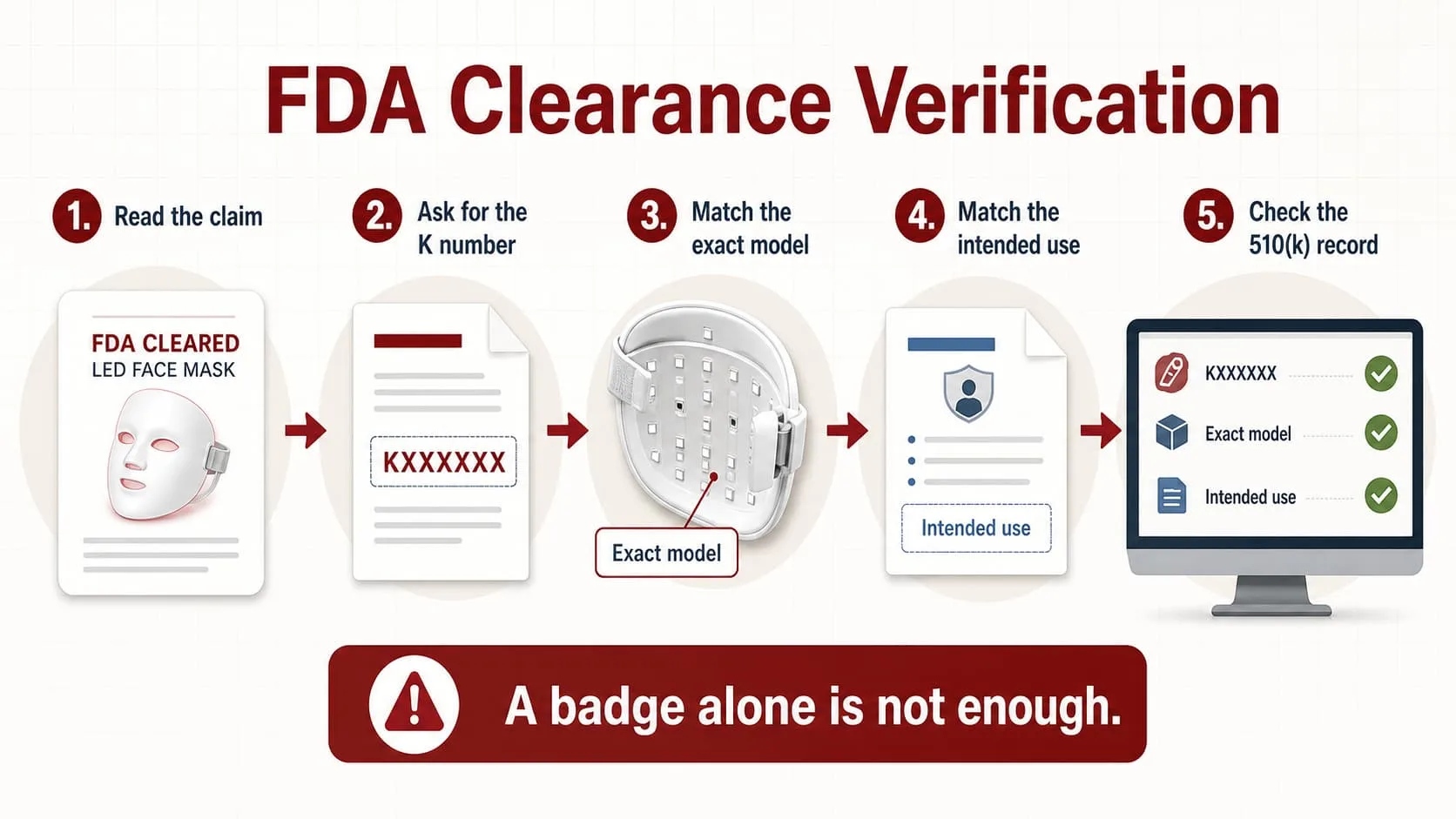
When U.S. medical-device clearance is claimed or required, look for “FDA cleared,” obtain the 510(k) number, and match the record to the device, model, and intended use. A logo, an establishment registration, or a vague statement such as “FDA certified” does not complete that check.
The FDA explains that a 510(k) is a premarket submission used to demonstrate substantial equivalence to a legally marketed device. A substantially equivalent decision allows the cleared device to be marketed for its stated scope. It is a meaningful, verifiable threshold; it is not a prize for the “best” mask, a guarantee of results for every user, or an approval of every marketing claim made on a sales page.
Use this four-step check when a seller makes that clearance claim:
A seller’s page does not have to display the K number for the product to be legitimate; many do not. But when the seller claims FDA clearance, refusal to provide the number, a missing FDA record, or a model/intended-use mismatch is a strong reason to stop and investigate further.
Mark this check not applicable only when the product does not make a U.S. medical-device intended-use or treatment claim and the applicable device classification and rules do not require a 510(k). A seller’s silence about clearance is not enough. If the seller makes a medical or treatment claim but omits its clearance status, first determine whether that intended use requires premarket authorization and verify the applicable FDA record; do not mark the check not applicable merely because the product page avoids the word “cleared.”
Private-label names require one more question: ask the seller to document how the retail model corresponds to a model in the clearance and labeling. Do not assume that a similar-looking shell or a manufacturer’s unrelated clearance automatically covers the product in your cart.
For a consumer-level explanation of the database process, use the FDA’s guide to learning whether a medical device has been cleared for marketing.
3. Match Wavelength to the Goal—and Check Placement
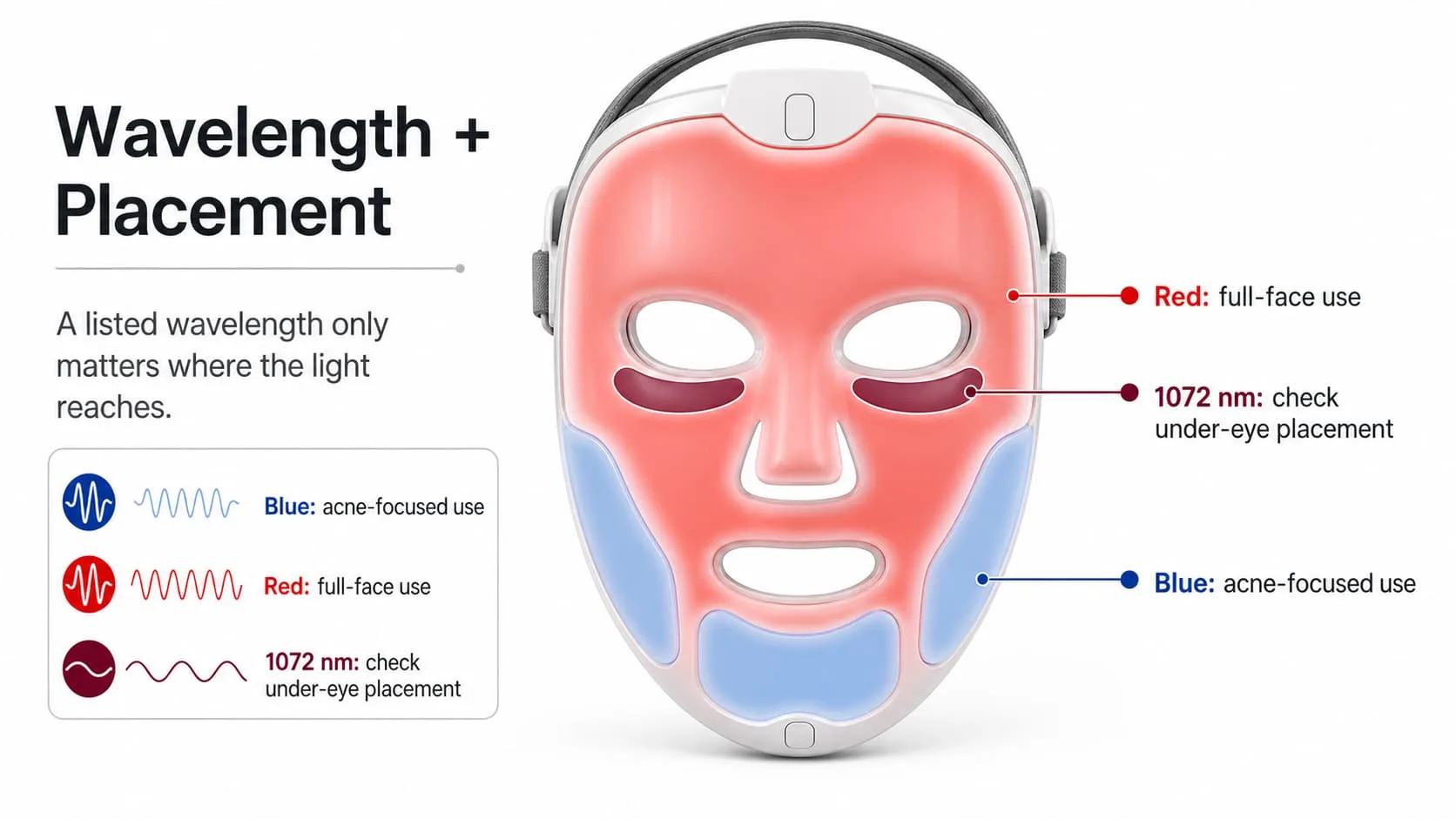
A useful wavelength must be active in the selected mode and positioned where the target area actually sits. A specification sheet can list a wavelength even when only a small number of its emitters are present or placed away from the area you care about.
Blue light provides a simple example. Some exact devices are cleared for mild-to-moderate inflammatory acne using blue or mixed modes, but that does not make every blue setting appropriate for every type of acne. Red, yellow, and infrared combinations can have different intended uses on specific devices. Start with the exact model’s labeling rather than a universal color-benefit chart.
Placement becomes especially important for localized concerns. A randomized, double-blind, placebo-controlled but self-reported study tested 1072 nm light around the eyes for six to eight weeks and reported perceived changes in fine lines, wrinkles, and under-eye bags. It was an older, narrow protocol, not proof that any mask listing 1072 nm will produce the same result. If 1072 nm is a deciding feature for under-eye use, we would ask two separate questions:
- How many 1072 nm chips are active in the relevant mode?
- Are those emitters physically distributed below and around the eye area, subject to the device’s eye-safety instructions?
Apply the same logic to every mode:
- 01 goal
- 02 wavelength
- 03 active emitters
- 04 placement
- 05 exact-device instructions and evidence
4. Count Physical LED Packages Before Counting Chips
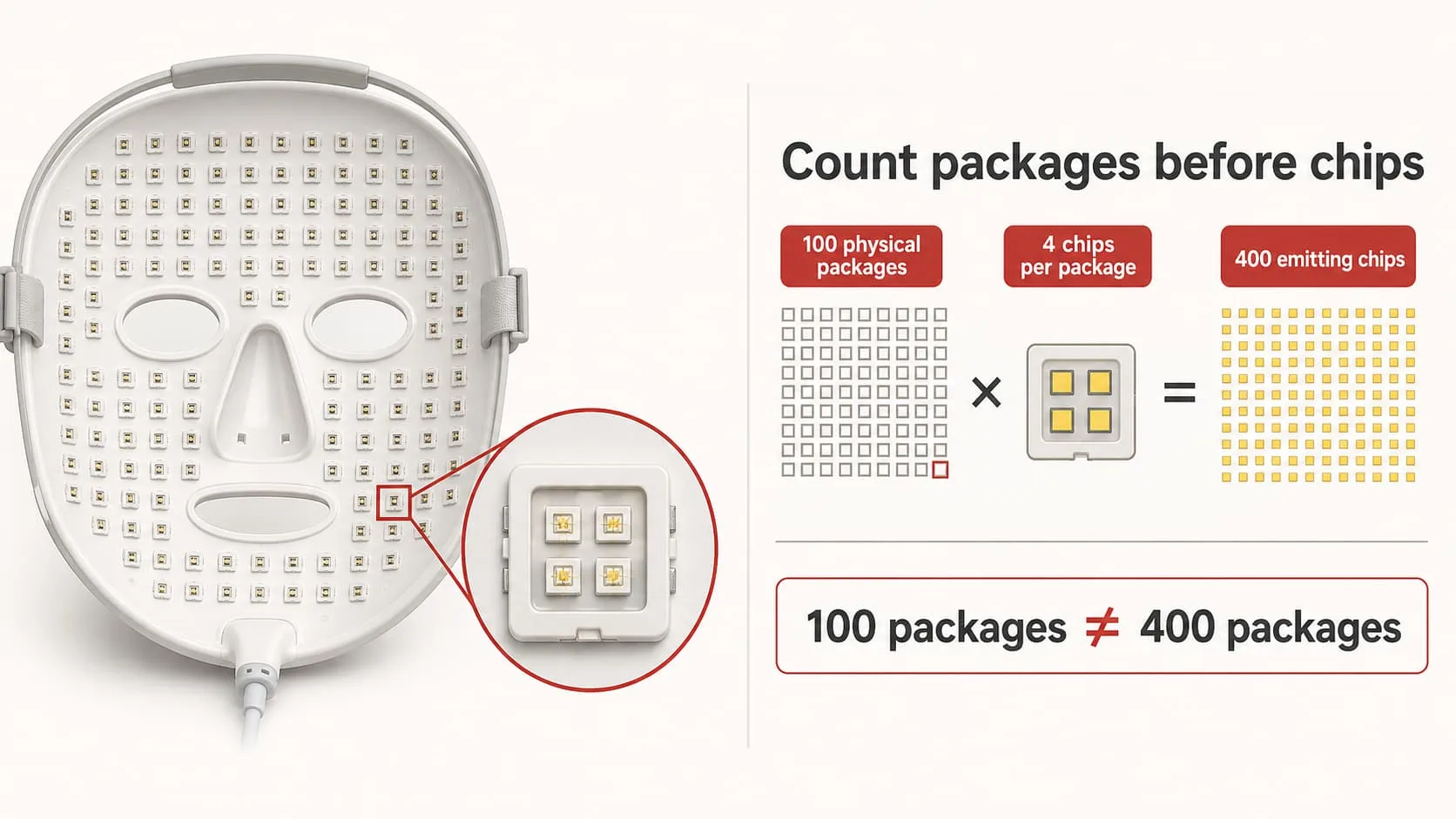
Ask whether the advertised number means physical LED packages or the emitting chips inside them. Without that definition, two products can use different counting methods and appear comparable when they are not.
Our counting rule is straightforward:
A mask with 100 physical LED packages still has 100 LEDs in the package-count sense, even if each package contains four emitting chips. The manufacturer may accurately state 400 emitting chips, but it should not present them as 400 physical LED packages.
Ask for three separate fields:
| Field | Example | Why it matters |
|---|---|---|
| Physical LED packages | 100 packages | Shows the number and possible density of physical light-source positions |
| Chips per package | 4 chips | Shows whether one package can contain several wavelengths or emitters |
| Chips assigned to each wavelength | e.g., a model-specific breakdown | Shows whether a headline wavelength is widely distributed or present only in a few locations |
LED count is not meaningless. In Wakelife’s product-segmentation experience, masks with 200 or more physical LED packages usually sit in a dense, higher-end design tier, while products below 80 packages more often sit in a value tier. These are internal product-design observations—not clinical, regulatory, or industry thresholds.
Do not rank masks by package count alone. Compare it with mask area, emitter placement, beam angle or optical design, wavelengths, drive conditions, irradiance, and uniformity. Two hundred poorly distributed emitters do not automatically beat 100 well-documented emitters that cover the intended area evenly.
5. Compare Irradiance With Its Test Conditions and Uniformity
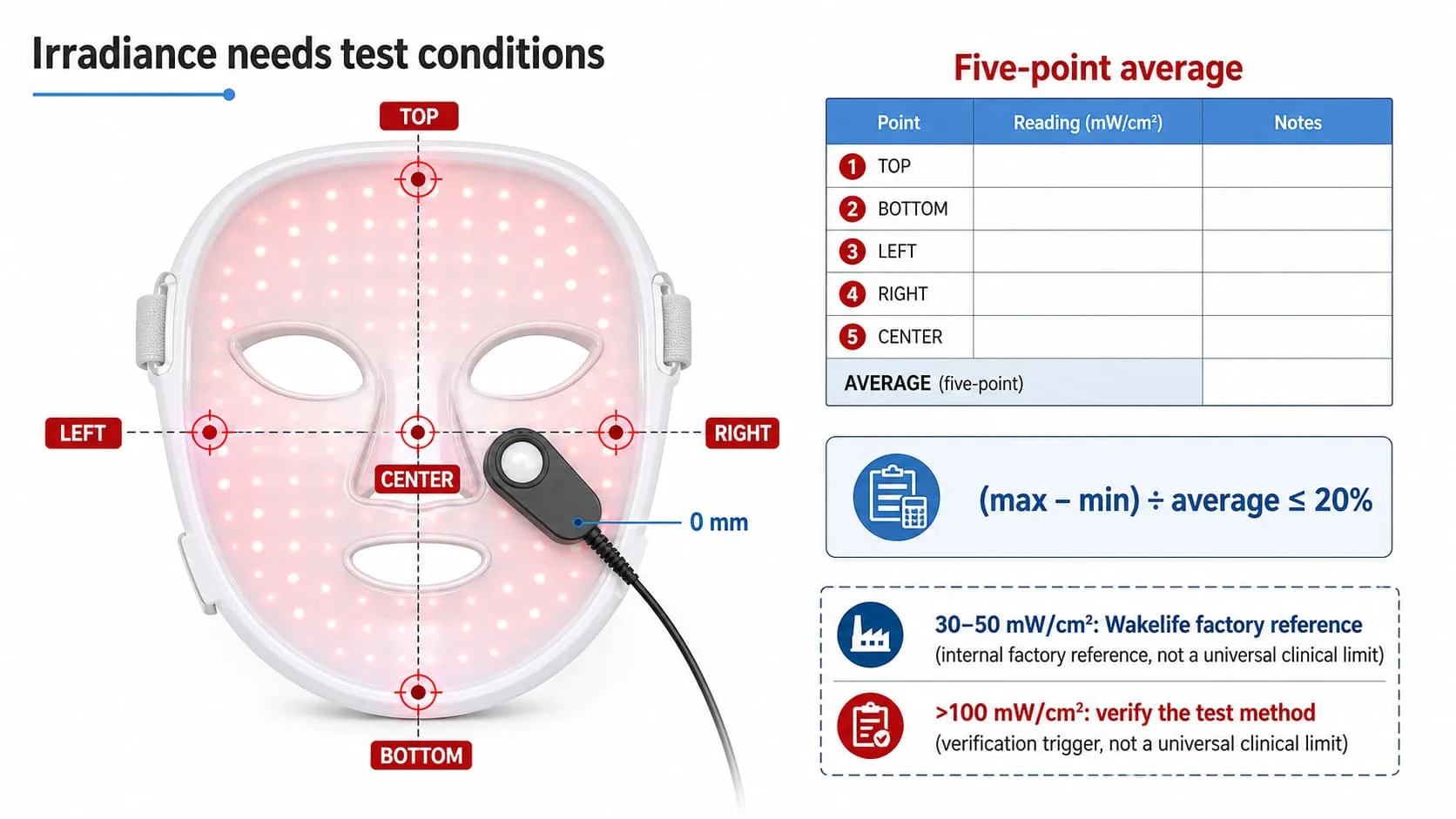
Do not compare two irradiance numbers until the seller tells you how each one was measured. Irradiance, usually reported in mW/cm², is light power delivered per unit area. Session time also matters: irradiance is not the same as total radiant exposure or a complete treatment protocol.
From our factory work, 30–50 mW/cm² is a common working range for close-fitting home LED masks we encounter. It is not a universally validated clinical range. We also treat a face-mask claim above 100 mW/cm² as a strong verification red flag—not automatic proof of fabrication, but a number we would not accept without the raw report, method, and operating conditions.
Ask for all of the following:
- measurement distance or contact condition;
- meter or detector used;
- active mode and wavelengths;
- continuous or pulsed operation;
- whether the published number is a peak, a single point, or a multi-point average;
- test locations and raw values;
- session time and the device’s labeled protocol; and
- the conditions under which any radiant-exposure value was calculated.
Wakelife’s current comparison method measures at 0 mm at five positions—top, bottom, left, right, and center—then calculates the average. We also examine spread rather than hiding it inside one average:
The 20% figure is our internal quality judgment, not an IEC, FDA, clinical, or industry-wide pass/fail limit. It is useful because an average alone can conceal a bright hotspot and a dim area. Ask for the five raw measurements whenever possible.
The 0 mm method is also a comparison convention, not a perfect copy of real use. Facial shape, gaps, tilt, pressure, and the distance from individual emitters can change what reaches different areas of skin.
Higher is not automatically better. A peer-reviewed review of photobiomodulation literature describes a frequently observed biphasic dose response in which lower exposures can produce a more favorable response than higher exposures under studied conditions. The authors also emphasize that wavelength, power density, fluence, timing, and other parameters complicate comparison. This supports caution about “highest wins”; it does not create one universal maximum for every face mask.
Optical-safety reports answer a different question. IEC 62471 specifies exposure limits, measurement techniques, and a classification approach for photobiological hazards from lamps and lamp systems, including LEDs. Such testing can support a safety assessment, but it does not prove that the device will achieve a claimed cosmetic result.
6. Inspect Fit, Coverage, and Build Quality
Finish with the parts you can inspect: whether the mask keeps the intended emitters in a repeatable position and whether its construction supports regular use. Visible workmanship cannot prove efficacy or regulatory status, but it can reveal reasons to remove a product from your shortlist.
Check the mask in normal wearing position, not only flat on a table:
- Are the LED windows and lenses seated and aligned consistently?
- Are there uneven gaps, loose trim, sharp edges, exposed adhesive, or obvious asymmetry?
- Do the straps and attachment points hold the mask without shifting the target areas?
- Are there pressure points around the nose, temples, and eye area that make the labeled session difficult to complete?
- Do cable exits, controller connections, and strain-relief areas feel secure?
- Does the fit create large or inconsistent distances between the emitters and important facial areas?
- Can the skin-contact surfaces be cleaned using the manufacturer’s stated method without damaging them?
A soft mask is not automatically better than a rigid one. A rigid shell may preserve emitter geometry but fit some faces poorly; a flexible mask may conform more closely but bend or shift the geometry. The useful question is whether the specific design gives your face stable coverage, tolerable pressure, and repeatable positioning.
Also review the actual routine before buying. If the device’s instructions, session length, cleaning process, eye guidance, or charging arrangement are impractical for you, its theoretical specifications will not compensate for inconsistent use. Continue with the guides to device-specific frequency and session length, where an LED mask fits in a skincare routine, and safe cleaning and maintenance.
Medical boundary: The American Academy of Dermatology advises discussing at-home light use with a dermatologist because an existing light-sensitive condition, medication, or treatment can change whether it is appropriate. Follow the warnings for your exact device and seek qualified care for concerning or persistent symptoms.
A 10-Minute Shortlist Check
Use this table before comparing price or extra modes:
| Check | Minimum useful answer | Stop or verify further when |
|---|---|---|
| Goal | One defined concern and target area | The product promises one mode for every concern |
| U.S. FDA claim, when claimed or required |
K number, applicant, corresponding model, and matching intended use. Mark not applicable only under both conditions stated in Section 2: no U.S. medical-device/treatment claim, and applicable rules do not require a 510(k)
|
Clearance may be required or is claimed, but only a badge is shown, the authorization path is unexplained, the record is missing, or model/use does not match |
| Wavelength and placement | Exact wavelengths, active chips by mode, and target-area distribution | Only color names or total wavelength count are supplied |
| LED count | Physical packages, chips per package, and chips by wavelength | Chip count is presented as package count without explanation |
| Irradiance | Raw multi-point values with distance, mode, meter, and session context | Only a peak number appears; in Wakelife’s internal screening, a face-mask claim above 100 mW/cm² triggers stronger report verification |
| Fit and build | Stable coverage, tolerable pressure, aligned components, and workable cleaning/use | Gaps, shifting, pressure, poor assembly, or impractical instructions undermine repeatable use |
Passing this check does not prove that a mask is the best choice or guarantee a result. It means the product has provided enough coherent information to deserve deeper consideration.
The Bottom Line
Choose the mask you can verify, not the one with the largest headline numbers. Define the goal first. When U.S. medical-device clearance is claimed or required, verify the exact device and intended use; do not treat clearance as a universal quality trophy. Match wavelengths to the goal and their physical placement. Separate LED packages from internal chips. Compare irradiance only with disclosed test conditions, multi-point distribution, and session context; Wakelife’s five-point method is one internal comparison approach, not a universal standard. Then decide whether the fit and construction make correct, repeatable use realistic.
Our strongest practical rule is simple:
More colors, LEDs, or irradiance should create more questions—not an automatic higher ranking.
Continue With the Right LED Face Mask Guide
Once a mask passes the first comparison, choose the next guide by the question you need to answer:
- Compare modes and colors: understand what LED mask colors mean, then compare a 7-color mask with a red-and-blue mask.
- Build a workable routine: decide where the mask fits in your skincare routine, check moisturizer and serum compatibility, follow device-specific frequency and session guidance, and learn how to clean and maintain the mask.
- Judge progress realistically: use the results timeline and reassessment guide, or review the evidence and limits for fine lines and wrinkles.
For Brands and Product Teams
Consumer trust improves when the product page and technical file use the same definitions. State the physical LED package count, chips per package, chips by wavelength and mode, irradiance test method, raw multi-point values, intended use, exact-model regulatory scope, and cleaning and use instructions. Avoid using one large number to hide a counting or measurement method.
After defining the target user and claim scope, product teams can explore Wakelife’s LED face mask platforms and OEM and ODM capabilities.
References
Regulatory and Standards Sources
| No. | Official Source |
|---|---|
| 1 | U.S. Food and Drug Administration. Premarket Notification 510(k). Accessed July 22, 2026. |
| 2 | U.S. Food and Drug Administration. K250830 510(k) Premarket Notification Database Record. Decision date June 9, 2025. Accessed July 22, 2026. |
| 3 | International Electrotechnical Commission. IEC 62471:2006—Photobiological Safety of Lamps and Lamp Systems. Accessed July 22, 2026. |
Professional Guidance and Peer-Reviewed Research
| No. | Official Source |
|---|---|
| 4 | American Academy of Dermatology. Is Red Light Therapy Right for Your Skin? Last updated September 13, 2024. Accessed July 22, 2026. |
| 5 | Huang YY, Chen ACH, Carroll JD, Hamblin MR. Biphasic Dose Response in Low Level Light Therapy. Dose-Response. 2009;7(4):358–383. doi:10.2203/dose-response.09-027.Hamblin. |
| 6 | Stirling RJ, Haslam JD. A Self-Reported Clinical Trial Investigates the Efficacy of 1072 nm Light as an Anti-Ageing Agent. Journal of Cosmetic and Laser Therapy. 2007;9(4):226–230. doi:10.1080/14764170701400085. |