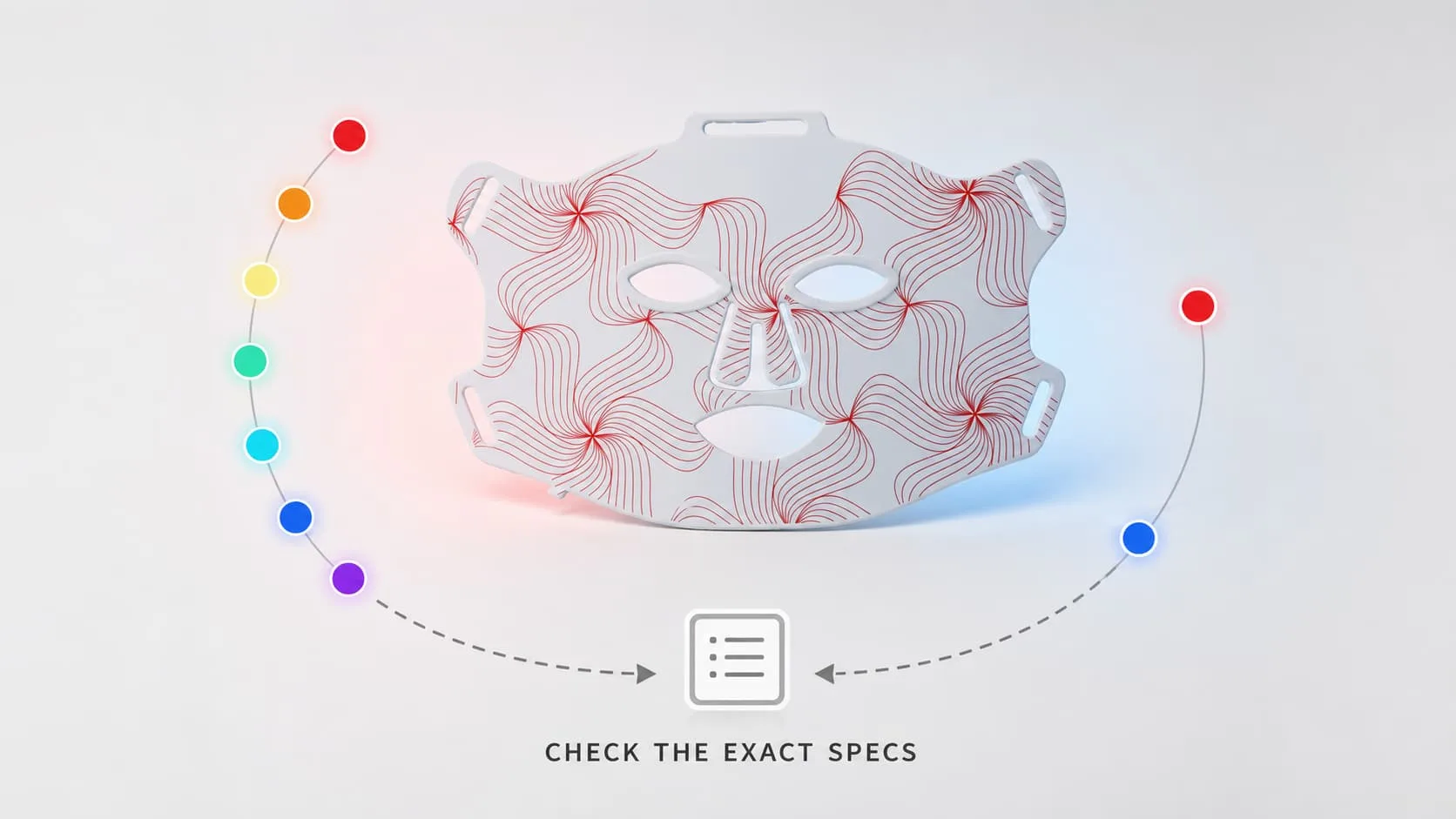
Short answer: A 7-color LED mask is not automatically better—and it is not the opposite of a red-and-blue mask, because red and blue may be two of its seven modes. Choose by your main concern and by the labeling and evidence for the exact device. A focused red/blue mask may be easier to evaluate when those are the only modes you need. Choose a 7-color model only when its extra modes have clear specifications, instructions, and device-specific support—not just an appealing color chart.
Medical note: This article provides general consumer education, not medical advice. LED masks vary in intended use, regulatory status, output, warnings, eye-protection requirements, and treatment protocol. Follow the labeling for your exact device. Seek qualified medical guidance for medications that increase light sensitivity, light-sensitive or active skin conditions, recent procedures, uncertain acne, or adverse reactions.
Is a 7-Color Mask Really Different From a Red-and-Blue Mask?
The labels overlap: a 7-color mask can already contain red and blue modes. “7-color” describes how many color or mode names a seller presents. “Red and blue” describes two wavelengths or modes the device includes. They are not two cleanly separated technology categories.
| Label on the product | What the label can tell you | What it does not prove |
|---|---|---|
| 7-color LED mask | The interface or instructions present seven color or mixed-light modes | Seven independently verified wavelengths, equal output in every mode, or seven clinically supported outcomes |
| Red-and-blue LED mask | The device includes red and blue light, separately or in a combined protocol | The exact wavelengths, whether near-infrared is included, how much light reaches the skin, or which use the device is labeled for |
| Purple, white, cyan, or another named mode | The manufacturer has assigned a name to a setting | Which emitters are active, whether the mode is a mixed color or a distinct wavelength, or what evidence applies |
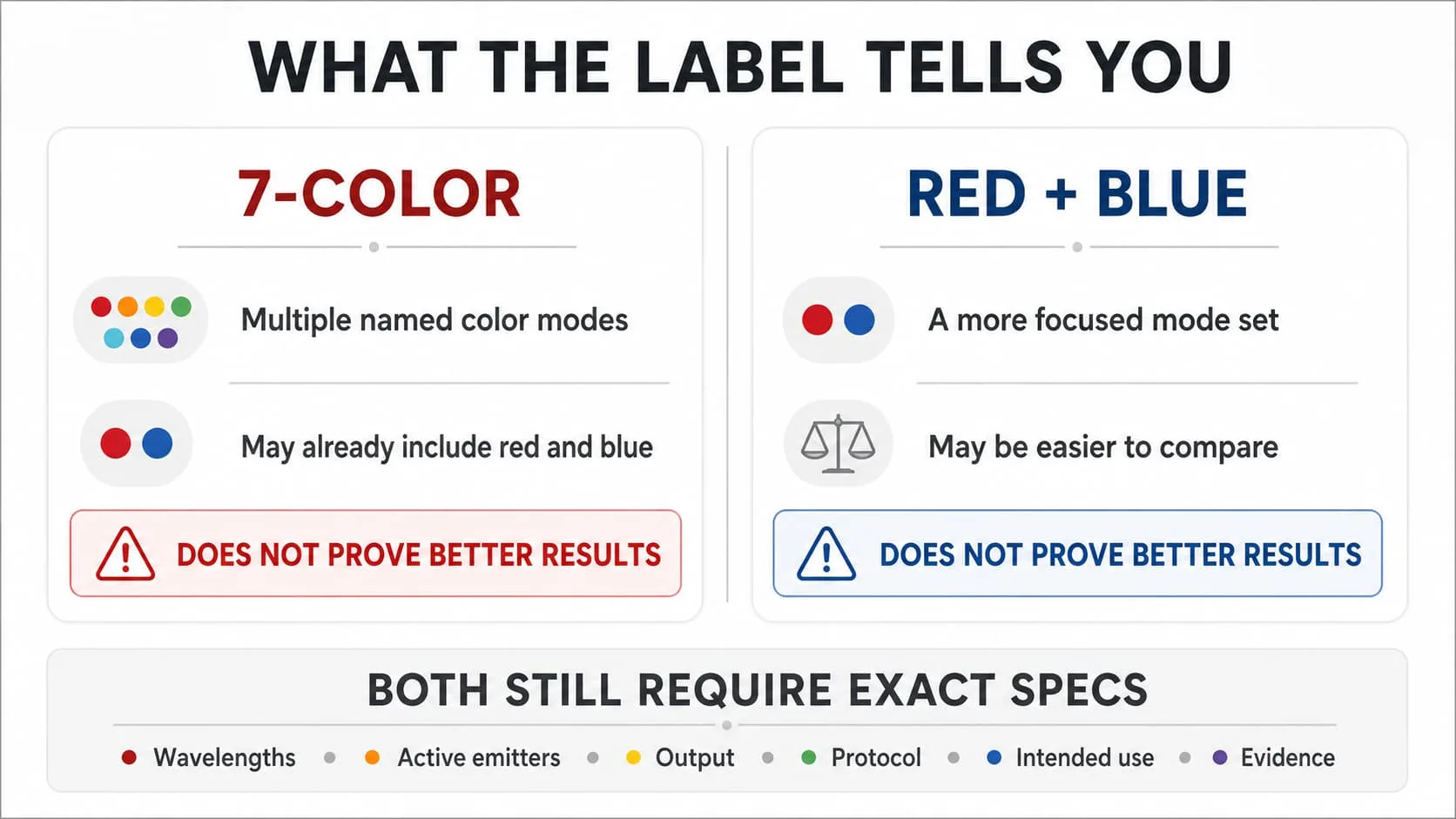
This distinction matters because a mode name is not a technical specification. One product may use “purple” for red and blue operating together; another may use the same word differently. “White” may describe several visible LEDs operating together rather than one therapeutic wavelength. The product documentation—not the color tile in an advertisement—must identify what the mode actually emits.
Which Configuration Fits Your Main Goal?
Choose the smallest set of well-documented modes that matches your main goal. Extra modes can be useful, but only when you know what they are and have a realistic reason to use them.
| Your main priority | What to look for | How the label affects the choice |
|---|---|---|
| Visible signs of skin aging, such as fine lines | A device specifically intended for that concern, with a documented red or red-plus-near-infrared protocol and clear instructions | You do not need seven colors just to obtain a well-defined red-light mode |
| Mild to moderate inflammatory acne | A device clearly intended for that use, with a documented blue or red-plus-blue protocol; do not use a mask to self-diagnose severe, cystic, or unclear acne | A focused red/blue device may be simpler to assess, but a 7-color device could qualify if its relevant mode and evidence are equally clear |
| Both aging-related concerns and inflammatory blemishes | Separate or combined modes that are labeled for the two intended uses, with instructions explaining how to select or alternate them | Either product label can work; the exact modes and instructions decide, not the number seven |
| Interest in yellow, green, cyan, purple, or white modes | Exact wavelength or emitter combination, measured output, intended use, treatment protocol, and device-specific support for the claimed benefit | Treat an unexplained color as an optional feature, not a reason to pay more |
The American Academy of Dermatology’s red-light guidance advises choosing a device created for the concern you want to address and following its directions. For acne, the AAD also warns that visible-light treatment does not address every type of lesion and that results vary. If you are not sure what you are trying to treat, getting the condition identified is more useful than choosing a longer list of colors.
What Does the Evidence Say About Red and Blue Light?
Red and blue light have a more developed evidence base for common at-home mask uses, but that evidence still belongs to the tested devices, wavelengths, doses, and participants. It does not turn every red or blue LED into an equivalent product.
A 2025 systematic review and meta-analysis of at-home LED devices for acne included six randomized clinical trials. The included blue-light devices operated from 414 to 445 nm and the red-light devices from 630 to 670 nm. The review found favorable results for red and/or blue devices in the studied mild-to-moderate acne settings, while the devices, schedules, and study durations varied. The authors also cautioned that moderate-to-high heterogeneity and limited generalizability prevent treating those findings as proof for every product. That supports a relevant evidence category; it does not identify one universal wavelength, dose, or mask protocol.
Evidence for skin rejuvenation is less uniform. A systematic review of randomized LED trials in dermatology gave acne a stronger recommendation grade than skin rejuvenation. Within the rejuvenation trials, some red or red-plus-near-infrared protocols improved measured outcomes, while another red-light trial found no significant improvement in elasticity or hydration. The review also documented wide variation in wavelength, irradiance, radiant exposure, session length, and study design.
That variation is why the AAD notes that results from studies using different devices and treatment times cannot simply be compared. “Red” or “blue” is the start of a specification, not the end of a buying decision.
Do Seven Colors Mean Seven Proven Benefits?
No. The number of selectable colors does not tell you how many benefits have been established for that exact mask. It also does not mean every extra color is useless.
If you are looking for a 7-color LED light therapy chart or the meaning of individual LED mask colors, use Wakelife’s LED face mask colors explained guide. This page stays focused on comparing a 7-color configuration with a focused red-and-blue mask.
An FDA record shows how device-specific the answer can be. The official K250830 510(k) database entry identifies a named family of LED masks, its applicant, its product codes, and a substantially equivalent decision. The linked K250830 clearance document and indications-for-use enclosure define different intended uses for specific modes, including a yellow-light mode for full-face wrinkles and a mixed red-blue-infrared mode for mild-to-moderate inflammatory acne.
That is evidence about the models and indications in K250830. It is not proof that every yellow LED mask has the same output, protocol, intended use, or regulatory status. FDA evaluates devices through defined regulatory pathways; it does not grant a free-standing “FDA-approved wavelength” that any seller can apply to a different product. The FDA’s device approvals and clearances overview explains the difference between 510(k) clearance and premarket approval, while its searchable records identify the actual device and decision.
Use the same scope rule for every extra color:
A supported mode is an exact device + defined emitters or wavelength + measured delivery + stated protocol + intended use + evidence or regulatory scope. A color name alone supplies none of those connections.
Which Specifications Matter More Than Color Count?
Intended use, exact light parameters, protocol, warnings, and device-level evidence matter more than the number of buttons or colors. Use this checklist before comparing price or accessories.
| Field to verify | What a useful answer looks like | Why it changes the decision |
|---|---|---|
| Intended use | A specific concern the exact model is designed and labeled to address | Prevents you from assuming every mode treats every concern |
| Exact wavelength for each mode | Values in nanometers, with an explanation of which LEDs operate together | Distinguishes a physical specification from a color name |
| Irradiance at the treatment area | Power per area, commonly reported in mW/cm², with a measurement condition | LED count or total wattage alone does not say how much power reaches a given area |
| Radiant exposure and session protocol | Energy per area in J/cm² when provided, plus session time, frequency, and course instructions | A dose depends on delivery and time; it is not interchangeable with irradiance |
| Coverage and fit | The treatment area, face distance or contact design, eye openings, and how the mask stays positioned | A strong specification is less useful if the intended area is not consistently covered |
| Warnings and eye protection | Contraindications, photosensitivity guidance, eye-protection directions, stop conditions, and cleaning instructions | Tells you whether the device is practical and appropriate to use as labeled |
| Device evidence and regulatory scope | A study, clearance, or test that names the exact model or clearly explains the applicable family and intended use | Stops evidence from one product or mode being borrowed for another |
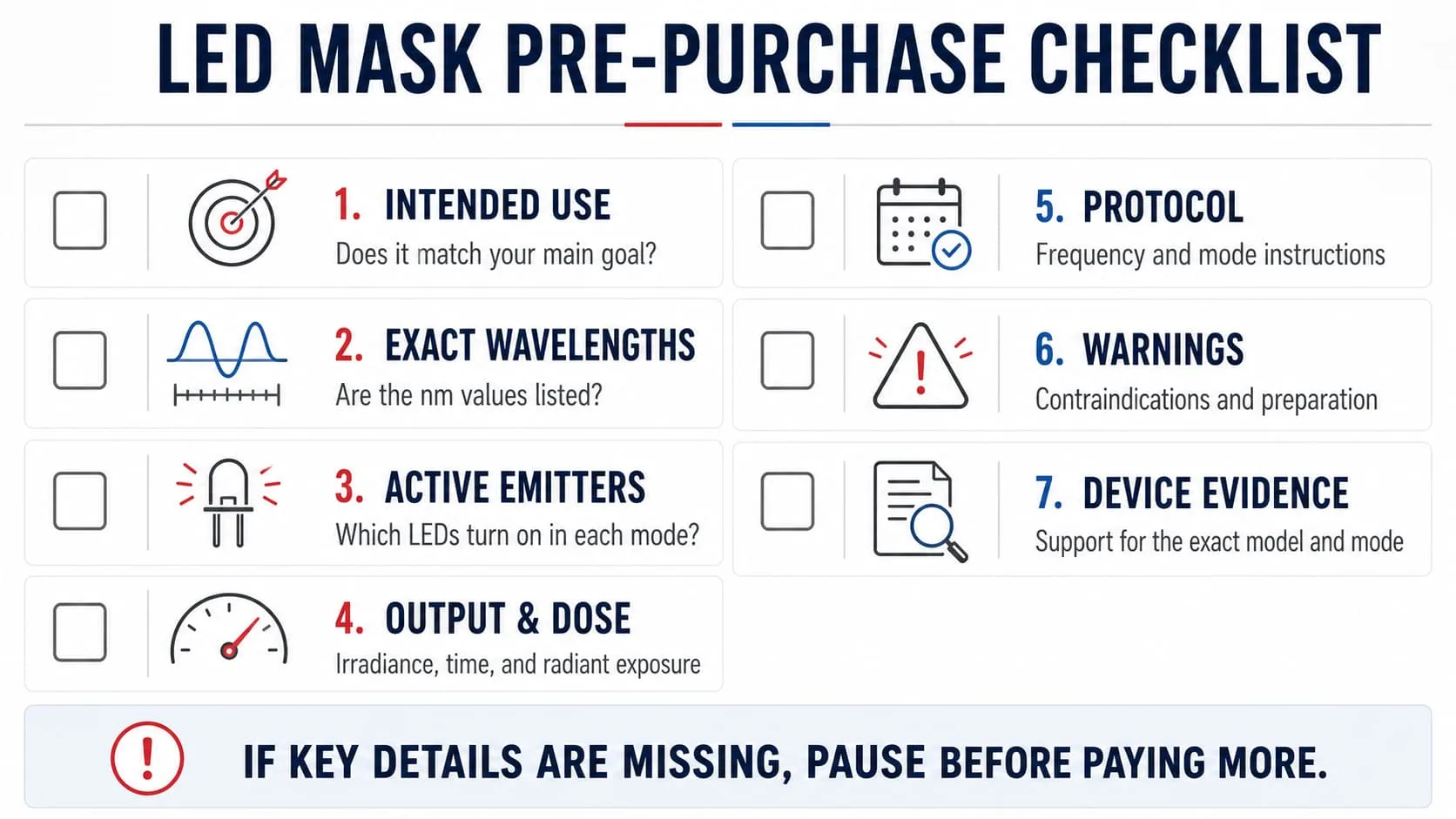
The units deserve special attention. A review of photobiomodulation parameters distinguishes irradiance, measured as power per area, from fluence or radiant exposure, measured as energy per area. These terms and units are not interchangeable. More importantly, neither a wavelength nor a high number in one field guarantees a better consumer result. The complete delivery protocol and the evidence for the exact use still matter.
What Are the Red Flags in a Multi-Color Mask Listing?
Pause when a seller gives benefit labels but withholds the specifications and scope needed to check them. Common red flags include:
- “Seven clinically proven colors” with no device-level study, clearance, or claim-by-claim evidence.
- “FDA-approved wavelengths” instead of an exact device record, number, model scope, and intended use.
- A wavelength list without irradiance, treatment time, mode logic, or Instructions for Use.
- Total wattage, LED count, or brightness presented as proof of skin outcomes.
- A study on a different device, professional system, wavelength combination, or protocol presented as proof for the mask being sold.
- Purple, white, cyan, or another mode described only by a benefit name, without identifying the active emitters.
- No accessible manual, warning section, eye-protection directions, or support path before purchase.
None of these gaps proves that a mask cannot work. They do mean you do not yet have enough information to compare it responsibly.
How Do You Make the Final Choice?
When two masks match your budget and comfort needs, choose the one that makes the relevant mode easier to verify and follow. A focused red/blue model may be the simpler option to evaluate when you only need those modes. A 7-color model can be reasonable when its extra settings are technically defined, supported for the exact device, and relevant to goals you will actually use.
Use this five-minute comparison:
- Write down one primary goal and, at most, one secondary goal.
- Cross out modes that do not serve those goals; do not give them value merely because they are included.
- Compare the remaining modes using the specification checklist above.
- Confirm that the manual explains how and when those modes are used, including whether combinations run together or separately.
- If one seller cannot provide the exact-device documentation, choose the better-documented option or pause the purchase.
For the broader product check beyond color configuration, use Wakelife’s six-point LED face mask selection guide to compare the exact model, intended use, emitter placement, LED count, irradiance evidence, fit, and build.
After buying, do not copy a schedule from another product. Use the protocol supplied with your exact mask. Wakelife’s LED face mask frequency guide explains how to find the complete schedule without turning one device’s minutes or weekly frequency into a category rule.
When Should You Ask a Dermatologist Before Choosing?
Get professional guidance when the decision depends on diagnosis, medication, a light-sensitive condition, a recent procedure, or a reaction—not just product specifications. This includes uncertain or severe acne, a history of light-triggered skin problems, medication that may increase photosensitivity, an active rash or damaged skin, and concern about pigmentation changes.
The AAD’s overview of lasers and lights for acne explains that visible light does not treat every type of acne lesion and that no one can predict exactly who will respond. Stop using a device and seek qualified guidance if you develop pain, a persistent rash, marked redness, blistering, vision symptoms, or another adverse reaction.
The Bottom Line
Do not choose a mask by asking whether seven is greater than two. Ask whether the exact modes you need are clearly defined, properly delivered, supported for the intended use, and practical to follow.
Red and blue have a stronger research trail for several common mask uses, but a red/blue label is not a quality certificate. Extra colors are not automatic evidence of extra benefits, yet a non-red/blue mode can have valid device-specific support. When the claims are similar, better documentation beats a longer color menu.
For Brands and Product Teams
Consumer confusion around “7 colors” usually begins with an incomplete mode-to-evidence map. Product documentation should connect every selectable mode to its active emitters, wavelength, measured irradiance, radiant exposure or programmed session, intended use, warnings, and exact-device evidence scope. Mixed-light modes should identify which LEDs operate together instead of relying on names such as purple or white.
If you are defining a focused red/blue platform or a documented multi-mode mask, explore Wakelife’s LED face mask product platforms and OEM/ODM development capabilities.
References
Independent and Authoritative Sources
| No. | Official Source |
|---|---|
| 1 | U.S. Food and Drug Administration. Device Approvals and Clearances. Accessed July 20, 2026. |
| 2 | American Academy of Dermatology. Is Red Light Therapy Right for Your Skin?. Last updated September 13, 2024. Accessed July 20, 2026. |
| 3 | American Academy of Dermatology. Lasers and Lights: How Well Do They Treat Acne?. Accessed July 20, 2026. |
| 4 | Ershadi S, Barbieri JS. At-Home LED Devices for the Treatment of Acne Vulgaris: A Systematic Review and Meta-Analysis. JAMA Dermatology. 2025;161(5):552–555. doi:10.1001/jamadermatol.2025.0019. |
| 5 | Jagdeo J, Austin E, Mamalis A, Wong C, Ho D, Siegel DM. Light-Emitting Diodes in Dermatology: A Systematic Review of Randomized Controlled Trials. Lasers in Surgery and Medicine. 2018;50(6):613–628. doi:10.1002/lsm.22791. |
| 6 | Zein R, Selting W, Hamblin MR. Review of Light Parameters and Photobiomodulation Efficacy: Dive Into Complexity. Journal of Biomedical Optics. 2018;23(12):120901. doi:10.1117/1.JBO.23.12.120901. |
Exact-Device Regulatory Example
This source documents only the named device family, decision, and related intended-use scope. It is not used to claim that every mask with the same color has the same status.
| No. | Official Source |
|---|---|
| 7 | U.S. Food and Drug Administration. 510(k) Premarket Notification K250830: LED Light Therapy Mask. Decision date June 9, 2025. Accessed July 20, 2026. |
| 8 | U.S. Food and Drug Administration. K250830 Clearance Letter and Indications for Use. June 9, 2025. Accessed July 20, 2026. |