Short answer: Some controlled studies report that specific red or red-plus-near-infrared devices improved certain crow’s-feet or wrinkle measurements. That supports a cautious “possibly, for some fine lines”—not a promise that every home mask will erase wrinkles. Results differed by device and assessment method. First define one modest line target, then verify the exact device and instructions. Do not expect LED to correct deep folds, lost volume, or structural sagging.
Which Facial Lines Are a Plausible Target for a Home LED Mask?
The most direct home-mask evidence concerns some crow’s-feet and periocular wrinkle outcomes; it does not prove that a line’s behavior during facial movement can predict whether it will respond. Surface dehydration can also change how pronounced a line looks, so keep that variable stable before judging an LED mask.
At home, you cannot reliably identify the exact tissue structure causing a line. You can, however, observe how the line behaves:
Lorem ipsum dolor sit amet, consectetur adipiscing elit. Ut elit tellus, luctus nec ullamcorper mattis, pulvinar dapibus leo.
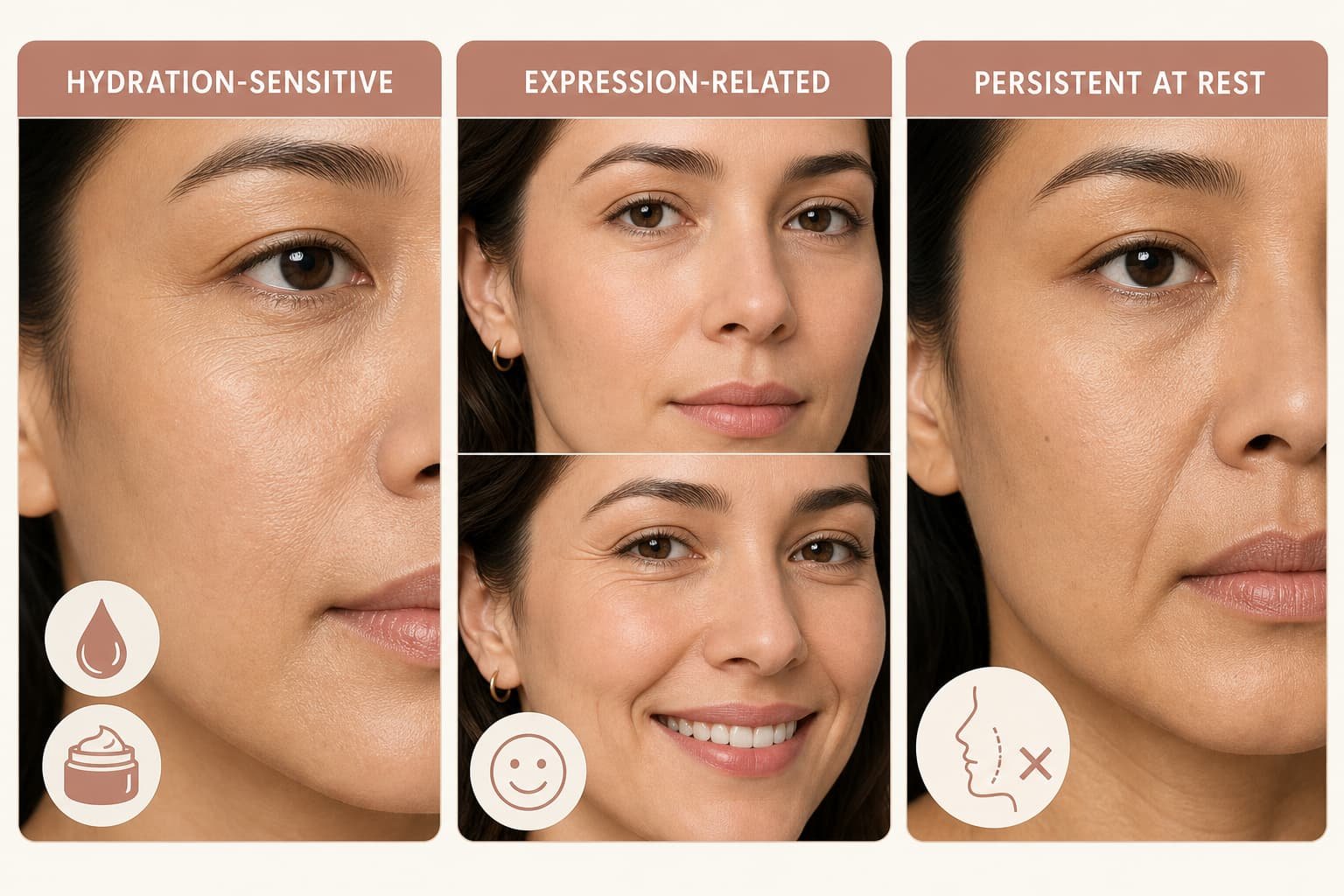
How a line responds to moisturizer, facial movement, and a relaxed expression can help set a realistic goal, but it is not a diagnosis.
Use this as a sorting tool, not a medical diagnosis. A line may have more than one cause, and a single moisturizer test cannot prove that a concern is “only dryness.” The practical question is whether the visible target is modest enough for a gradual home-care tool.
What Do Controlled LED Studies Actually Show for Wrinkles?
The research contains a real positive signal, especially for periocular lines, but the signal is not uniform across measurement methods or devices. The most responsible reading is that certain tested protocols changed certain outcomes—not that every red-light mask has a proven wrinkle result.
| Study | What was tested | Supportive result | Limitation or result that did not agree |
|---|---|---|---|
| Park et al., 2025 | A 630 nm red plus 850 nm near-infrared home mask in 60 Asian adults, compared with a lower-output sham | Independent and investigator crow’s-feet grading differed from sham at later study checkpoints | Participant-rated aesthetic improvement did not show a significant group difference. One exact device, protocol, and predominantly female Asian sample were tested. |
| Bragato et al., 2025 | A 660 ± 10 nm mask in 95 women, with two active schedules and a sham group | Image-analysis software found reductions in selected glabellar and right periorbital wrinkle lengths; FACE-Q satisfaction with facial appearance differed from sham | A blinded clinical Wrinkle Assessment Scale found no significant difference among groups. Software, clinicians, and participants did not tell one identical story. |
| Mota et al., 2023 | Researcher-applied contact devices, with red light on one side of the face and amber light on the other, in 137 women | Instrument-measured periocular wrinkle volume decreased on both actively treated sides | There was no untreated or sham side, and neither side showed improved hydration or viscoelasticity. This was not a home-mask trial. |
| Nam et al., 2017 | Two active LED devices used by 52 women | Skin-replica measurements improved from baseline in both active groups | Blinded dermatologists did not find a significant visual change, and there was no no-light control group. |
The mixed findings matter. In the Bragato trial, for example, software detected changes that the blinded clinical scale did not. In the Park trial, evaluator grading and participant self-rating did not align. Reporting only the favorable outcome would make the evidence look more certain than it is.
A 2023 systematic review and meta-analysis found an overall positive LED signal for skin rejuvenation and wrinkle outcomes. An earlier systematic review of home dermatology devices, based on literature available through 2020, did not find enough evidence to recommend home LEDs for wrinkles. The later trials add useful evidence, but they do not turn a varied device category into one proven treatment.
Why Can LED Wrinkle Studies Reach Different Conclusions?
“Did it work?” depends on what was measured, who assessed it, and which device delivered the light. Four differences explain much of the apparent contradiction.
The outcomes are not interchangeable. Wrinkle length, wrinkle volume, a clinical photo grade, participant satisfaction, hydration, and viscoelasticity answer different questions. A change in one does not prove a change in all the others.
The assessors are not interchangeable. Software can detect a small image difference that a blinded clinician or the participant does not consider noticeable. A participant can also feel satisfied without an objective wrinkle measure changing.
The devices and protocols are not interchangeable. “Red light” is a category label. Wavelengths, output at the skin, coverage, fit, session instructions, and total protocol vary. Evidence from one researched device does not automatically transfer to a mask that merely lists a similar color.
Study controls affect certainty. A sham or non-light comparison helps separate the light effect from natural fluctuation, photography, routine changes, and expectation. Active-versus-active or before-and-after studies can still be informative, but they answer a narrower question.
A 2025 methodological analysis of dermatology LED studies found wide variation in reported exposure, limited validation of the dose actually received, and inconsistent use of both non-light controls and blinded assessment. It does not show that every positive result is wrong. It shows why a pooled average should not be converted into a guaranteed result for an untested home mask.
How Much Wrinkle Improvement Is Realistic?
A realistic goal is a modest softening in the appearance of some early lines—not complete removal. The most defensible consumer language is “less pronounced,” “softer at the edges,” or “more even-looking texture.”
Avoid translating a study result into a personal percentage. A percentage measured by specialized imaging around the eyes in one protocol is not the same as a visible whole-face change. It also cannot predict what a different mask, skin type, line pattern, or camera will show.
This gives LED three practical roles:
- Reasonable option to test: a modest fine-line appearance is the defined target; the exact device and intended use are credible; and the user accepts uncertain, gradual, and modest change.
- Adjunct: the main concern is broader photoaging or a persistent static line, while the goal for LED is limited to general texture or appearance support.
- Wrong primary tool: the expected result is filling a deep fold, replacing lost facial volume, sharpening a lax jawline, or creating a rapid, dramatic transformation.
What Counts as Meaningful Progress at Home?
The strongest home signal is a repeatable appearance change in the same area under repeatable conditions. A photograph can show that a line looks softer; it cannot prove that collagen, elastin, or a particular tissue layer caused the change. Clinical-photography guidance likewise emphasizes reproducible positioning, angles, lighting, and image conditions when before-and-after photographs are compared.
| Evidence level | What to record | How to interpret it |
|---|---|---|
| Primary signal | The same fine-line area repeatedly looks less pronounced or has softer edges at more than one planned checkpoint, using the same lighting, camera position, distance, expression, and skin-care conditions | This supports a repeatable appearance change worth following. It does not establish the biological mechanism. |
| Supporting observation | Texture looks more even; makeup repeatedly settles less into the same lines; a blinded comparison is identified correctly more than once | Useful supporting context, but sensitive to makeup, skin care, sleep, expectation, and image quality |
| Exploratory observation | The skin feels more elastic or a line seems to settle faster after an expression | Record it separately. A feeling or an improvised “rebound test” is not a validated elasticity measurement. |
| Do not count as efficacy evidence | Immediate post-moisturizer plumping, one unusually good image, different lighting or angle, filters, beauty mode, or a change visible only after selecting the most favorable photograph | These conditions can create an apparent improvement without showing a repeatable LED-associated change. |
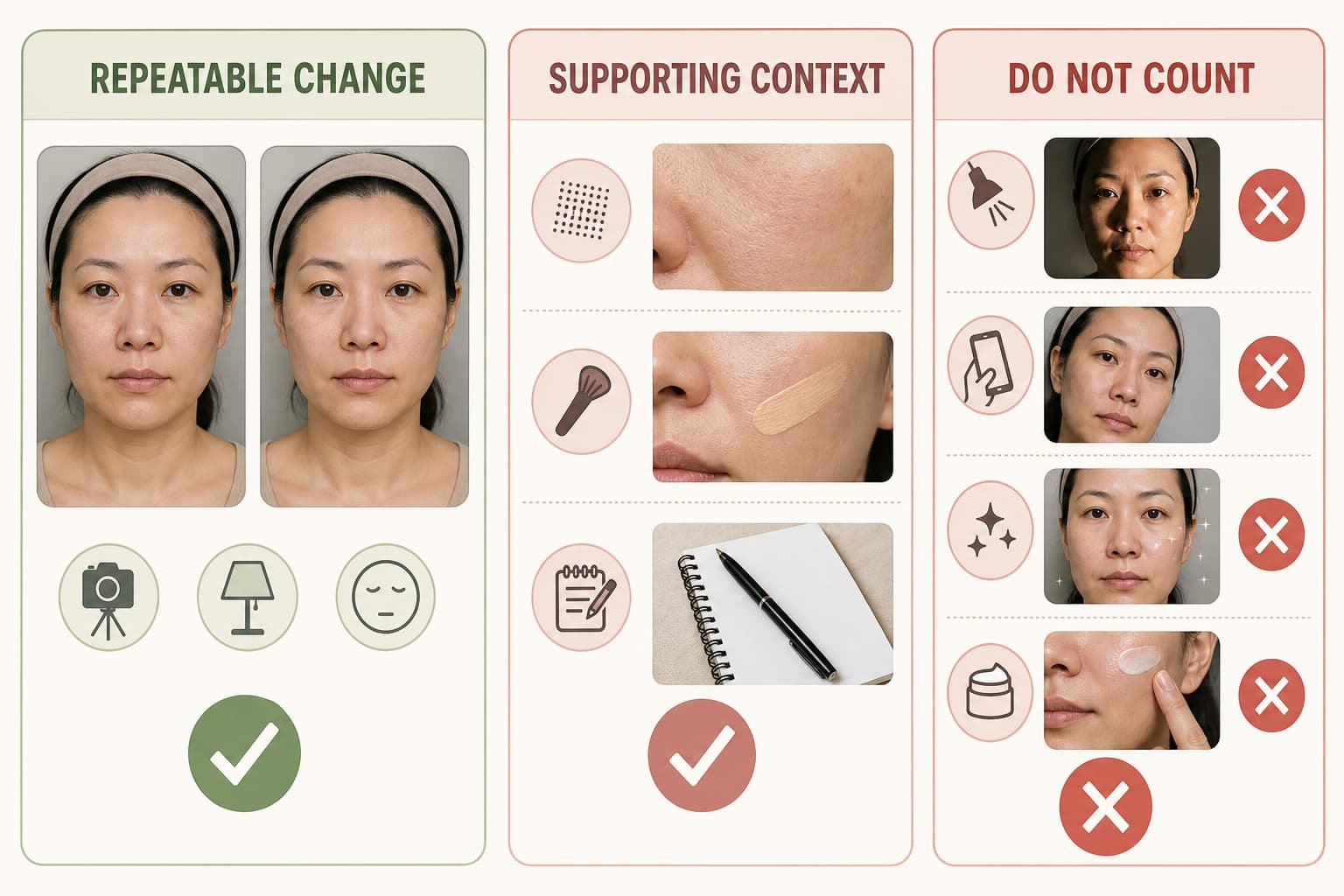
A repeatable change in the same area is stronger evidence than instant plumping, different lighting, or a single image.
For a fair comparison:
- Choose one defined area, such as the outer eye area, rather than judging the whole face as “better.”
- Take a relaxed image and the same repeatable expression image.
- Keep the room, light direction, camera, distance, angle, time of day, makeup status, and image processing consistent.
- Keep the rest of the routine as stable as practical. Do not deliberately stop moisturizer for several days to “test” the LED.
- Compare a small number of planned checkpoints instead of searching daily for tiny fluctuations.
- Keep a use log so a missing result is not confused with missed sessions, the wrong mode, or a changed routine.
If the pictures are not comparable, the honest conclusion is “uncertain,” not “worked” or “failed.”
When Is LED Only an Adjunct—or the Wrong Tool?
Stop extending the LED expectation when the target itself is outside what a home mask can reasonably change. More time does not convert a mismatched tool into a structural lifting or volume-restoration treatment.
| Main concern | Responsible expectation for home LED | Better next decision |
|---|---|---|
| Deep fold that stays prominent at rest | Surface appearance may change modestly; filling or erasing the fold is not a reasonable promise | Reframe the LED goal or seek a qualified assessment of options matched to the cause |
| Visible facial-volume change or sagging contour | Do not expect a mask to restore volume or reposition tissue | Treat LED as optional maintenance, not the main solution |
| Severe or rapidly changing skin concern | A cosmetic LED article cannot identify the cause | Obtain professional evaluation rather than extending a self-directed trial |
| No repeatable change with a credible device, correct use, a reasonable target, and adequate records | Do not answer automatically with “keep waiting” or increase exposure | Recheck the exact device, records, target, and routine; then decide whether to stop, change the goal, or seek qualified advice |
| A reaction or eye concern occurs during use | An efficacy article cannot determine whether the device remains appropriate | Follow the exact device’s stopping and eye-safety instructions; obtain qualified advice if the concern is significant, persistent, or worsening |
This is also where device transparency matters. A result from a researched mask cannot rescue a product whose wavelength, output conditions, mode, or instructions cannot be verified. If the device itself is still uncertain, use the six-point LED mask verification guide before deciding that your skin is the problem.
What Safety Questions Should Be Settled First?
Follow the instructions and warnings for the exact device, and do not increase session length or frequency to chase a wrinkle result. The American Academy of Dermatology advises speaking with a dermatologist before using an at-home red-light device, particularly when a person has a light-sensitive condition or takes medication that increases light sensitivity.
The AAD notes that temporary mild pain or irritated skin can occur. If you develop a reaction, use the exact device’s safety and stopping instructions rather than increasing or improvising exposure. If the device’s labeled purpose does not cover your concern, or if a condition or treatment may alter light sensitivity, settle that question before beginning an efficacy experiment.
For scheduling, use the instructions for the exact model and the separate guide to LED mask frequency and session length. A study schedule is not permission to copy that exposure onto another device.
The Bottom Line
Home LED masks may modestly soften the appearance of some early facial fine lines, but the evidence is device-specific and not every assessment method—or every user—shows the same result. Start by identifying a modest visible target. Keep hydration and photography conditions stable. Then look for a repeatable change in that exact area instead of an instant glow, a universal percentage, or a dramatic whole-face transformation.
If the concern is a deep static fold, lost volume, or structural laxity, change the goal instead of extending the timeline.
If the target is reasonable but progress is uncertain, use the LED mask results timeline and reassessment guide to verify the device and records before deciding whether the issue is use, evidence transfer, or product fit.
For Brands and Product Teams
Consumer trust improves when a wrinkle claim names the exact model, mode, protocol, target area, assessment method, and results that did not improve—not only the most favorable image or metric. Product pages should distinguish “softening the appearance of fine lines” from filling folds, restoring volume, or lifting tissue.
After defining the intended user, claim scope, and evidence plan, product teams can explore Wakelife’s LED face mask platforms and OEM and ODM capabilities.
References
-
American Academy of Dermatology. Is Red Light Therapy Right for Your Skin? Last updated September 13, 2024. Accessed July 23, 2026.
-
Park SH, Park SO, Jung JA. Clinical Study to Evaluate the Efficacy and Safety of Home-Used LED and IRED Mask for Crow’s Feet: A Multi-Center, Randomized, Double-Blind, Sham-Controlled Study. Medicine (Baltimore). 2025;104(7):e41596. doi:10.1097/MD.0000000000041596.
-
Bragato EF, et al. Role of Photobiomodulation Application Frequency in Facial Rejuvenation: Randomized, Sham-Controlled, Double-Blind, Clinical Trial. Lasers in Medical Science. 2025;40(1):170. doi:10.1007/s10103-025-04383-1.
-
Mota LR, et al. Photobiomodulation, Photomedicine, and Laser Surgery. 2023;41(2):48–56. doi:10.1089/photob.2022.0114. The formal title contains a protocol-specific outcome figure that is not generalized here.
-
Nam CH, et al. The Efficacy and Safety of 660 nm and 411 to 777 nm Light-Emitting Devices for Treating Wrinkles. Dermatologic Surgery. 2017;43(3):371–380. doi:10.1097/DSS.0000000000000981.
-
Cohen M, et al. Home-Based Devices in Dermatology: A Systematic Review of Safety and Efficacy. Archives of Dermatological Research. 2022;314(3):239–246. doi:10.1007/s00403-021-02231-0.
-
Ngoc LTN, Moon JY, Lee YC. Utilization of Light-Emitting Diodes for Skin Therapy: Systematic Review and Meta-Analysis. Photodermatology, Photoimmunology & Photomedicine. 2023;39(4):303–317. doi:10.1111/phpp.12841.
-
Grimes DR. Methodological Issues in Visible LED Therapy Dermatological Research and Reporting. PLOS ONE. 2025;20(9):e0332995. doi:10.1371/journal.pone.0332995.
-
Nair AG, Santhanam A. Clinical Photography for Periorbital and Facial Aesthetic Practice. Journal of Cutaneous and Aesthetic Surgery. 2016;9(2):115–121. doi:10.4103/0974-2077.184047.