Short answer: If your LED mask requires clean, dry skin, remove moisturizer, serum, toner, makeup, and SPF before the session, then apply your usual skincare afterward. Only use a serum or gel underneath the device when its instructions name that specific product. If your skin feels normal and the manual gives no waiting period, you can continue your skincare as soon as the programmed session ends.
Why Is Clean, Dry Skin the Safest Starting Point?
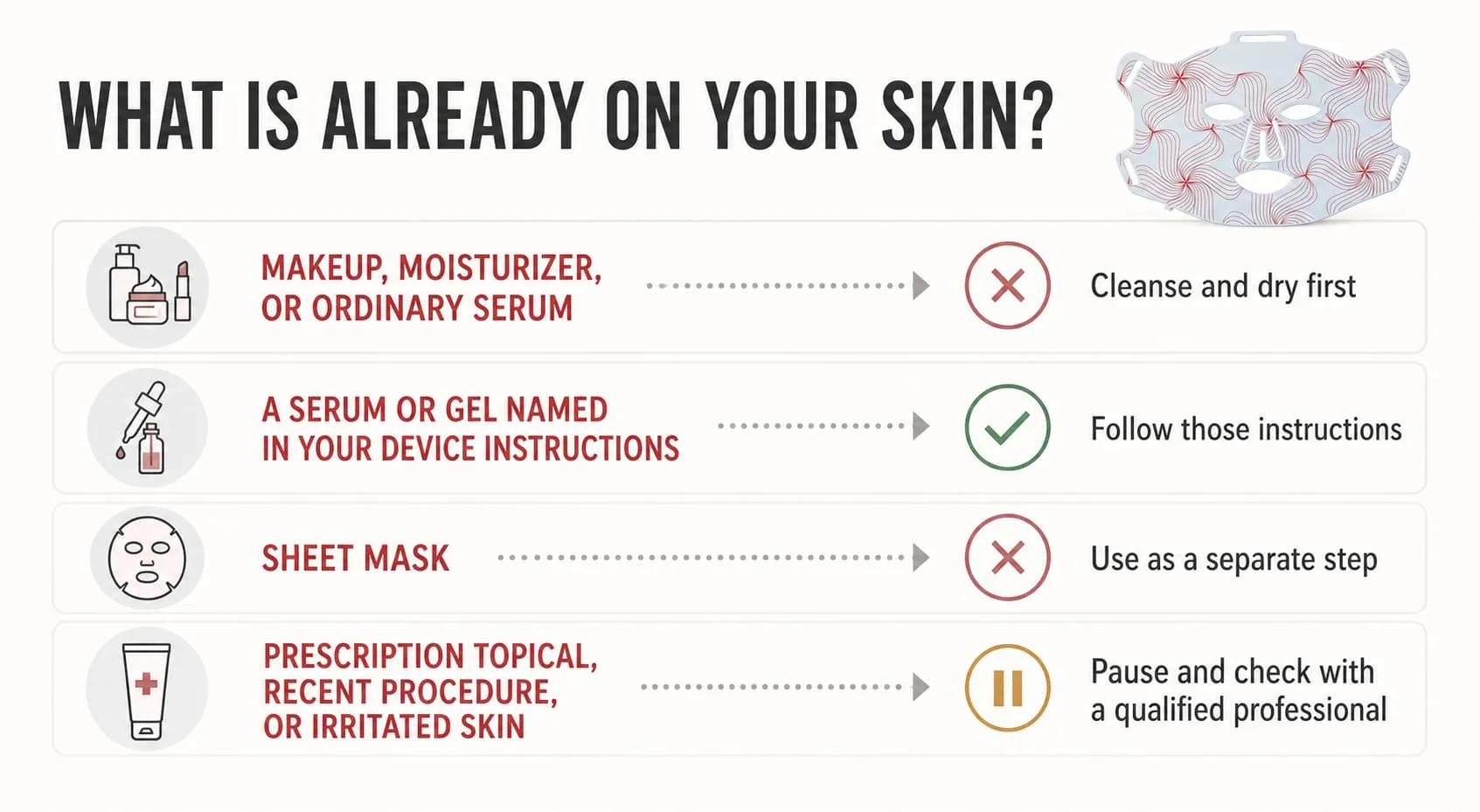
Clean, dry skin gives you a known starting condition and removes the need to guess how makeup, sunscreen, or a leave-on product fits with the device instructions.
This does not mean every moisturizer blocks a fixed percentage of light. Skincare formulas, application amounts, mask designs, and device functions vary too much for a general article to make that promise. The practical question is simpler: if the instructions say clean, dry skin, leaving moisturizer or serum on means you have not completed the stated preparation step.
Cleveland Clinic advises starting LED light therapy with a clean, makeup-free face and notes that home devices have different instructions. The FDA likewise advises consumers to review and follow the instructions for a home-use device.
Use these principles in this order:
- Start with clean, product-free skin when the device calls for it.
- Follow a different routine only when the instructions for your exact model clearly describe one.
- Pause when medication, a prescription topical, a recent procedure, damaged skin, or an unexpected reaction changes the question from routine skincare to individual safety.
What If You Already Applied Moisturizer, Serum, or Toner?
If your mask requires clean, dry skin, wash off the product, pat your face dry, and then begin the programmed session. Do not keep going simply because the product feels lightweight.
Choose the action that matches your situation:
| What the instructions say | What to do now |
|---|---|
| Use on clean, dry or makeup-free skin | Remove the product, cleanse as directed, dry your face, then start the session |
| Use with a specific serum or gel named in the instructions | Use only that named product and follow the supplied steps |
| Nothing clear about products on the skin | Pause and ask the device supplier; do not copy another device’s routine |
| The question involves a prescription, recent procedure, or irritated skin | Pause and get advice that covers both the product and the device |
The FDA recommends keeping the Instructions for Use available and following them as written. If yours are missing or unclear, contact the supplier or an appropriate healthcare professional instead of experimenting.
Which Products Should Come Off Before a Clean-Skin LED Session?
Remove makeup, tinted products, sunscreen, and ordinary leave-on skincare when your device calls for clean, dry skin. A product’s texture does not override that preparation step.
| What is already on your face? | What to do for a clean, dry skin device | The exception |
|---|---|---|
| Makeup, tinted product, or SPF | Remove it, cleanse, and dry before the session | Different preparation steps stated for your exact model |
| Moisturizer, cream, or face oil | Apply it after the session | The instructions clearly allow a specific pre-treatment product |
| Ordinary toner or serum | Apply it after the session | The instructions clearly allow or require that exact product |
| A specific serum or gel named in the manual | Follow the supplied steps | Confirm that the name and device model both match |
| Sheet, clay, or wash-off mask | Keep it as a separate step | The instructions clearly describe combined use |
| Prescription topical or product named in a warning | Do not improvise or stop treatment based on a blog | Follow the warning and ask the prescriber, dermatologist, or pharmacist |
If your question is about the complete order of cleansing, LED, toner, serum, moisturizer, and SPF, use the full LED mask skincare routine order. This page stays focused on whether a product is compatible with the device session itself.
When Can You Use a Serum or Sheet Mask With an LED Device?
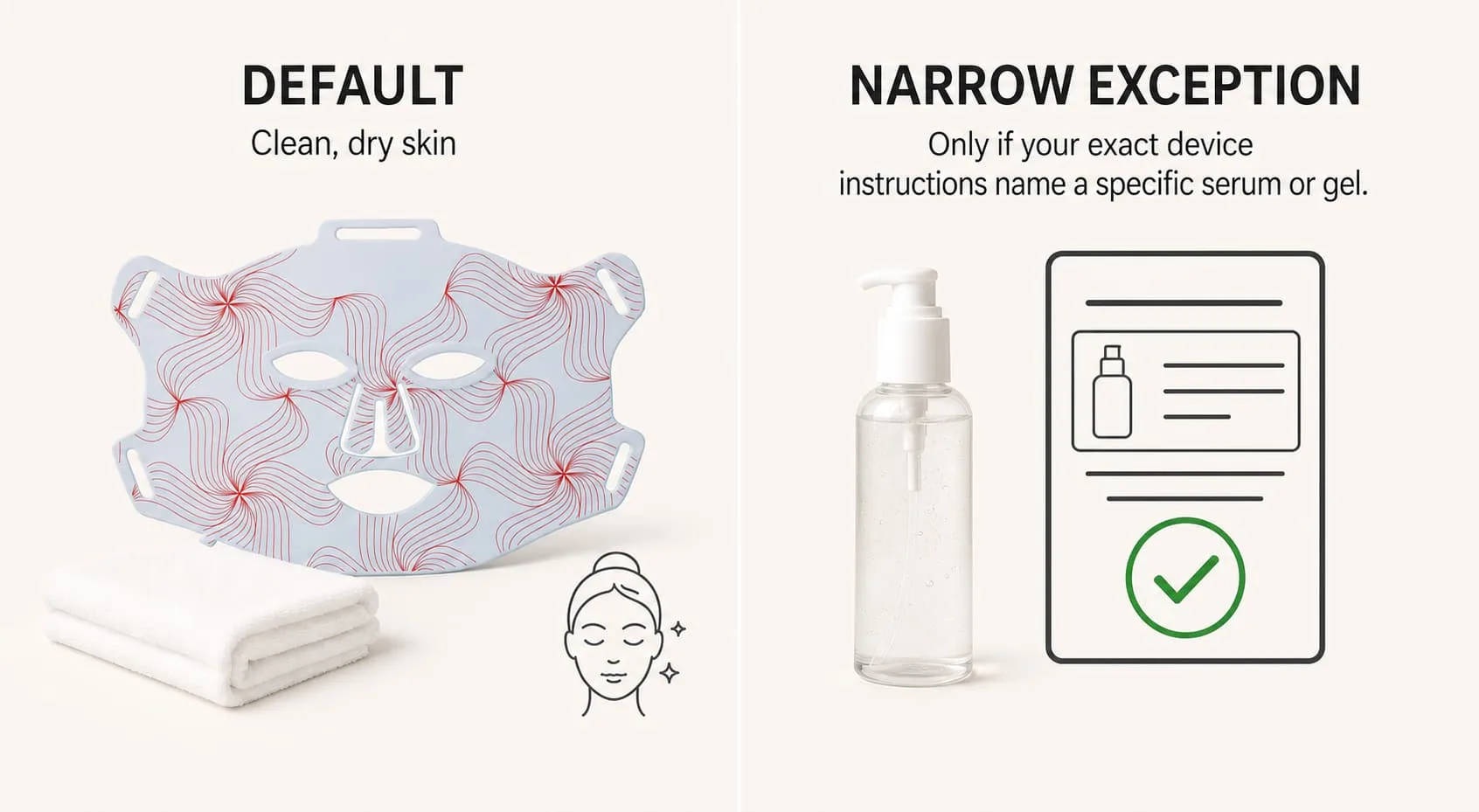
Use a serum under the device only when the instructions name that product or clearly say you can. Keep a sheet mask as a separate step unless the instructions clearly describe combined use.
An ordinary skincare serum is not the same as a serum or gel supplied for a particular device function. Words such as “hydrating” or “lightweight” are not enough to establish compatibility. Check that both the exact device model and the exact product are identified, and do not substitute another serum unless the instructions allow it.
The same principle applies to sheet masks. If the device calls for clean, dry skin, complete the LED session first and use the sheet mask separately. Do not cut or reposition a sheet mask in a way that covers vents, sensors, or eye openings. There is no need to claim that every sheet mask blocks light or causes overheating; the clean-skin requirement already gives you the action answer.
Are Retinol, Vitamin C, and Acids Automatically Incompatible?
No. These products should not be treated as one universal “photosensitive actives” list. What matters is whether the product is currently on your skin, whether the device or product label gives a warning, and whether your skin is irritated.
| Your situation | Practical next step |
|---|---|
| Retinol, Vitamin C, an exfoliating acid, or benzoyl peroxide is currently on your skin | Remove it before a clean, dry skin session |
| You used an over-the-counter active earlier, the device gives no same-day restriction, and your skin feels normal | Follow the device instructions; do not invent a universal waiting interval |
| The device or skincare label gives a same-day restriction or other warning | Follow that exact warning |
| Your skin is stinging, peeling, broken, unusually red, or painful | Postpone the session until the irritation question is resolved |
| You use a prescription topical or a medication named in a warning | Ask the prescriber, dermatologist, or pharmacist; do not stop treatment to fit an LED routine |
Cleveland Clinic notes that LED light therapy is not suitable for everyone and identifies certain medications that increase sensitivity to sunlight as a reason for medical review. It does not provide a universal skincare-ingredient blacklist, so this article does not create one.
How Soon After LED Can You Apply Moisturizer or Serum?
If your skin feels normal and the instructions do not specify a waiting period, you can continue with toner, serum, moisturizer, or face oil as soon as the programmed session ends. There is no need to invent a universal cooling-off period.
If the manual gives a waiting period, follow it. If your skin feels unusually hot, painful, itchy, or irritated, do not cover the reaction with more products and continue as normal. Pause, check the device guidance, and seek qualified advice when needed.
During the day, SPF remains the final step of your usual skincare routine. That is normal daytime sun protection, not a claim that every LED session makes the skin photosensitive.
When Should You Pause and Ask for Help?
Pause when the answer depends on medication, a procedure, damaged skin, an unexpected reaction, or instructions that are missing or contradictory.
Ask the device supplier or a qualified healthcare professional, as appropriate, if:
- You use a prescription topical or take a medication mentioned in the device’s photosensitivity or contraindication section.
- You recently had a laser procedure, chemical peel, microneedling, injectable treatment, surgery, or another facial procedure.
- Your skin is broken, actively inflamed, unusually painful, or reacting to a product.
- You develop unexpected pain, hives, rash, inflammation, or persistent redness during or after use.
- The manual is missing, uses an undefined warning, or gives conflicting directions.
Do not continue using the mask while trying to explain away a reaction, and do not stop prescribed medication based on general online advice. Cleveland Clinic advises contacting a healthcare provider for reactions such as hives, inflammation, pain, rash, or redness.
The Simple Rule to Remember
The answer is not “never use skincare with LED,” and it is not “add a serum to make LED work better.” The useful rule is:
Start with the skin condition your device requires. Use a product underneath only when the instructions clearly say you can or name the exact product.
For a clean, dry skin mask, cleanse and dry first, complete the programmed session, then continue your normal skincare. If a prescription, recent procedure, damaged skin, or unexpected reaction is involved, pause and get advice that accounts for both the product and the device.
For the broader AM or PM sequence, continue with the full LED mask skincare routine order.
If the device identity or preparation instructions are still unclear, use the six-point LED face mask selection guide to evaluate the exact model and its documentation before comparing topical products.
For Brands, Clinics, and Product Teams
Consumer confusion about moisturizer and serum often starts with unclear preparation steps, undefined ingredient warnings, or one set of instructions being reused across devices with different functions. The FDA’s considerations for over-the-counter medical devices state that labeling should be simple, visible, concise, and understandable to lay users, with clear warnings and contraindications. Product teams should therefore validate skincare compatibility for the exact model and make the clean-skin rule, permitted topical exceptions, prescription boundaries, and adverse-reaction actions easy to find.
If you are developing an LED mask or revising its consumer instructions, explore Wakelife’s LED face mask platforms and OEM and ODM capabilities.
Safety and Medical Guidance
This guide provides general consumer education. It cannot determine whether a particular LED device or topical product is appropriate for your individual circumstances. Always follow the instructions and warnings supplied with your exact device model.
If you use medication or a prescription topical, have a relevant medical condition, recently had a facial procedure, or develop an unexpected reaction, pause device use and ask your prescriber, dermatologist, pharmacist, or another qualified healthcare professional before continuing. Do not stop prescribed treatment based on this article.
References
| No. | Official Source |
|---|---|
| 01 | Cleveland Clinic. LED Light Therapy: How It Works, Colors, Benefits & Risks. Medically reviewed; last updated December 2, 2021. Accessed July 17, 2026. |
| 02 | U.S. Food and Drug Administration. Frequently Asked Questions About Home Use Devices. Accessed July 17, 2026. |
| 03 | U.S. Food and Drug Administration. Over-the-Counter (OTC) Medical Devices: Considerations for Device Manufacturers. Accessed July 17, 2026. |