Short answer: There is no universal LED face mask frequency. Official protocols differ by model: the DRx SpectraLite FaceWare Pro specifies one three-minute session daily, while Omnilux Contour specifies a 10-minute treatment three to five times weekly; neither schedule applies to other masks. Those numbers apply only to the named models, so use the schedule for your exact mask. Run one programmed cycle unless its instructions clearly allow more. If the instructions are missing or unclear, contact the manufacturer or official customer support before changing the time or frequency.
How Do You Find the Right Schedule for Your Mask?
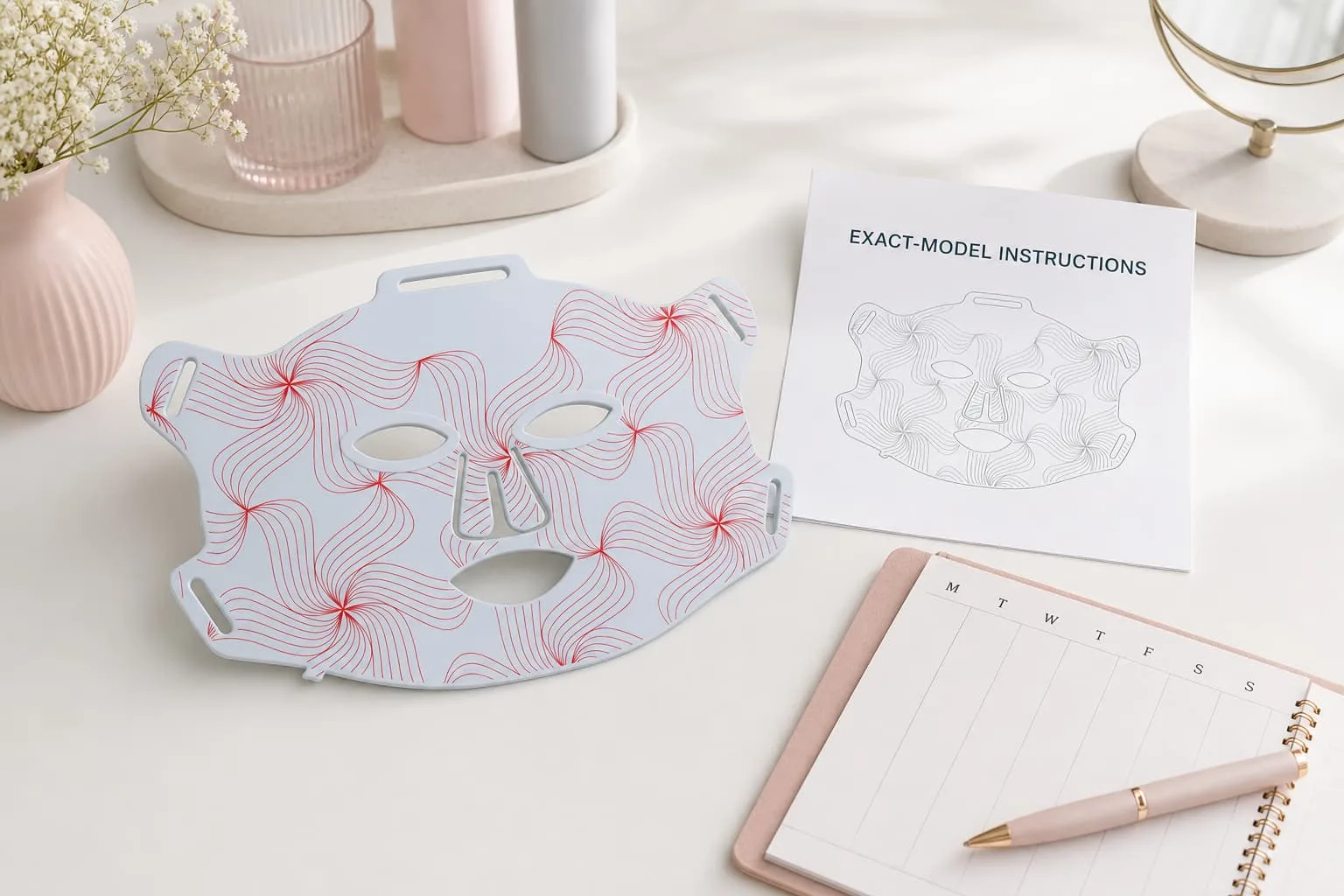
Find the instructions for your exact model and record the complete schedule—not just the number on its timer. The model name matters because two masks that look similar can have different outputs, modes, intended uses, programmed session lengths, and warnings.
For products regulated as medical devices, the FDA’s general device-labeling requirements explain that adequate directions for use can include frequency, duration, timing, method, and preparation. Its home medical-device checklist also tells users to keep the Instructions for Use available, follow them as given, and call the supplier when they do not understand how the device works.
Use this checklist with the manual, quick-start guide, app, or official support page for your model:
| What to find | What it answers | What not to assume |
|---|---|---|
| Programmed session length | How long one completed session lasts | A longer timer from another mask also applies to yours |
| Weekly or daily frequency | How many sessions the instructions allow | “Daily” and “3–5 times weekly” mean the same thing |
| Treatment course and maintenance phase | Whether the schedule changes after a stated number of weeks | The starting schedule continues forever |
| Mode-specific directions | Whether different light modes have separate schedules or can be combined | Every available mode should be run back-to-back |
| Repeat-use limit | Whether another cycle or same-day session is allowed | An automatic shutoff is an invitation to restart |
| Warnings and eye-protection directions | When to pause, seek advice, or use supplied protection | Advice for another model overrides your warning section |
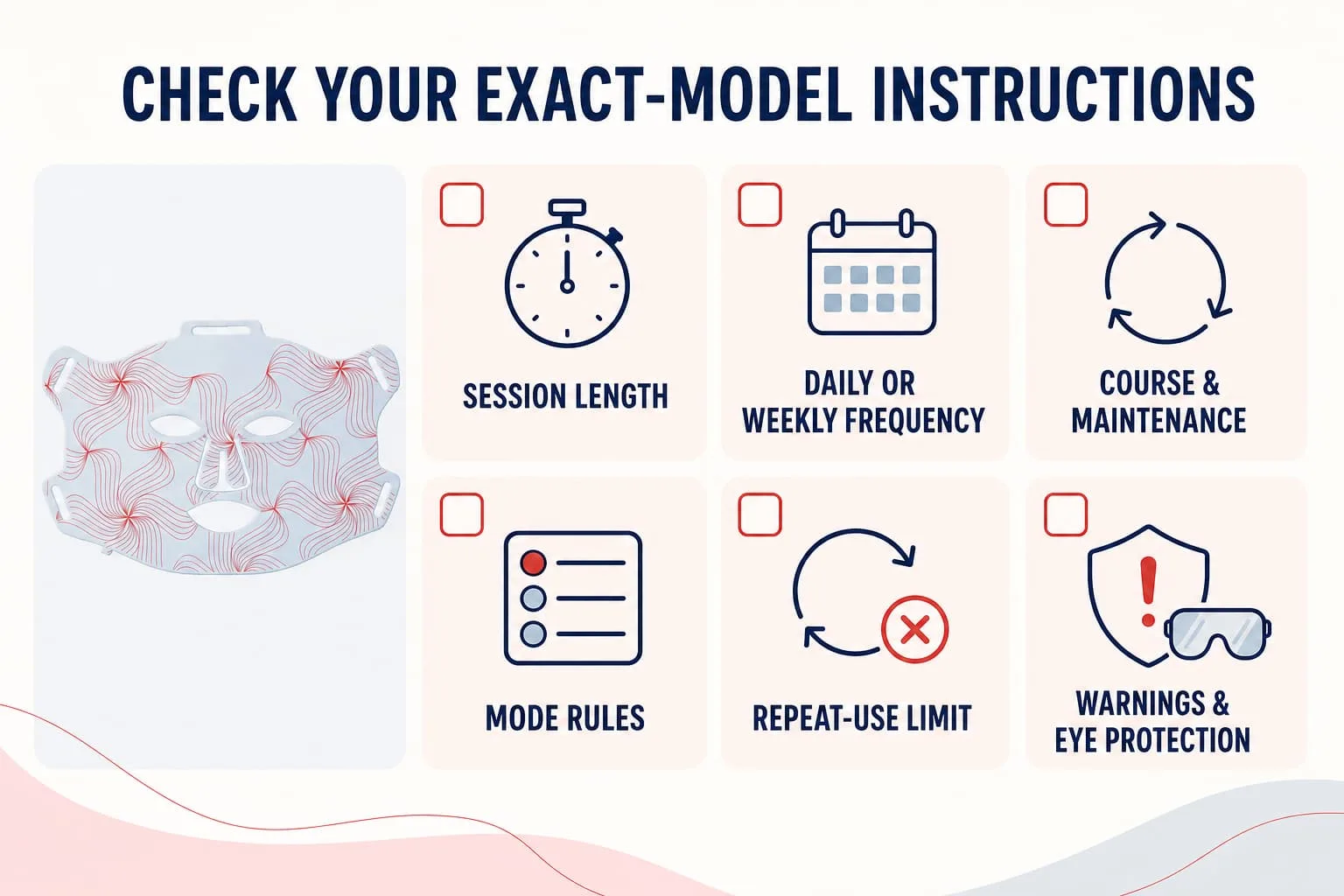
Check the model number on the device or packaging, not only the brand name. If the printed manual and an online page give different schedules, ask the official customer support which document revision applies to your device before changing your routine.
Can You Use an LED Face Mask Every Day?
Use an LED face mask every day only when the instructions for that exact model allow a daily schedule. Daily use is not automatically right or wrong for the whole category.
| What your exact instructions say | What to do |
|---|---|
| One session daily | Use one programmed session on the stated daily schedule; do not turn “daily” into “twice daily” |
| A set number of sessions per week | Stay within that weekly range; do not silently convert it to daily use |
| A fixed course followed by maintenance | Follow the starting phase, then change only when the instructions tell you to |
| Different schedules for different modes | Follow the rule for the mode you are using; do not stack modes unless combined use is described |
| No clear frequency | Pause the schedule decision and ask the official customer support for the instructions that match your model |
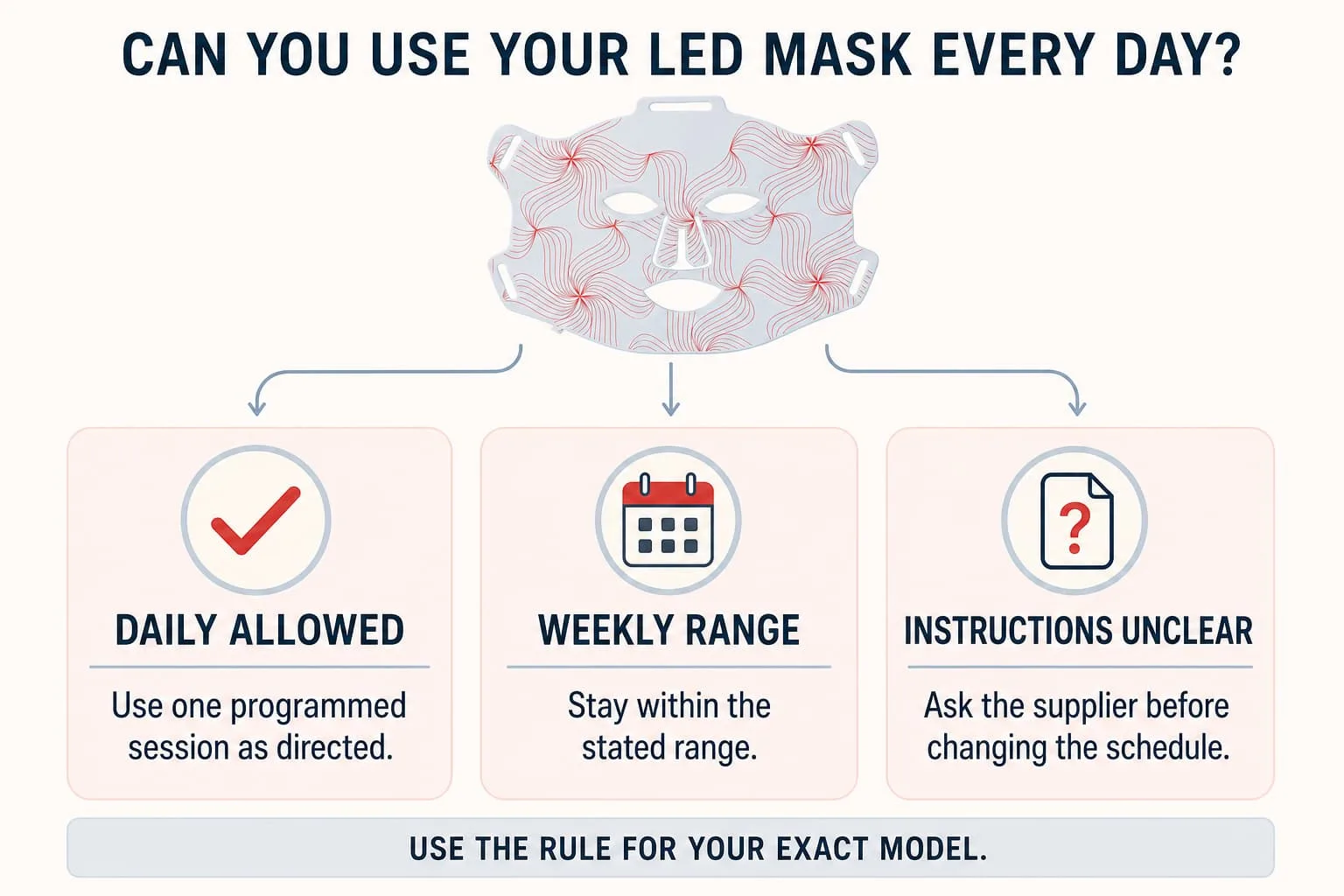
Two official device pages show why a universal answer would be misleading. The DRx SpectraLite FaceWare Pro support page describes one daily three-minute session for that model. The Omnilux Contour quick-start guide describes a 10-minute programmed treatment three to five times per week, while its official help center says daily use has not been studied for that device.
These are device-specific instruction examples, not brand endorsements and not clinical authority for every LED mask. They establish only that legitimate schedules can differ enough that copying another model’s routine is unreliable.
Should You Use an LED Mask Longer or Twice a Day?
Do not extend the timer, restart a completed cycle, or add a second daily session unless the instructions for your exact model clearly permit it. When the instructions define an automatic shutoff as the end of treatment, that completed cycle is the stated session—not general permission to start another one.
This gives direct answers to three common situations:
- If your mask stops after its programmed time, treat that cycle as the session described by its instructions.
- If the instructions say “daily,” read that as the stated number of daily sessions—not permission to keep repeating the cycle.
- If the device offers several modes, check whether the modes can be combined or alternated before using more than one on the same day.
For the FaceWare Pro example above, the manufacturer’s support page says the device was designed around one daily three-minute session and that additional same-day use does not speed its stated results. For Omnilux Contour, the manufacturer advises staying with three to five weekly sessions because daily use has not been studied for that model. Neither statement can establish a universal maximum for other masks.
The practical default is therefore not “more is better” or “more is always dangerous.” It is simpler: do not change an exact-device protocol without exact-device permission.
Why Can’t a Study Set the Schedule for Every LED Mask?
A study schedule tells you what researchers tested with one device, set of parameters, participant group, and outcome. It does not become the Instructions for Use for every consumer mask.
The American Academy of Dermatology notes that researchers study different devices for different amounts of time and ask different questions, so results from separate studies cannot simply be compared. The AAD’s consumer guidance therefore says that the time required varies and users should follow the directions supplied with their device.
Recent trials illustrate this scope problem:
- A 2025 randomized, sham-controlled facial-rejuvenation trial used a specific 660 nm mask for 21-minute sessions, comparing two and three sessions per week for four weeks. The quantity of active sessions did not significantly change the study’s photographic assessments or participant-satisfaction results at follow-up. That finding belongs to that device, population, period, and set of outcomes.
- A different 2025 randomized, sham-controlled home-mask trial used a 630 nm and 850 nm device for nine minutes, five times per week, for 12 weeks in adults of Asian descent with defined crow’s-feet criteria.
The useful lesson is not that two, three, or five sessions is the universal answer. It is that the device, output, session time, frequency, course length, intended use, and study population travel together. A research protocol can help explain evidence, but it cannot overwrite the directions for the mask in your hands.
How Do You Turn the Instructions Into a Weekly Plan?
Copy the exact schedule into a simple weekly record before your first session. This prevents memory, another brand’s routine, or eagerness to see results from gradually changing the protocol.
- Identify the exact model and document version. Record the model name or number and where you found its current instructions.
- Copy the full session rule. Include the programmed time, permitted frequency, mode, course length, and maintenance phase.
- Choose calendar slots that fit that rule. Add only the number of sessions allowed. Use nonconsecutive days only if the instructions require them; do not invent spacing rules.
- Set a review point. If the instructions change the schedule after a course, add that date now instead of continuing the starting frequency automatically.
You can use this blank schedule card:
| Schedule field | Your exact-device instruction |
|---|---|
| Device model and instruction version | |
| Programmed session length | |
| Daily or weekly frequency | |
| Mode or sequence rule | |
| Initial course length | |
| Maintenance schedule | |
| Repeat-use limit and warnings |
This schedule covers frequency and session length only. For where the mask fits in your skincare routine, use the LED mask skincare routine guide. If your question is whether moisturizer or serum can remain on the skin, use the LED mask moisturizer and serum compatibility guide.
What If You Miss a Session?
Do not assume that a missed session gives you permission to double the next one. There is no single catch-up rule that can be supported for every LED face mask.
If your instructions explain missed sessions, follow that rule. If they do not, check the official support material or ask the official customer support whether you should simply return to the stated schedule. Do not create a same-day repeat, longer session, or compressed weekly plan merely to reach a target count.
When Should You Pause and Ask for Help?
Pause when the decision involves a warning, a relevant medical variable, missing instructions, or an unexpected reaction—not just a scheduling preference.
The AAD advises consumers to consider whether red light could interact with a condition, medication, or other treatment, and to follow any eye-protection directions supplied with the device. Ask the appropriate official customer support or qualified healthcare professional if:
- You take a medication or use a prescription topical mentioned in the photosensitivity, contraindication, or warning section.
- You have a light-sensitive condition or another medical condition that may be affected by the device.
- You recently had a facial procedure and the device or procedure instructions do not clearly cover when to resume.
- You develop unexpected pain, persistent irritation, worsening skin changes, or another reaction during or after use.
- The required eye protection, session schedule, model identity, or warning language is missing or contradictory.
Do not stop prescribed medication to fit an LED schedule, and do not use a general article to diagnose a reaction. Bring the exact device name, instructions, and medication or procedure details when asking for help.
The Simple Rule to Remember
The right frequency is not the most common number on the internet. It is the complete schedule supplied for your exact device:
Use the stated program, stay within the stated frequency, and do not add time or sessions unless the exact instructions allow it.
Find the model-specific session length, weekly or daily frequency, mode rule, course and maintenance phases, repeat-use limit, and warnings. Put those details into your calendar. If the instructions are unclear—or a medication, condition, procedure, or unexpected reaction changes the situation—pause and ask the appropriate official customer support or qualified professional.
If you are still comparing devices, Wakelife’s six-point LED face mask selection guide explains how to assess the exact model, intended use, light placement, output documentation, fit, and instructions before relying on its schedule.
For Brands, Clinics, and Product Teams
Consumer questions about daily use and longer sessions often reveal a labeling problem: the timer is visible, but the complete schedule, mode rules, maintenance phase, and repeat-use limits are not easy to find. The FDA’s OTC medical-device considerations emphasize labeling that lay users can understand, including clear warnings and contraindications.
Product teams should validate the protocol for the exact model and make frequency, duration, mode sequencing, course transitions, prohibited improvisations, and escalation steps explicit. If you are developing an LED mask or revising its consumer instructions, explore Wakelife’s LED face mask platforms and OEM and ODM capabilities.
Safety and Medical Guidance
This article provides general consumer education, not medical advice. LED devices vary in intended use, regulatory status, output, programmed session length, permitted frequency, warnings, and eye-protection requirements. Follow the labeling for your exact device.
Seek qualified medical guidance when medication, a prescription topical, a medical condition, a recent procedure, or an unexpected reaction affects whether or how you should use the device. Do not stop prescribed treatment based on this article.
References
Independent and Authoritative Sources
| No. | Official Source |
|---|---|
| 01 | U.S. Food and Drug Administration. General Device Labeling Requirements. Accessed July 20, 2026. |
| 02 | U.S. Food and Drug Administration. Home Healthcare Medical Devices: A Checklist. Accessed July 20, 2026. |
| 03 | American Academy of Dermatology. Is Red Light Therapy Right for Your Skin?. Published September 13, 2024. Accessed July 20, 2026. |
| 04 | Bragato EF, Paisano AF, Pavani C, et al. Role of Photobiomodulation Application Frequency in Facial Rejuvenation: Randomized, Sham-Controlled, Double-Blind, Clinical Trial. Lasers in Medical Science. 2025;40(1):170. doi:10.1007/s10103-025-04383-1. |
| 05 | Park SH, Park SO, Jung JA. Clinical Study to Evaluate the Efficacy and Safety of Home-Used LED and IRED Mask for Crow’s Feet: A Multi-Center, Randomized, Double-Blind, Sham-Controlled Study. Medicine. 2025;104(7):e41596. doi:10.1097/MD.0000000000041596. |
Device-Specific Instruction Examples
These sources document only the named device protocols. They are not used as general clinical or category-level authority.
| No. | Official Source |
|---|---|
| 6 | Dr. Dennis Gross Skincare. DRx SpectraLite FaceWare Pro Device Support. Device-specific instructions; the page also links the current regional manuals. Accessed July 20, 2026. |
| 7 | Omnilux LED. Omnilux Contour Quick Start Guide; Product Help Center. Device-specific instructions. Accessed July 20, 2026. |