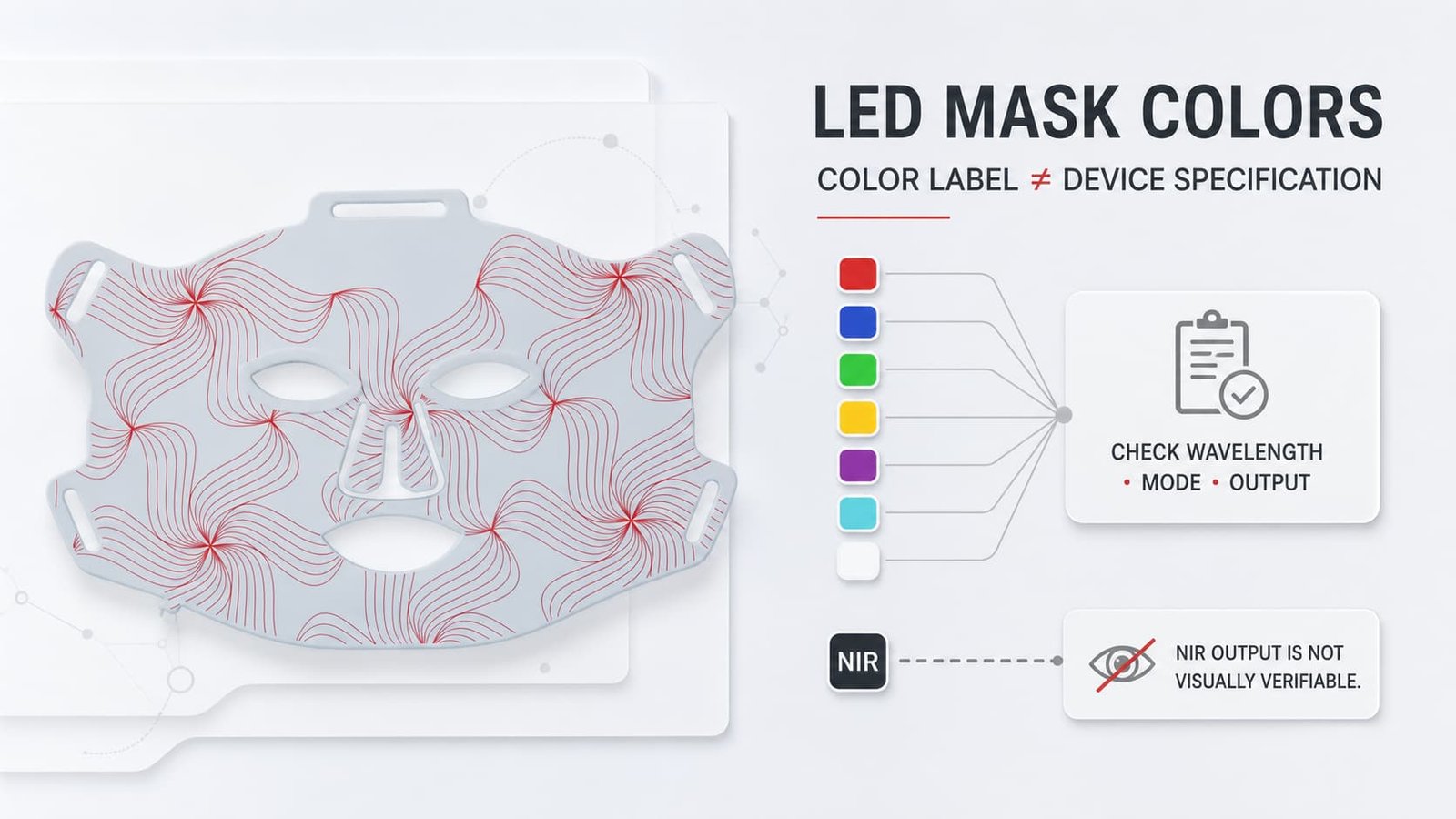
Kort antwoord: Een 7-kleuren LED-maskergrafiek kan helpen bij het decoderen van productlabels, maar die namen zijn geen gestandaardiseerde behandelregels. Rood en/of blauw hebben breder bewijs voor specifiek bestudeerde toepassingen, waaronder bepaalde onderzoeken met thuisapparatuur naar milde tot matige inflammatoire acne; geselecteerde roodlichtonderzoeken richten zich ook op zichtbare huidveroudering. NIR wordt afzonderlijk vermeld omdat het niet een van de zeven zichtbare kleurlabels is en zich doorgaans buiten het zicht van gebruikers bevindt. Controleer de golflengte van uw model, actieve emitters, uitgang, bedoeld gebruik, instructies, en ondersteunend bewijsmateriaal.
Medische notitie: Dit artikel biedt algemene consumentenvoorlichting, geen medisch advies. LED-maskers variëren in het beoogde gebruik, regelgevende status, uitgang, waarschuwingen, vereisten voor oogbescherming, en behandelprotocol. Volg de labels voor uw apparaat. Zoek gekwalificeerd medisch advies voor medicijnen die de lichtgevoeligheid verhogen, lichtgevoelige of actieve huidaandoeningen, recente procedures, onzekere of ernstige acne, of bijwerkingen.
Wat kan een LED-gezichtsmaskerkleurenkaart u eigenlijk vertellen??
Een kleurenkaart kan de labels die u ziet ordenen, maar hij kan u niet de volledige lichtopbrengst vertellen, protocol, of verwachte resultaat van een specifiek masker. De kleur die een persoon ziet, is gerelateerd aan de golflengte, toch zijn de grenzen van de kleurbanden eerder bij benadering dan universeel. De Definitie van zichtbare straling van de Internationale Commissie voor Verlichting merkt op dat er geen precieze grenzen voor het zichtbare spectrum bestaan, En NIST’s spectroscopieoverzicht legt uit dat kleur de lichtfrequentie en golflengte weerspiegelt.
Die fysieke relatie maakt een productlabel niet tot een behandelingsspecificatie. Een rode knop onthult niet de exacte nanometerwaarde, hoe breed de uitgezonden band is, hoeveel licht de huid bereikt, of welk sessieprotocol werd bestudeerd. Een paarse, cyaan, of witte knop vertegenwoordigt mogelijk niet eens één afzonderlijke golflengte.
Gebruik een kleurenkaart om twee vragen te beantwoorden:
- Wat zou dit label fysiek kunnen beschrijven??
- Welke informatie moet ik nog verifiëren voor dit model?
Gebruik het niet om uzelf een voorwaarde toe te kennen, een dosis creëren, of kopieer de instructies van een ander masker.
LED-gezichtsmasker kleurenkaart: Betekenis, Golflengte, en bewijsstatus
Het handigste diagram scheidt een visueel label van de gemeten golflengte en de bewijsstatus, Vervolgens kunt u de details voor uw kleur openen. Er is geen enkele interdisciplinaire grens voor ‘nabij-infrarood’. De CIE plaatst de bijbehorende IR-A-band op 780–1.400 nm en merkt op dat bijna-, midden-, en ver-infraroodgrenzen variëren per toepassing. De onderstaande cijfers zijn voorbeelden die daadwerkelijk worden gerapporteerd in het geciteerde onderzoek naar gezichtshuid of gezichtsapparaten voor thuis – geen specificaties voor elk masker met dezelfde kleurnaam of een bewering dat elke golflengte over een brede fysieke band wordt gebruikt voor gezichtsbehandeling.
De tabel heeft acht rijen omdat NIR wordt toegevoegd als een afzonderlijke modus waarvan de uitvoer doorgaans niet op zicht kan worden geverifieerd. NIR is niet een van de zeven zichtbare kleurlabels in de titel.
| Etiket dat u mogelijk ziet | Golflengtevoorbeelden in geciteerd onderzoek | Bewijsmomentopname voor gebruik van gezichtshuid |
|---|---|---|
| Rood | 630–670 nm in de geciteerde recensie over acne thuis; 633 En 660 nm in onderzoeken naar huidverjonging bij rood licht | Breder categorieonderzoek voor fotobiomodulatie (PBM, het gebruik van laag licht om de biologische activiteit te beïnvloeden) en geselecteerde zichtbare tekenen van huidveroudering; resultaten en parameters variëren |
| Blauw | 414–445 nm in de geciteerde recensie over acne thuis | Geselecteerde toepassingen voor thuisgebruik zijn voornamelijk onderzocht bij milde tot matige acne, vaak met blauw alleen of met rood; niet elke acnelaesie of diagnose wordt gedekt |
| Groente | 505 nm in het geciteerde onderzoek | Opkomend en protocolspecifiek; één golflengte- en maskerprotocol vormen geen universele groenlichtregel |
| Geel of amberkleurig | 570 En 590 nm in de geciteerde verkennende studie; beide gecombineerd met 620 nm rood en 850 nm infrarood | Beperkt en apparaatafhankelijk; het aangehaalde combinatieonderzoek kan een alleen-geel-effect niet isoleren |
| Paars of violet | Uit het label kan geen enkele waarde worden afgeleid | Het label alleen heeft geen categoriebrede bewijsbetekenis, omdat de fysieke implementatie ervan kan verschillen |
| Cyaan | Uit het label kan geen enkele waarde worden afgeleid | De naam legt geen gestandaardiseerd gezichtsprotocol vast |
| Wit | Uit het label kan geen enkele therapeutische golflengte worden afgeleid | ‘Wit’ levert niet één standaardvoordeel op |
| Nabij-infrarood (Nir) | Geen universele grens; gerelateerde CIE IR-A-band: 780–1.400 nm; voorbeeld van onderzoek naar gezichtsapparaten: 850 nm | Substantiële PBM-onderzoeksgeschiedenis, inclusief huidstudies, maar ondersteuning blijft golflengte-, dosis-, en modelspecifiek |
Deze snelle grafiek geeft opzettelijk niet elke kleur het beloofde voordeel. Dat zou het belangrijkste onderscheid verbergen: een benoemde kleur, een gemeten golflengte, een volledige dosis, een bestudeerd protocol, en een productclaim zijn vijf verschillende dingen. Open hieronder de relevante kleur om te zien wat het label fysiek kan beschrijven en wat er nog moet worden gecontroleerd op uw exacte masker.
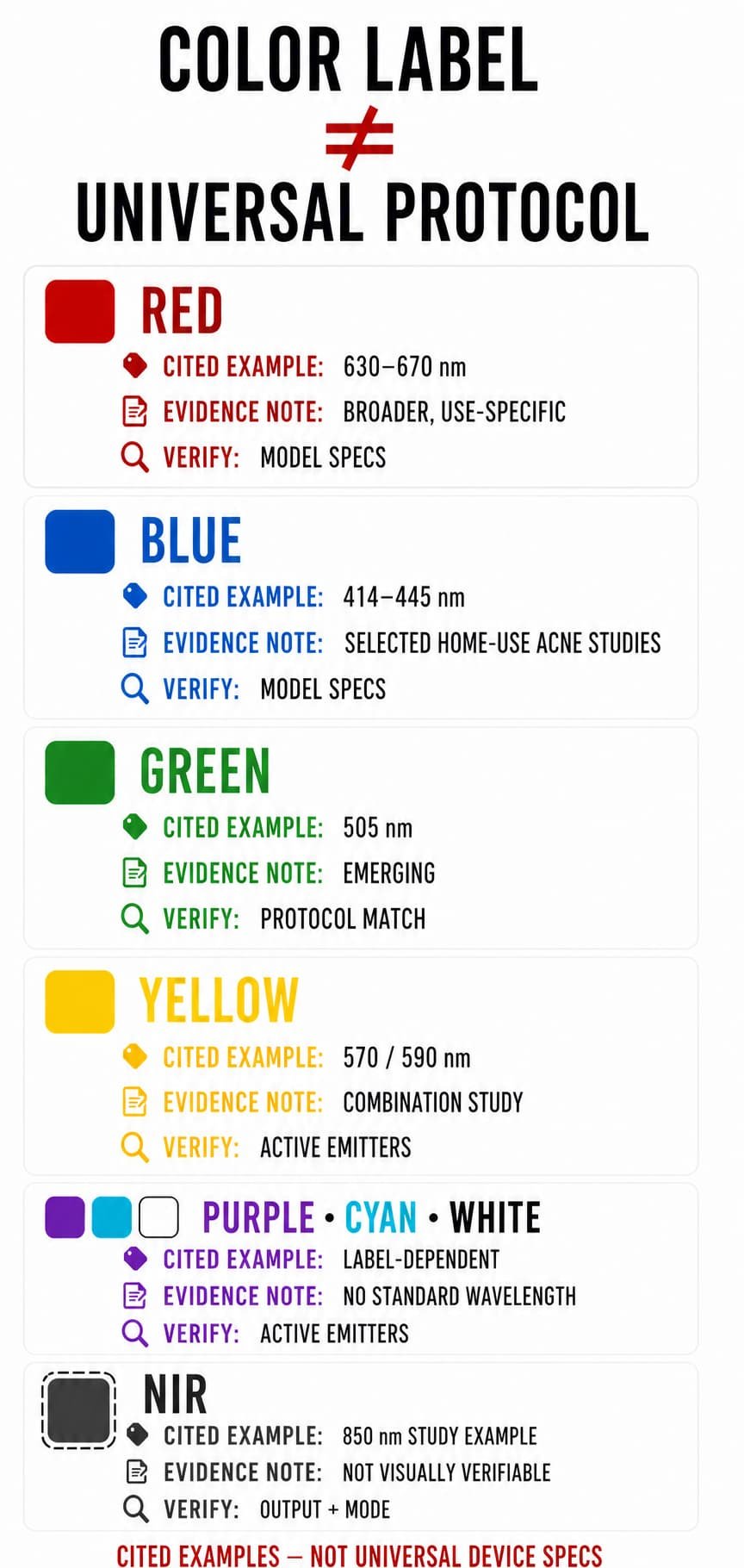
Wat kan elk kleurlabel beschrijven en wat moet u verifiëren??
Rood – geciteerde voorbeelden: 630–670 nm, 633 nm, En 660 nm
Wat het etiket kan beschrijven: Een zichtbare rode zender. Een product kan een andere rode golflengte gebruiken.
Wat te verifiëren: Exacte golflengte, bestraling (lichtvermogen geleverd per oppervlakte-eenheid), stralende blootstelling (totale geleverde lichtenergie per oppervlakte-eenheid) of geprogrammeerde sessie, bedoeld gebruik, waarschuwingen, en bewijs voor het model.
Blauw – geciteerde voorbeelden: 414–445 nm
Wat het etiket kan beschrijven: Een kortere zichtbare zender. Onderzoek en productdocumentatie noemen nabijgelegen violetblauwe waarden mogelijk ‘blauw’.
Wat te verifiëren: Golflengte, indicatie van acne, oog begeleiding, waarschuwingen voor lichtgevoeligheid, protocol, en of het bewijsmateriaal uw model omvat.
Groen – aangehaald voorbeeld: 505 nm
Wat het etiket kan beschrijven: Een zender met een groene regio of een instelling met een groen label.
Wat te verifiëren: Exacte golflengte, studie ontwerp, uitgang, doelresultaat, huidpopulatie, en of het product past bij het onderzochte protocol.
Geel of oranje – aangehaalde voorbeelden: 570 En 590 nm in een onderzoek met gecombineerd licht
Wat het etiket kan beschrijven: Een geel/oranje zender of een benoemde modus die andere zenders bevat. In het geciteerde verkennende onderzoek, beide gele golflengten werden gecombineerd 620 nm rood en 850 nm infrarood.
Wat te verifiëren: Of de modus nu alleen of gecombineerd geel is, zijn golflengten, uitgang, bedoeld gebruik, en ondersteuning voor dat model.
Paars of violet: uit het label kan geen enkele golflengte worden afgeleid
Wat het etiket kan beschrijven: Een discrete zender met violet bereik, een rood-plus-blauw combinatie, of een ander door de fabrikant gedefinieerd mengsel.
Wat te verifiëren: Welke golflengten en zenders worden ingeschakeld, of ze nu gelijktijdig of opeenvolgend werken, en welk bewijs van toepassing is op die combinatie.
Cyaan: uit het label kan geen enkele golflengte worden afgeleid
Wat het etiket kan beschrijven: Een discrete blauwgroene zender, een blauw-plus-groen mengsel, of een andere door de fabrikant gedefinieerde instelling.
Wat te verifiëren: Exacte spectrum- of emittercombinatie, uitgang, bedoeld gebruik, instructies, en apparaatbewijs.
Wit – uit het etiket kan geen enkele therapeutische golflengte worden afgeleid
Wat het etiket kan beschrijven: Verschillende zichtbare zenders werken samen, een breedspectrumbron, of een door de fabrikant gedefinieerde gemengde modus.
Wat te verifiëren: Spectrale output, actieve emitters, dosis, bedoeld gebruik, protocol, en apparaatspecifiek bewijsmateriaal.
Nabij-infrarood (Nir) — gerelateerde IR-A-band: 780–1.400 nm; aangehaald apparaatvoorbeeld: 850 nm
Wat het etiket kan beschrijven: Straling voorbij zichtbaar rood die doorgaans buiten het zichtbare bereik ligt, gebruikt als eigen modus of gecombineerd met zichtbaar licht. Een masker kan één specifieke NIR-golflengte gebruiken; de IR-A-band is een spectrale classificatie, geen assortiment gezichtsbehandelingen.
Wat te verifiëren: NIR-golflengte, of deze in elke modus actief is, uitgang, protocol, oog begeleiding, en bewijsomvang.
Waarom paars, Cyaan, en wit betekenen verschillende dingen in maskers?
Deze namen beschrijven hoe een modus eruit ziet of op de markt wordt gebracht, niet noodzakelijkerwijs één gestandaardiseerde zender. Twee maskers kunnen hetzelfde kleurwoord weergeven terwijl verschillende LED's worden geactiveerd.
| Moduslabel | Mogelijke technische interpretatie | De vraag die de onduidelijkheid oplost |
|---|---|---|
| Paars | Een violette LED, rode en blauwe LED's werken samen, of een ander mengsel | Welke exacte golflengten en emitters actief zijn? |
| Cyaan | Een discrete blauwgroene emitter of een mengsel van blauwe en groene LED's | Is het één gemeten golflengte of een gecombineerde modus? |
| Wit | Meerdere zichtbare LED's samen, een brede bron, of een geprogrammeerde reeks | Wat laat de spectrale output- of modustabel zien? |
| 7-kleur cyclus | Zeven afzonderlijke selecties, meerdere mengsels, of een automatische reeks | Zijn de modi gelijktijdig, opeenvolgend, of onafhankelijk selecteerbaar? |
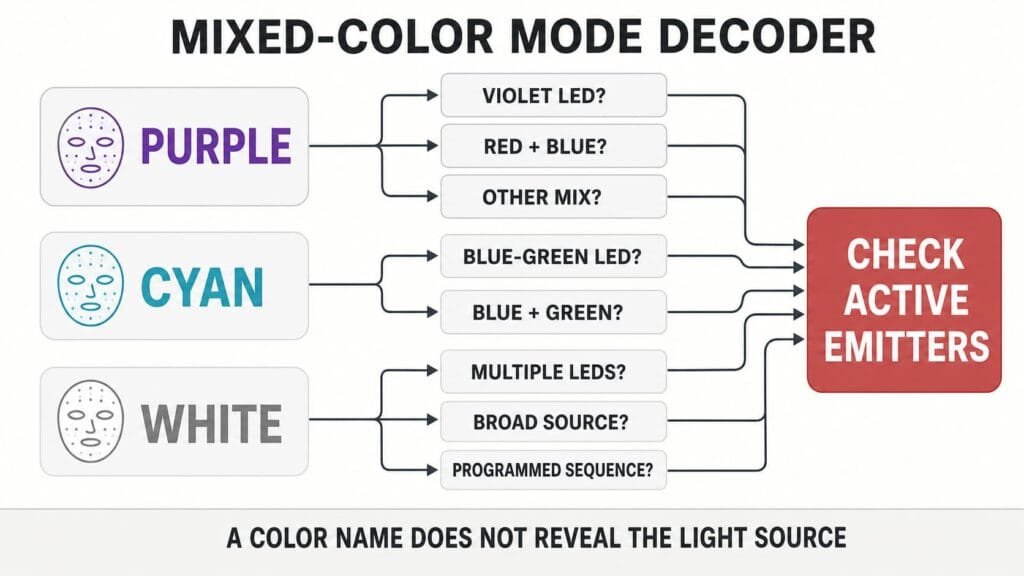
Een schermkleur, icon, of gloeiende productfoto kan deze vragen niet beantwoorden. Zoek naar een modustabel in de instructies of in het officiële ondersteuningsmateriaal waarin de actieve zenders worden geïdentificeerd. Als de documentatie alleen ‘paars voor kalmering’ of ‘wit voor vernieuwing’ herhaalt zonder het licht te identificeren, het heeft eerder een marketingdoel dan een reproduceerbaar technisch protocol beschreven.
Welke LED-kleuren sterker bewijs hebben voor gebruik op de gezichtshuid?
Rood en blauw hebben een bredere ondersteuning op categorieniveau dan de meeste extra zichtbare kleurlabels, maar zelfs hun bewijsmateriaal is eerder voorwaardelijk dan universeel. A systematische review van 31 gerandomiseerde LED-proeven gaf acne vulgaris een aanbeveling van graad B, terwijl andere dermatologische toepassingen graad C of D kregen; de auteurs merkten ook kleine steekproeven op, inconsistente verblinding, ontbrekende schijncontroles, en gevarieerde behandelingsparameters in delen van de literatuur. Uit het onderzoek bleek dat Jared Jagdeo en Daniel Siegel lid waren van de wetenschappelijke adviesraad van Global Med Technologies en dat Jagdeo honoraria ontving van het bedrijf; deze openbaarmaking is niet bepalend voor de bevindingen, maar het is relevant bij het afwegen van de aanbevelingen van de review.
Specifiek voor acne, A 2025 systematische review en meta-analyse van zes LED-onderzoeken voor thuis beoordeelde apparaten met rood en/of blauw licht. Dat ondersteunt een gedefinieerde hoeveelheid bewijsmateriaal voor bepaalde toepassingen van acne thuis. Het betekent niet dat elke blauwe knop geschikt is voor elke uitbraak, dat rood en blauw dezelfde rol spelen, of dat een kleurenkaart acne kan diagnosticeren.
De Richtlijnen van de American Academy of Dermatology over lasers en lichten voor acne maakt de praktische grens duidelijker: zichtbaar licht kan puistjes behandelen, maar geen mee-eters, witkoppen, cysten, of knobbeltjes, en de resultaten variëren. Voor roodlichtapparaten, de AAD adviseert eveneens het kiezen van een apparaat dat bedoeld is voor het probleem dat u wilt aanpakken en het volgen van de aanwijzingen ervan.
Groen en geel mogen niet als automatisch nutteloos worden afgedaan, maar hun bewijsmateriaal moet worden beschreven op het niveau waarop het daadwerkelijk bestaat:
- A 2025 studie van 505 nm groene LED omvatte cel- en 3D-huidmodelexperimenten plus een kleine, door beoordelaar geblindeerde split-face-interventie in 15 gezonde vrouwen tussen 45 en 57 jaar. Deelnemers gebruikten hiervoor het YA-MAN 23F1XX-masker 10 notulen, zes keer per week, voor acht weken. A 2026 correctie verduidelijkte de statistische rapportage en voegde eraan toe dat vier auteurs werknemers waren van YA-MAN Ltd. en het onderzoek werd uitgevoerd in het kader van een onderzoeksovereenkomst met het bedrijf. Het is relevant opkomend bewijs voor die golflengte, apparaat, bevolking, en protocol – geen toestemming om de conclusie over te dragen naar elke groene omgeving.
- A klein 2025 verkennend gerandomiseerd onderzoek ingeschreven 30 deelnemers, van wie 28 de studie afgerond, en vergeleken 570 nm met 590 nm geel licht. Beide groepen ontvingen ook 620 nm rood en 850 nm-infraroodlicht. Omdat er geen alleen-geel-arm was, het onderzoek kan geen enkel geel categorie-effect vaststellen.
Regelgevende vermeldingen zijn niet noodzakelijkerwijs beperkt tot rood en blauw. Die van de FDA K250830 510(k) databaserecord links naar de officiële samenvatting, waarvan de goedkeuringsbrief en indicaties voor gebruik rood zijn, geel, rood-plus-infrarood, blauw, en een rood-plus-blauw-plus-infrarood gemengde modus voor specifieke indicaties in de genoemde apparaatfamilie. Dit is een 510(k) Bepaling van substantiële gelijkwaardigheid en reikwijdte van de regelgeving voor exacte apparaten - geen onafhankelijk bewijs dat elke vermelde modus dezelfde klinische bewijsbasis heeft. Het verandert “geel” niet in een door de FDA goedgekeurde golflengtecategorie en bewijst niet dat een andere gele modus hetzelfde beoogde gebruik heeft.
De les is niet: ‘extra kleuren werken nooit’. Het is:
Hoe minder gestandaardiseerd het label en hoe dunner het categoriebewijs, hoe belangrijker exacte apparaatspecificaties en ondersteuning worden.
Waarom is nabij-infrarood anders dan de zichtbare kleuren??
De NIR-uitvoer kan actief zijn, zelfs als er geen zichtbaar licht zichtbaar is. Zichtbaar licht is slechts een deel van het elektromagnetische spectrum, en de CIE merkt op dat de menselijke zichtbaarheid niet één exacte grens kent. NIR bevindt zich voorbij zichtbaar rood, dus zichtbare helderheid, kleur, of een telefooncamerabeeld kan de uitvoer niet verifiëren.
Een masker kan NIR bieden als:
- een aparte selecteerbare modus;
- een zender die automatisch aangaat met rood;
- onderdeel van een gemengd acne- of verjongingsprotocol; of
- een optionele instelling die onafhankelijk van zichtbare LED's wordt geregeld.
Aan het masker kun je niet zien welke regeling van toepassing is. Controleer de golflengtetabel en modusinstructies. Een recensie van lichtparameters en fotobiomodulatie-efficiëntie benadrukt waarom dit ertoe doet: golflengte, bestraling, stralende blootstelling, behandeltijd, puls structuur, straal gebied, en meetomstandigheden zijn allemaal van invloed op de vraag of onderzoeken en apparaten zinvol kunnen worden vergeleken.
Hoe controleer je de kleurmodi op je LED-masker??
Verander de kleurenkaart in een apparaatcontrole met zes velden voordat u op een modus vertrouwt.
| Veld om te controleren | Een nuttig antwoord lijkt | Welk vaag antwoord blijft onbekend |
|---|---|---|
| Beoogd gebruik | Het exacte probleem en de gebruikersgroep waarvoor de modus is ontworpen of gelabeld | Of een algemene uitkeringslijst op u van toepassing is |
| Exacte golflengte | Een nanometerwaarde of gemeten spectrale band voor elke zender | Welk fysiek licht de kleurnaam vertegenwoordigt |
| Actieve zenders | Een modustabel die laat zien welke LED's samen werken en of ze gelijktijdig of opeenvolgend zijn | Of het nu paars is, cyaan, of wit is een afzonderlijke golflengte of een mengsel |
| Output en dosis | Bestraling (lichtvermogen geleverd per oppervlakte-eenheid) in mW/cm² onder aangegeven omstandigheden, plus sessietijd en stralingsblootstelling (totale geleverde lichtenergie per oppervlakte-eenheid) in J/cm² indien aanwezig | Hoeveel licht bereikt een gebied en of een onderzoeksprotocol vergelijkbaar is |
| Instructies en waarschuwingen | Frequentie, cursus, oog begeleiding, voorbereiding, contra-indicaties, omstandigheden stoppen, en schoonmaakvereisten | Of de modus praktisch of geschikt is om te gebruiken zoals aangegeven |
| Apparaatbewijs en reikwijdte van de regelgeving | Een studie, goedkeuring, of test die het model een naam geeft of de toepasselijke familie duidelijk definieert, modus, en bedoeld gebruik | Of er bewijsmateriaal van een ander apparaat is geleend |
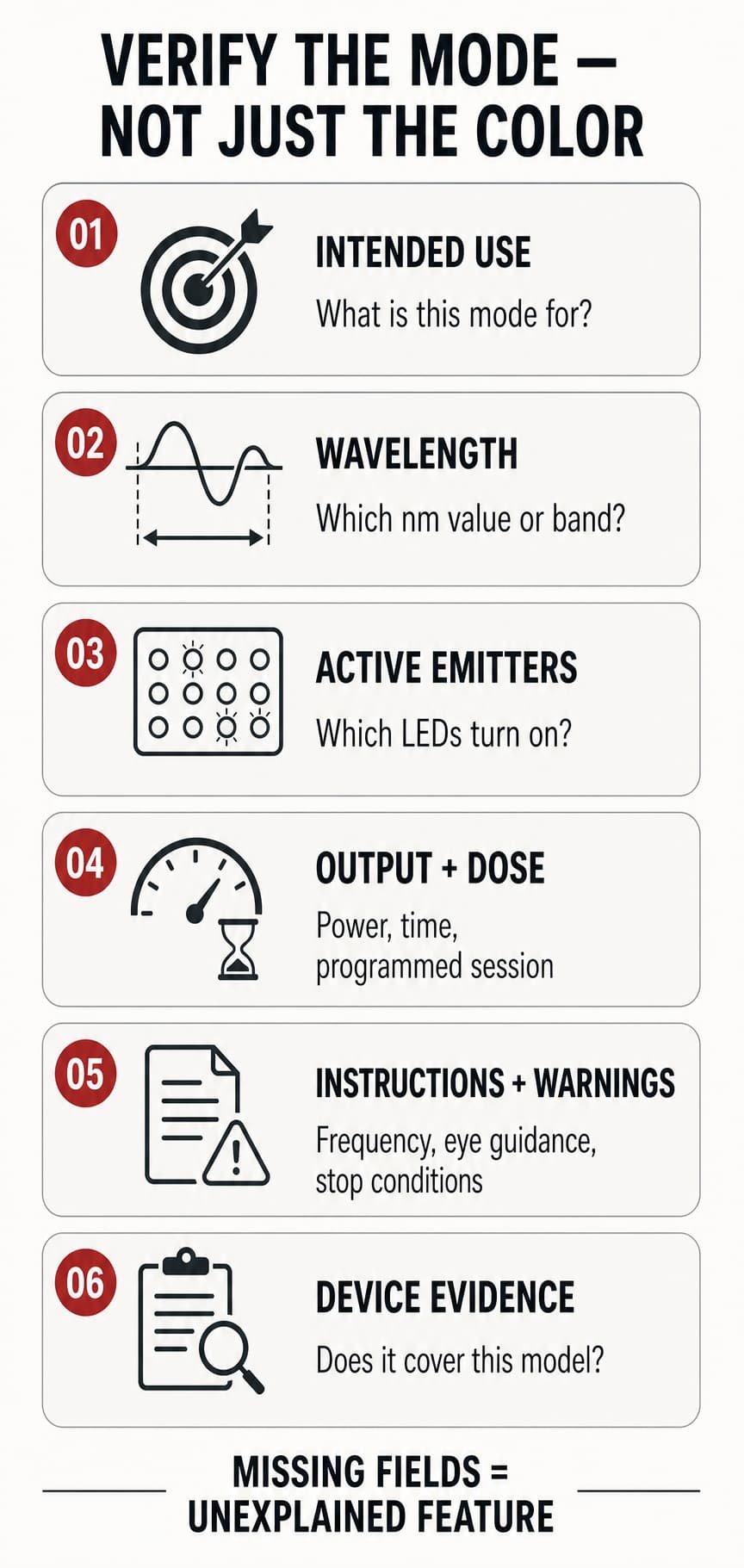
Als de verkoper alleen een regenboogafbeelding en een lijst met voordelen verstrekt, behandel de modi als onverklaarde kenmerken – niet als zeven geverifieerde behandelprogramma’s. Zoek de huidige officiële instructies of vraag het merk naar de ontbrekende informatie over de modus volgens de specificatie. Vul de gaten niet op met de grafiek van een ander bedrijf.
Voor de afzonderlijke koopvraag – of een gerichte rood/blauwe configuratie of een multi-mode masker beter bij uw doel past – gebruikt u Wakelife’s 7-kleur versus rood-en-blauw LED-maskervergelijking. Op die pagina worden configuraties vergeleken; op deze pagina worden de kleurlabels uitgelegd.
Voor een bredere controle van het exacte apparaat buiten de kleurmodi, ga verder met Wakelife's selectiegids voor zespunts LED-gezichtsmaskers.
Wanneer wordt een kleurvraag een medische vraag??
Een kleurenkaart kan niet bepalen welke aandoening u heeft en of blootstelling aan licht geschikt voor u is. Pauzeer de zelfselectie en zoek gekwalificeerde begeleiding wanneer:
- acne is ernstig, cystisch, nodulair, pijnlijk, littekens, of onzeker;
- u gebruikt een medicijn of een actueel recept dat verband houdt met lichtgevoeligheid;
- u een lichtgevoelige aandoening heeft, een actieve uitslag, onverklaarbare pigmentatie, of een veranderende huidlaesie;
- u onlangs een procedure heeft ondergaan of het nazorgplan van een arts volgt; of
- een sessie veroorzaakt aanhoudende pijn, branden, zwelling, oog symptomen, blaarvorming, of een andere bijwerking.
Stop niet met een medicijn en vervang geen masker voor een diagnose of voorgeschreven zorg op basis van een kleurlabel.
De onderste regel
Lees een LED-gezichtsmaskerkleurenkaart als vertaalhulpmiddel, niet als universeel behandelmenu. Rood en blauw hebben relatief bredere categoriegegevens voor specifieke gezichtstoepassingen. Groen en geel hebben opkomend of exact-protocol-bewijsmateriaal dat niet mag worden gegeneraliseerd. Paars, cyaan, en wit vereisen decodering op zenderniveau. NIR kan actief zijn, zelfs als er geen zichtbaar licht zichtbaar is.
Voor elke modus, terug naar dezelfde praktische controle: golflengte, actieve emitters, uitgang, dosis of geprogrammeerd protocol, bedoeld gebruik, waarschuwingen, en bewijs voor dat model. Als die details ontbreken, de kleurnaam kan ze niet leveren.
Voor merken en productteams
Verwarring bij consumenten rond meerkleurige maskers is vaak een documentatieprobleem. Een bruikbare modus-naar-bewijskaart moet elke selecteerbare instelling identificeren, actieve emittercombinatie, golflengte, gemeten opbrengst, geprogrammeerde sessie, bedoeld gebruik, waarschuwingen, en bewijsomvang. Gemengde modi moeten worden beschreven door hun zenders, in plaats van alleen te vertrouwen op namen als paars of wit.
Als u een multi-mode masker ontwikkelt of de consumenteninstructies ervan verbetert, verken Wakelife's LED-gezichtsmaskerplatforms En OEM- en ODM-mogelijkheden na het definiëren van het beoogde gebruik en het bewijsplan voor elke modus.
Referenties
Normen, Professionele begeleiding, en peer-reviewed onderzoek
| Nee. | Officiële bron |
|---|---|
| 1 | Internationale Commissie voor Verlichting. Zichtbare straling. Internationale verlichtingswoordenschat, CIE S 017:2020. Toegang tot juli 21, 2026. |
| 2 | Nationaal Instituut voor Standaarden en Technologie. Spectroscopie: Een meetkrachtcentrale. Toegang tot juli 21, 2026. |
| 3 | Internationale Commissie voor Verlichting. Infraroodstraling. Internationale verlichtingswoordenschat. Toegang tot juli 21, 2026. |
| 4 | Amerikaanse Academie voor Dermatologie. Is roodlichttherapie geschikt voor uw huid??. Laatst bijgewerkt in september 13, 2024. Toegang tot juli 21, 2026. |
| 5 | Amerikaanse Academie voor Dermatologie. Lasers en lichten: Hoe goed behandelen ze acne??. Toegang tot juli 21, 2026. |
| 6 | Ershadi S, Barbieri JS. LED-apparaten voor thuisgebruik voor de behandeling van acne vulgaris: Een systematische review en meta-analyse. JAMA-dermatologie. 2025;161(5):552–555. doi:10.1001/jamadermatol.2025.0019. |
| 7 | Jagdeo J, Austin E, Zoogdieren A, Wong C, Ik heb D, Zegel DM. Lichtgevende diodes in de dermatologie: Een systematische review van gerandomiseerde gecontroleerde onderzoeken. Lasers in chirurgie en geneeskunde. 2018;50(6):613–628. doi:10.1002/lsm.22791. |
| 8 | Zein R, W. verkopen, Hamblin Mr. Overzicht van lichtparameters en werkzaamheid van fotobiomodulatie: Duik in complexiteit. Tijdschrift voor biomedische optica. 2018;23(12):120901. doi:10.1117/1.JBO.23.12.120901. |
| 9 | Mima Y, Yamada T, Omatsu J, Yamashita T, Suzuki S, Takechi T, Ichikawa M, Yamazaki K, Sato S, Yoshizaki A. Remmend effect van 505 nm Groen licht-emitterende diode op melaninesynthese in cellulaire experimenten en een onderzoek naar menselijke interventie. Acta Dermato-Venereologica. 2025;105:adv43441. doi:10.2340/actadv.v105.43441. |
| 10 | Mima Y. Erratum: Remmend effect van 505 nm Groen licht-emitterende diode op melaninesynthese in cellulaire experimenten en een onderzoek naar menselijke interventie. Acta Dermato-Venereologica. 2026;106:adv45681. doi:10.2340/actadv.v106.45681. |
| 11 | Yi S, Ding J, Li X, et al. Werkzaamheid en veiligheid van 570/590 nm Geel licht gecombineerd met rood licht en infrarood-LED bij de behandeling van fotoveroudering van de gezichtshuid. Lasers in de medische wetenschap. 2025;40(1):435. doi:10.1007/s10103-025-04659-6. |
Exact apparaatregelgevingsvoorbeeld
Deze bron documenteert alleen de vermelde apparaatfamilie, modi, en indicaties voor gebruik. Het is geen bewijs dat elk product dat hetzelfde kleurwoord gebruikt, dezelfde status of hetzelfde doel heeft.
| Nee. | Officiële bron |
|---|---|
| 12 | ONS. Food and Drug Administration. K250830 510(k) Databaserecord voor pre-market-meldingen. Datum besluit: juni 9, 2025. De officiële samenvatting van het dossier bevat de goedkeuringsbrief en indicaties voor gebruik voor de vermelde apparaatfamilie. Toegang tot juli 21, 2026. |