Kort antwoord: Een zevenkleuren LED-masker is niet automatisch beter – en het is niet het tegenovergestelde van een rood-blauw masker, omdat rood en blauw twee van de zeven modi kunnen zijn. Kies op basis van uw voornaamste zorg en op basis van de etikettering en het bewijsmateriaal voor het exacte apparaat. Een gefocust rood/blauw masker kan gemakkelijker te evalueren zijn als dit de enige modi zijn die u nodig heeft. Kies alleen voor een 7-kleurenmodel als de extra modi duidelijke specificaties hebben, instructies, en apparaatspecifieke ondersteuning – niet alleen een aantrekkelijke kleurenkaart.
Medische notitie: Dit artikel biedt algemene consumentenvoorlichting, geen medisch advies. LED-maskers variëren in het beoogde gebruik, regelgevende status, uitgang, waarschuwingen, vereisten voor oogbescherming, en behandelprotocol. Volg de labels voor uw exacte apparaat. Zoek gekwalificeerd medisch advies voor medicijnen die de lichtgevoeligheid verhogen, lichtgevoelige of actieve huidaandoeningen, recente procedures, onzekere acne, of bijwerkingen.
Is een zevenkleurenmasker echt anders dan een rood-blauw masker??
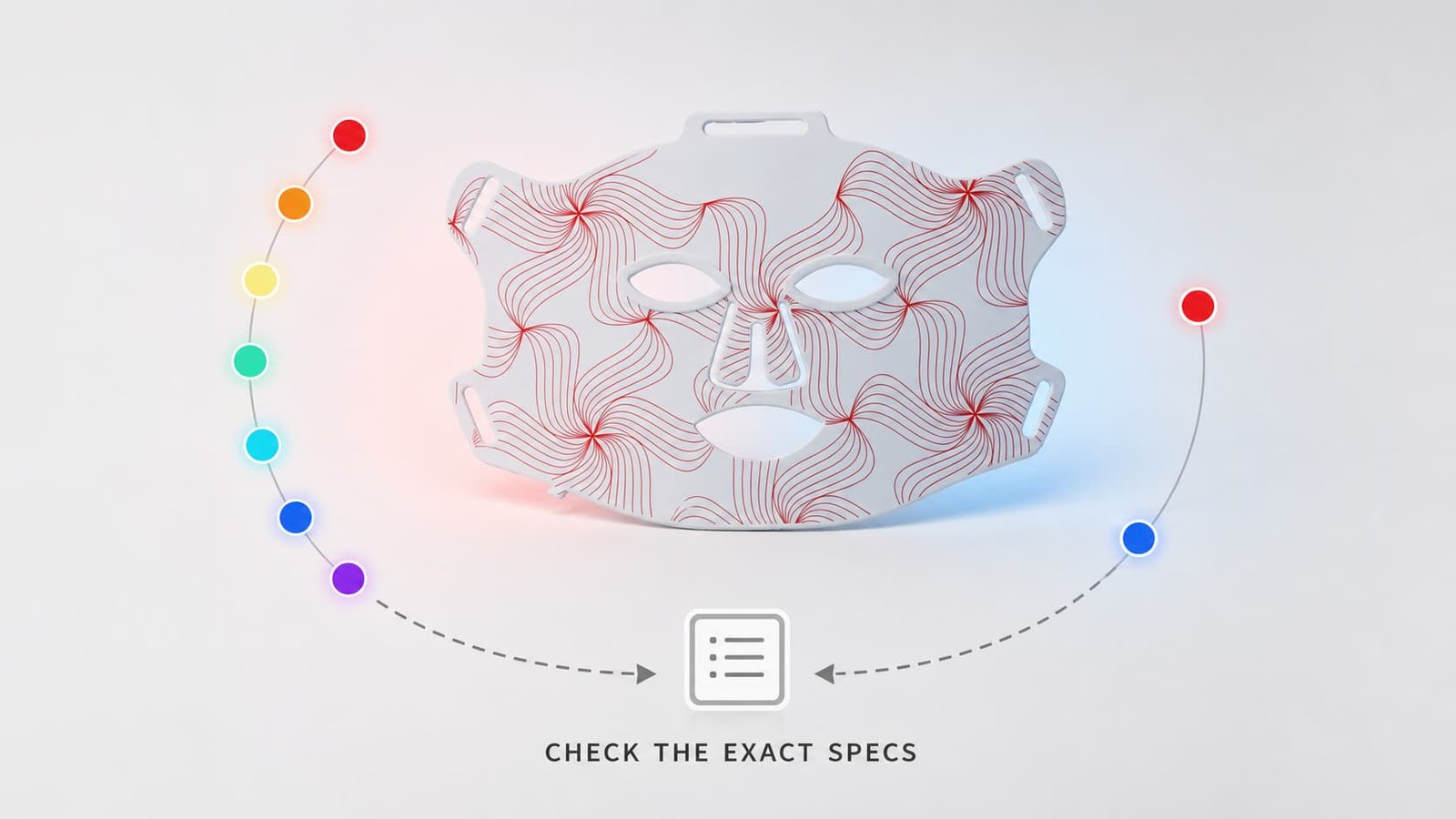
De labels overlappen elkaar: een 7-kleurenmasker kan al rode en blauwe modi bevatten. “7-kleuren” beschrijft hoeveel kleur- of modusnamen een verkoper presenteert. “Rood en blauw” beschrijft twee golflengten of modi die het apparaat bevat. Het zijn geen twee duidelijk gescheiden technologiecategorieën.
| Etiket op het product | Wat het etiket u kan vertellen | Wat het niet bewijst |
|---|---|---|
| 7-kleuren LED-masker | De interface of instructies presenteren zeven kleuren- of gemengd-lichtmodi | Zeven onafhankelijk geverifieerde golflengten, gelijke output in elke modus, of zeven klinisch ondersteunde uitkomsten |
| Rood-blauw LED-masker | Het apparaat is voorzien van rood en blauw licht, afzonderlijk of in een gecombineerd protocol | De exacte golflengten, of nabij-infrarood inbegrepen is, hoeveel licht de huid bereikt, of voor welk gebruik het apparaat is gelabeld |
| Paars, wit, cyaan, of een andere benoemde modus | De fabrikant heeft aan een instelling een naam gegeven | Welke emitters zijn actief, of de modus een gemengde kleur of een afzonderlijke golflengte is, of welk bewijs van toepassing is |
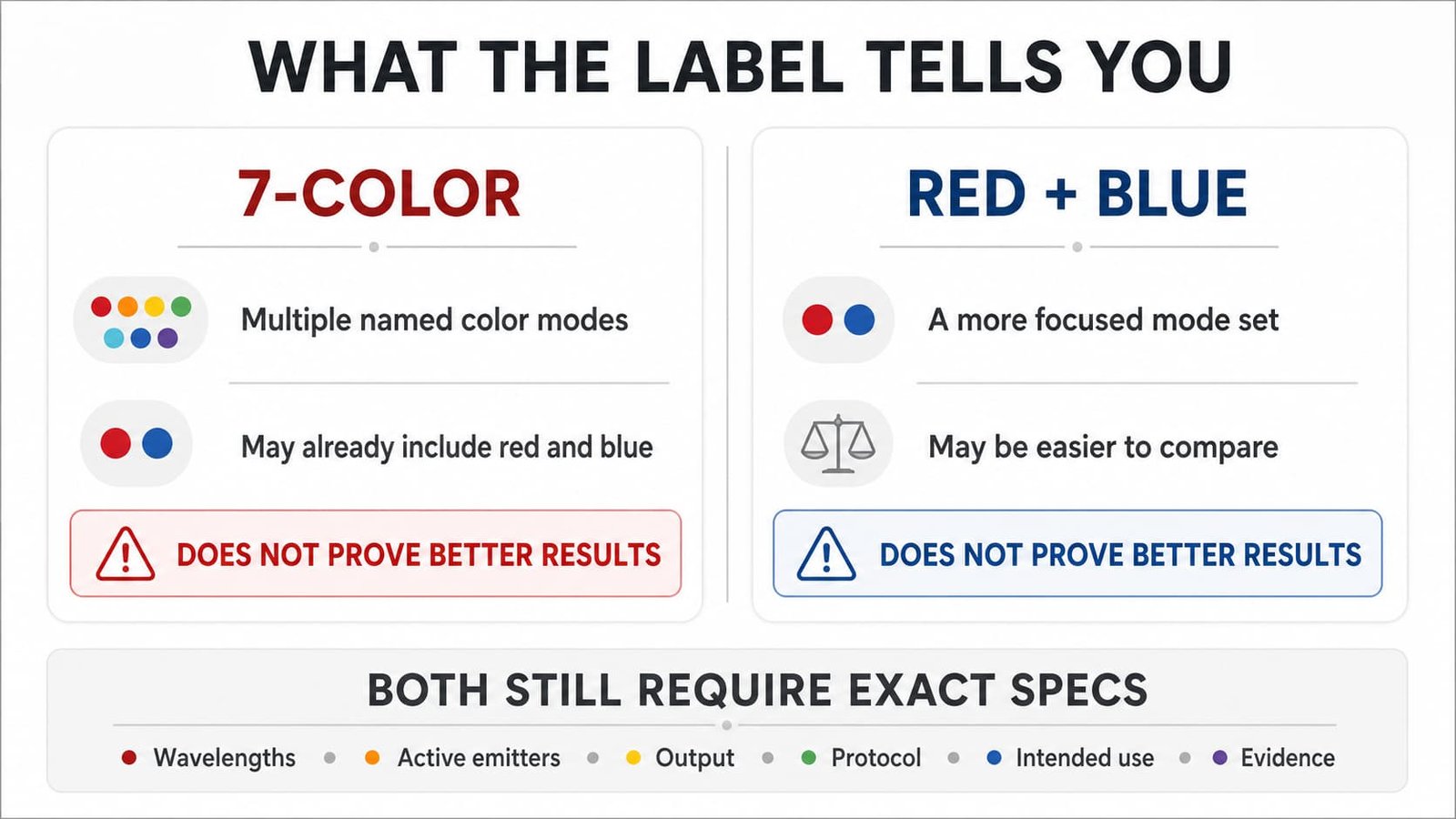
Dit onderscheid is van belang omdat een modusnaam geen technische specificatie is. Eén product kan 'paars' gebruiken voor rood en blauw dat samenwerkt; een ander kan hetzelfde woord anders gebruiken. ‘Wit’ kan meerdere zichtbare LED’s beschrijven die samen werken in plaats van één therapeutische golflengte. De productdocumentatie (niet de kleurentegel in een advertentie) moet identificeren wat de modus daadwerkelijk uitstraalt.
Welke configuratie past bij uw hoofddoel?
Kies de kleinste set goed gedocumenteerde modi die bij uw hoofddoel past. Extra modi kunnen handig zijn, maar alleen als je weet wat ze zijn en een realistische reden hebt om ze te gebruiken.
| Jouw belangrijkste prioriteit | Waar u op moet letten | Hoe het label de keuze beïnvloedt |
|---|---|---|
| Zichtbare tekenen van huidveroudering, zoals fijne lijntjes | Een apparaat dat specifiek voor dat probleem bedoeld is, met een gedocumenteerd rood- of rood-plus-nabij-infraroodprotocol en duidelijke instructies | Je hebt niet zeven kleuren nodig om een goed gedefinieerde roodlichtmodus te verkrijgen |
| Milde tot matige inflammatoire acne | Een apparaat dat duidelijk voor dat gebruik bedoeld is, met een gedocumenteerd blauw of rood-plus-blauw protocol; gebruik geen masker om zelf een ernstige diagnose te stellen, cystisch, of onduidelijke acne | Een gefocusseerd rood/blauw apparaat kan eenvoudiger te beoordelen zijn, maar een zevenkleurenapparaat zou in aanmerking kunnen komen als de relevante modus en het bewijsmateriaal even duidelijk zijn |
| Zowel ouderdomsgerelateerde problemen als ontstekingsvlekken | Afzonderlijke of gecombineerde modi die zijn gelabeld voor de twee beoogde toepassingen, met instructies waarin wordt uitgelegd hoe u deze kunt selecteren of afwisselen | Beide productlabels kunnen werken; de exacte modi en instructies beslissen, niet het getal zeven |
| Interesse in geel, groente, cyaan, paars, of witte modi | Exacte golflengte of emittercombinatie, gemeten opbrengst, bedoeld gebruik, behandelprotocol, en apparaatspecifieke ondersteuning voor het geclaimde voordeel | Beschouw een onverklaarde kleur als een optioneel kenmerk, geen reden om meer te betalen |
De Red-light-begeleiding van de American Academy of Dermatology adviseert u een apparaat te kiezen dat is gemaakt voor het probleem dat u wilt aanpakken en de aanwijzingen daarin op te volgen. Voor acne, de AAD waarschuwt ook dat behandeling met zichtbaar licht niet elk type laesie aanpakt en dat de resultaten variëren. Als u niet zeker weet wat u probeert te behandelen, Het is nuttiger om de aandoening te identificeren dan het kiezen van een langere lijst met kleuren.
Wat zegt het bewijs over rood en blauw licht?
Rood en blauw licht hebben een meer ontwikkelde wetenschappelijke basis voor algemeen gebruik van maskers thuis, maar dat bewijsmateriaal behoort nog steeds tot de geteste apparaten, golflengten, doses, en deelnemers. Het maakt niet van elke rode of blauwe LED een gelijkwaardig product.
A 2025 systematische review en meta-analyse van LED-apparaten voor thuisgebruik voor acne omvatte zes gerandomiseerde klinische onderzoeken. De meegeleverde blauwlichtapparaten bedienden vanaf 414 naar 445 nm en de roodlichtapparaten van 630 naar 670 nm. Uit de review kwamen gunstige resultaten naar voren voor rode en/of blauwe apparaten in de onderzochte milde tot matige acne-situaties, terwijl de apparaten, schema's, en de duur van de studie varieerde. De auteurs waarschuwden ook dat matige tot hoge heterogeniteit en beperkte generaliseerbaarheid verhinderen dat deze bevindingen als bewijs voor elk product worden beschouwd.. Dat ondersteunt een relevante bewijscategorie; het identificeert niet één universele golflengte, dosis, of maskerprotocol.
Het bewijs voor huidverjonging is minder uniform. A systematische review van gerandomiseerde LED-onderzoeken in de dermatologie gaf acne een sterker aanbevelingscijfer dan huidverjonging. Binnen de verjongingsproeven, sommige rood- of rood-plus-nabij-infraroodprotocollen verbeterden de gemeten resultaten, terwijl een ander roodlichtonderzoek geen significante verbetering in elasticiteit of hydratatie aantoonde. De review documenteerde ook een grote variatie in golflengte, bestraling, stralende blootstelling, sessie lengte, en studieontwerp.
Die variatie is de reden waarom de AAD opmerkt dat resultaten van onderzoeken met verschillende apparaten en behandeltijden niet zomaar kunnen worden vergeleken. “Rood” of “blauw” is het begin van een specificatie, niet het einde van een aankoopbeslissing.
Betekenen zeven kleuren zeven bewezen voordelen??
Nee. Het aantal selecteerbare kleuren vertelt u niet hoeveel voordelen er voor dat exacte masker zijn vastgesteld. Het betekent ook niet dat elke extra kleur nutteloos is.
Als u op zoek bent naar een 7-kleuren-LED-lichttherapiegrafiek of de betekenis van individuele LED-maskerkleuren, gebruik de uitleggids voor LED-gezichtsmaskers van Wakelife. Deze pagina blijft gericht op het vergelijken van een zevenkleurenconfiguratie met een gefocust rood-blauw masker.
Een FDA-record laat zien hoe apparaatspecifiek het antwoord kan zijn. De ambtenaar K250830 510(k) database-invoer identificeert een genoemde familie van LED-maskers, zijn aanvrager, zijn productcodes, en een in wezen gelijkwaardig besluit. De gekoppelde K250830 goedkeuringsdocument en gebruiksindicatiebijlage verschillende beoogde toepassingen voor specifieke vervoerswijzen definiëren, inclusief een geellichtmodus voor rimpels in het hele gezicht en een gemengde rood-blauw-infraroodmodus voor milde tot matige inflammatoire acne.
Dat is bewijsmateriaal over de modellen en indicaties in K250830. Het is geen bewijs dat elk geel LED-masker dezelfde output heeft, protocol, bedoeld gebruik, of regelgevende status. FDA evalueert apparaten via gedefinieerde regelgevingstrajecten; het verleent geen vrijstaande “FDA-goedgekeurde golflengte” die elke verkoper op een ander product kan toepassen. Die van de FDA Overzicht van apparaatgoedkeuringen en -vrijstellingen verklaart het verschil tussen 510(k) goedkeuring en premarket-goedkeuring, terwijl de doorzoekbare gegevens het daadwerkelijke apparaat en de beslissing identificeren.
Gebruik voor elke extra kleur dezelfde reikwijdteregel:
Een ondersteunde modus is een exact apparaat + gedefinieerde zenders of golflengte + gemeten levering + aangegeven protocol + bedoeld gebruik + bewijsmateriaal of reikwijdte van de regelgeving. Een kleurnaam alleen levert geen van deze verbindingen op.
Welke specificaties belangrijker zijn dan het aantal kleuren?
Beoogd gebruik, exacte lichtparameters, protocol, waarschuwingen, en bewijsmateriaal op apparaatniveau is belangrijker dan het aantal knoppen of kleuren. Gebruik deze checklist voordat u prijzen of accessoires vergelijkt.
| Veld om te verifiëren | Hoe een nuttig antwoord eruit ziet | Waarom het de beslissing verandert |
|---|---|---|
| Beoogd gebruik | Een specifiek probleem waarvoor het exacte model is ontworpen en geëtiketteerd | Voorkomt dat u ervan uitgaat dat elke modus elk probleem behandelt |
| Exacte golflengte voor elke modus | Waarden in nanometers, met uitleg over welke LED's samen werken | Onderscheidt een fysieke specificatie van een kleurnaam |
| Bestraling op het behandelgebied | Vermogen per gebied, gewoonlijk gerapporteerd in mW/cm², met een meetvoorwaarde | Het aantal LED's of het totale wattage alleen zegt niet hoeveel stroom een bepaald gebied bereikt |
| Stralingsblootstelling en sessieprotocol | Energie per oppervlakte in J/cm², indien opgegeven, plus sessietijd, frequentie, en cursusinstructies | Een dosis is afhankelijk van de toediening en het tijdstip; het is niet uitwisselbaar met bestraling |
| Dekking en pasvorm | Het behandelgebied, gezichtsafstand of contactontwerp, oogopeningen, en hoe het masker op zijn plaats blijft | Een sterke specificatie is minder nuttig als het beoogde gebied niet consistent wordt gedekt |
| Waarschuwingen en oogbescherming | Contra-indicaties, begeleiding bij lichtgevoeligheid, aanwijzingen voor oogbescherming, omstandigheden stoppen, en schoonmaakinstructies | Geeft aan of het apparaat praktisch en geschikt is om te gebruiken zoals op het etiket staat |
| Apparaatbewijs en reikwijdte van de regelgeving | Een studie, goedkeuring, of test die het exacte model noemt of de toepasselijke familie en het beoogde gebruik duidelijk uitlegt | Voorkomt dat bewijsmateriaal van het ene product of de ene modus wordt geleend voor een ander |
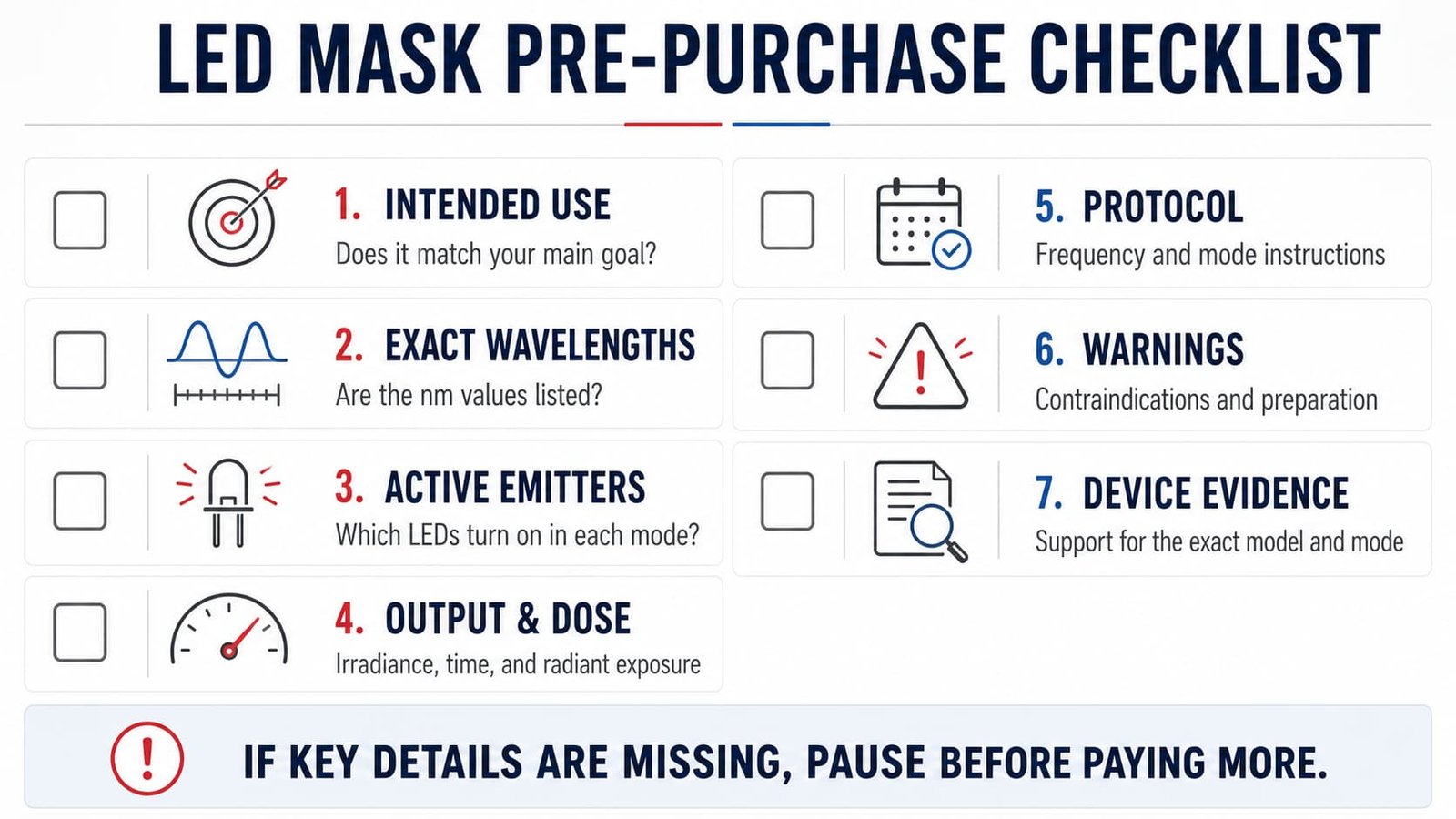
De eenheden verdienen speciale aandacht. A beoordeling van fotobiomodulatieparameters onderscheidt de straling, gemeten als vermogen per oppervlakte, tegen invloeden van invloed of blootstelling aan straling, gemeten als energie per gebied. Deze termen en eenheden zijn niet uitwisselbaar. Nog belangrijker, noch een golflengte, noch een hoog getal in één veld garandeert een beter consumentenresultaat. Het volledige leveringsprotocol en het bewijs voor het exacte gebruik zijn nog steeds van belang.
Wat zijn de rode vlaggen in een lijst met meerkleurige maskers??
Pauzeer wanneer een verkoper voordeellabels geeft, maar de specificaties en reikwijdte achterhoudt die nodig zijn om deze te controleren. Veelvoorkomende rode vlaggen zijn onder meer:
- “Zeven klinisch bewezen kleuren” zonder onderzoek op apparaatniveau, goedkeuring, of claim-voor-claim bewijs.
- “FDA-goedgekeurde golflengten” in plaats van een exact apparaatrecord, nummer, modelomvang, en bedoeld gebruik.
- Een golflengtelijst zonder bestraling, behandeltijd, modus logica, of gebruiksaanwijzing.
- Totaal wattage, LED-telling, of helderheid gepresenteerd als bewijs van huidresultaten.
- Een onderzoek op een ander apparaat, professioneel systeem, golflengte combinatie, of protocol dat wordt gepresenteerd als bewijs voor het verkochte masker.
- Paars, wit, cyaan, of een andere modus die alleen wordt beschreven door een voordeelnaam, zonder de actieve emitters te identificeren.
- Geen toegankelijke handleiding, waarschuwingssectie, aanwijzingen voor oogbescherming, of ondersteuningstraject vóór aankoop.
Geen van deze hiaten bewijst dat een masker niet kan werken. Ze betekenen wel dat je nog niet genoeg informatie hebt om verantwoord te vergelijken.
Hoe maak je de uiteindelijke keuze?
Wanneer twee maskers passen bij uw budget en comfortbehoeften, kies degene die het gemakkelijker maakt om de relevante modus te verifiëren en te volgen. Een gericht rood/blauw model kan de eenvoudigere optie zijn om te evalueren als u alleen die modi nodig heeft. Een 7-kleurenmodel kan redelijk zijn als de extra instellingen technisch gedefinieerd zijn, ondersteund voor het exacte apparaat, en relevant voor de doelen die u daadwerkelijk gaat gebruiken.
Gebruik deze vergelijking van vijf minuten:
- Schrijf één primair doel op en, hooguit, één secundair doel.
- Schrap modi die deze doelen niet dienen; geef ze geen waarde alleen maar omdat ze erbij horen.
- Vergelijk de resterende modi met behulp van de bovenstaande specificatiechecklist.
- Controleer of de handleiding uitlegt hoe en wanneer deze modi worden gebruikt, inclusief of combinaties samen of afzonderlijk lopen.
- Als een verkoper de exacte apparaatdocumentatie niet kan verstrekken, kies de beter gedocumenteerde optie of pauzeer de aankoop.
Kijk voor het bredere product verder dan de kleurconfiguratie, hij is bij Wakelife selectiegids voor zespunts LED-gezichtsmaskers om het exacte model te vergelijken, bedoeld gebruik, plaatsing van de zender, LED-telling, bewijs van bestraling, fit, en bouwen.
Na aankoop, kopieer geen schema van een ander product. Gebruik het protocol dat bij uw exacte masker is geleverd. Wakelife's Frequentiegids voor LED-gezichtsmaskers legt uit hoe je het volledige schema kunt vinden zonder de minuten of wekelijkse frequentie van een apparaat in een categorieregel te veranderen.
Wanneer moet u een dermatoloog raadplegen voordat u kiest??
Krijg professionele begeleiding als de beslissing afhangt van de diagnose, medicatie, een lichtgevoelige toestand, een recente procedure, of een reactie – niet alleen productspecificaties. Dit geldt ook voor onzekere of ernstige acne, een geschiedenis van door licht veroorzaakte huidproblemen, medicatie die de lichtgevoeligheid kan verhogen, een actieve uitslag of beschadigde huid, en bezorgdheid over pigmentatieveranderingen.
De AAD's overzicht van lasers en lichten voor acne legt uit dat zichtbaar licht niet elk type acne-laesie kan behandelen en dat niemand precies kan voorspellen wie er zal reageren. Stop met het gebruik van een apparaat en zoek gekwalificeerd advies als u pijn krijgt, een aanhoudende uitslag, duidelijke roodheid, blaarvorming, zichtsymptomen, of een andere bijwerking.
De onderste regel
Kies geen masker door te vragen of zeven groter is dan twee. Vraag of de exacte modi die u nodig heeft duidelijk zijn gedefinieerd, correct afgeleverd, ondersteund voor het beoogde gebruik, en praktisch te volgen.
Rood en blauw hebben een sterker onderzoekstraject voor verschillende veelvoorkomende maskergebruiken, maar een rood/blauw label is geen kwaliteitscertificaat. Extra kleuren zijn niet automatisch een bewijs van extra voordelen, toch kan een niet-rood/blauwe modus geldige apparaatspecifieke ondersteuning hebben. Wanneer de claims vergelijkbaar zijn, betere documentatie verslaat een langer kleurenmenu.
Voor merken en productteams
De verwarring bij consumenten over ‘zeven kleuren’ begint meestal met een onvolledige kaart van modus tot bewijs. Productdocumentatie moet elke selecteerbare modus verbinden met de actieve zenders, golflengte, gemeten straling, stralingsbelichting of geprogrammeerde sessie, bedoeld gebruik, waarschuwingen, en de reikwijdte van het exacte apparaatbewijs. Gemengde lichtmodi moeten identificeren welke LED's samen werken in plaats van te vertrouwen op namen als paars of wit.
Als u een gefocust rood/blauw platform of een gedocumenteerd multi-mode masker definieert, verken Wakelife's Productplatforms voor LED-gezichtsmaskers En OEM/ODM-ontwikkelingsmogelijkheden.
Referenties
Onafhankelijke en gezaghebbende bronnen
| Nee. | Officiële bron |
|---|---|
| 1 | ONS. Food and Drug Administration. Apparaatgoedkeuringen en goedkeuringen. Toegang tot juli 20, 2026. |
| 2 | Amerikaanse Academie voor Dermatologie. Is roodlichttherapie geschikt voor uw huid??. Laatst bijgewerkt in september 13, 2024. Toegang tot juli 20, 2026. |
| 3 | Amerikaanse Academie voor Dermatologie. Lasers en lichten: Hoe goed behandelen ze acne??. Toegang tot juli 20, 2026. |
| 4 | Ershadi S, Barbieri JS. LED-apparaten voor thuisgebruik voor de behandeling van acne vulgaris: Een systematische review en meta-analyse. JAMA-dermatologie. 2025;161(5):552–555. doi:10.1001/jamadermatol.2025.0019. |
| 5 | Jagdeo J, Austin E, Zoogdieren A, Wong C, Ik heb D, Zegel DM. Lichtgevende diodes in de dermatologie: Een systematische review van gerandomiseerde gecontroleerde onderzoeken. Lasers in chirurgie en geneeskunde. 2018;50(6):613–628. doi:10.1002/lsm.22791. |
| 6 | Zein R, W. verkopen, Hamblin Mr. Overzicht van lichtparameters en werkzaamheid van fotobiomodulatie: Duik in complexiteit. Tijdschrift voor biomedische optica. 2018;23(12):120901. doi:10.1117/1.JBO.23.12.120901. |
Exact apparaatregelgevingsvoorbeeld
Deze bron documenteert alleen de genoemde apparaatfamilie, beslissing, en het daarmee samenhangende beoogde gebruiksbereik. Er wordt niet beweerd dat elk masker met dezelfde kleur dezelfde status heeft.
| Nee. | Officiële bron |
|---|---|
| 7 | ONS. Food and Drug Administration. 510(k) Pre-marketingmelding K250830: LED-lichttherapiemasker. Datum besluit juni 9, 2025. Toegang tot juli 20, 2026. |
| 8 | ONS. Food and Drug Administration. K250830 Goedkeuringsbrief en indicaties voor gebruik. juni 9, 2025. Toegang tot juli 20, 2026. |