Kort antwoord: Rangschik LED-gezichtsmaskers niet op basis van het aantal kleuren, het geadverteerde aantal LED's, of het hoogste stralingsgetal. Bepaal eerst wat u wilt aanpakken. Controleer vervolgens eventuele Amerikaanse. FDA 510(k) ruimte voor het exacte apparaat of model en het beoogde gebruik. Controleer of de betreffende zenders het doelgebied bestrijken, vraag hoe de LED's worden geteld, vergelijk de bestraling alleen onder beschreven testomstandigheden, en inspecteer de pasvorm en montage. Een getal wordt pas nuttig als je weet wat er gemeten is, waar, en voor welk protocol.
Domein: In deze gids worden producten vergeleken. Het diagnosticeert geen huidaandoening en vervangt niet de labels en waarschuwingen voor uw exacte apparaat. Indien een voorwaarde, medicatie, of behandeling kan van invloed zijn op de vraag of licht thuis geschikt voor u is, lees de medische grens onder Punt 6 voordat u apparaten vergelijkt.
Waarom ‘meer’ het verkeerde uitgangspunt is
De meeste starters vergelijken drie dingen: hoeveel golflengtebanden een masker bevat, hoeveel LED's het beweert te bevatten, en hoe hoog de stralingssterkte lijkt te zijn. De natuurlijke aanname is dat er meer kleuren zijn, meer LED's, en meer kracht moet een beter masker opleveren.
Die snelkoppeling mislukt omdat de drie cijfers verschillende vragen beantwoorden:
- Een golflengte vertelt je welk licht er wordt uitgezonden, niet of de modus overeenkomt met uw doel of bewijs heeft voor dat model.
- Een LED-telling zegt pas iets over het fysieke ontwerp nadat de telmethode en het maskergebied bekend zijn.
- Bestralingssterkte beschrijft het lichtvermogen per oppervlakte-eenheid onder bepaalde meetomstandigheden, niet de volledige dosis of het verwachte resultaat.
Vanuit ons productieperspectief, een betere eerste vraag is niet: “Welk masker heeft de grootste cijfers?" Het is:
Kan ik het beweerde doel van dit apparaat herleiden tot een verifieerbaar model?, relevante lichtplaatsing, reproduceerbare uitvoergegevens, en een ontwerp dat ik kan gebruiken zoals aangegeven?
De volgende zes controles maken van die vraag een praktisch koopproces.
1. Definieer het doel voordat u functies vergelijkt
Begin met het probleem dat u met het apparaat wilt aanpakken, omdat het doel bepaalt welk bewijs, modus, en doelgebied zijn belangrijk. Een masker met zeven gelabelde kleuren is niet automatisch een betere keuze dan een masker met twee goed gedocumenteerde modi.
Bijvoorbeeld, de FDA-indicaties voor één genoemde familie van OTC LED-maskers onder 510(k) K250830 onderscheid maken tussen rood, geel, rood-plus-infrarood, blauw, en gemengde modi. De vermelde beoogde toepassingen zijn ook specifiek: rimpels in het hele gezicht of milde tot matige inflammatoire acne, afhankelijk van de modus. Dat record bewijst niet dat elk masker dat hetzelfde kleurwoord gebruikt, hetzelfde doel heeft.
Schrijf vier dingen op voordat u vergelijkingstabbladen opent:
- het belangrijkste probleem dat u wilt aanpakken;
- het gezichtsgebied dat er het meest toe doet;
- of u nu kiest voor een algemeen welzijnsproduct of een apparaat met een specifiek gereguleerd gebruiksdoel in uw markt; En
- de tijd en frequentie die u realistisch gezien kunt volgen volgens de apparaatinstructies.
Als u niet zeker weet wat het probleem is, of het binnen het aangegeven doel van het apparaat valt, of dat licht geschikt voor u is, de volgende stap is een gekwalificeerde beoordeling, en niet het selecteren van een kleur uit een productkaart.
Om nader te bekijken wat kleur- en moduslabels u wel en niet vertellen, hij is bij Wakelife 7-kleur versus rood-en-blauw LED-maskervergelijking.
2. Controleer het exacte apparaat wanneer FDA-goedkeuring wordt geclaimd of mogelijk vereist is
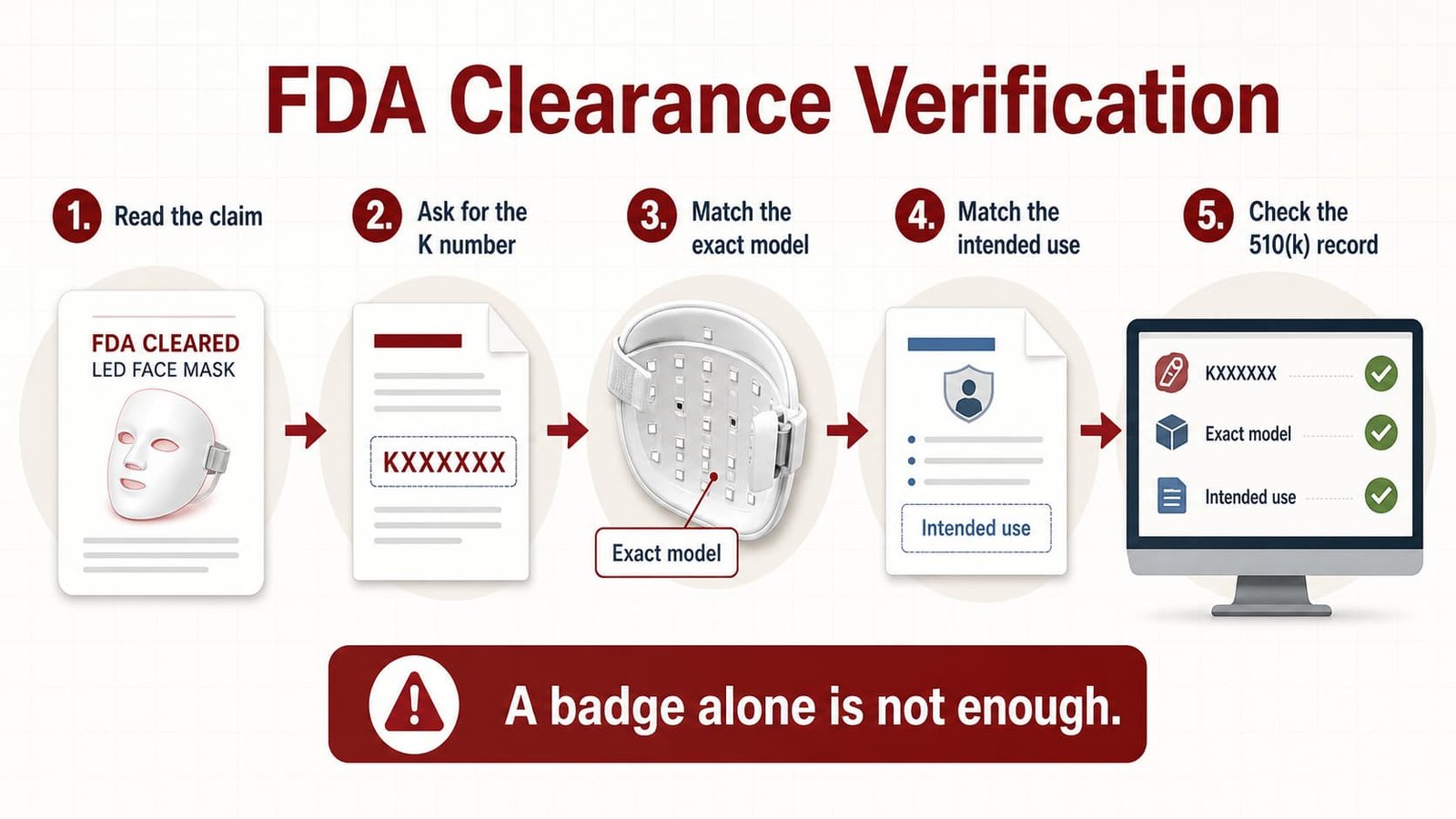
Wanneer de VS. toestemming voor medische hulpmiddelen wordt geclaimd of vereist, zoek naar "FDA goedgekeurd,'verkrijg de 510(k) nummer, en koppel het record aan het apparaat, model, en bedoeld gebruik. Het logo, een vestigingsregistratie, of een vage verklaring zoals “FDA gecertificeerd” maakt die controle niet compleet.
De FDA legt uit dat a 510(k) is een premarket-inzending die wordt gebruikt om te demonstreren substantiële gelijkwaardigheid met een legaal op de markt gebracht apparaat. Een substantieel gelijkwaardig besluit maakt het mogelijk dat het goedgekeurde apparaat op de markt wordt gebracht voor het aangegeven toepassingsgebied. Het is een betekenisvolle, verifieerbare drempel; het is geen prijs voor het “beste” masker, een resultaatgarantie voor elke gebruiker, of een goedkeuring van elke marketingclaim op een verkooppagina.
Gebruik deze controle in vier stappen wanneer een verkoper een goedkeuringsclaim indient:
De pagina van een verkoper hoeft het K-nummer niet weer te geven om het product legitiem te laten zijn; velen niet. Maar wanneer de verkoper FDA-goedkeuring claimt, weigering om het nummer door te geven, een ontbrekend FDA-record, of een mismatch tussen model en beoogd gebruik is een goede reden om te stoppen en verder onderzoek te doen.
Markeer deze controle not applicable alleen als het product geen Amerikaanse goedkeuring heeft. claim voor het beoogde gebruik of de behandeling van een medisch hulpmiddel En de toepasselijke apparaatclassificatie en -regels vereisen geen a 510(k). Het stilzwijgen van een verkoper over de goedkeuring is niet voldoende. Als de verkoper een medische claim of behandelingsclaim indient, maar de goedkeuringsstatus achterwege laat, bepaal eerst of voor het beoogde gebruik toestemming vóór het in de handel brengen vereist is en verifieer het toepasselijke FDA-dossier; markeer het vinkje niet not applicable alleen maar omdat de productpagina het woord ‘gewist’ vermijdt.
Voor private label-namen is nog een vraag vereist: vraag de verkoper om te documenteren hoe het winkelmodel overeenkomt met een model in de opruiming en etikettering. Ga er niet van uit dat een soortgelijk ogende schaal of een niet-gerelateerde goedkeuring van de fabrikant automatisch het product in uw winkelwagen bedekt.
Voor een uitleg op consumentenniveau van het databaseproces, gebruik die van de FDA gids om erachter te komen of een medisch hulpmiddel goedgekeurd is voor marketing.
3. Pas de golflengte aan het doel aan en controleer de plaatsing
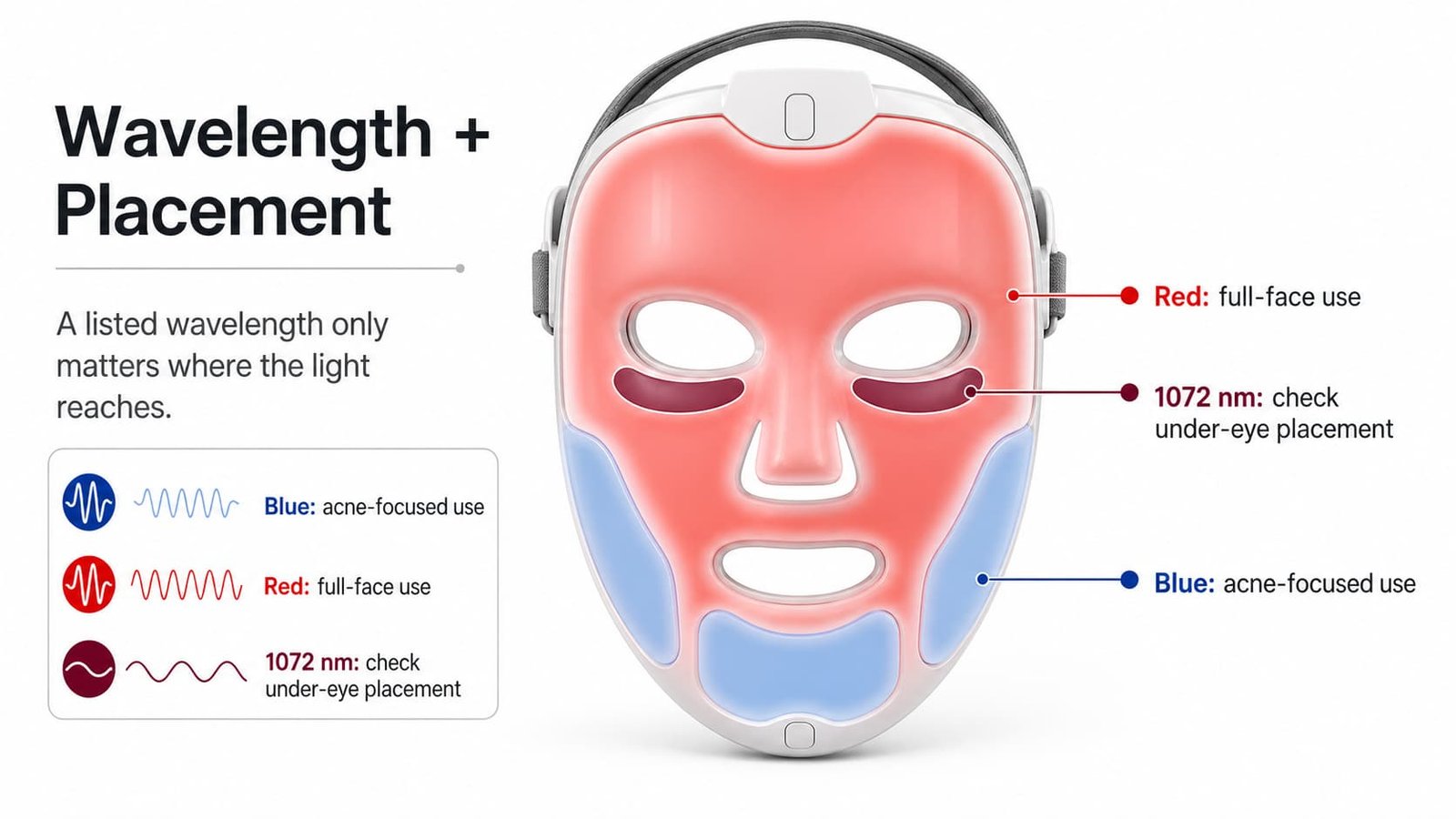
Er moet een bruikbare golflengte actief zijn in de geselecteerde modus en gepositioneerd zijn waar het doelgebied zich daadwerkelijk bevindt. Een specificatieblad kan een golflengte vermelden, zelfs als slechts een klein aantal van de zenders aanwezig is of ver verwijderd is van het gebied waar u om geeft.
Blauw licht is een eenvoudig voorbeeld. Sommige exacte apparaten zijn goedgekeurd voor milde tot matige inflammatoire acne met behulp van blauwe of gemengde modi, maar dat maakt niet elke blauwe instelling geschikt voor elk type acne. Rood, geel, en infraroodcombinaties kunnen op specifieke apparaten verschillende beoogde toepassingen hebben. Begin met de exacte etikettering van het model in plaats van met een universele kleur-voordeelgrafiek.
Plaatsing wordt vooral belangrijk voor gelokaliseerde problemen. A gerandomiseerd, dubbelblind, placebogecontroleerd maar zelfgerapporteerd onderzoek getest 1072 nm-licht rond de ogen gedurende zes tot acht weken en rapporteerde waargenomen veranderingen in fijne lijntjes, rimpels, en wallen onder de ogen. Het was een oudere, smal protocol, geen bewijs dat er een maskerlijst is 1072 nm zal hetzelfde resultaat opleveren. Als 1072 nm is een doorslaggevend kenmerk voor gebruik onder de ogen, we zouden twee afzonderlijke vragen stellen:
- Hoeveel 1072 nm-chips zijn actief in de betreffende modus?
- Zijn deze zenders fysiek verspreid onder en rond de ogen?, onderworpen aan de oogveiligheidsinstructies van het apparaat?
Pas dezelfde logica toe op elke modus:
- 01 doel
- 02 golflengte
- 03 actieve emitters
- 04 plaatsing
- 05 exacte apparaatinstructies en bewijsmateriaal
4. Tel fysieke LED-pakketten voordat u chips telt
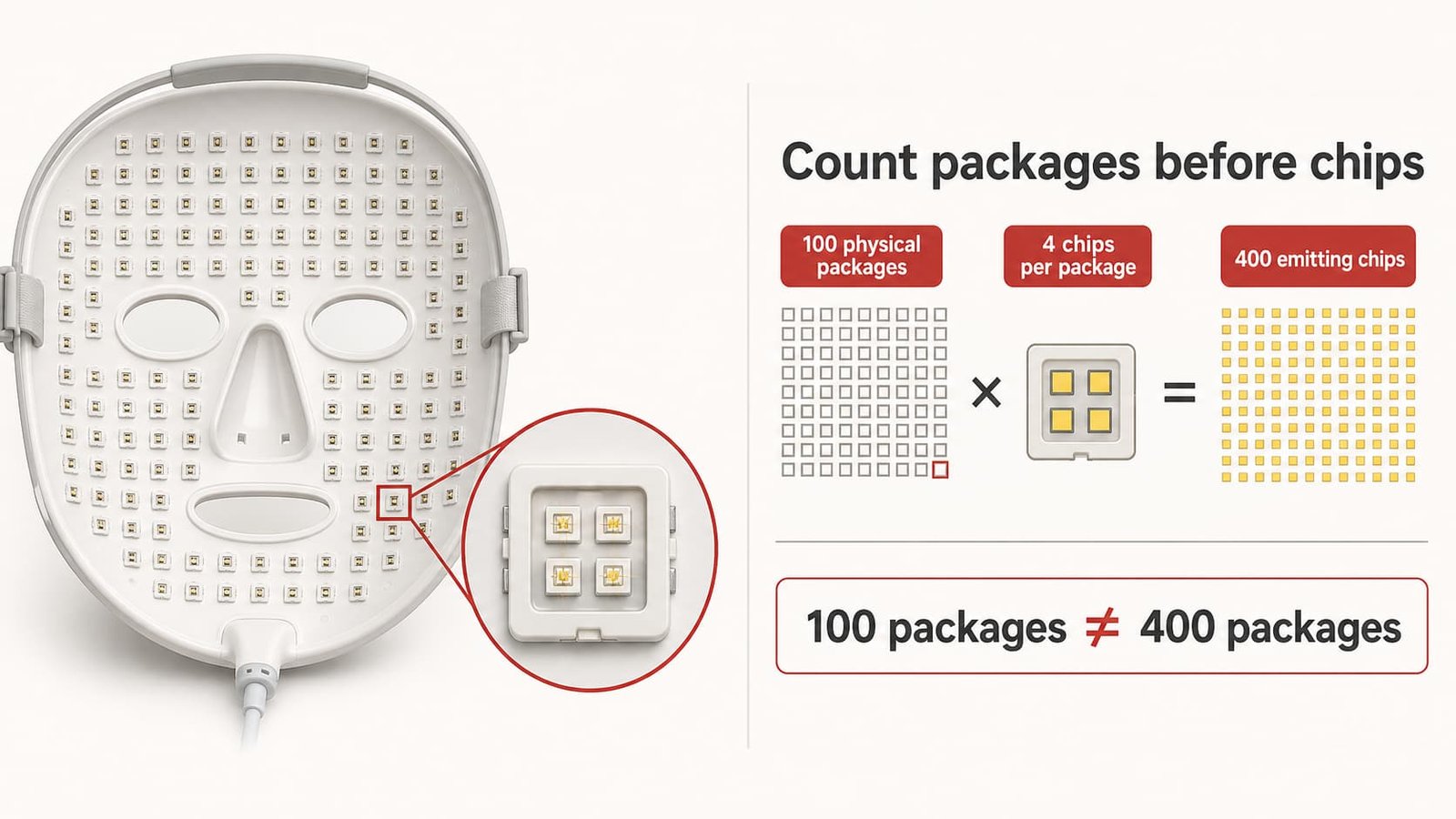
Vraag of het geadverteerde nummer fysieke LED-pakketten betekent of de emitterende chips erin. Zonder die definitie, twee producten kunnen verschillende telmethoden gebruiken en vergelijkbaar lijken terwijl dat niet het geval is.
Onze telregel is eenvoudig:
Een masker met 100 fysieke LED-pakketten hebben dat nog steeds 100 LED's in de zin van het aantal pakketten, zelfs als elk pakket vier emitterende chips bevat. De fabrikant kan dit nauwkeurig vermelden 400 chips uitstoten, maar het mag ze niet presenteren als 400 fysieke LED-pakketten.
Vraag om drie aparte velden:
| Veld | Voorbeeld | Waarom het ertoe doet |
|---|---|---|
| Fysieke LED-pakketten | 100 pakketten | Toont het aantal en de mogelijke dichtheid van fysieke lichtbronposities |
| Chips per verpakking | 4 chips | Geeft aan of één pakket meerdere golflengten of emitters kan bevatten |
| Chips toegewezen aan elke golflengte | Bijv., een modelspecifieke uitsplitsing | Geeft aan of een headline-golflengte wijd verspreid is of slechts op een paar locaties aanwezig is |
Het aantal LED's is niet zinloos. In de productsegmentatie-ervaring van Wakelife, maskers mee 200 of meer fysieke LED-pakketten zitten meestal in een dichte behuizing, hogere ontwerpniveau, terwijl producten hieronder 80 pakketten bevinden zich vaker in een waardelaag. Dit zijn interne observaties bij het productontwerp, en niet klinisch, regelgevend, of sectordrempels.
Rangschik maskers niet alleen op basis van het aantal pakketten. Vergelijk het met het maskergebied, plaatsing van de zender, stralingshoek of optisch ontwerp, golflengten, rijomstandigheden, bestraling, en uniformiteit. Tweehonderd slecht verdeelde emitters verslaan niet automatisch 100 goed gedocumenteerde zenders die het beoogde gebied gelijkmatig bestrijken.
5. Vergelijk de bestralingssterkte met de testomstandigheden en uniformiteit ervan
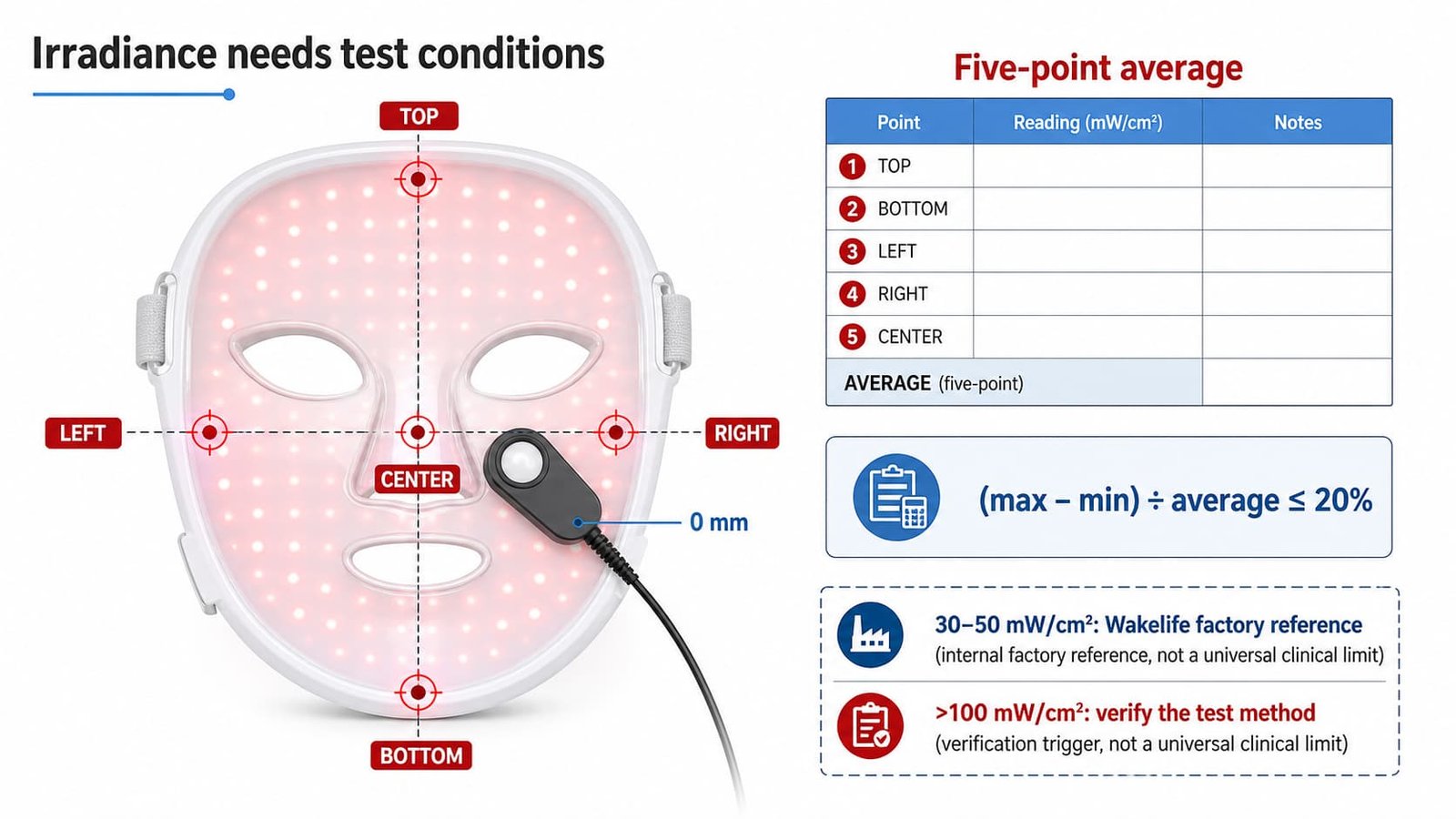
Vergelijk geen twee stralingsgetallen totdat de verkoper u vertelt hoe elk getal is gemeten. Bestraling, meestal gerapporteerd in mW/cm², is het geleverde lichtvermogen per oppervlakte-eenheid. De sessietijd is ook van belang: bestraling is niet hetzelfde als totale blootstelling aan straling of een compleet behandelprotocol.
Van ons fabriekswerk, 30–50 mW/cm² is een gebruikelijk werkbereik voor nauwsluitende LED-maskers voor thuis die we tegenkomen. Het is geen universeel gevalideerd klinisch bereik. Wij behandelen hierboven ook een gezichtsmaskerclaim 100 mW/cm² als een sterke rode vlag voor verificatie – niet als automatisch bewijs van fabricage, maar een aantal dat we zonder het ruwe rapport niet zouden accepteren, methode, en bedrijfsomstandigheden.
Vraag naar al het volgende:
- meetafstand of contactconditie;
- meter of detector gebruikt;
- actieve modus en golflengten;
- continue of gepulseerde werking;
- of het gepubliceerde aantal een piek is, een enkel punt, of een meerpuntsgemiddelde;
- testlocaties en ruwe waarden;
- sessietijd en het gelabelde protocol van het apparaat; En
- de omstandigheden waaronder een waarde voor stralingsblootstelling werd berekend.
De huidige vergelijkingsmethode van Wakelife meet op 0 mm op vijf posities – bovenaan, onderkant, links, rechts, en midden: berekent vervolgens het gemiddelde. We onderzoeken ook de spreiding in plaats van deze binnen één gemiddelde te verbergen:
De 20% figuur is ons interne kwaliteitsoordeel, geen IEC, FDA, klinisch, of sectorbrede pass/fail-limiet. Het is handig omdat alleen een gemiddelde een heldere hotspot en een donker gebied kan verbergen. Vraag waar mogelijk naar de vijf ruwe metingen.
De 0 mm-methode is ook een vergelijkingsconventie, geen perfecte kopie van echt gebruik. Gezichtsvorm, gaten, kantelen, druk, en de afstand tot individuele zenders kan veranderen wat verschillende delen van de huid bereikt.
Hoger is niet automatisch beter. A peer-reviewed overzicht van fotobiomodulatieliteratuur beschrijft een vaak waargenomen bifasische dosisrespons waarbij lagere blootstellingen een gunstiger respons kunnen veroorzaken dan hogere blootstellingen onder onderzochte omstandigheden. De auteurs benadrukken ook die golflengte, vermogensdichtheid, invloed, timing, en andere parameters bemoeilijken de vergelijking. Dit ondersteunt voorzichtigheid over “hoogste overwinningen”; er ontstaat niet één universeel maximum voor ieder mondkapje.
Optische veiligheidsrapporten beantwoorden een andere vraag. IEC 62471 specificeert blootstellingslimieten, meettechnieken, en een classificatiebenadering voor fotobiologische gevaren van lampen en lampsystemen, inclusief LED's. Dergelijke tests kunnen een veiligheidsbeoordeling ondersteunen, maar het bewijst niet dat het apparaat een geclaimd cosmetisch resultaat zal bereiken.
6. Pasvorm inspecteren, Dekking, en bouwkwaliteit
Sluit af met de onderdelen die u kunt inspecteren: of het masker de beoogde zenders in een herhaalbare positie houdt en of de constructie ervan regelmatig gebruik ondersteunt. Zichtbaar vakmanschap kan de werkzaamheid of wettelijke status niet bewijzen, maar het kan redenen aan het licht brengen om een product van uw shortlist te verwijderen.
Controleer het masker in de normale draagpositie, niet alleen plat op tafel:
- Zijn de LED-vensters en lenzen consistent geplaatst en uitgelijnd?
- Zijn er ongelijke hiaten?, losse bekleding, scherpe randen, blootgestelde lijm, of duidelijke asymmetrie?
- Houden de riemen en bevestigingspunten het masker vast zonder de doelgebieden te verschuiven?
- Zijn er drukpunten rond de neus?, tempels, en ooggebied waardoor de gelabelde sessie moeilijk te voltooien is?
- Zorg voor kabeluitgangen, controller aansluitingen, en trekontlastingszones voelen veilig aan?
- Zorgt de pasvorm voor grote of inconsistente afstanden tussen de zenders en belangrijke gezichtsgebieden??
- Kunnen de huidcontactoppervlakken worden gereinigd volgens de door de fabrikant aangegeven methode zonder deze te beschadigen??
Een zacht masker is niet automatisch beter dan een stijf masker. Een stijve schaal kan de geometrie van de emitter behouden, maar past slecht op sommige vlakken; een flexibel masker kan nauwer aansluiten, maar de geometrie buigen of verschuiven. De nuttige vraag is of het specifieke ontwerp je gezicht een stabiele dekking geeft, aanvaardbare druk, en herhaalbare positionering.
Bekijk ook de daadwerkelijke routine voordat u koopt. Als de instructies van het apparaat, sessie lengte, reinigingsproces, oog begeleiding, of oplaadregeling zijn voor u onpraktisch, de theoretische specificaties zullen inconsistent gebruik niet compenseren. Ga verder met de handleidingen voor apparaatspecifieke frequentie en sessieduur, waar een LED-masker past in een huidverzorgingsroutine, En veilige reiniging en onderhoud.
Medische grens: De American Academy of Dermatology adviseert om lichtgebruik thuis met een dermatoloog te bespreken vanwege een bestaande lichtgevoelige aandoening, medicatie, of behandeling kan veranderen of het passend is. Volg de waarschuwingen voor uw specifieke apparaat en zoek gekwalificeerde zorg bij zorgwekkende of aanhoudende symptomen.
Een shortlistcheck van 10 minuten
Gebruik deze tabel voordat u prijzen of extra modi vergelijkt:
| Rekening | Minimaal nuttig antwoord | Stop of verifieer verder wanneer |
|---|---|---|
| Doel | Eén gedefinieerd zorg- en doelgebied | Het product belooft één modus voor elk probleem |
| ONS. FDA-claim, wanneer dit wordt geclaimd of vereist |
K-nummer, aanvrager, overeenkomstig model, en overeenkomend met het beoogde gebruik. Markering not applicable alleen onder beide voorwaarden vermeld in Sectie 2: geen VS. claim voor medisch hulpmiddel/behandeling, en toepasselijke regels vereisen geen a 510(k)
|
Mogelijk is goedkeuring vereist of wordt er aanspraak op gemaakt, maar er wordt alleen een badge getoond, het autorisatiepad is onverklaard, het record ontbreekt, of model/gebruik komt niet overeen |
| Golflengte en plaatsing | Exacte golflengten, actieve chips per modus, en doelgebiedverdeling | Er worden alleen kleurnamen of het totale aantal golflengten verstrekt |
| LED-telling | Fysieke pakketten, chips per pakket, en chips op golflengte | Het aantal chips wordt zonder uitleg weergegeven als aantal pakketten |
| Bestraling | Ruwe meerpuntswaarden met afstand, modus, meter, en sessiecontext | Er verschijnt alleen een pieknummer; in de interne screening van Wakelife, een gezichtsmaskerclaim hierboven 100 mW/cm² zorgt voor een sterkere rapportverificatie |
| Passen en bouwen | Stabiele dekking, aanvaardbare druk, uitgelijnde componenten, en werkbare reiniging/gebruik | Hiaten, verschuiven, druk, slechte montage, of onpraktische instructies ondermijnen herhaalbaar gebruik |
Het slagen voor deze controle bewijst niet dat een masker de beste keuze is of garandeert geen resultaat. Het betekent dat het product voldoende samenhangende informatie heeft opgeleverd om dieper in overweging te nemen.
De onderste regel
Kies het masker dat u kunt verifiëren, niet degene met de grootste krantenkoppen. Bepaal eerst het doel. Wanneer de VS. toestemming voor medische hulpmiddelen wordt geclaimd of vereist, controleer het exacte apparaat en het beoogde gebruik; Beschouw goedkeuring niet als een universele kwaliteitstrofee. Zorg ervoor dat de golflengten overeenkomen met het doel en hun fysieke plaatsing. Scheid LED-pakketten van interne chips. Vergelijk de bestraling alleen met de beschreven testomstandigheden, distributie op meerdere punten, en sessiecontext; De vijfpuntenmethode van Wakelife is een interne vergelijkingsbenadering, geen universele standaard. Bepaal vervolgens of de pasvorm en constructie correct zijn, herhaalbaar gebruik realistisch.
Onze sterkste praktische regel is eenvoudig:
Meer kleuren, LED's, of instraling zou meer vragen moeten oproepen – en niet automatisch een hogere ranking.
Ga verder met de juiste LED-gezichtsmaskergids
Zodra een masker de eerste vergelijking doorstaat, kies de volgende gids op basis van de vraag die u moet beantwoorden:
- Vergelijk modi en kleuren: begrijpen wat LED-maskerkleuren betekenen, vergelijk dan a 7-kleurenmasker met een rood-blauw masker.
- Bouw een werkbare routine op: beslissen waar het masker past in jouw huidverzorgingsroutine, rekening compatibiliteit met vochtinbrengende crème en serum, volgen apparaatspecifieke frequentie en sessiebegeleiding, en leer hoe u het masker reinigt en onderhoudt.
- Beoordeel de voortgang realistisch: gebruik de resultatentijdlijn en herbeoordelingsgids, of bekijk de bewijs en grenzen voor fijne lijntjes en rimpels.
Voor merken en productteams
Het consumentenvertrouwen verbetert wanneer de productpagina en het technische bestand dezelfde definities gebruiken. Geef het aantal fysieke LED-pakketten op, chips per pakket, chips op golflengte en modus, testmethode voor straling, ruwe meerpuntswaarden, bedoeld gebruik, reikwijdte van het exacte model van de regelgeving, en reinigings- en gebruiksinstructies. Vermijd het gebruik van één groot getal om een tel- of meetmethode te verbergen.
Na het definiëren van de doelgebruiker en het claimbereik, productteams kunnen Wakelife's verkennen LED-gezichtsmaskerplatforms En OEM- en ODM-mogelijkheden.
Referenties
Regelgevings- en standaardbronnen
| Nee. | Officiële bron |
|---|---|
| 1 | ONS. Food and Drug Administration. Premarket-melding 510(k). Toegang tot juli 22, 2026. |
| 2 | ONS. Food and Drug Administration. K250830 510(k) Databaserecord voor pre-market-meldingen. Datum besluit juni 9, 2025. Toegang tot juli 22, 2026. |
| 3 | Internationale Elektrotechnische Commissie. IEC 62471:2006—Fotobiologische veiligheid van lampen en lampsystemen. Toegang tot juli 22, 2026. |
Professionele begeleiding en peer-reviewed onderzoek
| Nee. | Officiële bron |
|---|---|
| 4 | Amerikaanse Academie voor Dermatologie. Is roodlichttherapie geschikt voor uw huid?? Laatst bijgewerkt in september 13, 2024. Toegang tot juli 22, 2026. |
| 5 | Huang JJ, Chen ACH, Caroll JD, Hamblin Mr. Bifasische dosisrespons bij lichttherapie op laag niveau. Dosis-respons. 2009;7(4):358–383. doi:10.2203/dosis-respons.09-027.Hamblin. |
| 6 | Stirling RJ, Haslam JD. Een zelfgerapporteerd klinisch onderzoek onderzoekt de werkzaamheid van 1072 nm Licht als antiverouderingsmiddel. Tijdschrift voor cosmetische en lasertherapie. 2007;9(4):226–230. doi:10.1080/14764170701400085. |