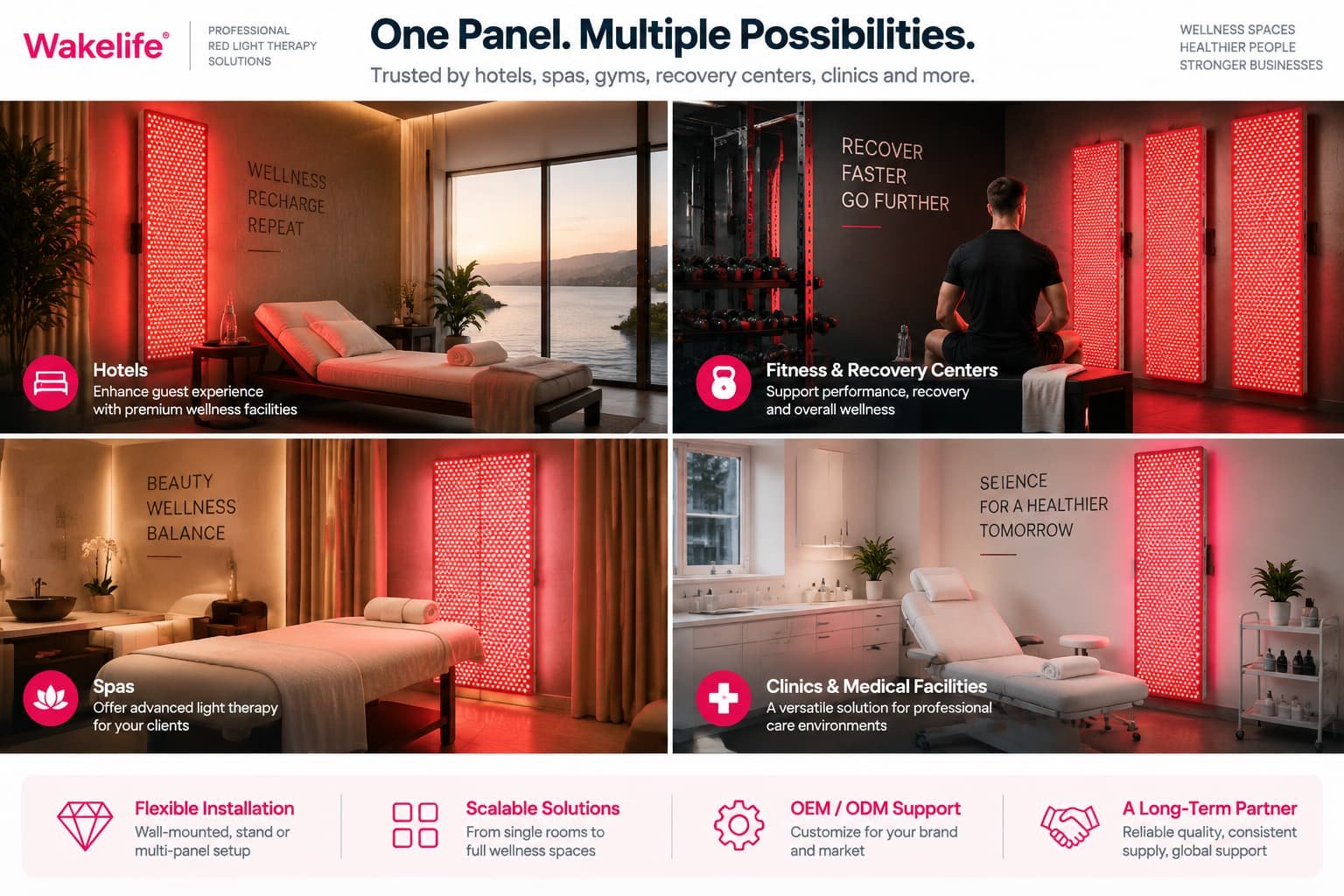
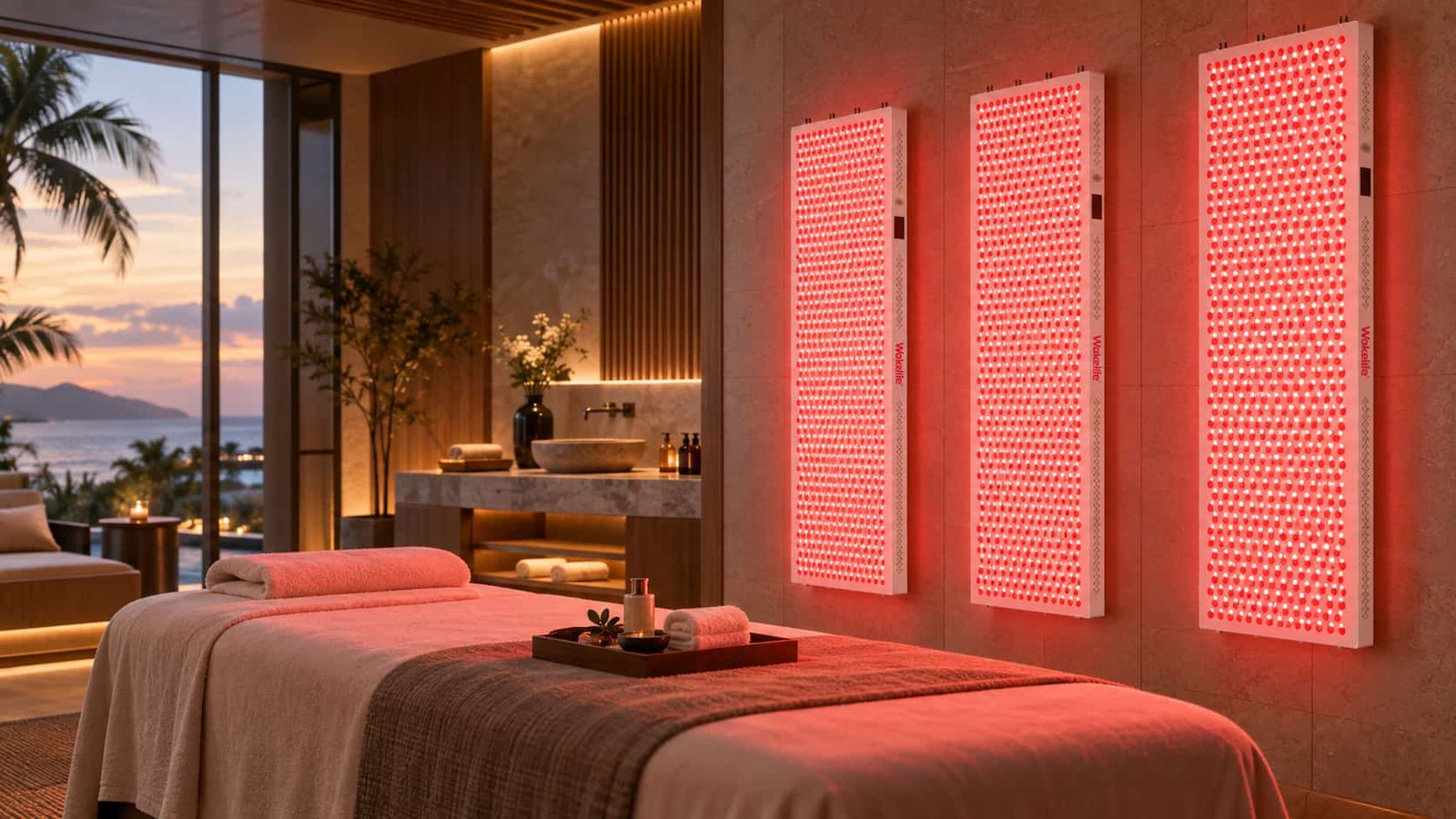
A sound red light therapy device development process does not wait until the product is finished to ask whether customers want it, whether the target cost still works, or whether production can scale. Commercial validation, cost control and engineering evidence should advance together, with a clear decision before each major investment.
Per il proprietario di un marchio, product manager or sourcing team, la questione pratica non è semplicemente, “What stage comes next?" È:
What must be true before we spend more money?
A useful process gives four possible answers at every gate:
- Andare – the evidence is strong enough for the next defined investment.
- Presa – the opportunity may remain valid, but a required input or decision is missing.
- Rivedere – the problem is worth solving, but the concept, specification, cost model or launch plan must change.
- Fermare – the commercial or technical case no longer justifies further investment.
This guide explains how those decisions connect from market definition and concept feedback through EVT, TVP, PVT, production ramp-up and lifecycle planning. The labels used for development stages can differ between companies. What matters is that every project defines what each gate must prove, who approves it and what remains unresolved.
The Process in One View
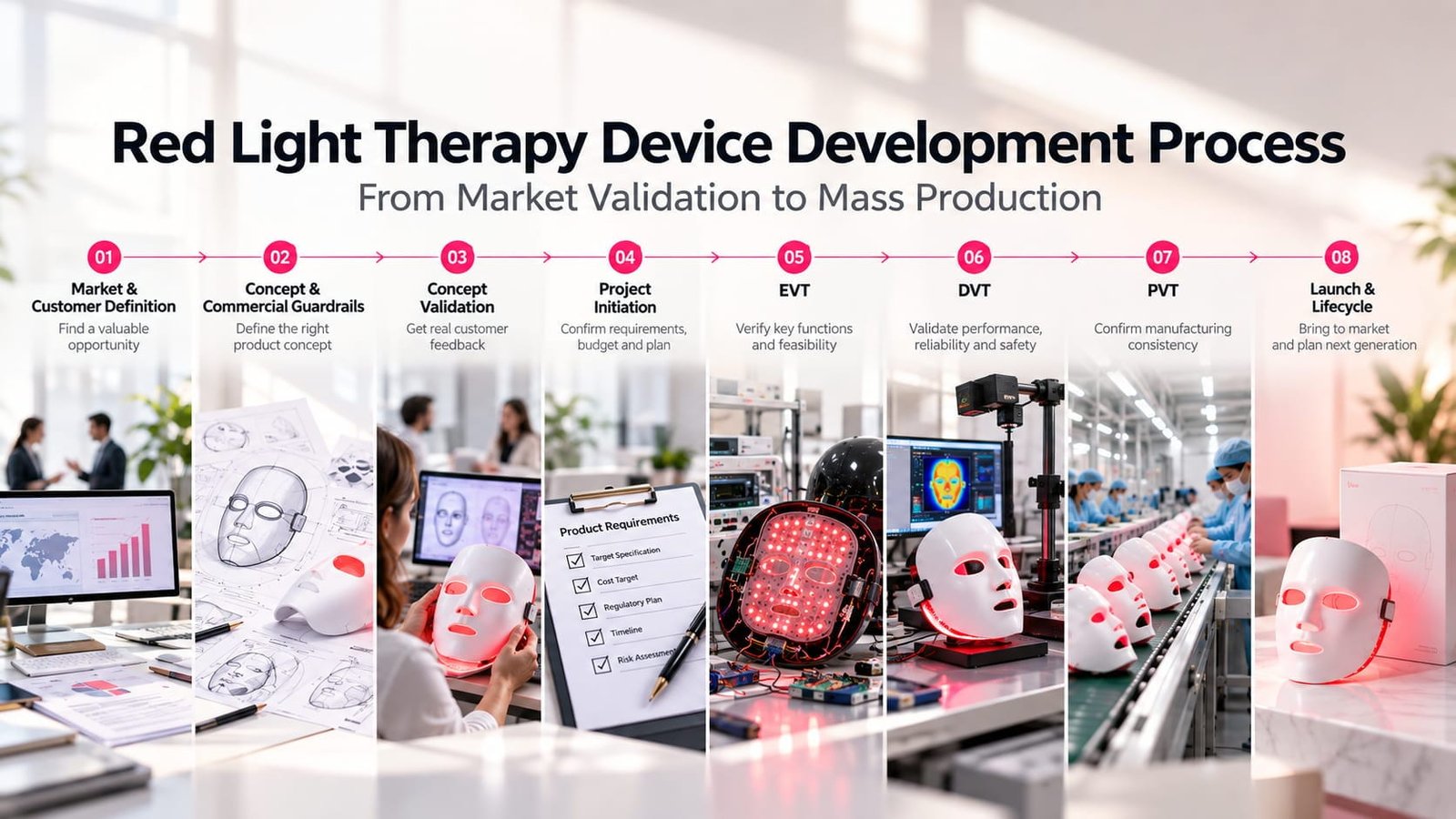
| Palcoscenico | Main decision | Evidence expected before moving on |
|---|---|---|
| 1. Market and customer definition | Are we solving a valuable problem for a reachable buyer? | Target segment, use scenario, canale, competing options and unmet need |
| 2. Concept and commercial guardrails | Can the idea fit the intended positioning and economics? | Concept options, prezzo indicativo, preliminary cost range, intended claims and major constraints |
| 3. Concept validation | Do relevant customers understand and value the proposed solution? | Structured feedback on renderings, mock-ups or low-fidelity prototypes, including objections |
| 4. Project initiation | Is the opportunity strong enough to justify formal development? | Approved requirements, bilancio, proprietà, risk register, regulatory assumptions and project plan |
| 5. EVT | Can the proposed engineering approach work? | Functional evidence for the highest-risk subsystems and interfaces |
| 6. TVP | Does the production-intent design meet its defined requirements? | Controlled design, verification results, reliability evidence and closed or accepted deviations |
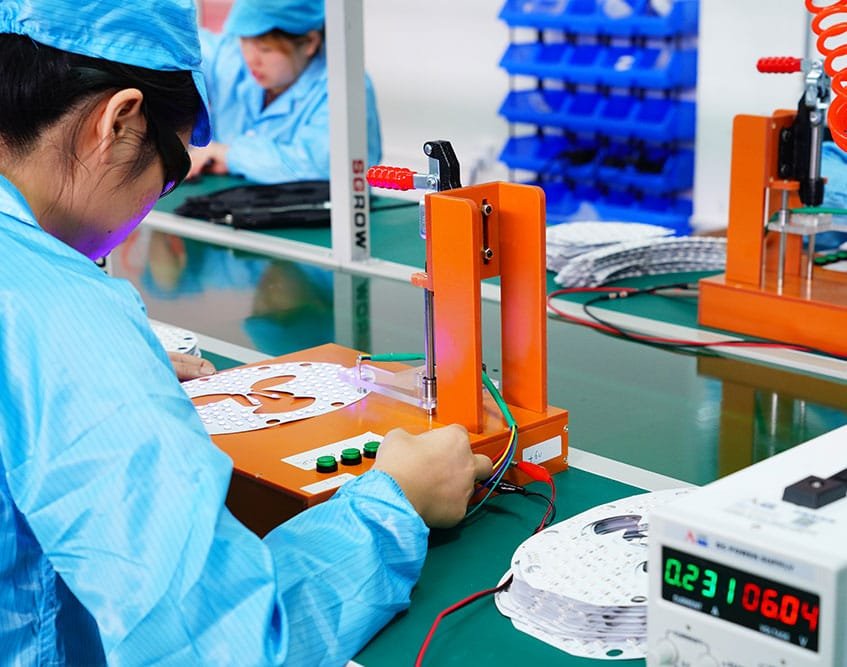
| 7. PVT and pilot production | Can the planned process build the product consistently? | Production tooling, istruzioni di lavoro, inspection controls, yield data and pilot-build results |
| 8. Launch and lifecycle | Can the brand launch, support and replace the product without a gap? | Launch readiness, controlled documentation, feedback loop, change plan and next-generation roadmap |
Do not treat this table as a universal regulatory sequence. A private-label project using an established platform may combine or omit engineering activities that a new-to-market ODM program requires. A medical-device project may need additional formal design, rischio, usabilità, testing and regulatory controls. The project plan should state which route applies.
Why Engineering Validation Alone Is Not Enough
A product can be technically functional and still fail commercially. It can also attract customer interest while remaining too expensive, unreliable or difficult to manufacture.
That is why development should manage three evidence streams in parallel:
| Evidence stream | Question it answers | What happens if it is ignored |
|---|---|---|
| Commercial evidence | Are the target customers, channel and price logic real? | The team builds a product that has no clear buyer or cannot support the required margin |
| Engineering evidence | Does the design meet the defined functional and performance requirements? | The product looks attractive but fails in use, testing or reliability |
| Production and compliance evidence | Can the exact configuration be built consistently and supported in the target market? | Late redesign, documentation gaps, unstable quality or a blocked launch |
These streams do not need to reach certainty at the same time. Early in the project, the evidence will be incomplete. The purpose of a stage gate is to decide whether the remaining uncertainty is acceptable for the next investment – not to pretend that all risk has disappeared.
Cancello 1: Define the Market Before Defining the Product
“We want a better red light therapy device” is not a usable product definition.
Before features, wavelengths or industrial design are discussed, define:
- the target region and sales channel;
- the buyer and end-user groups;
- the intended use environment, such as home, salone, clinica, gym or veterinary setting;
- the problem the current alternatives do not solve well;
- the planned positioning and price range;
- the intended-use and claim direction;
- the expected order pattern, service model and replacement needs.
The goal is not to create a large market slide. It is to identify the smallest customer group whose needs are sufficiently similar to guide one coherent product.
Assess Both Market Attractiveness and Your Ability to Win
A large market is not automatically the right market. Evaluate each candidate segment on two dimensions:
| Dimensione | Questions to ask |
|---|---|
| Market attractiveness | Is the need frequent and important? Are buyers already spending? Is the addressable group large enough for the planned investment? |
| Competitive ability | Can the brand reach these buyers? Does it have a credible channel, prezzo, product advantage, service model or evidence position? |
Prioritize segments where both are strong. If the market is attractive but the brand has no realistic route to compete, more product features will not solve the positioning problem.
The output of this gate should be a named target segment and a short list of customers or channel partners suitable for validation. “North America” or “beauty brands” is normally too broad to guide a development decision.
Cancello 2: Set Cost Guardrails Without Pretending the Estimate Is Final
Cost control begins before the bill of materials is complete.
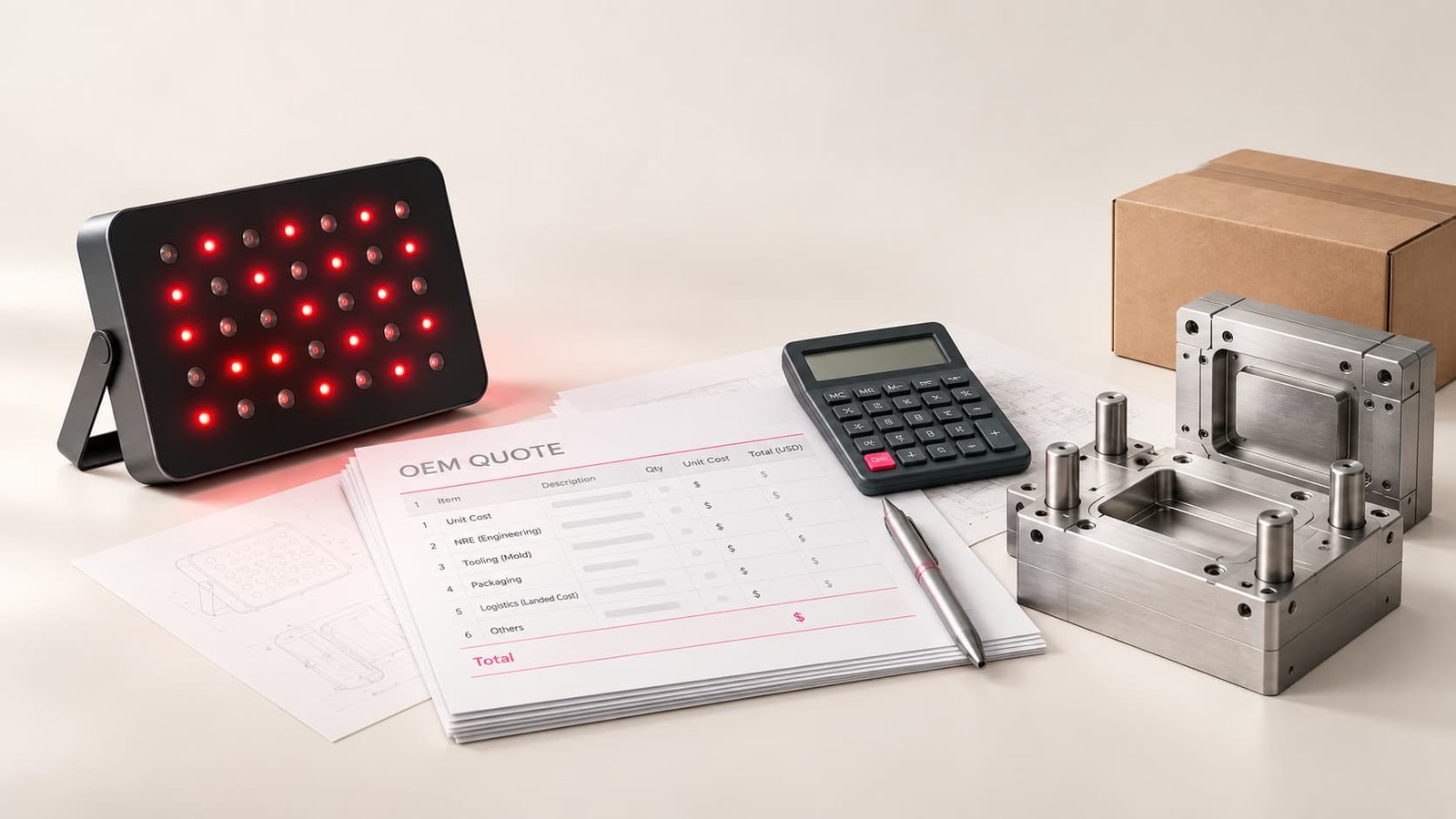
At the concept stage, a manufacturer cannot responsibly promise the final unit cost because materials, elettronica, utensileria, assembly steps, test requirements and yield are not yet fixed. But the team can still test whether the idea is directionally compatible with the target selling price and margin structure.
Cost confidence should increase as evidence becomes more specific:
| Development point | What can be estimated | What is still uncertain |
|---|---|---|
| Concetto | Broad architecture, likely major components, customization depth and tooling direction | Materiali finali, component quotations, detailed labor, test burden and yield |
| Project initiation | Preliminary specification, candidate BOM, development work, tooling and planned evidence package | Design changes, supplier selection, reliability findings and production losses |
| Design verification | Near-final components, tooling status, assembly method and most test requirements | Final cycle time, stable yield, rework and ramp-up behavior |
| Pilot production | Actual labor, process controls, resa di primo passaggio, rework and packaging flow | Future volume effects, supplier changes and later engineering changes |
This is why a price quoted from a vague concept should be treated as a planning range, not a locked production cost.
Before each gate, chiedere:
- Which assumptions changed?
- Which costs are based on supplier quotations or observed production data?
- Which figures remain estimates?
- What change would invalidate the current business case?
- Who has authority to approve the next irreversible expense?
An honest range early is safer than false precision that fails after tooling.
Cancello 3: Validate the Concept Before Expensive Commitment
Concept validation asks whether relevant customers understand the proposed product, see value in it and identify barriers while the design is still inexpensive to change.
The material shown can progress with the project:
- problem statement and value proposition;
- alternative product concepts;
- industrial-design sketches or renderings;
- interface flows and packaging direction;
- appearance models or low-fidelity mock-ups;
- functional prototypes;
- engineering samples.
Do not ask only, “Do you like it?” Positive reactions are easy to collect and difficult to use. Ask questions that expose a decision:
- What would this replace in your current product line or operation?
- Which feature or use step would prevent adoption?
- Which part of the concept is valuable enough to pay for?
- What evidence would your product, quality or compliance team require?
- Who else must approve the project?
- What would cause you to delay or reject it?
- Which changes are essential, and which are preferences?
Record the concept version, participant role, target segment, data, feedback, unresolved objection and resulting decision. A defined feedback window keeps the project moving, but the right duration depends on the sample stage, user workflow and customer availability.
Customer Feedback Is Not Design Validation
Commercial feedback and formal technical evidence answer different questions:
| Prova | What it may support | Ciò che non dimostra da solo |
|---|---|---|
| Positive reaction to a rendering | Interest in the appearance or proposition | Functional performance, sicurezza, manufacturability or purchase commitment |
| Hands-on prototype feedback | Usability observations, comfort issues and feature priorities | Production consistency, regulatory conformity or clinical performance |
| Written forecast or pilot interest | A stronger demand signal and planning input | Guaranteed orders or project profitability |
| Laboratory or engineering test | Performance against a defined method and acceptance criterion | Market demand or future-batch consistency |
| Pilot-production results | Evidence about the planned manufacturing process | Authorization for every market or every claim |
For projects intended to be medical devices, ordinary customer interviews must not be presented as formal human-factors or design validation. The FDA describes human-factors engineering as a defined process focused on intended users, uses, use environments and user interfaces to reduce use-related risk. The required work depends on the specific device and regulatory pathway; informal preference testing does not replace it. See the FDA’s human factors and usability engineering guidance.
Cancello 4: Make the Investment Decision Explicit
Before committing significant engineering, utensileria, certification or launch resources, bring the commercial and technical evidence into one review.
The review should include:
- target customer and use scenario;
- problem and unmet need;
- concept version and feedback record;
- approved requirements and unresolved questions;
- prezzo indicativo, current cost range and margin assumptions;
- forecast or other demand evidence, with its reliability stated;
- engineering feasibility and highest-risk functions;
- utensileria, Test, certification and development budget;
- target-market, intended-use and claim assumptions;
- project owner, decision authorities and milestone plan.
Then record one decision:
| Decisione | Usalo quando | Registrazione richiesta |
|---|---|---|
| Andare | The evidence is sufficient for the next named stage and the remaining risks are accepted | Approved scope, bilancio, owners, deliverables and next gate |
| Presa | A critical external input, document or decision is missing, but the current concept should not change yet | Missing item, proprietario, due date and work that must not begin |
| Rivedere | L'occasione resta valida, but the concept, specification, cost model or market route must change | Required revision, affected assumptions and revalidation plan |
| Fermare | The need, economics, feasibility or compliance path no longer supports the investment | Stop reason, reusable learning and disposition of existing work |
Avoid “approved” without a scope. A decision should state exactly what has been released: another concept iteration, an engineering prototype, utensileria, a pilot build or mass production.
How EVT, DVT and PVT Fit the Process
EVT, DVT and PVT are useful working labels, but companies do not always define them identically. Put the project-specific definitions, entry criteria, exit criteria and required records into the development plan.
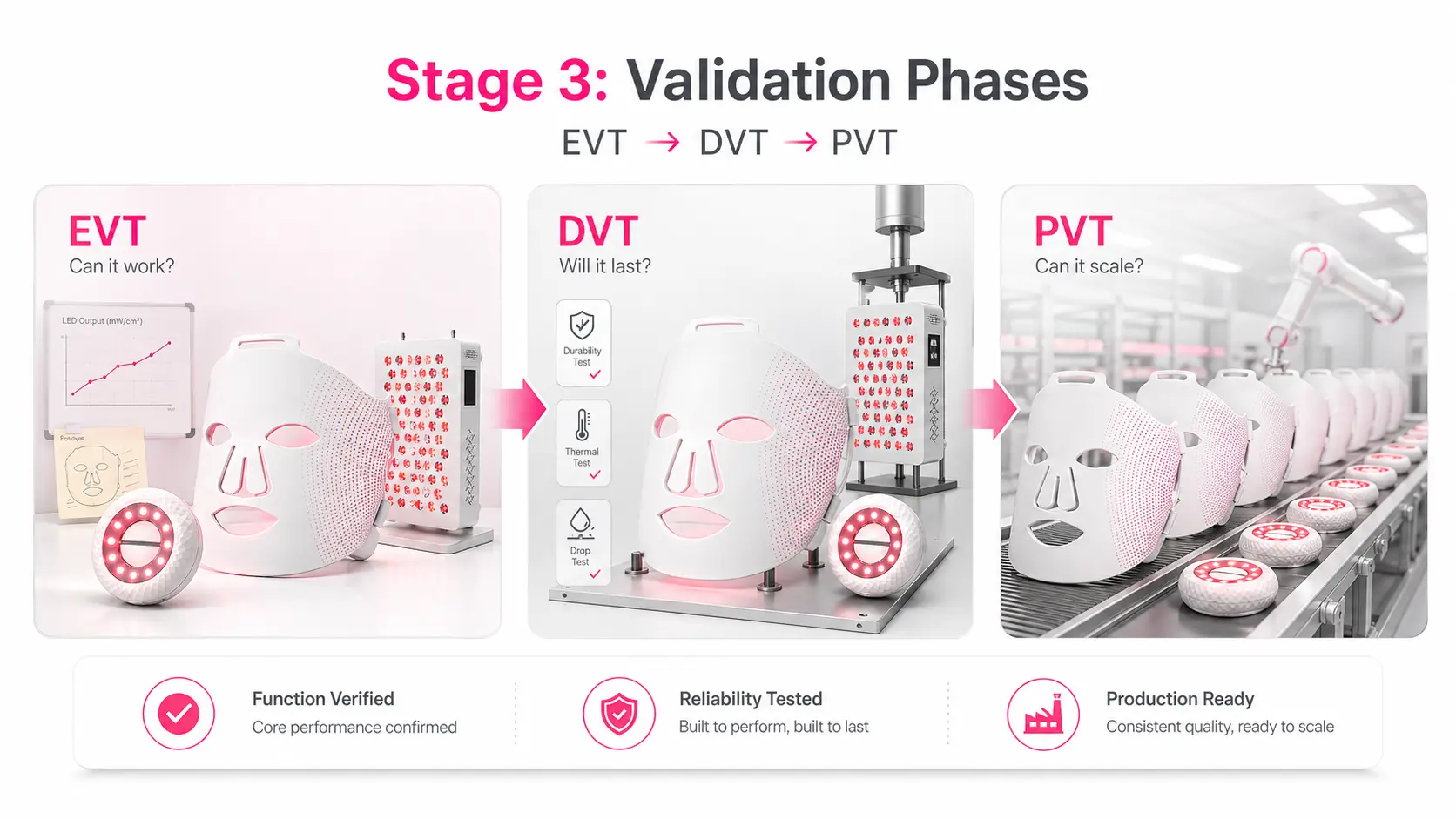
EVT: Can the Engineering Approach Work?
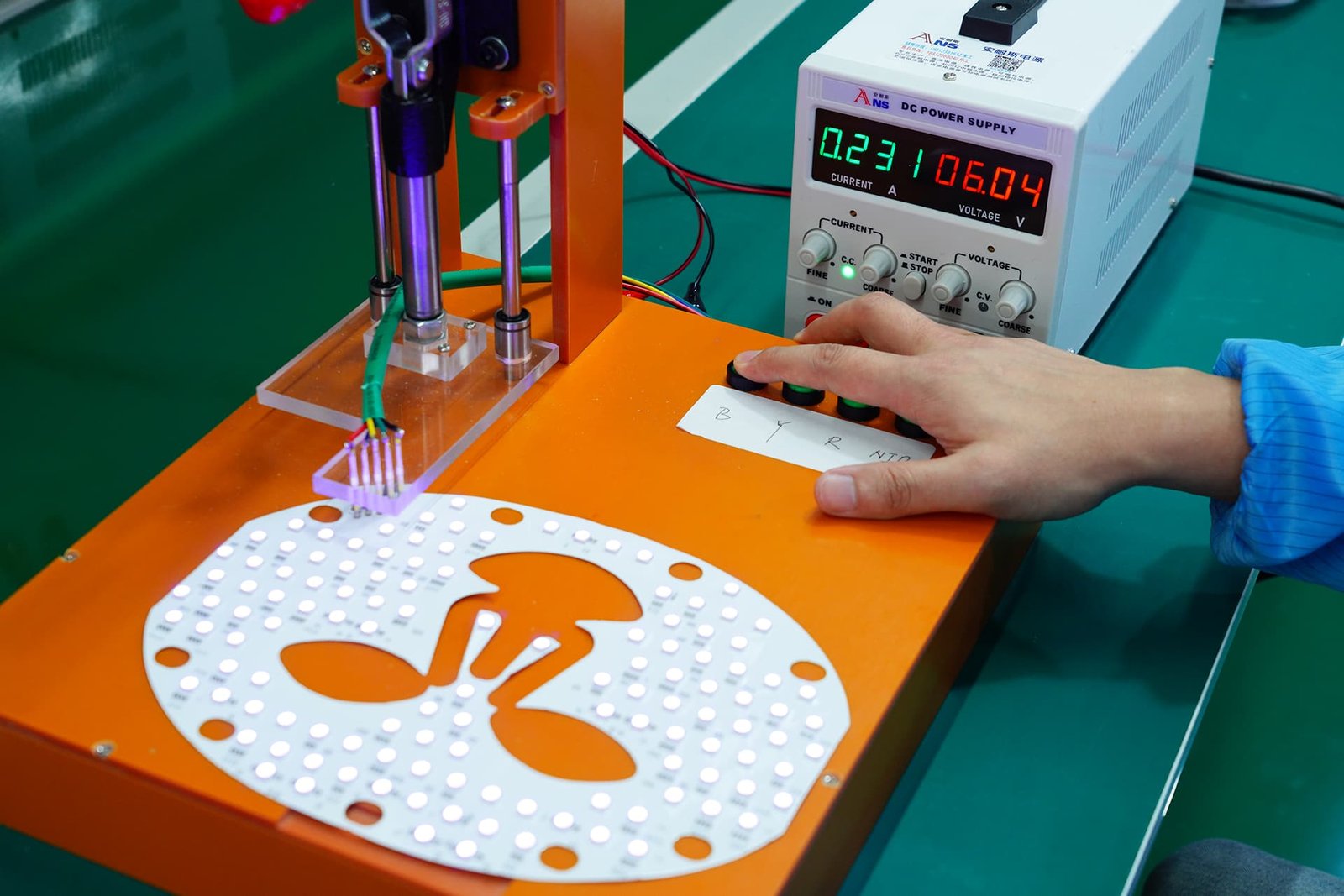
Engineering Validation Test activities usually focus on the highest-risk functions and interfaces. For an LED therapy device, the questions may involve optical architecture, elettronica, controlli, comportamento termico, power delivery, mechanical fit or software communication.
EVT evidence should identify:
- the exact prototype and revision tested;
- the requirement or design question;
- the method, setup and acceptance criterion;
- the observed result;
- open failures and planned changes;
- what the prototype does not yet represent.
A functional prototype can support further engineering. It does not automatically prove final appearance, affidabilità, production yield or market readiness.
TVP: Does the Controlled Design Meet Its Requirements?
DVT normally uses a more controlled, production-intent design to test whether the product meets its approved requirements. The plan may include optical, elettrico, meccanico, termico, affidabilità, confezione, etichettatura, usability and other project-specific verification.
Do not begin DVT with an unstable specification. If the target configuration keeps changing, test results will describe different products and cannot support one clear release decision.
Before closing DVT, confermare:
- the tested configuration is identified;
- critical requirements have objective results;
- deviations have owners and dispositions;
- design changes have been assessed for retest impact;
- the target-market evidence plan still matches the intended use and claims;
- unresolved issues are explicitly accepted or block the next stage.
PVT: Can the Planned Process Build It Consistently?
PVT or pilot production moves the question from the design to the manufacturing system. The exact batch size should come from the product, utensileria, processo, risk and commercial plan – not from a universal internet rule.
PVT should examine items such as:
- released drawings, Distinta base, firmware, artwork and work instructions;
- production tooling, fixtures and test equipment;
- trained operators and defined assembly sequence;
- in arrivo, in-process and final inspection controls;
- cycle time, resa di primo passaggio, rework and defect patterns;
- traceability and change control;
- packaging and shipment configuration;
- whether critical outputs remain within the approved acceptance criteria across multiple identified units.
For a buyer-side release tool, utilizzare il Elenco di controllo per l'approvazione dei campioni di dispositivi per terapia LED. It explains how to identify a sample revision, connect evidence to the exact configuration and distinguish sample approval from mass-production or regulatory approval.
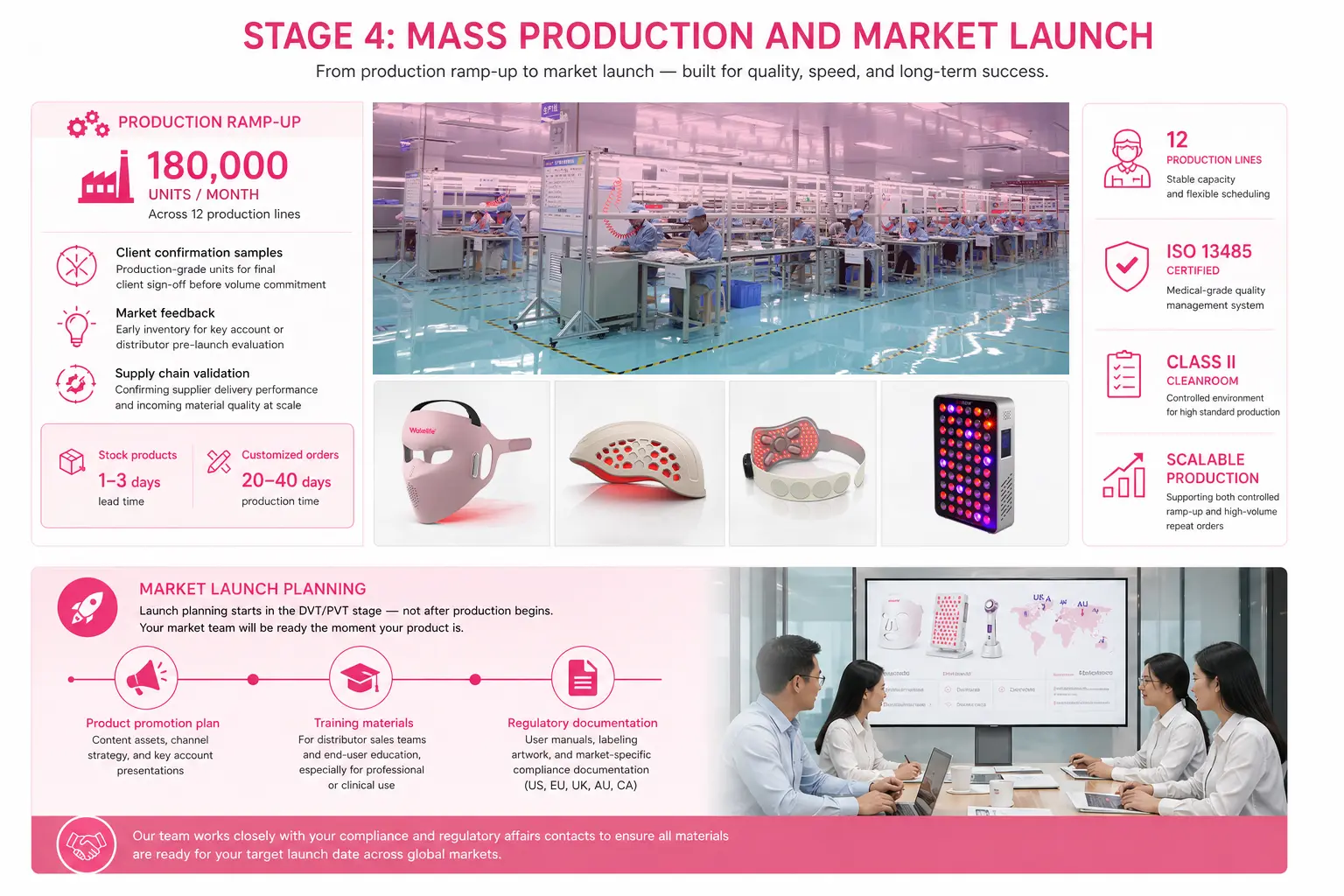
The marketing and commercial teams should not wait for mass production to discover what they need for launch.
As the design stabilizes, develop the launch inputs that depend on the actual product:
- channel and key-account plan;
- product positioning and approved claim set;
- istruzioni per l'utente, training and support content;
- confezione, labels and required market information;
- product photography and sales materials based on the final configuration;
- distributor or internal sales training;
- inventory, service and replacement-parts assumptions;
- launch forecast and controlled ramp-up plan.
Keep launch activity tied to the current development status. A rendering may support concept discussion, but it should not be presented as a shipping product. An engineering sample may support evaluation, but it may not represent final materials, firmware, artwork or production controls.
Plan Quality and Regulatory Requirements Early
The product category, destinazione d'uso, affermazioni, target market and exact configuration determine which regulatory and technical evidence may apply. “Red light therapy device” does not describe one universal regulatory route.
For US projects that are medical devices, quelli della FDA Regolamento del Sistema di Gestione della Qualità è entrato in vigore a febbraio 2, 2026 e incorpora l'ISO 13485:2016 by reference. The rule applies to finished medical-device manufacturers within its scope; it is not a reason to label every beauty or wellness product a medical device.
Iso 13485:2016 is a quality-management-system standard for organizations involved in medical devices and related services. Un'ISO 13485 certificate concerns the certified organization’s quality system and stated scope. Non lo è, da solo, clearance or approval of every product the organization manufactures.
La società madre di Wakelife, Shenzhen Sungrow LED Technology Co., Ltd, is listed in the BSI Client Directory under ISO 13485 certificato MD 800872. Buyers should still verify the exact model, destinazione d'uso, affermazioni, market and document scope for their own project.
IL Guida alla certificazione del dispositivo per terapia LED provides a separate evidence map for checking quality-system certificates, product-level records, testing and exact-model scope. Keep that workstream connected to development, but do not compress it into a logo checklist.
Manage the Product Lifecycle Before Sales Decline
Product development does not end at launch. A stable product line should manage three horizons:
- Selling now – maintain quality, supply, documentazione, service and market feedback for the current product.
- Developing next – convert repeated customer needs and known limitations into a controlled next-generation project.
- Planning later – monitor technology, components, regulations, channel changes and emerging customer tasks before they become urgent.
Do not wait until a product is difficult to sell before planning its successor. If the next version starts only after the current one declines, a brand may create a supply or product gap that gives customers time to switch.
Define the role of each generation. A new product should serve a clear segment or solve a clear limitation; it should not simply add features that confuse positioning or undermine the current line.
The product roadmap should also create a technology roadmap. If a future concept depends on a new optical architecture, materiale, sistema di controllo, app function, test method or regulatory capability, identify and study that need before the development deadline becomes a crisis.
What a Brand Should Ask Its OEM or ODM Partner
Before selecting a development partner or releasing the next stage, chiedere:
- Which target customer, use environment and market is this design being built for?
- Which assumptions are confirmed, and which are still hypotheses?
- What exactly will the next sample or prototype prove?
- How will customer feedback be recorded and converted into controlled requirements?
- How does the cost estimate change from concept to pilot production?
- Which expenses become difficult to reverse after this gate?
- How are EVT, DVT and PVT defined for this project?
- Which model, revisione, Distinta base, firmware and artwork does each test result cover?
- Which target-market and claim decisions must be made before design freeze?
- What evidence is required to release tooling, produzione pilota, mass production and shipment?
- Who owns each decision, deviation and change?
- When should planning for the next product generation begin?
A capable partner should be able to answer with project-specific records, not only a standard flowchart.
What to Prepare Before Starting an OEM/ODM Project
You do not need a complete engineering package to begin a feasibility discussion. You do need enough context to prevent the manufacturer from designing against the wrong problem.
Prepare what you currently know:
- mercato e canale di riferimento;
- intended users and use environment;
- problem to solve and competing products;
- product format or reference concept;
- required and optional features;
- destinazione d'uso e richieste previste;
- target selling price and current cost ceiling, if established;
- forecast range and launch timing, with assumptions identified;
- required customization depth;
- existing designs, test data, regulatory records or IP constraints;
- the decision you need from the manufacturer next.
Wakelife supports private-label, personalizzazione, OEM and ODM projects across light-therapy product categories. The right route depends on whether you are branding an established platform, changing a controlled configuration, manufacturing an existing design or developing a substantially new product. Rivedi il Wakelife OEM/ODM service and send the information above for a scoped feasibility discussion.
Conclusione
A strong red light therapy device development process is not a longer checklist. It is a disciplined way to reduce the right uncertainty before each irreversible decision.
Define the market before the product. Test the concept before expensive commitment. Let cost confidence increase with engineering and production evidence. Keep commercial validation separate from formal technical and regulatory proof. Define what EVT, DVT and PVT must demonstrate for the exact project. Start the next generation while the current product still has momentum.
When those decisions are documented, speed and control are no longer opposites. The team can move faster because it knows what evidence is sufficient, what remains open and what must not proceed yet.
Riferimenti
-
1
Amministrazione statunitense per gli alimenti e i farmaci. Regolamento del Sistema di Gestione della Qualità (QMSR) . Accesso settembre 23, 2026.
-
2
Amministrazione statunitense per gli alimenti e i farmaci. Applying Human Factors and Usability Engineering to Medical Devices . Guida finale, agosto 2026. Accesso settembre 23, 2026.
-
3
Organizzazione internazionale per la standardizzazione. Iso 13485:2016 - Dispositivi medici - Sistemi di gestione della qualità - Requirements for regulatory purposes . Accesso settembre 23, 2026.
-
4
BSI. Client Directory Certificate MD 800872 - Shenzhen Sungrow LED Technology Co., Ltd . Accesso settembre 23, 2026.