Irradiance (mW/cm²) measures how much light power reaches each square centimeter of your skin per second.
Energy density (J/cm²) — also called fluence or dose — is the total light energy deposited during your session.
Energy Density Calculator
Calculate treatment dose based on irradiance and exposure time. Designed for a clean, professional Wakelife-style presentation.
Enter irradiance and time to calculate the output dose.
Example: A device delivering 45 mW/cm² for 10 minutes (600 seconds): 45 × 600 ÷ 1,000 = 27.0 J/cm² — within the optimal therapeutic window.
Optimal dose for most skin and wellness applications: 10–30 J/cm² per session.
- Below 5 J/cm² → minimal biological response
- 10–30 J/cm² → optimal therapeutic range
- Above 50 J/cm² → diminishing or inhibitory effects (biphasic dose response)
Read the full guide below for the science, calculation steps, dose planning by goal, common mistakes, and manufacturer design guidance.
Why Dosimetry Matters More Than Power Claims
The red light therapy market is flooded with power claims. “100W panel.” “300 LEDs.” “Medical-grade intensity.” But none of these numbers tell you the one thing that actually determines whether your treatment works: how much therapeutic energy reaches your target tissue during a session.
That quantity is called dose, measured in joules per square centimeter (J/cm²). It is the single most important parameter in photobiomodulation (PBM), because decades of clinical research have established that biological responses to light are dose-dependent — and that there is both a minimum effective dose and a maximum useful dose.¹
Without understanding dosimetry, you are guessing. With it, you can plan treatments that are consistently effective, avoid wasting time on sub-therapeutic sessions, and prevent the diminishing returns that come from over-treatment.
This guide gives you every tool you need to calculate, plan, and optimize your light therapy dose.
Core Definitions: Irradiance, Energy Density, and Fluence
Irradiance (mW/cm²) — Power Density
Irradiance quantifies the rate at which light energy arrives at the tissue surface. It answers: how intense is the light right now?
- Unit: milliwatts per square centimeter (mW/cm²)
- Analogy: the flow rate of water from a hose
- Higher irradiance = faster energy delivery = shorter sessions needed for the same dose
Critical note: Irradiance is distance-dependent. The same device may measure 45 mW/cm² at the contact surface (0 cm) and only 20 mW/cm² at 15 cm away. When comparing devices, always confirm the measurement distance and whether the value represents a center-point peak or a surface-area average.
Energy Density (J/cm²) — Fluence / Dose
Energy density quantifies the total light energy deposited per unit area during a treatment session. It answers: how much light did the tissue receive in total?
- Unit: joules per square centimeter (J/cm²)
- Analogy: the total volume of water that filled the bucket
- This is the number that clinical research links to biological outcomes
The terms energy density, fluence, and dose are used interchangeably in PBM literature. Throughout this guide, we use dose for simplicity.
The Relationship
| Concept | Measures | Analogy | Unit |
|---|---|---|---|
| Irradiance | Rate of energy delivery | Water flow rate | mW/cm² |
| Time | Duration of delivery | How long the hose runs | seconds |
| Energy density (dose) | Total energy delivered | Total water in bucket | J/cm² |
Irradiance tells you how fast. Dose tells you how much.
You need both. A high-irradiance device used for too short a time delivers an insufficient dose. A low-irradiance device used for too long a time wastes your time — or worse, overshoots the optimal window before you realize it.
The Dosimetry Formula: Step by Step
The Formula
Dose (J/cm²) = Irradiance (mW/cm²) × Time (seconds) ÷ 1,000
The division by 1,000 converts milliwatts to watts (since 1 J = 1 W × 1 s).
Step-by-Step Calculation
Step 1: Find your device’s irradiance (mW/cm²) from the specification sheet or third-party test report. Confirm the measurement distance.
Step 2: Decide your treatment time and convert to seconds.
| Minutes | Seconds |
|---|---|
| 5 min | 300 s |
| 10 min | 600 s |
| 15 min | 900 s |
| 20 min | 1,200 s |
Step 3: Multiply irradiance by time, then divide by 1,000.
Worked Examples
Example A: Device irradiance: 25 mW/cm² | Time: 10 minutes (600 s) 25 × 600 ÷ 1,000 = 15.0 J/cm²
Example B: Device irradiance: 33 mW/cm² | Time: 10 minutes (600 s) 33 × 600 ÷ 1,000 = 19.8 J/cm²
Example C: Device irradiance: 45 mW/cm² | Time: 15 minutes (900 s) 45 × 900 ÷ 1,000 = 40.5 J/cm²
Reverse Calculation: How Long for a Target Dose?
If you have a target dose in mind, you can calculate the required treatment time:
Time (seconds) = Target Dose (J/cm²) × 1,000 ÷ Irradiance (mW/cm²)
Example: Target dose: 20 J/cm² | Device irradiance: 33 mW/cm² 20 × 1,000 ÷ 33 = 606 seconds ≈ 10 minutes
The Biphasic Dose Response: Why More Isn’t Better
The Arndt-Schulz Principle
One of the most important findings in photobiomodulation research is the biphasic dose response, formalized by Huang et al. (2009).¹ It follows the Arndt-Schulz law: biological systems respond to stimuli in a bell-shaped curve.
Applied to light therapy:
~5 J
~50 J
(Excessive)
What This Means for Your Treatments
| Dose Zone | Range | Biological Effect |
|---|---|---|
| Sub-threshold | < 5 J/cm² | Insufficient energy to trigger meaningful cellular response |
| Therapeutic window | 10–30 J/cm² | Optimal stimulation of mitochondrial activity, cytochrome c oxidase activation, ATP production, and downstream signaling cascades²³ |
| Plateau / diminishing | 30–50 J/cm² | Returns decrease; some applications may still benefit, but risk/reward ratio worsens |
| Inhibitory zone | > 50 J/cm² | Cellular stress responses; potential suppression of the very processes you’re trying to stimulate¹ |
Why This Is Counterintuitive
Most people assume “more = better.” In photobiomodulation, the science is clear: there is an optimal dose window, and exceeding it doesn’t just waste time — it can actively reduce your results.
This is why dosimetry literacy matters. You need to know not just that your device “has high power,” but exactly where your session falls on the dose-response curve.
Dose Ranges by Application
Published clinical literature suggests the following dose ranges. These are guidelines, not absolute prescriptions — individual responses vary, and wavelength selection significantly affects which tissue layers receive the dose.
| Application | Suggested Dose Range | Primary Wavelengths | Key Reference |
|---|---|---|---|
| Skin rejuvenation / collagen synthesis | 10–30 J/cm² | 630–660 nm | Avci et al., 2013² |
| Anti-inflammatory / redness reduction | 10–20 J/cm² | 810–850 nm | Hamblin, 2017³ |
| Wound healing | 4–15 J/cm² | 630–850 nm | Hamblin, 2017³ |
| Pain management (deeper tissue) | 15–40 J/cm² | 810–1,072 nm | Various |
| Hair growth stimulation | 5–15 J/cm² | 630–660 nm | Various |
Important: The same dose at different wavelengths treats different tissue depths. 20 J/cm² at 633 nm targets the dermis (1–3 mm depth), while 20 J/cm² at 850 nm reaches subcutaneous tissue and muscle (20–30 mm).
→ Deep dive into wavelength-tissue interactions: Wavelength Selection & Tissue Penetration Depth in PBM Devices
Average vs. Peak Irradiance — Which Number Should You Actually Use?
If you’ve ever compared two red light therapy devices and wondered why one brand claims 100 mW/cm² while another similar-looking panel only claims 35 mW/cm², the answer usually isn’t that one device is three times more powerful. The answer is that they’re measuring differently [5].
There are two ways to report irradiance, and the difference between them changes everything about how you interpret a product’s specs — and how you calculate your dose.
Peak Irradiance
Peak irradiance is the single highest reading a sensor can capture. It’s measured by placing the detector directly against the brightest point on the panel — typically dead center over one LED, at 0 cm distance.
This number represents the absolute maximum your skin could receive at one tiny spot. It does not represent what the rest of the treatment area receives.
Average Irradiance
Average irradiance is the mean power density measured across the entire active treatment surface. Because LEDs emit light in a beam pattern (typically 60°), the edges of the panel naturally deliver less energy than the center. The average accounts for this real-world variation.
This is the number that reflects what your tissue actually receives during a session.
Why This Distinction Matters
Consider a real example: a red light therapy panel measures 45 mW/cm² at its center hotspot (peak), but when you average the readings across the full treatment surface, the effective irradiance is 35 mW/cm² [4].
If you use the peak value (45) in your dose calculation for a 10-minute session:
- 45 × 600 ÷ 1,000 = 27 J/cm² (overestimated)
If you use the average value (35) for the same session:
- 35 × 600 ÷ 1,000 = 21 J/cm² (accurate)
That’s a 6 J/cm² difference — enough to push your perceived dose toward the upper boundary of the therapeutic window when your actual dose is comfortably in the middle. Over weeks of daily treatments, this miscalculation compounds.
⚠️ Industry Transparency Problem
Many brands report only peak irradiance without disclosing the measurement method. A device claiming “100 mW/cm²” measured at the center LED hotspot may only deliver 50–65 mW/cm² as an average across its surface. Always ask: is this peak or average? At what distance?
The Rule for Dose Calculations
Always use average irradiance for dose calculations. Peak values are useful for comparing individual LED output, but they overestimate the dose that most of your tissue actually receives during treatment. When a responsible brand lists its irradiance with a “+” symbol (e.g., “35+ mW/cm²”), it typically indicates a conservative average — the minimum you can expect across the treatment area.
Real-World Calculation — From Specs to Dose in 3 Steps
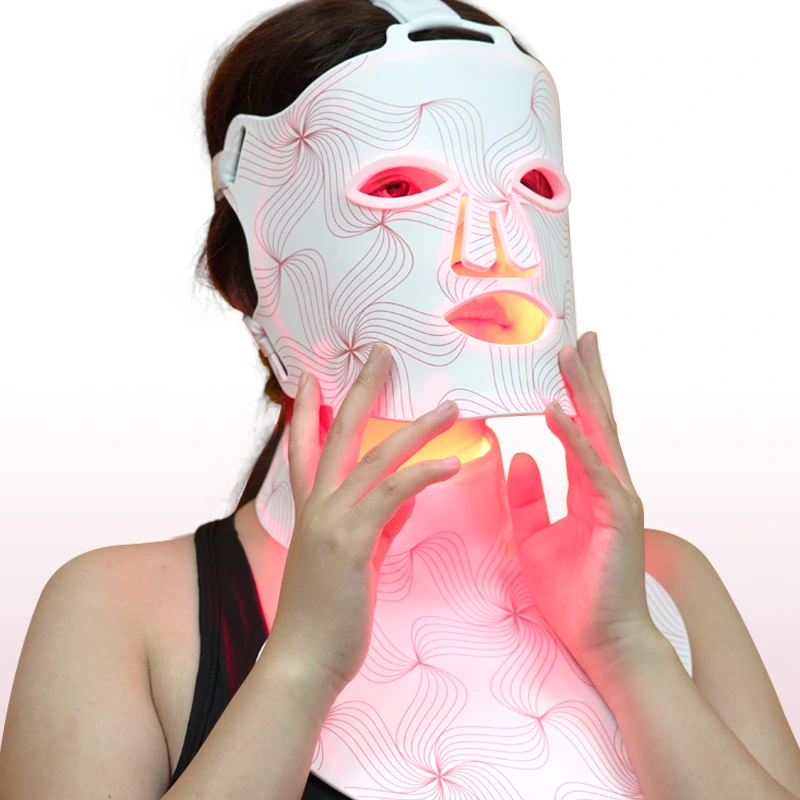
To bring these principles to life, let’s walk through a real calculation using a multi-wavelength LED face mask as a reference device — the WAKELIFE G15K, which combines 633 nm LED, 850 nm VCSEL, and 1072 nm VCSEL light sources.
Reference G15K Device Specifications
Step 1 — Choose the right irradiance value
We use 35 mW/cm² (the average), not 45 mW/cm² (the peak). This reflects what your skin actually receives across the full mask surface.
Step 2 — Convert treatment time to seconds
10 minutes × 60 = 600 seconds
Step 3 — Apply the dose formula
Dose = Irradiance × Time ÷ 1,000
Dose = 35 × 600 ÷ 1,000
= 21 J/cm²
Check the therapeutic window:
- ⚪ < 5 J/cm² — Sub-threshold
- 🔵 5–10 J/cm² — Approaching therapeutic range
- 🟢 10–30 J/cm² — Optimal therapeutic window ← 21 J/cm² lands here ✅
- 🟡 30–50 J/cm² — Diminishing returns
- 🔴 > 50 J/cm² — Potentially inhibitory
At 21 J/cm², a standard 10-minute session falls comfortably within the optimal range supported by the majority of photobiomodulation research. No adjustments needed.
What If You Want a Different Duration?
Using the same average irradiance (35 mW/cm²) at full intensity:
This shows why the sweet spot for most users with this device is 5 to 15 minutes per session. Beyond 15 minutes at full power, you begin entering diminishing-returns territory.
Dose Matrix — Adjusting for Intensity Levels
Some devices, including the G15K, offer adjustable intensity settings. This gives you a second variable to control your dose — not just time, but also power output.
Here’s an important detail: dimming an LED doesn’t simply multiply the irradiance by the percentage shown on the controller. Actual output depends on how the driver circuit reduces current. The values below are measured average irradiance at each setting, not calculated estimates.
G15K Measured Average Irradiance by Intensity Level
Bold = within the 10–30 J/cm² optimal window.
⚠️ = exceeding 30 J/cm², approaching diminishing-returns zone.
How to Read This Matrix
🟢 Beginners and sensitive skin: Start with 50% intensity, 10 minutes → 15.0 J/cm². This sits at the entry point of the therapeutic window — sufficient for skin rejuvenation benefits with minimal risk of overstimulation. If well-tolerated after 2–3 sessions, increase to 75%.
🟢 Standard daily use: 75% intensity, 10 minutes → 19.8 J/cm². This is the recommended setting for most users. It delivers a dose squarely within the optimal range for collagen synthesis and anti-inflammatory effects.
🟢 Experienced users with specific goals: 100% intensity, 10 minutes → 21.0 J/cm². Still well within the optimal window. Appropriate for users with established tolerance targeting more intensive results.
⚠️ Use with caution: Any combination producing more than 30 J/cm² exceeds the general guideline and enters the diminishing-returns zone. Not recommended for sensitive skin, facial treatments on beginners, or daily use at this level.
Important: Energy density increases linearly with both exposure time and irradiance. Exceeding recommended ranges may reduce efficacy due to the biphasic dose response discussed in above.
Why Multi-Wavelength Devices Add Complexity
The G15K delivers three wavelengths simultaneously. This is an advantage — but it also means the light reaching your tissue isn’t uniform in depth.
Each wavelength penetrates to a different layer:
| Wavelength | Type | Approximate Penetration | Primary Target |
|---|---|---|---|
| 633 nm | LED | 1–3 mm (dermis) | Collagen synthesis, skin texture |
| 850 nm | LED/VCSEL | 20–30 mm (deep tissue) | Anti-inflammatory, muscle recovery |
| 1072 nm | VCSEL | 30–40+ mm (deep tissue) | Emerging research: neurological, deep anti-inflammatory |
This means a single session simultaneously treats multiple tissue layers. The total average irradiance reading (35 mW/cm²) is the combined output of all three wavelengths hitting the surface.
So do you need to calculate each wavelength’s dose separately?
For home-use devices like the G15K: no. The wavelength ratio is fixed by the manufacturer and cannot be adjusted by the user. Your total surface dose (calculated from the combined average irradiance) is the number that matters for determining treatment time.
Where per-wavelength dosing becomes relevant is in clinical research protocols and custom-built devices where individual wavelength channels can be controlled independently. For consumer use, the total dose approach is both accurate and practical.
If you want to understand why the G15K uses VCSEL laser diodes for its near-infrared wavelengths instead of standard LEDs — and what difference coherent light makes at the tissue level.
→ Learn how coherent VCSEL light differs from incoherent LED: LED vs. Laser in Light Therapy Devices
Common Dosimetry Mistakes
Mistake #1: Ignoring Measurement Distance
A device spec sheet may state “35 mW/cm²” measured at a standardized testing distance, while contact-surface measurement yields a significantly higher value. This doesn’t mean anyone is wrong — it means measurement conditions matter enormously.
What to do: Always ask for the measurement distance, the instrument used, and whether the value represents peak or average irradiance. When comparing devices, ensure you’re comparing values measured under the same conditions.
Mistake #2: Assuming More Time Always Means Better Results
The biphasic dose response (Section 4) means there is a ceiling. Doubling your session time does not double your results. Beyond approximately 30–50 J/cm² for most skin applications, you enter diminishing or inhibitory territory.¹
What to do: Calculate your dose. Set a timer. Resist the urge to “do a little extra.”
Mistake #3: Comparing Devices by Wattage Alone
A “100W panel” does not necessarily deliver more therapeutic dose than a “60W device.” Total wattage measures electrical power consumption, not the light reaching your skin. A device with better optical design, tighter beam angles, or VCSEL sources may deliver superior irradiance at the treatment surface despite lower total wattage.⁴
What to do: Compare irradiance (mW/cm²) at the same measurement distance, not wattage.
Mistake #4: Ignoring Wavelength When Planning Dose
20 J/cm² at 633 nm and 20 J/cm² at 850 nm are not equivalent treatments. They target completely different tissue depths. Your dose target should be matched to the wavelength’s penetration depth and your intended tissue target.
What to do: Define your treatment goal first (surface skin vs. deep tissue), select the appropriate wavelength, then calculate dose.
→ Wavelength-depth matching guide: Wavelength Selection & Tissue Penetration Depth
Mistake #5: Neglecting Treatment Area Uniformity
If your device produces a “hot spot” in the center and significantly lower irradiance at the edges, the dose matrix only tells you what the center received. The periphery may be under-dosed.
What to do: Look for devices with uniform beam distribution. If your device has known non-uniformity, consider repositioning during treatment to improve coverage. A strong quality and compliance program ensures testing accounts for these variables.
→ What specifications to look for: How to Evaluate Red Light Therapy Device Specifications
For Device Manufacturers: Dosimetry in Product Design
This section is for brands, OEM/ODM partners, and product development teams building photobiomodulation devices.
The Problem in the Market Today
Many devices currently available are designed around component availability and cost, not around therapeutic dose delivery. This results in products that:
- Under-dose (too weak to produce clinical effects, leading to disappointed end-users)
- Lack clear dosing guidance (user doesn’t know what settings to use, leading to inconsistent outcomes)
- Cannot be differentiated on clinical grounds (no dosimetry data = no scientific credibility)
A dosimetry-first design approach reverses this process.
Dosimetry-First Product Design Framework
Step 1: Define the target dose range based on intended use. If your product targets skin rejuvenation, your design should deliver 10–30 J/cm² within practical session durations (5–15 minutes).
Step 2: Work backward to irradiance specifications.
| Target Dose | Session Time | Required Irradiance |
|---|---|---|
| 15 J/cm² | 10 min (600 s) | 25 mW/cm² |
| 20 J/cm² | 10 min (600 s) | 33 mW/cm² |
| 27 J/cm² | 10 min (600 s) | 45 mW/cm² |
| 30 J/cm² | 15 min (900 s) | 33 mW/cm² |
Step 3: Design intensity presets that correspond to meaningful dose tiers. Rather than arbitrary “Low / Medium / High” labels, map each preset to a specific dose outcome at a standard treatment time. Include a dose chart in the user manual.
Step 4: Specify irradiance testing at standardized conditions AND contact surface. Transparency in measurement conditions builds trust with both regulators and informed consumers.
Design Parameter Recommendations
| Parameter | Guideline | Rationale |
|---|---|---|
| Minimum irradiance at treatment surface | ≥ 20 mW/cm² | Below this, reaching therapeutic threshold requires impractically long sessions |
| Maximum irradiance at treatment surface | ≤ 60 mW/cm² | Prevents exceeding 50 J/cm² in standard 15-minute sessions |
| Timer presets | 3 options (e.g., 5 / 10 / 15 min) | Covers beginner through advanced dose tiers |
| Intensity levels | ≥ 3 levels | Allows users to adjust dose without changing session duration |
| User manual dose chart | Required | Single most impactful inclusion for user outcomes |
Common OEM/ODM Pitfalls
Pitfall 1: Over-specifying wattage in marketing. End consumers increasingly understand that wattage ≠ efficacy. Forward-thinking brands are shifting to irradiance-based claims, which are both more accurate and more defensible to regulators.
Pitfall 2: Omitting dose guidance from user manuals. Including a dosing chart (like the matrix in Section 6) dramatically improves user experience, reduces support inquiries, and increases repeat purchase rates. It is also increasingly expected by regulatory bodies.
Pitfall 3: Single-intensity devices. Without adjustable output, a device serves only one dose profile — severely limiting the addressable market and excluding sensitive-skin users from the safety perspective.
Pitfall 4: Not differentiating between light source technologies. VCSEL sources offer higher irradiance efficiency and deeper penetration than equivalent LED arrays. If your device uses VCSEL technology, this should be a core part of your product story — supported by dosimetry data.⁴
Partner with WAKELIFE
WAKELIFE’s parent company, Shenzhen Sungrow Led Technology Co., Ltd., provides end-to-end OEM/ODM services for photobiomodulation devices — from dosimetry-informed product design through prototyping, certification, and mass production.
We support brands at every stage:
- Concept → Visualization: Industrial design renderings matched to your brand identity via our R&D capabilities
- Prototyping → Validation: Functional prototypes with irradiance verification through our manufacturing facility
- Certification → Compliance: FDA, CE, ISO 13485 test reports and regulatory documentation via our Quality & Compliance team
- Branding → Market: Full private label and customization services including app customization
- Trial → Mass Production: Small-batch validation followed by strict QC production with dedicated after-sales support
Frequently Asked Questions
What is irradiance in red light therapy?
Irradiance (mW/cm²) is the power density of light at the treatment surface — how much light energy hits each square centimeter per second. It determines how quickly you accumulate a therapeutic dose.
How do I calculate my red light therapy dose?
Dose (J/cm²) = Irradiance (mW/cm²) × Time (seconds) ÷ 1,000. For example, 33 mW/cm² for 10 minutes (600 s): 33 × 600 ÷ 1,000 = 19.8 J/cm².
What is the optimal dose for skin rejuvenation?
Published research suggests 10–30 J/cm² per session for collagen synthesis and skin rejuvenation.² Start at the lower end (10–15 J/cm²) and increase gradually based on your skin’s tolerance.
Can I overdose on red light therapy?
Red light therapy does not cause burns or UV-type damage. However, the biphasic dose response means excessively high doses (typically > 50 J/cm²) can reduce or inhibit the therapeutic effect.¹ This makes your sessions less effective, not dangerous — but it is still a reason to track your dose.
Does higher wattage mean better results?
Not necessarily. Wattage measures electrical consumption, not therapeutic delivery. A well-designed 60W device with optimized optics can deliver higher irradiance at the skin surface than a poorly designed 150W panel. Always compare irradiance, not wattage.
How does wavelength affect dosing?
Different wavelengths penetrate to different tissue depths, so the same dose at different wavelengths treats different structures. 633 nm targets superficial skin (1–3 mm); 850 nm reaches deep tissue (20–30 mm); 1072 nm penetrates even deeper (30–40+ mm). Match your wavelength to your treatment target, then calculate dose accordingly.
→ Wavelength Selection & Tissue Penetration Depth in PBM Devices
What’s the difference between LED and VCSEL for dose delivery?
Both deliver photons, but VCSELs produce coherent, collimated light that maintains higher irradiance over distance and penetrates more efficiently into tissue. LEDs produce divergent, incoherent light whose irradiance drops rapidly with distance. The dosimetry formula is the same, but VCSELs typically deliver more dose per watt to target tissue.⁴
How often should I do red light therapy?
Most protocols suggest 3–5 sessions per week, with at least one rest day. Dose per session matters more than frequency. A consistent 20 J/cm² session five days a week is more effective than an irregular schedule with varying doses.
Related Topics
- Topic 03: Biphasic Dose Response in PBM
- Topic 06: Wavelength Selection & Tissue Penetration Depth
- Topic 10: Evaluating 7 Critical Device Specifications
- Topic 12: OEM/ODM Manufacturer Selection Guide
View all 30 topics: Complete Red Light Therapy Guide
References
Huang YY, Chen AC, Carroll JD, Hamblin MR. Biphasic dose response in low level light therapy. Dose-Response. 2009;7(4):358-383. doi:10.2203/dose-response.09-027.Hamblin
Avci P, Gupta A, Sadasivam M, et al. Low-level laser (light) therapy (LLLT) in skin: stimulating, healing, restoring. Semin Cutan Med Surg. 2013;32(1):41-52. PubMed
Hamblin MR. Mechanisms and applications of the anti-inflammatory effects of photobiomodulation. AIMS Biophysics. 2017;4(3):337-361. doi:10.3934/biophy.2017.3.337
Heiskanen V, Hamblin MR. Photobiomodulation: lasers vs. light emitting diodes? Photochem Photobiol Sci. 2018;17(8):1003-1017. doi:10.1039/c8pp00176f
Hamblin MR. Mechanisms and Mitochondrial Redox Signaling in Photobiomodulation. Photochem Photobiol. 2018;94(2):199-212. doi:10.1111/php.12864