TL;DR for buyers
- Do not choose a hair-growth device manufacturer by wavelength or emitter count alone. First match the form factor to the user workflow and sales channel; then verify the exact model’s optical output, safety controls, usability and target-market documents.
- Rigid helmets and integrated caps support hands-free use, modular caps support a lifestyle product story, and combs support portable section-by-section placement. None of those formats is automatically more effective.
- LED, conventional laser-diode and VCSEL platforms require different technical and safety questions. The source name does not by itself establish delivered exposure, scalp coverage, clinical performance or regulatory status.
- Published low-level light therapy research supports specific studied devices for pattern hair loss. It does not prove that a newly quoted device will reproduce another product’s results or protocol.
- Before approving a sample, lock the target market, intended user, planned claims and exact configuration. Then request a controlled specification, model-specific reports, labeling, instructions and a written change list.
What Should a Brand Decide Before Comparing Manufacturers?
Define the market, user workflow and claim boundary before comparing specifications. Otherwise, a supplier can quote an attractive device while the buyer is still undecided about what job that device must perform.
Start with this project brief:
| Decision | What to define before the RFQ | Why it changes the product choice |
|---|---|---|
| Target customer | Home user, hair-care customer, clinic patient, salon client or distributor portfolio | Changes the acceptable workflow, instruction burden and support model |
| Target market | United States, European Union, Canada, Australia or another named market | Changes the regulatory, labeling and importer-document questions |
| Planned claims | Scalp-care positioning, general wellness language or a specific hair-growth/alopecia intended use | Changes the evidence and market pathway; wording cannot be separated from intended use |
| User workflow | Hands-free full-session wear, portable targeted placement or integration with another hair-care routine | Determines whether helmet, cap or comb is practical |
| Commercial role | Entry SKU, premium hero product, clinic-support device or multi-SKU portfolio | Changes target cost, packaging, warranty, training and launch complexity |
| Customization | Logo and packaging only, firmware/settings changes, optical changes or a new industrial design | Changes testing, documentation and change-control scope |
A useful default rule is: choose the workflow first; verify the exact device second. A product that is technically impressive but awkward for the intended customer is still the wrong product. A product that fits the customer but lacks the required exact-model evidence is not ready for approval either.
This guide uses market phrases such as “hair-growth device” to describe the category buyers search for. Those phrases do not establish that every referenced product is a medical device, has an authorized hair-growth indication or is cleared for a particular market. Classification depends on the exact product, intended use, claims and jurisdiction.
Is Your Haircare Brand Ready for Its First Light-Based Scalp Device?
A haircare brand is ready to evaluate its first light-based scalp device when it has a traceable customer or channel need, a defined job for the SKU and named owners for the decisions that follow. You do not need to choose every technical specification before speaking with a manufacturer, but you should know what the first evaluation is meant to prove.
Use this readiness check before comparing helmets, caps or combs:
| Readiness check | Question for your team | Minimum output before moving forward |
|---|---|---|
| Customer or channel evidence | Who has asked for a device, and what problem or product format did they describe? Is the signal from customer inquiries, retailer or distributor conversations, support questions, or an internal hypothesis? | Record one traceable demand signal. Label an untested assumption as an assumption rather than treating it as forecast demand. |
| Role of the first SKU | What is the device expected to do within the current range: create an entry point, serve as a premium product, extend a scalp-care routine, or support a particular sales channel? | Choose one primary role. Do not assume that sharing a hair-care theme means the device and a cosmetic formula have proven combined effects. |
| Ownership and support | Who owns product decisions, evidence and labeling questions, customer education, returns, warranty issues and escalation after launch? | Assign an owner to each open responsibility and record what must be confirmed with the manufacturing partner. |
| Evaluation plan | What must a sample or limited channel evaluation answer: fit and usability, packaging, customer understanding, channel interest or likely support burden? | Set the questions, evidence to collect, review owner and decision date before requesting major customization. |
If all four areas are clear, proceed to platform and sample evaluation. If the product role is clear but evidence or support ownership is incomplete, close those gaps first. If the idea is based mainly on category attention and no team owns the customer or support problem, pause or narrow the concept before committing to custom engineering.
Once this internal brief is ready, use the form-factor matrix below to shortlist a helmet, integrated cap, modular cap or comb. Then use the RFQ checklist later in this guide to tell the manufacturer which decision the proposal must support.
Should You Choose a Helmet, Silicone Cap, Modular Cap or Comb?
Choose the form factor that makes the intended routine easiest to repeat and easiest for your team to validate. The four main formats solve different product jobs.
| Form factor | Best fit when | Main trade-off | What the sample must prove | Poor first choice when |
|---|---|---|---|---|
| Rigid helmet | A premium, hands-free product needs a defined internal geometry and full-head positioning | Larger package, higher shipping volume, storage, weight and fit pressure | Head-size range, pressure points, movement, thermal behavior, array-to-head geometry, controls and sensor fault states | The brand needs a discreet lifestyle appearance or very compact logistics |
| Integrated silicone cap | A wearable product needs a soft, packable body with an integrated light array | Flexible geometry can change fit, distance and cleaning stress | Repeatable fit, flex life, connector strain, cleaning limits, surface temperature and spatial output under the defined setup | The project requires a rigid fixed geometry or textile styling that changes seasonally |
| Modular fabric cap | A lifestyle brand wants a removable light insert that can work with different cap concepts | Insert placement and fabric integration can vary between uses | Alignment, retention, repeatable placement, fabric compatibility, charging layout and separation of electronic and washable parts | The claims or test plan depend on tightly fixed emitter-to-scalp geometry |
| Handheld comb | A portable or entry product needs section-by-section placement and can support an active user routine | User movement and sectioning create more workflow variation than hands-free wear | Tooth/contact geometry, movement instructions, reach through hair, cleaning and any serum, EMS or vibration compatibility | The customer expects passive, hands-free, simultaneous full-scalp use |
The table compares product workflow, not treatment effectiveness. Published studies use specific devices and protocols; they do not establish a universal clinical ranking among helmet, cap and comb formats.
Use the matrix to create a shortlist, then test the commercial fit. A premium hands-free line may begin with a rigid helmet or integrated cap; a lifestyle line may begin with a modular cap; a portable scalp-care bundle may begin with a comb. A clinic is not a form factor by itself: the decision still depends on who operates the device, how it is cleaned, what claims are planned and which exact-device evidence supports the workflow. A distributor may instead build a format ladder with entry, lifestyle and premium SKUs.
For a deeper comparison of wearable positioning, logistics and brand fit, see Wakelife’s cap-versus-helmet sourcing guide. Use that guide after the shortlist, then return here to connect the selected format with manufacturer evidence, sample approval and RFQ design.
Should a Brand Choose LED, Laser or VCSEL?
Choose LED, conventional laser diode or VCSEL as an engineering and market-path decision—not as a shortcut to an efficacy claim. The most important question is what the finished device delivers and how that output is controlled, tested and documented.
| Source architecture | Why a brand may consider it | What to request | Do not assume |
|---|---|---|---|
| LED | Multi-wavelength integration, flexible layouts, broad supplier ecosystem and non-laser product architecture | Spectral data, irradiance map, modes/duty cycle, thermal stability, applicable photobiological-safety report and exact tested configuration | Lower or higher clinical performance solely because it is LED |
| Conventional laser diode | Narrow-band laser source and a mature device category in some hair-growth products | Per-emitter output, beam profile, spatial map, finished-product laser classification, accessible emission, labels, instructions and applicable market records | A per-diode mW value equals scalp irradiance, fluence or eye safety |
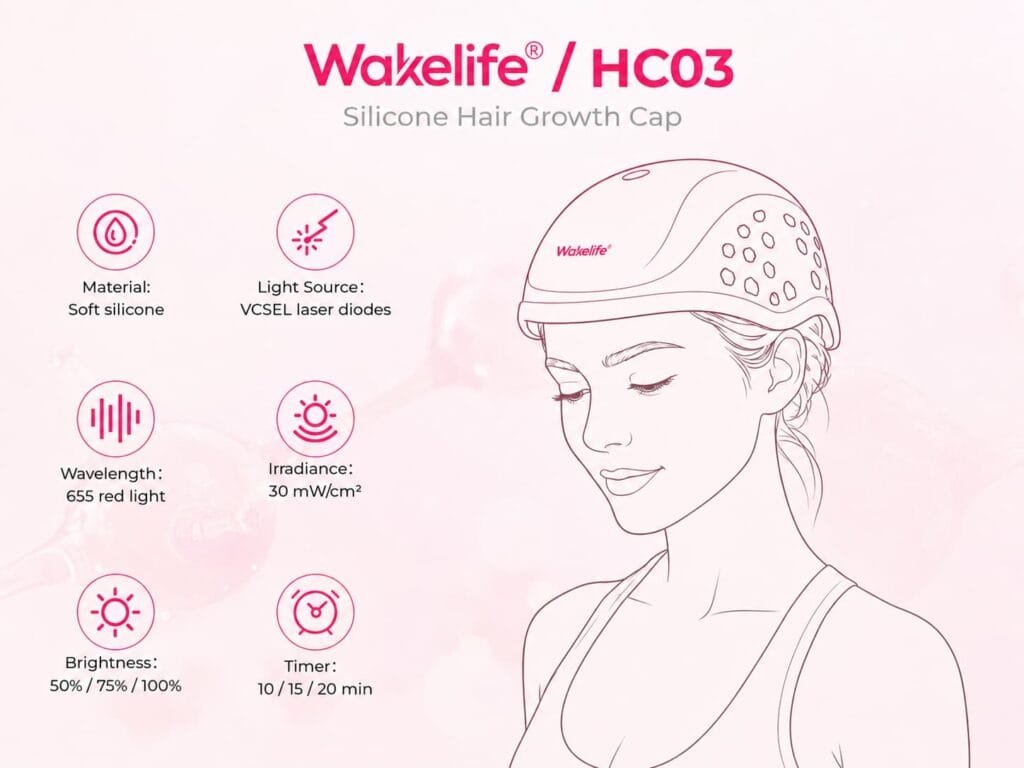
| VCSEL array | Compact laser-array integration and an alternative emitter architecture for caps, helmets and combs | Exact part identification, spectrum, per-emitter output, divergence/beam profile, array uniformity, thermal drift, finished-product laser classification and fault testing | Deeper penetration, more precision, better uniformity or better hair outcomes without direct comparative data |
The FDA’s laser-product overview distinguishes LEDs from laser diodes and explains that U.S. laser products are subject to applicable radiation-performance requirements. It also states that laser products used for medical applications must comply with applicable medical-device regulations. For a U.S. laser project, those are parallel checks; a medical-device record does not replace finished-product laser-radiation documentation, and laser documentation does not replace an applicable medical-device market pathway.
From a sourcing perspective, VCSEL remains a laser architecture. A supplier should not move a VCSEL product into an “LED-only” safety file merely because the emitters are small or arranged in a dense array.
Does Published LLLT Research Prove a Quoted Device Works?
No. Published evidence can support the product category, but the relevance of a study depends on the studied device, population, output, protocol and claim.
A 2021 systematic review and meta-analysis of home-use low-level light therapy devices included seven double-blind randomized controlled trials with 607 participants. The studied devices showed greater hair-density improvement than sham controls, but the review also described variation among devices and protocols, relatively short follow-up, and no direct head-to-head comparison between products.
That distinction changes how a brand should use research:
| Evidence layer | What it can support | What it cannot support by itself |
|---|---|---|
| Category-level systematic review | The broader low-level light/laser hair-growth category has human research | A newly quoted model produces the same result |
| Study of a named exact device | Findings for that device, population and protocol | Every product with a similar wavelength or shape |
| Finished-device optical and safety reports | Output, classification and tested conditions for the named configuration | Clinical hair-growth outcomes unless designed to establish them |
| Usability and fit validation | Whether intended users can wear, position, clean and operate the product as designed | Biological efficacy |
| Market authorization and labeling | What the named device and holder may support in the identified market | Different models, changed claims or unassessed custom configurations |
The FTC’s Health Products Compliance Guidance tells marketers to consider both express and implied messages and to ensure that support is scientifically sound and relevant to the specific product and advertising claim. A supplier’s research folder is therefore not enough. The buyer must map every planned product claim to evidence that is relevant to the quoted configuration.
Buyer rule: similar wavelength is a reason to investigate a device, not a substitute for exact-device evidence.
For a fuller review of human evidence, diagnosis boundaries, mechanism limits, wavelength assumptions and claim wording, continue with LLLT and Red Light for Hair Loss: Evidence, Limits and Claim Boundaries.
Which Documents Should a Hair-Growth Device Manufacturer Provide?
Ask what each document proves, what model it covers and what changed after it was issued. A folder of logos and certificates is not a usable evidence package.
| Evidence layer | What it should show | What it does not automatically show | Buyer action |
|---|---|---|---|
| Controlled specification and configuration list | Exact model, light sources, electronics, battery, adapter, firmware, accessories and tolerances | Market authorization or batch consistency | Match every quoted item to the signed sample and purchase specification |
| Optical performance file | Spectrum, irradiance under stated conditions, spatial distribution, modes, stability and measurement method | Clinical result or authorization | Check distance/plane, instrument, aperture, min/max/average, mode and full-session behavior |
| Laser / photobiological safety file | Applicable finished-product assessment, classification, labels, warnings and tested configuration | Efficacy or coverage of later modifications | Confirm exact model, all active modes, accessories, standard edition and report date |
| Electrical, EMC and battery file | Electrical safety, electromagnetic compatibility, charging and transport evidence as applicable | Hair-growth performance | Match adapter, battery, controller, intended environment and target-market needs |
| Quality-system evidence | Named manufacturing site, certificate scope, issuer and validity | Product approval, clearance or optical performance | Verify site and scope; do not treat a QMS certificate as product authorization |
| Market-authorization record | Holder/applicant, device name, exact model family, intended use and market status | Other markets, broader claims or every private-label variation | Verify the official database, decision/certificate, IFU and model mapping |
| Labeling and instructions | Intended user, setup, operating limits, warnings, contraindications, cleaning and maintenance | That the instructions are clinically or legally adequate for every market | Review against the final claims, sample, reports and importer/distributor duties |
| Change-control statement | Differences between standard sample, quoted unit and planned production | That every change is acceptable without retesting or regulatory review | Require written impact assessment before approving optical, firmware, material or claim changes |
What does an FDA record prove for a U.S. project?
The FDA’s current OAP product-classification page describes the generic type “laser, comb, hair” as Class II with a 510(k) submission type. OAP is therefore a generic classification starting point for a U.S. laser-comb project, not a clearance for any quoted model. A helmet or cap project must be classified independently by checking the applicable product code, exact official record, intended use and labeling; OAP should not be transferred from a comb to another form factor.
The FDA explains that a 510(k) is a substantial-equivalence premarket submission. The exact intended use, technological characteristics, performance information and modifications matter. Separately, the FDA states that establishment registration and device listing do not denote approval, clearance or authorization.
For a step-by-step K-number, model, indication, labeling and private-label check, use Wakelife’s FDA-cleared hair-growth device verification guide. Do not approve a U.S. medical claim from a certificate screenshot, an establishment number or another product’s K number.
What Is the Difference Between Private Label, OEM and ODM?
Define the actual changes instead of relying on the sales label. Suppliers use private label, OEM and ODM differently, but regulators, laboratories and quality teams evaluate what changed in the finished product.
| Project type | Typical scope | Main evidence question | Practical control |
|---|---|---|---|
| Private label | Existing hardware with buyer branding, packaging and agreed labeling | Does the exact device and labeling remain within the applicable authorized/tested scope, and what are the buyer’s market responsibilities? | Create a model/brand/label mapping and approve final artwork against the evidence package |
| OEM platform change | Existing platform with selected hardware, firmware, optical, accessory or industrial-design changes | Which reports, risk controls, labels or market records are affected? | Require a change list and written test/regulatory impact assessment before sample approval |
| ODM development | New or substantially redesigned hardware, optics, controls, firmware or intended use | What new design, verification, validation and market work is required? | Lock design inputs, evidence plan, ownership, milestones and change control before tooling |
The FDA’s 510(k) overview notes different responsibilities for manufacturers, specification developers, repackagers and relabelers, and explains that changes affecting safety, effectiveness or intended use may require a new 510(k). That does not produce one universal answer for every private-label arrangement. It means the parties should document the exact role, device, labeling and changes and obtain qualified regulatory review where the decision is not clear.
Three questions prevent most scope confusion:
- What is physically or digitally changing? Include light source, layout, output, timer, firmware, controller, battery, adapter, materials, accessories and app behavior.
- What is changing in the intended use or claim? Include product name, packaging, website copy, instructions, channel and target population.
- Which existing evidence names or covers the final configuration? Require exact-model mapping instead of a verbal promise that the project “uses the same certificate.”
How Should a Buyer Approve a Hair-Growth Device Sample?
A sample that powers on is not an approved sample. Approve it only after the physical unit, controlled specification, test evidence and planned labeling describe the same configuration.
Use this ten-part scorecard:
| Sample check | What to record | Hold the project when |
|---|---|---|
| 1. Identity | Model, revision, serial/sample number, firmware and accessories | The supplier cannot map the sample to a controlled specification |
| 2. Fit and placement | Head-size range, pressure points, movement, comb reach or insert alignment | Intended users cannot position the product repeatably |
| 3. Light configuration | Source count, wavelength channels, active modes and control behavior | The sample differs from the quote, report or UI description |
| 4. Optical output | Measurement method, defined plane/distance, spatial map and session stability | Only a peak or per-emitter number is supplied without conditions |
| 5. Safety controls | Interlocks, wear detection, timer, fault response, labels and warnings | A marketing phrase such as “eye-safe” replaces the report and fault evidence |
| 6. Thermal behavior | Skin-contact and housing temperature during worst-case operation | Heat changes output, comfort or component behavior beyond the agreed limit |
| 7. Power system | Runtime, charge time, charger/adapter, low-battery behavior and transport file | Results have no test conditions or the battery/adapter differs from the evidence |
| 8. Cleaning and durability | Wipe/wash boundary, sweat exposure, flex cycles, connector strain and drop handling | Cleaning instructions conflict with the electrical construction or no boundary is defined |
| 9. Labeling and instructions | Intended use, controls, limits, warnings, maintenance and market wording | Copy claims more than the evidence or authorization supports |
| 10. Document consistency | Exact model, revision, accessories, modes and dates across all files | Reports, sample and final quote describe different configurations |
Use a simple decision rule:
- Pass to pilot: the sample and documents match, critical risks are controlled, and only agreed commercial details remain.
- Hold: required evidence or test conditions are missing, but the configuration is still traceable and the supplier has a defined closure plan.
- Reject or rescope: the supplier substitutes unrelated certificates, refuses exact-model mapping, changes critical specifications without control or asks the buyer to market claims that the evidence does not support.
What Should Go Into a Hair-Growth Device RFQ?
A useful RFQ tells the manufacturer what decision the quote must support. Copy and complete the following list:
- Target country or countries: ________
- Primary channel: DTC / retail / distributor / salon / clinic / other ________
- Intended customer and use environment: ________
- Planned product positioning and exact claims under consideration: ________
- Preferred form factor: rigid helmet / integrated cap / modular cap / comb / open to recommendation
- Preferred source architecture: LED / laser diode / VCSEL / open to evidence-based recommendation
- Required user workflow: hands-free / targeted placement / portable / supervised / other ________
- Standard platform or requested changes: logo / packaging / UI / app / timer / optical layout / housing / accessories ________
- Target price, first order quantity and 12-month forecast: ________
- Required sample date and launch window: ________
- Documents required for the exact quoted model and target market: ________
- Please identify every difference between the standard model, quoted sample and proposed production configuration, and state which reports or market records are affected.
Attach a one-page claim brief and a configuration table if the project is beyond basic private label. This gives engineering, quality, regulatory and sales teams the same starting point and reduces late-stage rework.
Which Wakelife Product Path Can a Buyer Explore?
Use the product path that matches the workflow, then complete exact-model due diligence before approval.
- Explore the current laser and LED hair-growth device range for helmet, cap and comb options.
- For a rigid helmet platform, review the T01 VCSEL hair-growth device, then verify the exact quoted configuration, finished-device reports and target-market status.
- For a dual-wavelength LED cap platform, review the C01 LED hair-growth cap and confirm the final configuration, test conditions and intended positioning for the destination market.
- For a flexible integrated laser cap, review the HC03 product page and its sample-and-document sourcing guide.
- For a portable handheld platform, review the HT01 product page and its optical, safety and RFQ sourcing guide.
- For U.S. claims and document verification, follow the FDA-cleared hair-growth device verification guide before approving the K number, labeling or private-label scope.
If the current standard platforms do not match the brief, send the target market, channel, user workflow, claims, preferred form factor, customization list and forecast to Wakelife. That information is enough for a first platform recommendation and gap review; a buyer does not need to finalize every optical specification before starting the discussion.
Frequently Asked Questions
Is a higher emitter count always better?
No. Emitter count does not by itself establish scalp coverage, irradiance, fluence, uniformity or clinical performance. Compare the array geometry, active modes, measurement plane, spatial map, stability and user fit. Request a finished-device report rather than ranking products from the largest number on a product page.
Is VCSEL better than LED for a hair-growth device?
There is no universal answer from the source label alone. VCSEL is a laser architecture and changes the engineering and safety questions, but superiority in penetration, coverage or hair outcomes requires direct comparative evidence. Choose based on the exact design, output, safety file, claims and commercial brief.
Does the same wavelength mean two devices can use the same evidence?
No. Wavelength is only one part of the exposure. Source type, output, beam profile, array geometry, distance, coverage, session time, controls, population and protocol can all differ. Treat a similar wavelength as category context, not product equivalence.
Can a private-label brand rely on a manufacturer’s 510(k)?
Possibly in a properly structured unchanged-device arrangement, but “private label” alone does not answer the question. Verify the 510(k) holder, exact model, intended use, labeling, manufacturer/importer roles and every planned change. Escalate new claims, hardware/firmware changes or unclear model mapping to qualified regulatory review.
Which form factor is best for a clinic?
The clinic workflow decides the format. Evaluate who operates the device, whether use is supervised, cleaning between users, fit range, session management, instructions, evidence and target-market status. A consumer-looking cap can still have a demanding evidence burden, while a rigid helmet is not automatically a professional device.
What information should a buyer send first?
Send the target market, channel, intended user, planned claims, preferred workflow, required changes, target price, order quantity and launch timing. Those inputs let the manufacturer recommend a platform and identify evidence gaps before the buyer spends time choosing emitter counts or cosmetic details.
Final Buyer Decision
Choose the manufacturer that can keep four things aligned: the intended user, the exact product, the evidence package and the final claims. The most impressive hardware list is not valuable if the form factor does not fit the customer or the documents do not map to the production configuration.
Start with the zero-cost step: copy the RFQ list above and complete the target market, channel, claims and preferred workflow. Then compare one or two form factors through a controlled sample and evidence review. When the project brief is ready, contact Wakelife’s OEM/ODM team to discuss a standard platform, private-label program or custom development path.
References
-
1
Lueangarun S, et al. A Systematic Review and Meta-analysis of Randomized Controlled Trials of United States Food and Drug Administration-Approved, Home-use, Low-Level Light/Laser Therapy Devices for Pattern Hair Loss. Journal of Clinical and Aesthetic Dermatology. 2021.
-
2
U.S. Food and Drug Administration. Product Classification: OAP, laser, comb, hair.
-
3
U.S. Food and Drug Administration. Premarket Notification 510(k).
-
4
U.S. Food and Drug Administration. Are There “FDA Registered” or “FDA Certified” Medical Devices?.
-
5
U.S. Food and Drug Administration. Laser Products and Instruments.
-
6
U.S. Federal Trade Commission. Health Products Compliance Guidance.
-
7
Wakelife. Laser and LED Hair-Growth Device Range.
- 8
-
9
Wakelife. T01 VCSEL Hair Growth Device.
-
10
Wakelife. C01 Dual-Wavelength LED Hair Growth Cap.
-
11
Wakelife. HC03 Silicone VCSEL Laser Hair Growth Cap.
- 12
-
13
Wakelife. HT01 VCSEL Laser Hair and Scalp Care Comb.
- 14
- 15