TL;DR for buyers
- BK300 is the compact option for targeted-area product concepts, demonstrations and projects where a smaller equipment footprint matters.
- BK900 is the middle format for buyers who need a longer housing without independent zone control and will validate the required coverage on a sample.
- BK1800 is the large-area option for projects that need full-, upper- or lower-zone selection and more installation choices.
- Published irradiance values should not be used to rank the three models until they are measured under the same mode, spectral range, distance, plane and averaging method.
- The BK models do not currently have a model-specific FDA 510(k), and UV-emitting tanning devices carry established health risks. For U.S. projects, registration or listing does not replace applicable premarket and radiation requirements; warnings, labeling, eyewear and exposure controls belong in the product definition.
Quick Answer: How Do the Three BK Models Differ?
The main choice is not simply small, medium or large. It is the operating format the buyer needs to validate.
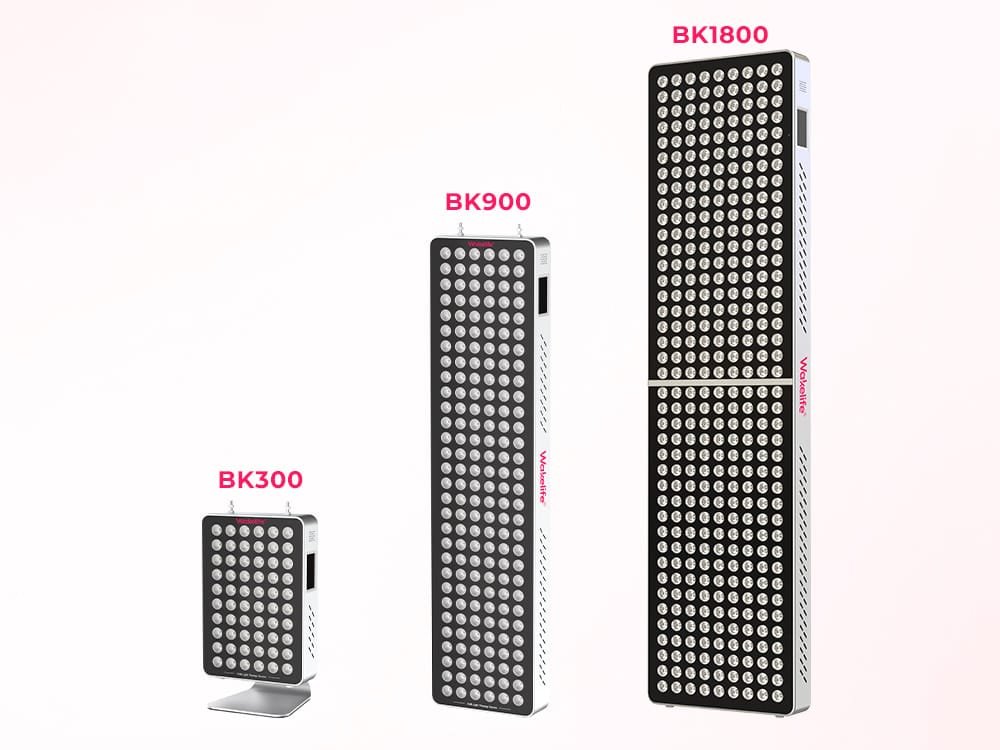
BK300 is a compact desktop or hanging panel. BK900 extends the panel length and adds floor-stand use, but it still operates without independent zones. BK1800 adds the largest housing, three selectable emission areas and wall-mounting as an additional installation route.
That makes the initial sourcing decision relatively straightforward:
| Buyer requirement | Model to evaluate first | Reason |
|---|---|---|
| Compact product, targeted positioning or lower space demand | BK300 | Smallest housing and desktop/hanging installation |
| Longer panel without zone-management requirements | BK900 | Intermediate panel length and floor-stand/hanging options |
| Large-area format with selectable upper/lower operation | BK1800 | Full, upper and lower zone control plus floor, hanging and wall installation |
This is only a shortlist—not a performance conclusion. Physical size, LED count and electrical power do not establish UV dose, coverage uniformity, tanning outcome or safety. Those questions require comparable exact-model testing.
Side-by-Side BK300, BK900 and BK1800 Specifications
The following figures are supplier-declared specifications from the current Wakelife product pages. They are useful for defining a sample and RFQ, but they are not a substitute for controlled optical, electrical, thermal or regulatory records.
Before comparing models, review the UVB tanning panel sourcing guide to define the intended use, destination market, exact configuration and required evidence.
| Specification | BK300 | BK900 | BK1800 |
|---|---|---|---|
| LED packages | 60 | 180 | 360 |
| Rated electrical power | 108 W | 355 W | 514 W |
| Nominal wavelengths | 295 / 311 / 415 / 630 / 660 / 810 / 830 / 850 / 1060 nm | Same configuration | Same configuration |
| Housing size | 320 × 220 × 65 mm | 890 × 220 × 65 mm | 1190 × 310 × 65 mm |
| Approximate weight | Not published on current product page | Not published on current product page | 15.8 kg |
| Declared beam angle | Not published on current product page | Not published on current product page | 30° |
| Declared irradiance at 3 inches (≈76 mm) | 130–150 mW/cm² | 160–180 mW/cm² | 116 mW/cm² |
| Timer control range | 5–20 min | 5–20 min | 5–30 min |
| Brightness control | 0–100% | 0–100% | 0–100% |
| Pulse settings | 0–40 Hz | 0–40 Hz | 10 / 20 / 30 / 40 Hz in custom mode |
| Independent zone control | No | No | Full / upper / lower |
| Installation | Desktop / hanging | Floor stand / hanging | Floor stand / hanging / wall mounting |
| IP rating | IP20 | IP20 | IP20 |
Not published means the value is absent from the current public model page; it is not a zero value or confirmation that the models differ. Request the dated specification for the exact quoted configuration before using weight or beam angle in a commercial comparison.
Two qualifications are essential when reading the table.
First, rated wattage is electrical input, not optical output. A higher wattage or larger LED count does not by itself prove that more UVB reaches the skin, that coverage is more uniform or that the device produces a faster result.
Second, the published mW/cm² figures do not yet identify whether the measurement covers all wavelengths or UVB only, which program and brightness were active, or whether the number is a center-point, peak or area average. BK1800’s published 3-inch value is lower than BK900’s even though BK1800 has more LED packages and higher rated power. That is not necessarily an error; it shows why the current figures should not be turned into an output ranking.
When Does BK300 Make Sense?
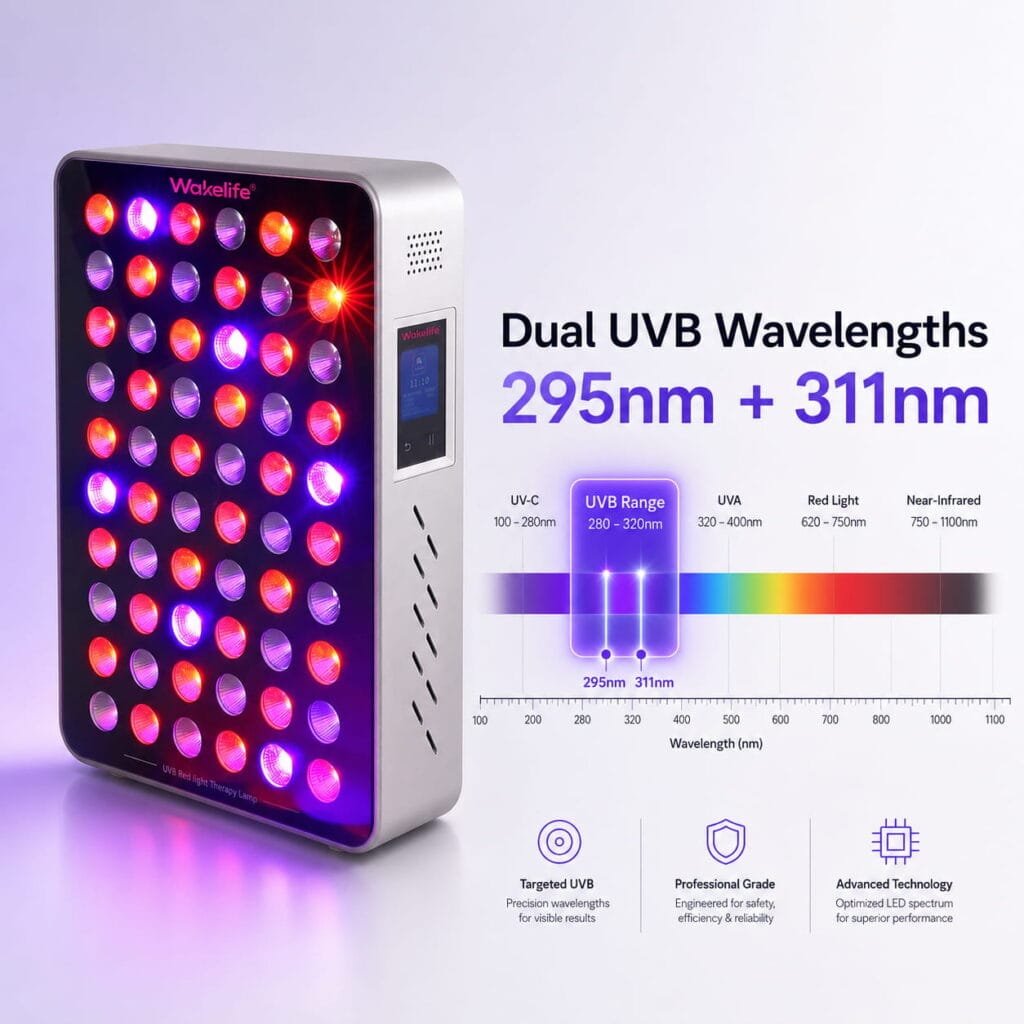
BK300 is the most practical starting point when compactness and targeted-area positioning matter more than broad simultaneous coverage.
The current supplier page lists a 320 × 220 × 65 mm housing with desktop and hanging installation. That can suit distributors or private-label brands testing a smaller-format product, as well as studios that want a demonstration or targeted-area setup with a limited equipment footprint.
BK300 may be appropriate when:
- a compact shipping and display format is commercially important;
- the planned use concept does not require upper/lower zone selection;
- the buyer wants to begin with a smaller sample before evaluating a larger installation;
- the operating space does not accommodate a long floor-mounted panel.
The smaller housing should not be described as a lower-risk or lower-dose option without comparable testing. Buyers still need the spectral report, measurement map, warning labels, eyewear specification and target-market review for the exact configuration.
When Does BK900 Make Sense?
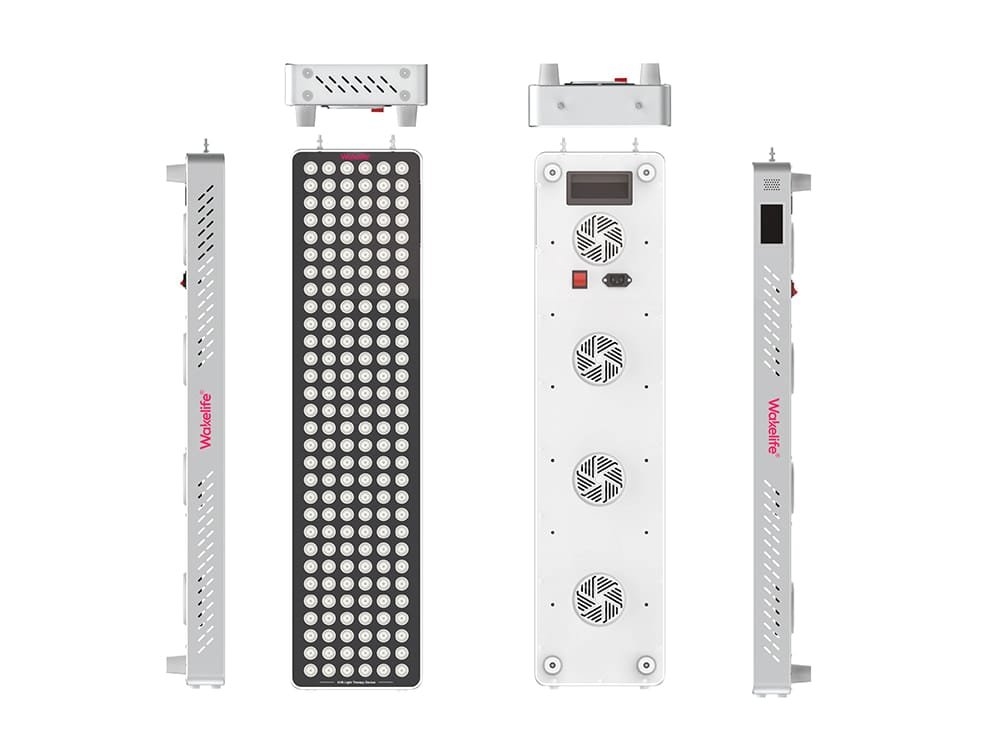
BK900 fits projects that need a longer panel and floor-stand use but do not require independently selectable zones.
The current supplier page lists an 890 × 220 × 65 mm housing and 180 LED packages. Its longer housing creates a different physical format to validate from BK300, while the controls remain simpler than BK1800’s zoned architecture.
BK900 may be the more efficient model to evaluate when:
- the buyer wants a longer format than BK300;
- floor-stand or hanging installation fits the planned operating area;
- independent upper/lower control is not part of the business concept;
- the project needs a middle-range product between a compact device and the largest zoned model.
Do not translate the declared 160–180 mW/cm² at 3 inches into a session recommendation. A useful sample report must identify the spectral range measured, operating mode, brightness, pulse state, warm-up condition, instrument, calibration, measurement grid and uncertainty.
When Does BK1800 Make Sense?
BK1800 is the model to evaluate when large-area hardware, selectable zones and installation flexibility are core project requirements.
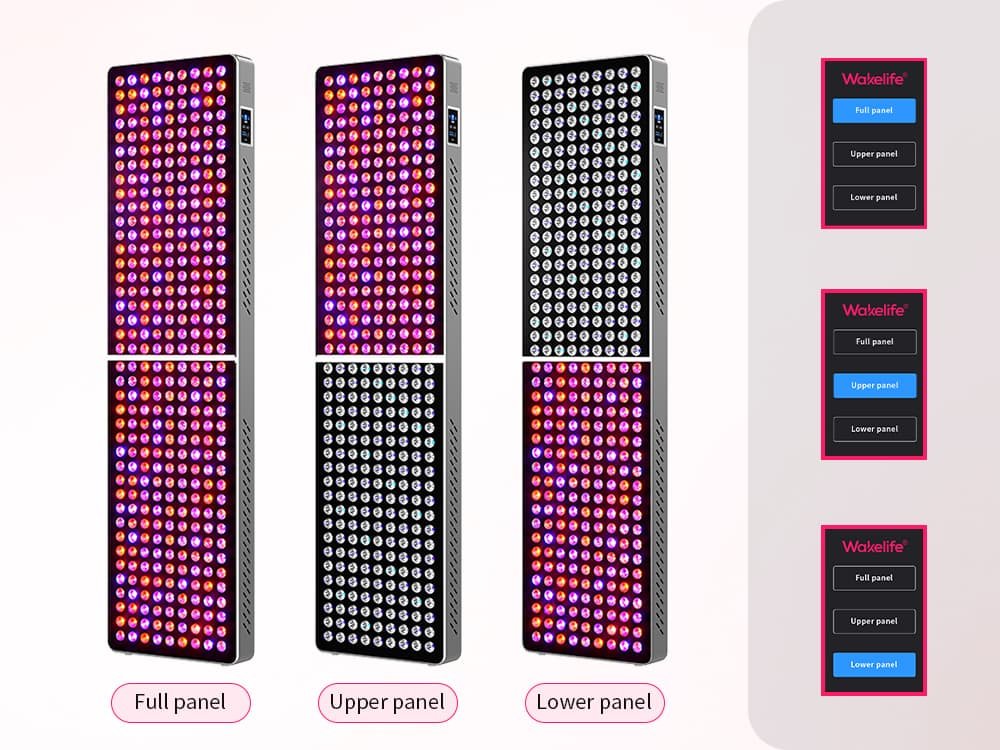
The current supplier page lists a 1190 × 310 × 65 mm housing, 360 LED packages and a declared 30-degree beam angle. It also describes full-, upper- and lower-panel selection, plus floor-stand, hanging and wall-mounting options.
BK1800 may fit buyers who need:
- a large-area product platform;
- upper- and lower-zone selection as an operational feature;
- multiple installation paths for different studio or distributor projects;
- a flagship-format private-label product with more complex control requirements.
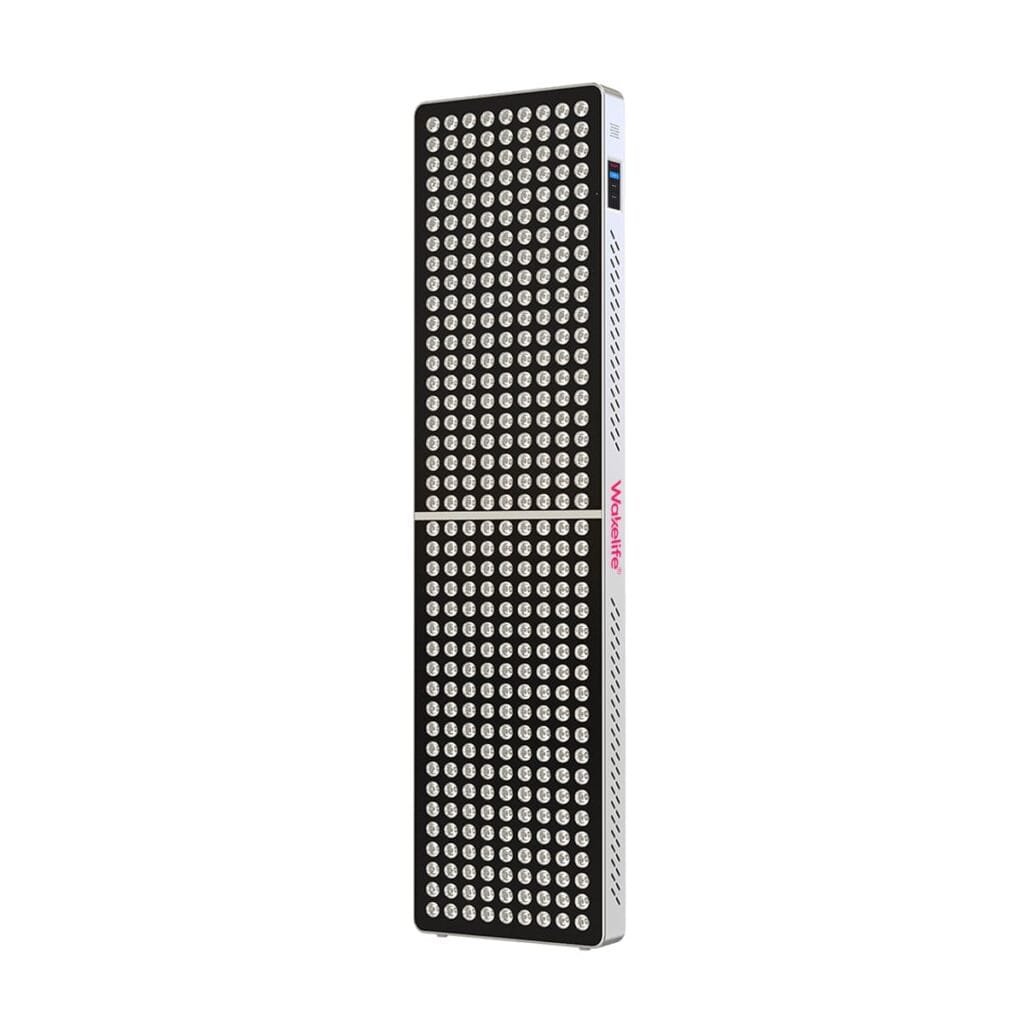
Zone selection also creates additional validation work. Before approval, request output maps for the full, upper and lower settings, including zone boundaries, inactive-area leakage, sensor interaction, restart behavior and fault conditions. The presence of zone control does not prove that each mode delivers a uniform or validated exposure.
What Do the Wavelengths and Preset Names Actually Establish?
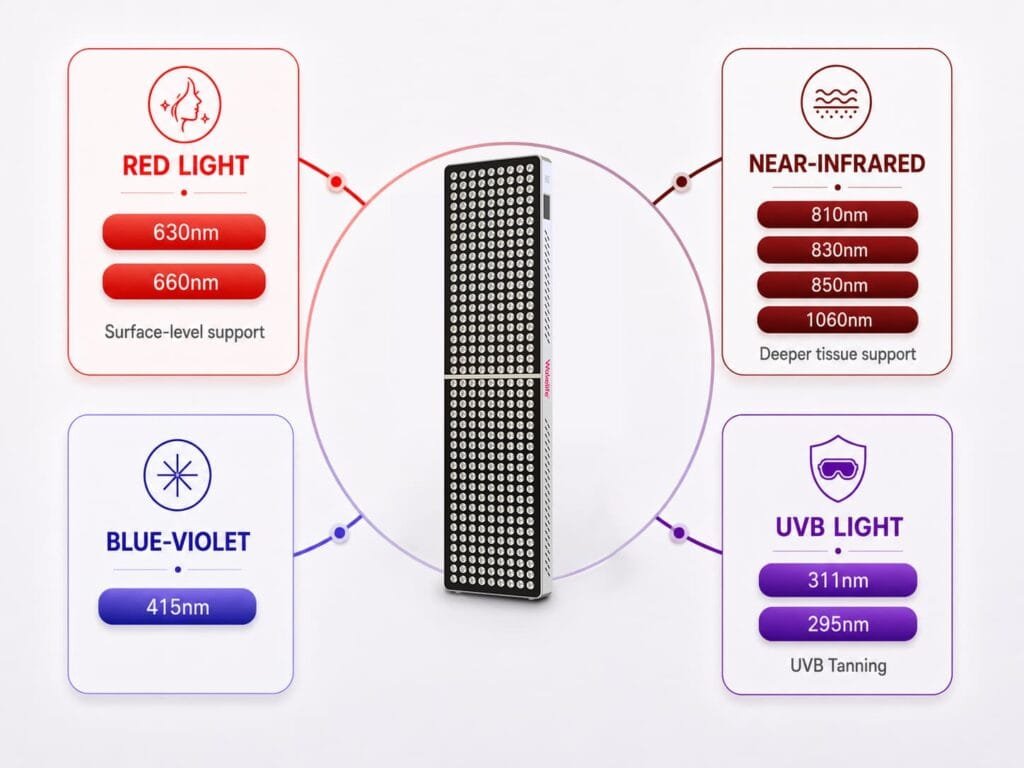
They establish the nominal hardware and interface configuration—not a set of proven outcomes.
The current BK pages list nominal wavelengths of 295, 311, 415, 630, 660, 810, 830, 850 and 1060 nm. The two UV wavelengths fall within the UVB region; the World Health Organization generally defines UVB as 280–315 nm. The remaining wavelengths span visible blue, red and near-infrared regions.
A multi-wavelength list does not reveal:
- the optical power allocated to each wavelength;
- wavelength tolerance or spectral bandwidth;
- which channels operate in each preset;
- irradiance at the relevant use plane;
- spatial uniformity across the treatment area;
- the biological effect of the finished device.
The current interface also contains preset names such as “Tanning,” “Skin Collagen,” “Muscle Recovery,” “Decrease,” “Acne Care” and “Bone Health,” plus a custom mode. These should be treated as UI labels. Without exact-device evidence and market-specific claim review, they should not be presented as proven skin, muscle, acne, vitamin D or bone-health benefits. “Decrease” is transcribed from the current BK product pages, but the word is semantically incomplete; buyers should confirm the final firmware label or replace it with neutral, descriptive wording before approving the UI.
Why Irradiance Cannot Yet Be Used to Rank the Models
Irradiance becomes comparable only when the spectral and measurement conditions are comparable.
For each model, ask whether the published value is:
- UVB-only irradiance or combined broadband irradiance;
- measured in a specific preset or with all channels active;
- measured at 100% brightness and continuous output;
- a peak, center-point, minimum or spatial average;
- measured at the housing, LED surface or intended exposure plane;
- supported by a calibrated detector suitable for the reported spectral range.
Also request a measurement grid, detector details, calibration date, uncertainty and the optical state after warm-up. For BK1800, the full, upper and lower settings need separate maps.
This matters because irradiance is not the same as radiant exposure. Radiant exposure depends on irradiance over time, while a valid UV risk assessment may also require wavelength weighting. The current control ranges therefore must not be converted into a buyer-facing UV dose or exposure schedule from the product-page figures alone.
Why UV Risk Must Stay Visible in a Sourcing Comparison
Engineering controls can reduce specific hazards, but they do not turn UV tanning into a risk-free product category.
The International Agency for Research on Cancer classifies UV-emitting tanning devices as carcinogenic to humans. The European Commission’s SCHEER scientific opinion concluded that UV radiation from sunbeds causes cutaneous melanoma and squamous-cell carcinoma and that there is no safe exposure limit for the carcinogenic effects of UV radiation from sunbeds.
These are category-level risk conclusions. They do not prove that the three BK models have identical spectral output or risk, and they cannot be used to calculate an individual exposure plan. They do mean a B2B comparison should never equate a timer, sensor, selectable zone or protective-eyewear accessory with a general safety guarantee. Product design, labeling, operator controls, user restrictions and destination-market review must be assessed together.
What Safety Controls Need Exact-Model Verification?
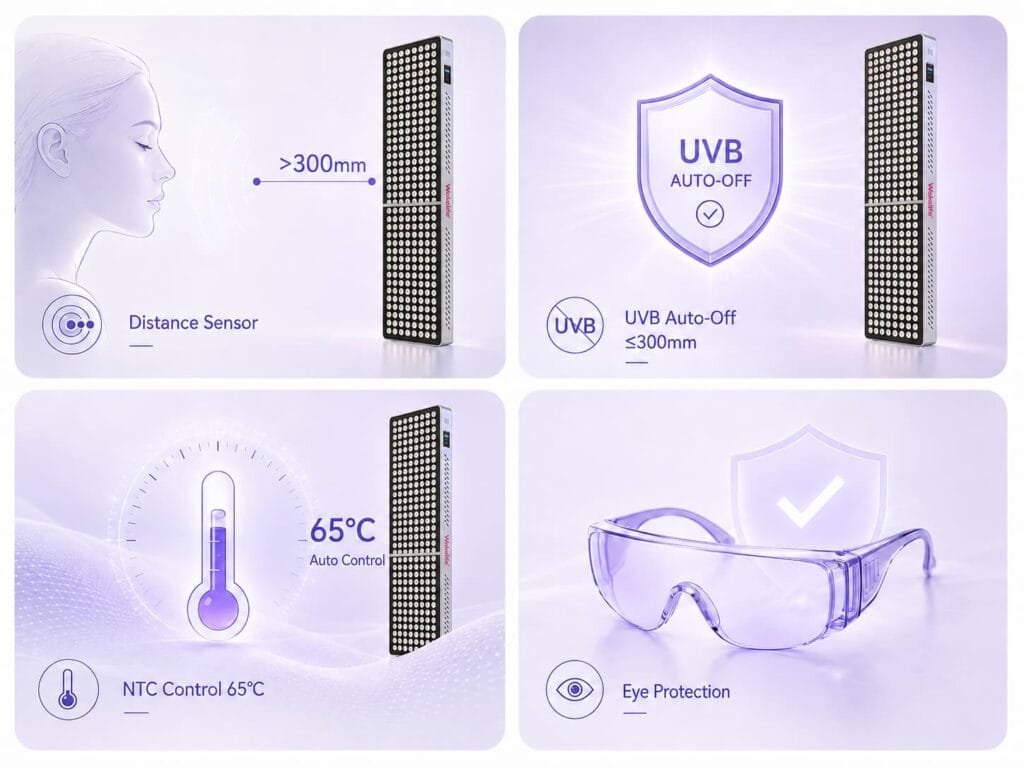
The product pages describe several engineering controls: an audible warning and UVB shutoff when a user is detected within 300 mm, power reduction above a declared internal-temperature threshold of 65°C, timer/manual controls and protective eyewear.
These are relevant design features, but their presence does not establish that the finished product is safe or compliant. Exact-model verification should cover:
- Proximity detection: sensor field, detection reliability, response time, restart logic, objects or body positions that may not be detected, bypass and single-fault conditions.
- Thermal behavior: maximum setting, longest permitted operation, repeated operation, ventilation clearances, installation orientation and abnormal conditions.
- Timer and controls: timer accuracy, manual termination, power interruption, restart, control lock and foreseeable misuse.
- Protective eyewear: exact eyewear model, spectral transmittance across the product output, quantity, fitting instructions, inspection and replacement criteria.
- Mechanical installation: stand stability, tip-over testing, hanging and wall-load requirements, fasteners and service clearances.
- Labels and instructions: warning language, exposure position, target-market language, operating limitations and configuration-specific instructions.
For applicable non-medical skin-exposure appliances, IEC 60335-2-27:2024 was published in 2024 as the seventh international edition, replacing the sixth edition published in 2019; a corrected version was issued in January 2026. Buyers should not assume that publication of a new IEC edition automatically changes the national or harmonized EN edition used in every destination market; the applicable adoption, deviations and transition dates must be checked for the project.
For EU projects, the current consolidated harmonized-standards list available on August 12, 2026 lists EN 60335-2-27:2013 with A1:2020, A2:2020 and AC:2021-11 with a restriction. Under Commission Implementing Decision (EU) 2025/1457, the specified notes in clause 6 and Annex BB do not confer a presumption of conformity with the relevant Low Voltage Directive safety objectives. The European Commission’s sunbed summary describes a 0.3 W/m² limit for total erythema-weighted UV irradiance under this standard family. This weighted limit is not directly comparable with the product pages’ unweighted mW/cm² figures. A spectral measurement and the prescribed erythema weighting are needed before assessing the exact model against it.
All three models are currently listed as IP20. They should therefore be planned for the indoor environment and cleaning limitations defined in the final instructions; IP20 is not a water-resistance claim.
What Does the Lack of a Model-Specific 510(k) Mean for U.S. Buyers?
BK300, BK900 and BK1800 do not currently have a model-specific FDA 510(k), so buyers should not treat them as cleared for U.S. tanning-device marketing.
The FDA describes sunlamp products intended to irradiate the body with ultraviolet radiation in the 200–400 nm range to induce tanning as both medical devices and electronic products. The current FDA classification record for sunlamp products identifies them as Class II devices under 21 CFR 878.4635 with a 510(k) submission type.
Separately, 21 CFR 1040.20 contains electronic-radiation requirements addressing matters such as timers, manual termination, protective eyewear, labels, exposure schedules, instructions and test conditions.
The current 21 CFR 878.4635 special controls also require a prominent black-box product warning stating that a sunlamp product should not be used on persons under 18. The 2014 FDA final order specifies the label format and text, while the FDA’s tanning-products overview summarizes the under-18 labeling requirement. State and operator restrictions remain a separate jurisdiction-specific check; the federal labeling requirement should not be presented as the complete U.S. age-access analysis.
The same final order separately requires four contraindication or warning statements in the user instructions and in consumer-directed catalogs, specification sheets, descriptive brochures and sales webpages: the product is contraindicated for persons under 18 and when skin lesions or open wounds are present; it should not be used by people with a personal or family history of skin cancer; and people repeatedly exposed to UV radiation should be regularly evaluated for skin cancer. For a U.S. launch, this means webpage and sales-material review is part of the labeling work—not only a manual check.
For that reason:
- an FDA-registered manufacturing establishment does not mean the factory or the BK models are FDA approved or cleared;
- a device-listing statement does not replace a model-specific premarket pathway;
- a timer, proximity sensor or pair of protective glasses does not by itself establish compliance with the applicable requirements;
- any U.S. project needs a documented product classification, intended-use and regulatory assessment before launch.
This does not prevent a buyer from discussing a development project or evaluating a sample. It does mean the RFQ should separate product development from market authorization, including who is responsible for testing, submissions, labeling and revalidation after customization.
What Should Buyers Request Before Approving a Sample?
Use one controlled checklist across all three models:
| Verification item | What the supplier should identify |
|---|---|
| Configuration control | Model, BOM/configuration ID, firmware and UI revision |
| Spectral output | Full spectrum, 295/311 nm tolerance and output contribution by wavelength/channel |
| Irradiance mapping | Mode, brightness, pulse, distance, plane, grid, uniformity, instrument, calibration and uncertainty |
| Zone testing | BK1800 full/upper/lower output plus boundary and fault-condition behavior |
| Safety-control testing | Proximity, thermal, timer, manual stop, restart and foreseeable-misuse results |
| Protective eyewear | Model, spectral transmittance, instructions and replacement specification |
| Mechanical installation | Stand, hanging and wall-mount load/stability requirements as applicable |
| Labels and manual | Warnings, exposure-position information, operating limits, applicable age warning and target-market language |
| Market documents | Exact model, report/certificate number, holder, scope, standard edition and validity |
| Customization impact | Which optical, thermal, EMC, safety, labeling or regulatory checks must be repeated |
For U.S. projects, add the exact regulatory pathway and, where applicable, 510(k), establishment/listing and electronic-radiation records. For other markets, request the exact-model documents required by the destination—not a generic factory certificate or a report for a different configuration.
Which Model Should Go Into Your RFQ?
Choose by operating format first, then verify the exact configuration before making performance or compliance claims.
- Shortlist BK300 for compact, targeted-area or lower-footprint concepts.
- Shortlist BK900 for a longer panel with floor-stand or hanging use and no need for independent zones.
- Shortlist BK1800 for large-area projects that genuinely benefit from full/upper/lower selection and multiple installation routes.
In the RFQ, state the destination market, intended commercial use, installation method, permitted claims, required UI language, sample configuration and documents expected before approval. That gives the manufacturer enough information to quote a controlled product rather than an undefined collection of features.
To move from model comparison to product-line review, explore the complete BK Series and review the current panel formats, shared platform features and UVB project pathways.
Contact Wakelife to discuss BK-series configuration, OEM/ODM requirements, sample validation and documentation scope. Any final market claim or authorization remains tied to the exact product, intended use and destination-market requirements.
Frequently Asked Questions
Which is the largest model: BK300, BK900 or BK1800?
BK1800 is the largest of the three by the housing size and LED package count declared on the current supplier pages. The BK1800 page lists 1190 × 310 × 65 mm and 360 LED packages. These figures establish its declared physical format, not a higher UV dose or better result.
Does BK1800 have higher irradiance than BK900?
The current published figures do not show that. BK1800 is listed at 116 mW/cm² at 3 inches, while BK900 is listed at 160–180 mW/cm² at 3 inches. Because the spectral range, mode, averaging and other test conditions are not fully disclosed, the figures should not be treated as a controlled performance comparison.
What is the main control difference between BK1800 and the smaller models?
The current supplier pages list full-, upper- and lower-zone selection for BK1800 and no independent zone control for BK300 or BK900. Buyers should request separate output maps and safety-logic tests for every BK1800 zone state.
Are BK300, BK900 and BK1800 FDA cleared?
No model-specific FDA 510(k) is currently available for BK300, BK900 or BK1800. An FDA-registered establishment or device-listing statement does not equal FDA approval or clearance. A U.S. tanning-device project requires an exact-model regulatory assessment before launch.
Do the preset names prove skin, muscle, acne or bone-health benefits?
No. The current preset names describe interface options. They do not establish exact-model clinical outcomes or authorized claims. Buyers should review the claim set, firmware wording, manual and packaging for the destination market.
What should a buyer compare before choosing a BK model?
Compare physical format, installation, zone control, sample-handling requirements and the supplier’s declared configuration first. Then verify spectral output, irradiance mapping, safety controls, eyewear, labeling and exact-model market documents before approving performance or compliance claims.
References
- 1
- 2
- 3
- 4
- 5
- 6
- 7
- 8
- 9
- 10
- 11
- 12
- 13