Introduction: Pourquoi le processus est important dans la fabrication de thérapie par la lumière rouge
Dans le secteur en croissance rapide des appareils de thérapie par la lumière rouge, de nombreuses marques se concentrent sur le design, commercialisation, ou fonctionnalités.
Mais un facteur critique est souvent négligé:
Le processus de développement de produits.
Chez Wakelife Beauty — un fabricant OEM de luminothérapie LED de qualité médicale fondé en 2015, avec 50+ R&D ingénieurs, 120+ brevets, et 1,000+ partenariats de marque mondiaux – nous avons observé une tendance claire au cours d’une décennie de fabrication:
La plupart des pannes de produits ne sont pas causées par la technologie. Ils sont causés par un manque de développement structuré.
Cet article partage les leçons concrètes de notre expérience de développement de produits tout au long du cycle de vie du produit (de la première conversation avec le client jusqu'au retrait du produit) et explique comment un processus structuré réduit les risques., améliore la qualité, et permet une production évolutive dans notre 20,000 Installation de m² à Shenzhen.
Partie 1 — Pourquoi nous avons construit un processus structuré (Et ce qui n'allait pas avant)
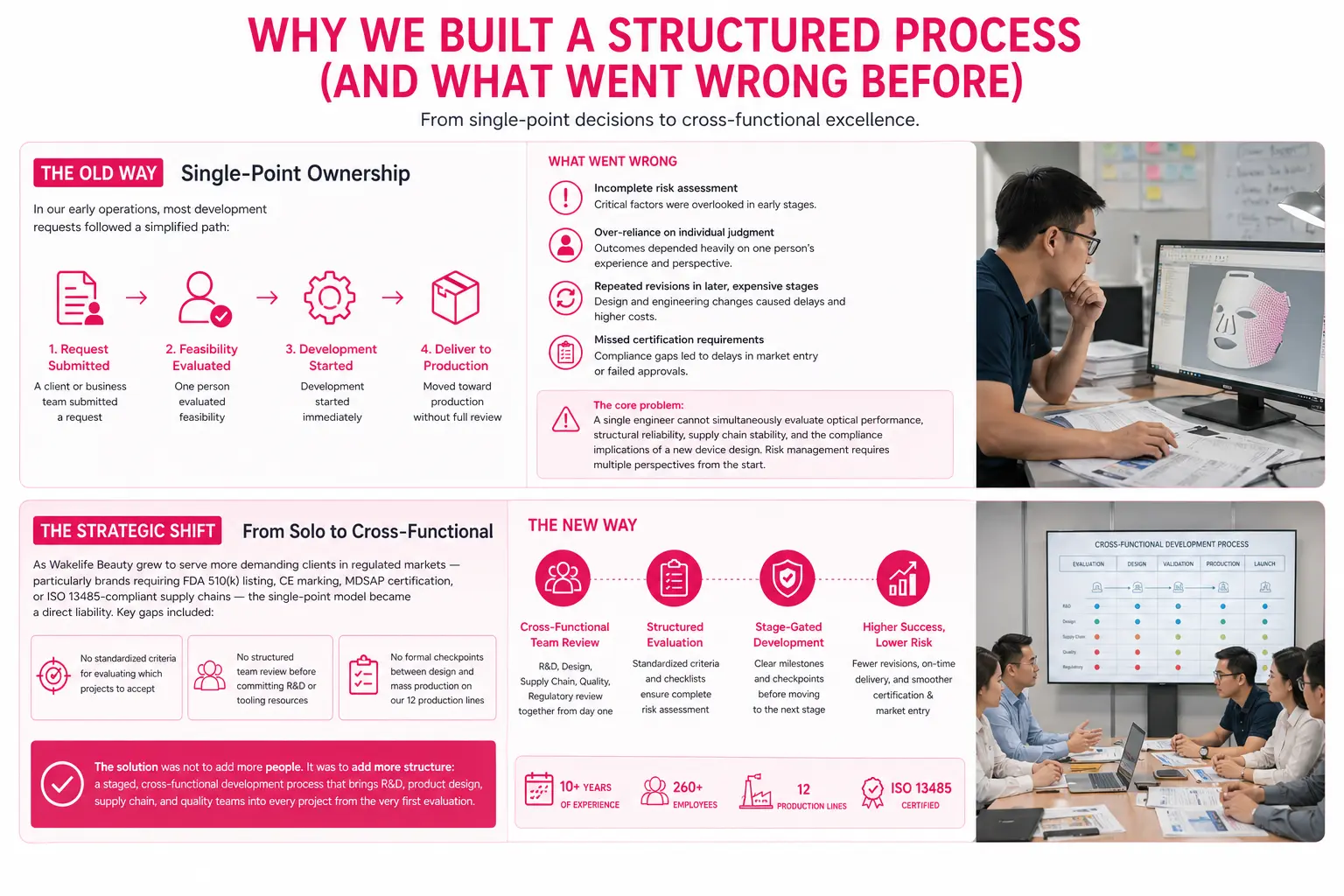
L'ancienne méthode: Propriété en un seul point
Dans nos premières opérations, la plupart des demandes de développement ont suivi un chemin simplifié:
- Un client ou une équipe commerciale a soumis une demande
- Une personne a évalué la faisabilité
- Le développement a commencé immédiatement
Cette approche semblait rapide. Mais dans le développement de produits de luminothérapie LED, qui s'étend à la conception optique, ingénierie des structures, électronique, et des exigences réglementaires de plus en plus complexes aux États-Unis, UE, ROYAUME-UNI, et en Australie – cela a constamment conduit à:
- Évaluation des risques incomplète
- Une confiance excessive dans le jugement individuel
- Révisions répétées plus tard, étapes plus coûteuses
- Exigences de certification manquées qui ont retardé l’entrée sur le marché
Le problème central: Un seul ingénieur ne peut pas évaluer simultanément les performances optiques, fiabilité structurelle, stabilité de la chaîne d'approvisionnement, et les implications en matière de conformité d'une nouvelle conception d'appareil. La gestion des risques nécessite dès le départ plusieurs perspectives.
Le changement stratégique: Du solo au cross-fonctionnel
À mesure que Wakelife Beauty grandissait pour servir des clients plus exigeants sur les marchés réglementés – en particulier les marques exigeant la FDA 510(k) inscription, Marquage CE, Certification MDSAP, ou chaînes d'approvisionnement conformes à la norme ISO 13485 : le modèle à point unique est devenu une responsabilité directe. Principales lacunes incluses:
- Pas de critères standardisés pour évaluer les projets à accepter
- Aucune revue structurée de l'équipe avant de valider R&D ou ressources d'outillage
- Aucun point de contrôle formel entre la conception et la production en série sur nos 12 lignes de production
La solution n'était pas d'ajouter plus de personnes. C'était pour ajouter plus de structure: une mise en scène, processus de développement transversal qui amène R&D, conception de produits, chaîne d'approvisionnement, et des équipes de qualité dans chaque projet dès la première évaluation.
Partie 2 - Scène 1: Confirmation des exigences
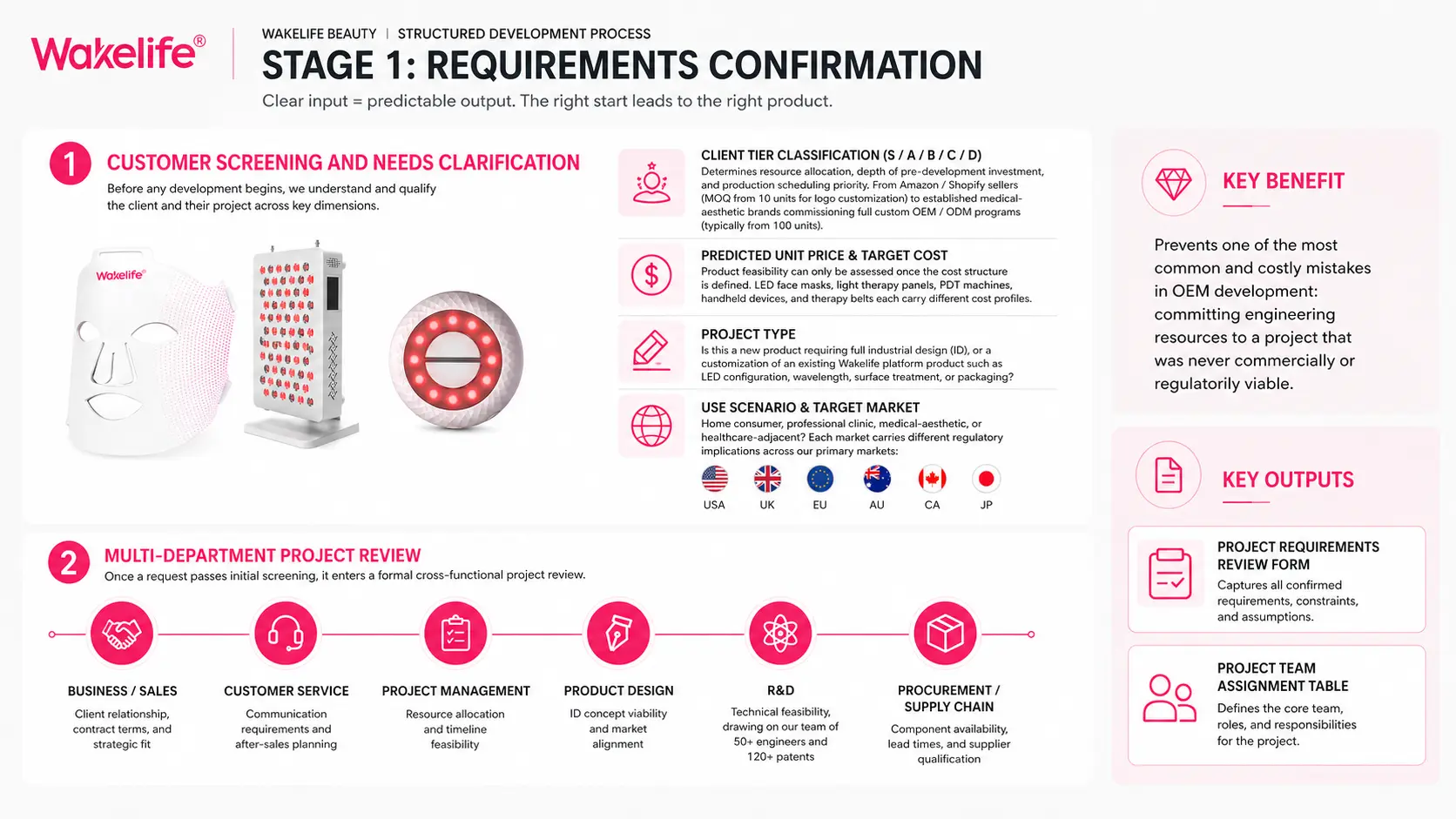
Sélection des clients et clarification des besoins
Avant tout début de développement, la première étape consiste à comprendre – et qualifier – le client et son projet.
Chez Wakelife Beauté, les demandes entrantes sont évaluées selon plusieurs dimensions:
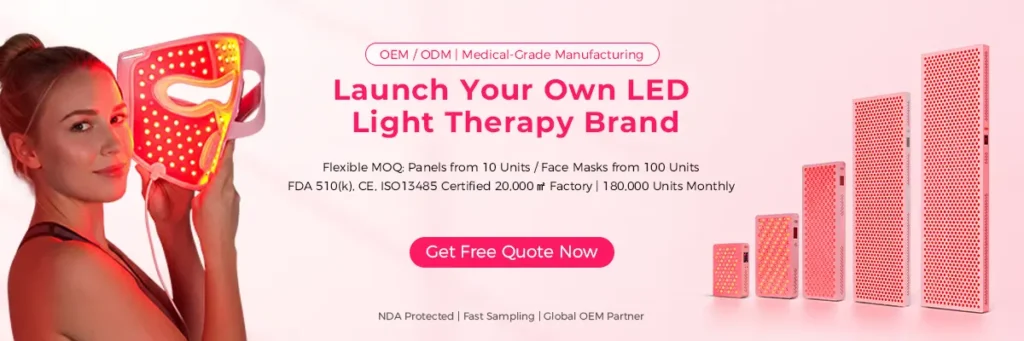
- Classification du niveau client (S / UN / B / C / D) - cela détermine l'allocation des ressources, profondeur de l'investissement préalable au développement, et priorité à la planification de la production. Notre 1,000+ Les partenaires de marque vont des vendeurs Amazon et Shopify entrant sur le marché avec des panels de marques privées (MOQ à partir de 10 unités pour la personnalisation du logo) aux marques médico-esthétiques établies qui commandent des OEM entièrement personnalisés / Programmes ODM (généralement de 100 unités)
- Prix unitaire prévu et coût cible — la faisabilité du produit ne peut être évaluée qu'une fois la structure des coûts définie. Masques du visage LED, panneaux de luminothérapie, Machines PDT, appareils portables, et les ceintures thérapeutiques ont chacune des profils de coûts différents
- Type de projet — s'agit-il d'un nouveau produit nécessitant une conception industrielle complète (IDENTIFIANT), ou une personnalisation d'un produit de la plateforme Wakelife existant comme une configuration LED, longueur d'onde, traitement de surface, ou emballage?
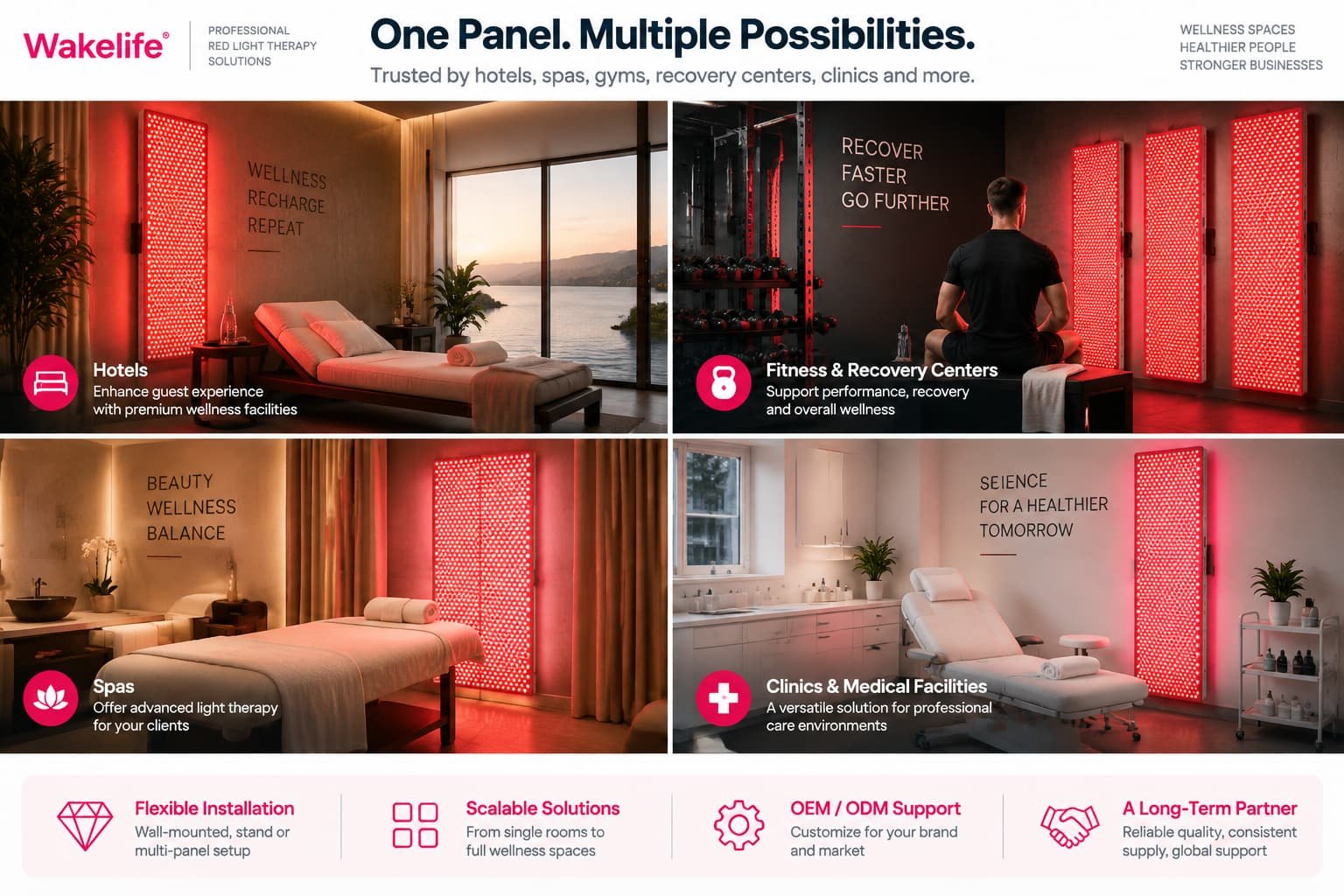
- Scénario d'utilisation et marché cible — consommateur domestique, clinique professionnelle, médico-esthétique, ou adjacent aux soins de santé? Chaque marché entraîne des implications réglementaires différentes sur nos principaux marchés: les États-Unis, Royaume-Uni, Union européenne, Australie, Canada, et le Japon
Cette étape de sélection évite l'une des erreurs les plus courantes et les plus coûteuses dans le développement OEM.: engager des ressources d'ingénierie dans un projet qui n'a jamais été commercialement ou réglementairement viable.
Entrée claire = sortie prévisible.
Examen de projet multi-département
Une fois qu’une demande passe la sélection initiale, il entre dans une revue formelle de projet transversale impliquant:
- Entreprise / Ventes - relation client, termes du contrat, et adéquation stratégique
- Service client — exigences de communication et planification après-vente (soutenu par notre équipe après-vente dédiée à wakelifebeauty.com/after-sales-support/)
- Gestion de projet — allocation des ressources et faisabilité du calendrier
- Conception de produits — Viabilité du concept d'identification et alignement sur le marché (Les préférences esthétiques européennes et nord-américaines sont évaluées spécifiquement, car ce sont nos principaux marchés d'exportation)
- R&D — faisabilité technique, en s'appuyant sur notre équipe de 50+ ingénieurs et 120+ brevets
- Approvisionnement / Chaîne d'approvisionnement — disponibilité des composants, délais de livraison, et qualification des fournisseurs
Cet examen produit deux résultats clés: un Formulaire d'examen des exigences du projet et un Tableau d'affectation des équipes de projet - le fondement de tout ce qui suit.
Sans cette étape, les risques identifiés après un investissement dans l'outillage ou l'achat de composants deviennent exponentiellement plus coûteux à résoudre.
Partie 3 - Scène 2: Conception de produits et R&D
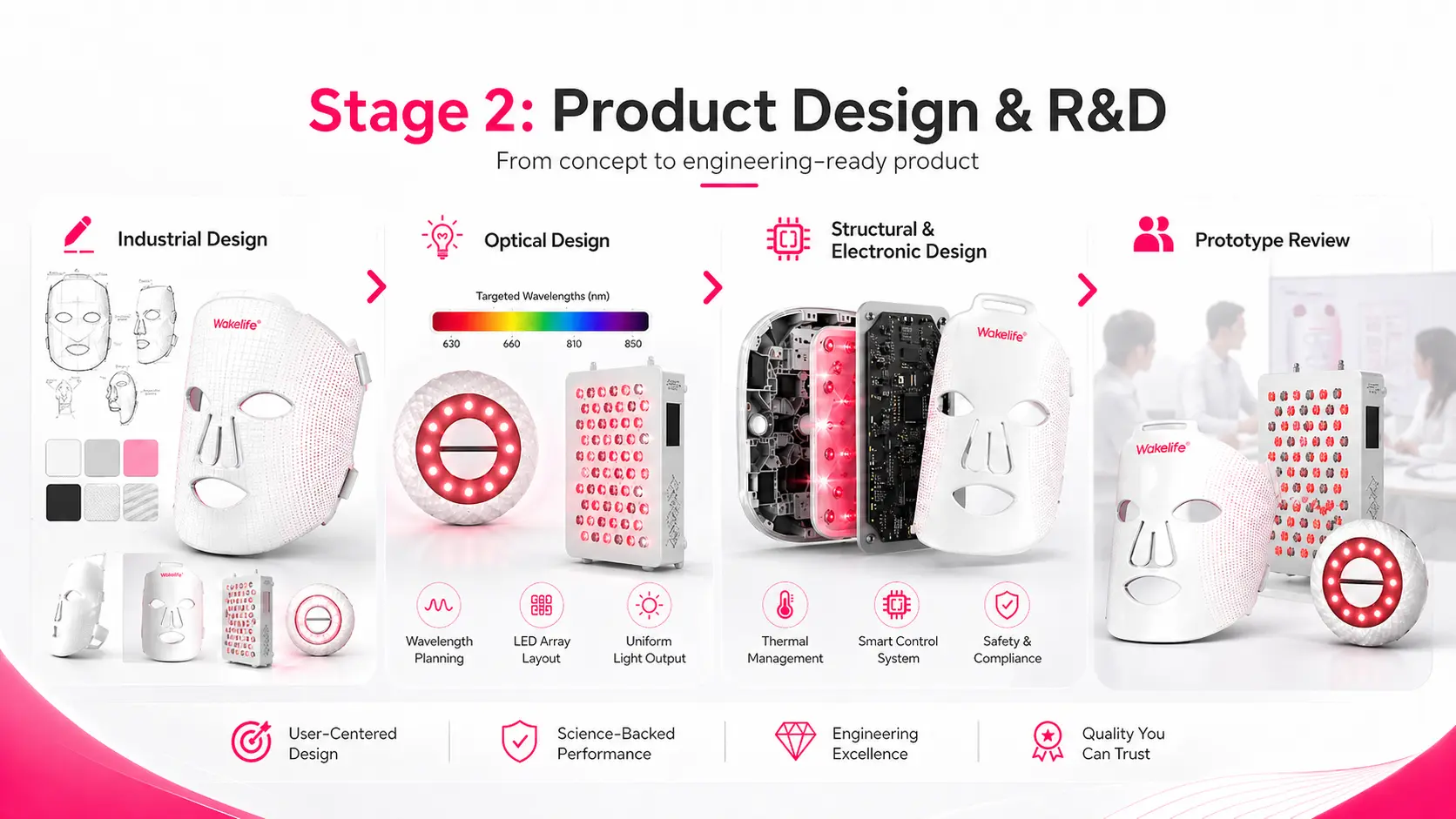
Dessin industriel (IDENTIFIANT) Phase
Une fois qu'un projet est officiellement lancé – généralement déclenché par la confirmation du paiement du client – le design industriel commence. Chez Wakelife Beauté, L'identification n'est pas purement esthétique. Il s'agit d'un point de décision stratégique qui façonne chaque décision d'ingénierie et de conformité en aval..
La phase d'identification comprend:
- Conception d'apparence — facteur de forme, sélection des matériaux, options de traitement de surface, et spécifications de couleur et de finition. Pour composants métalliques: sablage, anodisation, galvanoplastie, et revêtement UV. Pour composants en plastique: peinture en aérosol, revêtement au toucher, et gravure laser pour logos et textes
- Conception de l'expérience utilisateur — disposition des boutons, logique d'interaction, exigences d'affichage, et ergonomie
- Alignement de la marque — s'assurer que le langage visuel de l'appareil correspond au positionnement du client sur le marché. Les appareils destinés aux marchés européens et nord-américains nécessitent un calibrage esthétique spécifique
- Conception d'étiquettes réglementaires — CE, FCC, FDA, Ukca, et les marquages RoHS doivent être intégrés dans la présentation de l'identification dès le départ
Les résultats de la phase d'identification incluent les rendus d'identification, 3Fichiers de modélisation D, et un document préliminaire de spécification du produit — partagé avec le client pour confirmation avant le début de l'investissement dans le prototypage physique.
Pour les clients qui n’ont pas leur propre direction de conception, L’équipe ID de Wakelife Beauty peut développer des concepts à partir d’un brief. Pour les clients ayant des conceptions existantes, notre équipe évalue les implications en matière de fabricabilité et de conformité avant le début de l'ingénierie.
Ingénierie et R&Phase de conception D
Après approbation de la pièce d'identité, notre R&Équipe D — soutenue par 120+ des brevets et une expérience de 10 ans dans le développement de dispositifs LED de qualité médicale — commence la conception technique complète.
Conception optique:
- Sélection et vérification de la longueur d'onde (les configurations courantes incluent 630 nm, 660nm, 810nm, 830nm, et 850 nm pour les applications rouges et proches infrarouges)
- Calcul de l'irradiance et disposition du réseau de LED
- Précision de longueur d'onde et tolérances de regroupement : une variable de coût clé pour les applications de qualité médicale. Un regroupement plus serré (Par exemple, ±3 nm) nécessite un tri à partir de lots de production plus importants et est tarifé en conséquence
- Définitions des modes d'éclairage: longueur d'onde unique, double longueur d'onde, modes pulsés, et configurations de minuterie
- Configurations de LED double couche et multicolores pour les appareils nécessitant une fourniture simultanée de longueurs d'onde
Conception structurelle:
- 3D dessins mécaniques et spécifications de tolérance
- Logique d'assemblage: encliquetable, assemblage par vis, ou construction en silicone flexible (utilisé dans notre catégorie de masques LED)
- Test de chute et évaluation de la durabilité : l'inadéquation des tolérances structurelles est l'une des causes profondes les plus courantes de défaillance de l'EVT dans les nouveaux programmes d'appareils.
Conception de systèmes électroniques:
- Schémas de circuits et disposition des PCB
- Gestion de l’énergie et performances thermiques
- Logique de contrôle: marche/arrêt, changement de mode, minuteur, et fonctions de réglage de l'intensité
- Tableau intelligent vs. sélection de cartes standard en fonction des exigences en matière de fonctionnalités
- Intégration Bluetooth pour les appareils connectés à une application (pris en charge via notre programme de personnalisation d'application à wakelifebeauty.com/app-customization/)
Conformité matérielle:
- Conformité RoHS pour l'entrée sur le marché de l'UE
- Silicone de qualité alimentaire pour les composants en contact avec la peau (standard sur nos produits de masques LED)
- Perles LED de qualité médicale : une norme de spécification dans toute notre gamme de produits
Une fois le package de conception terminé, un examen inter-équipes est organisé. Le but n’est pas de confirmer que la conception fonctionne sur papier – il s’agit de faire apparaître des risques qui n’apparaîtront que lors des tests physiques.: empilement de tolérance, instabilité de l'assemblage, dissipation thermique, et des problèmes de fiabilité à long terme qui deviennent des obligations de garantie et de conformité après le lancement.
Partie 4 - Scène 3: Phases de validation (EVT, TVP, PVT)
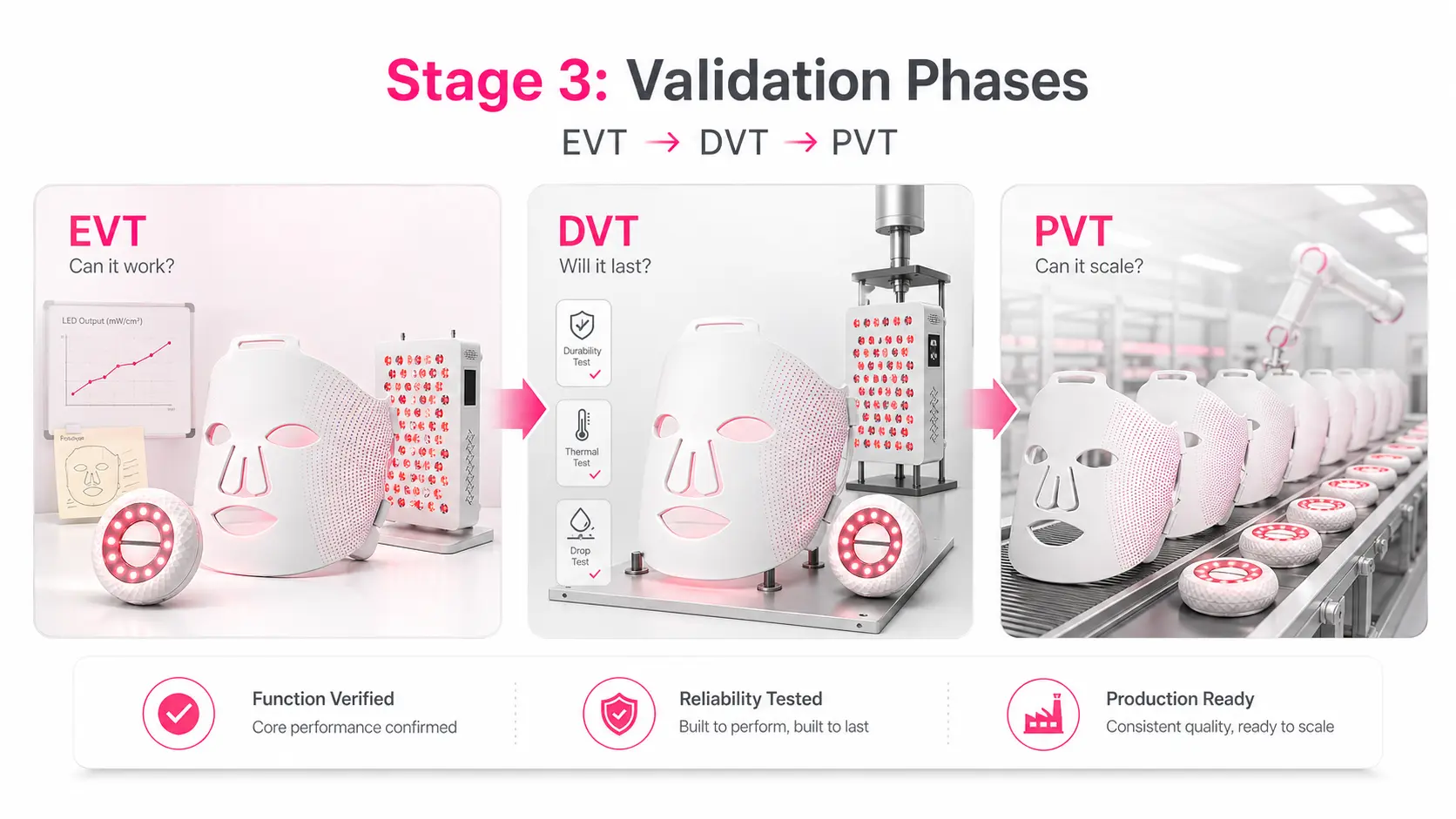
C’est là que de nombreuses marques – et de nombreux fournisseurs OEM – font des économies.. Sauter ou compresser la validation est l'un des prédicteurs les plus fiables d'un échec de production de masse.. Notre système qualité certifié ISO 13485 et nos processus de fabrication alignés sur MDSAP nécessitent une validation structurée comme étape non négociable pour les programmes de dispositifs de qualité médicale..
EVT — Test de validation technique
Réponse à la question: Est-ce que ça peut marcher?
EVT produit le premier prototype fonctionnel. L'objectif est de vérifier que la conception technique remplit sa fonction prévue dans des conditions contrôlées.:
- La sortie optique répond-elle aux spécifications d'irradiation et de longueur d'onde cibles?
- Le système électronique se comporte-t-il correctement dans tous les modes de fonctionnement?
- L'assemblage structurel tient-il ensemble grâce à une manipulation de base?
Les échantillons sont assemblés à l'aide de composants prototypes ou en début de production et évalués conjointement par R&D et Qualité. Un rapport de synthèse EVT formel documente les résultats et pilote la prochaine itération de conception..
Pour les projets de personnalisation simples, tels qu'un changement de couleur ou de longueur d'onde sur un produit de plateforme Wakelife existant, l'EVT peut être éliminé par le biais d'un accord entre les équipes au stade de l'examen du projet., réduire les délais de livraison pour les gammes de produits établies. Pour les nouveaux programmes de produits, L'EVT n'est pas facultatif.
DVT — Test de validation de conception
Réponse à la question: Est-ce que ça va durer?
DVT utilise des composants et des processus proches de la production pour valider la stabilité et la fiabilité de la conception. Chez Wakelife Beauté, DVT s'exécute généralement sur un petit lot (50–100 unités) et comprend:
- Tests de chute et d'impact (1.2norme de hauteur en m pour les programmes d'appareils grand public)
- Fonctionnement continu et cyclage thermique
- Tests de fiabilité alignés sur la portée de certification cible — CE, FCC, Ul, MÉTÉO, TGA, Ukca, ou FDA 510(k) selon le marché cible
- Examen de la qualité cosmétique et de l'assemblage par rapport aux normes de production
Un rapport récapitulatif sur la TVP et un rapport de fiabilité sont produits. Tous les résultats – dans toute l’ingénierie, chaîne d'approvisionnement, production, et qualité - sont formellement suivis. Aucun problème n'est clos sans vérification. La PVT ne commence pas tant que la clôture de la DVT n'est pas confirmée.
Ce processus de clôture est de par sa conception interfonctionnel. Problèmes de chaîne d'approvisionnement, problèmes d'outillage, et les problèmes de qualité des composants identifiés dans DVT appartiennent au service concerné et sont résolus avant le début de l'étape suivante..
PVT — Test de validation de production
Réponse à la question: Peut-il évoluer?
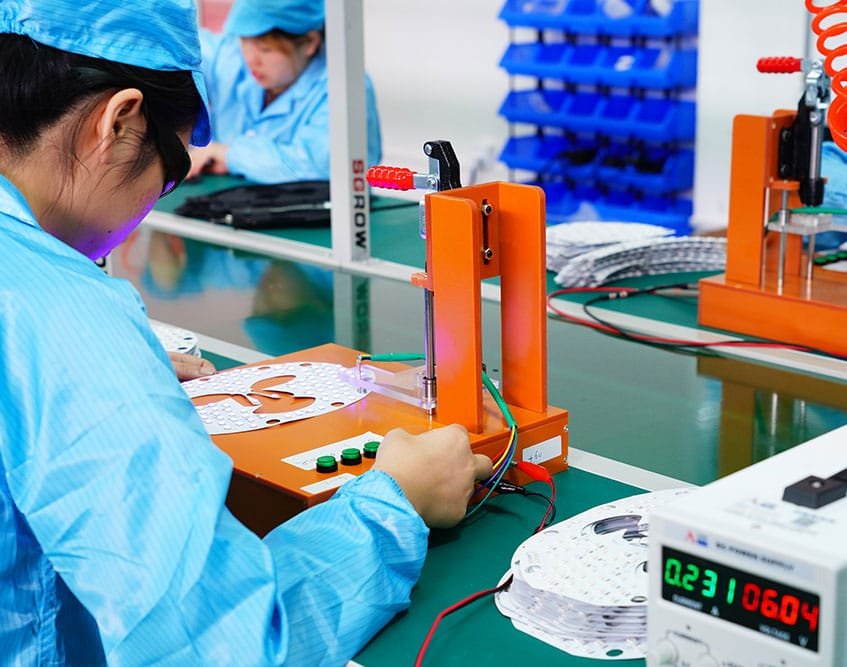
PVT exécute un lot de production pilote – généralement 500 unités - utilisant un outillage de production complet, nos conditions de production en salle blanche de classe II, et personnel de production standard. Son objectif est de confirmer que notre 12 les lignes de production peuvent fournir de manière constante la qualité validée dans DVT.
Sorties PVT:
- Rapport récapitulatif PVT confirmant que tous les problèmes DVT sont résolus
- Documentation finale du processus pour le transfert de la production
- Temps de cycle confirmés, taux de rendement, et points de contrôle de qualité pour la planification de la production de masse
Après deux tours de validation structurée, la grande majorité des risques liés à la conception et aux processus ont été identifiés et résolus. La production de masse commence avec des taux de défauts considérablement inférieurs à ceux des projets qui contournent cette séquence – et avec la piste documentaire requise pour étayer les demandes de certification du marché réglementé..
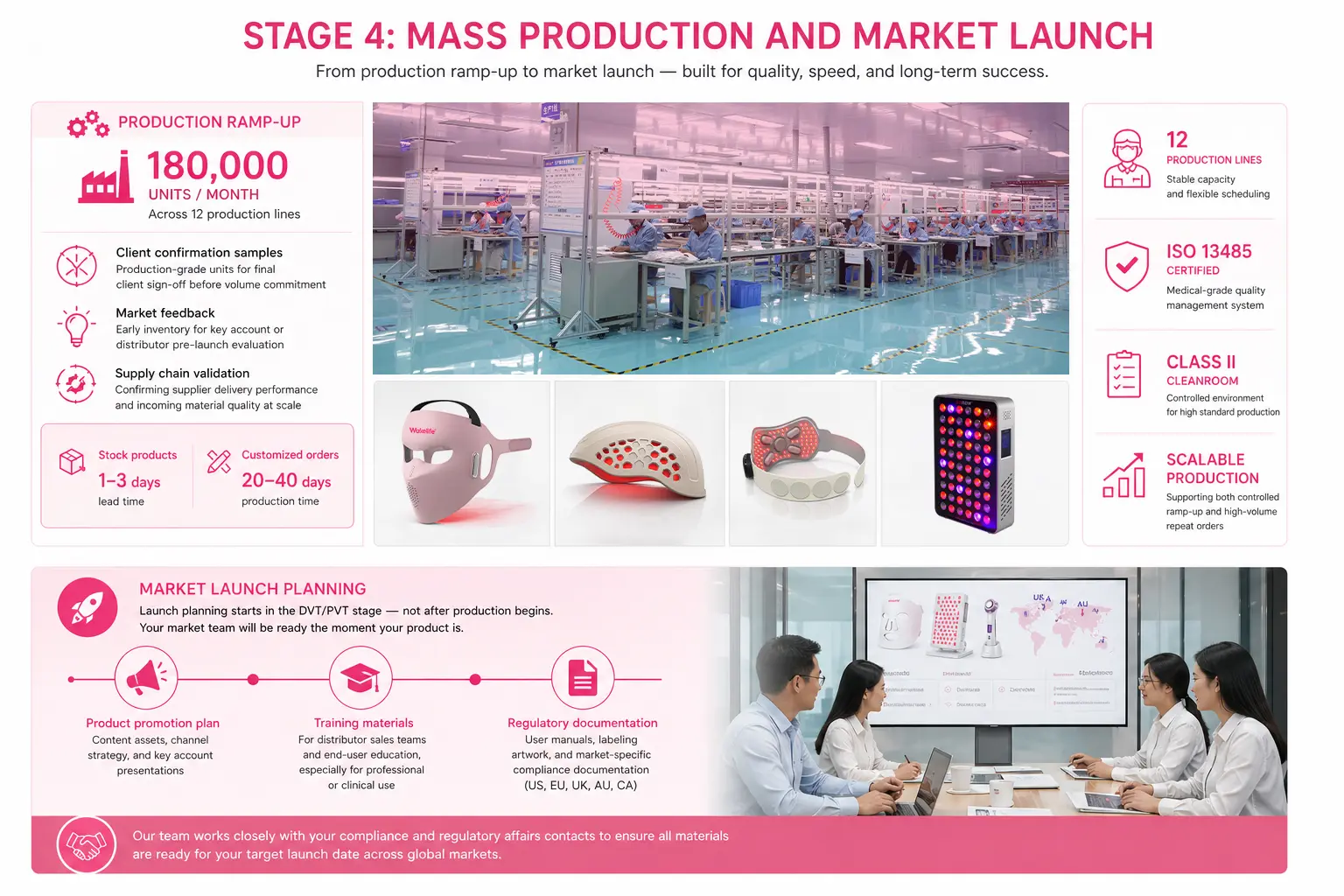
Montée en puissance de la production
Avec une capacité mensuelle de 180,000 unités à travers 12 lignes de production, Wakelife Beauty peut prendre en charge à la fois des programmes de montée en puissance contrôlés et des programmes de production répétée à haut volume..
Avant de s’engager dans une production en grande série, de nombreux projets, en particulier les lancements de nouveaux produits, bénéficient d'un traitement contrôlé en petits lots pour la validation du marché:
- Échantillons de confirmation client — unités de production pour l'approbation du client final avant l'engagement de volume
- Commentaires du marché — inventaire anticipé pour l'évaluation préalable au lancement d'un compte clé ou d'un distributeur
- Validation de la chaîne d'approvisionnement — confirmer les performances de livraison des fournisseurs et la qualité des matériaux entrants à l'échelle commerciale
Les produits en stock sont généralement disponibles avec des délais de livraison de 1 à 3 jours. Les commandes de production personnalisées durent 20 à 40 jours en fonction de la complexité du projet, profondeur de personnalisation, et les exigences de certification.
Planification du lancement sur le marché
Chez Wakelife Beauté, le développement de produits est formellement lié à la planification du lancement sur le marché au stade DVT/PVT – et non après le début de la production. L’équipe marché du client ne doit pas attendre un produit fini pour préparer son lancement.
Lancer des activités de support qui se déroulent en parallèle du PVT:
- Plan de promotion du produit — actifs de contenu, stratégie de canal, et présentations grands comptes
- Matériel de formation — pour les équipes commerciales des distributeurs et la formation des utilisateurs finaux, particulièrement important pour le positionnement à usage professionnel ou clinique
- Documentation réglementaire — manuels d'utilisation, oeuvre d'étiquetage, et documentation de conformité spécifique au marché pour les États-Unis, UE, ROYAUME-UNI, australien, et entrée sur le marché canadien
Pour les clients avec OEM / Accords ODM, notre équipe se coordonne directement avec les contacts de conformité ou d'affaires réglementaires du client pendant cette phase pour garantir que tous les documents sont prêts pour la date de lancement cible..
Partie 6 - Scène 5: Gestion du cycle de vie des produits
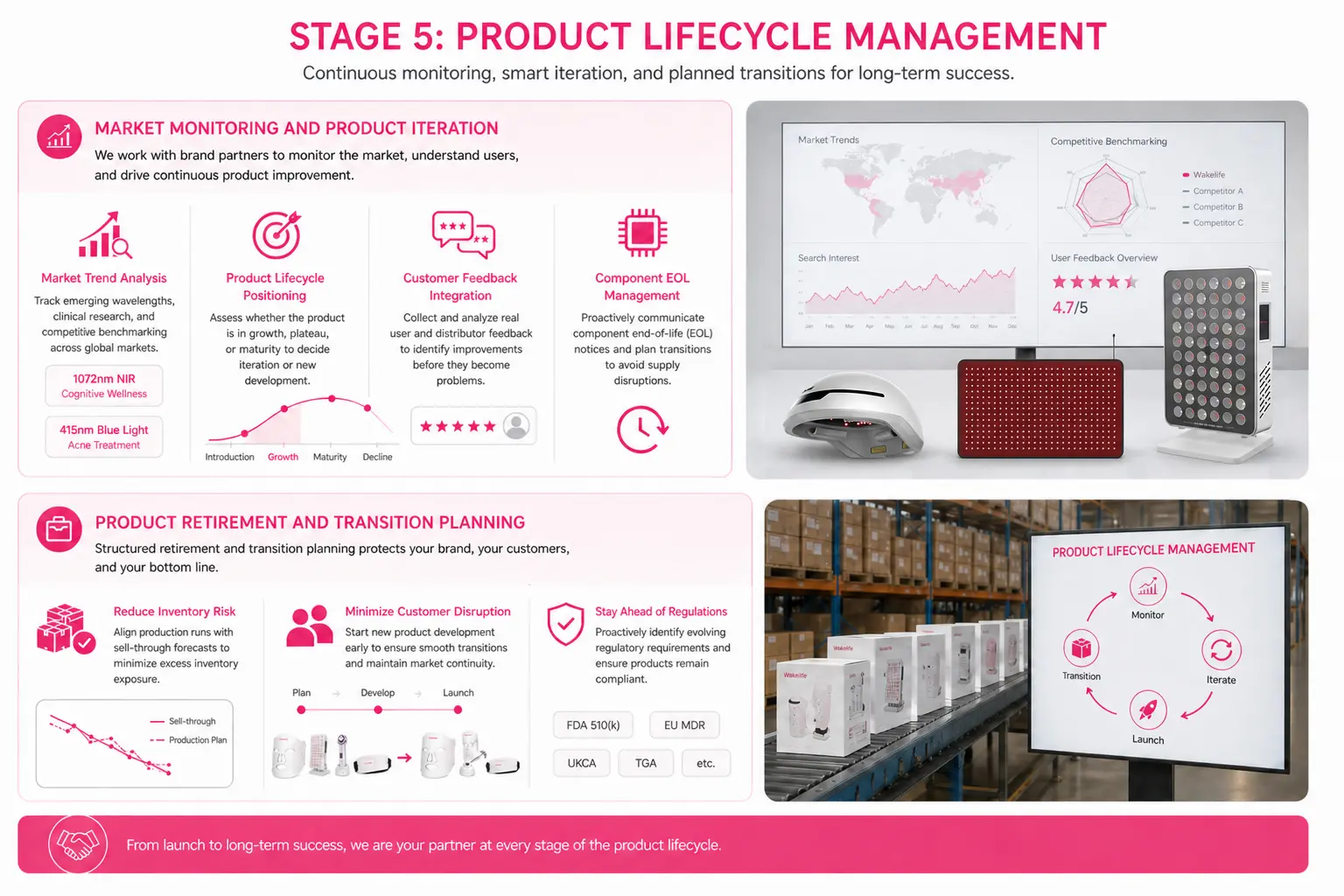
Surveillance du marché et itération de produits
Le lancement d'un produit n'est pas la fin de la relation de développement. Wakelife Beauty travaille avec des marques partenaires pour surveiller:
- Analyse des tendances du marché — applications émergentes en matière de longueurs d'onde (comme le proche infrarouge 1072 nm pour le bien-être cognitif, ou lumière bleue 415 nm pour l'acné), nouvelle recherche clinique validant les protocoles thérapeutiques, et une analyse comparative des produits compétitifs sur nos principaux marchés
- Positionnement du cycle de vie du produit — si un produit est en phase de croissance, plateau, ou l'approche de la maturité détermine si un investissement itératif ou un nouveau programme de développement de produits est la bonne prochaine étape
- Intégration des retours clients — collecte structurée des commentaires des utilisateurs finaux et des distributeurs pour identifier les opportunités d'amélioration avant qu'elles ne deviennent des problèmes de garantie ou de retours
Pour les clients OEM, la gestion du cycle de vie comprend une communication proactive lorsque les composants arrivent en fin de vie (EOL) les avis sont émis par les fournisseurs de LED ou d'électronique — permettant aux clients de planifier les transitions de composants ou les mises à jour de produits sans interruption de l'approvisionnement.
Planification du retrait et de la transition des produits
Quand un produit arrive en fin de vie, une planification de retraite structurée évite deux problèmes courants qui nuisent aux relations avec les marques:
- Exposition aux stocks excédentaires — en alignant les calendriers de production sur les prévisions de ventes des clients
- Perturbation client — en lançant des programmes de développement de nouveaux produits suffisamment tôt pour maintenir la continuité du marché
Produits qui ne peuvent pas répondre aux exigences réglementaires évolutives, par exemple, comme FDA 510(k) les exigences ou les seuils de conformité du MDR de l’UE évoluent – sont signalés de manière proactive, non découvert au moment de la défaillance du marché.
Partie 7 - Scène 6: Formulaires, Documentation, et gestion du changement
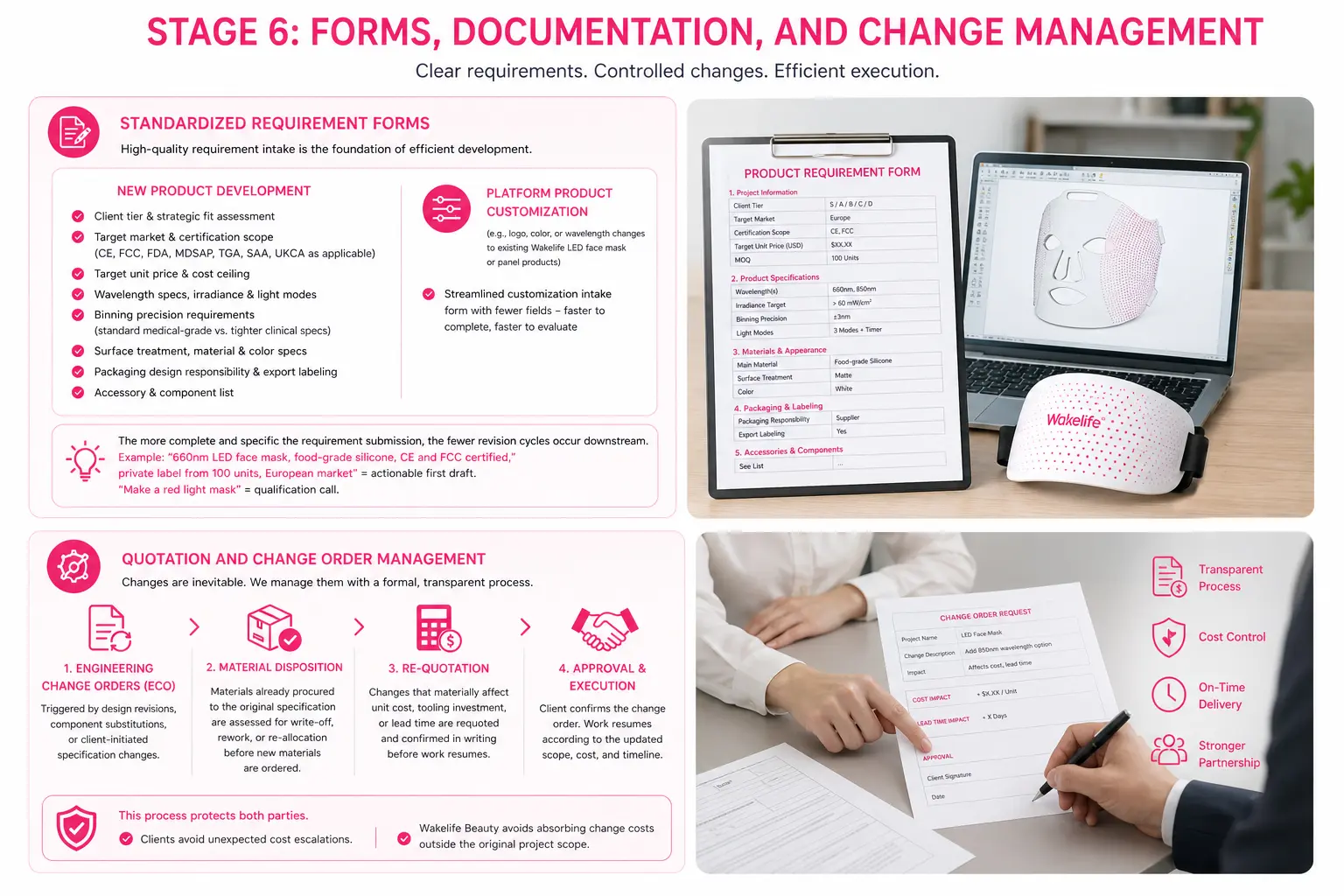
Formulaires d'exigences standardisés
L’un des facteurs les plus sous-estimés de l’efficacité du développement est la qualité de la soumission initiale des exigences.. Wakelife Beauty utilise des formulaires de demande d'exigences structurés pour tous les types de projets:
Pour le développement de nouveaux produits:
- Évaluation du niveau client et de l’adéquation stratégique
- Marché cible et portée de la certification (CE, FCC, FDA, Mdsap, TGA, MÉTÉO, UKCA, le cas échéant)
- Prix unitaire cible et plafond de coût
- Spécifications de longueur d'onde, cibles d'irradiation, et exigences en matière de mode d'éclairage
- Exigences de précision du regroupement (tolérances standard de qualité médicale vs. des spécifications cliniques plus strictes)
- Traitement de surface, matériel, et spécifications de couleur
- Responsabilité de la conception des emballages et exigences en matière d’étiquetage à l’exportation
- Liste des accessoires et composants
Pour la personnalisation des produits de la plateforme (Par exemple, logo, couleur, ou changements de longueur d'onde sur les masques ou panneaux LED Wakelife existants):
- Un formulaire d'admission à la personnalisation simplifié avec moins de champs — plus rapide à remplir, plus rapide à évaluer
Plus la soumission des exigences est complète et spécifique, moins il y a de cycles de révision en aval. Une exigence qui précise « masque facial LED 660 nm, silicone de qualité alimentaire, Certifié CE et FCC, marque privée de 100 unités, marché européen » génère une première ébauche exploitable. Une exigence qui dit « faire un masque aux feux rouges » génère un appel de qualification.
Gestion des devis et des ordres de modification
Les changements sont inévitables dans le développement de produits. Ce qui compte, c'est la façon dont ils sont gérés.
Tous les changements après le lancement du projet chez Wakelife Beauty suivent un processus formel d'ordre de modification.:
- Ordres de modification technique (ÉCO) — déclenché par des révisions de conception, substitutions de composants, ou modifications de spécifications initiées par le client
- Disposition matérielle — les matériaux déjà achetés selon les spécifications initiales sont évalués pour être radiés, retravailler, ou réaffectation avant la commande de nouveaux matériaux
- Re-cotation — les changements qui affectent sensiblement le coût unitaire, investissement en outillage, ou les délais sont demandés et confirmés par écrit avant la reprise des travaux
Ce processus protège les deux parties. Les clients évitent les augmentations de coûts inattendues. Wakelife Beauty évite d'absorber des coûts de changement qui ne relèvent pas de la portée initiale du projet – une source de frictions fournisseur-client importante dans les relations OEM non structurées..
Partie 8 - Scène 7: Collaboration et exécution en équipe
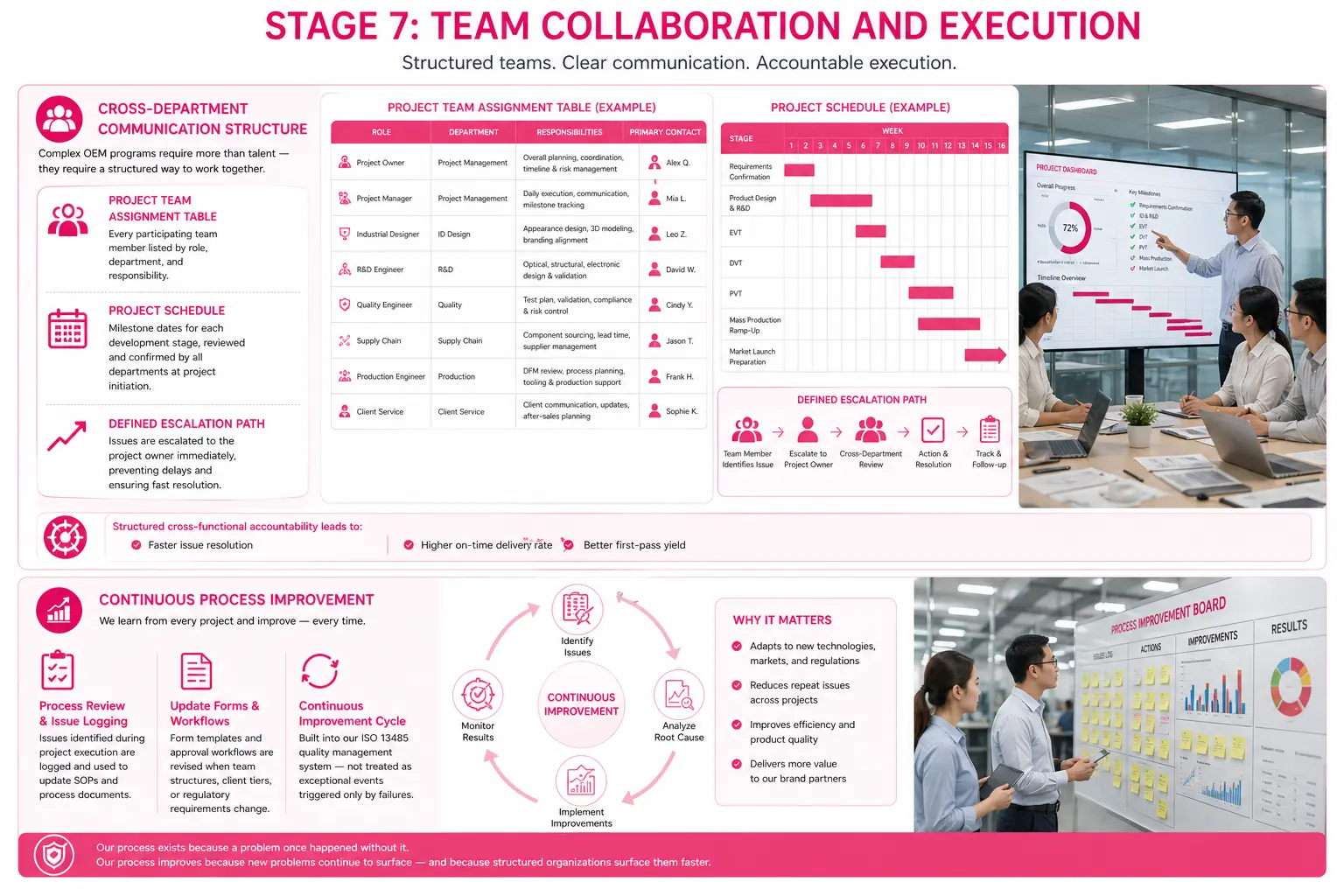
Structure de communication interdépartementale
Le processus de développement par étapes décrit ci-dessus ne fonctionne que lorsque la communication entre les services est également structurée.. Chez Wakelife Beauté, avec 260+ employés dans R&D, production, qualité, chaîne d'approvisionnement, et les équipes en contact direct avec les clients, les canaux de communication informels ne suffisent pas pour les programmes OEM complexes.
Chaque projet fonctionne avec:
- UN Tableau d'affectation des équipes de projet — chaque membre de l'équipe participant répertorié par rôle, département, et la responsabilité
- UN Calendrier du projet — dates clés pour chaque étape de développement, examiné et confirmé par tous les départements au lancement du projet, non fixé unilatéralement par une seule équipe
- UN Chemin d'escalade défini — les problèmes soulevés par n'importe quel service sont immédiatement signalés au propriétaire du projet, éviter qu’ils stagnent au sein d’une seule fonction
Le passage d'une propriété unique à une responsabilité interfonctionnelle structurée est le changement que la plupart des clients OEM remarquent lorsqu'ils passent d'un fournisseur moins organisé à une usine fonctionnant sous ISO. 13485 et systèmes qualité MDSAP. C'est également le changement qui a le plus grand impact mesurable sur les taux de livraison à temps et le rendement au premier passage..
Amélioration continue des processus
Aucun processus n'est permanent. Chez Wakelife Beauté, notre processus de développement est revu et mis à jour sur une base continue:
- Les problèmes identifiés lors de l'exécution du projet sont enregistrés et utilisés pour mettre à jour la documentation des processus et les procédures opérationnelles standard.
- Les modèles de formulaires et les flux de travail d'approbation sont révisés lorsque les structures d'équipe, définitions de niveau client, ou les exigences réglementaires changent
- Les cycles d’amélioration continue sont intégrés à notre ISO 13485 système de gestion de la qualité — non traité comme des événements exceptionnels déclenchés uniquement par des défaillances
Cela reflète un principe cohérent dans tous 10+ années de notre expérience dans la fabrication OEM:
Le processus existe parce qu'un problème s'est produit une fois sans lui. Le processus s'améliore parce que de nouveaux problèmes continuent de surgir – et parce que les organisations structurées les font apparaître plus rapidement que les organisations non structurées..
Vous voulez voir ce qui se passe lorsque ce processus échoue?
Comprendre le processus de développement est la première étape. Mais dans de vrais projets, des échecs se produisent encore - généralement à cause d'une seule décision vague au stade des exigences, ou un « gain de temps » raccourci dans la validation.
Nous’J'ai documenté 5 véritables échecs de projets OEM, chacun remontant à un point de rupture spécifique dans le processus de développement:
👉 5 Défaillances réelles des équipementiers dans les appareils de thérapie LED – et comment les éviter
Si vous envisagez de développer ou de vous procurer un appareil de thérapie par la lumière rouge, ces cas vous aideront à identifier les risques avant le début de votre projet – et non après.
Conclusion — Le processus est un avantage concurrentiel, Pas un coût
Un processus de développement d'un appareil de thérapie par la lumière rouge bien conçu ne consiste pas à ajouter de la complexité ou de la bureaucratie à ce qui devrait être un simple engagement de fabrication..
Il s'agit de:
- Réduire l’incertitude à chaque étape du développement
- Prévenir les pannes coûteuses à résoudre tardivement
- Activation de la cohérence, production évolutive à travers 12 lignes de production et 180,000 unités par mois
- Construire la piste documentaire et les preuves de qualité qui régulent les marchés, en particulier aux États-Unis, UE, et l'Australie — exigent
- Respecter les délais et les engagements de qualité qui 1,000+ les marques partenaires attendent de Wakelife Beauty depuis plus d'une décennie
Les sept étapes décrites dans cet article — Confirmation des exigences, Conception de produits et R&D, Validation EVT/TVP/PVT, Production de masse et lancement sur le marché, Gestion du cycle de vie, Documentation et gestion des changements, et exécution interfonctionnelle - ne sont pas des cadres théoriques. Ils reflètent de vraies leçons tirées de projets réels, y compris les échecs qui ont rendu chaque étape nécessaire.
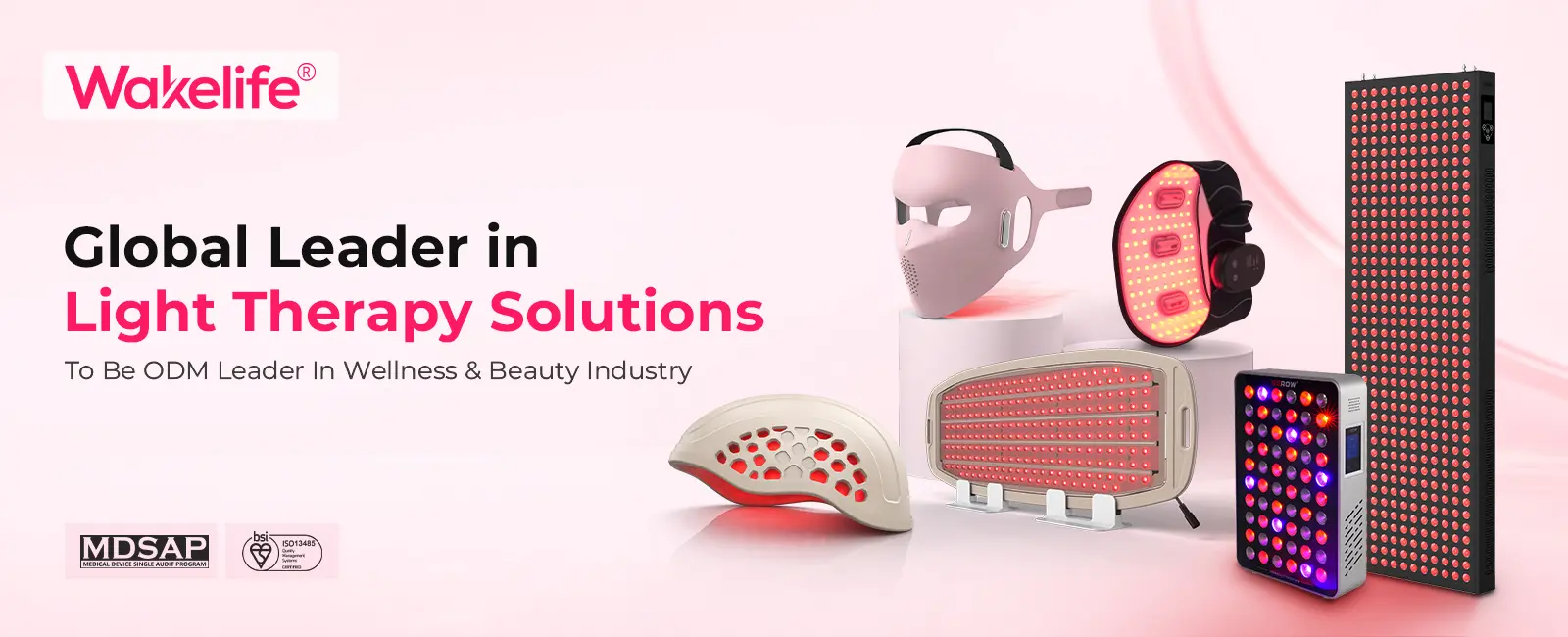
Si vous développez ou achetez des appareils de thérapie par la lumière rouge : masques faciaux à LED, panneaux de luminothérapie, Machines PDT, appareils portables, masques pour les yeux, appareils de croissance des cheveux, ou ceintures thérapeutiques – en collaboration avec un OEM expérimenté / Un fabricant ODM qui gère un processus de développement structuré peut réduire considérablement vos risques, compresser votre chronologie, et améliorez votre préparation au marché.
Chez Wakelife Beauté, nous fournissons:
- Assistance au développement de bout en bout à travers les sept étapes, des exigences à la gestion du cycle de vie
- Systèmes de fabrication de qualité médicale -ISO 13485, Mdsap, Salle blanche de classe II, IEC 60601
- Certifications internationales — FDA 510(k) K250830, CE, Ukca, TGA, FCC, MÉTÉO, Ul, Rohs, BSCI
- Options de quantité minimale de commande flexibles — personnalisation du logo à partir de 10 unités sur panneaux sélectionnés; marque privée et OEM / Programmes ODM de 100 unités
- Échantillonnage rapide — produits en stock disponibles dans 1 à 3 jours; commandes personnalisées en 20 à 40 jours
- Personnalisation des applications et du matériel — Intégration Bluetooth et prise en charge des applications de marque pour les programmes d'appareils intelligents
- 10+ années d'expérience — 50+ R&D ingénieurs, 120+ brevets, 260+ employés, 1,000+ partenaires de marque mondiaux
Prêt à discuter de votre projet?
Que vous pénétriez pour la première fois sur le marché de la thérapie par la lumière rouge, faire évoluer une gamme de produits existante, ou transférer un programme actuel vers un partenaire de fabrication plus structuré - nous pouvons évaluer où vous en êtes dans le processus de développement et définir ensemble la prochaine étape appropriée.
👉 Apprenez-en plus sur notre OEM / Services ODM: https://wakelifebeauty.com/oem-odm/
👉 Explorez nos capacités de fabrication: https://wakelifebeauty.com/manufacturing/
👉 Consultez nos références en matière de qualité et de conformité: https://wakelifebeauty.com/quality-compliance/