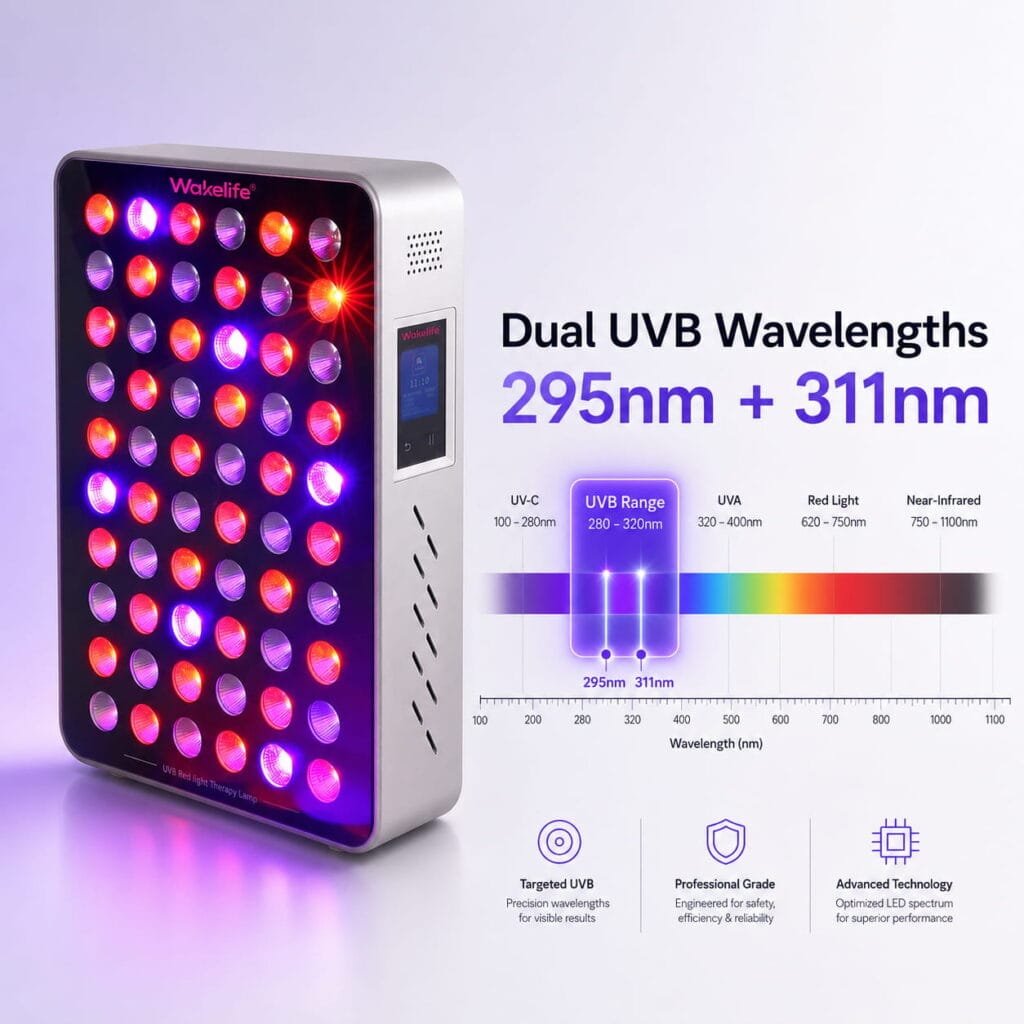
TL;RD (pour les acheteurs) BK300 est un bronzage UVB grand public compact & panneau d'exposition à la lumière – pas un dispositif médical. Son avantage n'est pas son nombre de 60 LED. C’est que le BK300 prend la seule partie du spectre que la plupart des panneaux évitent – UVB (295nm + 311nm) - et le transforme en un produit qui est mesurable, contrôlé à distance, et honnêtement explicable à votre client final. Pour toi, c'est une histoire de rayon que les concurrents ne peuvent pas copier rapidement, plus un moteur de contenu prêt à l'emploi: 9 longueurs d'onde et 7 modes.
1. Soyons clairs sur ce qu’est cet appareil – et ce qu’il ne l’est pas
BK300 est un bronzage UVB grand public / panneau d'exposition à la lumière. Il ne diagnostique pas, traiter, guérir, ou prévenir toute maladie, et ne devrait jamais être commercialisé de cette façon.
Son statut de conformité: le La série BK a passé CE, FCC, et tests RoHS, il est fabriqué sous ISO 13485 + Mdsap systèmes, et BK300 est inclus dans les informations de liste des appareils de la FDA provenant d'un établissement enregistré par la FDA.
Une distinction que nous ne brouillerons pas, et toi non plus tu ne devrais pas: un liste des appareils est l'enregistrement de l'appareil auprès de la FDA. C'est pas une « autorisation » ou une « approbation » de la FDA. La FDA elle-même est explicite sur ce point – voir les propres directives de la FDA sur Enregistrement et liste des appareils et 510(k) Notification préalable à la commercialisation. (Notre établissement détient un espace séparé 510(k) autorisation — K250830 — mais cette autorisation appartient à un Masque facial à LED, pas à BK300. Vous pouvez vérifier vous-même toute autorisation auprès du public de la FDA. 510(k) base de données. Nous ne laisserons pas ces deux-là être confondus, et nous vous recommandons de les conserver également séparés sur vos propres pages.)
Pourquoi ouvrir avec ça? Parce que nous avons vu des acheteurs coller une fiche technique gonflée sur Amazon ou un magasin DTC et se retrouver directement face à un problème de conformité de la plateforme.. Nous préférons dire une phrase de moins plutôt que de vous laisser porter la responsabilité de notre formulation..
2. La véritable histoire derrière 311 nm: Emprunter les connaissances, Pas l'approbation
311nm — UVB à bande étroite — a une longue, antécédents documentés en dermatologie, où les unités UVB à bande étroite sont réglementées comme dispositifs médicaux. Ce n’est pas du folklore marketing; c'est une littérature clinique bien indexée. Le Présentation de la photothérapie par l'American Academy of Dermatology est un point de départ utile; pour la profondeur, une revue systématique évaluée par des pairs – comme celle d’Almutawa et al., « Efficacité de la photothérapie localisée et de la thérapie photodynamique pour le psoriasis » (PubMed PMC3047947) — illustre à quel point cette longueur d'onde a été étudiée dans des contextes cliniques contrôlés.
La distinction honnête: ce qui est autorisé, ce sont ces dispositifs médicaux spécifiques – et non « la longueur d’onde de 311 nm ». BK300 émet 311 nm, mais c'est le cas pas hériter de l’autorisation de tout dispositif médical. Nous citons ce contexte pour une raison: pour montrer que 311nm est un sujet profondément étudié, longueur d'onde prévisible - c'est pourquoi nous sommes convaincus de le transformer en un produit de consommation. C'est pas une affirmation selon laquelle le BK300 a des effets thérapeutiques.
La valeur pour vous: vous pouvez honnêtement dire aux clients qu'il s'agit d'une « longueur d'onde qui a fait l'objet de recherches sérieuses » – une source crédible, histoire fondée sur des preuves qui n'a jamais besoin d'une exagération d'efficacité pour atterrir.
3. Vous n’obtenez le droit de dire « fossé » qu’après avoir été honnête quant au risque
La plupart des panneaux évitent les UVB car, incontrôlé, ça brûle – et une surexposition chronique comporte un réel risque de cancer de la peau. Nous ne prétendrons pas le contraire. CIRC (l’agence de recherche sur le cancer de l’OMS) classe les appareils de bronzage émettant des UV comme Groupe 1 cancérigènes — la catégorie à risque le plus élevé — documentée dans Monographies du CIRC Volume 100D: Radiation. Le Le rayonnement UV de l’OMS Q&UN le dit clairement pour le grand public.
Notre logique: le risque n’est pas supprimé par l’évitement – il est supprimé par le contrôle technique. Comme une radiographie médicale: nuisible incontrôlé, un outil de routine lorsqu'il est contrôlé. La ligne est toujours contrôlé contre. incontrôlé.
Mais « contrôlé » ne peut pas être un slogan, alors voici exactement comment le BK300 l'applique:
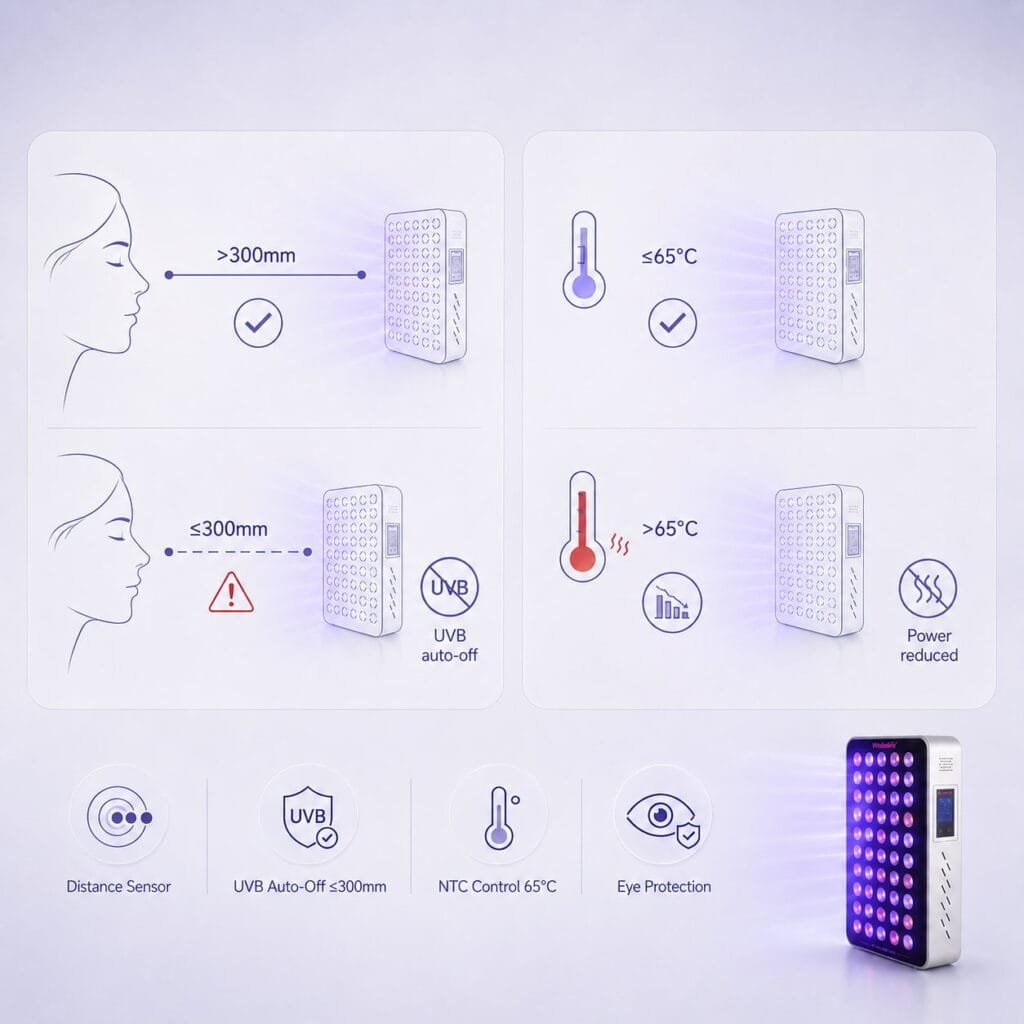
- Capteur de distance + arrêt automatique des UVB: si l'utilisateur est à l'intérieur ≤300mm (30cm), un buzzer retentit et le canal UVB s'éteint automatiquement. Les UVB ne dépassent que le seuil de sécurité.
- Contrôle de température NTC: au-dessus de 65°C, l'appareil réduit automatiquement la puissance.
- Lunettes de protection incluses — conforme aux principes de sécurité photobiologique énoncés dans Lignes directrices de l'ICNIRP sur les limites d'exposition aux rayonnements ultraviolets, la référence en libre accès internationalement reconnue pour les limites d’exposition aux UV.
C’est ce que signifie réellement « l’ingénierie assure le contrôle – et non le manuel d’instructions ».
4. Une note sur la lecture honnête du tableau d'irradiance
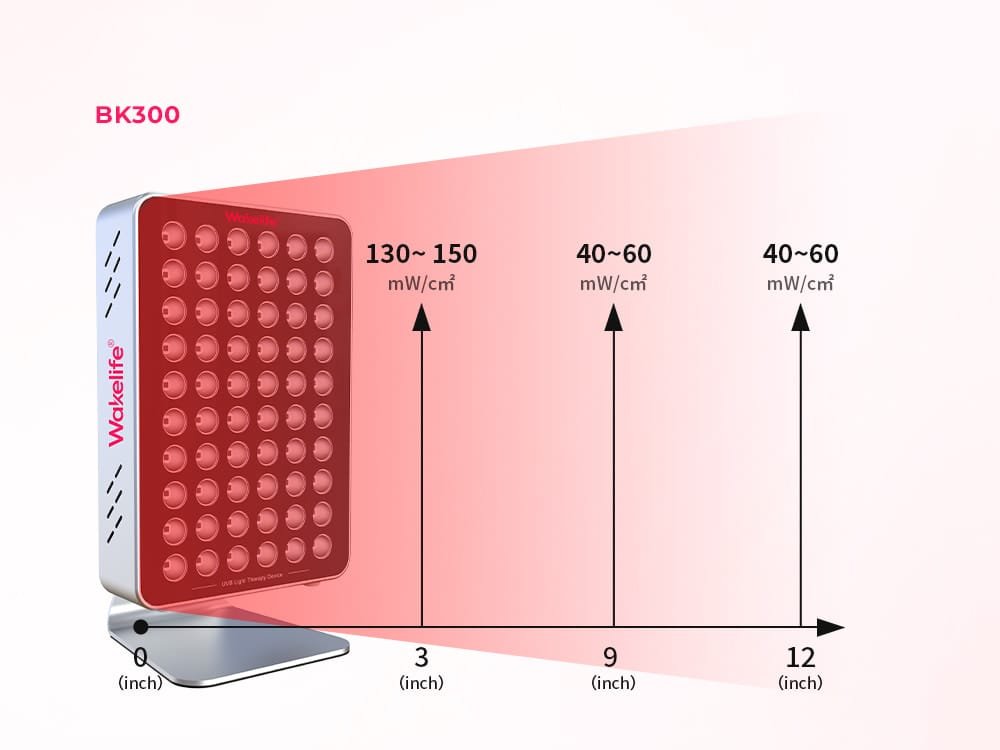
| Distance | Irradiance |
|---|---|
| 3 pouce (~76mm) | 130–150 mW/cm² |
| 9 pouce (~230mm) | 40–60 mW/cm² |
| 12 pouce (~300mm) | 40–60 mW/cm² |
Voici un point que la plupart des copies d'usine cacheraient, et nous le ferons ressortir pour vous: le chiffre de 3 pouces est une référence de mesure, pas une recommandation d'utilisation des UVB. Parce que le capteur de distance coupe les UVB à ≤300 mm, l'utilisation réelle du bronzage UVB se produit à partir de 30 cm - c'est-à-dire, la zone 40-60 mW/cm². Si le marketing d’un acheteur implique « rester 3 à quelques centimètres pour un bronzage rapide,» qui contredit la propre logique de sécurité de l’appareil. Indiquez à vos utilisateurs finaux la distance de sécurité, et la dosimétrie reste honnête.
5. 9 Longueurs d'onde = récits multiples; 7 Modes = un calendrier de contenu
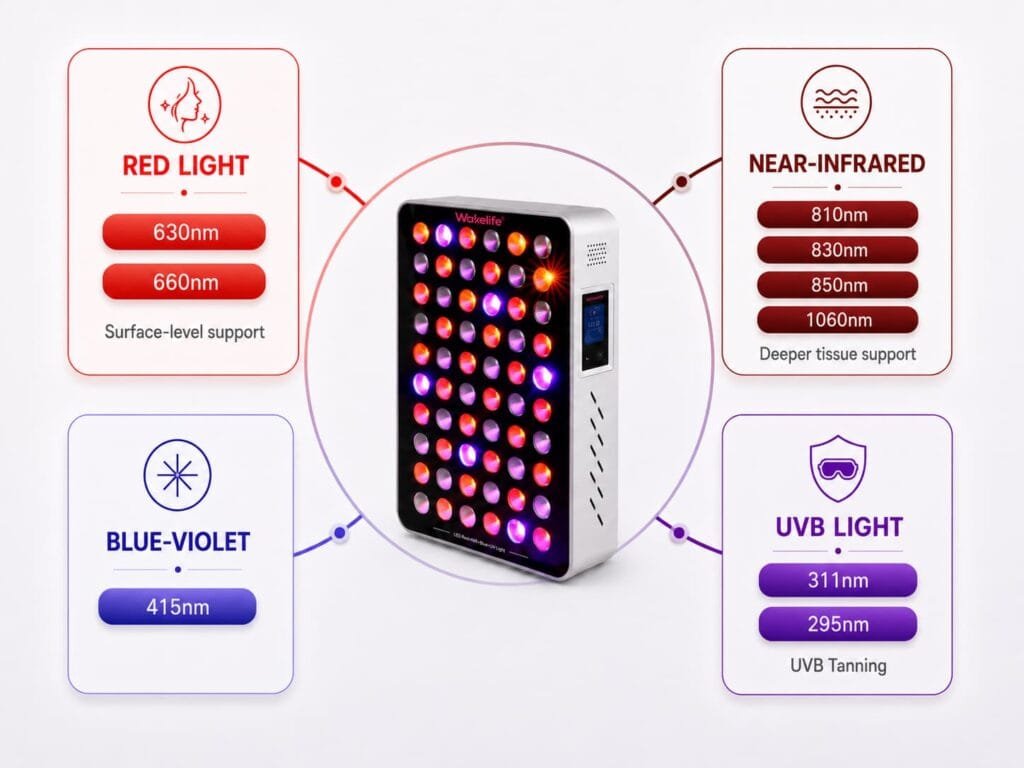
BK300 9 longueurs d'onde sont 9 angles de contenu indépendants; c'est 6 préréglage + 1 modes personnalisés sont un rythme de publication tout fait. « Plus rien à publier » après le lancement est une véritable crainte du DTC – nous avons stocké les munitions.
Une correction qui mérite d'être apportée à votre message: Le bronzage du BK300 est sans UVA. Le 9 les longueurs d'onde sont de 295/311 nm (UVB), 415nm (bleu-violet), 630/660nm (rouge), et 810/830/850/1060nm (NIR/IR) — pas d'UVA. C’est important car les UVA sont la bande la plus fortement associée au photovieillissement et aux dommages à l’ADN., comme détaillé par le Explication UVA/UVB de la Skin Cancer Foundation. Donc « axé sur les UVB, Sans UVA » est en fait un nettoyeur différenciateur par rapport aux lits de bronzage typiques. Ne le diluez pas en sous-entendant UVA.
Sur la dénomination du mode, une recommandation honnête: la liste des préréglages actuelle comprend « Santé osseuse M6 » (295+311nm) et « Diminution de M4. » La chaîne UVB → vitamine D → calcium → os est composée de plusieurs étapes et dépend de chaque individu.; le compresser dans un nom de mode appelé « Santé osseuse » fait une promesse physiologique que ni vous ni nous ne pouvons tenir - et elle se propage en aval au fur et à mesure. ton risque de non-conformité. Nous suggérerions neutre, descriptif noms:
| Mode | Longueurs d'onde | Nom neutre suggéré | Ce qu'il faut éviter de réclamer |
|---|---|---|---|
| M1 | 295/311 + 630/660 + 810/830/850/1060 | "Bronzage (Piloté par UVB)» | « bronzage en toute sécurité, risque zéro » |
| M2 | 630/660 | "Peau / Routine collagène” | « inverse le vieillissement » |
| M3 | 810/830/850/1060 | "Récupération / Routine NIR » | « traite les blessures musculaires » |
| M4 | 630/660 + 295 | « Routine lumière apaisante » | "réduit l'inflammation" (renommer de « Diminuer ») |
| M5 | 630/660 + 415 | « Routine soin des imperfections » | "traite l'acné" |
| M6 | 295/311 | « Routine d’exposition aux UVB » | « Santé des os » |
| M7 | Coutume | "Coutume (OEM / ODM)» | — |
Mêmes modes, même pouvoir de vente – juste sur un terrain honnête.
6. Sur le « Bronzage » et la « Vitamine D »,« Nous affirmons uniquement ce que les preuves soutiennent
Bronzage: La mélanogenèse induite par les UVB est une photobiologie établie. La voie biochimique – l’absorption des UVB déclenchant la synthèse de mélanine – est documentée dans la littérature évaluée par des pairs.; voir Brenner & Audience, "Le rôle protecteur de la mélanine contre les dommages causés par les UV sur la peau humaine" (PubMed PMC2671032). Alors bronzage en fonction est légitime de faire de la publicité. Mais les résultats varient selon le type de peau, distance, et la durée de la session – c'est pourquoi le visuel avant/après est correctement étiqueté « à titre de référence visuelle uniquement ».; les résultats peuvent varier. Gardez cette clause de non-responsabilité; ça fait du vrai travail.
Vitamin D: la bande UVB autour de 290-315 nm est la partie du spectre solaire responsable de la synthèse cutanée de la vitamine D, comme le documente le Fiche d'information sur la vitamine D du Bureau des compléments alimentaires du NIH. Mais attention aux limites : « cette bande de longueur d’onde pilote la synthèse » en principe" est pas "Cet appareil produit une quantité significative de vitamine D à distance et pendant une durée sûre." Notre formulation est donc « offre une exposition dans la bande de 295 nm,» pas "complète la vitamine D." La différence d’un mot est une différence d’un ordre de grandeur en matière de risque de non-conformité.
7. Référence rapide des spécifications
| Article | BK300 |
|---|---|
| Taper | Panneau de bronzage UVB compact (corps-cible) |
| LEDS | 60 PCS (CMS 3535) |
| Longueurs d'onde | 295, 311, 415, 630, 660, 810, 830, 850, 1060nm (Sans UVA) |
| Modes | 6 préréglage + 1 coutume |
| Afficher | 3.0″TFT LCD tactile |
| Luminosité / Impulsion / Minuteur | 0–100% / 0–40Hz / 5–20 minutes |
| Irradiance | 130-150 à 3 pouces; 40–60 @9–12 pouces (MW / CM²) |
| Sécurité | capteur de distance (Arrêt automatique UVB ≤300 mm), CTN ≤65°C, lunettes incluses |
| Taille | 320 × 220 × 65mm |
| Tension / IP | 100–240 V CA / IP20 |
| Conformité | CE, FCC, Rohs; ISO 13485 + Mdsap; Dispositif FDA inscription |
8. Le compactage est un compromis – et nous vous dirons ce que cela coûte
Le format compact du BK300 signifie moins de fret, MOQ plus convivial, et une faible barrière d'essai - bon pour l'ouverture des marchés et les tests de demande.
Mais le compromis, indiqué clairement pour qu'un acheteur avisé ne puisse pas vous surprendre: BK300 couvre une zone corporelle ciblée, et son éclairement est inférieur à BK900 (130–150 contre 160–180 mW/cm² à 3 pouces; 40–60 contre 60–80 @9-12 pouces; 60 contre 180 LEDS; 320 contre 890MM grand). Si votre client a besoin couverture de la moitié du corps ou un positionnement de qualité studio, Le BK300 n’est pas la réponse – le BK900 l’est. L'ajustement précis du BK300: niveau d'entrée, utilisation monozone, espaces plus petits, et canaux sensibles au prix et à la logistique.
Je ne sais pas si le format compact BK300 est le bon point de départ? Voir tous les panneaux de bronzage UVB de la série BK pour comparer compact, formats professionnels et grandes surfaces avant de choisir un modèle.
9. Prochaine étape pour les acheteurs
Dis-nous trois choses: votre marché cible, le positionnement que vous souhaitez (beauté? bronzage? bien-être?), et votre volume attendu. Nous trouverons le bon modèle BK, donner des conseils en matière de conformité, et vous remettons un cadre de contenu déployable. Nous répondons dans 24 heures.
Liste de référence
- NOUS. FDA- Enregistrement et liste des appareils
- NOUS. FDA- Notification préalable à la commercialisation 510(k)
- NOUS. FDA- 510(k) Base de données de notifications préalables à la commercialisation
- Académie américaine de dermatologie — Aperçu de la photothérapie
- Almutawa et coll.. — Efficacité de la photothérapie localisée pour le psoriasis, PMC3047947
- CIRC — Monographies Volume 100D: Radiation (Appareils de bronzage UV, Groupe 1)
- OMS - Rayonnement UV Q&UN
- ICNIRP — Lignes directrices sur les limites d'exposition aux rayons ultraviolets
- Fondation du cancer de la peau — Rayonnement UV (UVA/UVB)
- Brenner & Audience - Rôle protecteur de la mélanine contre les dommages causés par les UV, PMC2671032
- Bureau des compléments alimentaires du NIH — Vitamin D (Fiche d'information pour les professionnels de la santé)