respuesta corta: No hay una sola semana en la que todos los usuarios de máscaras de luz roja LED deban ver resultados. Los estudios de LED faciales han medido resultados específicos en puntos de control que van aproximadamente desde 4 a 16 semanas, pero cada uno usó su propio dispositivo, cronograma, población, y método de evaluación, y algunas medidas mejoraron mientras que otras no. Siga las instrucciones exactas de su dispositivo, sigue un objetivo con fotos comparables, y reevaluar el dispositivo, rutina, u objetivo en lugar de aumentar la exposición. Deténgase por importantes, persistente, o empeoramiento de los síntomas.
¿Existe un cronograma para los resultados de la máscara LED??
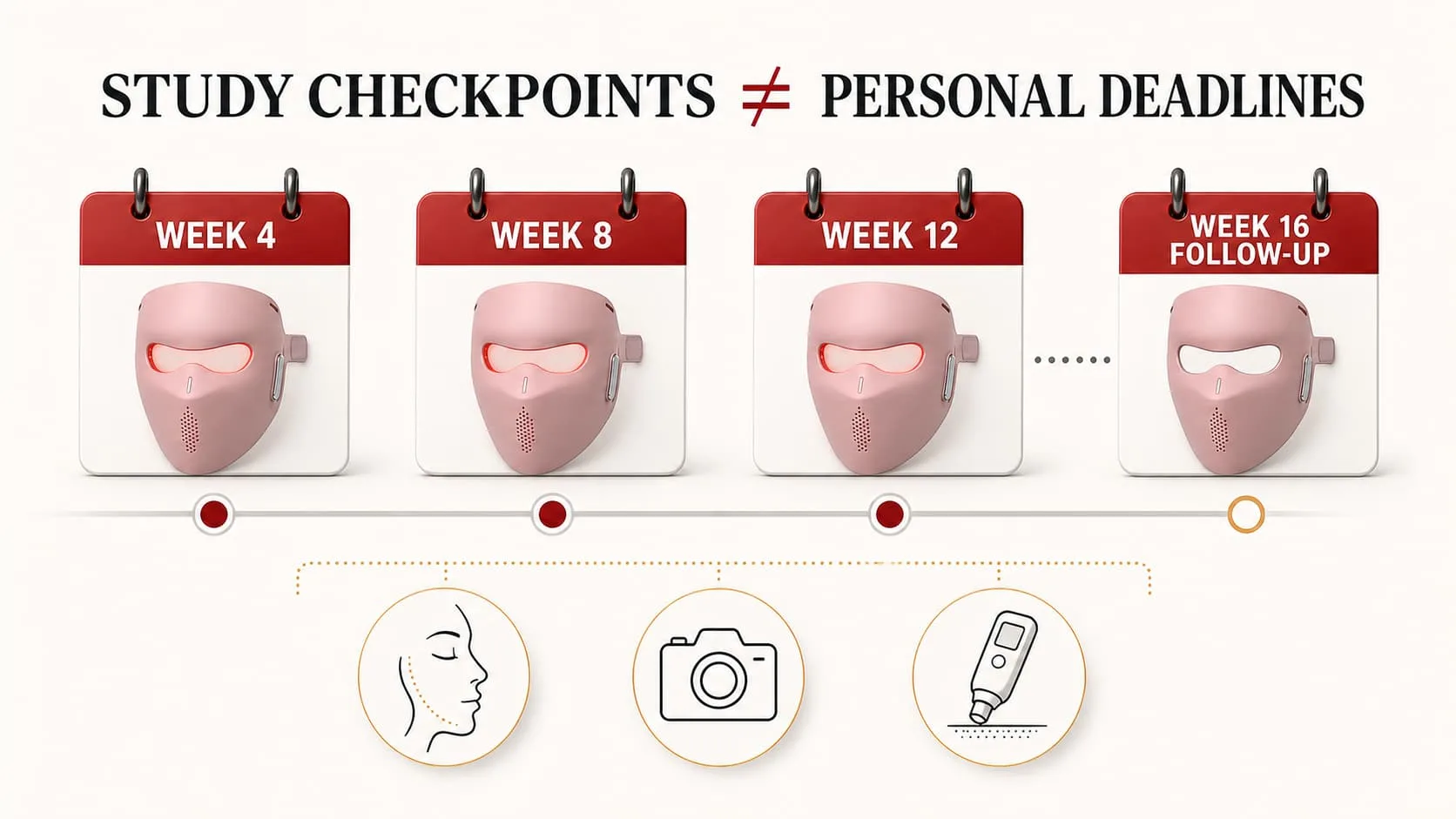
No. Un punto de control del estudio le indica cuándo los investigadores midieron un resultado definido bajo un protocolo; No es una fecha límite para que tu piel deba cambiar..
El Academia Americana de Dermatología explica por qué una única línea de tiempo no es confiable: Los estudios utilizan diferentes dispositivos., correr durante diferentes periodos de tiempo, y hacer diferentes preguntas. La AAD también señala que el tiempo necesario varía y que no todos ven resultados.
Cuatro variables deben permanecer juntas al interpretar un estudio:
- Resultado: ¿El estudio midió las patas de gallo?, longitud de la arruga, hidratación, elasticidad, enrojecimiento, o satisfacción del participante?
- Dispositivo y modo: ¿Qué longitudes de onda y salida utilizó el dispositivo probado??
- Protocolo: ¿Cuánto duró cada sesión?, ¿Con qué frecuencia se usó?, y por cuantas semanas?
- Evaluación: ¿El resultado fue juzgado por el participante?, un evaluador ciego, una escala clínica, software, o un instrumento?
Si alguna de esas variables cambia, la línea de tiempo puede no transferirse. Una medición de arrugas de cuatro semanas con un dispositivo de investigación no es una promesa de que otra mascarilla creará cambios visibles en cuatro semanas.. Una prueba de patas de gallo de 12 semanas no establece un plazo de 12 semanas para los poros, pigmentación, acné, o lifting facial.
¿Qué midieron realmente los estudios de LED faciales y cuándo??
Los estudios controlados han informado algunos cambios después de protocolos cortos y otros después de protocolos más largos., pero no producen una secuencia universal de resultados visibles..
| Estudiar | Protocolo de investigación exacto | Control | lo que se observó | Lo que no debes concluir |
|---|---|---|---|---|
| Bragato et al., 2025 | 95 mujeres de 45 a 60 años; 660 ± 10 máscara nm.; 21-sesiones de minutos, dos o tres veces por semana para 4 semanas; control simulado | Curso de tratamiento de cuatro semanas.; la publicación informa valoración fotográfica 30 días después del tratamiento | ImageJ encontró cambios en la longitud de algunas arrugas glabelares y periorbitarias derechas, y la satisfacción de los participantes difería de la farsa | La Escala de Evaluación de Arrugas ciega no encontró diferencias significativas entre los grupos. Esto no convierte las cuatro semanas en un plazo límite para obtener resultados completos ni establece una frecuencia universal.. |
| Mota et al., 2023 | 137 mujeres de 40 a 65 años; Dispositivos LED de contacto aplicados por investigadores (no una máscara casera) con rojo 660 nm por un lado y ámbar 590 nm por el otro; 10 minutos por lado, 10 sesiones terminadas 4 semanas | Antes versus después del curso de 4 semanas | El volumen de arrugas perioculares medido disminuyó en ambos lados tratados activamente | Ningún tratamiento mejoró la hidratación o la viscoelasticidad.. Ambos lados recibieron luz activa., por lo que el estudio no tuvo efectos no tratados o simulados y no puede establecer un efecto de máscara general de cuatro semanas. |
| Parque y col., 2025 | 60 Adultos asiáticos de 30 a 65 años; 630 LED + 850 nm máscara casera IRED; 9 minutos, cinco veces por semana para 12 semanas; farsa de bajo rendimiento | Semanas 4, 8, y 12 durante el uso; semana 16 fue un seguimiento 4 semanas después de terminar el uso | Las evaluaciones de las patas de gallo independientes y de los investigadores no mostraron una diferencia grupal estable durante la semana. 4 pero lo hizo en semanas 8, 12, y 16 | La mejora calificada por los participantes no difirió significativamente entre los grupos. Fabricante del dispositivo Y&J Bio financió el estudio; Los autores informan investigaciones y escritos independientes.. Los resultados no pueden establecer un cronograma para otras máscaras o resultados. |
Para un juicio separado sobre si una línea visible es un objetivo LED plausible, ver Wakelife guía de evidencia sobre máscaras faciales LED para líneas finas y arrugas.
Estos ensayos son útiles porque muestran lo que se probó.. También muestran por qué un simple gráfico de “resultados por semana X” puede inducir a error.:- Una medición de software, escala clínica, y la impresión del participante puede no coincidir.
- El cambio de arrugas no demuestra cambio de hidratación o elasticidad..
- Un período de tratamiento y un período de seguimiento no son lo mismo.
- La etiqueta del mismo color no hace que dos dispositivos sean equivalentes.
¿Por qué pueden las fotos, Instrumentos, y su propia impresión no está de acuerdo?
Los “resultados” pueden referirse a diferentes resultados y diferentes formas de medirlos.. Decida qué está rastreando antes de decidir si la máscara funcionó.
| Lo que quieres rastrear | Un registro más apropiado | Limitación principal |
|---|---|---|
| Un área de arrugas definida | Misma expresión, fotografías en la misma posición; un método de calificación consistente si está disponible | La iluminación y la posición de la cabeza pueden exagerar u ocultar las líneas. |
| Uniformidad de textura o tono visible | Fotografías comparables de rostro completo y primeros planos. | Procesamiento de cámara, constituir, sequedad temporal, y la iluminación puede alterar la apariencia |
| Hidratación o elasticidad | Un instrumento validado utilizado consistentemente | Estos cambios no se pueden establecer de forma fiable a partir de una selfie normal. |
| "Resplandor" general | Fotografías repetidas más una descripción escrita de lo que significa "brillo" para usted. | Es subjetivo y muy sensible a la luz., aceite, constituir, y configuración de la cámara |
| Acné o una afección cutánea diagnosticada. | Recuentos de condiciones específicas o evaluación clínica vinculada a un dispositivo apropiado | El tipo y la gravedad del acné son importantes; no reutilice una línea de tiempo antienvejecimiento ni autodiagnostique una condición que empeora |
Esta es la razón por la que una persona puede sentir que nada cambió mientras un evaluador detecta una pequeña diferencia, o sentirse más alegre mientras una escala clínica no muestra ningún cambio.. Ninguna observación debería cancelar automáticamente la otra.. Responden diferentes preguntas.
La conclusión más segura para el consumidor es más limitada.: buscar un cambio repetible en un resultado definido, en condiciones comparables, sin tratar una fotografía como prueba de causa.
¿Cómo se puede realizar un seguimiento más justo del progreso de las máscaras LED en casa??
Cree una línea de base y repita la misma configuración fotográfica a intervalos planificados. La constancia importa más que tomar fotos todos los días.
La investigación sobre fotografía facial muestra que los cambios en ángulo de luz y inclinación de la cabeza puede cambiar la forma en que se percibe la cara y el área de los ojos. Un resultados-estudio de fotografía También se identificó el posicionamiento., expresión, iluminación, fondo, zoom, constituir, y el momento como factores que pueden hacer que las comparaciones de antes y después sean engañosas.
Utilice esta lista de verificación mínima:
- Elija un objetivo y área principal. Escribe exactamente lo que pretendes observar., como un área de patas de gallo o una textura visible general. No combine cinco preocupaciones en un solo juicio de “funcionó/no funcionó”.
- Toma una línea base antes de cambiar la rutina. No uses maquillaje y registra la fecha., dispositivo exacto, modo, y rutina actual de cuidado de la piel.
- Mantenga la fuente de luz y la dirección iguales.. Utilice la misma habitación y lámpara o la misma posición de luz natural indirecta. No compare la luz frontal suave con la luz lateral intensa.
- Mantenga la cámara y la posición de la cara iguales. Coincidir con la altura de la cámara, ajuste de lente o zoom, distancia, enmarcado, ángulo de la cabeza, y expresión. Evita los filtros de belleza, retoque de retratos, y ediciones automáticas cuando sea posible.
- Mantenga un registro de uso. Grabar sesiones completadas, modo, y cualquier sesión perdida de acuerdo con las instrucciones de su dispositivo exacto. No cambie el protocolo para que el registro parezca completo.
- Registre otros cambios y reacciones.. Tenga en cuenta los nuevos productos para el cuidado de la piel., procedimientos, discusiones sobre medicamentos con un profesional, irritación inusual, u otros cambios que podrían afectar la interpretación.
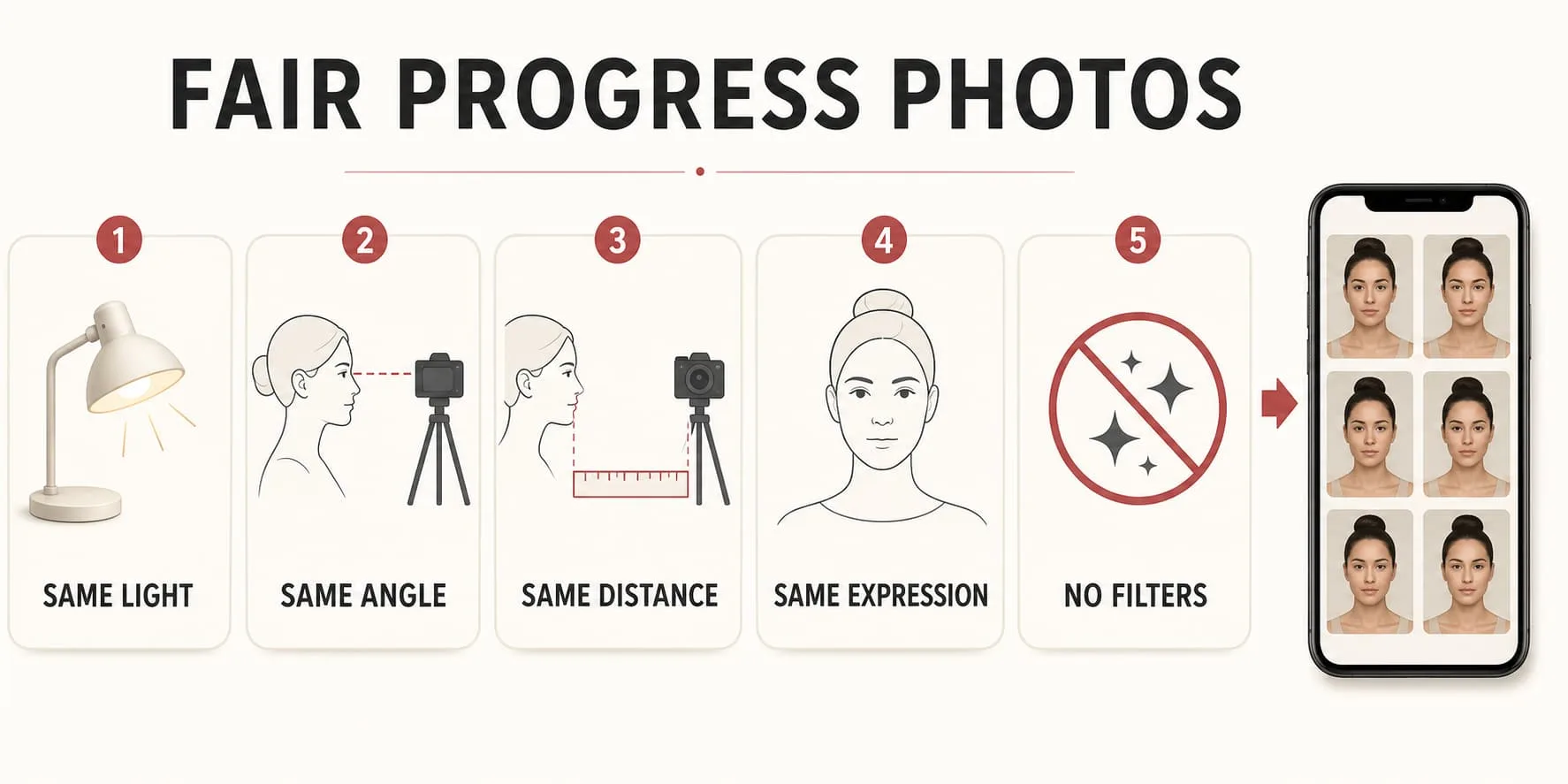
La estandarización reduce el sesgo de comparación evitable; no convierte una serie de fotografías caseras en un ensayo clínico. variación natural, otras partes de tu rutina, y el procesamiento de la cámara aún puede afectar lo que ves.
Aún no hay cambios visibles: ¿qué debería comprobar primero??
Consulta el objetivo y el protocolo actual antes de añadir más tiempo o sesiones.. “Sin resultado” puede significar un desajuste en el resultado, un problema de ejecución, una comparación injusta, o ninguna respuesta observable bajo la rutina actual.
Utilice este orden:
| Controlar | Que verificar | ¿Qué cambia la respuesta? |
|---|---|---|
| 1. Meta | ¿El objetivo se menciona en el uso previsto o en las instrucciones del dispositivo?, ¿Es lo suficientemente específico como para realizar un seguimiento?? | Si el objetivo está fuera del alcance del dispositivo, más semanas no solucionan el desajuste. |
| 2. Dispositivo y modo exactos | ¿Tienes las instrucciones específicas del modelo?, ¿Y estás utilizando el modo destinado a ese objetivo?? | un nombre de marca, etiqueta de color, o el protocolo de otro modelo no es suficiente. La información faltante o contradictoria exige la verificación del proveedor. |
| 3. Uso real | ¿El tiempo real de la sesión?, frecuencia, modo, curso, y las instrucciones oculares/de seguridad coinciden exactamente con las instrucciones del dispositivo.? | Si la ejecución difirió, corregir la rutina a través de las instrucciones oficiales o del proveedor; no improvisar una dosis de recuperación. |
| 4. Calidad de comparación | ¿Son realmente comparables los registros de referencia y de seguimiento?? | Si no, establecer una línea de base limpia sin cambiar el protocolo del dispositivo y realizar un seguimiento del siguiente punto de control apropiado. |
| 5. Observación emparejada por resultados | ¿Se ha completado realmente el curso indicado por el dispositivo o un período de estudio relevante para el mismo resultado?? | Si no, La observación continua puede ser razonable cuando se tolera el uso.. si tiene, dejar de ampliar automáticamente el plazo y reevaluar. |
Si el modelo exacto, uso previsto, colocación de longitud de onda, condiciones de salida, o la calidad de la instrucción no se puede verificar, él está en Wakelife's Guía de verificación de mascarilla LED de seis puntos antes de ampliar el cronograma.
Para verificar los campos de programación del dispositivo exacto, él está en Wakelife's Guía de frecuencia de máscara LED y duración de la sesión. No duplique una sesión, reiniciar un temporizador completado, modos de pila, o aumentar el uso semanal simplemente porque el progreso visible se siente lento. Si el pedido o los productos de cuidado de la piel pueden estar cambiando la rutina, utilizar las guías para Dónde encaja una máscara LED en una rutina de cuidado de la piel y si la crema hidratante o el suero pueden permanecer en la piel. Las instrucciones para el dispositivo exacto aún controlan.¿Cuándo debería dejar de esperar y cambiar de dirección??
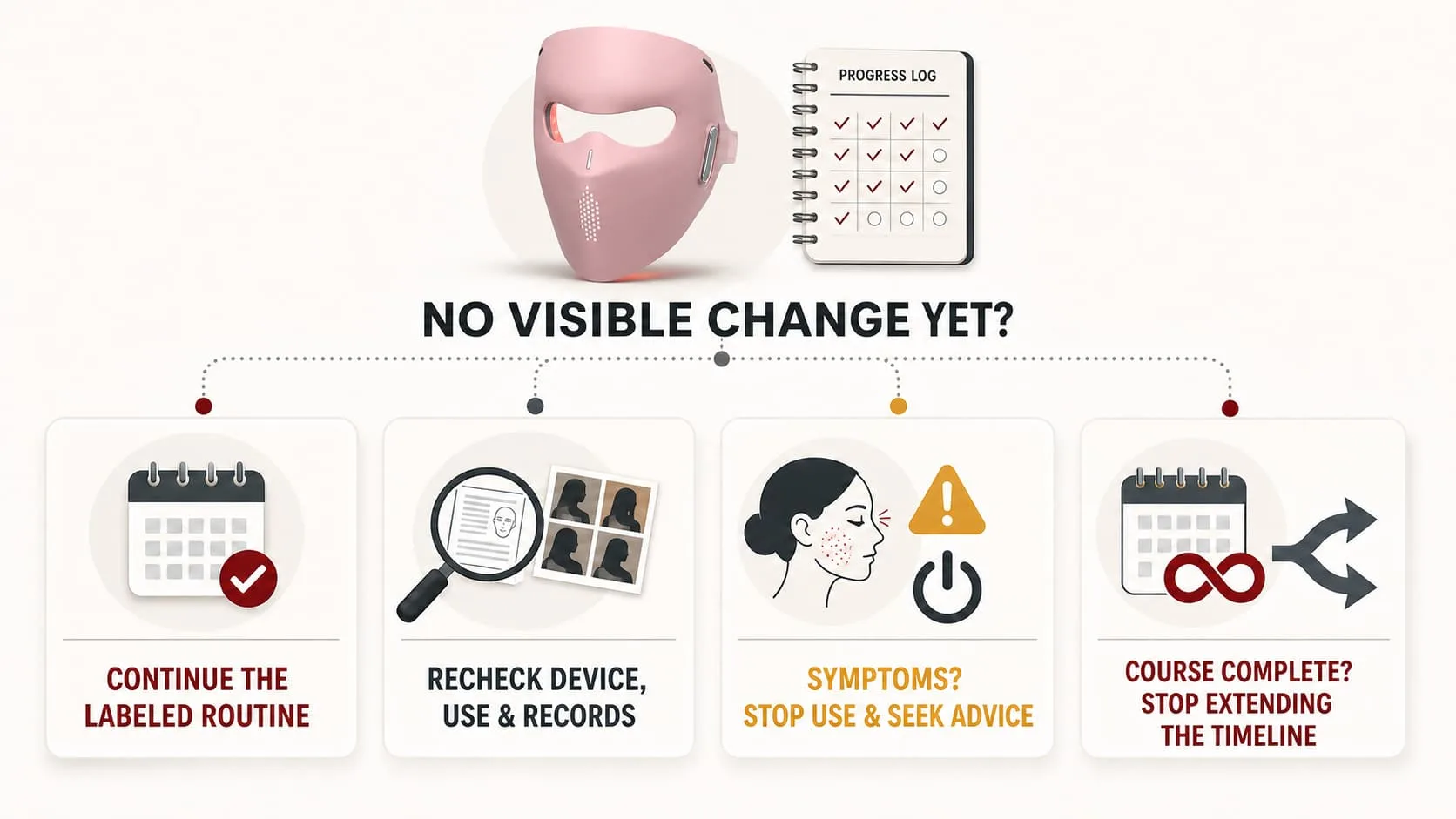
Deje de ampliar el cronograma cuando el problema ya no sea simplemente “aún no hay suficiente observación”.
| Decisión | cuando encaja | Siguiente paso |
|---|---|---|
| Continuar con la misma rutina etiquetada y seguir grabando. | El objetivo y el modo coinciden., las instrucciones son claras, el uso real es consistente, los registros son comparables, el curso correspondiente está incompleto, y no hay ninguna reacción preocupante | Continúe solo dentro de las instrucciones exactas del dispositivo y compare en el siguiente punto de control planificado |
| Vuelva a verificar antes de continuar | el modelo, modo, cronograma, uso previsto, o falta la línea base, contradictorio, o no verificable | Solicite al proveedor las instrucciones exactas y la información de soporte del dispositivo.; corregir el registro antes de juzgar la línea de tiempo |
| Deja de usarlo y busca consejo. | Significativo, persistente, o se produce un empeoramiento de los síntomas de la piel o los ojos | Deje de utilizar el dispositivo y busque asesoramiento profesional adecuado.. No pruebes una rutina más larga o más intensiva. |
| Deja de extender la línea de tiempo y cambia de dirección. | El objetivo está fuera del alcance razonable del dispositivo., o se ha completado un curso con resultados coincidentes sin ninguna mejora visible repetible | Deja de agregar semanas arbitrarias. Reevaluar el dispositivo y el objetivo., Póngase en contacto con el proveedor sobre el soporte aplicable., y buscar una evaluación calificada cuando la preocupación objetivo lo requiera. |
Si un curso bien documentado termina sin un cambio repetible, la conclusión responsable no es “fallaste” o “todas las máscaras LED son inútiles”. es mas estrecho:
No se observó ninguna mejora visible repetible con este dispositivo, modo, rutina, y seguimiento de los resultados durante el período evaluado.
Esa conclusión es suficiente para poner fin a una línea de tiempo abierta.. Puede llevar a comprobar si el dispositivo coincide con su documentación., ajustando la meta, usar una estrategia diferente de cuidado de la piel no médica, discutir la inquietud con un profesional calificado, o usando la devolución de la marca, garantía, o proceso de actualización cuando corresponda. No prueba que el cuerpo de la persona sea biológicamente incapaz de responder., y el resultado de una persona no debe proyectarse en usuarios similares.
La regla práctica para recordar
La pregunta no es sólo "¿Cuántas semanas han pasado??" Utilice una secuencia más útil:
Definir un resultado
Los puntos de control de la investigación pueden ayudarle a comprender cuándo los investigadores buscaron un cambio. No pueden prometer cuándo verás uno.. El uso coherente y el seguimiento justo son importantes, pero también lo es reconocer cuando el dispositivo, meta, situación de seguridad, o el resultado observado ya no admite "simplemente sigue esperando".
Para marcas, Clínicas, y equipos de productos
“Lo usé durante semanas y no vi nada” no es sólo un problema de motivación del consumidor. Puede revelar un uso previsto poco claro., instrucciones de modo incompleto, especificaciones no verificables, seguimiento deficiente de los resultados, o un proceso postventa que no tiene un punto de parada responsable.
Los equipos de producto deben conectar cada reclamo de los consumidores con el modelo exacto., modo, protocolo etiquetado, resultado de apoyo, punto de control del estudio, y un camino de reevaluación realista. Los equipos de soporte también necesitan una forma documentada de distinguir la ejecución incompleta de la discrepancia entre dispositivo y objetivo, y finalizar el cronograma honestamente cuando registros comparables no muestran cambios repetibles..
Las marcas que desarrollan protocolos de máscaras LED más claros y educación posventa pueden explorar Wakelife Plataformas de mascarillas LED y Capacidades OEM y ODM.
Orientación médica y de seguridad
Este artículo proporciona educación general para el consumidor., No es un consejo médico ni un diagnóstico.. Las máscaras LED varían según el uso previsto, estado regulatorio, producción, modos, horarios, advertencias, y requisitos de protección ocular. Siga las etiquetas de su dispositivo exacto.
Deje de utilizar el dispositivo y busque asesoramiento profesional adecuado en caso de, persistente, o empeoramiento de la irritación; sobre los síntomas oculares; empeoramiento de una condición existente; o una situación que involucra una condición sensible a la luz, medicamento, prescripción tópica, o procedimiento reciente. No suspenda el tratamiento prescrito ni diagnostique una reacción basándose en este artículo..
Referencias
Orientación profesional y revisiones de evidencia
-
1
Academia Americana de Dermatología. ¿Es la terapia con luz roja adecuada para su piel?? Actualizado septiembre 13, 2024. Consultado en julio. 23, 2026.
-
2
Ngoc LTN, Puede, Lee Y.C.. Utilización de diodos emisores de luz para terapia cutánea.: Revisión sistemática y metanálisis. Fotodermatología, Fotoinmunología & Fotomedicina. 2023;39(4):303–317. doi:10.1111/phpp.12841.
-
3
Grimes DR. Cuestiones metodológicas en la investigación y los informes dermatológicos sobre la terapia con LED visibles. MÁS UNO. 2025;20(9):e0332995. doi:10.1371/diario.pone.0332995.
Estudios LED faciales
-
4
Bragato EF, Paisano AF, Pavani C, et al. Papel de la frecuencia de aplicación de la fotobiomodulación en el rejuvenecimiento facial: Aleatorizado, Controlado de forma simulada, Doble ciego, Ensayo clínico. Láseres en la ciencia médica. 2025;40(1):170. doi:10.1007/s10103-025-04383-1.
-
5
Mota LR, Duarte ES, Galache TR, et al. La fotobiomodulación reduce el volumen de las arrugas perioculares al 30%: Un ensayo controlado aleatorio. Fotobiomodulación, Fotomedicina, y Cirugía Láser. 2023;41(2):48–56. doi:10.1089/fotob.2022.0114.
-
6
Parque SH, Parque así, joven si. Estudio clínico para evaluar la eficacia y seguridad de las máscaras LED e IRED de uso doméstico para las patas de gallo: Un multicentro, Aleatorizado, Doble ciego, Estudio controlado de forma simulada. Medicamento. 2025;104(7):e41596. doi:10.1097/Maryland.0000000000041596.
Fotografía y grabación de resultados
-
7
Hernández CA, Espinal J.M., Uribe ZapataD., et al. La influencia de diferentes ángulos de luz durante la evaluación fotográfica estandarizada del paciente en la percepción estética del rostro. Cirugía Plástica Estética. 2021;45:2751–2759. doi:10.1007/s00266-021-02314-3.
-
8
Vaca EE, Bricker J.T., Miotón LM, Fagien S, Alghoul MS. La influencia de la inclinación sagital de la cabeza en la apariencia periorbitaria: Implicaciones para la fotografía clínica y la evaluación de resultados posoperatorios. Foro Abierto de la Revista de Cirugía Estética. 2022;4:ojab043. doi:10.1093/asjof/ojab043.
-
9
DJ Soares, por Haven HN, yi ch. #La verdad fea? Una evaluación cualitativa de los resultados de la fotografía en Instagram: Presentamos el sistema de puntuación SEPIA. Cirugía Plástica y Reconstructiva—Global Open. 2022;10(8):e4464. doi:10.1097/GOX.0000000000004464.