Before comparing irradiance figures from two hair-growth cap suppliers, check whether the reports answer the same optical question. Start with the test object, geometría, measured regions, modo de funcionamiento, measurement system and result definition. If those conditions cannot be reconstructed, request the missing records before deciding what additional measurement is necessary.
For a brand product or quality lead, the immediate decision is whether the documents support a particular sample comparison. A more complete report does not establish better product output, and an optical comparison does not establish clinical effectiveness.
Start with the question you need answered
Suppose your team wants to compare irradiance distribution across the frontal, crown and side regions of two assembled caps under an agreed operating condition.
Irradiance describes radiant power arriving per unit area at a receiving surface. That makes the receiving location part of the question, rather than a detail to resolve after comparing figures. Ver el CIE definition of irradiance (1).
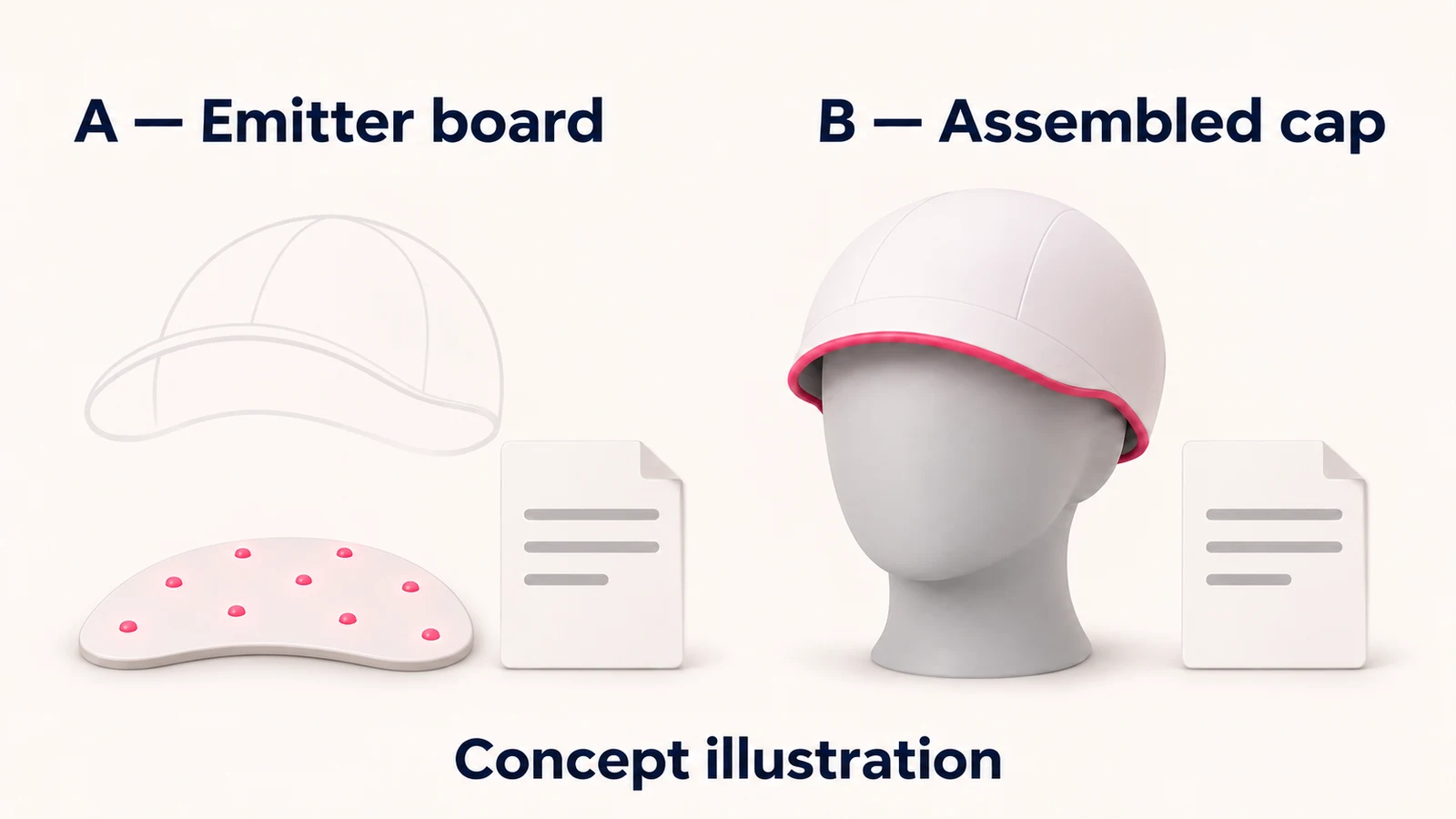
A measurement of an exposed emitter board may help examine that board. no lo hace, por sí mismo, answer how the complete cap distributes light across the regions in your comparison.
A worked comparison: two fictional excerpts
A and B below are fictional teaching excerpts, not Wakelife or other suppliers’ test reports. No measured performance is represented.
| Artículo | Fictional excerpt A | Fictional excerpt B |
|---|---|---|
| Test object | Removed emitter board laid flat | Complete cap fitted to a headform |
| Geometría | Flat plane; “fixed distance,” with no distance value | Headform dimensions and fitting sketch; probe positions and orientations absent |
| Regions | One center point in board coordinates | Frontal, crown and side regions named; original point map absent |
| Modo | All channels at highest control setting | Selected channels at a lower setting |
| Definición de resultado | “Maximum”; spatial maximum versus temporal peak unspecified | “Regional average”; valores individuales, region boundaries and calculation absent |
| Measurement record | Instrument and calibration not provided | Instrument identified; detector area and calibration not provided |
Decisión: neither excerpt supports ranking the caps for the stated regional question.
A describes a different test object and only one location. B uses a configuration more relevant to the question, but the excerpt does not let you reconstruct or check its regional results. B is therefore a better starting point for this document review, not evidence of a better cap.
Read each mismatch as a specific next action
Geometry and coverage: recover the map before interpreting the average
For A, request the actual distance, receiving-plane position and detector orientation. Then establish whether any measurements of the assembled cap exist. Completing the board record could clarify its own result; it would not turn that result into assembled-cap regional data.
For B, request the original point map, region boundaries and probe positions and orientations. The fitting sketch alone does not show where or how the detector received light.
Radiometry requires attention to measurement distance, detector sampling area and spatial distribution. Hadis and colleagues’ methodological review (2) explains these general limitations; it does not prescribe a hair-cap headform or sampling grid. For this comparison, the practical request is enough setup detail to connect each reading to its location and receiving geometry.
Próximo, unpack “regional average.” Ask for the individual readings and calculation. An arithmetic mean of selected points is not automatically an average over the whole region’s area. Whether it represents that area depends on the sampling arrangement and any weighting. Ask the technical team to explain the intended interpretation rather than assuming that more points alone settle the question.
Operating mode and result definition: resolve two different meanings of “maximum”
A’s highest setting and B’s lower setting describe different operating conditions. Control labels alone do not tell you whether the optical conditions are comparable.
Ask which channels were active, whether operation was continuous or pulsed, what power supply was used and when readings were taken. Reporting recommendations from Jenkins and Carroll (3) include wavelength, fuerza, momento, área objetivo, pulse characteristics and location; they also identify warming and equipment age as possible influences on output. These are research-reporting considerations, not cap acceptance criteria or a prescribed warm-up period.
A’s “maximum” needs a separate clarification. Does it mean the highest reading among spatial locations, a temporal peak at one location, o algo más? B’s “average” also needs a time basis if output varies during measurement. A spatial maximum, a temporal peak and a regional average describe different quantities. Converting units cannot make them interchangeable.
Measurement system: an instrument name is only the beginning
B identifies an instrument, while A does not. That difference improves traceability but cannot establish which result is more accurate.
Request the detector or probe details, active receiving area, wavelength settings or spectral integration range, applicable calibration records and the uncertainty associated with the reported result. Ask how the probe responds to light arriving from different angles in the intended setup. These are practical report-review requests. The official summary of CEI 202:2011 (4) addresses spectral responsivity, measurement arrangements, reference detectors and uncertainty; it does not validate this cap setup or rank instruments by name.
Keep spectral and spatial information separate. Spectral irradiance describes irradiance with respect to wavelength, as defined in the CIE vocabulary (1). Combining wavelength contributions over a stated band and combining readings across locations are different operations. A reported total still needs its wavelength basis as well as its spatial interpretation.
Retrieve records first; arrange measurements for the remaining gap
An omission from an excerpt means the information was not supplied. It does not prove the laboratory never recorded it.
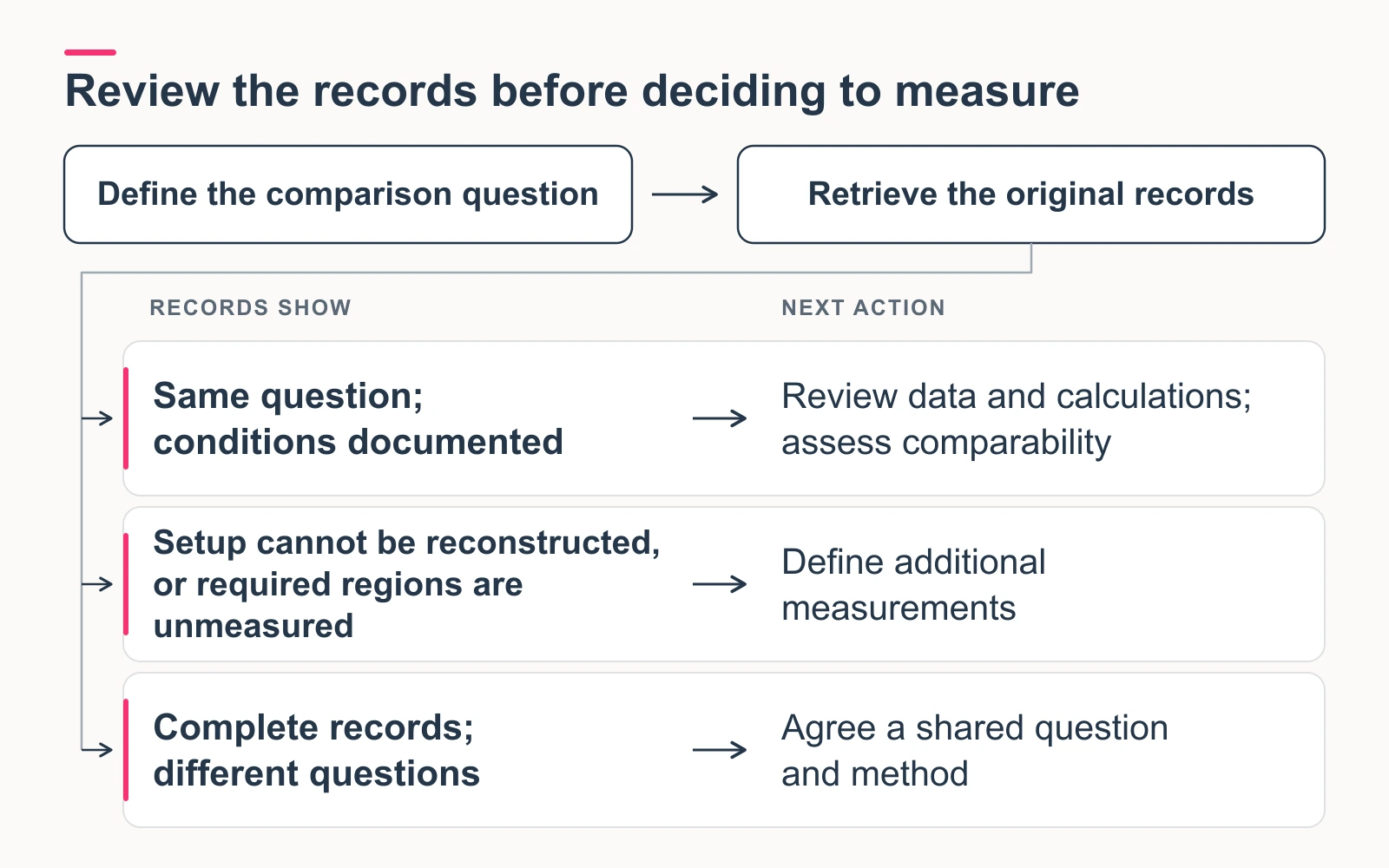
Request the original test sheets, setup photographs, mapa de puntos, instrument records and calculations. Use them to decide which of three situations applies:
- The records reconstruct the relevant condition. Review the underlying data and calculation before deciding whether the comparison is supported.
- The records cannot reconstruct the condition, or the required regions were never measured. Agree the necessary additional measurement scope with technical staff.
- Complete records still answer different questions. Define a shared comparison question and method; additional paperwork alone will not reconcile the results.
En este ejemplo, finding A’s missing distance would not resolve the board-versus-cap mismatch. Finding B’s point map could make its regional result reviewable, but would not make A comparable. These are separate gaps with separate remedies.
Give engineering a brief they can act on
The following is a suggested handoff, not a test standard. Fill it using the recovered records and mark unresolved fields explicitly.
- Objetivo, regions and samples: Compare assembled-cap irradiance distribution in the agreed frontal, crown and side regions. Identify the unit count, sample IDs, configurations and batch IDs where available, and define the region boundaries. Keep conclusions tied to the tested samples unless a wider sampling basis is documented.
- Fitting and detector geometry: Record headform dimensions, cap fitting, detector positions, distances and orientations. Explain how the method handles relevant differences in product fit.
- Operating condition and timing: Specify active channels, control settings, pulse operation, fuente de alimentación, runtime and measurement timing. Record ambient-light conditions and how background light and the instrument’s dark signal were handled. Record the basis for treating conditions as comparable.
- Required data and calculation: Retain point-level readings, wavelength or band definition, detector and calibration information, averaging method and measurement uncertainty. Define every “maximum” or “average.”
- Decision basis and exclusions: Agree what comparison or acceptance decision the results must support, how differences will be evaluated and what remains outside scope. Do this before interpreting the outcome.
A common method should preserve relevant product-fit differences; mechanically flattening every device could remove a feature the comparison needs to examine. Equally, an unobstructed headform measurement does not measure every wearer’s actual scalp exposure or absorbed follicle dose.
For A and B, the next step is a targeted records request followed by an engineering decision on the remaining measurement gap. There is no supported cap ranking yet.
If your team is still selecting a product format, utilizar el hair growth cap, Comparación de casco y peine.. For a project scope discussion, contact Wakelife with the comparison question and unresolved documentation needs.
Referencias
-
1
CIE S 017:2020, Vocabulario de iluminación internacional: Irradiancia, 17-21-053 y irradiancia espectral, 17-21-056. Official online definitions; no cap-specific measurement or acceptance method.
-
2
Hadis et al. (2016). The dark art of light measurement: accurate radiometry for low-level light therapy. Láseres en la ciencia médica, 31:789–809. Full-text methodological review used for radiometry principles. Coauthor James D. Carroll was affiliated with THOR Photomedicine; a commercial connection applies. Clinical and regulatory passages are not used here.
-
3
Jenkins and Carroll (2011). How to report low-level laser therapy (Lllt)/photomedicine dose and beam parameters in clinical and laboratory studies. Fotomedicina y Cirugía Láser, 29(12):785–787. PubMed abstract only; research-reporting recommendations. Listed affiliation includes SpectraMedics Pty Ltd; full conflict-of-interest information was unavailable.
-
4
CEI 202:2011. Spectral Responsivity Measurement of Detectors, Radiometers and Photometers. Official public summary of a technical report; the full paid report was not reviewed. Used only for general detector-characterization scope.