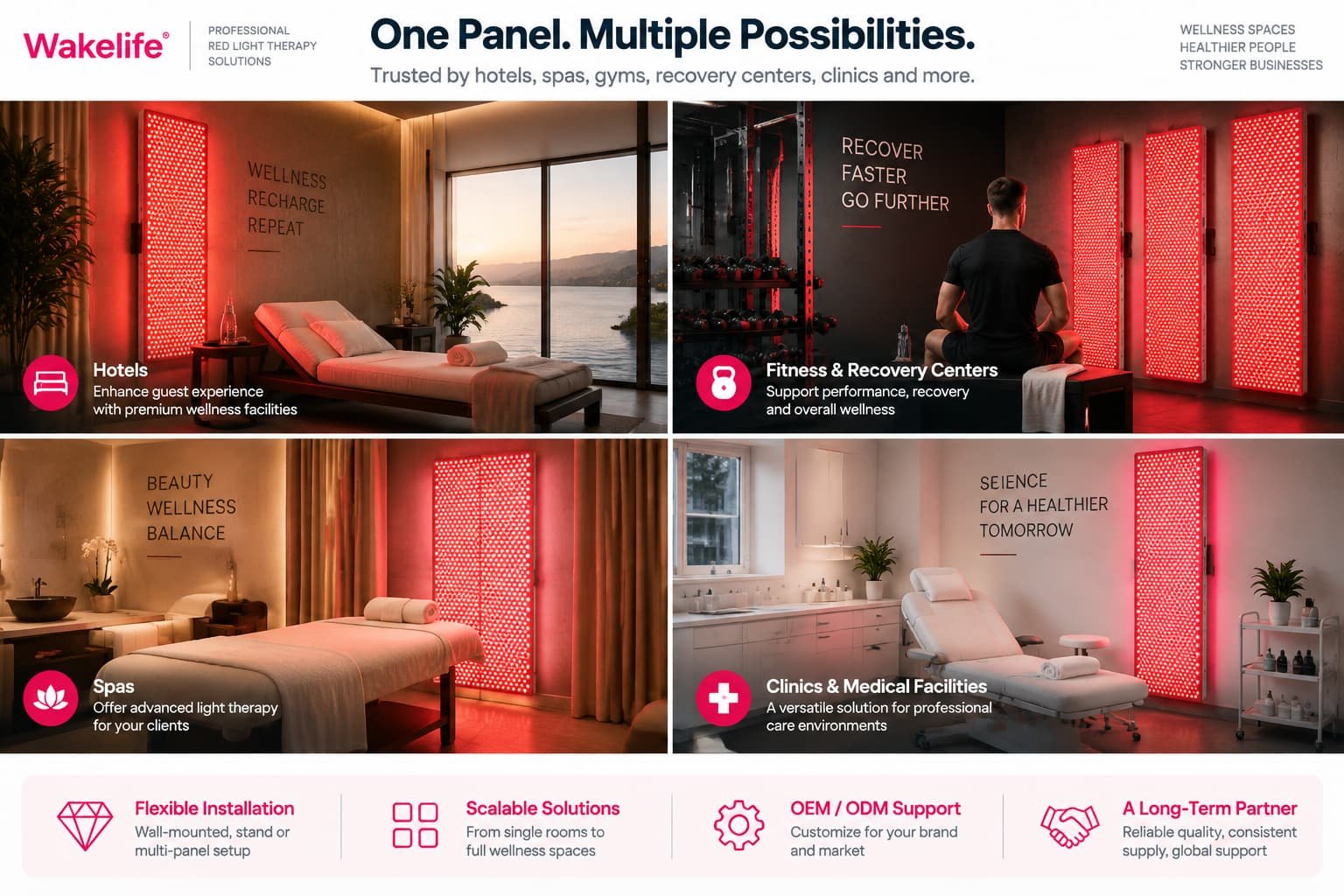
TL;DR (para compradores) BK900 es un Bronceado UVB de consumo de medio cuerpo & panel de exposición a la luz, no es un dispositivo médico. No diagnostica, tratar, curar, o prevenir cualquier enfermedad. 180 LED. 9 longitudes de onda, libre de rayos UVA. 7 modos. Construido bajo ISO 13485 + MDSAP en una instalación registrada por la FDA. Para marcas que ya han validado la categoría UVB y están listas para pasar a ser premium, o para estudios y espacios de bienestar que necesitan cobertura de medio cuerpo con resultados mensurables y un posicionamiento de cumplimiento honesto..
1. Seamos claros sobre qué es y qué no es este dispositivo
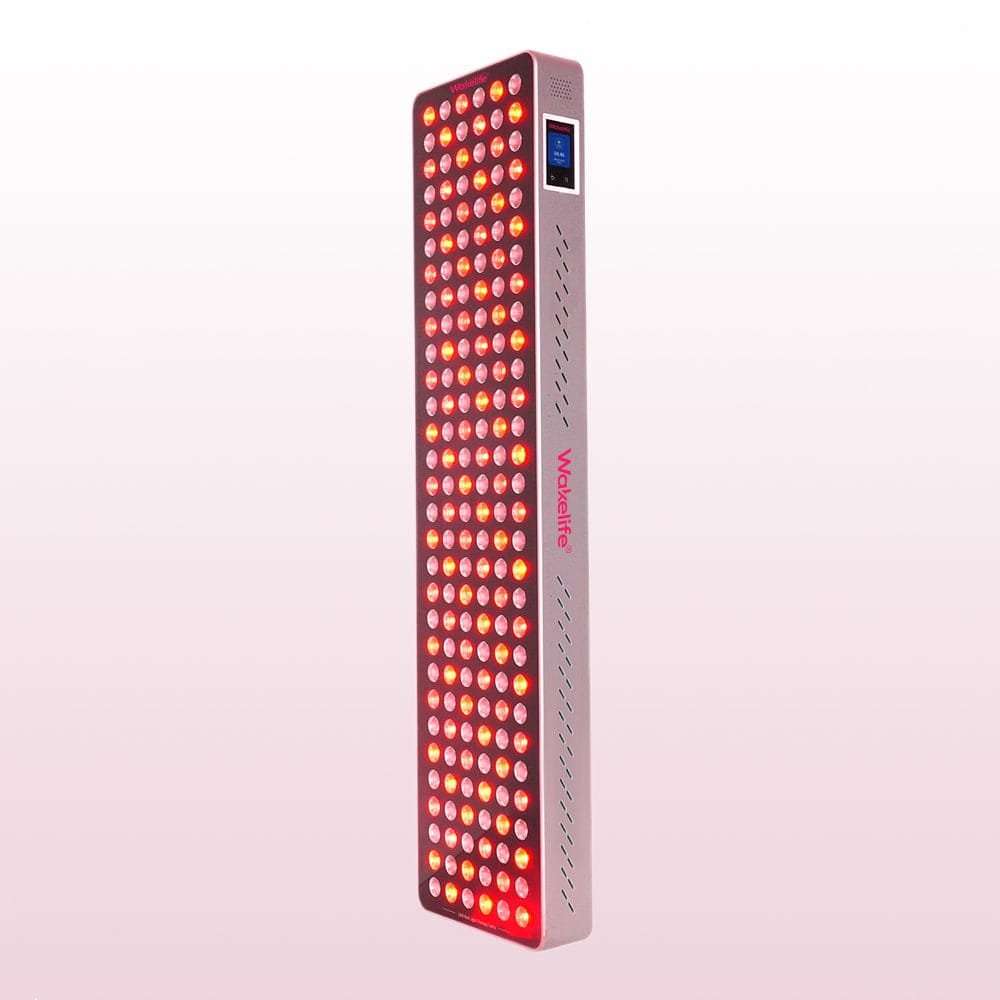
BK900 es un bronceador UVB de consumo / panel de exposición a la luz. No diagnostica, tratar, curar, o prevenir cualquier enfermedad, y nunca debería comercializarse de esa manera.
Su estado de cumplimiento: el La serie BK ha pasado la CE, FCC, y pruebas RoHS, está fabricado bajo ISO 13485 + Mdsap sistemas en una instalación registrada por la FDA, y BK900 está incluido en la información de listado de dispositivos de la FDA.
Una distinción que no borraremos, y tú tampoco deberías: a listado de dispositivos es el registro del dispositivo con la FDA. Es no una “autorización” o “aprobación” de la FDA. La propia FDA es explícita sobre este punto (ver Registro y listado de dispositivos y 510(k) Notificación previa a la comercialización. Nuestras instalaciones tienen un 510(k) autorización (K250830), pero esa autorización pertenece a un específico máscara facial LED, no hasta BK900. Puedes comprobarlo tú mismo en el FDA 510(k) base de datos. No dejaremos que esos dos se mezclen, y te recomendamos que también los mantengas separados en tus propias páginas..
¿Por qué abrir con esto?? Porque hemos visto a compradores pegar una hoja de especificaciones inflada en una tienda DTC y encontrarse con un problema de cumplimiento de la plataforma.. Preferimos decir una frase menos antes de que usted sea responsable de nuestra redacción.. Todo lo que sigue supone que has absorbido esta distinción..
Si es completamente nuevo en la categoría UVB y desea conocer la imagen completa del Grupo IARC 1 clasificación, 311nm antecedentes clínicos, y la filosofía de control de ingeniería: la cubrimos en profundidad en el Informe BK300. Todo lo que aparece allí también se aplica al BK900.. Esta página se centra en lo que es diferente.: fuerza, cobertura, y ajuste del canal.
2. Un panel de medio cuerpo que sigue siendo práctico
Cuando las marcas de bienestar evalúan un panel de exposición a la luz para la producción de marcas privadas, dos preguntas suelen venir primero: ¿Está construido con un estándar de calidad real?? y ¿La hoja de especificaciones realmente se mantiene unida?? BK900 fue diseñado teniendo ambas cosas en mente.
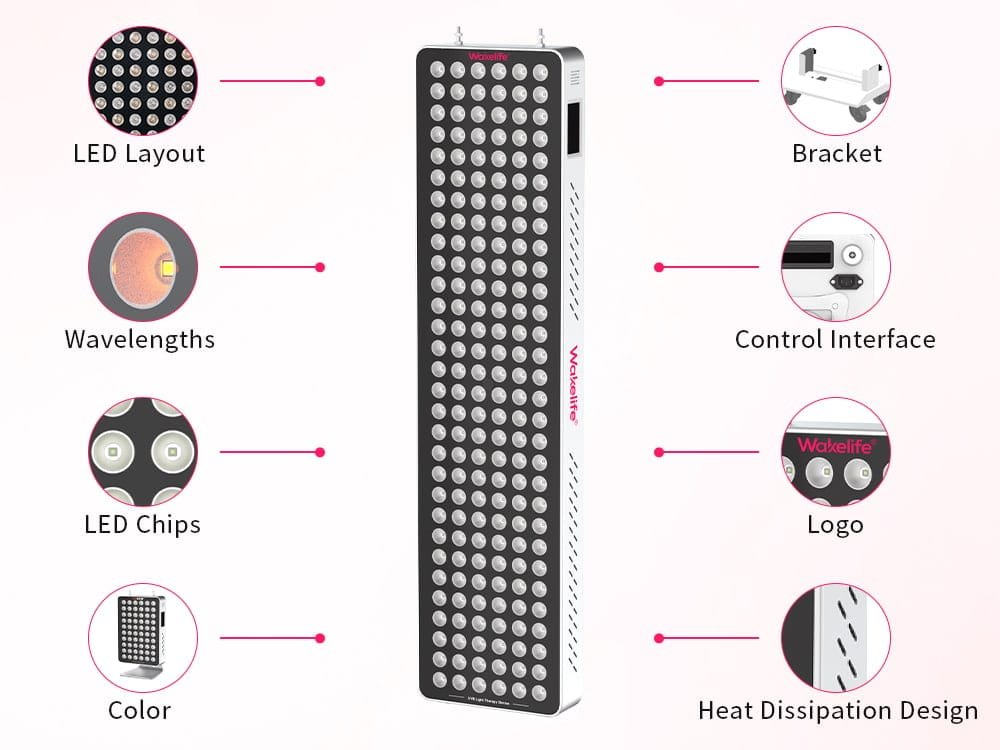
En 890 × 220 × 65 mm, El BK900 está diseñado para cubrir la mitad del cuerpo.. La longitud de 890 mm permite a los usuarios abordar el torso, atrás, o piernas a lo largo de un lapso significativo, mientras que el ancho de 220 mm mantiene el panel liviano, fácil de montar, y fácil de enviar. La vivienda utiliza un cubierta frontal y trasera de acero laminado en frío con un Marco de aluminio AL6063 — acabado en plata anodizada brillante, con opciones de color personalizadas disponibles para socios OEM.
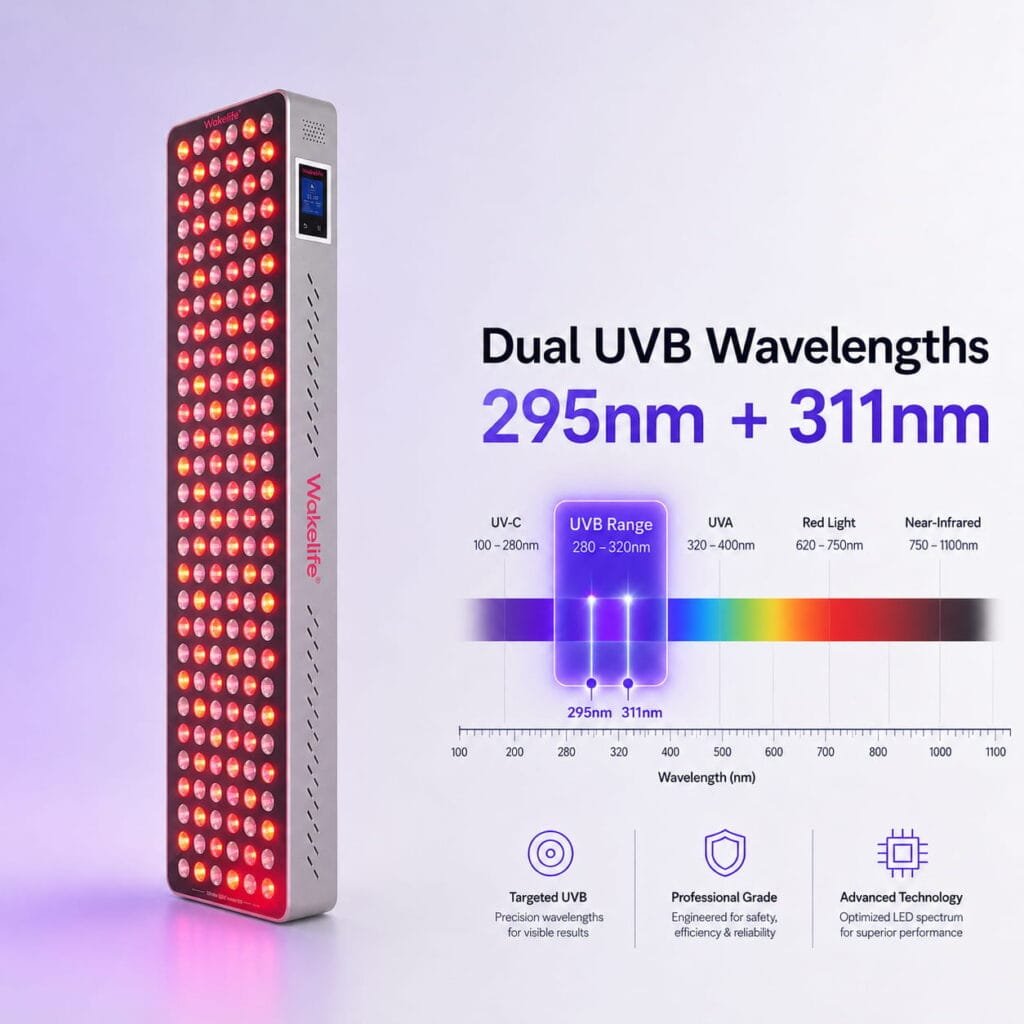
Detrás del difusor sentarse 180 SMD 3535 LED, Combinando chips de tres núcleos de tres colores junto con chips de un solo núcleo de un solo color.. Esta arquitectura permite que el dispositivo ofrezca nueve longitudes de onda distintas desde un solo panel sin sacrificar la densidad de salida.. Cuatro categorías de luz bajo una misma carcasa:
- UVB (295Nuevo Méjico + 311Nuevo Méjico) — modos de bronceado y exposición a los rayos UVB, gobernado por un sensor de distancia incorporado
- Azul-Violeta (415Nuevo Méjico) — rutinas de cuidado de la piel específicas
- Rojo (630Nuevo Méjico + 660Nuevo Méjico) — rutinas cutáneas a nivel de superficie
- Nir & Y (810Nuevo Méjico + 830Nuevo Méjico + 850Nuevo Méjico + 1060Nuevo Méjico) - Más adentro, rutinas orientadas a la recuperación
La salida es totalmente ajustable: el brillo funciona entre 0 y 100 %, frecuencia de pulso 0–40 Hz, y el temporizador incorporado se puede configurar desde 5 a 20 minutos. Todo controlado a través de un 3.0″ Pantalla táctil LCD TFT. El panel acepta 100–240 VCA a 50/60 Hz y tiene una clasificación de protección IP20..
3. Usted gana el derecho a decir "controlado" sólo después de haber sido honesto acerca del riesgo
La mayoría de los paneles evitan los rayos UVB porque, sin control, quema, y la sobreexposición crónica conlleva un riesgo real de cáncer de piel. IARC (la agencia de investigación del cáncer de la OMS) clasifica los dispositivos de bronceado que emiten rayos UV como Grupo 1 carcinógenos — la categoría de mayor riesgo — documentada en Monografías IARC Volumen 100D: Radiación. El Q de la radiación ultravioleta de la OMS&A dice esto claramente para el público general.
nuestra lógica: El riesgo no se elimina evitandolo, sino mediante el control de ingeniería.. La línea es siempre revisado vs. sin control.
Así es exactamente como lo aplica BK900:
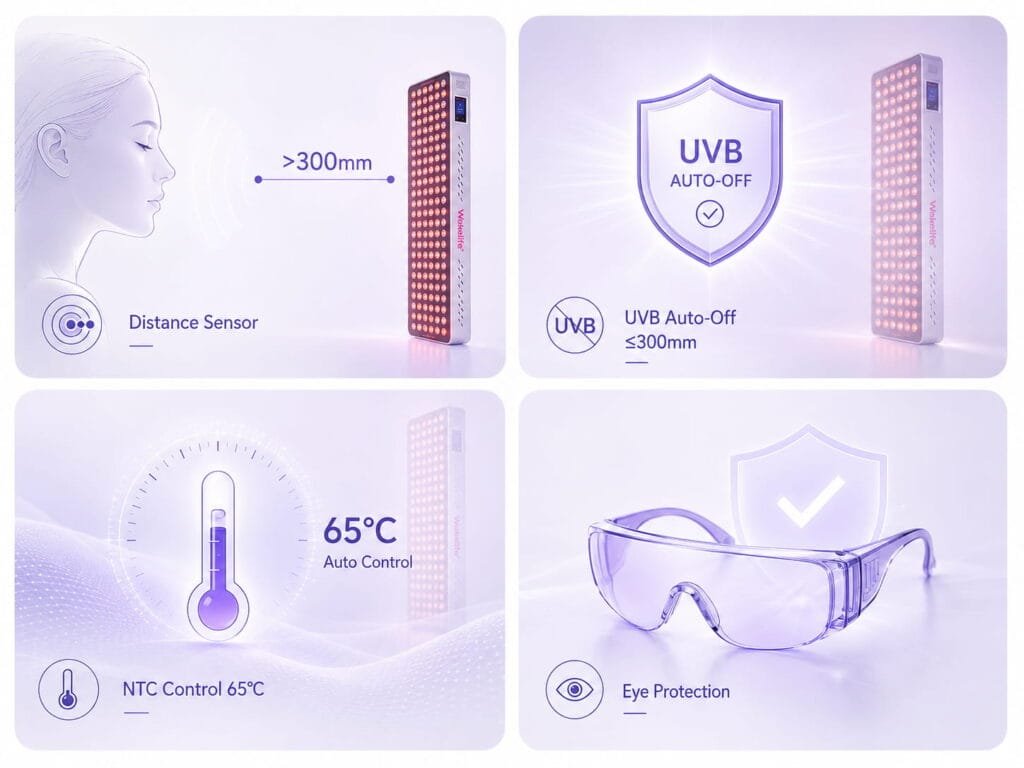
- sensor de distancia + apagado automático de UVB: UVB solo se activa cuando el usuario se coloca más allá 300mm (30centímetro). Si el usuario se mueve dentro de ese umbral, El canal UVB se corta físicamente, no es una luz de advertencia., un cierre duro.
- Control de temperatura NTC: arriba 65°C, el dispositivo reduce automáticamente la energía, antes de que se convierta en un evento de seguridad.
- Gafas protectoras incluidas. — coherente con los principios de seguridad fotobiológica descritos en Directrices de la ICNIRP sobre límites de exposición a la radiación ultravioleta, la referencia de libre acceso reconocida internacionalmente para los límites de exposición a los rayos UV. Este requisito debería reforzarse en el embalaje., en el manual de usuario, y en cualquier material de incorporación que una marca prepare para los usuarios finales..
- Alerta de timbre a una distancia de trabajo insegura.
Esto es lo que realmente significa “la ingeniería lleva el control, no el manual de instrucciones”.
4. 9 Longitudes de onda, Sin rayos UVA
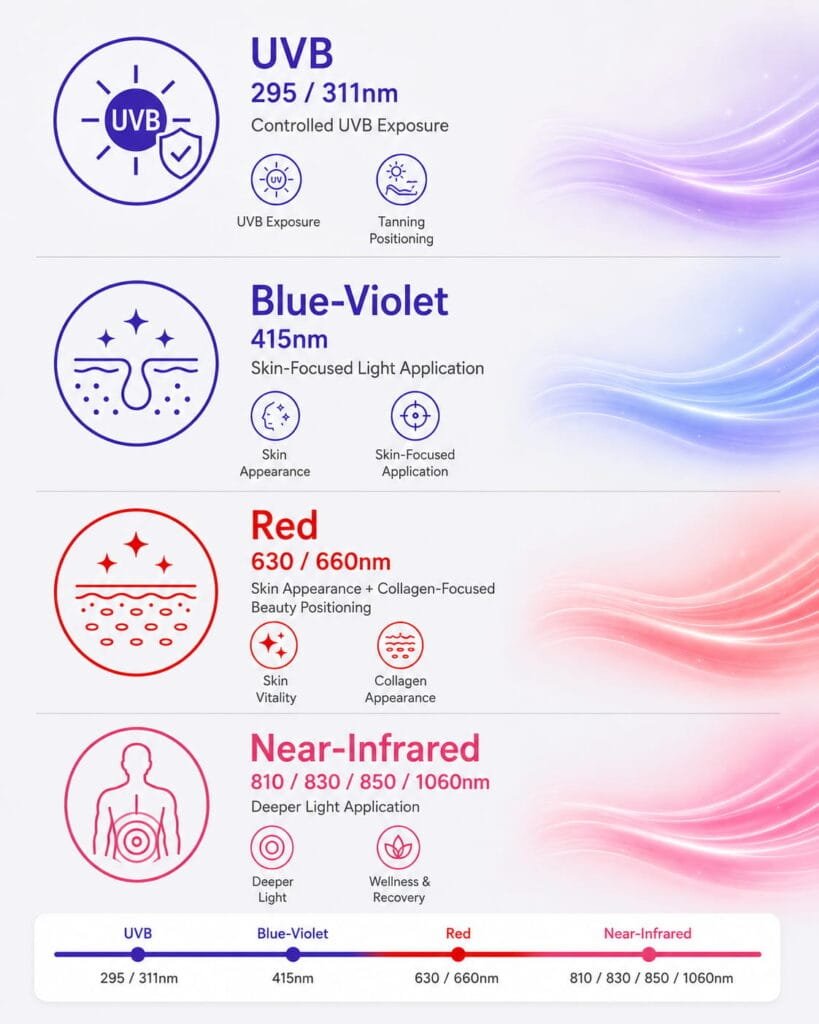
Espectro del BK900: 295/311Nuevo Méjico (UVB), 415Nuevo Méjico (azul-violeta), 630/660Nuevo Méjico (rojo), 810/830/850/1060Nuevo Méjico (NIR/IR). Sin rayos UVA: la banda más asociada con el fotoenvejecimiento y el daño del ADN, como lo detalla el Explicador de UVA/UVB de la Skin Cancer Foundation. “Impulsado por UVB, Sin UVA” es un diferenciador más limpio que las camas de bronceado tradicionales.. No lo diluyas implicando UVA..
Las longitudes de onda no cambian desde BK300.. Lo que cambia es con cuáles lideras. En un panel premium de medio cuerpo, curtido (UVB) y recuperación de tejido profundo (Nir) conviértete en el héroe de las historias, no el elenco secundario.
5. Siete modos, Una pantalla: con nombres que son honestos
El BK900 ofrece siete modos seleccionables a través de su pantalla táctil LCD TFT de 3,0 ″ integrada.. Los nombres para mostrar están fijos en la interfaz del dispositivo.; Lo que importa para el cumplimiento es el lenguaje de posicionamiento que utiliza en su marketing.. Para M4 «Disminuir» y M6 «Salud ósea» en particular (nombres que puedan implicar efectos para los que el dispositivo no fue autorizado) use el lenguaje de posicionamiento, no es el nombre para mostrar.
M1 · Bronceado — 630/660 + 810/830/850/1060 + 295/311Nuevo Méjico
Posicionamiento: «Rutina de bronceado UVB.» Modo de bronceado UV, opera más allá del umbral de distancia de trabajo de 300 mm impuesto por el sensor de distancia. Evitar: «bronceado seguro, riesgo cero»
M2 · Colágeno de la piel — 630/660 nm
Posicionamiento: «Rutina de bienestar de la piel.» Rutina de cuidado de la piel con luz roja. Evitar: «revierte el envejecimiento»
M3 · Recuperación Muscular — 810/830/850/1060 nm
Posicionamiento: «Rutina de recuperación y bienestar corporal.» Modo NIR dominante para rutinas posteriores a la actividad. Evitar: «trata lesiones musculares»
M4 · Disminución — 630/660 + 295Nuevo Méjico
Posicionamiento: «Rutina ligera y relajante.» Modo calmante de baja intensidad. Evitar: «reduce la inflamación»
M5 · Cuidado del acné — 630/660 + 415Nuevo Méjico
Posicionamiento: «Soporte para el cuidado de la piel propensa a imperfecciones.» azul violeta (415Nuevo Méjico) Rutina de luz específica para el cuidado de la piel.. Evitar: «trata el acné»
M6 · Salud ósea — 295/311 nm
Posicionamiento: «Rutina de exposición a la luz UVB.» Modo de exposición UVB, Funciona más allá de una distancia de trabajo de 300 mm.. Evitar: «apoya la salud ósea»
M7 · Personalizado — Longitudes de onda seleccionadas por el usuario, tiempo, y pulso
Posicionamiento: «Configuración flexible de OEM/ODM.» Los operadores pueden configurar su propia combinación de salida., frecuencia de pulso, y sincronización: hacer que el panel se adapte a diferentes posicionamientos de marca y rutinas de usuario final.
6. Comprender los números de irradiancia: honestamente
La irradiación es donde muchos paneles se vuelven vagos. Las cifras del BK900 se miden a distancias fijas:
3 pulgada (~76mm): 160–180 mW/cm² 9 pulgada (~229mm): 60–80 mW/cm² 12 pulgada (~305mm): 60–80 mW/cm²
Tres cosas que debes saber para leer estos números correctamente:
Primero, la cifra de 3 pulgadas es una referencia de medición, no una recomendación de uso de UVB. Porque el sensor de distancia corta los rayos UVB a ≤300 mm, La exposición real a los rayos UVB ocurre en el rango de más de 30 cm, es decir,, la zona de 60–80 mW/cm². Si su marketing implica "mantenerse 3 pulgadas de distancia para máxima potencia,” que contradice la propia lógica de seguridad del dispositivo. Informe a sus usuarios finales la distancia de uso seguro, y la dosimetría se mantiene honesta.
Segundo, El mayor rendimiento a distancia de medición todavía refleja una diferencia de ingeniería real vs.. Bk300. La matriz de 180 LED del BK900 y su mayor superficie significan que se envían más fotones a través de la zona de medio cuerpo a una distancia de trabajo segura.. Para el propietario de una marca, esto respalda precios premium con datos: es la diferencia entre “nuestro panel es poderoso” y "Nuestro panel ofrece entre 60 y 80 mW/cm² a una distancia de trabajo; aquí está la medida".
Tercero, La producción de UVB no está incluida en las cifras de irradiancia anteriores.. Estos valores se refieren al rojo combinado. + salida de infrarrojo cercano. UVB (295Nuevo Méjico / 311Nuevo Méjico) sólo se activa más allá de 300 mm, controlado por el sensor de distancia incorporado. Los separamos porque la dosimetría UVB es una conversación diferente a la salida rojo/NIR, y combinarlas crea un riesgo de cumplimiento posterior..
7. ¿Para quién es realmente el BK900?
El estudio o espacio de bienestar
Necesita un dispositivo que llene una sala de tratamiento. Cobertura de medio cuerpo. Resultados medibles en torno a los cuales su personal puede crear protocolos de servicio. Arquitectura de seguridad que satisface las cuestiones de responsabilidad: apagado automático del sensor de distancia, control de temperatura, gafas protectoras. una unidad, siete modos. Menos equipos para gestionar.
Lanzaste un panel compacto. esta funcionando. Ahora sus distribuidores solicitan un SKU premium, algo que puedan colocar en cuentas profesionales a un precio más alto.. BK900 se integra a su cadena de suministro existente sin necesidad de una nueva relación con el proveedor. Arquitectura de misma longitud de onda. Misma planta de fabricación. Mismo paquete de cumplimiento. Recién empaquetado para un nivel diferente.
El proyecto de marca privada premium
Estás construyendo una marca en torno al bronceado profesional y la exposición a la luz.. Necesitas un producto estrella, algo que se vea y funcione como un producto estrella. Formato de medio cuerpo. pantalla táctil. UI personalizada a través de M7. Tu logotipo, tu color, tu longitud de onda preestablecida. Comercialícelo como un dispositivo de estudio, construido según sus especificaciones.
No estoy seguro de que BK900 sea el adecuado? Si estás probando la categoría UVB por primera vez, Necesita MOQ y costos de flete más bajos, o se dirigen a usuarios domésticos en lugar de canales profesionales; BK300 es el punto de entrada. BK900 es a lo que te gradúas una vez que se prueba la categoría.
8. Referencia rápida de especificaciones
| Artículo | BK900 |
|---|---|
| Tipo | Bronceado UVB de medio cuerpo & panel de exposición a la luz |
| Dimensiones | 890 × 220 × 65 mm |
| Cobertura | Longitud de medio cuerpo (torso, atrás, piernas) |
| LED | 180 pcs (SMD 3535, tricolor de tres núcleos + monocolor mononuclear) |
| Longitudes de onda | 295, 311, 415, 630, 660, 810, 830, 850, 1060Nuevo Méjico (libre de rayos UVA) |
| Modos | 6 programar + 1 costumbre |
| Mostrar | 3.0″ Pantalla táctil LCD TFT |
| Brillo / Legumbres / Minutero | 0–100% / 0–40Hz / 5–20 minutos |
| Irradiancia | 160-180 @ 3 pulgadas; 60–80 @ 9–12 pulgadas (MW/cm²) — UVB no incluido; Los rayos UVB solo se activan más allá de los 300 mm. |
| Seguridad | sensor de distancia (Apagado automático UVB ≤300 mm), NTC≤65°C, gafas incluidas, zumbador |
| Alojamiento | Cubierta de acero laminado en frío; Marco de aluminio AL6063 |
| Finalizar | Plata anodizada brillante (colores personalizados disponibles para OEM) |
| Voltaje / IP | 100–240 VCA, 50/60Hz / IP20 |
| Cumplimiento | Ceñudo, FCC, ROHS; ISO 13485 + Mdsap; Dispositivo FDA listado |
9. BK300 frente a. BK900: ¿Cuál se adapta a tu canal??
| Bk300 (Compacto) | BK900 (Medio cuerpo) | |
|---|---|---|
| LED | 60 pcs | 180 pcs |
| Irradiancia @ 3 pulgadas | 130–150 mW/cm² | 160–180 mW/cm² |
| Irradiancia @ 9–12 pulgadas | 40–60 mW/cm² | 60–80 mW/cm² |
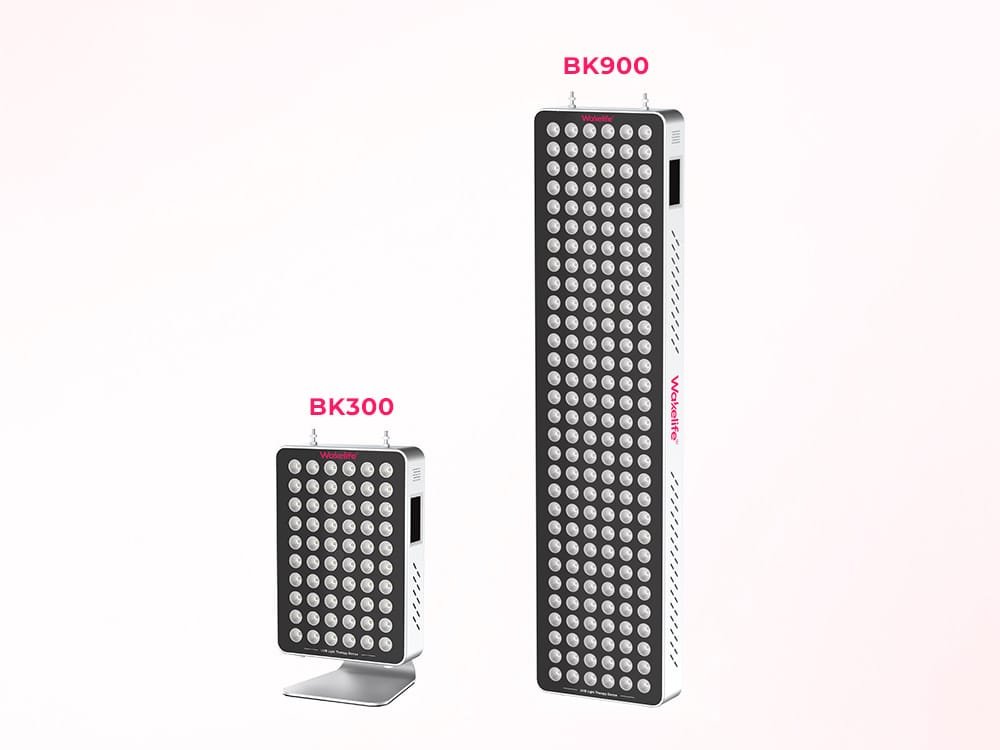
| Dimensiones | 320 × 220 × 65 mm | 890 × 220 × 65 mm |
| Mejor ajuste | Nivel de entrada, zona única, pruebas de mercado, canales sensibles al precio | Canales profesionales, uso de estudio, SKU premium, marcas UVB establecidas |
| no para | Cobertura de medio cuerpo, posicionamiento de calidad de estudio | Entrada al mercado de carga baja, exigir pruebas con un presupuesto |
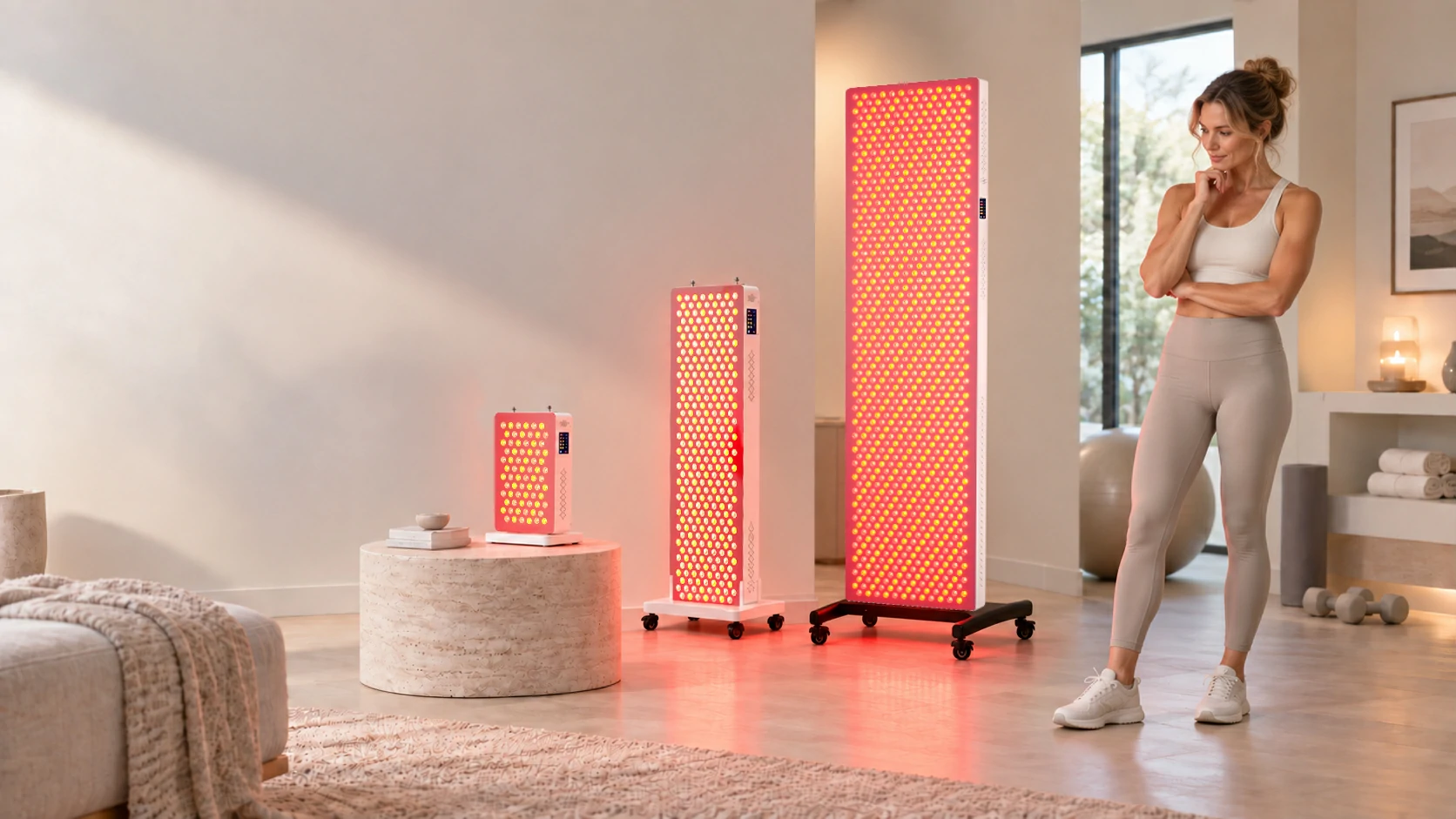
BK300 y BK900 no son los únicos formatos disponibles. Los compradores que también necesiten un panel más grande con zonas operativas seleccionables pueden compare la gama completa de paneles UVB Serie BK, incluido BK1800.
10. Por qué es importante el estándar de fabricación
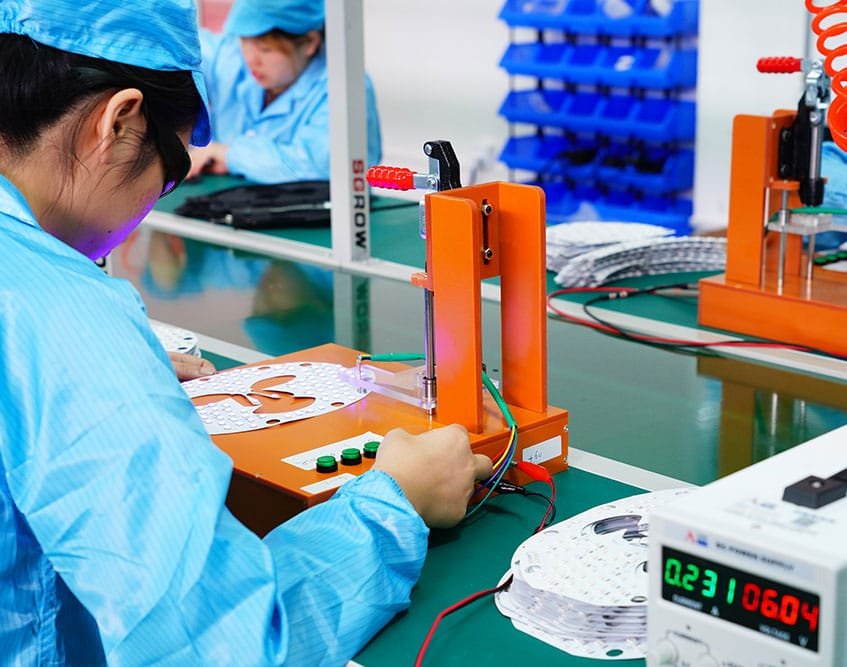
Muchos proveedores pueden enviar un panel. Son menos los que pueden enviar uno fabricado según un sistema que los reguladores y los compradores minoristas serios reconocen.. El BK900 se fabrica bajo un ISO 13485 sistema de gestión de calidad, en una instalación que es Registrado por la FDA y certificado por MDSAP, con el dispositivo incluido en Listado de dispositivos de la FDA.
Vale la pena ser preciso sobre lo que eso significa y lo que no significa.. La ISO 13485 / La certificación MDSAP y el registro de la FDA describen la sistema de calidad y las instalaciones - la disciplina, trazabilidad, y control de procesos detrás de cómo se construye el BK900. No sustituyen la autorización específica del dispositivo., y BK900 no se comercializa sobre la base de ningún 510(k) autorización. Para socios OEM/ODM, el beneficio práctico es sencillo: Usted se abastece de un fabricante cuyos procesos están auditados según un estándar reconocido., que hace la debida diligencia, documentación, y el cumplimiento posterior es mucho más fácil de gestionar.
Las opciones de personalización abarcan todo el espectro OEM/ODM.: logo, color, embalaje, interfaz de usuario de pantalla táctil, integración de aplicaciones, y configuración de longitud de onda a través del modo personalizado M7.
11. Siguiente paso para los compradores
Cuéntanos tres cosas: tu mercado objetivo, los canales en los que estás vendiendo (estudio? bienestar? hogar?), y tu volumen esperado. Encontraremos el modelo BK correcto, dar orientación sobre cumplimiento, y entregarle un marco de contenido desplegable. Respondemos dentro 24 horas.
Leer siguiente
Lista de referencias
- A NOSOTROS. FDA— Registro y listado de dispositivos
- A NOSOTROS. FDA— Notificación previa a la comercialización 510(k)
- A NOSOTROS. FDA— 510(k) Base de datos de notificaciones previas a la comercialización
- CIIC— Monografías Volumen 100D: Radiación (Dispositivos de bronceado UV, Grupo 1)
- OMS - Radiación UV Q&A
- ICNIRP— Directrices sobre límites de exposición a la radiación ultravioleta
- Fundación contra el cáncer de piel — Radiación ultravioleta (UVA/UVB)
- Academia Estadounidense de Dermatología - Descripción general de la fototerapia
- Almutawa et al.. — Eficacia de la fototerapia localizada para la psoriasis, PMC3047947
- Brennero & Audiencia - Papel protector de la melanina contra el daño de los rayos UV, PMC2671032
- Oficina de Suplementos Dietéticos de los NIH — vitamina d (Hoja informativa para profesionales de la salud)