Eine teurere Laser-Haarwuchskappe kann sich lohnen, wenn Sie mit den Mehrkosten etwas kaufen, das Sie überprüfen können und das Sie tatsächlich verwenden werden: ein eindeutig identifiziertes Gerät, Beweise, die für dieses Gerät relevant sind, eine praktikable Passform und Routine, vollständige Anleitung, oder stärkere Garantie und Support. Der Preis allein beweist nicht, dass sich die Ergebnisse beim Haarwachstum verbessern, mehr Sicherheit, Eignung für Ihre Art von Haarausfall oder Ihren Regulierungsstatus.
Die praktische Frage lautet also nicht: „Welche Obergrenze kostet am meisten?“?„Es ist „Was bringt der Preisunterschied?“, und kann ich es für genau dieses Gerät überprüfen??”
Dieser Leitfaden gilt auch, wenn Sie eine Mütze mit einem Helm oder Kamm vergleichen. Es werden weder Marken eingestuft noch ein allgemeingültiger Behandlungsplan bereitgestellt. Nutzen Sie die Vergleichskarte unten, um vor dem Kauf zwei oder drei exakte Produkte auf derselben Seite zu vergleichen.
Beginnen Sie mit der Ursache für Haarausfall, Nicht der Gerätepreis
Ein gut dokumentiertes Gerät kann immer noch ein schlechter Kauf sein, wenn es für das Problem, das Sie lösen möchten, nicht relevant ist. Haarausfall kann mehrere Ursachen haben, und die Amerikanische Akademie für Dermatologie weist darauf hin, dass es wichtig ist, die Ursache zu finden, da die richtige Vorgehensweise davon abhängt. Wenn die Ursache ungewiss ist, Bevor ein Gerät für den Heimgebrauch in den Mittelpunkt Ihrer Entscheidung rückt, sollte dies von einem entsprechenden medizinischen Fachpersonal beurteilt werden.
Auch die Forschung zur Low-Level-Licht- oder Lasertherapie ist enger gefasst, als der Begriff „Haarausfall“ vermuten lässt. A 2025 systematische Überprüfung und Metaanalyse bedeckt 38 Studien und 3,098 Teilnehmer, aber die meisten Teilnehmer hatten androgenetische Alopezie, oder musterbedingter Haarausfall. Die Überprüfung ergab ein insgesamt positives Haardichtesignal für die untersuchten Interventionen in dieser Population, und weisen gleichzeitig eine hohe statistische Heterogenität auf. Die Evidenz für andere Arten von Haarausfall war für die gleiche gepoolte Analyse zu begrenzt.
Das bedeutet, dass Beweise auf Kategorieebene die Untersuchung eines Geräts rechtfertigen können; Es kann Ihnen nicht sagen, dass jede Lichtquelle vorhanden ist, Kappe, Helm oder Kamm reproduzieren das Ergebnis. Für umfassendere Forschungsgrenzen, siehe Wakelife’s Leitfaden für LLLT und Rotlichtbeweise.
Vor dem Preisvergleich, aufschreiben:
- der Haarausfallzustand oder der Verwendungszweck, den das Gerät angeblich behandeln soll;
- ob diese Beschreibung für Ihre Situation relevant ist;
- das genaue Modell und die Version, die Sie in Betracht ziehen; Und
- der Markt, auf dem es verkauft wird.
Ob die ersten beiden Punkte unklar bleiben, Ein detaillierter Preisvergleich kann zu falschen Angaben über den falschen Kauf führen.
Was kann ein Haarwuchsgerät teurer machen??
Mehrere tatsächliche Produkt- und Serviceunterschiede können die Kosten erhöhen. Keine davon weist automatisch ein besseres klinisches Ergebnis nach.
| Mögliche Quelle zusätzlicher Kosten | Was die zusätzlichen Kosten kosten können | Was es allein nicht beweist | Was zu überprüfen ist |
|---|---|---|---|
| Lichtquellen- und Array-Design | Eine andere Quellkonfiguration, physische Anordnung oder Abdeckungsdesign | Das sind mehr Emittenten, Eine bestimmte Wellenlänge oder ein reines Laseretikett führt zu besseren Ergebnissen | Genaues Modell, Quelltyp, angegebenen Wellenlängeninformationen, Array-Layout und jeden verfügbaren Messkontext |
| Struktur und Passform | Kopfbedeckung, Verstellbarkeit, Gewichtsverteilung, Belüftung oder eine Konstruktion, die dazu dient, das Gerät in Position zu halten | Dass ein größeres oder schwereres Produkt eine bessere Behandlung bietet | Abmessungen, Gewicht, Anpassungsmethode, Kontakt- oder Distanzannahmen und Rückgabebedingungen, wenn die Anpassung schlecht ist |
| Kontrollen und Routine | Timer, Batteriebetrieb, Ladezubehör, Sitzungskontrollen, App-Funktionen oder einfachere Bedienung | Dass mehr Funktionen die Haarergebnisse verbessern | Welche Funktionen sind in der genauen Version vorhanden?, was die Anleitung erfordert und welche Funktionen Sie konsequent nutzen werden |
| Produktspezifische Nachweise und Marktaufzeichnungen | Forschung, technische Dateien oder behördliche Arbeiten im Zusammenhang mit einem benannten Gerät und der beabsichtigten Verwendung | Dieser Beweis für ein verwandtes Gerät, gemeinsame Wellenlänge oder ähnliche Shell-Übertragungen automatisch | Gerätename studieren, Modellzuordnung, untersuchte Population und Protokoll, Zielmarkt und angegebener Verwendungszweck |
| Herstellung und dokumentierte Prüfung | Rückverfolgbarkeit, Inspektionsprotokolle, Testberichte, Verpackungskontrollen oder eine einheitlichere Dokumentation | Dass ein Werkszertifikat oder ein Testlogo die klinische Wirksamkeit belegt | Eigentümer melden, Genaue getestete Konfiguration, Datum, Testmethode und ob das verkaufte Modell mit dem Rekord übereinstimmt |
| Garantie, Rückgabe und Support | Eine längere schriftliche Garantie, brauchbarer Rückgabeprozess, Ersatzteile oder reaktionsschnellen Service | Dass eine großzügige Garantie das Produkt medizinisch geeignet macht | Ausschlüsse, Rückgabefenster, Wiedereinlagerungs- oder Versandkosten, Servicestandort und wer sich um ein ausgefallenes Gerät kümmert |
Was zu überprüfen ist Genaues Modell, Quelltyp, angegebenen Wellenlängeninformationen, Array-Layout und jeden verfügbaren Messkontext
Was zu überprüfen ist Abmessungen, Gewicht, Anpassungsmethode, Kontakt- oder Distanzannahmen und Rückgabebedingungen, wenn die Anpassung schlecht ist
Was zu überprüfen ist Welche Funktionen sind in der genauen Version vorhanden?, was die Anleitung erfordert und welche Funktionen Sie konsequent nutzen werden
Was zu überprüfen ist Gerätename studieren, Modellzuordnung, untersuchte Population und Protokoll, Zielmarkt und angegebener Verwendungszweck
Was zu überprüfen ist Eigentümer melden, Genaue getestete Konfiguration, Datum, Testmethode und ob das verkaufte Modell mit dem Rekord übereinstimmt
Was zu überprüfen ist Ausschlüsse, Rückgabefenster, Wiedereinlagerungs- oder Versandkosten, Servicestandort und wer sich um ein ausgefallenes Gerät kümmert
Das Wort Mai Angelegenheiten. Eine Prämie kann diese Posten widerspiegeln, Markenpositionierung, Vertriebskosten, Marketing, oder eine Kombination. Ihre Aufgabe ist es, dokumentierte Werte von Annahmen zu trennen.
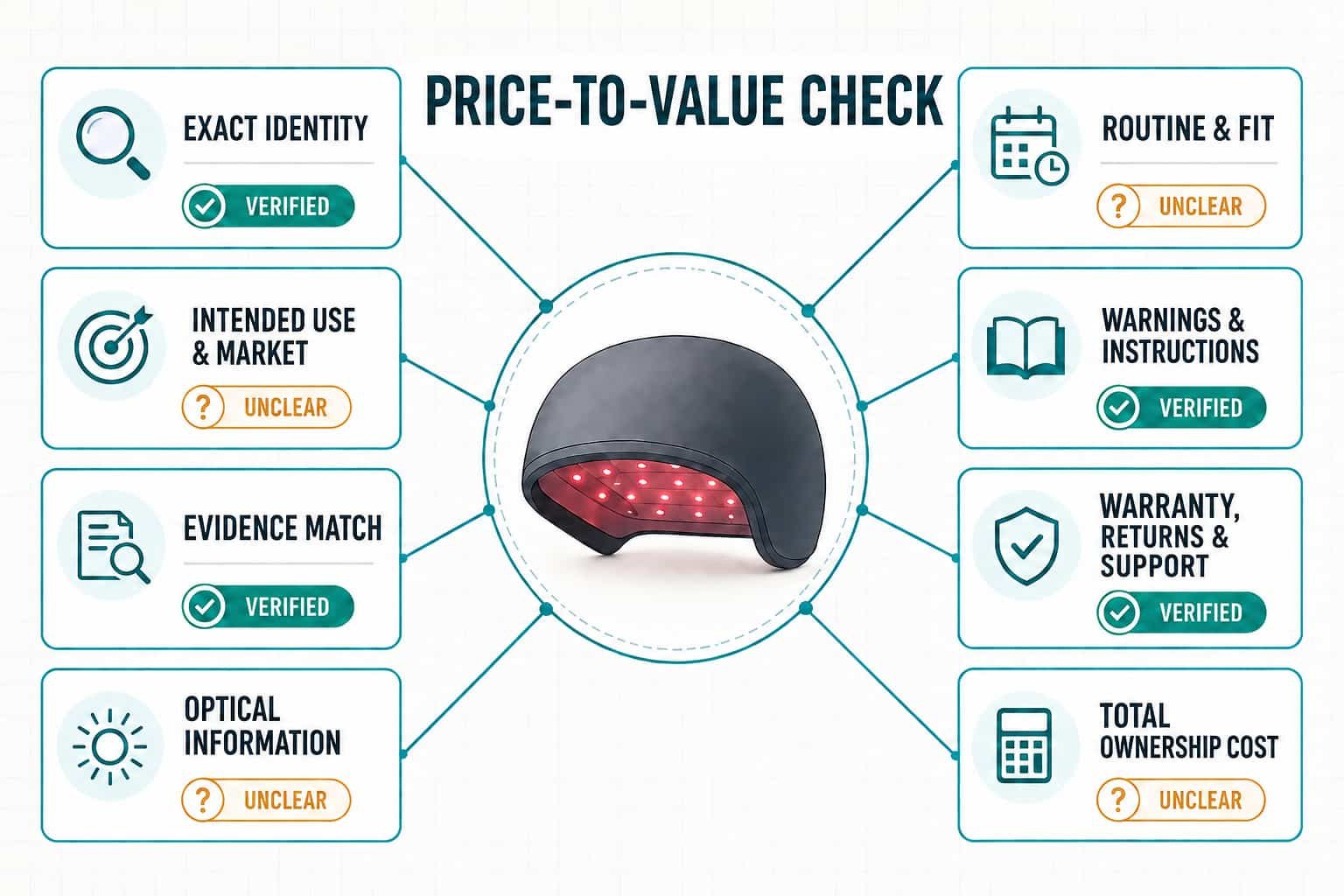
Verwenden Sie diese Preis-Leistungs-Vergleichskarte mit acht Feldern
Wählen Sie zwei oder drei exakte Geräte aus. Markieren Sie jedes Feld Verifiziert oder Unklar. Markieren Sie ein Feld erst dann als „Verifiziert“, wenn Sie die Informationen anhand der angegebenen Quelle überprüft und die Identität bestätigt haben, Umfang und Grenzen entsprechen der Produktversion, die Sie tatsächlich erhalten würden. Verifiziert bedeutet nicht, dass es sich bei dem Feld um eine Produktstärke handelt oder dass die Wirksamkeit des genauen Geräts nachgewiesen wurde. Verwenden Nicht zutreffend nur für einen Unterpunkt, der tatsächlich fehlt und nicht versprochen wird, B. eine App, die das Gerät nicht bietet, ein Zubehör, das nicht benötigt wird, oder ein Marktanspruch, den der Verkäufer nicht erhebt. Nicht verwenden. Nicht zutreffend für genaue Identität, Verwendungszweck, Anweisungen, eine gesundheitsbezogene oder behördliche Aussage des Verkäufers, oder den schriftlichen Garantie- und Rückgabeweg.
| Feld | Was soll aufgezeichnet werden? | Als bestätigt markieren, wann | Markieren Sie Unklar, wann |
|---|---|---|---|
| 1. Genaue Identität | Marke, genaues Modell, Version und Verkäufer | Die Produktseite, Etikett, Anweisungen und unterstützender Datensatz verweisen auf dieselbe Version | Die Auflistung kombiniert Varianten, ändert Modellnamen oder liefert kein identifizierbares Modell |
| 2. Verwendungszweck und Vermarktung | Der angegebene Zweck, Benutzergruppe und Verkaufsland oder -region | Sie haben die genauen Geräteinformationen und alle zitierten Marktdaten überprüft, und bestätigt, dass es sich um den angegebenen Verwendungszweck handelt, Benutzergruppe und Marktumfang stimmen überein | Die Seite verwendet eine weit gefasste „Haarausfall“-Sprache, stützt sich auf ein globales Abzeichen ohne Marktumfang oder kann nicht mit dem zitierten Datensatz abgeglichen werden |
| 3. Beweisübereinstimmung | Klassifizieren Sie jede zitierte Quelle als exakten Beweis, Kategoriehintergrund oder kein Beweisanspruch; Nehmen Sie sein Gerät auf, Bevölkerung, ggf. Protokoll und Ergebnis | Sie haben die angegebene Quelle gefunden und bestätigt, dass die Beschreibung und die Beschränkungen des Verkäufers damit übereinstimmen; Ein Exact-Device-Anspruch ist diesem Gerät zugeordnet, während die Kategorieforschung ausdrücklich als reine Kategorieforschung gekennzeichnet ist | Der Verkäufer geht davon aus, dass es sich um eine genaue Geräteunterstützung handelt, gibt jedoch ein anderes Gerät oder einen anderen Zustand an, oder die zitierte Quelle kann nicht gefunden werden |
| 4. Optische Informationen | Quelltyp, angegebenen Wellenlängen, Layout und verfügbarer Ausgabe- oder Messkontext | Die Informationen benennen das genaue Modell und erklären, was gemessen wurde, wo und unter welchen Bedingungen | Der Verkäufer gibt nur eine Diodenzahl an, eine Wellenlänge oder eine Leistungszahl ohne Kontext |
| 5. Routine und fit | Anweisungen, Positionierung, Kontrollen, Aufladen, Gewicht und Einstellung | Sie können den erforderlichen Arbeitsablauf verstehen und beurteilen, ob er zu Ihrem täglichen Gebrauch passt | Die Routine bleibt bis nach dem Kauf verborgen oder die Passform kann nicht beurteilt werden |
| 6. Warnungen und Anweisungen | Benutzerhandbuch, Warnungen, Kontraindikationen, Reinigung und Lagerung | Eine Anleitung zum genauen Gerät ist vor dem Kauf vorhanden und verständlich | Sicherheitshinweise sind allgemein gehalten, unvollständig oder inkonsistent auf der Seite und im Handbuch |
| 7. Garantie, Rückgabe und Support | Garantiedauer, Ausschlüsse, Rückgabefenster, Gebühren und Servicekontakt | In der schriftlichen Richtlinie wird erläutert, wer die Rücksendungen abwickelt, Mängel und Ersatz | Auf der Seite steht „garantiert“, es werden jedoch keine anwendbaren Bedingungen oder Verantwortlichen genannt |
| 8. Gesamtbetriebskosten | Kaufpreis zzgl. benötigtem Zubehör, Ersatz, Versand, Steuern und dokumentierte Serviceexposition | Sie können die gleichen enthaltenen Artikel und bekannten Kosten über den Zeitraum vergleichen, in dem Sie das Gerät voraussichtlich besitzen | Ein niedriger Gesamtpreis schließt benötigte Artikel aus oder die Rücksende- und Servicekosten sind unbekannt |
Als bestätigt markieren, wann Die Produktseite, Etikett, Anweisungen und unterstützender Datensatz verweisen auf dieselbe Version
Markieren Sie Unklar, wann Die Auflistung kombiniert Varianten, ändert Modellnamen oder liefert kein identifizierbares Modell
Verwenden Sie für den abschließenden Vergleich eine leere Tabelle wie diese:
| Vergleichsfeld | Gerät A | Gerät B | Gerät C |
|---|---|---|---|
| Genaues Modell/Version | |||
| Verwendungszweck/Markt | |||
| Beweisübereinstimmung | |||
| Optische Informationen | |||
| Routine/fit | |||
| Warnungen/Anweisungen | |||
| Garantie/Rückgabe/Support | |||
| Gesamtbetriebskosten | |||
| Endgültige Entscheidung: Kaufen / Fragen / Pause |
Verwandeln Sie die Karte nicht in eine nicht unterstützte numerische Punktzahl. Eine fehlende genaue Identität oder nicht verfügbare Anweisungen können mehr ausmachen als mehrere kleine Annehmlichkeiten zusammen. Die Karte soll den Grund für eine Prämie aufzeigen und die Lücken aufzeigen, die noch einer Lösung bedürfen.
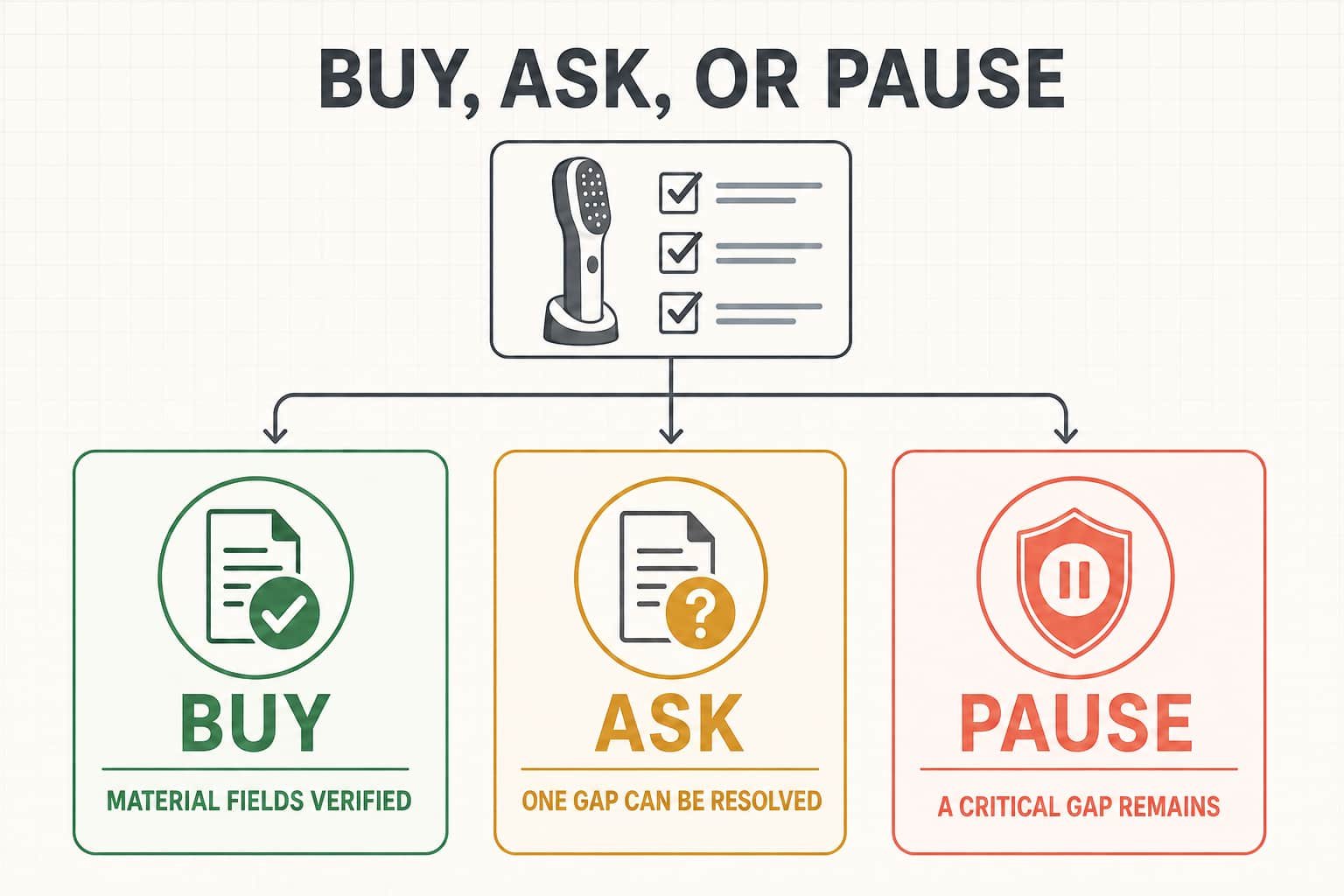
Ordnen Sie auf diese Weise die gemischten Feldergebnisse der endgültigen Entscheidung zu:
- Kaufen wenn die genaue Identität und Zweckmäßigkeit festgestellt sind; Anweisungen und Warnungen sind verfügbar; Jeder wesentliche Beweis oder jede behördliche Behauptung wurde in seinem tatsächlichen Umfang überprüft; kaufen, Die Rückgabe- und Supportbedingungen sind klar; und die Prämie erfüllt ein Bedürfnis, das Sie haben.
- Fragen wenn das Produkt vielleicht passt, aber ein Materialbereich noch unklar ist und ein bestimmtes Modell vorliegt, Quelle, Anweisungen oder Richtlinien könnten das Problem lösen.
- Pause wenn die Ursache des Haarausfalls unklar bleibt, das genaue Produkt bzw. der Verwendungszweck lässt sich nicht ermitteln, Anweisungen sind nicht verfügbar, oder eine wesentliche gesundheitsbezogene oder behördliche Angabe kann ihrer Quelle nicht zugeordnet werden.
Was der Preis nicht beweisen kann
Ein höherer Preis bedeutet kein besseres Ergebnis
A 2021 systematische Überprüfung und Metaanalyse fanden heraus, dass sich Geräte für den Heimgebrauch in ihrer Form unterscheiden, Quellkonfiguration, Wellenlänge, Leistung und Protokoll. Seine Geräteform- und Quellenanalysen verglichen Untergruppen über mehrere Versuche hinweg; sie waren nicht direkt, Direktversuche mit konkurrierenden Verbraucherprodukten oder Preisniveaus. Daher ist es sinnvoll, „höherer Preis bedeutet bessere Ergebnisse“ als unbestätigte Schlussfolgerung zu betrachten, es sei denn, produktspezifische Vergleichsbeweise stützen dies.
Mehr Dioden oder eine höhere Leistungszahl begründen keine klinische Überlegenheit
Eine Diodenzahl beschreibt die Menge, nicht die vollständigen Lieferbedingungen an der Kopfhaut. Ein Leistungswert benötigt auch eine Messdefinition, Standort, Bereich und Betriebszustand. Keine der beiden Zahlen allein begründet eine Deckung, abgegebene Dosis, Sicherheit oder ein Haarwachstumsergebnis.
„Nur Laser“ bedeutet nicht automatisch besser als Laser plus LED oder LED
Quellenbezeichnungen sind hilfreich, um ein Design zu identifizieren. Es handelt sich nicht um ein klinisches Ranking. Unterschiede zwischen den Geräten, Protokolle und Studienpopulationen verhindern, dass eine Quellenbezeichnung allein die Schlussfolgerung trägt.
Eine bekannte Marke oder viele Bewertungen machen das Gerät nicht für jeden geeignet
Markengeschichte und Bewertungen können die Unsicherheit über Service oder Benutzerfreundlichkeit verringern. Sie können die Ursache des Haarausfalls nicht diagnostizieren oder feststellen, dass eine Person ein bestimmtes Ergebnis erzielen wird.
Eine Regulierungsphrase ist keine Leistungsbewertung
Der regulatorische Status hat einen definierten Markt- und Produktumfang. Es sollte überprüft werden, da es Aufschluss darüber geben kann, ob die Marketingsprache einer offiziellen Aufzeichnung entspricht. Es sollte nicht in die Behauptung umgewandelt werden, dass ein zugelassenes oder CE-gekennzeichnetes Gerät ein anderes übertrifft.
Wie sollten Sie die FDA- und CE-Sprache lesen??
Ordnen Sie jede behördliche Aussage genau dem Gerät zu, Hersteller oder Verantwortlicher, Verwendungszweck und Zielmarkt. Akzeptieren Sie kein Logo oder Zertifikatsbild als Abschluss.
Für die Vereinigten Staaten, Die Erklärung zur Registrierung und Listung der FDA besagt, dass die Registrierung einer Einrichtung und die Geräteauflistung nicht bedeuten, dass ein Gerät zugelassen ist, freigegeben oder autorisiert. Die Behörde warnt außerdem davor, keine Zulassungsbescheinigungen auszustellen. In einem separaten FDA-Übersicht über die Geräteregulierung, beschreibt die Agentur 510(k) als ein Freigabeverfahren für wesentliche Äquivalenz und nicht als Vorabgenehmigung. Bei keinem der Status handelt es sich um eine Rangfolge der Produkte nach erwarteten Ergebnissen.
Wenn ein Verkäufer die FDA-Sprache verwendet:
- Fragen Sie nach dem genauen Modell und 510(k) Nummer, wenn die Freigabe beansprucht wird.
- Durchsuchen Sie die offiziellen FDA-Daten, anstatt sich auf ein Abzeichen oder einen Screenshot zu verlassen.
- Vergleichen Sie den Bewerber, Gerätename, Verwendungszweck und abgedeckte Modelle mit dem verkauften Produkt.
- Behandeln Sie die Registrierungs- oder Auflistungssprache getrennt von der Freigabe.
Wakelife’s Leitfaden zur Überprüfung von Haarwuchsgeräten der FDA erklärt den Datensatzabgleichsprozess im Detail.
Für den europäischen Markt, Die Europäische Kommission Unter CE-Kennzeichnung versteht man die Erklärung des Herstellers, dass ein Produkt den geltenden EU-Anforderungen entspricht. Bei der CE-Kennzeichnung handelt es sich nicht um eine Sicherheitsbescheinigung einer EU-Behörde und es handelt sich nicht um eine Qualitäts- oder Wirksamkeitsbewertung. Fragen Sie nach, welche rechtlichen Rahmenbedingungen und Produktdokumentationen genau für das Gerät und den Verwendungszweck gelten, anstatt die CE-Kennzeichnung als universelles Premium-Merkmal zu behandeln.
Was können Ihnen Bewertungen und Vorher-Nachher-Fotos sagen??
Bewertungen sind am nützlichsten, um Fragen zu finden, die untersucht werden müssen. Wiederholte Kommentare zur Passform, Aufladen, Kontrollen, Hitze, Lärm, Transportschäden, Die Rücksendeabwicklung oder der Kundensupport können praktische Probleme aufdecken, die in einer Spezifikationstabelle übersehen werden.
Sie sind viel schwächer für den Nachweis eines gesundheitlichen Ergebnisses. Menschen können unterschiedliche Ursachen für Haarausfall haben, andere Interventionen nutzen, Befolgen Sie verschiedene Routinen und fotografieren Sie ihre Haare bei unterschiedlichem Licht, Winkel, Styling und Zeitpunkte. Die US Federal Trade Commission Richtlinien zur Einhaltung von Gesundheitsprodukten besagt, dass gesundheitsbezogene Wirksamkeits- und Sicherheitsaussagen kompetente und zuverlässige wissenschaftliche Beweise erfordern; Vermerke ersetzen nicht die für den zugrunde liegenden Anspruch erforderlichen Beweise.
Verwenden Sie Bewertungen, um Zeilen zu Ihrer Fragenliste hinzuzufügen. Benutzen Sie nicht einen dramatischen Erfahrungsbericht oder ein unkontrolliertes Fotopaar als Anlass, ein Ergebnis auf sich selbst zu übertragen.
Wann ist ein niedriger Preis eine falsche Wirtschaft??
Ein preisgünstigeres Gerät kann einen schlechten Wert haben, wenn die fehlenden Informationen oder Dienste Kosten verursachen, die Sie an der Kasse nicht gesehen haben. Beispiele hierfür sind:
- Das Modell, das Sie erhalten, kann nicht mit der Auflistung oder den Anweisungen übereinstimmen;
- Erforderliches Zubehör ist ausgeschlossen;
- Eine schlechte Passform erschwert die ordnungsgemäße Verwendung des Geräts;
- Durch die Rückgabebedingungen werden Ihnen erhebliche Versand- oder Wiedereinlagerungskosten auferlegt;
- Es gibt keinen erreichbaren Support-Pfad, wenn das Gerät ausfällt; oder
- Wichtige Beweise und regulatorische Aussagen gehören zu einem anderen Produkt.
Diese Bedingungen beweisen nicht, dass jedes günstige Gerät schlecht ist. Sie zeigen, warum Gesamtpreis und Gesamtwert unterschiedliche Fragen sind.
Wann ist eine Prämie ungerechtfertigt??
Ein höherer Preis lässt sich nur schwer rechtfertigen, wenn der Verkäufer die darüber hinausgehende Prämie nicht begründen kann:
- eine größere Diodenanzahl ohne Liefer- oder Messkontext;
- „medizinischer Grad,„„FDA-registriert“ oder eine ähnliche Formulierung ohne genaue Aufzeichnung und Umfang;
- Erfahrungsberichte als Beweis für ein vorhersehbares Ergebnis;
- Funktionen, die Sie nicht benötigen oder nicht nutzen werden; oder
- eine Garantieüberschrift, deren Ausschlüsse den meisten praktischen Wert aufheben.
Bitten Sie den Verkäufer, das genaue Merkmal anzugeben, Dokument oder Dienstleistung hinter dem höheren Preis. Ordnen Sie dann die Antwort der Acht-Felder-Karte zu. Wenn die Prämie nicht an eine Differenz gebunden werden kann, können Sie sie überprüfen und nutzen, Behandeln Sie es als unbewiesen, anstatt anzunehmen, dass es gut oder schlecht ist.
Treffen Sie die endgültige Entscheidung: Kaufen, Fragen oder Pause
Verwenden Sie drei Ergebnisse, anstatt jeden Vergleich zu einem Gewinner zu zwingen.
| Entscheidung | Verwenden Sie es wann | Nächste Aktion |
|---|---|---|
| Kaufen | Die genaue Identität und bestimmungsgemäße Relevanz werden festgestellt; Anweisungen und Warnungen sind verfügbar; Jeder wesentliche Beweis oder jede behördliche Behauptung wurde anhand der angegebenen Quelle überprüft und im Rahmen seines Geltungsbereichs bestätigt; kaufen, Die Rückgabe- und Supportbedingungen sind klar; und die Prämie erfüllt ein Bedürfnis, das Sie haben | Speichern Sie die Produktseite, Anweisungen, Richtlinie und jede für die Entscheidung verwendete Quelle oder Aufzeichnung |
| Fragen | Das Produkt könnte passen, aber ein materielles Feld ist noch unklar und ein spezifisches Modell, Quelle, Anweisungen oder Richtlinien könnten das Problem lösen | Stellen Sie eine Frage zu diesem Feld und fordern Sie das genannte Dokument an, Modell, Informieren Sie sich über die Quelle oder Richtlinie, bevor Sie eine Entscheidung treffen |
| Pause | Die Ursache des Haarausfalls bleibt ungewiss; das genaue Produkt bzw. der Verwendungszweck lässt sich nicht ermitteln; Anweisungen sind nicht verfügbar; oder eine wesentliche gesundheitsbezogene oder behördliche Angabe kann ihrer Quelle nicht zugeordnet werden | Lösen Sie das Klinische, Beheben Sie die Produktidentitäts- oder Anspruchs-Beweislücke, bevor Sie den Preis erneut vergleichen |
Nächste Aktion Speichern Sie die Produktseite, Anweisungen, Richtlinie und jede für die Entscheidung verwendete Quelle oder Aufzeichnung
Nächste Aktion Stellen Sie eine Frage zu diesem Feld und fordern Sie das genannte Dokument an, Modell, Informieren Sie sich über die Quelle oder Richtlinie, bevor Sie eine Entscheidung treffen
Nächste Aktion Lösen Sie das Klinische, Beheben Sie die Produktidentitäts- oder Anspruchs-Beweislücke, bevor Sie den Preis erneut vergleichen
Eine Prämie ist am vertretbarsten, wenn sie eine für Sie wichtige Einschränkung beseitigt und die unterstützenden Informationen die genaue Geräteüberprüfung überstehen. Ein niedrigerer Preis ist dann sinnvoll, wenn die wesentlichen Felder noch übersichtlich sind und die weggelassenen Funktionen für Ihre Nutzung kaum von Nutzen sind. Keine der beiden Entscheidungen erfordert, dass eine Preisstufe allgemein als die beste erklärt wird.
Für Marken und Einzelhändler, die diese Kategorie bewerten
Fragen zu Verbraucherpreisen decken häufig Lücken auf der Produktseite und im Support auf: unklare Modellidentität, Beweise, die nicht mit der verkauften Version übereinstimmen, versteckte Anweisungen, oder Rückgabebedingungen, die erst nach dem Kauf erscheinen. Marken sollten diese Lücken schließen, bevor sie eine Funktion oder ein Dokument als Grund für eine Prämie angeben.
Marken und Kliniken vergleichen die kommerzielle Rolle von Kappen, Helme und Kämme können von Wakelife verwendet werden Leitfaden zur Beschaffung von Formfaktoren. Je breiter OEM/ODM-Leitfaden für Haarwuchsgeräte erklärt, wie Channel-Käufer von Produktrolle und Formfaktor zu Mustern wechseln können, Dokumentation und eine Ausschreibung. Kategorierecherchen und Marktaufzeichnungen müssen noch der genauen Plattform und den geplanten Ansprüchen zugeordnet werden.

Referenzen
-
1
Perez S.M., Vattigunta M, Kelly C, Eber A. Low-Level-Laser- und LED-Therapie bei Alopezie: Eine systematische Überprüfung und Metaanalyse
Dermatologische Chirurgie. 2025;51(2):179–183. -
2
Lueangarun S, Visutjindaporn P, Parcharoen Y, Jamparuang P, Tempark T. Eine systematische Überprüfung und Metaanalyse randomisierter kontrollierter Studien mit Genehmigung der US-amerikanischen Lebensmittel- und Arzneimittelbehörde, Heimgebrauch, Low-Level-Licht-/Lasertherapiegeräte gegen musterbedingten Haarausfall: Gerätedesign und Technologie
Zeitschrift für klinische und ästhetische Dermatologie. 2021;14(11):E64–E75.
Der Titel des Artikels wird wie veröffentlicht wiedergegeben; Dieser Leitfaden verwendet510(k)-clearedstattFDA-approvedbei der Beschreibung dieses Regulierungswegs. -
3
Amerikanische Akademie für Dermatologie. Haarausfall: Überblick
-
4
US-amerikanische Lebensmittel- und Arzneimittelbehörde. Gibt es „FDA-registrierte“ oder „FDA-zertifizierte“ Medizinprodukte?? Woher weiß ich, was von der FDA zugelassen ist??
-
5
US-amerikanische Lebensmittel- und Arzneimittelbehörde. Überblick über regulatorische Anforderungen: Medizinische Geräte – Transkript
-
6
Federal Trade Commission. Richtlinien zur Einhaltung von Gesundheitsprodukten
-
7
Europäische Kommission. CE -Markierung