Short answer: There is no single week when every LED red-light mask user should see results. Facial LED studies have measured specific outcomes at checkpoints ranging roughly from 4 to 16 weeks, but each used its own device, schedule, population, and assessment method—and some measures improved while others did not. Follow your exact device instructions, track one goal with comparable photos, and reassess the device, routine, or goal instead of increasing exposure. Stop for significant, persistent, or worsening symptoms.
Is There One Timeline for LED Mask Results?
No. A study checkpoint tells you when researchers measured one defined outcome under one protocol; it is not a deadline by which your skin must change.
The American Academy of Dermatology explains why a single timeline is unreliable: studies use different devices, run for different lengths of time, and ask different questions. The AAD also notes that the time needed varies and that not everyone sees results.
Four variables have to stay together when you interpret a study:
- Outcome: Was the study measuring crow’s feet, wrinkle length, hydration, elasticity, redness, or participant satisfaction?
- Device and mode: Which wavelengths and output did the tested device use?
- Protocol: How long was each session, how often was it used, and for how many weeks?
- Assessment: Was the result judged by the participant, a blinded evaluator, a clinical scale, software, or an instrument?
If any of those variables changes, the timeline may not transfer. A four-week wrinkle measurement from one research device is not a promise that another mask will create visible changes in four weeks. A 12-week crow’s-feet trial does not establish a 12-week deadline for pores, pigmentation, acne, or facial lifting.
What Did Facial LED Studies Actually Measure—and When?
Controlled studies have reported some changes after short protocols and others after longer protocols, but they do not produce one universal sequence of visible results.
| Study | Exact research protocol | Checkpoint | What was observed | What you should not conclude |
|---|---|---|---|---|
| Bragato et al., 2025 | 95 women aged 45–60; 660 ± 10 nm mask; 21-minute sessions, two or three times weekly for 4 weeks; sham control | Four-week treatment course; the publication reports photographic assessment 30 days after treatment | ImageJ found changes in the length of some glabellar and right periorbital wrinkles, and participant satisfaction differed from sham | The blinded Wrinkle Assessment Scale found no significant difference among groups. This does not make four weeks a whole-face result deadline or establish a universal frequency. |
| Mota et al., 2023 | 137 women aged 40–65; researcher-applied contact LED devices—not a home mask—with red 660 nm on one side and amber 590 nm on the other; 10 minutes per side, 10 sessions over 4 weeks | Before versus after the 4-week course | Measured periocular wrinkle volume decreased on both actively treated sides | Neither treatment improved hydration or viscoelasticity. Both sides received active light, so the study had no untreated or sham side and cannot establish a general four-week mask effect. |
| Park et al., 2025 | 60 Asian adults aged 30–65; 630 nm LED + 850 nm IRED home mask; 9 minutes, five times weekly for 12 weeks; lower-output sham | Weeks 4, 8, and 12 during use; week 16 was a follow-up 4 weeks after use ended | Independent and investigator crow’s-feet assessments did not show a stable group difference at week 4 but did at weeks 8, 12, and 16 | Participant-rated improvement did not differ significantly between groups. Device maker Y&J Bio funded the study; the authors report independent research and writing. Results cannot set a timeline for other masks or outcomes. |
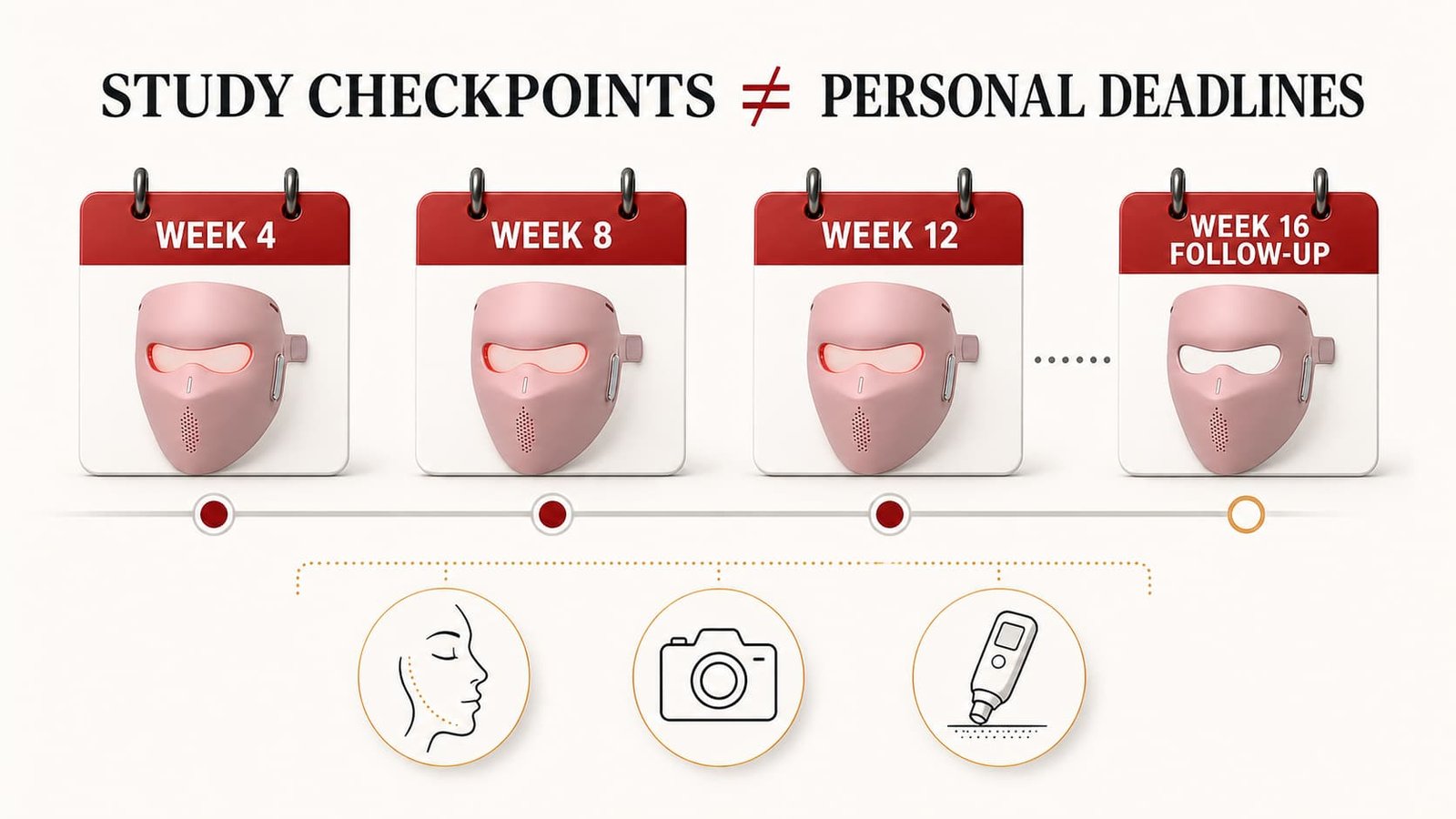
For a separate judgment about whether a visible line is a plausible LED target at all, see Wakelife’s evidence guide to LED face masks for fine lines and wrinkles.
These trials are useful because they show what was tested. They also show why a simple “results by week X” chart can mislead:- A software measurement, clinical scale, and participant impression may not agree.
- Wrinkle change does not prove hydration or elasticity change.
- A treatment period and a follow-up period are not the same thing.
- The same color label does not make two devices equivalent.
Why Can Photos, Instruments, and Your Own Impression Disagree?
“Results” can refer to different outcomes and different ways of measuring them. Decide what you are tracking before you decide whether the mask worked.
| What you want to track | A more appropriate record | Main limitation |
|---|---|---|
| A defined wrinkle area | Same-expression, same-position photographs; a consistent rating method if available | Lighting and head position can exaggerate or hide lines |
| Texture or visible tone evenness | Comparable full-face and close-up photographs | Camera processing, makeup, temporary dryness, and lighting can alter appearance |
| Hydration or elasticity | A validated instrument used consistently | These changes cannot be established reliably from an ordinary selfie |
| General “glow” | Repeated photographs plus a written description of what “glow” means to you | It is subjective and highly sensitive to light, oil, makeup, and camera settings |
| Acne or a diagnosed skin condition | Condition-specific counts or clinical assessment tied to an appropriate device | Acne type and severity matter; do not reuse an anti-aging timeline or self-diagnose a worsening condition |
This is why a person can feel that nothing changed while an evaluator detects a small difference—or feel brighter while a clinical scale shows no change. Neither observation should automatically cancel the other. They answer different questions.
The safest consumer conclusion is narrower: look for a repeatable change in one defined outcome, under comparable conditions, without treating a photograph as proof of cause.
How Can You Track LED Mask Progress More Fairly at Home?
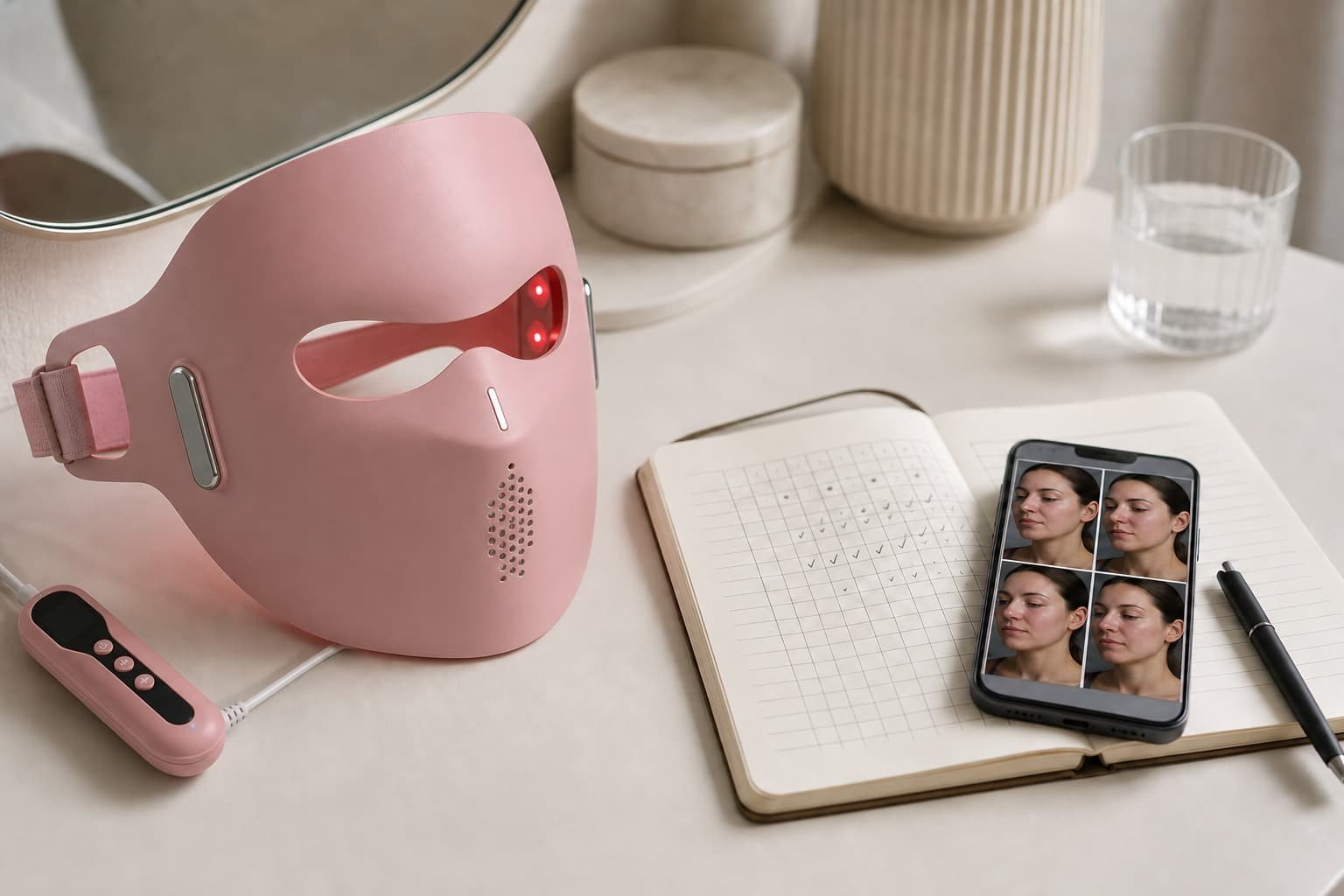
Create a baseline and repeat the same photograph setup at planned intervals. Consistency matters more than taking photos every day.
Research on facial photography shows that changes in light angle and head tilt can change how the face and eye area are perceived. An outcomes-photography study also identified positioning, expression, lighting, background, zoom, makeup, and timing as factors that can make before-and-after comparisons misleading.
Use this minimum checklist:
- Choose one primary goal and area. Write down exactly what you intend to observe, such as one crow’s-feet area or overall visible texture. Do not combine five concerns into one “worked/didn’t work” judgment.
- Take a baseline before changing the routine. Use no makeup and record the date, exact device, mode, and current skincare routine.
- Keep the light source and direction the same. Use the same room and lamp or the same indirect daylight position. Do not compare soft frontal light with strong side light.
- Keep the camera and face position the same. Match camera height, lens or zoom setting, distance, framing, head angle, and expression. Avoid beauty filters, portrait retouching, and automatic edits when possible.
- Keep a use log. Record completed sessions, mode, and any missed sessions according to the instructions for your exact device. Do not change the protocol to make the log look complete.
- Record other changes and reactions. Note new skincare products, procedures, medication discussions with a professional, unusual irritation, or other changes that could affect interpretation.
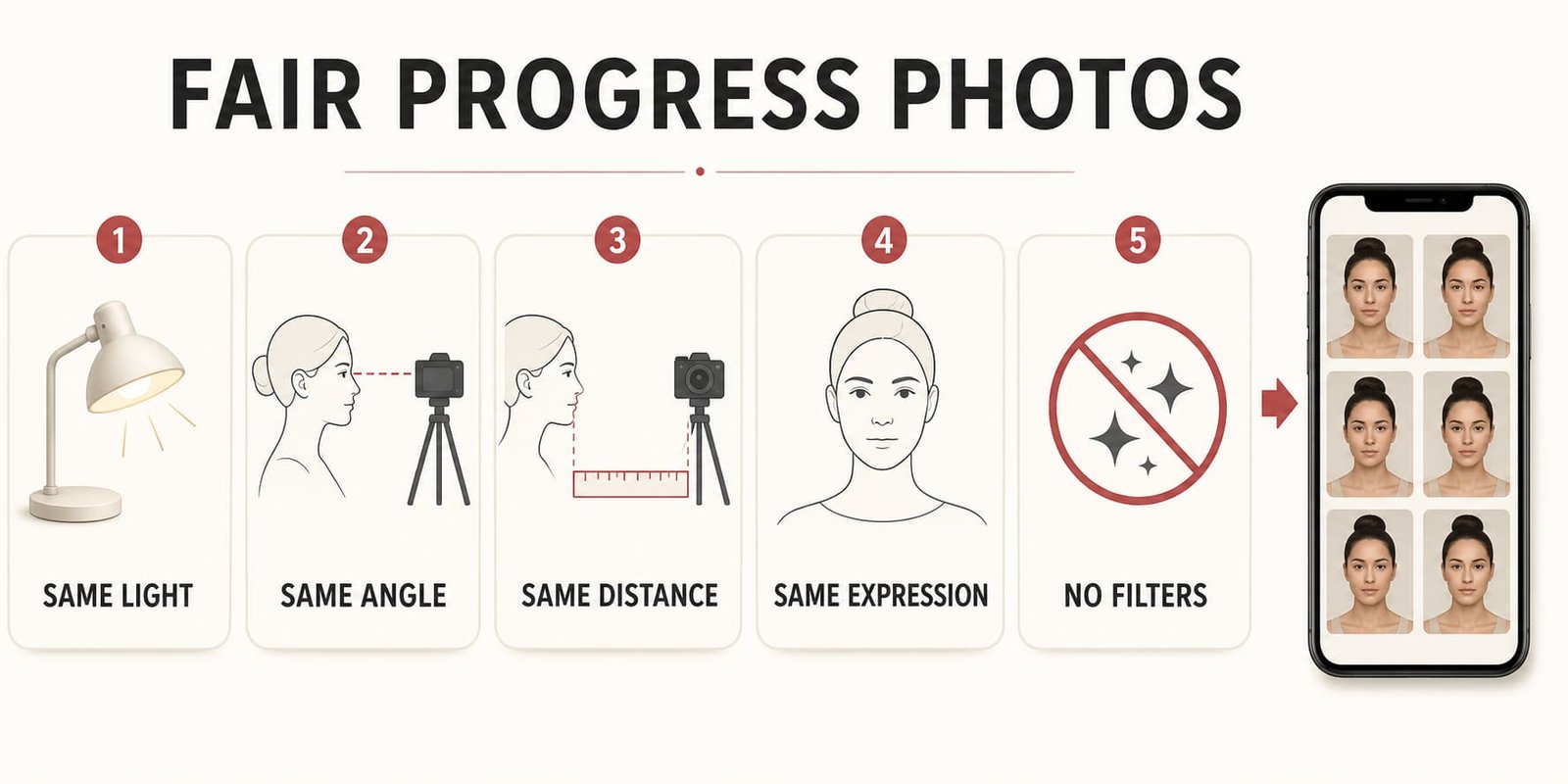
Standardization reduces avoidable comparison bias; it does not turn a home photo series into a clinical trial. Natural variation, other parts of your routine, and camera processing can still affect what you see.
No Visible Change Yet—What Should You Check First?
Check the goal and the actual protocol before adding more time or sessions. “No result” can mean an outcome mismatch, an execution problem, an unfair comparison, or no observable response under the current routine.
Use this order:
| Check | What to verify | What the answer changes |
|---|---|---|
| 1. Goal | Is the goal named in the device’s intended use or instructions, and is it specific enough to track? | If the goal is outside the device’s scope, more weeks do not fix the mismatch. |
| 2. Exact device and mode | Do you have the model-specific instructions, and are you using the mode intended for that goal? | A brand name, color label, or another model’s protocol is not enough. Missing or contradictory information calls for supplier verification. |
| 3. Actual use | Did the real session time, frequency, mode, course, and eye/safety instructions match the exact-device directions? | If execution differed, correct the routine through the official instructions or supplier; do not improvise a catch-up dose. |
| 4. Comparison quality | Are the baseline and follow-up records genuinely comparable? | If not, establish a clean baseline without changing the device protocol and track the next appropriate checkpoint. |
| 5. Outcome-matched observation | Has the device’s stated course or a relevant study period for the same outcome actually been completed? | If not, continued observation may be reasonable when use is tolerated. If it has, stop automatically extending the deadline and reassess. |
If the exact model, intended use, wavelength placement, output conditions, or instruction quality cannot be verified, use Wakelife’s six-point LED face mask verification guide before extending the timeline.
For the exact-device schedule fields to check, use Wakelife’s LED mask frequency and session-length guide. Do not double a session, restart a completed timer, stack modes, or increase weekly use merely because visible progress feels slow. If skincare order or products may be changing the routine, use the guides to where an LED mask fits in a skincare routine and whether moisturizer or serum can remain on the skin. The instructions for the exact device still control.When Should You Stop Waiting and Change Direction?
Stop extending the timeline when the problem is no longer simply “not enough observation yet.”
| Decision | When it fits | Next step |
|---|---|---|
| Continue the same labeled routine and keep recording | The goal and mode match, the instructions are clear, actual use is consistent, records are comparable, the relevant course is incomplete, and there is no concerning reaction | Continue only within the exact-device instructions and compare at the next planned checkpoint |
| Recheck before continuing | The model, mode, schedule, intended use, or baseline is missing, contradictory, or not verifiable | Ask the supplier for the exact instructions and supporting device information; correct the record before judging the timeline |
| Stop using and seek advice | Significant, persistent, or worsening skin or eye symptoms occur | Stop using the device and seek appropriate professional advice. Do not test a longer or more intensive routine. |
| Stop extending the timeline and change direction | The goal is outside the device’s reasonable scope, or an outcome-matched course has been completed with no repeatable visible improvement | Stop adding arbitrary weeks. Reassess the device and goal, contact the supplier about applicable support, and seek qualified assessment when the target concern requires it. |
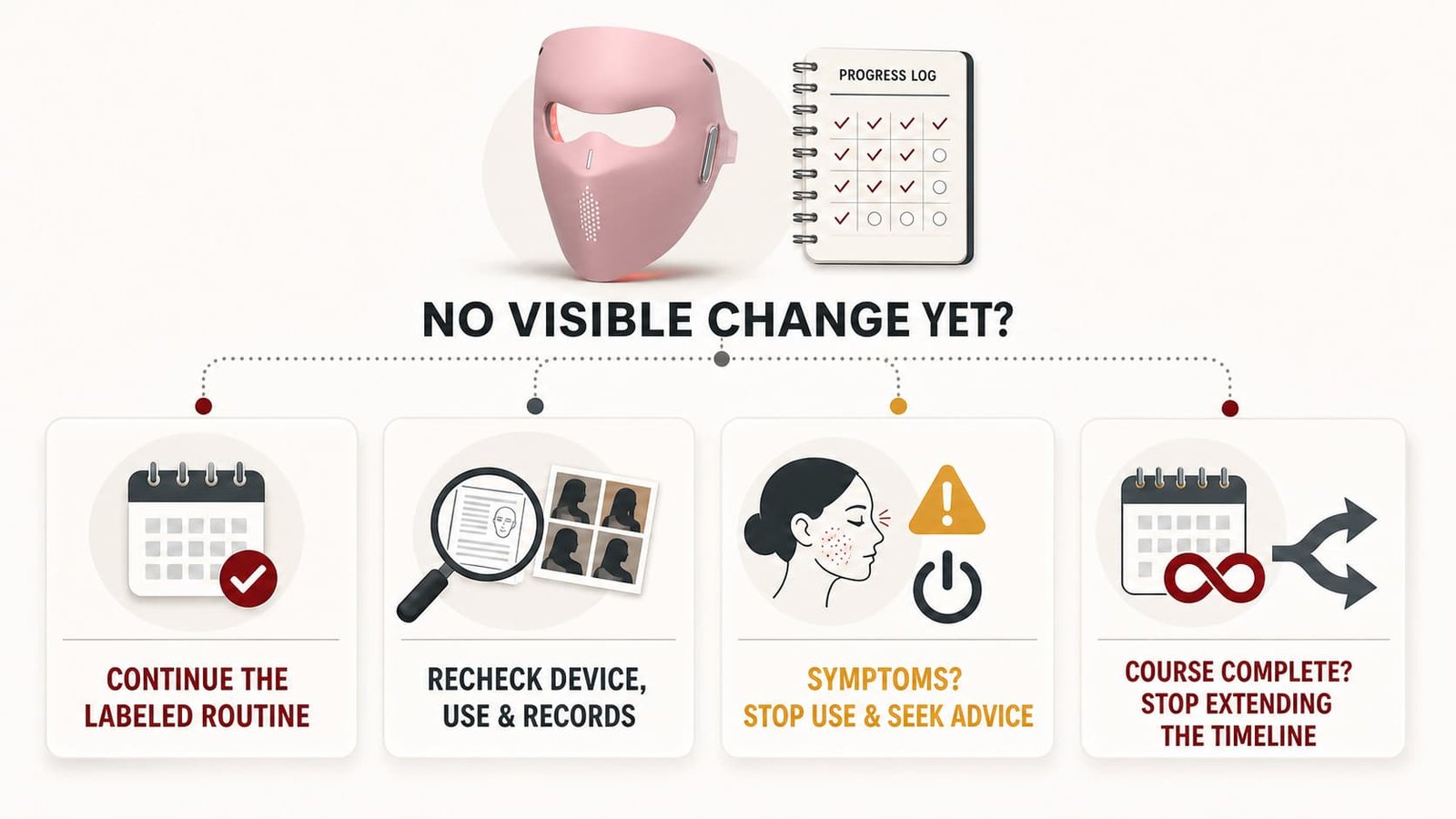
If a well-documented course ends without a repeatable change, the responsible conclusion is not “you failed” or “all LED masks are useless.” It is narrower:
No repeatable visible improvement was observed with this device, mode, routine, and tracked outcome over the period assessed.
That conclusion is enough to end an open-ended timeline. It may lead to checking whether the device matches its documentation, adjusting the goal, using a different nonmedical skincare strategy, discussing the concern with a qualified professional, or using the brand’s return, warranty, or upgrade process when applicable. It does not prove that the person’s body is biologically unable to respond, and one person’s result should not be projected onto similar users.
The Practical Rule to Remember
The question is not only “How many weeks has it been?” Use a more useful sequence:
Define one outcome
Research checkpoints can help you understand when investigators looked for a change. They cannot promise when you will see one. Consistent use and fair tracking matter, but so does recognizing when the device, goal, safety situation, or observed result no longer supports “just keep waiting.”
For Brands, Clinics, and Product Teams
“I used it for weeks and saw nothing” is not only a consumer-motivation problem. It can reveal unclear intended use, incomplete mode instructions, unverifiable specifications, poor outcome tracking, or an after-sales process that has no responsible stopping point.
Product teams should connect each consumer claim to the exact model, mode, labeled protocol, supporting outcome, study checkpoint, and realistic reassessment path. Support teams also need a documented way to distinguish incomplete execution from device/goal mismatch—and to end the timeline honestly when comparable records show no repeatable change.
Brands developing clearer LED mask protocols and after-sales education can explore Wakelife’s LED face mask platforms and OEM and ODM capabilities.
Safety and Medical Guidance
This article provides general consumer education, not medical advice or a diagnosis. LED masks vary in intended use, regulatory status, output, modes, schedules, warnings, and eye-protection requirements. Follow the labeling for your exact device.
Stop using the device and seek appropriate professional advice for significant, persistent, or worsening irritation; concerning eye symptoms; worsening of an existing condition; or a situation involving a light-sensitive condition, medication, prescription topical, or recent procedure. Do not stop prescribed treatment or diagnose a reaction based on this article.
References
Professional Guidance and Evidence Reviews
-
1
American Academy of Dermatology. Is Red Light Therapy Right for Your Skin? Updated September 13, 2024. Accessed July 23, 2026.
-
2
Ngoc LTN, Moon JY, Lee YC. Utilization of Light-Emitting Diodes for Skin Therapy: Systematic Review and Meta-Analysis. Photodermatology, Photoimmunology & Photomedicine. 2023;39(4):303–317. doi:10.1111/phpp.12841.
-
3
Grimes DR. Methodological Issues in Visible LED Therapy Dermatological Research and Reporting. PLOS ONE. 2025;20(9):e0332995. doi:10.1371/journal.pone.0332995.
Facial LED Studies
-
4
Bragato EF, Paisano AF, Pavani C, et al. Role of Photobiomodulation Application Frequency in Facial Rejuvenation: Randomized, Sham-Controlled, Double-Blind, Clinical Trial. Lasers in Medical Science. 2025;40(1):170. doi:10.1007/s10103-025-04383-1.
-
5
Mota LR, Duarte IS, Galache TR, et al. Photobiomodulation Reduces Periocular Wrinkle Volume by 30%: A Randomized Controlled Trial. Photobiomodulation, Photomedicine, and Laser Surgery. 2023;41(2):48–56. doi:10.1089/photob.2022.0114.
-
6
Park SH, Park SO, Jung JA. Clinical Study to Evaluate the Efficacy and Safety of Home-Used LED and IRED Mask for Crow’s Feet: A Multi-Center, Randomized, Double-Blind, Sham-Controlled Study. Medicine. 2025;104(7):e41596. doi:10.1097/MD.0000000000041596.
Photography and Outcome Recording
-
7
Hernandez CA, Espinal JM, Uribe Zapata D, et al. The Influence of Different Light Angles During Standardized Patient Photographic Assessment on the Aesthetic Perception of the Face. Aesthetic Plastic Surgery. 2021;45:2751–2759. doi:10.1007/s00266-021-02314-3.
-
8
Vaca EE, Bricker JT, Mioton LM, Fagien S, Alghoul MS. The Influence of Sagittal Head Tilt on Periorbital Appearance: Implications for Clinical Photography and the Evaluation of Postoperative Results. Aesthetic Surgery Journal Open Forum. 2022;4:ojab043. doi:10.1093/asjof/ojab043.
-
9
Soares DJ, von Haven HN, Yi CH. #TheUglyTruth? A Qualitative Evaluation of Outcomes Photography on Instagram: Introducing the SEPIA Scoring System. Plastic and Reconstructive Surgery—Global Open. 2022;10(8):e4464. doi:10.1097/GOX.0000000000004464.