Bestraling (MW/cm²) meet hoeveel lichtkracht elke vierkante centimeter van uw huid per seconde bereikt.
Energiedichtheid (J/cm²) – ook wel fluence of dosis genoemd – is de totale lichtenergie die tijdens uw sessie wordt afgezet.
Energiedichtheidscalculator
Bereken de behandelingsdosis op basis van de bestraling en de blootstellingstijd. Ontworpen voor een schone, professionele presentatie in Wakelife-stijl.
Voer de bestralingssterkte en de tijd in om de uitgangsdosis te berekenen.
Voorbeeld: Een apparaat dat bezorgt 45 mW/cm² voor 10 notulen (600 seconden): 45 × 600 ÷ 1,000 = 27.0 J/cm² — binnen het optimale therapeutische venster.
Optimale dosis voor de meeste huid- en welzijnstoepassingen: 10–30 J/cm² per sessie.
- Onderstaand 5 J/cm² → minimale biologische respons
- 10–30 J/cm² → optimaal therapeutisch bereik
- Boven 50 J/cm² → afnemende of remmende effecten (bifasische dosisrespons)
Lees de volledige gids hieronder voor de wetenschap, berekening stappen, dosisplanning per doel, veelvoorkomende fouten, en ontwerprichtlijnen van de fabrikant.
Waarom dosimetrie belangrijker is dan machtsclaims
De roodlichttherapiemarkt wordt overspoeld met stroomclaims. “100W paneel.” “300 LED’s.” “Intensiteit van medische kwaliteit.” Maar geen van deze cijfers vertelt u het enige dat daadwerkelijk bepaalt of uw behandeling werkt: hoeveel therapeutische energie uw doelweefsel bereikt tijdens een sessie.
Die hoeveelheid wordt genoemd dosis, gemeten in joule per vierkante centimeter (J/cm²). Het is de belangrijkste parameter bij fotobiomodulatie (PBM), omdat decennia van klinisch onderzoek hebben aangetoond dat biologische reacties op licht dat wel zijn dosisafhankelijk — en dat er zowel een minimale effectieve dosis als een maximale bruikbare dosis bestaat.¹
Zonder dosimetrie te begrijpen, je raadt het. Met het, u kunt behandelingen plannen die consistent effectief zijn, vermijd tijdverspilling aan subtherapeutische sessies, en de afnemende opbrengsten als gevolg van overbehandeling voorkomen.
Deze gids geeft u alle hulpmiddelen die u nodig heeft om te berekenen, plan, en optimaliseer uw dosis lichttherapie.
Kerndefinities: Bestraling, Energiedichtheid, en Fluentie
Bestraling (MW/cm²) — Vermogensdichtheid
De bestralingssterkte kwantificeert de tarief waarbij lichtenergie het weefseloppervlak bereikt. Het antwoordt: hoe intens is het licht op dit moment?
- Eenheid: milliwatt per vierkante centimeter (MW/cm²)
- Analogie: de stroomsnelheid van water uit een slang
- Hogere bestralingssterkte = snellere energieafgifte = kortere sessies nodig voor dezelfde dosis
Kritische noot: Bestraling is afstandsafhankelijk. Hetzelfde apparaat kan meten 45 mW/cm² op het contactoppervlak (0 cm) en alleen 20 bij mW/cm² 15 cm afstand. Bij het vergelijken van apparaten, bevestig altijd de meetafstand en of de waarde a vertegenwoordigt middelpunt piek of een oppervlaktegemiddelde.
Energiedichtheid (J/cm²) – Vloeiendheid / Dosis
Energiedichtheid kwantificeert de totaal lichtenergie die per oppervlakte-eenheid wordt afgezet tijdens een behandelsessie. Het antwoordt: hoeveel licht heeft het weefsel in totaal ontvangen?
- Eenheid: joule per vierkante centimeter (J/cm²)
- Analogie: het totale watervolume dat de emmer vulde
- Dit is het getal dat klinisch onderzoek koppelt aan biologische uitkomsten
De voorwaarden energiedichtheid, invloed, En dosis worden door elkaar gebruikt in de PBM-literatuur. In deze hele gids, wij gebruiken dosis voor eenvoud.
De relatie
| Concept | Maatregelen | Analogie | Eenheid |
|---|---|---|---|
| Bestraling | Snelheid van energielevering | Waterdebiet | MW/cm² |
| Tijd | Duur van levering | Hoe lang de slang loopt | seconden |
| Energiedichtheid (dosis) | Totaal geleverde energie | Totaal water in emmer | J/cm² |
Instraling vertelt u hoe snel. Dosis vertelt u hoeveel.
Je hebt beide nodig. Een apparaat met hoge stralingssterkte dat te kort wordt gebruikt, levert een onvoldoende dosis op. Een apparaat met weinig straling dat te lang wordt gebruikt, verspilt uw tijd - of erger, overschrijdt het optimale venster voordat u het beseft.
De dosimetrieformule: Stap voor stap
De Formule
Dosis (J/cm²) = Bestraling (MW/cm²) × Tijd (seconden) ÷ 1,000
De verdeling door 1,000 converteert milliwatt naar watt (sinds 1 J = 1 W× 1 S).
Stapsgewijze berekening
Stap 1: Vind de straling van uw apparaat (MW/cm²) uit het specificatieblad of het testrapport van derden. Bevestig de meetafstand.
Stap 2: Bepaal uw behandeltijd en converteer deze naar seconden.
| Notulen | Seconden |
|---|---|
| 5 min | 300 S |
| 10 min | 600 S |
| 15 min | 900 S |
| 20 min | 1,200 S |
Stap 3: Vermenigvuldig de bestraling met de tijd, deel dan door 1,000.
Uitgewerkte voorbeelden
Voorbeeld A: Instraling van het apparaat: 25 MW/cm² | Tijd: 10 notulen (600 S) 25 × 600 ÷ 1,000 = 15.0 J/cm²
Voorbeeld B: Instraling van het apparaat: 33 MW/cm² | Tijd: 10 notulen (600 S) 33 × 600 ÷ 1,000 = 19.8 J/cm²
Voorbeeld C: Instraling van het apparaat: 45 MW/cm² | Tijd: 15 notulen (900 S) 45 × 900 ÷ 1,000 = 40.5 J/cm²
Omgekeerde berekening: Hoe lang voor een doeldosis?
Als u een doeldosis in gedachten heeft, U kunt de benodigde behandeltijd berekenen:
Tijd (seconden) = Doeldosis (J/cm²) × 1,000 ÷ Bestralingssterkte (MW/cm²)
Voorbeeld: Doeldosis: 20 J/cm² | Instraling van het apparaat: 33 MW/cm² 20 × 1,000 ÷ 33 = 606 seconden ≈ 10 notulen
De bifasische dosisrespons: Waarom meer niet beter is
Het Arndt-Schulz-principe
Een van de belangrijkste bevindingen in het onderzoek naar fotobiomodulatie is de bifasische dosisrespons, geformaliseerd door Huang et al. (2009).¹ Het volgt de wet van Arndt-Schulz: biologische systemen reageren op stimuli in een klokvormige curve.
Toegepast op lichttherapie:
~5 J
~50 J
(Excessief)
Wat dit betekent voor uw behandelingen
| Dosiszone | Bereik | Biologisch effect |
|---|---|---|
| Subdrempel | < 5 J/cm² | Onvoldoende energie om een betekenisvolle cellulaire respons teweeg te brengen |
| Therapeutisch venster | 10–30 J/cm² | Optimale stimulatie van mitochondriale activiteit, cytochroom c-oxidase-activering, ATP-productie, en stroomafwaartse signaalcascades²³ |
| Plateau / afnemend | 30–50 J/cm² | Het rendement neemt af; sommige toepassingen kunnen er nog steeds baat bij hebben, maar de risico/opbrengstverhouding verslechtert |
| Remmende zone | > 50 J/cm² | Cellulaire stressreacties; mogelijke onderdrukking van juist de processen die u probeert te stimuleren¹ |
Waarom dit contra-intuïtief is
De meeste mensen gaan ervan uit dat ‘meer = beter’ is. Bij fotobiomodulatie, de wetenschap is duidelijk: er is een optimaal dosisvenster, en als je deze overschrijdt, verspil je niet alleen tijd — het kan uw resultaten actief verminderen.
Dit is de reden waarom dosimetriegeletterdheid belangrijk is. U moet niet alleen weten dat uw apparaat “een hoog vermogen heeft," Maar precies waar uw sessie valt op de dosis-responscurve.
Dosisbereiken per toepassing
Gepubliceerde klinische literatuur suggereert de volgende dosisbereiken. Dit zijn richtlijnen, geen absolute voorschriften – individuele reacties variëren, en golflengteselectie heeft een significante invloed op welke weefsellagen de dosis ontvangen.
| Sollicitatie | Aanbevolen doseringsbereik | Primaire golflengten | Sleutelreferentie |
|---|---|---|---|
| Huidverjonging / collageen synthese | 10–30 J/cm² | 630–660 nm | Avci et al., 2013² |
| Ontstekingsremmend / vermindering van roodheid | 10–20 J/cm² | 810–850 nm | Hamblin, 2017³ |
| Wondgenezing | 4–15 J/cm² | 630–850 nm | Hamblin, 2017³ |
| Pijnbestrijding (dieper weefsel) | 15–40 J/cm² | 810–1.072 nm | Verscheidene |
| Stimulatie van de haargroei | 5–15 J/cm² | 630–660 nm | Verscheidene |
Belangrijk: Dezelfde dosis bij verschillende golflengten behandelt verschillende weefseldiepten. 20 J/cm² bij 633 nm richt zich op de dermis (1–3 mm diepte), terwijl 20 J/cm² bij 850 nm bereikt onderhuids weefsel en spieren (20–30 mm).
→ Diepe duik in golflengte-weefselinteracties: Golflengte selectie & Weefselpenetratiediepte in PBM-apparaten
Gemiddeld versus. Piekbestraling: welk getal moet u eigenlijk gebruiken??
Als je ooit twee apparaten voor roodlichttherapie hebt vergeleken en je hebt afgevraagd waarom één merk dit beweert 100 mW/cm², terwijl een ander soortgelijk uitziend paneel alleen maar beweert 35 MW/cm², het antwoord is meestal niet dat één apparaat drie keer krachtiger is. Het antwoord is dat ze meten anders [5].
Er zijn twee manieren om de bestraling te rapporteren, en het verschil daartussen verandert alles over hoe u de specificaties van een product interpreteert – en hoe u uw dosis berekent.
Piekbestraling
Piekinstraling is de hoogste waarde die een sensor kan registreren. Dit wordt gemeten door de detector direct tegen het helderste punt op het paneel te plaatsen, meestal in het midden boven één LED, bij 0 cm afstand.
Dit getal vertegenwoordigt de absoluut maximum uw huid kan op een klein plekje terechtkomen. Dat doet het niet vertegenwoordigen wat de rest van het behandelgebied ontvangt.
Gemiddelde straling
De gemiddelde bestralingssterkte is de gemiddelde vermogensdichtheid gemeten over de hele oppervlakte gehele actieve behandelingsoppervlak. Omdat LED's licht uitstralen in een straalpatroon (typisch 60°), de randen van het paneel leveren uiteraard minder energie dan het midden. Het gemiddelde verklaart deze variatie in de echte wereld.
Dit is het getal dat weerspiegelt wat uw weefsel daadwerkelijk ontvangt tijdens een sessie.
Waarom dit onderscheid ertoe doet
Denk eens aan een reëel voorbeeld: een roodlichttherapiepaneel meet 45 mW/cm² in de centrale hotspot (piek), maar wanneer u het gemiddelde neemt van de metingen over het volledige behandelingsoppervlak, de effectieve bestralingssterkte is 35 MW/cm² [4].
Als u de piekwaarde gebruikt (45) in uw dosisberekening voor een sessie van 10 minuten:
- 45 × 600 ÷ 1,000 = 27 J/cm² (overschat)
Als je de gemiddelde waarde gebruikt (35) voor dezelfde sessie:
- 35 × 600 ÷ 1,000 = 21 J/cm² (nauwkeurig)
Dat is een 6 J/cm² verschil — voldoende om uw waargenomen dosis naar de bovengrens van het therapeutische venster te duwen, terwijl uw werkelijke dosis comfortabel in het midden ligt. Gedurende weken van dagelijkse behandelingen, deze misrekening wordt groter.
⚠️ Probleem met transparantie in de sector
Veel merken rapporteren alleen piekinstraling zonder de meetmethode bekend te maken. Een apparaat dat claimt “100 MW/cm²” gemeten in het midden kan de LED-hotspot gemiddeld slechts 50–65 mW/cm² leveren over het hele oppervlak. Vraag het altijd: is deze piek of het gemiddelde? Op welke afstand?
De regel voor dosisberekeningen
Gebruik altijd de gemiddelde instraling voor dosisberekeningen. Piekwaarden zijn handig voor het vergelijken van individuele LED-uitvoer, maar ze overschatten de dosis die het grootste deel van uw weefsel daadwerkelijk ontvangt tijdens de behandeling. Wanneer een verantwoord merk zijn uitstraling vermeldt met een “+” symbool (Bijv., “35+ MW/cm²”), het geeft doorgaans een conservatief gemiddelde aan – het minimum dat u voor het gehele behandelgebied kunt verwachten.
Berekening in de praktijk: van specificaties tot dosering 3 Stappen
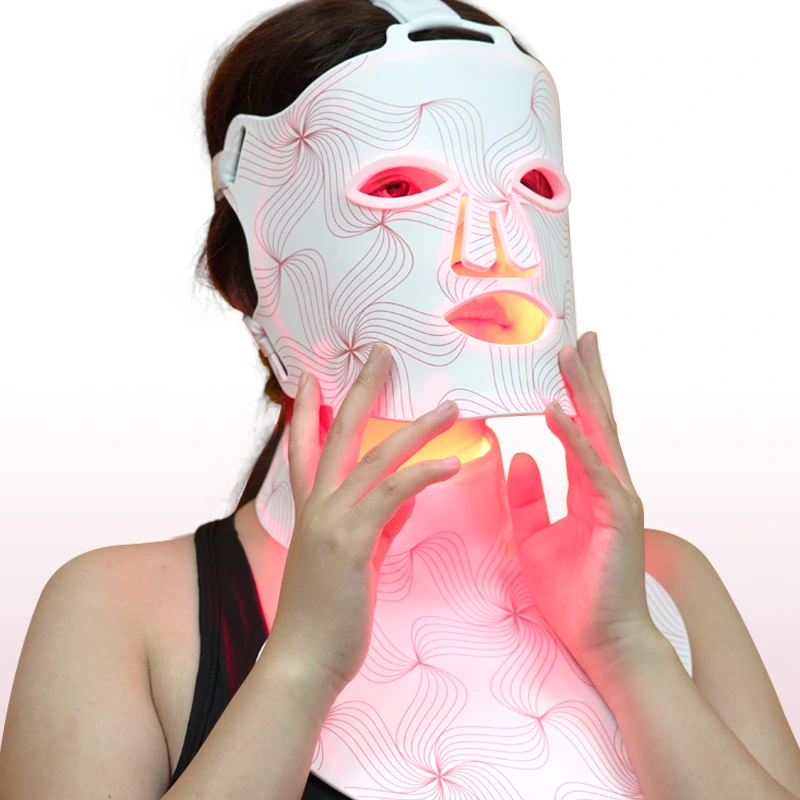
Om deze principes tot leven te brengen, laten we een echte berekening doornemen met behulp van meerdere golflengten LED-gezichtsmasker als referentieapparaat: de WAKELIFE G15K, wat combineert 633 nm-LED, 850 nmVCSEL, En 1072 nm VCSEL-lichtbronnen.
Referentie G15K apparaatspecificaties
Stap 1 — Kies de juiste instralingswaarde
Wij gebruiken 35 MW/cm² (het gemiddelde), niet 45 MW/cm² (de piek). Dit weerspiegelt wat uw huid daadwerkelijk ontvangt over het volledige maskeroppervlak.
Stap 2 — Converteer de behandeltijd naar seconden
10 minuten × 60 = 600 seconden
Stap 3 — Pas de dosisformule toe
Dosis = Bestralingssterkte × Tijd ÷ 1,000
Dosis = 35 × 600 ÷ 1,000
= 21 J/cm²
Controleer het therapeutische venster:
- ⚪ < 5 J/cm² — Onderdrempel
- 🔵 5–10 J/cm² — Nadert het therapeutische bereik
- 🟢 10–30 J/cm² — Optimaal therapeutisch venster ← 21 J/cm² landt hier ✅
- 🟡 30–50 J/cm² — Vermindering van het rendement
- 🔴 > 50 J/cm² — Potentieel remmend
Bij 21 J/cm², een standaardsessie van 10 minuten valt comfortabel binnen het optimale bereik dat wordt ondersteund door het merendeel van het fotobiomodulatieonderzoek. Geen aanpassingen nodig.
Wat als u een andere duur wilt??
Met dezelfde gemiddelde instraling (35 MW/cm²) op volle intensiteit:
Dit laat zien waarom de meeste gebruikers van dit apparaat de goede plek hebben 5 naar 15 minuten per sessie. Voorbij 15 minuten op vol vermogen, je begint het gebied van de afnemende opbrengsten te betreden.
Dosismatrix — Aanpassing voor intensiteitsniveaus
Sommige apparaten, inclusief de G15K, bieden instelbare intensiteitsinstellingen. Dit geeft u een tweede variabele waarmee u uw dosis kunt controleren – niet alleen de tijd, maar ook het vermogen.
Hier is een belangrijk detail: het dimmen van een LED vermenigvuldigt niet simpelweg de instraling met het percentage dat op de controller wordt weergegeven. De werkelijke output hangt af van hoe het stuurcircuit de stroom vermindert. De onderstaande waarden zijn de gemeten gemiddelde instraling bij elke instelling, geen berekende schattingen.
G15K Gemeten gemiddelde instraling op basis van intensiteitsniveau
Vetgedrukt = binnen het optimale venster van 10–30 J/cm².
⚠️ = overschrijden 30 J/cm², de zone van de afnemende meeropbrengsten nadert.
Hoe deze matrix te lezen
🟢 Beginners en gevoelige huid: Begin met 50% intensiteit, 10 minuten → 15.0 J/cm². Dit bevindt zich op het beginpunt van het therapeutische venster – voldoende voor huidverjongingsvoordelen met minimaal risico op overstimulatie. Indien goed verdragen na 2-3 sessies, verhogen naar 75%.
🟢 Standaard dagelijks gebruik: 75% intensiteit, 10 minuten → 19.8 J/cm². Dit is de aanbevolen instelling voor de meeste gebruikers. Het levert een dosis op die precies binnen het optimale bereik ligt voor collageensynthese en ontstekingsremmende effecten.
🟢 Ervaren gebruikers met specifieke doelen: 100% intensiteit, 10 minuten → 21.0 J/cm². Nog steeds ruim binnen het optimale venster. Geschikt voor gebruikers met een gevestigde tolerantie die gericht zijn op intensievere resultaten.
⚠️ Wees voorzichtig: Elke combinatie die meer dan produceert 30 J/cm² overschrijdt de algemene richtlijn en komt in de zone met verminderde opbrengsten terecht. Niet aanbevolen voor de gevoelige huid, gezichtsbehandelingen voor beginners, of dagelijks gebruik op dit niveau.
Belangrijk: De energiedichtheid neemt lineair toe met zowel de belichtingstijd als de bestraling. Het overschrijden van de aanbevolen bereiken kan de werkzaamheid verminderen als gevolg van de hierboven besproken bifasische dosisrespons.
Waarom apparaten met meerdere golflengten complexiteit toevoegen
De G15K levert drie golflengten tegelijkertijd. Dit is een voordeel, maar het betekent ook dat het licht dat uw weefsel bereikt niet uniform van diepte is.
Elke golflengte dringt door tot in een andere laag:
| Golflengte | Type | Geschatte penetratie | Primair doel |
|---|---|---|---|
| 633 nm | Geleid | 1–3 mm (dermis) | Collageensynthese, huidtextuur |
| 850 nm | LED/VCSEL | 20–30 mm (diep weefsel) | Ontstekingsremmend, spierherstel |
| 1072 nm | VCSEL | 30–40+mm (diep weefsel) | Opkomend onderzoek: neurologisch, diepe ontstekingsremmend |
Dit betekent dat een enkele sessie tegelijkertijd meerdere weefsellagen behandelt. De totale gemiddelde stralingswaarde (35 MW/cm²) is de gecombineerde output van alle drie de golflengten die het oppervlak raken.
U moet dus de dosis van elke golflengte afzonderlijk berekenen?
Voor apparaten voor thuisgebruik zoals de G15K: Nee. De golflengteverhouding wordt vastgelegd door de fabrikant en kan niet door de gebruiker worden aangepast. Uw totale oppervlaktedosis (berekend op basis van de gecombineerde gemiddelde instraling) is het getal dat van belang is voor het bepalen van de behandeltijd.
Waar dosering per golflengte relevant wordt, zijn klinische onderzoeksprotocollen en op maat gemaakte apparaten waarbij individuele golflengtekanalen onafhankelijk kunnen worden geregeld. Voor consumentengebruik, de totale dosisbenadering is zowel nauwkeurig als praktisch.
Als je wilt begrijpen waarom de G15K VCSEL-laserdiodes gebruikt vanwege zijn nabij-infrarode golflengten in plaats van standaard LED's - en welk verschil coherent licht maakt op weefselniveau.
→ Ontdek hoe coherent VCSEL-licht verschilt van onsamenhangende LED: LED versus. Laser in lichttherapieapparaten
Veel voorkomende dosimetriefouten
Fout #1: Meetafstand negeren
Op een apparaatspecificatieblad kan “35 mW/cm²” staan, gemeten op een gestandaardiseerde testafstand, terwijl contactoppervlakmeting een aanzienlijk hogere waarde oplevert. Dit betekent niet dat iemand ongelijk heeft – het betekent wel meetomstandigheden zijn enorm belangrijk.
Wat te doen: Vraag altijd naar de meetafstand, het gebruikte instrument, en of de waarde piek- of gemiddelde bestraling vertegenwoordigt. Bij het vergelijken van apparaten, Zorg ervoor dat u waarden vergelijkt die onder dezelfde omstandigheden zijn gemeten.
Fout #2: Ervan uitgaan dat meer tijd altijd betere resultaten betekent
De bifasische dosisrespons (Sectie 4) betekent dat er een plafond is. Een verdubbeling van uw sessietijd verdubbelt niet uw resultaten. Meer dan ongeveer 30–50 J/cm² voor de meeste huidtoepassingen, je betreedt afnemend of remmend terrein.¹
Wat te doen: Bereken uw dosis. Stel een timer in. Weersta de drang om ‘een beetje extra te doen’.
Fout #3: Apparaten vergelijken op wattage alleen
Een ‘paneel van 100 W’ levert niet noodzakelijkerwijs een grotere therapeutische dosis op dan een ‘apparaat van 60 W’. Het totale wattage meet het elektriciteitsverbruik, niet het licht dat je huid bereikt. Een apparaat met een beter optisch ontwerp, strakkere stralingshoeken, of VCSEL-bronnen kunnen ondanks een lager totaal wattage superieure bestraling op het behandelingsoppervlak leveren.⁴
Wat te doen: Vergelijk bestraling (MW/cm²) op dezelfde meetafstand, niet wattage.
Fout #4: Golflengte negeren bij het plannen van de dosis
20 J/cm² bij 633 nm en 20 J/cm² bij 850 nm zijn geen gelijkwaardige behandelingen. Ze richten zich op totaal verschillende weefseldiepten. Uw dosisdoel moet overeenkomen met de penetratiediepte van de golflengte en het beoogde weefseldoel.
Wat te doen: Bepaal eerst uw behandeldoel (oppervlaktehuid vs. diep weefsel), selecteer de juiste golflengte, bereken vervolgens de dosis.
→ Gids voor het matchen van golflengte en diepte: Golflengte selectie & Weefselpenetratiediepte
Fout #5: Het verwaarlozen van de uniformiteit van het behandelgebied
Als uw apparaat een ‘hot spot’ in het midden produceert en de straling aan de randen aanzienlijk lager is, de dosismatrix vertelt u alleen wat het centrum heeft ontvangen. De periferie kan ondergedoseerd zijn.
Wat te doen: Zoek naar apparaten met een uniforme straalverdeling. Als uw apparaat niet-uniformiteit heeft gekend, overweeg herpositionering tijdens de behandeling om de dekking te verbeteren. Een sterke kwaliteit- en complianceprogramma zorgt voor het testen van accounts voor deze variabelen.
→ Op welke specificaties moet je letten?: Hoe u de specificaties van een roodlichttherapieapparaat kunt beoordelen
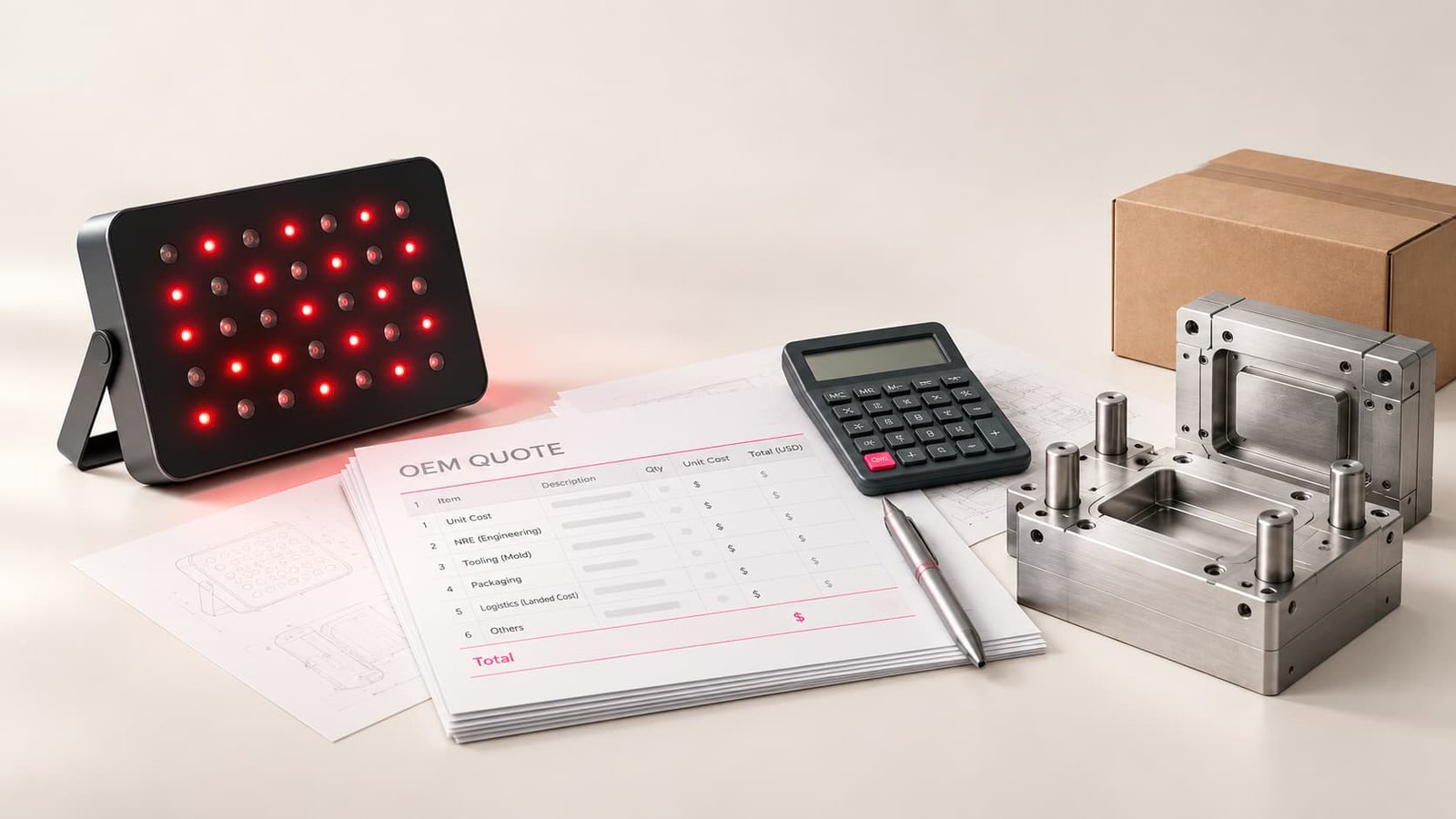
Voor apparaatfabrikanten: Dosimetrie in productontwerp
Dit gedeelte is voor merken, OEM/ODM-partners, en productontwikkelingsteams die fotobiomodulatie-apparaten bouwen.
Het probleem in de huidige markt
Veel apparaten die momenteel beschikbaar zijn, zijn rondom ontworpen beschikbaarheid en kosten van componenten, niet in de buurt therapeutische dosisafgifte. Dit resulteert in producten die:
- Onderdosis (te zwak om klinische effecten te veroorzaken, wat tot teleurgestelde eindgebruikers leidt)
- Gebrek aan duidelijke doseringsrichtlijnen (gebruiker weet niet welke instellingen hij moet gebruiken, wat tot inconsistente uitkomsten leidt)
- Kan op klinische gronden niet worden onderscheiden (geen dosimetriegegevens = geen wetenschappelijke geloofwaardigheid)
Een op dosimetrie gerichte ontwerpbenadering keert dit proces om.
Dosimetrie-eerste raamwerk voor productontwerp
Stap 1: Definieer het doeldosisbereik op basis van het beoogde gebruik. Als uw product gericht is op huidverjonging, uw ontwerp moet 10–30 J/cm² opleveren binnen de praktijksessieduur (5–15 minuten).
Stap 2: Werk terug naar de bestralingsspecificaties.
| Doeldosis | Sessie tijd | Vereiste bestraling |
|---|---|---|
| 15 J/cm² | 10 min (600 S) | 25 MW/cm² |
| 20 J/cm² | 10 min (600 S) | 33 MW/cm² |
| 27 J/cm² | 10 min (600 S) | 45 MW/cm² |
| 30 J/cm² | 15 min (900 S) | 33 MW/cm² |
Stap 3: Ontwerp intensiteitsvoorinstellingen die overeenkomen met betekenisvolle dosisniveaus. In plaats van willekeurig ‘Laag / Medium / Hoge”-labels, wijs elke preset toe aan een specifiek dosisresultaat op een standaard behandeltijdstip. Voeg een dosisgrafiek toe aan de gebruikershandleiding.
Stap 4: Specificeer bestralingstests onder gestandaardiseerde omstandigheden EN contactoppervlak. Transparantie in de meetomstandigheden schept vertrouwen bij zowel toezichthouders als geïnformeerde consumenten.
Aanbevelingen voor ontwerpparameters
| Parameter | Richtlijn | Reden |
|---|---|---|
| Minimale bestraling op het behandelingsoppervlak | ≥ 20 MW/cm² | Hieronder dit, Het bereiken van de therapeutische drempel vereist onpraktisch lange sessies |
| Maximale bestraling op het behandeloppervlak | ≤ 60 MW/cm² | Voorkomt overschrijding 50 J/cm² in standaardsessies van 15 minuten |
| Voorinstellingen voor timers | 3 opties (Bijv., 5 / 10 / 15 min) | Van beginners tot geavanceerde dosisniveaus |
| Intensiteitsniveaus | ≥ 3 niveaus | Hiermee kunnen gebruikers de dosis aanpassen zonder de sessieduur te wijzigen |
| Gebruikershandleiding dosisgrafiek | Vereist | De meest impactvolle opname voor gebruikersresultaten |
Veel voorkomende OEM/ODM-valkuilen
Valkuil 1: Overspecificatie van wattage in marketing. Eindconsumenten begrijpen steeds meer dat wattage ≠ werkzaamheid is. Vooruitstrevende merken schakelen over op op straling gebaseerde claims, die zowel nauwkeuriger als beter verdedigbaar zijn voor toezichthouders.
Valkuil 2: Het weglaten van dosisaanwijzingen uit gebruikershandleidingen. Inclusief een doseerschema (zoals de matrix in Sectie 6) verbetert de gebruikerservaring dramatisch, vermindert ondersteuningsvragen, en verhoogt het aantal herhalingsaankopen. Dit wordt ook steeds vaker verwacht door toezichthoudende instanties.
Valkuil 3: Apparaten met één intensiteit. Zonder regelbare output, een apparaat dient slechts één dosisprofiel, wat de bereikbare markt ernstig beperkt en gebruikers met een gevoelige huid uit veiligheidsoogpunt uitsluit.
Valkuil 4: Geen onderscheid maken tussen lichtbrontechnologieën. VCSEL-bronnen bieden een hogere bestralingsefficiëntie en diepere penetratie dan vergelijkbare LED-arrays. Als uw apparaat VCSEL-technologie gebruikt, dit zou een kernonderdeel van uw productverhaal moeten zijn, ondersteund door dosimetriegegevens.⁴
Partner van WAKELIFE
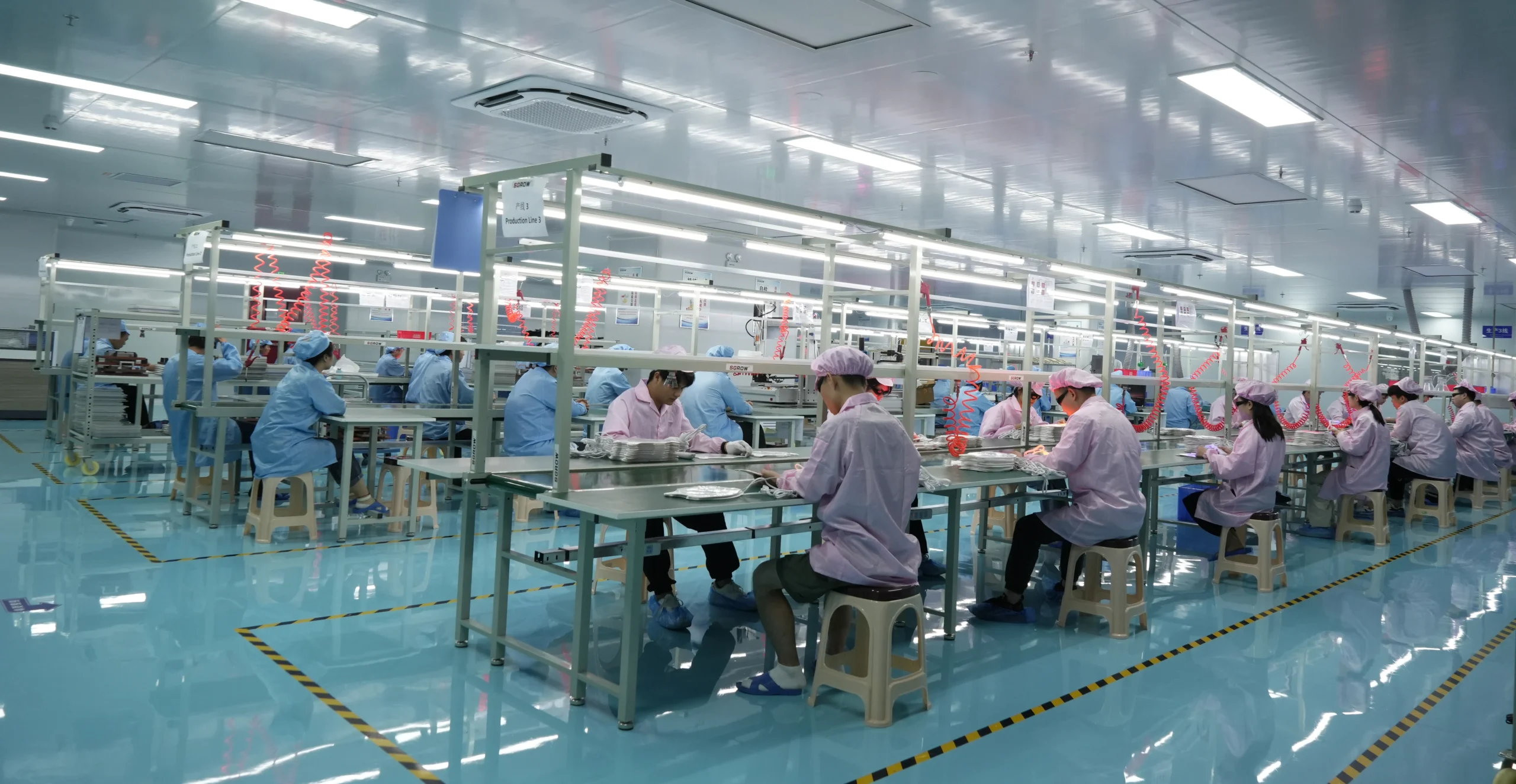
Het moederbedrijf van WAKELIFE, Shenzhen Sungrow Led Technologie Co., Ltd., biedt end-to-end OEM/ODM-diensten voor fotobiomodulatie-apparaten – van dosimetrie-geïnformeerd productontwerp tot prototyping, certificering, en massaproductie.
Wij ondersteunen merken in elke fase:
- Concept → Visualisatie: Industriële ontwerpweergaven afgestemd op uw merkidentiteit via onze R&D-mogelijkheden
- Prototyping → Validatie: Functionele prototypes met stralingsverificatie via onze productiefaciliteit
- Certificering → Naleving: FDA, CE, ISO 13485 testrapporten en wettelijke documentatie via onze Kwaliteit & Naleving team
- Branding → Markt: Vol private label En maatwerk diensten inclusief App -aanpassing
- Proef → Massaproductie: Validatie van kleine batches gevolgd door strikte QC-productie met toegewijde ondersteuning na verkoop
Veelgestelde vragen
Wat is bestraling bij roodlichttherapie?
Bestraling (MW/cm²) is de vermogensdichtheid van licht op het behandelingsoppervlak - hoeveel lichtenergie elke vierkante centimeter per seconde raakt. Het bepaalt hoe snel u een therapeutische dosis opbouwt.
Hoe bereken ik mijn roodlichttherapiedosis?
Dosis (J/cm²) = Bestraling (MW/cm²) × Tijd (seconden) ÷ 1,000. Bijvoorbeeld, 33 mW/cm² voor 10 notulen (600 S): 33 × 600 ÷ 1,000 = 19.8 J/cm².
Wat is de optimale dosis voor huidverjonging?
Gepubliceerd onderzoek suggereert 10–30 J/cm² per sessie voor de collageensynthese en huidverjonging.² Begin aan de onderkant (10–15 J/cm²) en verhoog geleidelijk op basis van de tolerantie van uw huid.
Kan ik een overdosis roodlichttherapie krijgen??
Roodlichttherapie veroorzaakt geen brandwonden of UV-schade. Echter, de bifasische dosisrespons betekent te hoge doses (typisch > 50 J/cm²) kan het therapeutische effect verminderen of remmen.¹ Dit maakt uw sessies minder effectief, niet gevaarlijk – maar het is nog steeds een reden om uw dosis bij te houden.
Betekent een hoger wattage betere resultaten??
Niet noodzakelijkerwijs. Het wattage meet het elektriciteitsverbruik, geen therapeutische bevalling. Een goed ontworpen apparaat van 60 W met geoptimaliseerde optica kan een hogere stralingssterkte aan het huidoppervlak leveren dan een slecht ontworpen paneel van 150 W. Vergelijk altijd de bestraling, niet wattage.
Hoe beïnvloedt de golflengte de dosering??
Verschillende golflengten dringen door tot verschillende weefseldiepten, dus dezelfde dosis bij verschillende golflengten behandelt verschillende structuren. 633 nm richt zich op de oppervlakkige huid (1–3 mm); 850 nm bereikt diep weefsel (20–30 mm); 1072 nm dringt nog dieper door (30–40+mm). Zorg ervoor dat uw golflengte overeenkomt met uw behandelingsdoel, bereken vervolgens de dosis dienovereenkomstig.
→ Golflengte selectie & Weefselpenetratiediepte in PBM-apparaten
Wat is het verschil tussen LED en VCSEL voor dosistoediening?
Beide leveren fotonen, maar VCSEL's produceren coherent, gecollimeerd licht dat een hogere stralingssterkte over afstand handhaaft en efficiënter in het weefsel doordringt. LED's produceren divergent, onsamenhangend licht waarvan de stralingssterkte snel afneemt met de afstand. De dosimetrieformule is hetzelfde, maar VCSEL's leveren doorgaans meer dosis per watt aan het doelweefsel.⁴
Hoe vaak moet ik roodlichttherapie doen??
De meeste protocollen suggereren 3-5 sessies per week, met minimaal één rustdag. Dosis per sessie is belangrijker dan frequentie. Een consistente 20 Een J/cm² sessie van vijf dagen per week is effectiever dan een onregelmatig schema met wisselende doseringen.
Gerelateerde onderwerpen
- Onderwerp 03: Bifasische dosisrespons bij PBM
- Onderwerp 06: Golflengte selectie & Weefselpenetratiediepte
- Onderwerp 10: Evalueren 7 Kritieke apparaatspecificaties
- Onderwerp 12: OEM/ODM-fabrikantselectiegids
Bekijk alles 30 onderwerpen: Volledige handleiding voor roodlichttherapie
Referenties
Huang JJ, Chen AC, Caroll JD, Hamblin Mr. Bifasische dosisrespons bij lichttherapie op laag niveau. Dosis-respons. 2009;7(4):358-383. doi:10.2203/dosis-respons.09-027.Hamblin
Avci P, Gupta A, Sadasivam M, et al. Laser op laag niveau (licht) therapie (LLLT) in de huid: stimulerend, genezing, herstellen. Halfgesneden medische chirurg. 2013;32(1):41-52. PubMed
Hamblin Mr. Mechanismen en toepassingen van de ontstekingsremmende effecten van fotobiomodulatie. DOEL Biofysica. 2017;4(3):337-361. doi:10.3934/biofy.2017.3.337
Heiskanen V, Hamblin Mr. Fotobiomodulatie: lasers versus. lichtgevende diodes? Photochem Photobiol Sci. 2018;17(8):1003-1017. doi:10.1039/c8pp00176f
Hamblin Mr. Mechanismen en mitochondriale redoxsignalering bij fotobiomodulatie. Fotochem Fotobiol. 2018;94(2):199-212. doi:10.1111/php.12864