Wavelength selection is the most critical parameter in photobiomodulation device design. Rotlicht (630-660 nm) targets superficial tissues (skin, wounds) by activating cytochrome c oxidase heme centers. Nahinfrarot (810-850 nm) penetrates deeper (muscle, bone, brain) by targeting the CuA center. Der therapeutic window spans 600-1000 nm, with peak absorption at 660 nm und 830 nm. Tissue penetration follows the optical window von 650-1350 nm, where scattering dominates over absorption. For comprehensive treatment, dual-wavelength devices (660 nm + 830 nm) provide optimal coverage across tissue depths.
Einführung
Why does a 660 nm red light device work wonders for facial rejuvenation but struggle to reach deep muscle tissue? The answer lies in wavelength-dependent tissue penetration—a fundamental principle of optical physics that determines whether photons reach their target or are absorbed by unintended chromophores.
Wavelength selection is not merely a marketing specification; it’s the primary determinant of:
- Which tissues can be effectively treated
- Which chromophores are activated
- Treatment efficacy for specific conditions
- Device design parameters (LED arrays, power requirements)
This article provides the technical foundation for rational wavelength selection, combining optical physics, biological mechanisms, und klinische Beweise. Understanding these principles enables informed decisions in device development, clinical protocol design, and therapeutic application.
The Physics of Light-Tissue Interaction
Optical Properties of Tissue
When light enters biological tissue, three phenomena occur:
| Phenomenon | Beschreibung | Wavelength Dependence |
|---|---|---|
| Absorption | Light energy captured by molecules | Strong for UV/visible, weak for NIR |
| Scattering | Light direction changed by tissue structures | Dominant in therapeutic window |
| Transmission | Light passing through tissue | Depends on absorption/scattering balance |
Key Chromophores in Tissue:
| Chromophore | Absorption Peak | Tissue Location |
|---|---|---|
| Hemoglobin | 420, 540, 580 nm | Blood vessels |
| Melanin | Broad UV-visible | Epidermis |
| Water | 970, 1200, 1450 nm | All tissues |
| Cytochrome c oxidase | 660, 830 nm | Mitochondria |
| Lipids | 930, 1040, 1200 nm | Cell membranes |
The Therapeutic Window
Biological tissues have an optical window where penetration is maximized:
Absorption
    ↑
High│  ████
    │      ████
    │          ████        ████
    │              ████████    ████
    │  Hemoglobin    ↑    Water
    │  Melanin   Window
    │              ↓
Low │                  ████████
    └────────────────────────────→ Wavelength
       400   600   800   1000   1200   1400 nm
              ↑_______↑
            THERAPEUTIC
              WINDOW
Therapeutic Window Characteristics:
- Reichweite: Etwa 650-1350 nm
- Mechanismus: Scattering dominates over absorption
- Penetration: Maximum depth achieved
- Clinical significance: Enables deep tissue treatment
Key Research: Jacques (2013) provides comprehensive review of optical properties in biological tissues.
Rotlicht: 630-660 nm
Biological Targeting
Red light in the 630-660 nm range primarily targets superficial tissues:
Primary Chromophore:
- Heme centers in cytochrome c oxidase
- Peak absorption at approximately 660 nm
- Efficient activation of Complex IV
Gewebedurchdringung:
- Epidermis: 100% (primary target)
- Dermis: 30-50% transmission
- Subkutan: 10-20% transmission
- Muscle: <5% transmission
Effective Depth:
- Superficial: 1-2 mm (epidermis, superficial dermis)
- Mäßig: 2-5 mm (full dermis, hair follicles)
- Tief: Limited penetration beyond 5 mm
Clinical Applications
Red light excels in superficial tissue applications:
| Anwendung | Depth Requirement | Efficacy |
|---|---|---|
| Hautverjüngung | 0.1-2 mm | ★★★★★ |
| Wundheilung | 0.5-3 mm | ★★★★★ |
| Aknebehandlung | 0.5-2 mm | ★★★★★ |
| Hair growth | 2-5 mm | ★★★★☆ |
| Psoriasis | 0.5-2 mm | ★★★★★ |
| Oral mucosa | 0.5-2 mm | ★★★★★ |
| Muscle recovery | 10-50 mm | ★★☆☆☆ |
| Joint pain | 20-50 mm | ★☆☆☆☆ |
Optimal Wavelengths in Red Range
Research identifies specific peaks within the red spectrum:
| Wellenlänge | Target | Research Support |
|---|---|---|
| 630 nm | Heme a | Zunahme (2005) |
| 633 nm | General red | HeNe laser standard |
| 650 nm | Heme a/a3 | Wunsch & Matuschka (2014) |
| 660 nm | Peak absorption | Most common therapeutic wavelength |
| 670 nm | Heme a3 | Zunahme (2005) |
Clinical Standard: 660 nm has emerged as the most widely used red wavelength due to optimal CcO absorption and LED manufacturing efficiency.
Nahinfrarot: 810-850 nm
Biological Targeting
Nahinfrarot (Nir) penetrates significantly deeper than red light:
Primary Chromophore:
- CuA center in cytochrome c oxidase
- Peak absorption at approximately 830 nm
- Alternative absorption at 810-850 nm-Bereich
Gewebedurchdringung:
- Epidermis: 60-70% transmission
- Dermis: 40-50% transmission
- Subkutan: 30-40% transmission
- Muscle: 20-30% transmission
- Knochen: 10-15% transmission
- Brain: 5-10% transmission (transcranial)
Effective Depth:
- Superficial: 5-10 mm (Dermis, subcutaneous)
- Mäßig: 10-30 mm (muscle, small joints)
- Tief: 30-50+ mm (large joints, brain, spine)
Clinical Applications
NIR excels in deep tissue applications:
| Anwendung | Depth Requirement | Efficacy |
|---|---|---|
| Muscle recovery | 10-50 mm | ★★★★★ |
| Joint pain/arthritis | 20-50 mm | ★★★★★ |
| Brain health | 20-40 mm | ★★★★☆ |
| Bone healing | 10-30 mm | ★★★★☆ |
| Nerve regeneration | 10-30 mm | ★★★★☆ |
| Deep wounds | 5-15 mm | ★★★★★ |
| Hautverjüngung | 0.1-2 mm | ★★★☆☆ |
| Aknebehandlung | 0.5-2 mm | ★★☆☆☆ |
H3: Optimal Wavelengths in NIR Range
Research identifies several effective NIR wavelengths:
| Wellenlänge | Target | Research Support |
|---|---|---|
| 780 nm | CuA center | Early NIR range |
| 810 nm | CuA center | Wang et al. (2016) – brain applications |
| 830 nm | Peak CuA absorption | Optimal for deep tissue |
| 850 nm | CuA center | Common LED manufacturing |
| 904 nm | CuA center | Mochizuki-Oda (2002) |
| 980 nm | Water absorption | Limited therapeutic use |
Clinical Standard: 830 nm is considered optimal for deep tissue penetration, though 810 nm und 850 nm are commonly used due to LED availability and manufacturing efficiency.
Dual-Wavelength Strategy
Rationale for Combined Red + Nir
Modern PBM devices increasingly use dual-wavelength configurations:
Vorteile:
- Comprehensive coverage: Targets both superficial and deep tissues
- Multiple chromophores: Activates both heme and CuA centers
- Synergistic effects: Red and NIR may enhance each other’s efficacy
- Versatility: Single device for multiple applications
Common Combinations:
| Combination | Rot | Nir | Anwendungen |
|---|---|---|---|
| Standard | 660 nm | 830 nm | General wellness, skin, muscle |
| Facial | 630 nm | 830 nm | Hautverjüngung, Akne |
| Tiefes Gewebe | 660 nm | 850 nm | Muscle, gemeinsam, brain |
| Multi-target | 630+660 nm | 830+850 nm | Comprehensive therapy |
Research Support: Ferraresi et al. (2016) demonstrated enhanced muscle recovery with dual-wavelength (660+830 nm) compared to single wavelengths.
WakeLife Beauty Dual-Wavelength Design
Our devices leverage dual-wavelength optimization:
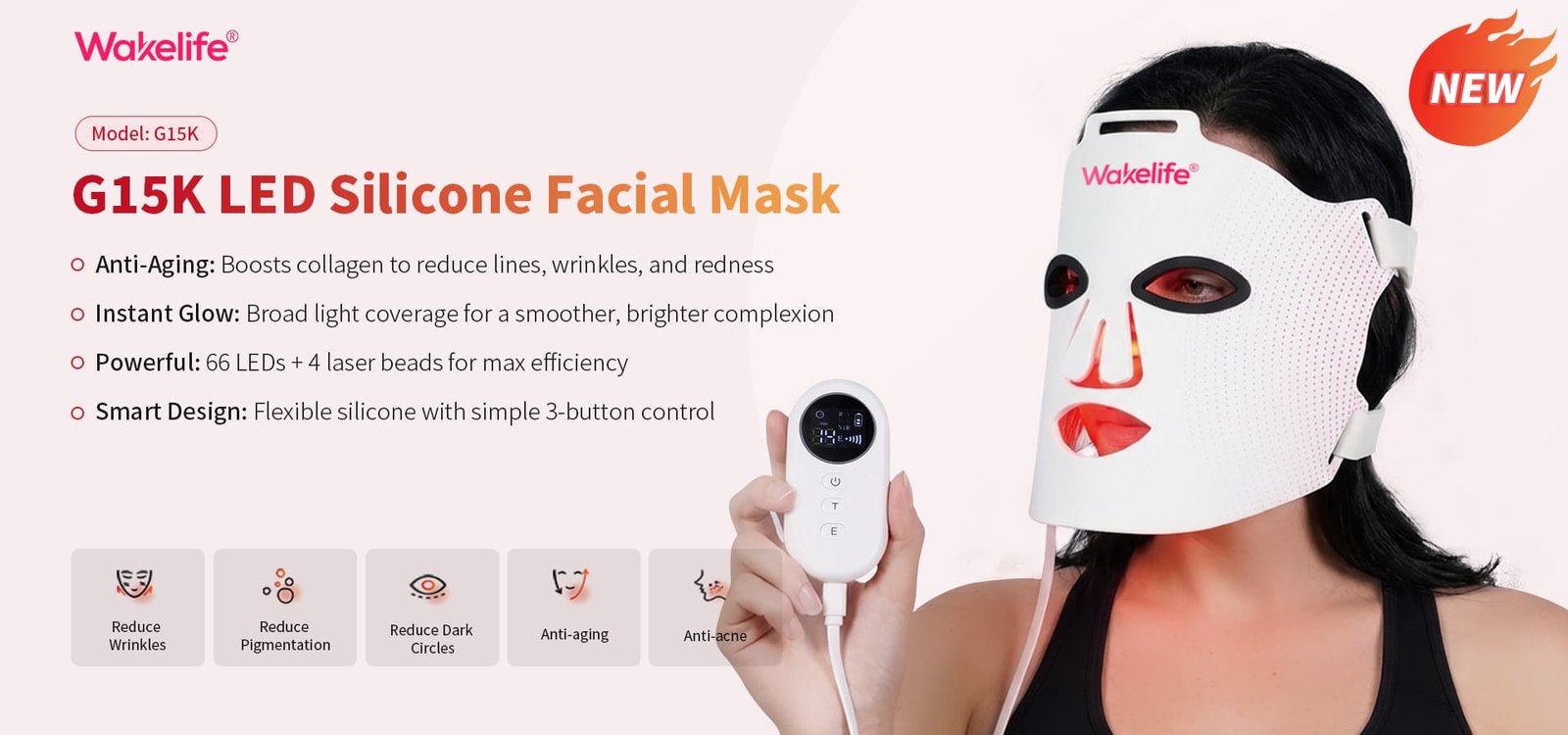
G15 LED -Gesichtsmaske:
- 660 nm: Targets facial skin, collagen stimulation
- 850 nm: Reaches deeper dermal layers, hair follicles
- Ratio: Optimized for facial tissue depths
- Ergebnis: Comprehensive facial rejuvenation
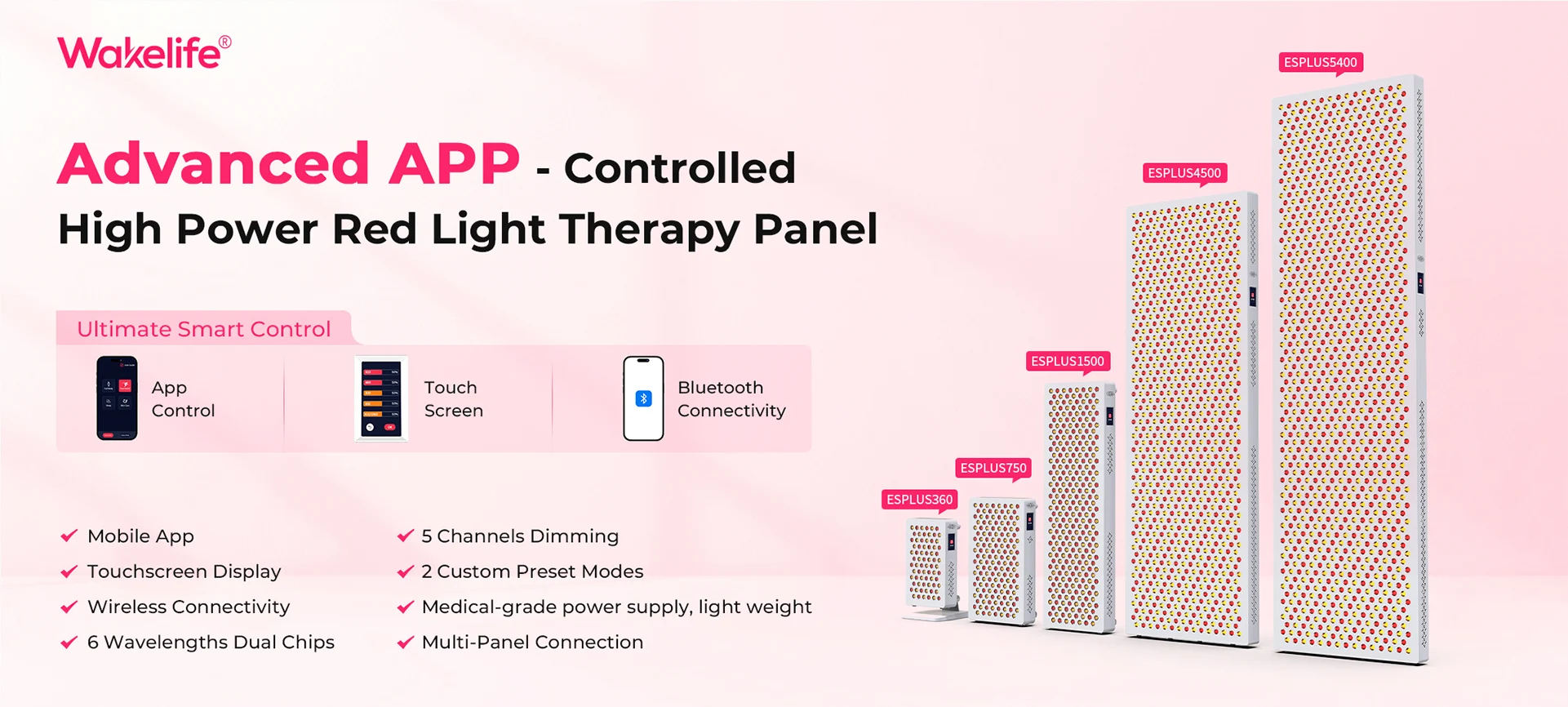
Therapy Panels:
- 660 nm: Surface tissue activation
- 830 nm: Deep muscle and joint penetration
- Adjustable: Independent control of each wavelength
- Ergebnis: Versatile treatment options
Factors Affecting Penetration Depth
Tissue Optical Properties
Beyond wavelength, tissue characteristics affect penetration:
| Factor | Effect on Penetration | Clinical Implication |
|---|---|---|
| Skin pigmentation | Melanin absorbs 400-700 nm | Darker skin = less red light penetration |
| Blood content | Hemoglobin absorbs 500-600 nm | Vascular areas = more absorption |
| Tissue density | Dense tissue = more scattering | Muscle vs. fat penetration differs |
| Flüssigkeitszufuhr | Water absorbs 970+ nm | Dehydrated tissue = altered penetration |
| Age | Collagen changes affect scattering | Older skin = different optical properties |
Delivery Parameters
Device design affects effective penetration:
| Parameter | Wirkung | Optimization |
|---|---|---|
| Bestrahlung | Higher = deeper effective penetration | 30-100 mW/cm² optimal |
| Treatment time | Longer = cumulative dose | Balance with biphasic response |
| Contact vs. non-contact | Contact reduces reflection | Direct contact improves coupling |
| Angle of incidence | Perpendicular = maximum transmission | 90° angle optimal |
| Distanz | Inverse square law applies | Consistent distance critical |
Clinical Decision Framework
Selecting Wavelength by Application
| Target Tissue | Recommended Wavelength | Rationale |
|---|---|---|
| Epidermis | 630-660 nm | Direct activation, high absorption |
| Dermis | 660-830 nm | Moderate penetration needed |
| Hair follicles | 660-850 nm | 4-5 mm depth requirement |
| Subcutaneous fat | 830-850 nm | 5-10 mm penetration |
| Muscle | 810-850 nm | 10-50 mm depth |
| Joints | 810-850 nm | Through skin, fat, to synovium |
| Knochen | 830-850 nm | 10-30 mm penetration |
| Brain (transcranial) | 810-830 nm | Through skull, 20-40 mm |
Selecting Wavelength by Condition
| Condition | Primary Wavelength | Secondary | Rationale |
|---|---|---|---|
| Akne | 630-660 nm | 830 nm | Target bacteria + Entzündungen reduzieren |
| Falten | 660 nm | 830 nm | Collagen stimulation at multiple depths |
| Muscle soreness | 830 nm | 660 nm | Deep penetration primary |
| Arthritis | 830 nm | 660 nm | Joint capsule penetration |
| Wundheilung | 660 nm | 830 nm | Surface + deep tissue |
| Hair loss | 660 nm | 850 nm | Follicle stimulation |
| Brain health | 810 nm | — | Optimal transcranial penetration |
| Nerve pain | 830 nm | 660 nm | Neural tissue penetration |
Advanced Topics
Pulsing and Wavelength Interaction
Some research suggests pulsed delivery may enhance specific wavelengths:
| Pulse Frequency | Potential Effect | Research Status |
|---|---|---|
| 10 Hz | Brain wave entrainment | Emerging research |
| 1000 Hz | Enhanced penetration | Theoretical |
| 10,000 Hz | Reduced tissue heating | Limited evidence |
Current Consensus: Continuous wave remains standard; pulsing effects require more validation.
Future Wavelength Research
Emerging research explores extended therapeutic windows:
- Blaues Licht (400-480 nm): Antimicrobial, superficial effects
- Grünes Licht (500-570 nm): Melanin targeting, Pigmentierung
- Far-infrared (3000+ nm): Thermal effects, different mechanisms
Notiz: These wavelengths operate through different mechanisms than red/NIR PBM and require separate validation.
FAQ
What is the best wavelength for red light therapy?
There is no single “best” wavelength—it depends on target tissue. For skin: 660 nm. For deep tissue: 830 nm. For comprehensive treatment: dual-wavelength (660+830 nm).
How deep does red light penetrate?
Rotlicht (660 nm) penetrates 1-2 mm effectively. Nahinfrarot (830 nm) penetrates 10-50 mm. Penetration depth depends on tissue type and optical properties.
Can near-infrared treat skin conditions?
Ja, though less efficiently than red light. NIR can reach deeper skin structures (hair follicles, sebaceous glands) that red light cannot access.
Why do some devices use 850 nm instead of 830 nm?
850 nm LEDs are more widely available and cost-effective. The difference in penetration is minimal (both target CuA center effectively).
Does skin color affect wavelength selection?
Ja. Darker skin has more melanin, which absorbs visible light (400-700 nm). Nir (800+ nm) is less affected by melanin and may be preferred for darker skin types.
Can I combine multiple wavelengths?
Ja, dual-wavelength devices (660+830 nm) are increasingly common and may provide synergistic benefits for comprehensive treatment.
What about 980 nm oder 1064 nm lasers?
These wavelengths target water absorption and produce thermal effects. They operate through different mechanisms than PBM and require different safety considerations.
How do I know if a wavelength is penetrating effectively?
Clinical response is the best indicator. If treating superficial conditions (skin), red light should work. For deep conditions (joints, muscle), NIR is required. Lack of response may indicate insufficient penetration.
Abschluss
Wavelength selection is the foundation of effective photobiomodulation. The choice between red (630-660 nm) und fast infrarot (810-850 nm) determines not just efficacy but whether photons reach their intended targets at all.
Key Principles:
- Match wavelength to depth: Red for superficial, NIR for deep
- Consider tissue optics: Melanin, blood, and water affect penetration
- Dual-wavelength advantage: Comprehensive coverage across depths
- Clinical validation matters: Research supports specific wavelengths
For device manufacturers, wavelength selection is a critical design decision affecting:
- Target market (superficial vs. deep tissue)
- LED sourcing and cost
- Clinical positioning
- Competitive differentiation
For clinicians and users, understanding wavelength enables:
- Appropriate device selection
- Realistic expectation setting
- Protocol optimization
- Treatment troubleshooting
Der 660 nm + 830 nm combination has emerged as the clinical standard, but the field continues to evolve as research identifies optimal wavelengths for specific applications. The future of PBM lies not in finding a single “best” wavelength, but in understanding how to match wavelength, Dosis, and delivery to specific therapeutic targets.
Related Topics
Referenzen
Jacques, S. L. (2013). Optical properties of biological tissues: a review. Physics in Medicine & Biologie, 58(11), R37-R61. https://pubmed.ncbi.nlm.nih.gov/20583833/
Zunahme, T. (2005). Photobiological modulation of cell attachment via cytochrome c oxidase. Photochemical & Photobiological Sciences, 4(5), 421-428. https://pubmed.ncbi.nlm.nih.gov/16848227/
Wunsch, A., & Matuschka, K. (2014). A controlled trial to determine the efficacy of red and near-infrared light treatment in patient satisfaction, reduction of fine lines, Falten, Rauheit der Haut, and intradermal collagen density increase. Photomedizin und Laserchirurgie, 32(2), 93-100. https://pubmed.ncbi.nlm.nih.gov/24395451/
Wang, X., et al. (2016). Transcranial photobiomodulation with near-infrared light from animal models to human applications. Progress in Neurobiology, 142, 1-22. https://pubmed.ncbi.nlm.nih.gov/27362728/
Mochizuki-Oda, N., et al. (2002). Effects of near-infrared laser irradiation on adenosine triphosphate production by mitochondria and cerebral blood flow. Lasers in Surgery and Medicine, 31(3), 183-188. https://pubmed.ncbi.nlm.nih.gov/12445290/
Ferraresi, C., et al. (2016). Photobiomodulation in human muscle tissue: an advantage in sports performance? Journal of Biophotonics, 9(11-12), 1273-1284. https://pubmed.ncbi.nlm.nih.gov/27583886/
Bashkatov, A. N., et al. (2011). Optical properties of human skin, subcutaneous and mucous tissues in the wavelength range from 400 Zu 2000 nm. Journal of Physics D: Applied Physics, 38(15), 2543-2555. https://iopscience.iop.org/article/10.1088/0022-3727/38/15/004
NIR Photobiomodulation Society. (2024). Wavelength Selection Guidelines for Therapeutic Applications. https://www.photobiomodulation.org/