A more expensive laser hair-growth cap may be worth it when the extra cost buys something you can verify and will actually use: a clearly identified device, evidence relevant to that device, a workable fit and routine, complete instructions, or stronger warranty and support. Price by itself does not prove better hair-growth results, greater safety, suitability for your type of hair loss or regulatory status.
The practical question is therefore not “Which cap costs the most?” It is “What does the price difference buy, and can I verify it for this exact device?”
This guide also applies when you are comparing a cap with a helmet or comb. It does not rank brands or provide a universal treatment schedule. Use the comparison card below to put two or three exact products on the same page before you buy.
Start With the Reason for Hair Loss, Not the Device Price
A well-documented device can still be a poor purchase when it is not relevant to the problem you are trying to address. Hair loss has multiple possible causes, and the American Academy of Dermatology advises that finding the cause is important because the right course of action depends on it. If the cause is uncertain, an appropriate healthcare professional should assess it before a home-use device becomes the center of your decision.
Research on low-level light or laser therapy is also narrower than the phrase “hair loss” suggests. A 2025 systematic review and meta-analysis covered 38 studies and 3,098 participants, but most participants had androgenetic alopecia, or pattern hair loss. The review reported a positive overall hair-density signal for the studied interventions in that population, while also reporting high statistical heterogeneity. Evidence for other hair-loss types was too limited for the same pooled analysis.
That means category-level evidence can justify examining a device; it cannot tell you that every light source, cap, helmet or comb will reproduce the result. For the fuller research boundaries, see Wakelife’s LLLT and red-light evidence guide.
Before comparing prices, write down:
- the hair-loss condition or intended use the device claims to address;
- whether that description is relevant to your situation;
- the exact model and version you are considering; and
- the market in which it is being sold.
If the first two points remain unclear, a detailed price comparison may create false precision around the wrong purchase.
What Can Make One Hair-Growth Device More Expensive?
Several real product and service differences can raise cost. None of them automatically proves a better clinical result.
| Possible source of added cost | What the extra cost may buy | What it does not prove by itself | What to verify |
|---|---|---|---|
| Light-source and array design | A different source configuration, physical arrangement or coverage design | That more emitters, a particular wavelength or a laser-only label produces better results | Exact model, source type, stated wavelength information, array layout and any available measurement context |
| Structure and fit | Head coverage, adjustability, weight distribution, ventilation or a design intended to keep the device in position | That a larger or heavier product delivers a superior treatment | Dimensions, weight, adjustment method, contact or distance assumptions and return terms if fit is poor |
| Controls and routine | Timers, battery operation, charging accessories, session controls, app functions or simpler operation | That more features improve hair outcomes | Which features exist on the exact version, what the instructions require and which features you will use consistently |
| Product-specific evidence and market records | Research, technical files or regulatory work associated with a named device and intended use | That evidence for a related device, shared wavelength or similar shell transfers automatically | Study device name, model mapping, studied population and protocol, target market and stated intended use |
| Manufacturing and documented testing | Traceability, inspection records, test reports, packaging controls or more consistent documentation | That a factory certificate or test logo establishes clinical efficacy | Report owner, exact tested configuration, date, test method and whether the sold model matches the record |
| Warranty, returns and support | A longer written warranty, usable return process, replacement parts or responsive service | That a generous warranty makes the product medically suitable | Exclusions, return window, restocking or shipping costs, service location and who handles a failed device |
What to verify Exact model, source type, stated wavelength information, array layout and any available measurement context
What to verify Dimensions, weight, adjustment method, contact or distance assumptions and return terms if fit is poor
What to verify Which features exist on the exact version, what the instructions require and which features you will use consistently
What to verify Study device name, model mapping, studied population and protocol, target market and stated intended use
What to verify Report owner, exact tested configuration, date, test method and whether the sold model matches the record
What to verify Exclusions, return window, restocking or shipping costs, service location and who handles a failed device
The word may matters. A premium can reflect these items, brand positioning, distribution costs, marketing, or a combination. Your job is to separate documented value from assumptions.
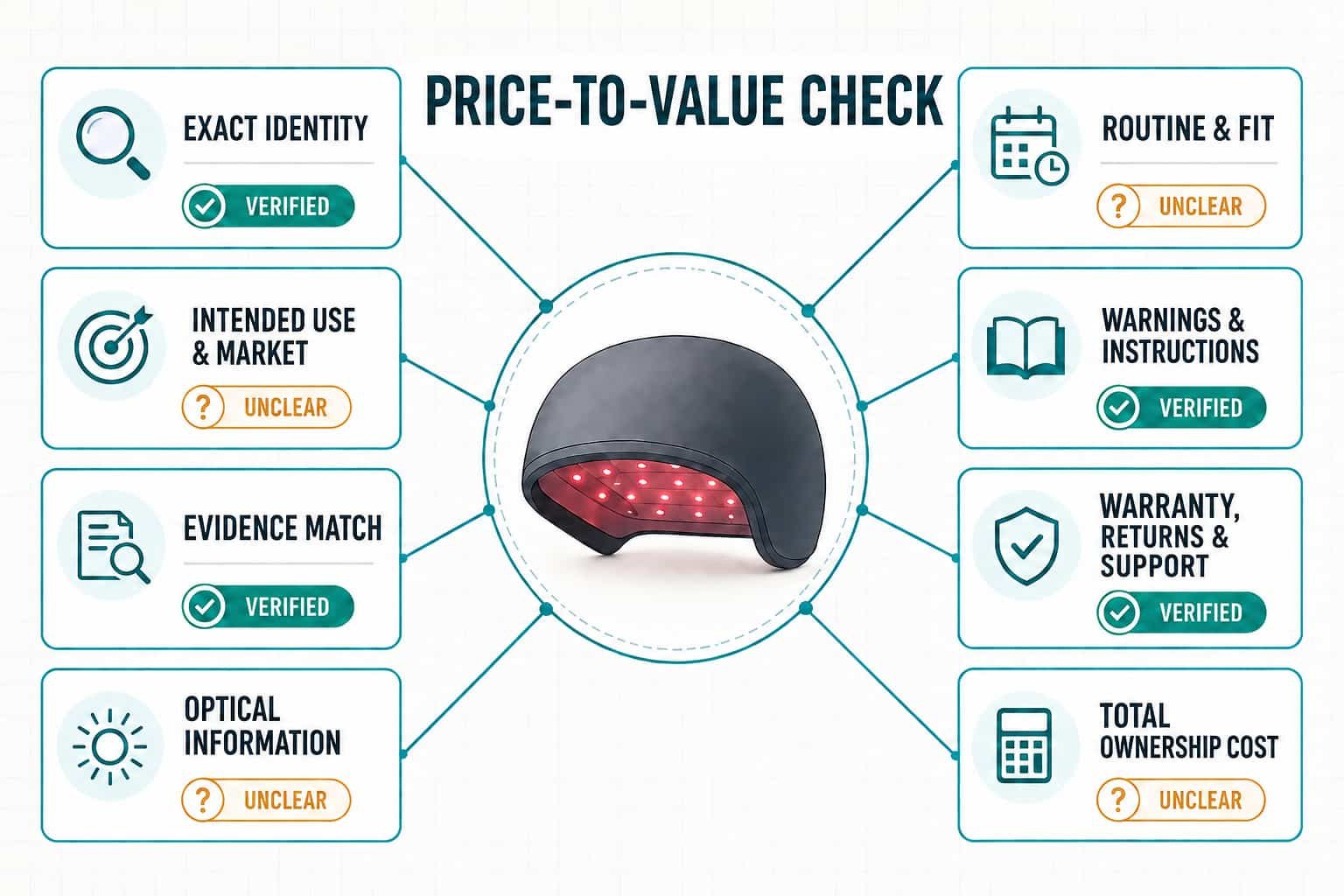
Use This Eight-Field Price-to-Value Comparison Card
Choose two or three exact devices. Mark each field Verified or Unclear. Mark a field Verified only after you have checked the information against its named source and confirmed that the identity, scope and limits match the product version you would actually receive. Verified does not mean the field is a product strength or that exact-device efficacy has been demonstrated. Use Not applicable only for a sub-item that is genuinely absent and not promised, such as an app the device does not offer, an accessory it does not require or a market claim the seller does not make. Do not use Not applicable for exact identity, intended use, instructions, a health or regulatory claim the seller does make, or the written warranty and return path.
| Field | What to record | Mark Verified when | Mark Unclear when |
|---|---|---|---|
| 1. Exact identity | Brand, exact model, version and seller | The product page, label, instructions and supporting record point to the same version | The listing combines variants, changes model names or supplies no identifiable model |
| 2. Intended use and market | The stated purpose, user group and country or region of sale | You checked the exact-device information and any cited market record, and confirmed that the stated intended use, user group and market scope match | The page uses broad “hair loss” language, relies on a global badge without market scope or cannot be matched to the cited record |
| 3. Evidence match | Classify each cited source as exact-device evidence, category background or no evidence claim; record its device, population, protocol and outcome where applicable | You located the cited source and confirmed that the seller’s description and limits match it; an exact-device claim maps to that device, while category research is explicitly identified as category-only | The seller implies exact-device support but cites another device or condition, or the cited source cannot be located |
| 4. Optical information | Source type, stated wavelengths, layout and available output or measurement context | The information names the exact model and explains what was measured, where and under what conditions | The seller gives only a diode count, one wavelength or a power number without context |
| 5. Routine and fit | Instructions, positioning, controls, charging, weight and adjustment | You can understand the required workflow and judge whether it fits your daily use | The routine is hidden until after purchase or the fit cannot be evaluated |
| 6. Warnings and instructions | User manual, warnings, contraindications, cleaning and storage | Instructions for the exact device are available and understandable before purchase | Safety guidance is generic, incomplete or inconsistent across the page and manual |
| 7. Warranty, returns and support | Warranty length, exclusions, return window, fees and service contact | The written policy explains who handles returns, faults and replacement | The page says “guaranteed” but gives no usable terms or responsible party |
| 8. Total ownership cost | Purchase price plus required accessories, replacements, shipping, taxes and documented service exposure | You can compare the same included items and known costs over the period you expect to own it | A low headline price excludes required items or the return and service costs are unknown |
Mark Verified when The product page, label, instructions and supporting record point to the same version
Mark Unclear when The listing combines variants, changes model names or supplies no identifiable model
Use a blank table like this for the final comparison:
| Comparison field | Device A | Device B | Device C |
|---|---|---|---|
| Exact model/version | |||
| Intended use/market | |||
| Evidence match | |||
| Optical information | |||
| Routine/fit | |||
| Warnings/instructions | |||
| Warranty/returns/support | |||
| Total ownership cost | |||
| Final decision: Buy / Ask / Pause |
Do not turn the card into an unsupported numerical score. A missing exact identity or unavailable instructions can matter more than several minor conveniences combined. The card is meant to expose the reason for a premium and the gaps that still require an answer.
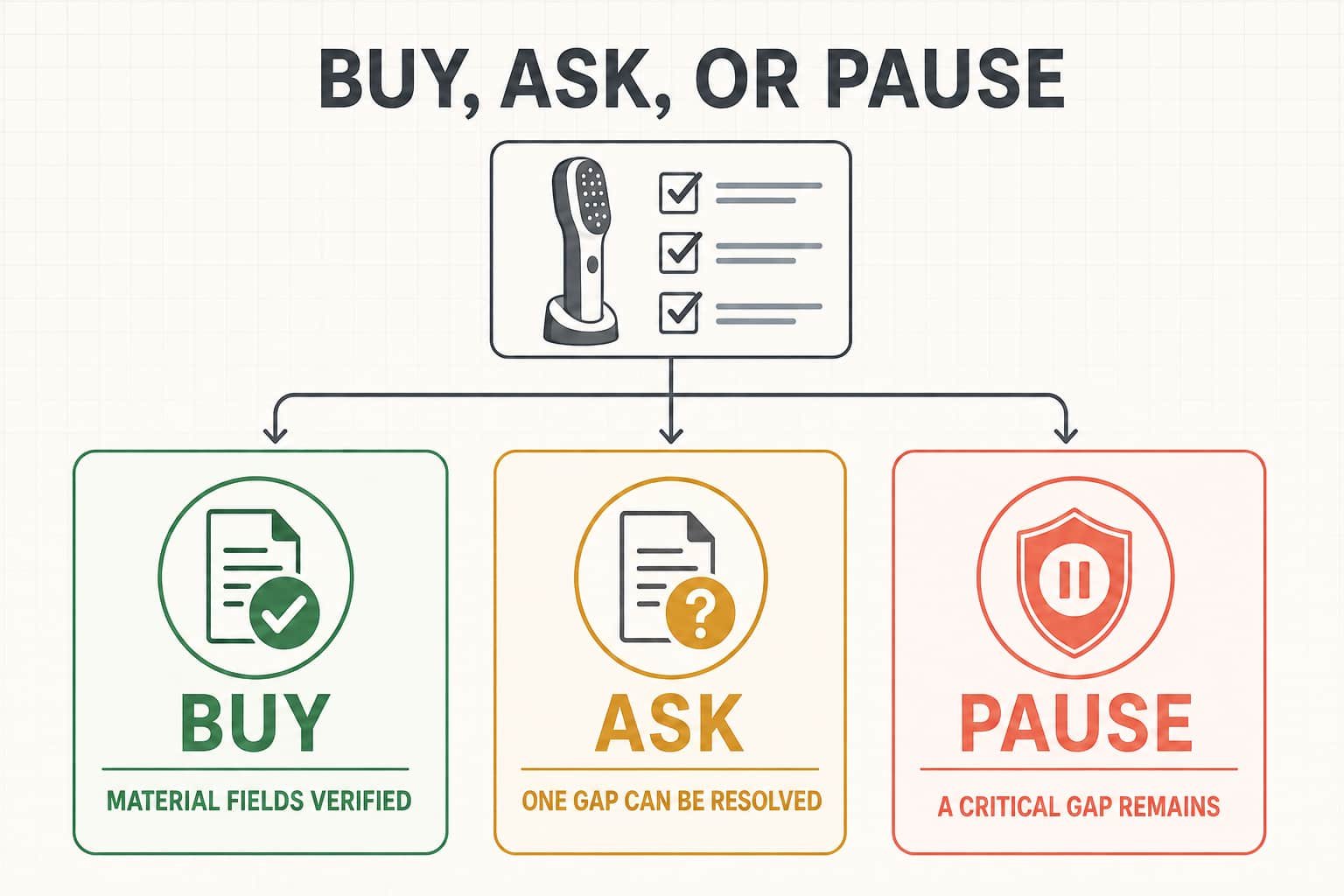
Map the mixed field results to the final decision this way:
- Buy when the exact identity and intended-use relevance are established; instructions and warnings are available; every material evidence or regulatory claim has been verified within its actual scope; purchase, return and support terms are clear; and the premium solves a need you have.
- Ask when the product may fit but a material field is still unclear and a specific model, source, instruction or policy could resolve it.
- Pause when the cause of hair loss remains uncertain, the exact product or intended use cannot be established, instructions are unavailable, or a material health or regulatory claim cannot be matched to its source.
What Price Cannot Prove
A higher price does not prove a better result
A 2021 systematic review and meta-analysis found that home-use devices differed in form, source configuration, wavelength, power and protocol. Its device-form and source analyses compared subgroups across trials; they were not direct, head-to-head trials of competing consumer products or price levels. It is therefore reasonable to treat “higher price means better results” as an unverified inference unless product-specific comparative evidence supports it.
More diodes or a higher power number does not establish clinical superiority
A diode count describes quantity, not the complete delivery conditions at the scalp. A power value also needs a measurement definition, location, area and operating condition. Neither number alone establishes coverage, delivered dose, safety or a hair-growth outcome.
“Laser only” does not automatically mean better than laser plus LED or LED
Source labels are useful for identifying a design. They are not a clinical ranking. Differences among devices, protocols and study populations prevent a source label from carrying the conclusion by itself.
A familiar brand or many reviews does not make the device suitable for everyone
Brand history and reviews may reduce uncertainty about service or usability. They cannot diagnose the cause of hair loss or establish that an individual will achieve a particular result.
A regulatory phrase is not a performance score
Regulatory status has a defined market and product scope. It should be verified because it can reveal whether marketing language maps to an official record. It should not be converted into a claim that one cleared or CE-marked device will outperform another.
How Should You Read FDA and CE Language?
Match every regulatory statement to the exact device, manufacturer or responsible party, intended use and target market. Do not accept a logo or certificate image as the conclusion.
For the United States, the FDA’s registration and listing explanation states that establishment registration and device listing do not mean that a device is approved, cleared or authorized. The agency also warns that it does not issue registration certificates. In a separate FDA overview of device regulation, the agency describes 510(k) as a substantial-equivalence clearance process rather than premarket approval. Neither status is a ranking of products by expected results.
When a seller uses FDA language:
- Ask for the exact model and 510(k) number if clearance is claimed.
- Search the official FDA record rather than relying on a badge or screenshot.
- Compare the applicant, device name, intended use and covered models with the product being sold.
- Treat registration or listing language separately from clearance.
Wakelife’s FDA hair-growth-device verification guide explains the record-matching process in detail.
For the European market, the European Commission describes CE marking as the manufacturer’s declaration that a product conforms to applicable EU requirements. CE marking is not an EU authority’s endorsement of safety and is not a quality or efficacy ranking. Ask which legal framework and product documentation apply to the exact device and intended purpose instead of treating the CE letters as a universal premium feature.
What Can Reviews and Before-and-After Photos Tell You?
Reviews are most useful for finding questions to investigate. Repeated comments about fit, charging, controls, heat, noise, shipping damage, return handling or customer support can reveal practical issues that a specification table misses.
They are much weaker for proving a health outcome. People may have different hair-loss causes, use other interventions, follow different routines and photograph their hair under different lighting, angles, styling and time points. The US Federal Trade Commission’s Health Products Compliance Guidance states that health-related efficacy and safety claims require competent and reliable scientific evidence; endorsements do not replace the evidence needed for the underlying claim.
Use reviews to add rows to your question list. Do not use one dramatic testimonial or an uncontrolled photo pair as the reason to transfer a result to yourself.
When Is a Low Price a False Economy?
A lower-priced device can become poor value when the missing information or service creates costs you did not see at checkout. Examples include:
- the model you receive cannot be matched to the listing or instructions;
- required accessories are excluded;
- poor fit makes the device difficult to use as instructed;
- the return policy shifts substantial shipping or restocking costs to you;
- there is no reachable support path when the device fails; or
- key evidence and regulatory statements belong to another product.
These conditions do not prove that every inexpensive device is poor. They show why headline price and total value are different questions.
When Is a Premium Unjustified?
A higher price remains difficult to justify when the seller cannot explain the premium beyond:
- a larger diode count without delivery or measurement context;
- “medical grade,” “FDA registered” or similar language without an exact record and scope;
- testimonials presented as proof of a predictable result;
- features that you do not need or will not use; or
- a warranty headline whose exclusions remove most practical value.
Ask the seller to identify the exact feature, document or service behind the higher price. Then map the answer to the eight-field card. If the premium cannot be tied to a difference you can verify and use, treat it as unproven rather than assuming it is good or bad.
Make the Final Decision: Buy, Ask or Pause
Use three outcomes instead of forcing every comparison into a winner.
| Decision | Use it when | Next action |
|---|---|---|
| Buy | The exact identity and intended-use relevance are established; instructions and warnings are available; every material evidence or regulatory claim has been checked against its named source and confirmed within its scope; purchase, return and support terms are clear; and the premium solves a need you have | Save the product page, instructions, policy and every source or record used for the decision |
| Ask | The product may fit, but a material field is still unclear and a specific model, source, instruction or policy could resolve it | Ask a question tied to that field and request the named document, model, source or policy before deciding |
| Pause | The cause of hair loss remains uncertain; the exact product or intended use cannot be established; instructions are unavailable; or a material health or regulatory claim cannot be matched to its source | Resolve the clinical, product-identity or claim-evidence gap before comparing price again |
Next action Save the product page, instructions, policy and every source or record used for the decision
Next action Ask a question tied to that field and request the named document, model, source or policy before deciding
Next action Resolve the clinical, product-identity or claim-evidence gap before comparing price again
A premium is most defensible when it removes a constraint that matters to you and the supporting information survives exact-device verification. A lower price is reasonable when the essential fields are still clear and the omitted features have little value for your use. Neither decision requires declaring one price tier universally best.
For Brands and Retailers Evaluating This Category
Consumer price questions often expose product-page and support gaps: unclear model identity, evidence that does not map to the sold version, hidden instructions, or return terms that appear only after purchase. Brands should resolve those gaps before presenting a feature or document as the reason for a premium.
Brands and clinics comparing the commercial roles of caps, helmets and combs can use Wakelife’s form-factor sourcing guide. The broader hair-growth device OEM/ODM guide explains how channel buyers can move from product role and form factor to samples, documentation and an RFQ. Category research and market records still need to be mapped to the exact platform and planned claims.
References
-
1
Perez SM, Vattigunta M, Kelly C, Eber A. Low-Level Laser and LED Therapy in Alopecia: A Systematic Review and Meta-Analysis
Dermatologic Surgery. 2025;51(2):179–183. -
2
Lueangarun S, Visutjindaporn P, Parcharoen Y, Jamparuang P, Tempark T. A Systematic Review and Meta-analysis of Randomized Controlled Trials of United States Food and Drug Administration-Approved, Home-use, Low-Level Light/Laser Therapy Devices for Pattern Hair Loss: Device Design and Technology
Journal of Clinical and Aesthetic Dermatology. 2021;14(11):E64–E75.
The article title is reproduced as published; this guide uses510(k)-clearedrather thanFDA-approvedwhen describing that regulatory pathway. -
3
American Academy of Dermatology. Hair loss: Overview
-
4
US Food and Drug Administration. Are There “FDA Registered” or “FDA Certified” Medical Devices? How Do I Know What Is FDA Approved?
-
5
US Food and Drug Administration. Overview of Regulatory Requirements: Medical Devices — Transcript
-
6
Federal Trade Commission. Health Products Compliance Guidance
-
7
European Commission. CE Marking