Short answer: A specification listing 415, 590, 633 and 850 nm identifies four nominal wavelength channels in the declared product design. It does not, by itself, prove the finished device’s measured spectrum, the optical contribution of each channel, an equal dose, a synergistic effect, photobiological safety, regulatory authorization or production consistency.
That distinction matters when a brand, importer or distributor is comparing multi-wavelength LED devices. A wavelength list is useful—but only at the first level of an evidence chain.
Before approving a specification or requesting a sample, ask three questions:
- What is being declared? The LED architecture, channel ratio, operating modes and user controls.
- What has been measured on the finished device? The spectrum and irradiance for each relevant mode and setting, under stated conditions.
- What separate evidence supports safety and the intended claims? Optical-safety assessment, market-specific documentation and claim-relevant evidence for the exact product route.
This guide shows how to keep those three questions separate. It is written for B2B product, sourcing, quality and compliance teams—not as a treatment guide or a recommendation of a therapeutic dose.

What Can a Four-Wavelength Specification Actually Prove?
It can define the supplier’s declared configuration. Each stronger conclusion needs another evidence layer.
Use this table as a first-pass specification check:
| Specification field | What it can establish | What it does not establish by itself |
|---|---|---|
| 415, 590, 633 and 850 nm | Four nominal wavelength channels are intended in the design | Actual peak wavelengths, tolerances, spectral width, secondary emission or output at the finished-device level |
| Four-channel LED package or chip layout | The planned source architecture, if supported by a controlled bill of materials | Equal optical output from the four channels |
| 1:1:1:1 ratio | A declared relationship only after the ratio’s basis is defined | Equal radiant power, irradiance, energy contribution or skin-level dose |
| Mode 1, Mode 2, Mode 3 and Mode 4 | The intended controller logic and channel combinations | That every named channel is operating to specification or contributing equally in each mode |
| 50%, 75% and 100% brightness | Three user-interface settings | A linear relationship between the displayed percentage and optical output |
| 5–30 minute timer | Available session-time controls | Delivered dose without measured, stable irradiance for the selected mode and test plane |
| Irradiance at 0 cm | A value at the emitting surface, if its mode, setting and method are stated | Irradiance at another working plane, spatial uniformity, per-band contribution or clinical dose |
| IEC 62471 report | A photobiological-hazard assessment for the named sample and conditions | Clinical efficacy, general market authorization or future-batch consistency |
The practical rule is simple: treat a catalog specification as a design declaration, not as a substitute for finished-device measurements.
What Do 415, 590, 633 and 850 nm Mean on the Specification Sheet?
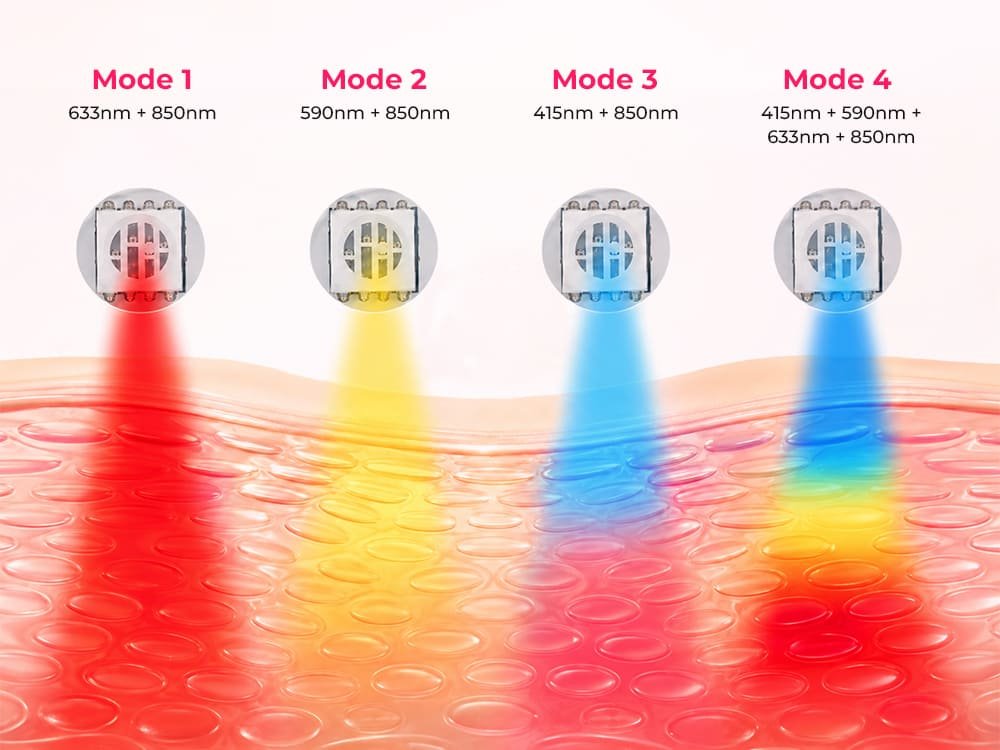
They are nominal channel identifiers—not a measured description of the finished device’s emission.
Each number is a nominal wavelength identifier, expressed in nanometers. It helps engineering and sourcing teams distinguish the intended optical channels and map them to the LED bill of materials, driver design and operating modes.
The number is not a complete description of the light leaving the finished device.
Real LEDs emit over a spectral band rather than at one mathematically exact wavelength. A useful finished-device record may therefore include the measured peak wavelength, permitted tolerance, spectral distribution and full width at half maximum (FWHM) for each applicable mode. A 2025 PLOS One paper on methodological issues in visible LED therapy research likewise cautioned that a central wavelength does not describe the full spectral emission of an LED (Grimes, 2025). That paper examined visible-range devices—its analysis did not cover an 850 nm infrared channel—and is cited here only for measurement and reporting discipline; it is not evidence that this four-wavelength device is effective or ineffective.
There is also an important visibility trap. The cited NIST review of radiometry and photometry treats photometry as eye-weighted measurement within the visible range and gives that range as 360–830 nm. An 850 nm channel therefore cannot be evaluated by comparing how bright it looks with the 415, 590 or 633 nm channels. Visual brightness is not a radiometric power measurement, even for the visible channels.
For sourcing purposes, the four numbers answer which nominal channels are declared. A mode-specific spectral record answers what the assembled device actually emitted during the test.
Why Is a Nominal Wavelength Not a Complete Spectrum?
Two LEDs sold under the same nominal wavelength label can differ in measured peak, spectral width and output. The finished device can also add variables such as drive current, optical layers, diffuser construction, thermal conditions and channel-control logic.
That is why a complete optical review separates at least these fields:
- nominal wavelength in the controlled product specification;
- exact LED part number, supplier and binning rule where applicable;
- measured spectral graph for each relevant finished-device mode;
- measured peak and agreed tolerance;
- spectral bandwidth or FWHM where it is a project requirement;
- sample identity, instrument, test date and operating condition.
NIST’s spectroradiometry overview defines spectral irradiance in terms of optical power per unit area per wavelength interval and discusses calibration traceability to SI standards. The CIE S 025/E:2015 standard page also shows why normalized measurement conditions and configuration-specific reporting matter for reproducible LED measurements.
CIE S 025 covers LED lamps, modules and luminaires for photometric and colorimetric measurement. It is not a clinical, photobiological-safety or market-authorization standard for a therapy device, and this guide is not asserting that every flexible LED device must be tested to S 025. The relevant lesson here is narrower: a measurement result needs a defined configuration and reproducible conditions.
For a detailed buyer checklist covering spectrum, test distance, point maps, instruments, sample identity and report scope, use Wakelife’s IEC 62471, irradiance and wavelength report guide. This article stays at the specification-interpretation level.
Does a 1:1:1:1 Wavelength Ratio Mean Equal Optical Output?
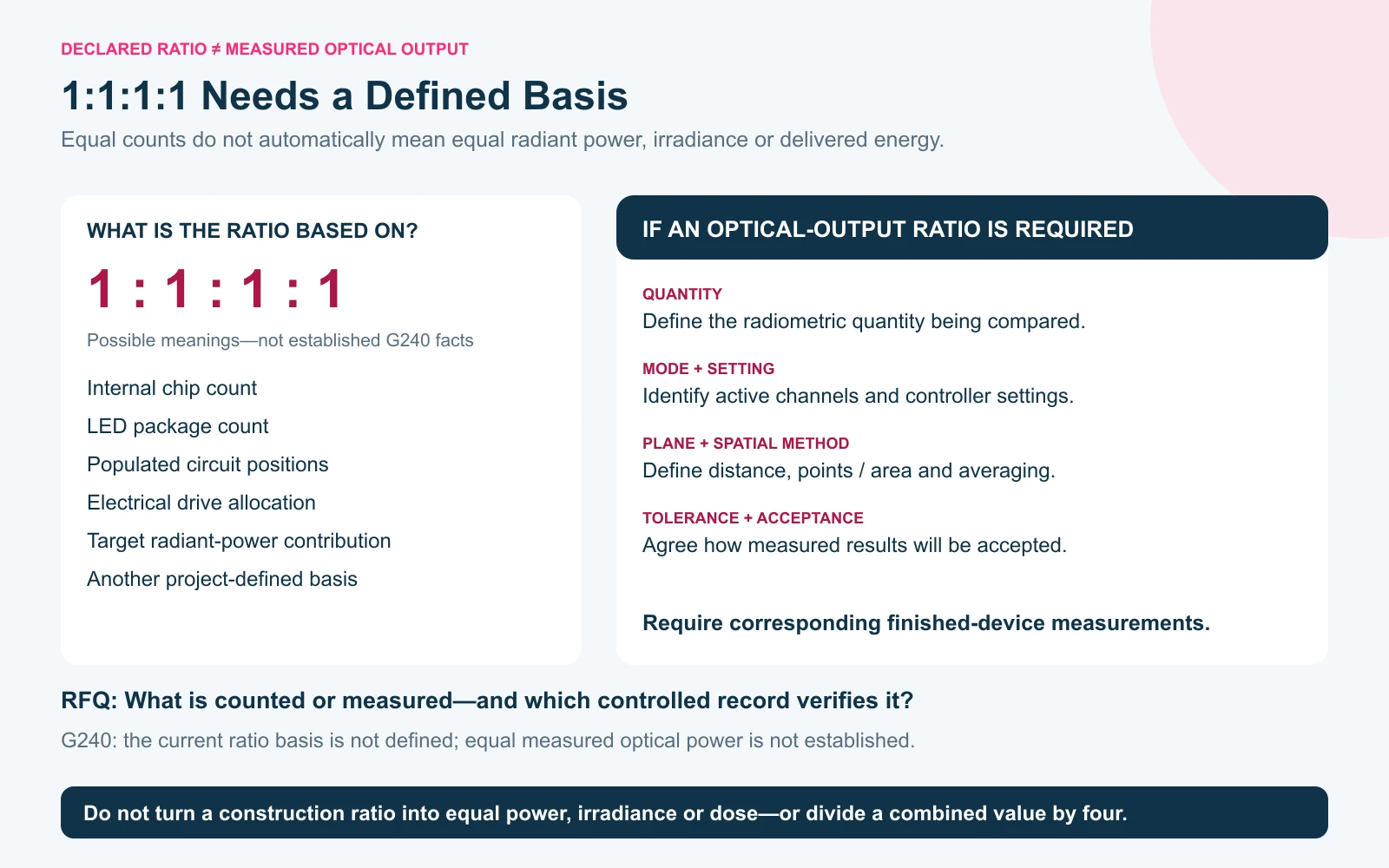
No. Not until the supplier defines the denominator and provides the corresponding measurement.
A four-part ratio could refer to:
- internal chip count;
- LED package count;
- populated circuit positions;
- electrical drive allocation;
- a target radiant-power contribution;
- another project-specific basis.
Those meanings are not interchangeable. Equal chip counts do not automatically produce equal radiant power because wavelengths, LED dies, drive conditions and optical paths can differ. Equal source-level power would still not automatically mean equal irradiance across a flexible treatment area or equal energy delivered during every operating mode.
The correct RFQ question is not “Is the ratio 1:1:1:1?” It is:
What exactly is being counted or measured in the 1:1:1:1 ratio, and which controlled document or finished-device test verifies it?
If the answer is chip count, record it as a construction ratio. If the project requires an optical-output ratio, define the measurement quantity, mode, setting, test plane, spatial method, tolerance and acceptance rule separately. Do not silently convert a construction ratio into an equal-power or equal-dose claim.
What Do Four Operating Modes Prove?
They prove intended controller behavior—not measured output in each mode.
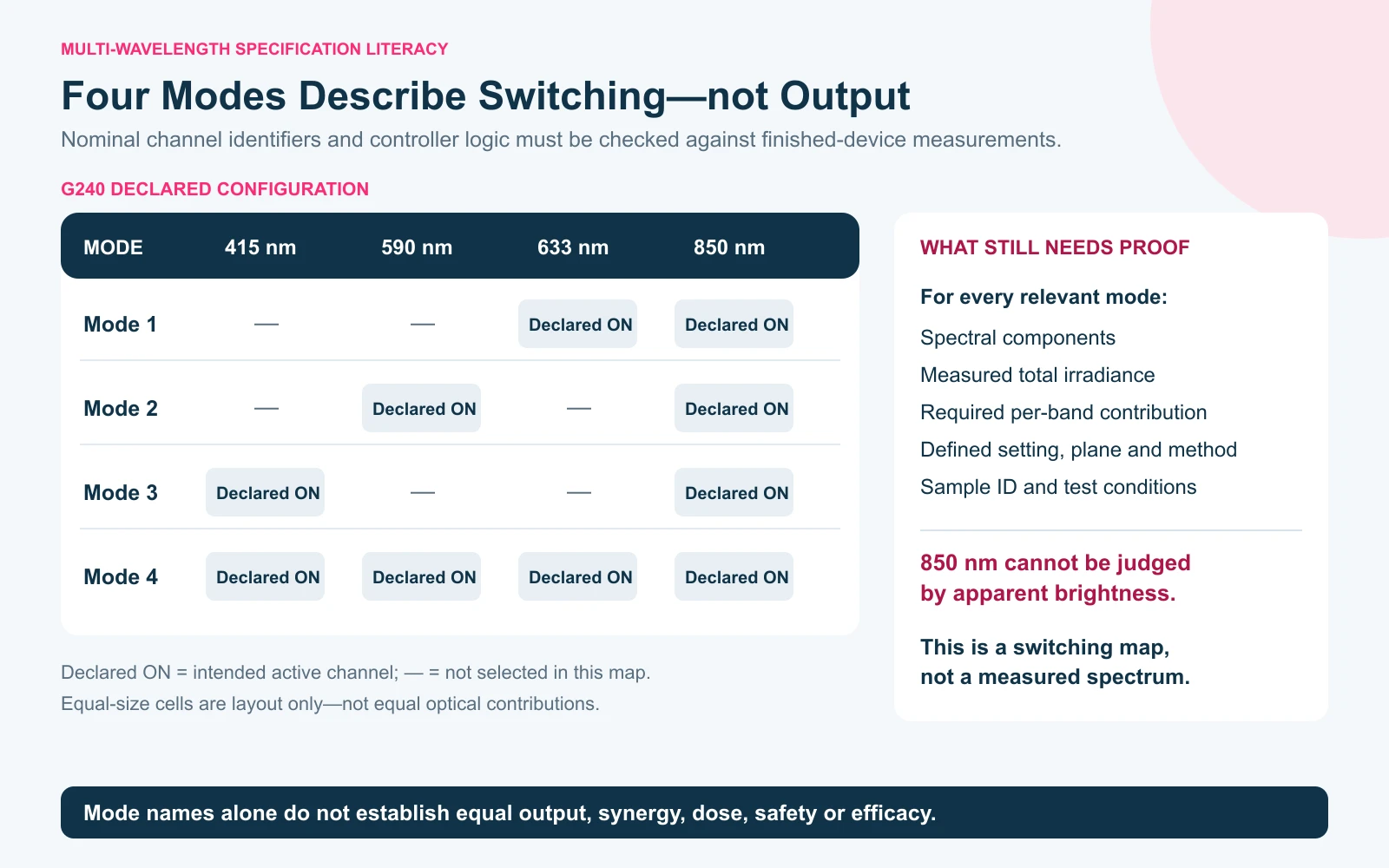
An operating-mode table documents intended controller behavior. It does not replace mode-specific optical verification.
Consider this declared mode architecture for a four-wavelength platform:
| Mode | Declared active channels | What still needs verification |
|---|---|---|
| Mode 1 | 633 + 850 nm | Both spectral components, total irradiance and any required per-band contribution |
| Mode 2 | 590 + 850 nm | Both spectral components, total irradiance and any required per-band contribution |
| Mode 3 | 415 + 850 nm | Both spectral components, total irradiance and any required per-band contribution |
| Mode 4 | 415 + 590 + 633 + 850 nm | All four spectral components, total irradiance and any required per-band contribution |
This table proves what the controller is intended to switch on. It does not prove that the measured output meets the agreed specification, that the 850 nm contribution is the same in Modes 1–4, or that combining channels produces a synergistic result.
For sample review, activate every mode and confirm the user workflow. For optical approval, match each required mode to a finished-device spectral record and irradiance result. If a claim depends on one channel or combination, identify the claim evidence separately rather than inferring it from the mode name.
The same caution applies to a no-pulse specification. “No pulse” can define the intended output mode, but a buyer still needs the agreed test method if temporal output behavior is a critical parameter.
Do Brightness Settings and a Timer Define the Delivered Dose?
They define user controls, not dose on their own.
Radiant exposure is commonly expressed as energy per unit area. Under a defined, stable condition, it relates irradiance to exposure time. But a meaningful calculation still needs the correct irradiance for the selected wavelength combination, brightness setting, measurement plane and spatial method.
For example, a supplier-declared value of “at least 40 mW/cm² at 0 cm”—the same form of statement used in the G240 example later in this guide—remains incomplete if it does not also state:
- the active mode and brightness setting;
- whether the value is a single point, maximum, minimum or area average;
- the point map or area represented;
- the measuring instrument and calibration status;
- operating time and thermal condition;
- sample identity, units and tolerance.
It would be incorrect to divide one combined irradiance number by four and assign one-quarter to each wavelength. It would also be incorrect to use a surface value as the value at another distance or through a different optical/contact condition without measurement.
The FDA’s January 2023 draft guidance for certain photobiomodulation devices treats wavelength, fluence, spot size, output mode, radiant power or irradiance, and pulsing parameters as separate device characteristics. This is Draft—Not for Implementation, provides nonbinding recommendations, and applies only to the class II PBM medical devices within its stated scope. It does not automatically govern a nonmedical beauty or wellness product. It is cited here only as a clear example of why wavelength alone is not a complete device or dose description.
Do More Wavelengths Prove Better Results or Synergy?
No. Channel count is a design feature, not an efficacy conclusion.
A multi-wavelength architecture may give a product team more selectable modes or support a particular product concept. That commercial flexibility does not establish that four wavelengths are better than one, that simultaneous operation is superior to separate operation, or that the combination creates a synergistic biological effect.
Each wavelength label has its own evidence boundary:
- A 415 nm label alone does not prove acne treatment.
- A 590 nm label alone does not prove redness reduction or accelerated repair.
- A 633 nm label alone does not prove increased collagen or wrinkle reduction.
- An 850 nm label alone does not prove treatment of pain, inflammation or deep-tissue conditions.
Those may be claim directions encountered in the market, but a public claim must be assessed against the exact device, intended use, target population, operating parameters, evidence and applicable market route. The four nominal wavelength labels are not that evidence.
This is also why a product marketed under an industry category name containing “PDT” does not inherit the claims of medical photodynamic therapy. The intended use, presence or absence of a photosensitizing drug, device route and supporting evidence must be evaluated independently.
What Evidence Should Support a Multi-Wavelength LED Device?
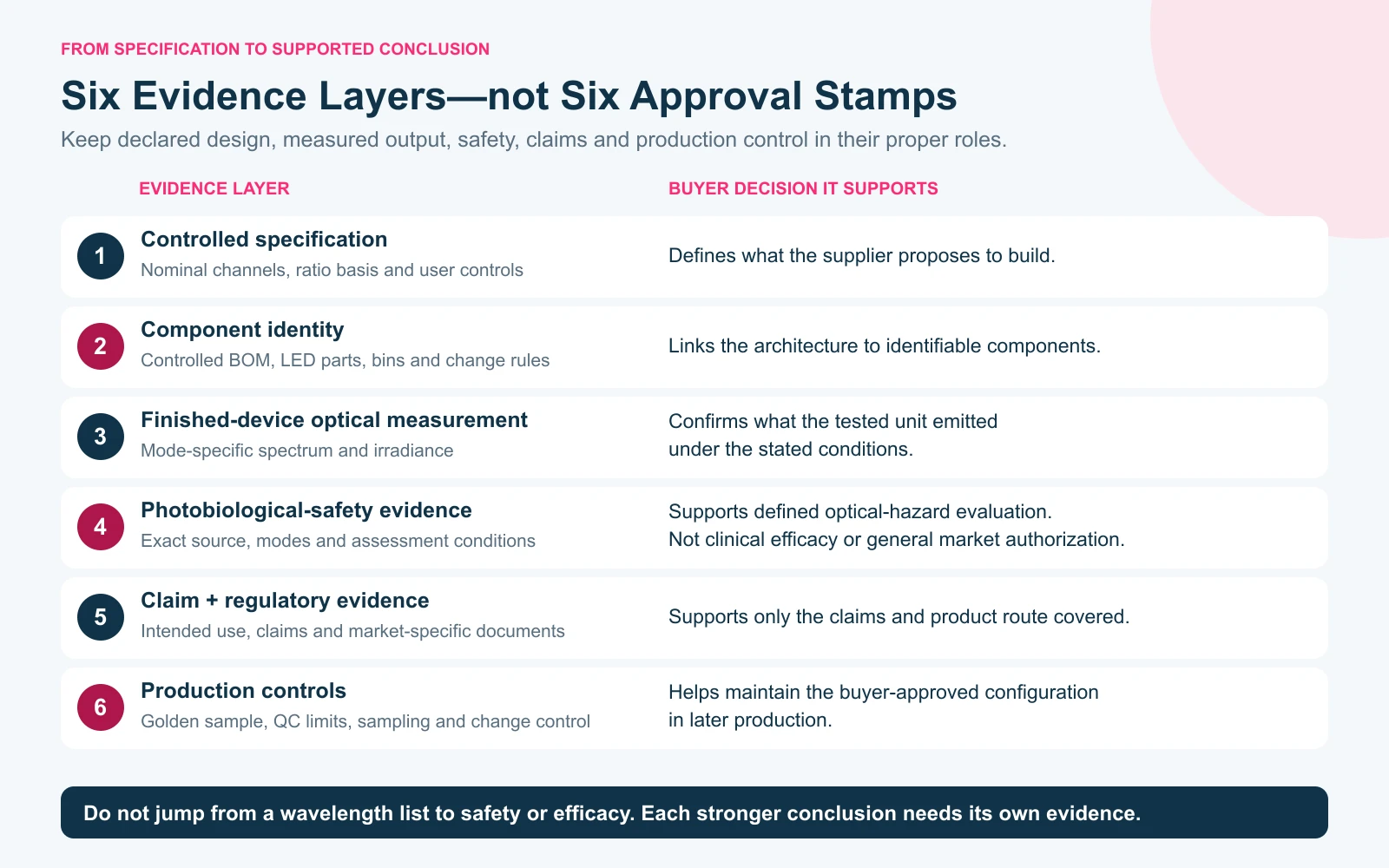
Use a six-level evidence ladder. Do not skip from Level 1 to a safety or efficacy conclusion.
| Level | Evidence | Buyer decision it supports |
|---|---|---|
| 1. Controlled specification | Nominal wavelengths, ratio definition, modes, brightness, timer and no-pulse/pulse status | Confirms what the supplier proposes to build |
| 2. Component identity | Controlled BOM, LED part numbers, supplier/bin controls and change rules | Links the proposed architecture to identifiable components |
| 3. Finished-device optical measurement | Mode-specific spectrum and irradiance under defined conditions | Confirms what the tested assembled unit emitted |
| 4. Photobiological-safety evidence | Applicable assessment covering the exact source, modes and conditions | Supports the defined optical-hazard evaluation—not efficacy |
| 5. Claim and regulatory evidence | Intended-use, claim-relevant and market-specific documentation | Supports only the claims and route actually covered |
| 6. Production controls | Golden sample, acceptance limits, calibrated QC method, sampling and change control | Helps maintain the approved configuration in later production |
IEC 62471 belongs at Level 4: it addresses photobiological hazards from lamps and lamp systems, including LED sources, under defined conditions. It is not a clinical-efficacy certificate or a general market authorization. For the wider distinction between product authorization, quality-system certificates, safety reports and optical records, see the LED Therapy Device Certification Guide.
Worked Example: What Is Declared for the G240—and What Is Still to Be Verified?
Wakelife’s current controlled G240 specification provides a useful example of the boundary between declared design and measured performance.
| Field | Current declared specification | Evidence boundary |
|---|---|---|
| Source construction | 240 pieces of 5050 LED packages; 960 internal chips | Construction statement; not per-band optical output |
| Wavelengths | 415, 590, 633 and 850 nm | Nominal channel list; not a measured spectrum |
| Ratio | Nominal 1:1:1:1 | The current controlled specification does not define the ratio’s denominator or basis and does not establish equal measured optical power |
| Modes | 633+850; 590+850; 415+850; all four wavelengths | Declared controller map; each mode still needs the agreed optical verification |
| Brightness | 50%, 75% and 100% | User settings; optical linearity has not been established by the labels |
| Timer | 5–30 minutes | Session-control range; not dose by itself |
| Temporal mode | No pulse | Declared operating feature |
| Irradiance | Specified as ≥40 mW/cm² at the emitting surface, 0 cm | Current statement does not provide complete mode, grid, instrument, average/peak, thermal and tolerance fields needed for independent comparison or per-band dose calculation |
| Intended claim route | Nonmedical beauty and wellness scope | Does not authorize a disease-treatment or numerical clinical-result claim |

This example should not be read as a verified optical-performance report. Mode-specific spectral graphs, measured peaks and tolerances, FWHM or other agreed spectral-width records, per-band contribution, brightness-setting behavior, spatial irradiance method, instrument details, thermal conditions and unit-to-unit variation remain request-level items for an exact project.
That transparency is the point: a supplier can define a platform before every project-specific evidence package is complete, as long as the buyer and supplier do not represent the declared fields as stronger proof than they are.
What Changes When an OEM Buyer Changes the Wavelength Configuration?
A wavelength customization is not only a color choice. Depending on the design, it can affect:
- the LED BOM, part numbers, bin controls and approved suppliers;
- driver current, electrical load and thermal behavior;
- controller firmware and mode mapping;
- spectral distribution and irradiance by mode;
- diffuser or optical-layer performance;
- photobiological-safety assessment scope;
- labeling, instructions, warnings and public claims;
- regulatory documentation and test applicability;
- golden-sample definition, QC limits and engineering change control.
The change review should therefore start before the new wavelength ratio is promised in a catalog or purchase specification. Ask which records remain applicable, which need an engineering update and which must be repeated on the finished configuration.
What Should Buyers Put in the RFQ?
For a four-wavelength LED device, request one mode-specific evidence card rather than a loose collection of wavelength claims.
Include:
- Exact model, intended market, intended use and proposed public claims.
- Nominal wavelengths and the tolerance rule expected for each channel.
- Definition of the wavelength ratio: what is counted or measured.
- Complete mode map, including brightness settings and pulse/no-pulse behavior.
- Required spectral fields by mode: graph, measured peak, spectral width if required, sample ID and instrument.
- Required irradiance fields by mode and setting: plane/distance, point map, average/peak/minimum definition, instrument, thermal condition and tolerance.
- Photobiological-safety and market-document scope for the exact configuration.
- Sample quantity, golden-sample process, production acceptance limits and change-notification rules.
If the project is still at concept stage, mark unverified fields as to be measured. Do not fill them with values copied from a different model, LED data sheet or earlier batch.
Wakelife can review a four-wavelength requirement against the available flexible PDT LED light therapy platform and identify which items are standard specifications versus project-specific verification. To prepare an RFQ, send the target market, intended claims, wavelength and mode requirements, sample quantity and the optical evidence fields your team needs through the contact page.
Bottom Line
The specification “415, 590, 633 and 850 nm” proves a declared four-channel design—not a complete spectrum, equal output, dose, safety, efficacy or authorization.
For an OEM decision, move through the evidence in order: freeze the controlled specification, identify the components, measure the finished device by mode, review safety and claim evidence for the intended route, then lock production controls. If a field has not reached its evidence level, label it as unverified instead of allowing four precise-looking numbers to carry a conclusion they cannot support.
References
- 1
- 2
- 3
-
4
International Electrotechnical Commission. IEC 62471:2006 — Photobiological Safety of Lamps and Lamp Systems
-
5
U.S. Food and Drug Administration. Photobiomodulation Devices: Premarket Notification [510(k)] Submissions (Draft Guidance)
- 6