TL;DR (for B2B buyers)
- First decide what you need: private label, OEM customization, ODM development, or a long-term product-line partner.
- Compare the product itself before comparing certificates: mask material, fit, wavelength set, LED layout, eye design, controller, battery, packaging, and MOQ.
- Do not choose a mask-only supplier if your roadmap may expand into neck devices, panels, hair growth, pet therapy, or other light therapy categories.
- Compliance still matters, but it is one part of sourcing: verify FDA 510(k), market-specific records, quality-system certificates, optical safety and output reports, electrical safety / EMC evidence, battery transport files, and radio evidence where relevant to the selected configuration.
- Before paying a deposit, send a structured RFQ and request samples, test reports, certificate numbers, packaging files, lead time, warranty terms, and customization limits.
If you are sourcing an LED face mask for a beauty, wellness, clinic, or retail brand, the hard part is not finding a factory. The hard part is knowing which factory will still make sense after your first order.
Most supplier pages look similar: FDA, CE, OEM/ODM, private label, fast delivery. Those words are useful only after you know what to compare.
This guide gives you a practical sourcing framework: supplier type, product specifications, customization depth, compliance documents, category expansion, and the RFQ checklist you should send before committing.
1. What Type of LED Face Mask Supplier Do You Need?
Choose private label if you need speed, OEM if you need controlled customization, ODM if you need a differentiated product, and a multi-category manufacturer if your brand roadmap extends beyond face masks.
Not every buyer needs the same kind of supplier. A first-order Amazon seller, a clinical skincare brand, a distributor, and a wellness-device company will evaluate factories differently.
| Supplier model | Best for | What you usually get | Main limitation |
|---|---|---|---|
| Private label | Fast launch, small product test | Existing mask, logo, packaging, manual edits | Low differentiation |
| OEM customization | Brand-ready product with controlled changes | Existing platform plus color, wavelength, controller, packaging, accessory changes | Limited by existing tooling |
| ODM development | Differentiated product concept | Industrial design, mold, electronics, firmware, testing support | Higher cost and longer timeline |
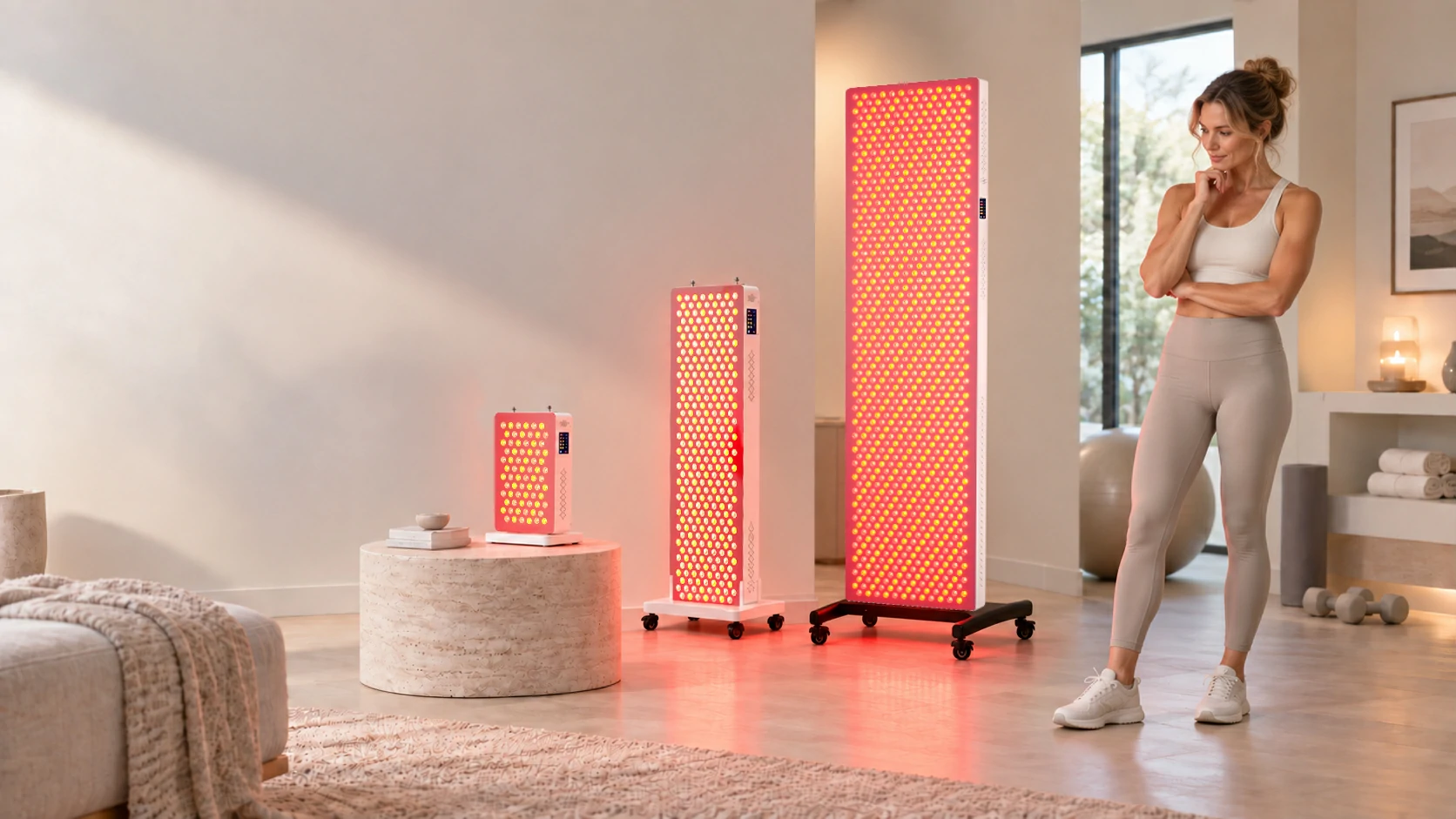
| Product-line partner | Multi-SKU brand roadmap | Masks plus adjacent categories such as panels, hair growth, pet therapy, or UVB | Requires deeper supplier evaluation |
The simplest mistake is choosing a private-label supplier when your real goal is ODM. The second mistake is choosing a mask-only supplier when your brand strategy is a light therapy portfolio.
Before asking for a quote, define your sourcing intent in one sentence:
We need an existing silicone LED face mask for private label launch in the US and EU, with packaging localization and regulatory files for distributor review.
That sentence is more useful than sending ten screenshots and asking, “Can you make this?”
2. Which LED Face Mask Specifications Should You Compare First?
Compare the specifications that affect user experience, claims, cost, and compliance: mask structure, wavelength set, LED count and layout, irradiance, eye design, controller, battery, material, packaging, and test documentation.
Price makes sense only after the product is comparable. A low quote may reflect fewer LEDs, weaker material, simpler electronics, lower packaging quality, or a lack of test documentation.
Core product specifications
| Spec | What to ask | Why it matters |
|---|---|---|
| Mask type | Silicone flexible mask, rigid shell mask, neck/chest attachment, or combination set | Affects fit, comfort, packaging, and product positioning |
| Wavelengths | Red, blue, near-infrared, or multi-wavelength configuration | Affects intended use, content angle, and claim review |
| LED count and layout | Total LEDs, chip type, placement map, face coverage | Affects visual marketing and treatment-area coverage |
| Irradiance | Measurement value, distance, test method, report date | Prevents vague “high power” claims |
| Eye design | Eye opening, eye shield, goggles, or light-blocking structure | Important for user comfort and risk control |
| Controller | Button controller, remote, app, timer, modes, intensity levels | Affects UX and customization cost |
| Power | Rechargeable battery, wired use, charging port, adapter requirements | Affects certification, packaging, and user convenience |
| Material | Skin-contact silicone or plastic, odor, flexibility, biocompatibility files | Affects comfort, safety documentation, and returns |
| Packaging | Retail box, insert, manual, barcode, language versions | Affects channel readiness |
Example: how model families can differ
In an OEM discussion, a model comparison table should make the buyer’s decision easier, not just list more numbers. Final specifications should always be confirmed on the quotation, product specification sheet, and sample approval record for the selected model.
| Model family | Format | Wavelength set | LED / chip configuration | Power / battery | OEM positioning |
|---|---|---|---|---|---|
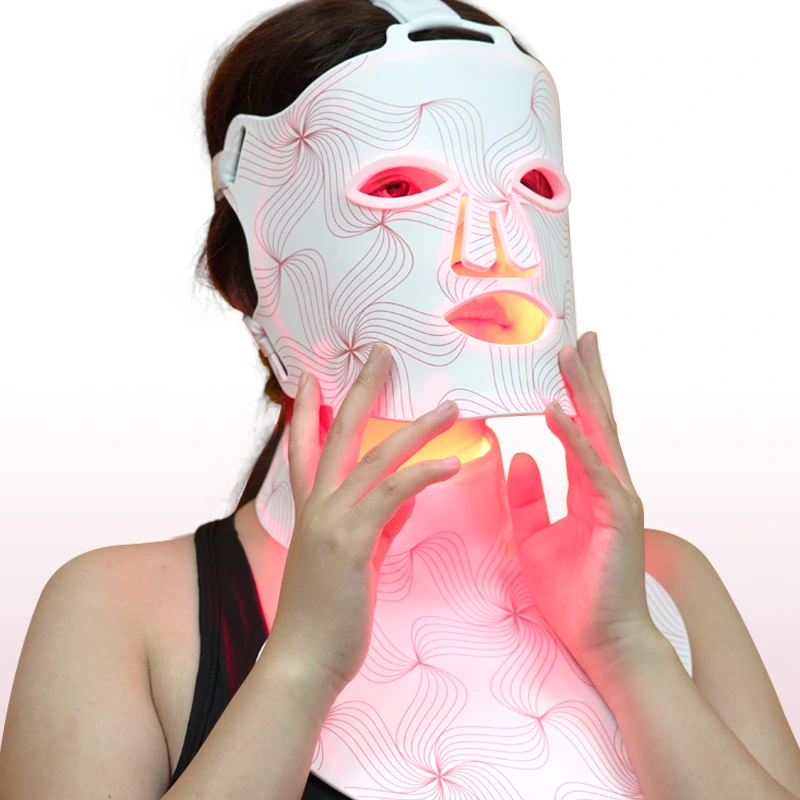
| G11 | Face mask | 415 / 590 / 630 / 850 / 1072nm | 90 LEDs; includes 1072nm LEDs | Approx. 6W; 4000mAh controller | Multi-wavelength face-mask platform |
| G11P | Face + neck set | 415 / 590 / 630 / 850 / 1072nm | 90 LEDs on mask + 57 LEDs on neck | Approx. 10W; 5000mAh controller | Face-and-neck bundle for higher perceived value |
| G15 | Lightweight face + neck set | 415 / 590 / 660 / 850nm | 122 LEDs on mask + 64 LEDs on neck | Approx. 8W; 5000mAh controller | Thin silicone set for mid-to-premium private label |
| G15K | Lightweight face mask | 633 / 850 / 1072nm | 66 LEDs | Approx. 8W; 2000mAh controller | Cost-effective, travel-friendly mask platform |
| G17 | 3D liquid-silicone mask | 415 / 633 / 850 / 1072nm | 93 LEDs / 279 chips | 4000mAh controller | Premium 3D silicone mask with compact control system |
G11 and G11P are currently presented on one combined product-family page. They remain separate configurations: G11 is the face-mask version, while G11P adds the neckpiece and uses a different controller specification. Confirm the selected configuration on the quotation, controlled product specification sheet, and approved sample record rather than relying on the shared webpage alone.
The point is not that one model is universally better. The point is that the right OEM model depends on the brand’s channel, price tier, desired form factor, claim strategy, packaging plan, and future product roadmap.
Do not compare only LED count. Two masks with the same LED number can differ in wavelength accuracy, material feel, heat behavior, eye comfort, controller logic, and QC records.
What to ask for in a sample round
Ask for more than a sample unit. Ask for the sample plus its data:
- Product specification sheet
- Wavelength report or spectrophotometer record
- Irradiance measurement with distance and conditions
- Material statement for skin-contact parts
- Packaging dieline or existing packaging file
- User manual and warning language
- Available color, logo, and accessory options
If the sample feels good but the supplier cannot explain the data behind it, treat that as an early warning.
3. How Much Customization Do You Actually Need?
For most first launches, logo, packaging, manual, color, and accessory changes are enough. Deeper customization such as mold, wavelength, firmware, app, or electronics should be reserved for brands with a clear positioning reason and enough budget.
Customization sounds attractive, but every change adds cost, time, and validation work. A good OEM discussion separates cosmetic customization from engineering customization.
Common customization layers
| Layer | Examples | Typical use case |
|---|---|---|
| Branding | Logo, box, manual, pouch, barcode | Private label launch |
| Visual identity | Color, finish, accessory set, retail bundle | Beauty and retail brands |
| Light configuration | Wavelength mix, LED layout, mode names | Brands with a specific content or claims strategy |
| Electronics | Controller, timer, intensity, battery, charging design | Higher-end product positioning |
| Firmware or app | App control, usage tracking, guided routines | Connected-device brands |
| Tooling | New shell, mask shape, attachment, mechanical structure | ODM or exclusive product line |
The right question is not “Can we customize everything?” The right question is “Which customization will a customer notice, and which one helps our channel sell?”
For many B2B buyers, a strong existing platform with clean packaging and verified documentation is a better first move than a heavily customized product with untested assumptions.
4. Can the Supplier Support Your Brand After the First Mask?
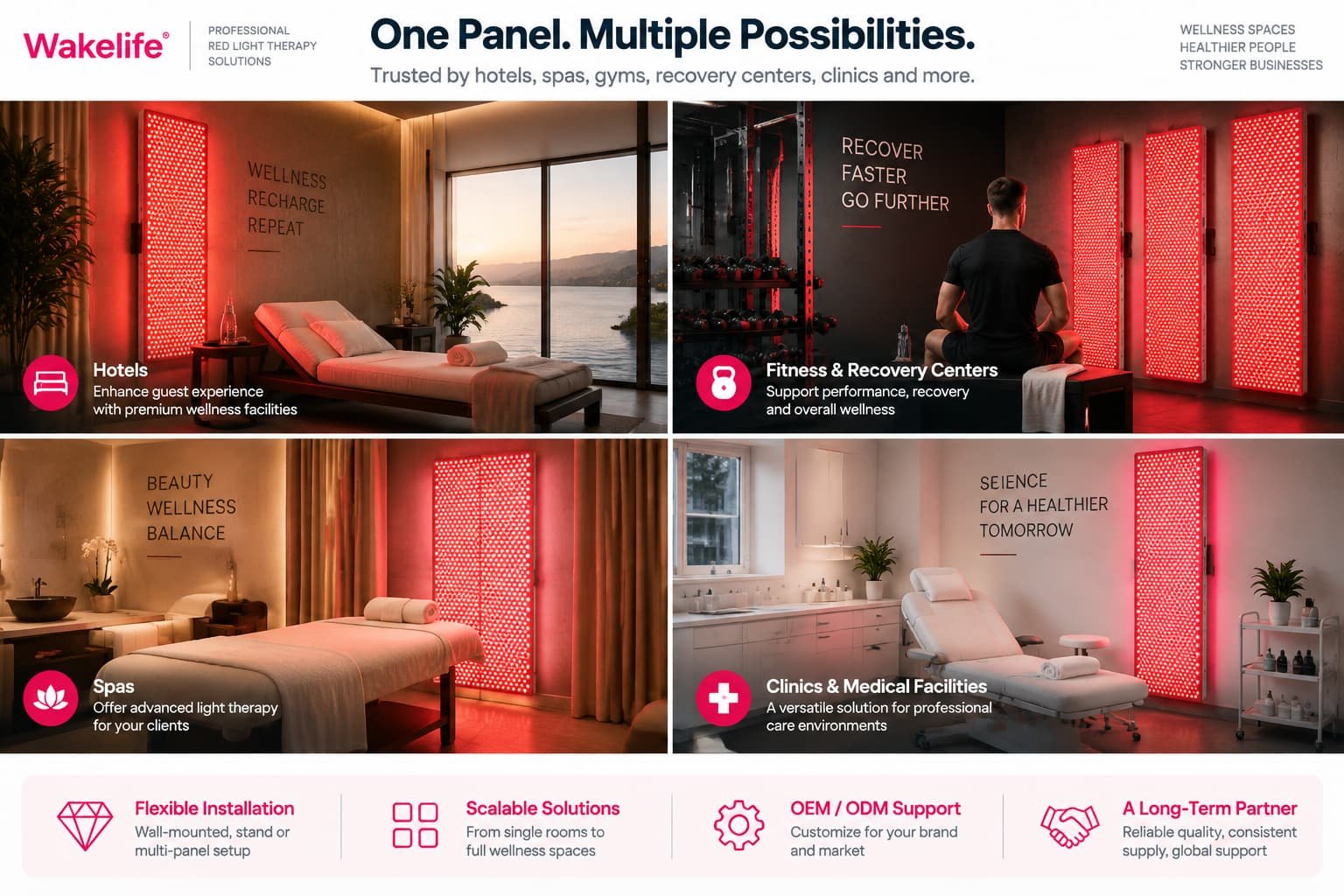
If your brand may expand beyond face masks, evaluate whether the factory can manufacture adjacent light therapy categories, not just whether it has one good mask model.
LED face masks are often the entry product. If the launch works, buyers usually start asking about:
- Neck and chest devices
- Red light therapy panels
- Hair growth caps or helmets
- Eye or scalp devices
- Pet therapy pads or wearables
- Clinic or recovery products
Changing suppliers for every new product adds friction: new audits, new QC systems, new test files, new communication habits, and inconsistent documentation.
Mask-only vs multi-category manufacturer
| Question | Mask-only supplier | Multi-category manufacturer |
|---|---|---|
| Can they support the first LED face mask? | Often yes | Yes |
| Can they support panels or hair growth later? | Often limited or brokered | More likely to have in-house experience |
| Can documentation style stay consistent across SKUs? | Harder | Easier |
| Can the brand build a product matrix with one factory conversation? | Limited | Stronger |
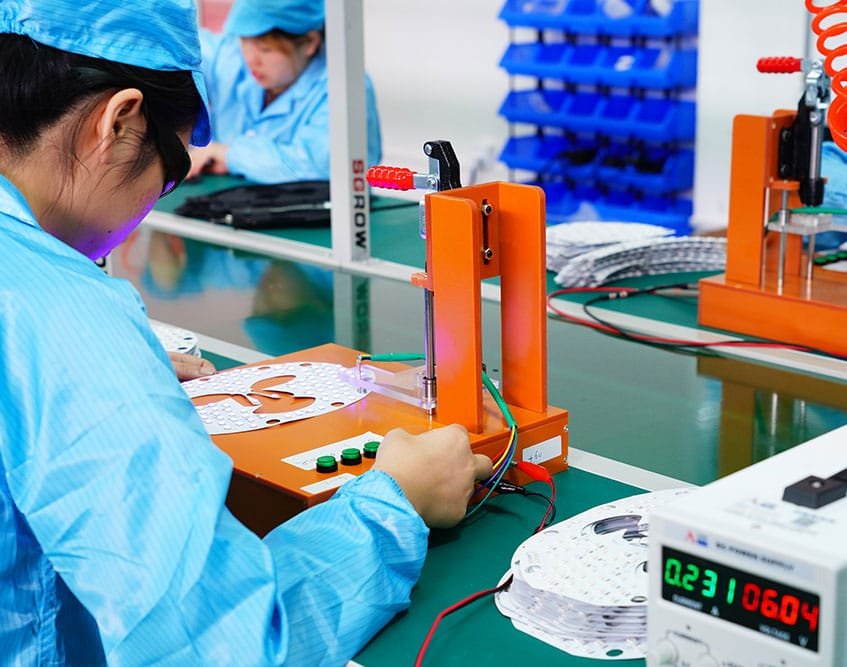
Wakelife describes its Shenzhen facility as approximately 20,000 m² of in-house manufacturing space and presents broader manufacturing capability beyond one mask product. Treat this as factory-background information; for compliance decisions, still rely on public records, certificate numbers, and test reports.
The sourcing point is simple: do not only ask whether the supplier can make your first product. Ask what happens when your first product succeeds.
5. Which Compliance Documents Should You Verify?
Verify compliance after you understand the product, but before you pay a deposit. The exact file set depends on the model, intended purpose, power design, wireless functions, private-label changes, target market, and sales channel.
This is where certificates belong in an OEM sourcing guide: not as the whole story, but as the evidence layer that protects your brand.
The minimum verification set
| Document | What to verify | Why it matters |
|---|---|---|
| FDA 510(k), if claimed | K number, applicant, device name, product codes, decision, and model scope from the clearance documentation | Prevents confusion with FDA registration and avoids over-reading the database entry |
| ISO 13485 | Certificate number, issuer, scope, expiry | Shows medical-device QMS coverage |
| MDSAP, if available | Certificate number, scope, validity | Signals multi-market QMS audit maturity |
| TGA ARTG, if targeting Australia | ARTG ID, sponsor, manufacturer, class, product type | Supports Australian market review |
| Health Canada MDL, if targeting Canada | Licence number, manufacturer, device class, licence name, device identifiers | Supports Canadian market review |
| IEC 62471 | Photobiological safety report | Important for LED light safety evaluation |
| Electrical safety and EMC, where applicable | Applicable IEC 60601 series reports, ANSI/AAMI ES60601-1 evidence, CB documentation, EMC results, and NRTL certification status for the exact product configuration | Separates medical electrical safety evidence from optical safety and market authorization |
| EU / UK market conformity | Intended purpose, classification, CE / EU MDR route, Declaration of Conformity, technical-document references, UK Responsible Person and MHRA status where applicable | Prevents a general CE document from being treated as medical-device market evidence |
| Wireless / app radio evidence, if fitted | Radio module, FCC evidence for the US, RED evidence for the EU, and the corresponding final-product configuration | Connected features can introduce separate radio and EMC obligations |
| Lithium-battery transport and safety, if fitted | UN 38.3 test summary for the supplied battery or pack, plus applicable cell / pack safety documentation and shipping information | Helps prevent freight, warehouse, marketplace, and fulfillment delays |
| Material files | Skin-contact material and biocompatibility support where applicable | Important for wearable devices |
| Optical reports | Wavelength and irradiance records with test conditions | Verifies that the light output matches the spec |
The public records and certificate-directory entries cited below were rechecked on July 13, 2026. Public status and scope can change, so buyers should repeat the live checks for their own project.
For Wakelife/Sungrow, buyers can verify public evidence including FDA 510(k) K250830, BSI ISO 13485 certificate MD 800872, BSI MDSAP certificate MDSAP 800873, the Health Canada MDALL manufacturer page for SHENZHEN SUNGROW LED TECHNOLOGY CO., LTD, Company ID 187745, and the face-mask ARTG examples 510468 and 525268. These identifiers are useful because your team can check core public records independently; exact ARTG model scope still needs sponsor/manufacturer documentation, and full FDA model scope should be checked in the clearance letter / 510(k) summary. Customer-specific regulatory entries and model relationships are not reproduced in this guide.
For a deeper certificate-by-certificate verification framework, read the LED Therapy Device Certification Guide.
For electrical-safety terminology and the difference between an IEC report, CB report, NRTL mark, and UL certification, read UL 60601-1 and IEC 60601 for LED Therapy Devices. This is a verification method, not a statement that every LED face mask requires or holds the same certification. Wakelife’s public UL File No. E545599 relates to specified LED therapy belt models and must not be used as evidence for a face mask.
For CE, UKCA, FCC, RED, RCM, EESS, SAA, and Global-Mark evidence by market and product configuration, read CE, UKCA, FCC, SAA and Global-Mark Compliance for LED Therapy Devices.
One caution: do not turn a certificate into a claim it does not support. FDA registration and device listing are not 510(k) clearance. 510(k) clearance is not FDA approval. ISO 13485 is a quality-system certificate, not product clearance. TGA ARTG is market-specific and should be read by product and class.
The phrase “medical-grade” is not a standalone regulatory classification, clearance, or certificate. When a supplier uses it, translate the phrase into checkable facts: intended purpose, market classification, model scope, applicable standards, test reports, quality-system scope, labeling, and public authorization records.
6. What Should You Put in Your RFQ?
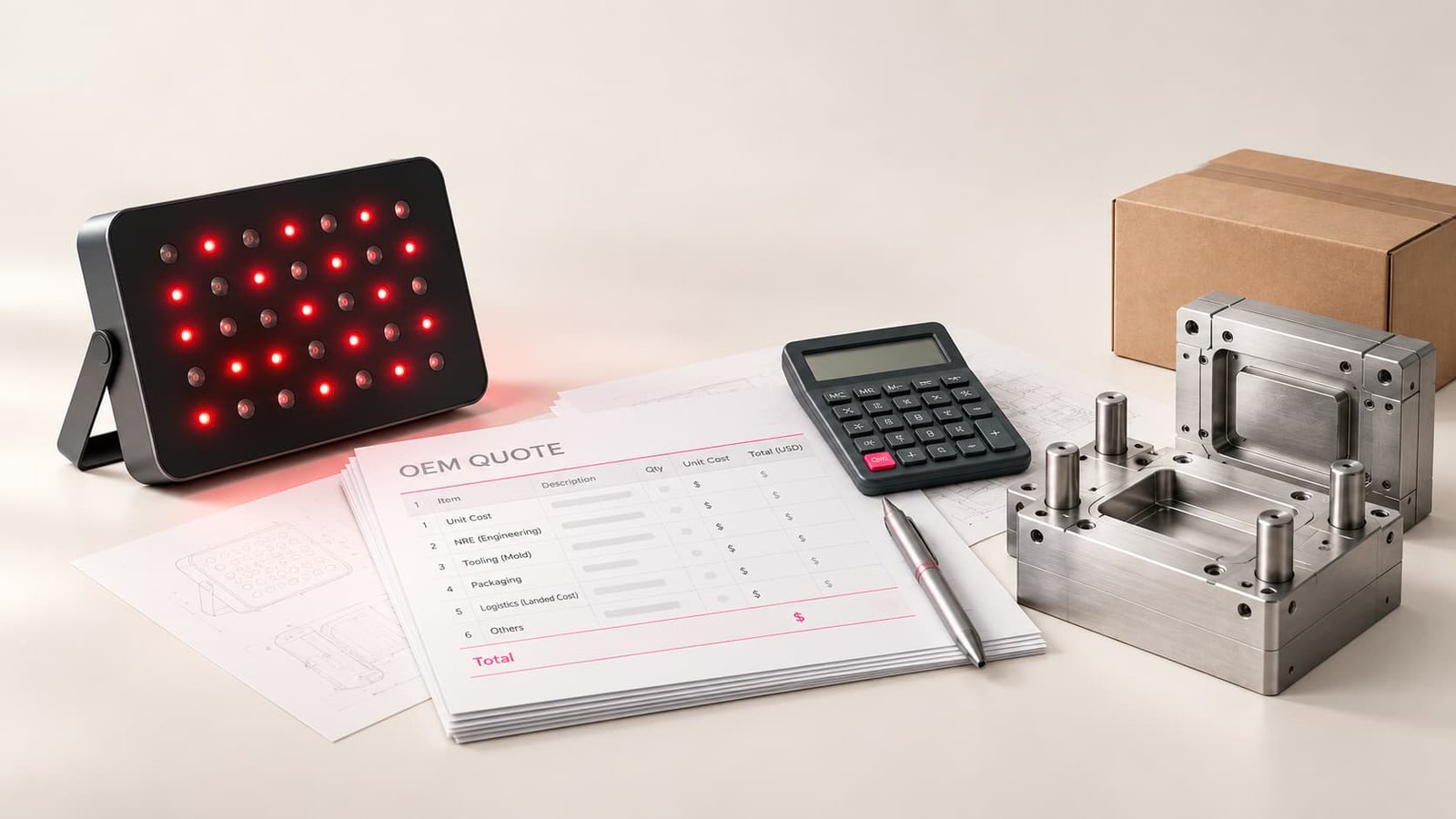
A good RFQ should tell the supplier your market, product model, customization level, compliance needs, packaging requirements, quantity plan, and launch timeline.
Many bad quotes come from vague RFQs. If you only ask “best price for LED mask,” you will receive prices that are impossible to compare.
LED face mask OEM RFQ checklist
Send this information in your first serious inquiry:
| RFQ item | What to include |
|---|---|
| Target market | US, EU, UK, Australia, Canada, Middle East, or other |
| Buyer type | DTC brand, distributor, clinic chain, retailer, Amazon seller, medspa brand |
| Product type | Silicone mask, rigid mask, mask + neck, premium set, app-connected device |
| Quantity plan | Sample quantity, first order target, 6-month forecast |
| Customization | Logo, color, packaging, manual language, wavelength, modes, controller, app |
| Compliance needs | FDA 510(k), CE / EU MDR, UKCA / MHRA, TGA, MDL, ISO 13485, MDSAP, IEC 62471, applicable electrical safety / EMC, material files, UN 38.3, and radio evidence for connected models |
| Packaging | Retail box, gift box, pouch, inserts, barcode, warning language |
| Channel | Amazon, Shopify, retail, clinic, distributor, professional channel |
| Timeline | Sample deadline, packaging deadline, mass production deadline |
| Roadmap | Future panels, hair growth, pet therapy, neck/chest, or other products |
This makes the supplier answer the real question: not just “How much is one mask?”, but “Can you support the product, market, and roadmap I am actually building?”
7. How Do You Compare LED Face Mask Manufacturers Without Getting Lost in Sales Claims?
Short answer: Use a fixed comparison table. Score every supplier on the same dimensions: product fit, customization depth, documentation, QC data, MOQ, lead time, category expansion, and communication quality.
Here is a practical comparison framework:
| Dimension | Strong answer | Red flag |
|---|---|---|
| Product match | Clear model options with spec sheets and samples | Only catalog screenshots |
| Customization | Explains what can change and what needs tooling | Says “everything can be customized” with no limits |
| Compliance | Gives certificate numbers, model scope, database links, and configuration-specific reports | Sends logos without identifiers or calls a product “medical-grade” without defining the evidence |
| Optical QC | Provides wavelength and irradiance reports | Uses only marketing specs |
| MOQ | Explains MOQ by customization layer | One vague MOQ for every option |
| Lead time | Separates sample, packaging, tooling, mass production | Promises fast delivery for everything |
| Category roadmap | Can discuss adjacent products and documentation | Offers to “source it” from elsewhere |
| Communication | Pushes back on risky claims and unclear requirements | Says yes to every claim |
The best supplier conversation is not the smoothest one. It is the one where the manufacturer can tell you what is possible, what needs evidence, what affects cost, and what should not be claimed.
For B2B light therapy products, that honesty is not a weakness. It is part of the product.
Frequently Asked Questions
What is the difference between private label, OEM, and ODM LED face masks?
Private label uses an existing product with branding changes. OEM usually means controlled customization on an existing platform. ODM means deeper product development, such as new tooling, electronics, firmware, or industrial design.
What is a reasonable MOQ for LED face mask OEM orders?
MOQ depends on the supplier and customization level. Logo and packaging changes usually require lower MOQ than new colors, new wavelength configurations, firmware changes, or new tooling.
Should I choose a supplier only because it has FDA 510(k)?
No. FDA 510(k) evidence is important when relevant, but you still need to evaluate product quality, fit, customization, QC data, communication, market documents, and category roadmap.
What files should I request before placing an LED face mask OEM order?
Request the product spec sheet, sample unit, packaging files, certificate numbers, FDA 510(k) evidence if claimed, ISO 13485 certificate, applicable market records, IEC 62471 report, electrical safety / EMC evidence where relevant, material documentation, UN 38.3 battery test summary for rechargeable configurations, radio evidence for connected models, and recent wavelength and irradiance test records.
What to Do Next
Prepare three things before contacting an LED face mask OEM supplier:
- Your target market and sales channel.
- Your preferred product type and customization level.
- Your compliance and documentation requirements.
Then ask for a structured response: available models, MOQ, unit price range, sample cost, customization options, compliance files, optical reports, packaging options, lead time, and roadmap support.
Send your product idea, target market, planned claims, and expected order quantity. We can help you compare supplier options, documentation requirements, and product-line fit, including cases where another manufacturer may be a better match.
The goal is not to choose the loudest factory page. The goal is to choose the supplier that can carry your first product and your next one.
Regulatory note: This guide provides general B2B sourcing and due-diligence information, not legal, medical, or regulatory advice. Required documents and permitted claims depend on the exact model, intended purpose, configuration, private-label changes, supply-chain roles, and target market. Obtain qualified project-specific review before launch.