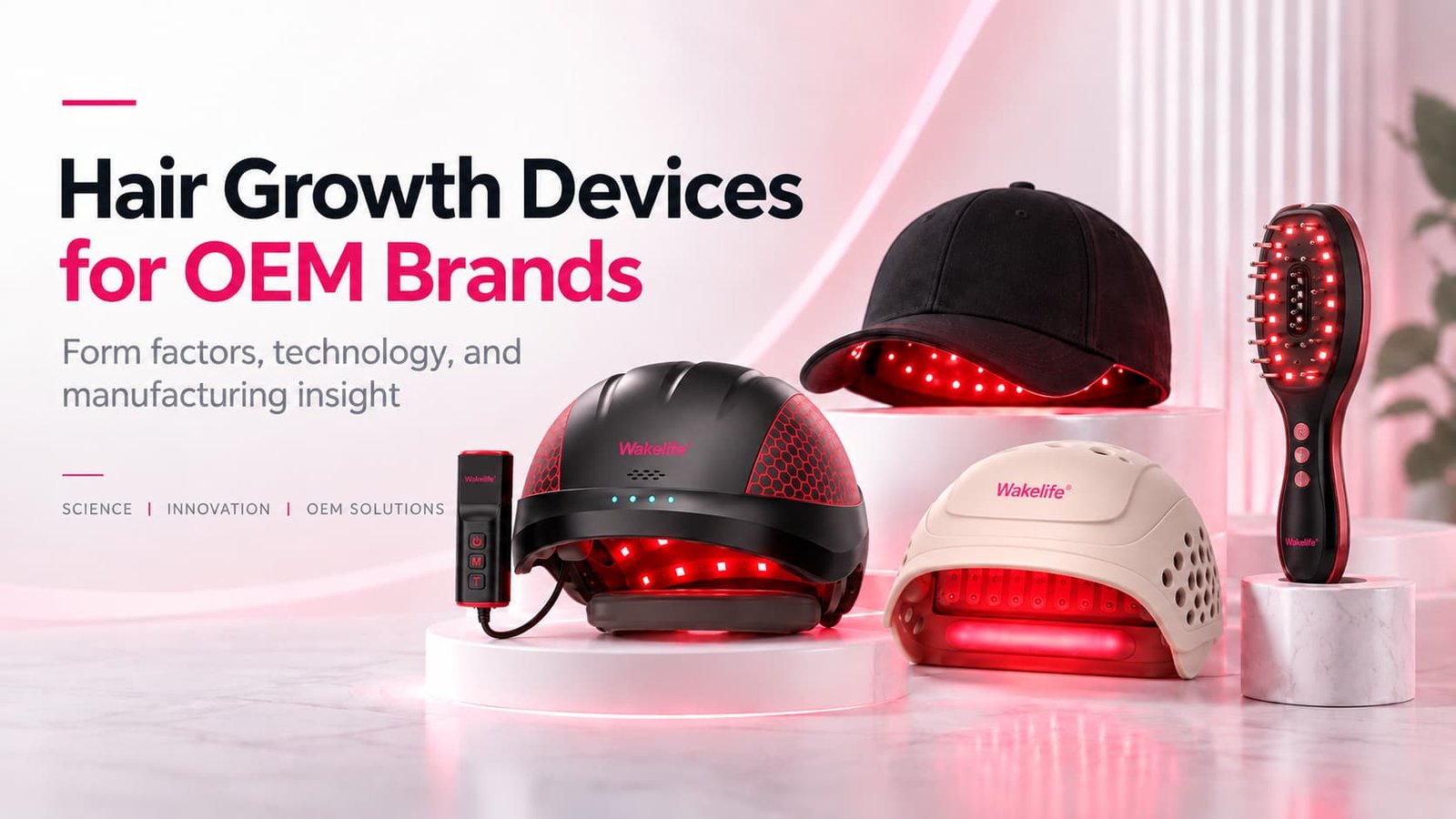
Lichtgevende diode (Geleid) fototherapie heeft zich ontwikkeld van klinische dermatologie naar reguliere professionele schoonheids- en huidverzorgingsproducten voor thuis. Maar toch zit er achter elk LED-mondkapje, paneel, of handheld-apparaat zit in één, beslissende technische keuze: golflengte. De nanometer (nm) De waarde die op een specificatieblad is afgedrukt, is geen marketingnummer; het bepaalt hoe diep het licht doordringt, welke cellulaire routes het activeert, en of een apparaat in aanmerking komt voor medische goedkeuring zoals de FDA 510(k).
In dit referentieartikel worden de tien klinisch bestudeerde golflengten uitgelegd die worden gebruikt in moderne LED-therapieapparaten, het peer-reviewed bewijsmateriaal achter elk ervan, en welke FDA 510(k) goedkeuring — inclusief de onlangs uitgegeven K250830 — betekent eigenlijk voor merken die OEM/ODM-producten betrekken. Het is geschreven voor productmanagers, regelgevende teams, distributeurs, en esthetische professionals die een goede kennis van de wetenschap nodig hebben, geen marketingclaims.
1. De wetenschap: Hoe LED-licht interageert met de huid
LED-fototherapie — ook bekend als fotobiomodulatie (PBM) of lichttherapie op laag niveau (LLLT) — werkt door niet-thermische fotonenabsorptie. Wanneer een foton met de juiste golflengte wordt geabsorbeerd door een chromofoor in huidweefsel (vooral cytochroom c-oxidase in de mitochondriale ademhalingsketen), het veroorzaakt een cascade van intracellulaire gebeurtenissen: verhoogde ATP-synthese, gemoduleerde reactieve zuurstofsoorten (ROS), en veranderde genexpressie gerelateerd aan ontstekingen, proliferatie, en extracellulaire matrixremodellering.1
Drie principes bepalen elke golflengtebeslissing bij het ontwerpen van LED-apparaten:
- Absorptiespecificiteit — verschillende chromoforen (porfyrinen, melanine, hemoglobine, water, cytochroom c-oxidase) absorberen licht op karakteristieke pieken.
- Penetratie diepte — langere golflengten in het rood en nabij-infrarood (Nir) bereik dringt dieper door in de dermis en het onderhuidse weefsel dan kortere blauwe golflengten.2
- Dosisreactie — biologische effecten volgen een bifasische dosiscurve: te weinig energie heeft geen effect, terwijl overmatige energie de gewenste reactie kan belemmeren.
Deze drie principes zijn de reden waarom golflengteselectie niet kan worden geïmproviseerd. Elk nanometerbereik is afgestemd op een specifiek klinisch doel.
2. Golflengte per golflengte: Wat het bewijsmateriaal feitelijk aantoont
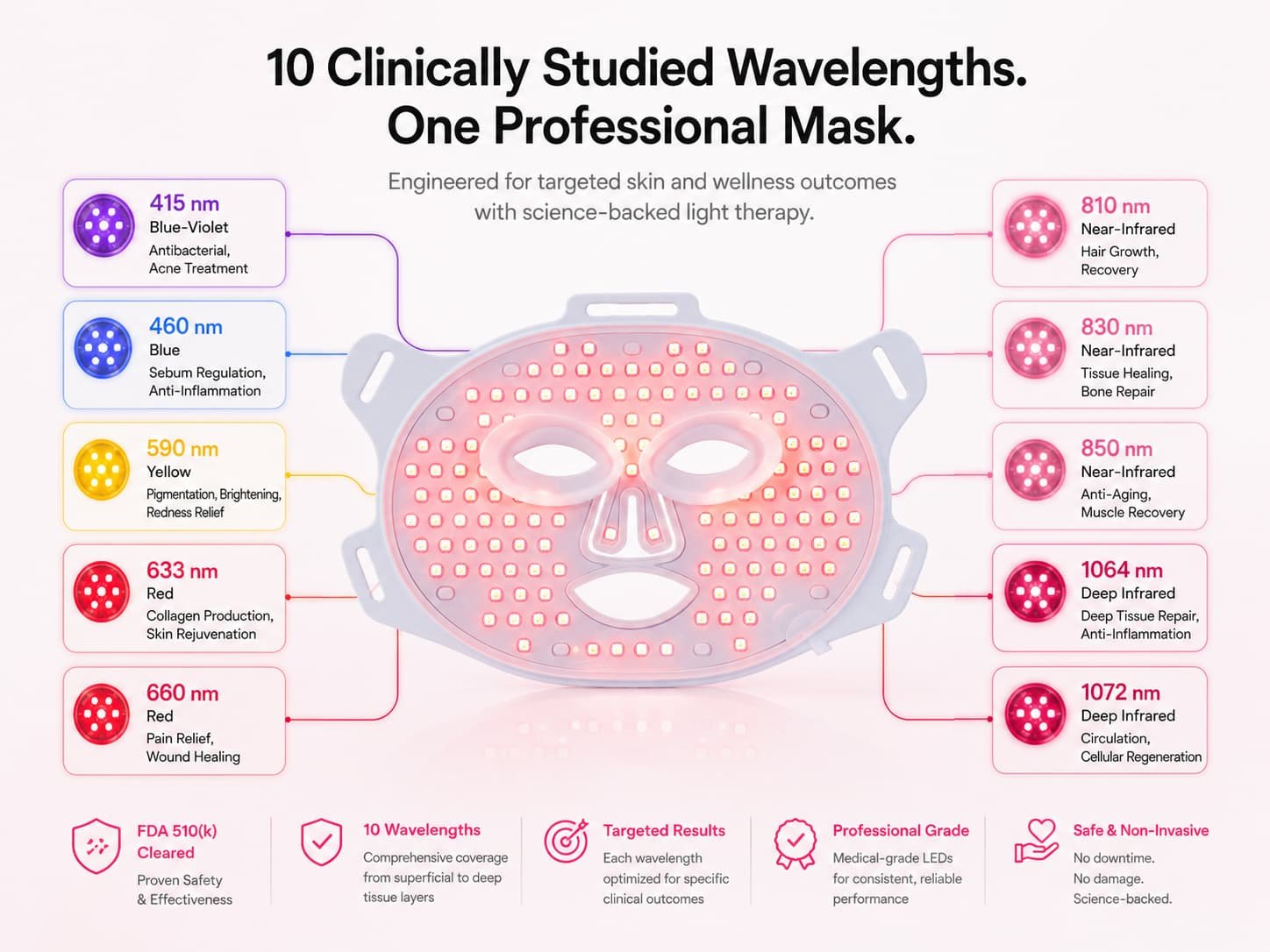
415 nm — Blauwviolet (Antibacterieel, Acne)
De 415 nm-band wordt geabsorbeerd door endogene porfyrinen (voornamelijk coproporfyrine III) geproduceerd door Cutibacterium acnes (vroeger Propionibacterium acnes). Absorptie genereert singletzuurstof die de bacterie van binnenuit verstoort, waardoor een niet-antibiotisch antimicrobieel effect ontstaat.3 Klinische onderzoeken van 415 nm monotherapie en 415 nm + 633 nm-combinatieprotocollen hebben een significante vermindering van het aantal inflammatoire acne-laesies aangetoond over een periode van 4 tot 12 weken.4 5 A 2019 systematische review in Annalen van de huisartsgeneeskunde concludeerde dat blauwlicht-fototherapie een klinisch levensvatbaar hulpmiddel is voor milde tot matige acne vulgaris.6
Penetratie: ~1 mm (alleen epidermis en bovenste papillaire dermis).
460 nm — Blauw (Regulatie van talg, Anti-ontsteking)
Iets langer dan 415 nm, 460 nm dringt marginaal dieper door terwijl de antibacteriële eigenschappen behouden blijven. Het wordt vaak gebruikt voor de talgregulatie en als kalmerende golflengte voor een ontstoken huid. Omdat beide 415 nm en 460 nm binnen het zichtbare blauwe bereik vallen, apparaten bedoeld voor oogheelkundige aangrenzende gebieden (gezichtsmaskers, oogmaskers) moet de bestraling zorgvuldig controleren om binnen de door de IEC gedefinieerde veiligheidsdrempels voor blauw licht van het netvlies te blijven 62471.
590 nm — Geel (Pigmentatie, Verheldering, Roodheid)
Geel licht op 590 nm wordt geabsorbeerd door hemoglobine en wordt veel gebruikt voor het verminderen van post-inflammatoir erytheem, diffuse roodheid, en kleine pigmentatie-onregelmatigheden. Het speelt ook een gedocumenteerde rol bij het kalmeren van de gevoelige huid na de procedure en wordt vaak opgenomen in PDT (fotodynamische therapie) protocollen voor actinische keratose als aanvullende golflengte.7
633 nm — Rood (Collageen, Huidverjonging)
633 nm is de meest uitgebreid bestudeerde golflengte in de LED-dermatologie. Weiss et al. heeft dat aangetoond 633 nm LED-fotomodulatie verhoogt de fibroblastactiviteit en pro-collageensynthese en vermindert tegelijkertijd matrix metalloproteïnase-1 (MMP-1) expressie – het enzym dat verantwoordelijk is voor de afbraak van collageen.8 Dit dubbele mechanisme vormt de basis voor bijna elke ‘anti-verouderingsclaim’ die verband houdt met roodlichttherapie.9
Penetratie: ~ 2–3 mm (reticulaire dermis).
660 nm — Rood (Pijnverlichting, Wondgenezing)
660 nm deelt er veel van 633 nm’s effecten, maar dringt iets dieper door en wordt vaker aangehaald in de literatuur over wondgenezing en musculoskeletale pijn. Uit in-vitrostudies blijkt 660 nm moduleert de proliferatie van fibroblasten en beïnvloedt ROS-signalering bij klinisch relevante fluctuaties.10 De meeste moderne paneel- en riemformaatapparaten combineren 660 nm met een NIR-golflengte zoals 850 nm om zowel oppervlakkige als diepe weefsellagen in één sessie aan te pakken.
810 nm — Nabij-infrarood (Haargroei, Herstel)
810 nm dringt voorbij de dermis door tot in de onderhuidse laag en wordt veel gebruikt bij lasertherapie op laag niveau (LLLT) protocollen voor traumaherstel, neurale modulatie, en follikelstimulatie. Het is ook een van de standaardgolflengten voor transcraniaal fotobiomodulatieonderzoek.
830 nm — Nabij-infrarood (Weefselgenezing, Botreparatie)
830 nm heeft gedocumenteerde effecten op de osteoblastactiviteit, lymfedrainage, en postoperatief herstel. Het is de golflengte die het vaakst wordt genoemd in peri-operatieve LED-protocollen die worden gebruikt in klinieken voor plastische chirurgie voor het verminderen van kneuzingen en versnelde wondsluiting.
850 nm — Nabij-infrarood (Anti-veroudering, Spierherstel)
850 nm is de meest populaire NIR-golflengte in roodlichtpanelen voor consumenten vanwege het gunstige evenwicht tussen de penetratiediepte (~5–6 mm in het onderhuidse weefsel) en LED-efficiëntie op chipniveau. Het gecontroleerde onderzoek van Wunsch en Matuschka toonde meetbare verbeteringen in de ruwheid van de huid aan, rimpel diepte, en intradermale collageendichtheid wanneer 850 nm werd gecombineerd met rode golflengten in een polychromatisch protocol.11
1064 nm — Diep infrarood (Pigment, Vetmodulatie)
1064 nm bereikt de diepste van alle niet-thermische LED-golflengten bij klinisch gebruik en wordt geassocieerd met vetmodulatie en selectieve pigmenttargeting in op laser gebaseerde protocollen. In LED-formaat (niet-coherent), 1064 nm wordt gebruikt bij een lagere bestralingssterkte voor algemene conditionering van diep weefsel.
1072 nm — Diep infrarood (Huidbarrière, Anti-rimpel)
1072 nm heeft een specifieke onderzoeksvoetafdruk op het gebied van de behandeling van herpes simplex en het herstel van de huidbarrière. Het is een van de meer gespecialiseerde golflengten en wordt over het algemeen geconfigureerd in professionele systemen met meerdere golflengten in plaats van consumentenapparaten met één golflengte.
3. Waarom apparaten met meerdere golflengten beter presteren dan apparaten met één golflengte
A 2008 Onderzoek door Sadick heeft aangetoond dat het combineren van rode en infrarode golflengten meetbaar grotere verbeteringen in fijne lijntjes en huidtextuur oplevert dan beide golflengten alleen.12 Dit komt overeen met de bredere fotobiomodulatieliteratuur: verschillende golflengten bereiken verschillende weefseldiepten en activeren verschillende chromoforen, een polychromatisch protocol bestrijkt dus meer biologische terreinen per sessie.13
Echter, “meer golflengten” is niet automatisch beter. Er zijn drie technische afwegingen van toepassing:
- De totale bestralingssterkte moet binnen veilige en effectieve grenzen blijven — doorgaans 30–100 mW/cm² op het huidoppervlak.
- Elke golflengte moet een klinisch betekenisvolle dosis opleveren – het toevoegen van een symbolisch aantal LED’s met een ‘bonus’-golflengte levert zelden de dosis op die nodig is voor een biologisch effect.
- Driver- en thermische architectuur moeten de configuratie ondersteunen — Apparaten met meerdere golflengten vereisen onafhankelijke kanaalcontrole om te voorkomen dat golflengten worden gemengd tot ineffectieve gemiddelden.
Dit is de reden waarom twee apparaten die met identieke golflengtelabels op de markt worden gebracht, zeer verschillende klinische resultaten kunnen opleveren. Pariteit op het specificatieblad is niet hetzelfde als prestatiepariteit.
4. Penetratiediepte: Een praktische referentie
| Golflengte | Geschatte penetratiediepte | Primaire doellaag |
|---|---|---|
| 415 nm | ~1 mm | Opperhuid |
| 460 nm | ~1–1,5 mm | Opperhuid |
| 590 nm | ~1,5–2 mm | Papillaire dermis |
| 633 nm | ~ 2–3 mm | Reticulaire dermis |
| 660 nm | ~3 mm | Reticulaire dermis |
| 810 nm | ~4–5 mm | Onderhuids |
| 830 nm | ~5 mm | Onderhuids |
| 850 nm | ~ 5–6 mm | Onderhuids |
| 1064 nm | ~6–8 mm | Diep onderhuids |
| 1072 nm | ~6–8 mm | Diep onderhuids |
De penetratiewaarden zijn bij benadering en afhankelijk van het huidtype, hydratatie, bestraling, en straalgeometrie.2
5. Bestraling, Dosis, en de bifasische curve
Golflengte alleen bepaalt de uitkomst niet. Twee extra parameters wegen even zwaar:
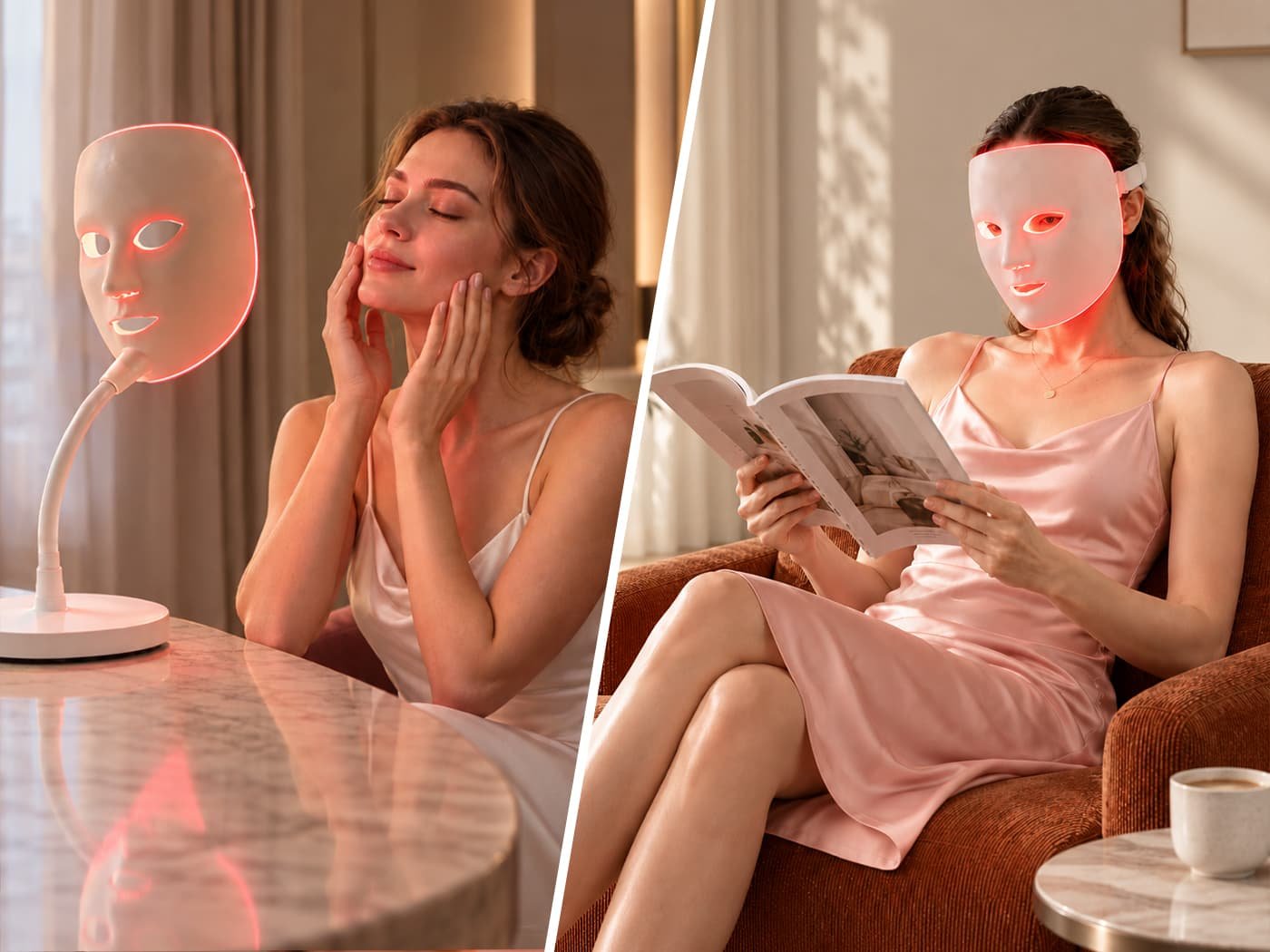
- Bestraling (MW/cm²) — de vermogensdichtheid aan het huidoppervlak. De meeste klinische LED-protocollen werken tussen 30 En 100 MW/cm². De reguliere LED-gezichtsmaskers van Wakelife leveren dat 60+ mW/cm² op het naar de huid gerichte oppervlak, gemeten op gekalibreerde werkafstand.
- Vloeiendheid (J/cm²) — de totale geleverde energie per oppervlakte-eenheid, berekend als bestralingssterkte x tijd. De meeste gepubliceerde protocollen clusteren daartussen 3 En 60 J/cm² afhankelijk van indicatie en doeldiepte.
De bifasische dosisrespons beschreven door Hamblin en anderen betekent dat een verdubbeling van de belichtingstijd het resultaat niet verdubbelt.14 Voorbij een optimaal venster, extra blootstelling kan juist het pad onderdrukken dat de behandeling moet activeren. Dit is de reden waarom een verantwoord apparaatontwerp ingebouwde timers en instralingsplafonds omvat in plaats van open ‘meer is beter’-regelingen.
6. Klinische indicaties en logica voor golflengteselectie
| Indicatie | Primaire golflengte | Aanvullende golflengte |
|---|---|---|
| Ontstekingsacne | 415 nm | 633 nm |
| Pretoaging / fijne lijntjes | 633 nm | 850 nm |
| Erytheem na de procedure | 590 nm | 633 nm |
| Pigmentatie-onregelmatigheden | 590 nm | 633 nm |
| Wondgenezing | 660 nm | 830 nm |
| Haargroei | 650 nm | 850 nm |
| Herstel van gewrichten en spieren | 660 nm | 850 nm |
| Periorbitale fijne lijntjes | 633 nm | 850 nm |
Deze matrix is geen behandelprotocol; het is een kaart van golflengte naar indicatie voor productplanning. Definitieve klinische protocollen moeten altijd worden gevalideerd aan de hand van gepubliceerd bewijsmateriaal, waar van toepassing, reikwijdte van de wettelijke goedkeuring.
7. Wat FDA 510(k) Opruiming betekent eigenlijk
FDA 510(k) goedkeuring is een pre-market-inzending die aantoont dat een apparaat dat is substantieel gelijkwaardig naar een legaal op de markt gebracht predicaatapparaat. Het is geen bewijs van werkzaamheid in de informele zin – het is een bevinding van de toezichthouder dat het apparaat net zo veilig en effectief is als het predikaat voor de goedgekeurde indicatie.
Voor LED-fototherapieapparaten, de indicaties verdwenen onder 510(k) vallen doorgaans binnen de productcode NHN (infraroodlamp voor medische doeleinden) of ILY (aangedreven, op licht gebaseerd laserchirurgisch instrument), afhankelijk van de apparaatclassificatie.
Een representatieve recente goedkeuring – FDA 510(k) K250830 — illustreert de structuur van een LED-gezichtsmaskerinzending: gedefinieerde golflengten, gedefinieerde stralingsbereiken, gedefinieerde behandelingsduur, en een gelabelde indicatie die consistent is met het predikaat. Merken die OEM/ODM-producten kopen, moeten drie punten verifiëren voordat ze op toestemming kunnen vertrouwen:
- De vergunninghouder van het record — de legale fabrikant genoemd in de 510(k) is de entiteit die de FDA verantwoordelijk houdt. OEM-klanten krijgen een afzonderlijk gestructureerde leveringsrelatie die gedocumenteerd moet worden.
- De gewiste indicatie voor gebruik — marketingclaims moeten binnen de goedgekeurde indicatie blijven. Off-label claims (Bijv., “behandelt rosacea” terwijl alleen “algemene dermatologische aandoeningen” werden verholpen) regelgevende blootstelling creëren.
- De configuratie getest - golflengtetelling, LED-telling, bestraling, en behandeltijd ingediend in de 510(k) definieer het gewiste apparaat. Materiële veranderingen kunnen een nieuwe vereisen 510(k) onder FDA 2017 begeleiding.16 17
Het is ook vermeldenswaard dat het in februari effectief is 2026, FDA's kwaliteitsmanagementsysteemverordening (QMSR) zal de erfenis vervangen 21 CFR-onderdeel 820, het harmoniseren van Amerikaanse eisen met ISO 13485.15 Fabrikanten opereren al onder ISO 13485 (Wakelife inbegrepen) zijn structureel gepositioneerd voor deze transitie.
8. Van specificatie tot productie: Welke merken moeten verifiëren
Voordat u een OEM/ODM-project voor productie, merken moeten de volgende documentatie aanvragen – en beoordelen:
- Spectrale meetrapporten — piekgolflengte, volledige breedte op half maximum (FWHM), en spectrale zuiverheid per LED-bak.
- Fotometrische rapporten — bestraling op werkafstand, uniformiteit over het behandelingsoppervlak, en stralingshoek.
- Fotobiologische veiligheidsrapporten — IEC 62471 classificatie van risicogroepen, vooral voor apparaten met een blauwe golflengte.
- EMC- en elektrische veiligheidsrapporten — IEC 60601-1 en IEC 60601-1-2 voor medische apparatuur, IEC 62368-1 voor apparaten van consumentenkwaliteit.
- Biocompatibiliteitsrapporten —ISO 10993 voor alle huidcontactmaterialen, vooral siliconen gezichtsmaskers.
- Documentatie van het kwaliteitssysteem —ISO 13485 certificeringsbereik en toepasselijke MDSAP-dekking.
Wakelife levert elk van deze rapporten als standaardproducten voor OEM/ODM-partners, naast het apparaat zelf. Dit is de documentatielaag die een gereguleerde productiepartner onderscheidt van een generieke leverancier.
9. Samenvatting: Een werkend raamwerk voor golflengtebeslissingen
Bij het beoordelen van een LED-therapieproduct – of het nu gaat om sourcing voor een merk, opgeven voor een kliniek, of het ontwerpen van een nieuw apparaat: pas dit raamwerk in vijf stappen toe:
- Definieer eerst het klinische doel. Golflengte volgt indicatie, niet het omgekeerde.
- Selecteer golflengten met peer-reviewed bewijsmateriaal op de diepte van het doelweefsel. De penetratiediepte moet overeenkomen met de laag waarin de chromofoor leeft.
- Controleer de bestraling en fluentie op het naar de huid gerichte oppervlak. “Aantal LED’s” alleen is geen prestatiemaatstaf.
- Controleer of de reikwijdte van de regelgeving overeenkomt met marketingclaims. Duidelijke indicatie, geen ambitieus exemplaar, bepaalt wat rechtmatig kan worden gezegd.
- Vereist volledige documentatie van de fabrikant. Spectraal, fotometrisch, fotobiologisch, EMC, en over biocompatibiliteitsrapporten valt niet te onderhandelen.
Consequent toegepast, dit raamwerk scheidt op bewijs gebaseerde producten van producten van marketingkwaliteit en beschermt zowel eindgebruikers als de merken die hen bedienen.
10. Over Wakelife
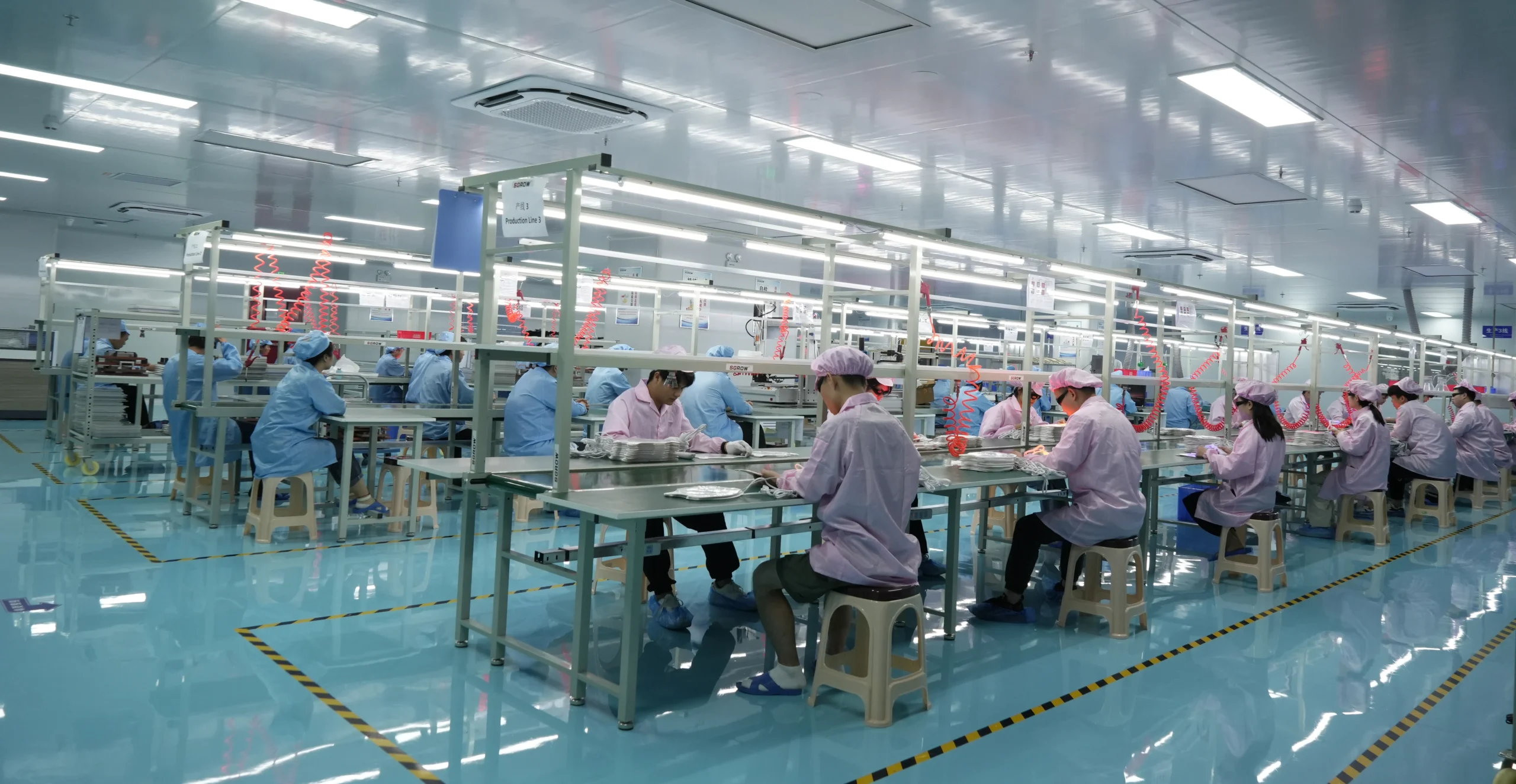
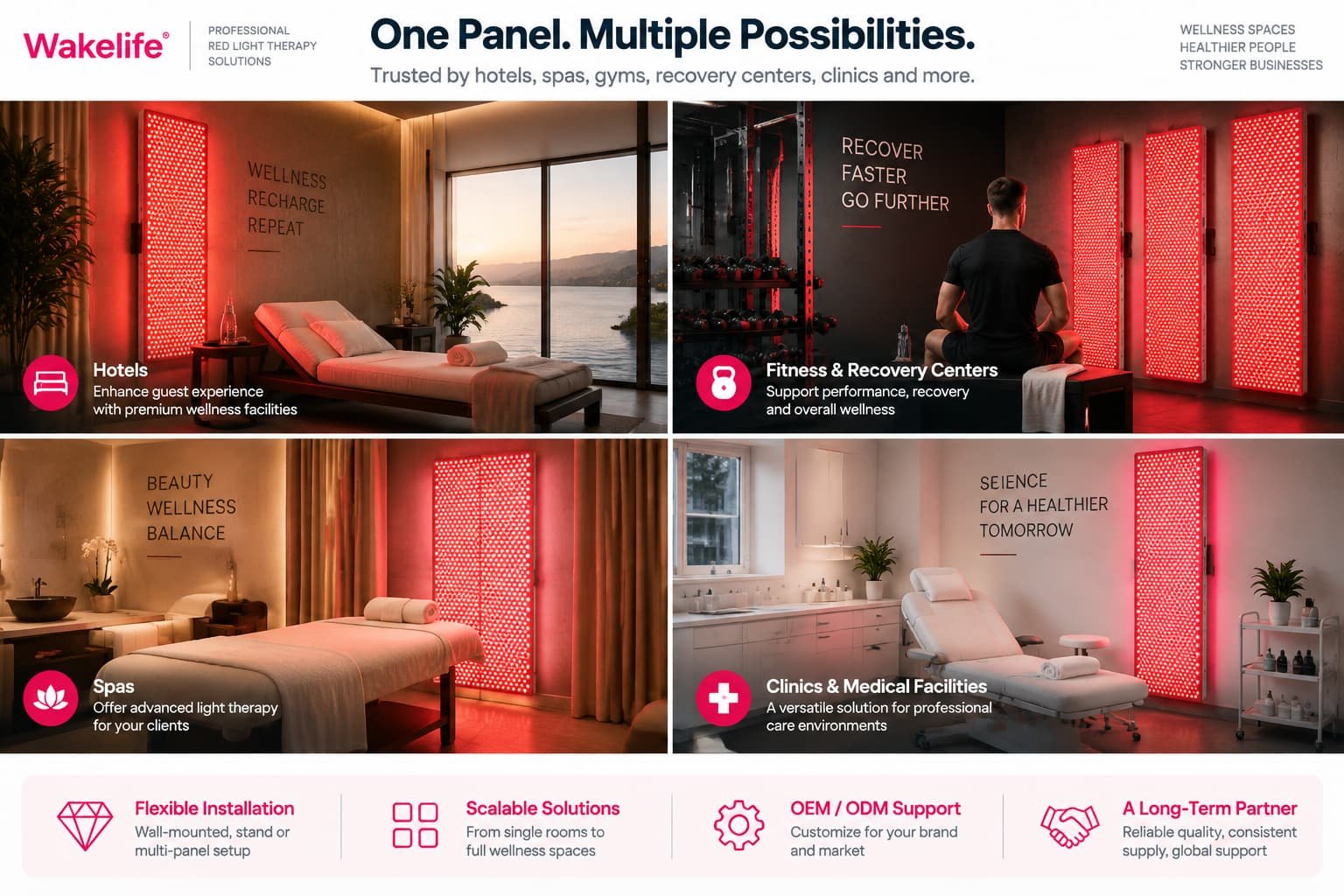
Wakelife is de professionele schoonheidsafdeling van Shenzhen Sungrow LED Technology Co., Ltd., een toegewijde fabrikant van roodlichttherapie, opgericht in 2015. Werkend vanaf twee ISO 13485 en MDSAP-gecertificeerde faciliteiten in totaal 20,000 m² in Shenzhen, Wakelife ontwikkelt en produceert LED-gezichtsmaskers, roodlichtpanelen, PDT-systemen, oogmaskers, haargroei apparaten, apparaten voor gerichte zorg, ped roodlichttherapieapparaten en therapiebanden voor professionele schoonheidsmerken in meer dan 100 landen.
Voor technische specificaties, fotometrische rapporten, of OEM/ODM-vragen, zie onze productie en R&D-mogelijkheden of neem rechtstreeks contact op met ons engineeringteam. Aanvullende Wakelife-productinformatie voor iedereen 9 Productlijnen voor LED-therapie zijn beschikbaar op onze productoverzichtpagina.
Referenties
1. Karu T.I.. Mitochondriale signalering in zoogdiercellen geactiveerd door rode en bijna-IR-straling. Fotochem Fotobiol. 2008;84(5):1091-1099.
2. As C, Dubec M, Donne K, Bashford T. Effect van golflengte en bundelbreedte op penetratie in licht-weefselinteractie met behulp van computationele methoden. Lasers Med. Sci. 2017;32(8):1909-1918.
3. Asjkenazi H, Malik Z, Harth Y, Nitzan Y. Uitroeiing van Propionibacterium acnes door zijn endogene porfyrines na verlichting met blauw licht van hoge intensiteit. FEMS Immunol Med Microbiol. 2003;35(1):17-24.
4. Goldberg DJ, Russel BA. Combinatie blauw (415 nm) en rood (633 nm) LED-fototherapie bij de behandeling van milde tot ernstige acne vulgaris. J Cosmetlaser Ther. 2006;8(2):71-75.
5. Lee SY, Jij CE, Parkeer MIJN. Blauw- en roodlichtcombinatie LED-fototherapie voor acne vulgaris bij patiënten met huidfototype IV. Lasers Surg Med. 2007;39(2):180-188.
6. Scott AM, Stehlik P, Clark J, et al. Blauwlichttherapie voor acne vulgaris: een systematische review en meta-analyse. Ann Fam Med. 2019;17(6):545-553.
7. Opel DR, Hagström E, Tempo en, et al. Lichtgevende diodes: Een korte recensie en klinische ervaring. J Clin Aesthet Dermatol. 2015;8(6):36-44.
8. Weiss RA, McDaniel DH, Geronemus RG, Weiss MA. Klinische ervaring met lichtgevende diode (Geleid) fotomodulatie. Dermatolchirurg. 2005;31(9 Pt 2):1199-1205.
9. Barolet D. Lichtgevende diodes (LED's) op het gebied van de dermatologie. Halfgesneden medische chirurg. 2008;27(4):227-238.
10. Lev-Tov H, Zoogdieren A, Brody N, Zegel D, Jagdeo J. Remming van de proliferatie van fibroblasten in vitro met behulp van rode lichtgevende diodes. Dermatolchirurg. 2013;39(8):1167-1170.
11. Wens A, Matuschka K. Een gecontroleerd onderzoek om de werkzaamheid van de behandeling met rood en nabij-infrarood licht voor de patiënttevredenheid te bepalen, vermindering van fijne lijntjes, rimpels, ruwheid van de huid, en toename van de intradermale collageendichtheid. Gefotografeerde laserchirurgie. 2014;32(2):93-100.
12. Sadick NS. Een onderzoek om de werkzaamheid van een nieuw draagbaar apparaat met lichtemitterende diodes bij de behandeling van een door licht verouderde huid te bepalen. J Cosmet Dermatol. 2008;7(4):263-267.
13. Avci P, Gupta A, Sadasivam M, et al. Laser op laag niveau (licht) therapie (LLLT) in de huid: stimulerend, genezing, herstellen. Halfgesneden medische chirurg. 2013;32(1):41-52.
14. Hamblin Mr. Mechanismen en toepassingen van de ontstekingsremmende effecten van fotobiomodulatie. DOELSTELLING Biofysiek. 2017;4(3):337-361.
15. ONS. Food and Drug Administration. Medische apparaten; Wijzigingen in de kwaliteitssysteemverordening (QMSR-eindregel), 89 FR 7496. Effectief februari 2, 2026.
16. ONS. Food and Drug Administration. Beslissen wanneer u moet indienen 510(k) voor een wijziging aan een bestaand apparaat - Leidraad voor industrie- en FDA-personeel. oktober 25, 2017.
17. ONS. Food and Drug Administration. Beslissen wanneer u moet indienen 510(k) voor een softwarewijziging aan een bestaand apparaat - Leidraad voor industrie- en FDA-personeel. oktober 25, 2017.