TL;DR voor klinieken, wellness merken, en patiënten
- Kleine gecontroleerde onderzoeken suggereren dat er sprake is van enige fotobiomodulatie (PBM) protocollen kunnen tijdelijk toenemen lokale huid- of capillaire bloedstroommetingen.
- De bevinding is smal. Het betekent niet automatisch een hogere bloedstroom in een grotere slagader, betere circulatie van het hele lichaam, verbeterde weefselzuurstof, of een blijvend klinisch voordeel.
- De resultaten variëren per golflengte, optische dosis, behandelgebied, meetmethode, temperatuur, en individuele reactie. Er bestaan zowel positieve als negatieve menselijke bevindingen.
- Stikstofmonoxide levert een plausibele bijdrage aan vasodilatatie, maar de lichtgevoelige route is nog niet vastgelegd en mag niet worden gepresenteerd als een bewezen eenstapsmechanisme.
- Een exact apparaat kan een duidelijke indicatie hebben voor het tijdelijk verhogen van de lokale bloedcirculatie, maar die formulering is niet van toepassing op een ander product en vormt geen behandeling voor een chronische slechte bloedsomloop, perifere slagaderziekte (PAD), diabetes vasculaire ziekte, of hart- en vaatziekten.
- Mensen met een verminderd beschermend gevoel of wonden hebben een exacte veiligheidsbeoordeling van het apparaat nodig, terwijl nieuwe vasculaire waarschuwingssignalen medische beoordeling vereisen in plaats van zelfbehandeling.
Medische notitie: Dit artikel is educatief en diagnosticeert of behandelt geen vasculaire aandoening. Terugkerende beenpijn tijdens activiteit, de ene voet wordt kouder dan de andere, gevoelloosheid, kleurverandering, rust pijn, of een langzaam genezende wond kan medische beoordeling vereisen; de ONS. Nationaal Hart, Long, en Bloedinstituut (NHLBI) noemt deze onder mogelijke PAD-symptomen. De NHLBI's leven-met-PAD begeleiding adviseert spoedeisende zorg bij plotseling verlies van gevoel of beweging in een voet, vooral als deze blauw of bleek wordt en kouder dan de andere voet. Stel professionele zorg niet uit om een licht apparaat te proberen.
Verhoogt roodlichttherapie de bloedstroom??
Soms, maar slechts in beperkte mate, lokaal, en protocolspecifieke betekenis.
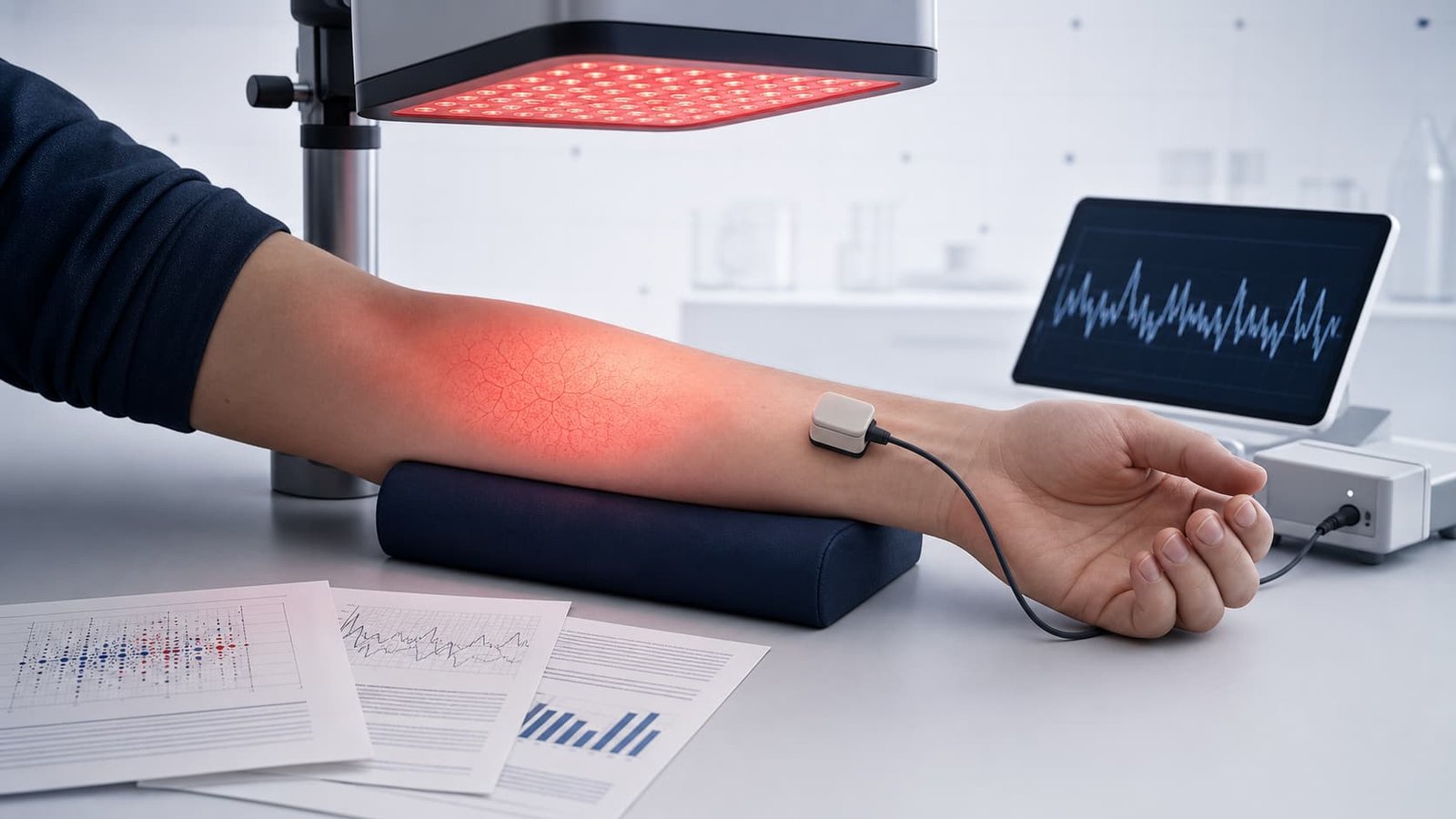
Verschillende kleine studies bij mensen hebben een toename van de huidperfusie op korte termijn aangetoond, capillaire bloedcelsnelheid, of een andere lokale microcirculatiemaatregel na een specifieke PBM-blootstelling. Andere onderzoeken vonden geen verandering in de metingen van grotere schepen, plasma-nitriet, transcutane zuurstof, of gerelateerde uitkomsten.
Het meest accurate antwoord is daarom niet een universeel ‘ja’ of ‘nee’. Het is:
Sommige rood- of nabij-infraroodprotocollen hebben in kleine studies bij mensen de lokale microcirculatiemetingen veranderd. Deze resultaten wijzen niet op een duurzame verbetering van de systemische circulatie of op de behandeling van een vaatziekte.
Dat onderscheid is van belang voor klinieken omdat een patiënt mogelijk een ‘verhoogde bloedstroom’ hoort, omdat ‘dit de oorzaak van mijn koude voeten zal behandelen’., pijn in het been, zweer, of PAD.” De onderzoeken ondersteunen deze sprong niet.
‘Bloedstroom’ is niet één resultaat
Een resultaat op het ene niveau kan bewijs op een ander niveau niet vervangen.
| Bewijsniveau | Voorbeeld meting | Wat het kan laten zien | Wat het zelf niet kan bewerkstelligen |
|---|---|---|---|
| Lokale huid- of capillaire microcirculatie | Laser Doppler-stroom, fotoplethysmografie, capillaire bloedcelsnelheid | Een kortetermijnverandering in een klein verlicht gebied | Grotere slagaderstroom, circulatie van het hele lichaam, of verbetering van de ziekte |
| Lokale weefselzuurstof | Transcutane zuurstofdruk (TcPO₂) | Zuurstof gemeten via de huid op een gedefinieerde plaats | De oorzaak van elke verandering of een duurzaam wondgenezingsvoordeel |
| Hemodynamiek van grotere bloedvaten | Femorale slagadersnelheid of pulsatiliteit | Een vasculaire meting in een genoemde slagader | Huid-capillaire reactie, totale perfusie van de ledematen, of klinisch voordeel |
| Systemische markers | Plasma-nitriet, bloeddruk, endotheliale functietesten | Een geselecteerde lichaamsbrede of vasculaire marker | Symptoomverlichting of wijziging van de ziekte tenzij het onderzoek dit meet |
| Patiënt- en ziekteresultaten | Op loopafstand, wondgenezing, pijn, ziekenhuisopname, gebeurtenissen in ledematen | Een klinisch relevant resultaat bij een gedefinieerde patiëntengroep | Overdraagbaarheid naar een andere diagnose, apparaat, of protocollair |
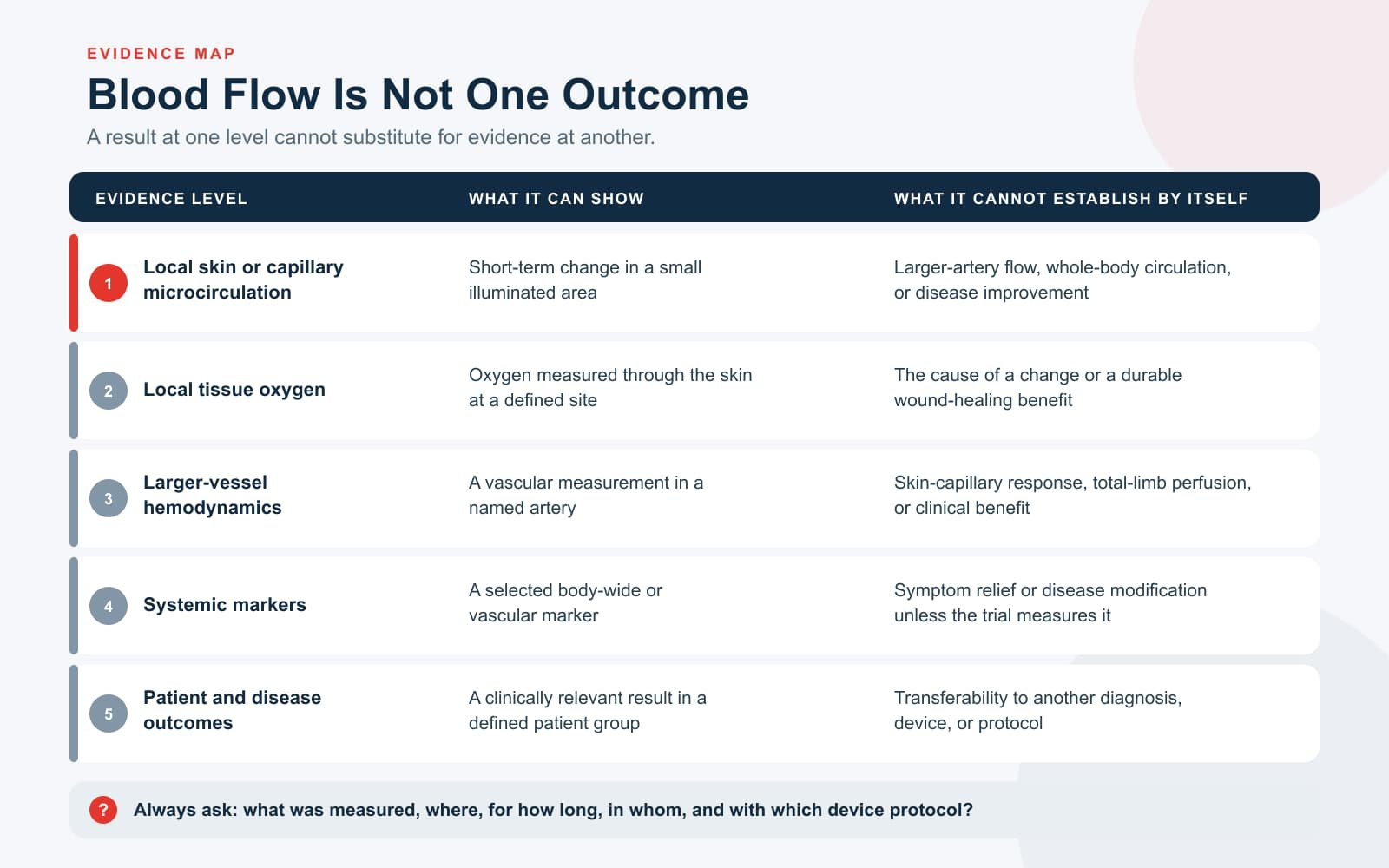
‘Circulatie’ is nuttig alledaags taalgebruik, maar het is te breed om als wetenschappelijk eindpunt te dienen. Voordat u een claim herhaalt, vragen: Wat werd gemeten, waar, voor hoe lang, bij wie, en met welke apparaatparameters?
De instrumenten zijn niet uitwisselbaar. In de Riaz laser-Doppler-onderzoek, perfusie werd gerapporteerd in relatieve bloedperfusie-eenheden in plaats van in een absolute stroom zoals milliliters per minuut; de Gavische studie maakte ook gebruik van fotoplethysmografie, die een optisch pulsgerelateerd signaal registreert in plaats van een directe volumetrische stroom. Een verandering binnen de studie kan daarom informatief zijn, maar percentages van verschillende instrumenten, instellingen, en lichaamslocaties mogen niet worden samengevoegd alsof ze dezelfde hoeveelheid meten.
Wat hebben gecontroleerde menselijke studies gevonden?
Het menselijke bewijsmateriaal bevat lokale positieve signalen, nul resultaten, en aanzienlijke grenzen.
| Studie | Bevolking en protocol | Meting | Belangrijkste bevinding | Wat het niet bewijst |
|---|---|---|---|---|
| Mak en Cheing, 2012 | 30 gezonde volwassenen; gerandomiseerd naar 890 nm monochromatische infraroodenergie, schijn, of een warm pak aan de voet voor 30 notulen | Capillaire bloedcelsnelheid en oppervlakkige huidflux | De actieve groep vertoonde een grotere toename dan schijn en hitte | Voordeel op lange termijn, systemische circulatie, of een effect in PAD |
| Gavish et al., 2020 | 20 gezonde niet-rokers; gerandomiseerd naar 633 nm rood of 830 nm nabij-infrarood bij de pols voor 5 notulen | Fotoplethysmografie, laser-Doppler, en huidtemperatuur | De 830 nm-groep vertoonde een mediane toename van de microcirculatie tijdens en na blootstelling; de 633 nm-groep vertoonde geen mediane toename | Een schijngecontroleerd behandelingseffect; elke golflengtegroep had slechts ongeveer 10 mensen, en de reacties waren gevarieerd |
| Dutra et al., 2021 | 13 gezonde, ongetrainde mannen; gerandomiseerd, dubbelblind, schijn-gecontroleerde crossover met behulp van gecombineerd 630/850 nm PBM vóór het fietsen | Femorale piek systolische snelheid, pulsatiliteitsindex, plasma-nitriet, en trainingsprestaties | Geen significante verschillen in de vasculaire maatregelen, nitriet, of prestatie | Dat elke lokale huidreactie afwezig is; de studie had betrekking op een ander protocol en eindpunt |
| Franzen-Korzendorfer et al., 2008 | 18 mensen met diabetes en verlies van beschermend gevoel; één voet ontvangen 890 nm actieve belichting en de andere schijnvertoning gedurende 11–12 sessies | TcPO₂, gevoel, en pijn | Geen significant actief versus schijnverschil in de drie uitkomsten | Een definitief oordeel voor alle diabetische voet- of vasculaire protocollen; de toewijzing was quasi-willekeurig en de steekproef was klein |
| Riaz et al., 2026 | 24 gezonde volwassenen; 890 nm nabij-infrarood na een placeboconditie van dezelfde persoon | Lokale laser-Doppler huidstroom en temperatuur | De lokale stroming nam toe na enkele continue of intermitterende blootstellingen, met grote individuele variatie | Een gerandomiseerd effect, onafhankelijk van warmte; placebo kwam altijd op de eerste plaats, voortdurende blootstelling verhoogde de huidtemperatuur met ongeveer 6°C, en kleine hittecontroles werden niet inferentieel getest |
Bij deze onderzoeken werden verschillende lichaamslocaties en vasculaire niveaus gemeten en werden verschillende golflengten gebruikt, machtsdichtheden, belichtingstijden, temperaturen, en uitkomsten. De meeste schreven gezonde volwassenen in en beoordeelden de respons tijdens de blootstelling, onmiddellijk daarna, of binnen een korte follow-up van dezelfde sessie. Ze zorgen niet voor persistentie de volgende dag of voor een cumulatief effect.
Deze onderzoeken stellen geen golflengtehiërarchie vast. Onder de hier beoordeelde onderzoeken, alleen Gavish en collega's vergeleken rood rechtstreeks met nabij-infraroodlicht: in dat kleine, geen schijnstudie, de 830 nm-groep vertoonde een mediane lokale toename van de microcirculatie, terwijl de 633 nm-groep niet. Eén vergelijking van actieve golflengten kan geen algemeen voordeel opleveren voor nabij-infraroodlicht.
Commerciële context: Commerciële betrokkenheid op zichzelf valideert of ontkracht een resultaat niet, maar het hoort thuis in de interpretatie. In het Gavish-onderzoek, de vermelde vereniging van één auteur was een commercieel bedrijf; het toegankelijke document bevatte geen afzonderlijke verklaring van belangenverstrengeling. Voor de Franzen-Korzendorfer-studie, Anodyne Therapy doneerde de actieve en schijnapparaten, en de eerste auteur was manager bij American Medical Technologies. Deze feiten staan naast de sterke punten en beperkingen van elk onderzoek.
Waarom verschillen de onderzoeksresultaten?
Een PBM-resultaat hoort bij de volledige belichtings- en meetopstelling, en niet alleen bij het golflengtelabel.
Belangrijke bronnen van variatie zijn onder meer:
- Vasculair niveau en lichaamsplaats. Huidperfusie ter hoogte van de pols of voet is niet dezelfde meting als de snelheid van de dijslagader of de bloedstroom van de totale ledematen.
- Golflengte en spectrale output. “Rood licht” kan verwijzen naar verschillende zichtbare rode banden, terwijl nabij-infraroodprotocollen gebruik kunnen maken 810, 830, 850, 890 nm, of een andere band.
- Bestralingssterkte en stralingsblootstelling. Vermogen per gebied, sessie tijd, afstand, straal gebied, inschakelduur, en het pulspatroon hebben allemaal invloed op de geleverde belichting.
- Temperatuur. Het verwarmen van de huid kan op zichzelf de lokale perfusie veranderen. Een onderzoek heeft geschikte controles en temperatuurregistraties nodig voordat de hele respons aan een niet-thermische fotochemische route kan worden toegeschreven.
- Timing. Een verandering die is vastgelegd tijdens de belichting of 20 minuten later heeft geen aanhoudend effect gedurende dagen of maanden.
- Karakteristieken van deelnemers. Leeftijd, basislijn vasculaire tonus, roken, medicatie, suikerziekte, PAD, neuropathie, en andere omstandigheden kunnen zowel de respons als het risico veranderen.
- Studie ontwerp. Kleine monsters, vaste behandelvolgorde, ontbrekende schijncontroles, meerdere ongecorrigeerde vergelijkingen, en selectieve berichtgeving kan een schijnbaar effect minder zeker maken.
Voor apparaatteams, de praktische implicatie is eenvoudig: een onderzoek waarbij één golflengte wordt gebruikt, kan een product niet valideren louter omdat de productcatalogus dezelfde nominale golflengte vermeldt. De exacte uitvoer, geometrie, behandelgebied, schema, beoogde gebruiker, comparator, en eindpunt moeten nog steeds overeenkomen.
Verklaart stikstofmonoxide de bloedstroomreactie??
Stikstofmonoxide levert een plausibele bijdrage, maar het PBM-traject is nog niet geregeld.
Stikstofmonoxide helpt de vasculaire tonus te reguleren, Daarom hebben onderzoekers onderzocht of rood of nabij-infrarood licht biologisch opgeslagen stikstofmonoxide beter beschikbaar kan maken. Bij laboratoriumwerk, Keszler et al. vond golflengte-afhankelijke afgifte uit S-nitrosothiolen en dinitrosyl-ijzercomplexen en waargenomen ontspanning in geïsoleerde gezichtsslagaders van muizen.
Dat ondersteunt de biologische plausibiliteit. Het bewijst niet dat een consumentenapparaat een klinisch belangrijke hoeveelheid stikstofmonoxide in een persoon vrijgeeft of dat stikstofmonoxide elk lokaal perfusieresultaat verklaart.
Cytochroom c-oxidase (CCO) wordt ook vaak gepresenteerd als de gevestigde PBM-fotoacceptor die remmend stikstofmonoxide afgeeft. Het bewijsmateriaal is minder vaststaand dan de marketingsteno suggereert. A 2020 kritische beoordeling betwijfelde of het betrouwbaar was, reproduceerbaar bewijs was voldoende om CCO die centrale rol toe te kennen. Een latere experiment met geïsoleerde enzymen vond dat 670 of 830 nm-licht veranderde het CCO-zuurstofverbruik of de omgekeerde remming van een stikstofoxidedonor onder de geteste omstandigheden niet.
De verantwoordelijke kliniekverklaring is:
PBM kan de vasculaire signalering beïnvloeden via meer dan één lichtgevoelige of secundaire route, en stikstofmonoxide kunnen hieraan bijdragen. Het exacte menselijke pad en het klinische belang ervan worden nog onderzocht.
Is dit bewijs van toepassing op een slechte bloedsomloop?, PAD, of diabetesvoet?
Er kan geen directe conclusie over de behandeling worden getrokken op basis van het huidige bewijsmateriaal.
“Slechte bloedsomloop” is een symptoombeschrijving, niet één diagnose. Arteriële ziekte, veneuze ziekte, neuropathie, medicatie effecten, temperatuurregeling, en andere aandoeningen kunnen verschillende klachten veroorzaken en een andere evaluatie vereisen.
Het patiëntenbewijs dat het dichtst in de buurt komt, blijft klein en maakt gebruik van uitkomsten die niet direct antwoord geven op de circulatievraag:
- A 2022 gerandomiseerd, dubbelblinde piloot in 20 mensen thuis gestudeerd 808 nm PBM plus standaardzorg bij mensen met ernstige diabetische voetulcera en neuropathie; 18 had ook PAD, en ernstige comorbiditeiten kwamen vaak voor. Verkleining van het wondoppervlak bevoordeelde actieve PBM, maar uit het onderzoek bleek niet dat een verbeterde perfusie het resultaat veroorzaakte. De fabrikant leverde de actieve en schijnapparaten, betaald voor zorgverlening en statistische diensten van derden, en leverde de studiecamera; één auteur maakte betaald advies voor de fabrikant bekend. Deze relaties op zichzelf ontkrachten het resultaat niet, maar ze voegen context toe aan een kleine pilot.
- A 2025 piloot binnen 11 mensen met diabetische voetulcera en PAD vergeleek PBM plus lichaamsbeweging met alleen lichaamsbeweging. Sommige maatregelen verbeterden ten opzichte van de uitgangssituatie, maar er werden geen significante verschillen tussen de groepen gevonden. De steekproef en de toewijzingsmethode maken het haalbaarheidsbewijs, geen behandelingsconclusie.
- A 2026 systematische review van zes gerandomiseerde LED-onderzoeken rapporteerde mogelijke signalen voor het wondgebied, wondbedkwaliteit, of microcirculatie bij chronische wonden aan de onderste ledematen. Protocollen waren zeer heterogeen, er was geen kwantitatieve meta-analyse mogelijk, en de algemene GRADE-zekerheid was zeer laag.
Wondgenezing en bloedstroom zijn verwante klinische onderwerpen, maar het zijn geen uitwisselbare eindpunten. Een kleinere wond bewijst op zichzelf niet dat PBM de arteriële perfusie verbeterde; een lokale perfusiemeting brengt geen wondgenezing tot stand; en geen van beide stelt een behandeling voor PAD vast.
Dit bewijst niet dat PBM geen rol speelt in toekomstig vasculair of wondzorgonderzoek. Het betekent dat het huidige bewijs onvoldoende is voor een behandelingsclaim voor consumentenapparatuur of voor het vervangen van gevestigde medische evaluatie en zorg.
Wat zijn de veiligheidsgrenzen voor circulatiegerelateerd gebruik?
Een onderzoeksexposure is geen instructie voor thuisgebruik, en de veiligheid hangt af van het exacte apparaat en de gebruiker.
In het Riaz-onderzoek, één continu 890 nm-blootstellingscondities verhoogden de lokale huidtemperatuur met ongeveer 6°C bij gezonde volwassenen. Dat is een protocolspecifieke observatie en een mogelijke thermische bijdrage aan de gemeten stroomverandering – geen bewijs dat elk PBM-apparaat de huid met 6°C verwarmt. Het laat wel zien waarom klinieken het temperatuurgedrag zouden moeten verifiëren in plaats van aan te nemen dat elke rode of nabij-infrarode modus niet-thermisch is.
Een verminderd beschermend gevoel verandert de vraag over risicobeheersing, omdat een gebruiker mogelijk minder goed in staat is ongemakkelijke verwarming op te merken. Voor iemand met diabetische neuropathie, een actieve of langzaam genezende wond, bekende vaatziekte, of een andere aandoening die het behandelde gebied aantast, gebruik moet worden beoordeeld aan de hand van de exacte apparaat instructies, contra-indicaties, waarschuwingen, temperatuur gedrag, sessielimieten, en toezichteisen. Uit de hier besproken onderzoeken kan geen universele temperatuurlimiet of behandelingsdosis worden afgeleid.
Gebruik geen wellnesslichtprogramma om een nieuwe verkoudheid zelf te behandelen, bleek, of blauwe voet, plotseling verlies van gevoel of beweging, rust pijn, of een verslechterende of langzaam genezende wond. Deze bevindingen vereisen medische beoordeling. Dit artikel creëert ook geen universele PBM-contra-indicatielijst: medicatiegerelateerde lichtgevoeligheid en andere aandoeningspecifieke beperkingen moeten worden gecontroleerd aan de hand van de etikettering van het product en gekwalificeerd klinisch advies.
Wat kunnen klinieken zeggen zonder het bewijsmateriaal te overdrijven?
Beschrijf de gemeten bevinding en de limiet in dezelfde zin.
| Bewijs-gematchte taal | Overdrijving om te vermijden |
|---|---|
| “Sommige kleine studies bij mensen hebben een tijdelijke toename van de lokale huid- of capillaire bloedstroommetingen gevonden na specifieke PBM-protocollen.” | “Roodlichttherapie verbetert de bloedsomloop.” |
| “In een kleine vergelijking van actieve golflengten zonder een schijngroep, 830 nm vertoonde een mediane lokale toename van de microcirculatie 633 nm deed het niet; dit levert geen algemeen golflengtevoordeel op.” | “Het is bewezen dat nabij-infrarood de bloedstroom beter verhoogt dan rood licht.” |
| “Stikstofmonoxide is een van de voorgestelde bijdragers aan PBM-gerelateerde vasodilatatie; het traject wordt nog bestudeerd.” | “Bij rood licht komt stikstofmonoxide vrij, opent bloedvaten, en herstelt de bloedsomloop.” |
| “Lokale microcirculatie is niet hetzelfde eindpunt als de doorstroming van grotere slagaders of verbetering van de ziekte.” | "Betere huidperfusie betekent een betere cardiovasculaire gezondheid." |
| “Het huidige bewijsmateriaal wijst niet op een behandeling voor PAD of een andere vaatziekte.” | “Helpt een slechte bloedsomloop in de benen en voeten.” |
| Voor een exact apparaat met bijpassende U.S. goedkeuring en etikettering: “verhoog tijdelijk de lokale bloedcirculatie waar toegepast.” | “Ons apparaat kan de bloedsomloop verbeteren omdat een ander product met een vergelijkbare golflengte FDA-goedkeuring heeft.” |
| “Dit exacte model ontvangen 510(k) goedkeuring voor de indicaties voor gebruik zoals vermeld in het FDA-dossier.” | “De FDA heeft dit apparaat of het voorgestelde circulatiemechanisme goedgekeurd of goedgekeurd.” |
Toegestane formulering is afhankelijk van het exacte product, bedoeld gebruik, doelmarkt, publiek, bewijs, label, en algemene consumentenindruk. Voor de bredere beoordelingsworkflow, hij is bij Wakelife Claimgids voor LED Beauty-apparaten. Het scheidt een afgemeten productfeit van een schoonheid, welzijn, therapeutisch, of medische claim; het is geen vervanging voor marktspecifieke juridische of regelgevende toetsing.
Kan “tijdelijk de lokale bloedcirculatie verhogen” verschijnen in door de FDA goedgekeurde indicaties?
Ja voor bepaalde apparaten in de Verenigde Staten, niet voor PBM als algemene categorie.
Bijvoorbeeld, de FDA K240222 510(k) samenvatting voor gespecificeerde Dermalux LED-apparaten omvat, voor de 830 nm nabij-infraroodmodus, formulering over het tijdelijk verhogen van de lokale bloedcirculatie, waar toegepast. Die indicatie is gekoppeld aan de genoemde apparaten, hun beoogde gebruik, technologische vergelijking, en gewiste etikettering. Het geeft geen toestemming aan een ander 830 nm-product om de claim te kopiëren, en er wordt geen behandeling voor PAD of chronische slechte bloedsomloop vastgesteld.
Een eerder apparaatrecord laat een ander regelgevingskader zien. De 2006 K060792 goedkeuringsbrief en bijlagen noem één regelgevingsnummer: 21 CFR 890.5500, naam van de regeling Infrared lamp—en beide productcodes ILY en GEX. Die van de aanvrager 510(k) samenvatting afzonderlijk vermeld 21 CFR 878.4810 En 890.5500. Binnen dat overzicht, de genoemde 660/940 nm rood- en nabij-infraroodconfiguraties dragen de warmte, actueel-verwarming, weefsel-temperatuur, en circulatietekst, terwijl de blauwlichtfuncties de acne-indicatie dragen. FDA is gescheiden ILY-productclassificatierecord beschrijft het apparaattype als lamp, infrared, therapeutic heating, plaatst het in de Fysische Geneeskunde, en koppelt FDA-richtlijnen voor verwarmings- en koelapparatuur 510(k) toepassingen. Dit wel niet betekent dat elke PBM-circulatieclaim thermisch is. Hieruit blijkt dat K060792 niet kan worden aangehaald als erkenning door de FDA van een niet-thermisch stikstofmonoxidemechanisme.
K060792 illustreert ook waarom claimteams de exacte gebruiksindicaties en de huidige etikettering van het apparaat moeten gebruiken in plaats van een zin uit de verklaring van de aanvrager te kopiëren. 510(k) samenvatting. De samenvatting gebruikt local blood circulation en stelt dat de indiener het hulpmiddel geschikt achtte voor gebruik op recept en zonder recept. De bijgevoegde gebruiksindicaties zijn weggelaten local en markeert Gebruik op recept. Dit historische contrast zorgt er niet voor dat elk op de circulatie betrekking hebbend hulpmiddel alleen op recept verkrijgbaar is. De huidige gegevens van de FDA vermelden ILY als een Klasse II, 510(K) Exempt inzendingstype en GEX als Klasse II met indieningstype 510(k); zeggen beide records GMP Exempt? No. De ILY-vrijstelling is onderworpen aan 21 CFR 890.9, inclusief limieten die een ander beoogd gebruik of een andere fundamentele wetenschappelijke technologie met zich meebrengen. Huidig 21 CFR 890.5500, productcodevereisten, bedoeld gebruik, en Rx/OTC-status moeten daarom voor elk nieuw apparaat worden gecontroleerd.
Onderzoeksformuleringen en regelgevingsformuleringen beantwoorden verschillende vragen. Een onderzoek kan een lokale fysiologische verandering meten zonder een productclaim goed te keuren. Omgekeerd, een apparaatspecifieke gewiste indicatie bewijst niet dat elk product dat een vergelijkbare golflengte gebruikt, hetzelfde resultaat oplevert.
De formulering die wordt gebruikt om de goedkeuring te beschrijven, is ook van belang. In de K060792-brief van de FDA staat dat de vaststelling van substantiële gelijkwaardigheid niet betekent dat de FDA heeft vastgesteld dat het apparaat voldoet aan andere eisen van de Federal Food and Drug Administration (FDA)., Medicijn, en Cosmetic Act of met statuten en voorschriften beheerd door andere federale instanties. Afzonderlijk, 21 CFR 807.97 bepaalt dat het indienen van een kennisgeving voorafgaand aan het op de markt brengen en vervolgens het ontvangen van een vaststelling van substantiële gelijkwaardigheid geen officiële goedkeuring inhoudt; het creëren van een goedkeuringsindruk vanwege de naleving van de pre-market-notificatie is misleidend en vormt misbranding. Gebruik nauwkeurig 510(k) clearance en exacte indicaties voor gebruikstaal; converteer het niet naar FDA approved, FDA-goedkeuring, of FDA-erkenning van een voorgesteld mechanisme. Dezelfde historische brief verwijst ook naar registratie en notering, etikettering, kwaliteitssysteem, en toepasselijke verplichtingen op het gebied van stralingscontrole; huidige vereisten moeten afzonderlijk worden geverifieerd.
In de Europese Unie, de Verordening medische hulpmiddelen definieert het beoogde doel via het etiket van de fabrikant, instructies voor gebruik, promotie- of verkoopmateriaal en verklaringen, en klinische evaluatie. Classificatieregels worden vervolgens toegepast overeenkomstig dat beoogde doel. Een kliniek of private-labelmerk moet daarom elke oplagegerelateerde verklaring koppelen aan de exacte apparaatdocumentatie, bedoeld gebruik, markt, en conformiteitsroute in plaats van taal te lenen van een niet-gerelateerde goedkeuring.
Hoe moet een kliniek een apparaat evalueren voor een circulatiegerelateerd welzijnsprogramma??
Begin met de klinische en communicatieve reikwijdte, werk dan achteruit naar het apparaat.
- Definieer het beoogde gebruik. Beschrijft het programma een algemene welzijnsroutine, het meten van een lokale fysiologische respons, het ondersteunen van het herstel, of voorstellen om een gediagnosticeerde aandoening aan te pakken? Dat zijn geen gelijkwaardige scopes.
- Noem de doelgroep. Gezonde volwassenen zijn niet uitwisselbaar met oudere volwassenen, mensen met diabetes, mensen die vasoactieve medicatie gebruiken, of patiënten met een bekende vaatziekte.
- Kies het eindpunt. Bepaal of de bewijsvraag betrekking heeft op lokale huidperfusie, weefsel zuurstof, een arteriële maatregel, een symptoom, loop prestatie, of een klinische uitkomst.
- Overeenkomen met het volledige protocol. Vergelijk golflengte, spectrale bandbreedte, bestraling, stralende blootstelling, afstand, sessie tijd, behandelgebied, pulsmodus, temperatuur, schema, en follow-up – niet alleen golflengte.
- Scheid onderzoeksbewijs van bewijsmateriaal op exacte apparaten. Een gepubliceerd onderzoek kan een wetenschappelijke onderbouwing ondersteunen. Het valideert niet automatisch een ander model. Vraag modusspecifieke spectrale en bestralingsrecords aan, meetomstandigheden, voorbeeld identiteit, veiligheidsrapporten, en batchcontrolecriteria. Wakelife's IEC 62471, golflengte, en stralingsgids verklaart deze bewijslagen.
- Stem elke patiëntgerichte verklaring op één lijn. De website, toestemmingsmateriaal, uitreiking, personeelsscript, getuigenis, instructies, waarschuwingen, en het vervolgproces moeten binnen dezelfde grenzen van het beoogde gebruik en het bewijsmateriaal blijven.
- Stel een verwijzingsgrens op. Een wellnessapparaat mag de vasculaire beoordeling van symptomen of wonden die mogelijk een diagnose en behandeling vereisen, niet vertragen.
Hoe we het bewijsmateriaal hebben beoordeeld
Dit is een gerichte bewijssamenvatting, geen systematische review. De zoek- en broncontrole zijn tot en met juli bijgewerkt 29, 2026. We gaven prioriteit aan gecontroleerde studies bij mensen die de lokale perfusie rechtstreeks maten, weefsel zuurstof, een benoemde slagader, of een ander vasculair eindpunt, en we behielden zowel positieve als nulbevindingen. Laboratoriummechanismestudies werden alleen gebruikt om de biologische plausibiliteit te verklaren. PAD- en wondstudies werden gebruikt om de grens tussen een circulatiemeting en de uitkomst van de ziekte te definiëren, om geen behandelaanbevelingen te doen.
Voor de opgenomen bronnen, we hebben artikel-ID's gecontroleerd, toegankelijke samenvattingen of volledige tekst, studie ontwerp, relevante eindpunten, en financiering of openbaarmaking van conflicten, indien beschikbaar. Fabrikant, detailhandelaar, en algemene commerciële pagina's werden niet als klinisch bewijs behandeld. Nieuw bewijsmateriaal of correcties kunnen deze samenvatting veranderen, dus de bronset moet opnieuw worden gecontroleerd voordat er grote claims of een productpositioneringsbeslissing worden genomen.
De onderste regel
Menselijk onderzoek levert een geloofwaardig maar beperkt signaal op: Sommige PBM-protocollen kunnen lokale huid- of capillaire bloedstroommetingen tijdelijk verhogen. De bewijsbasis is klein, heterogeen, en protocolgevoelig, temperatuur, meetplaats, en individuele reactie. Er wordt niet vastgesteld dat één golflengte in het algemeen superieur is.
Hetzelfde onderzoek doet dat niet zorgen voor een duurzame verbetering van de bloedsomloop in het hele lichaam, een betrouwbaar stikstofoxidemechanisme bij mensen, of behandeling voor chronische slechte bloedsomloop, PAD, diabetes vasculaire ziekte, of hart- en vaatziekten.
Voor klinieken en wellnessmerken, de veiligste en nuttigste vraag is niet: ‘Verbetert rood licht de bloedsomloop?" Het is:
Welke bevolking, apparaatprotocol, anatomische plaats, meting, tijdvenster, en beoogde bewering wordt door het bewijsmateriaal daadwerkelijk ondersteund?
Evaluatie van een PBM-apparaat voor een kliniek of gereguleerd wellnessprogramma? Begin met het definiëren van het beoogde gebruik, doelgroep, en bewijseindpunt. Wakelife kan u vervolgens helpen apparaatspecificaties en beschikbare documentatie in dat kader in kaart te brengen.
Referenties
- Max MC, Cheing GL. Onmiddellijke effecten van monochromatische infraroodenergie op de microcirculatie bij gezonde proefpersonen. Fotogeneeskunde en laserchirurgie. 2012;30(4):193–199. doi:10.1089/foto.2011.3012.
- Gavish L, Hoffer O, Rabin N, et al. Microcirculatoire reactie op fotobiomodulatie – waarom sommigen reageren en anderen niet. Lasers in chirurgie en geneeskunde. 2020;52(9):863–872. doi:10.1002/lsm.23225. Proefregistratie: NCT03357523.
- Dutra YM, Claus GM, Malta ES, et al. Fotobiomodulatie 30 minderjarige 6 uur vóór het fietsen verandert de snelheid van de bloedstroom in rust niet, door inspanning geïnduceerde fysiologische reacties of tijd tot uitputting bij gezonde mannen. Grenzen in de fysiologie. 2021;11:607302. doi:10.3389/fphys.2020.607302.
- Franzen Korzendorfer H, Blackinton M, Rone-Adams S, McCulloch J. Het effect van monochromatische infraroodenergie op transcutane zuurstofmetingen en beschermende sensatie. Stoma-wondbehandeling. 2008;54(6):16–31.
- Riaz M, Bosch PC, Åm MK, et al. Effecten van nabij-infrarood fotobiomodulatie op de lokale doorbloeding van de huid bij gezonde proefpersonen. Fotonica. 2026;13(2):119. doi:10.3390/fotonica13020119.
- Keszler A, Lindemer B, Hogg N, Wierook D, Lohr NL. Golflengte-afhankelijkheid van vasodilatatie en NO-afgifte uit S-nitrosothiolen en dinitrosyl-ijzercomplexen door verrood/nabij-infrarood licht. Archieven van biochemie en biofysica. 2018;649:47–52. doi:10.1016/j.abb.2018.05.006.
- Eigenzinnig BJ, Whelan HT. Wat de kern vormt van fotobiomodulatie: licht, cytochroom c-oxidase, en stikstofmonoxide – beoordeling van het bewijsmateriaal. Fotobiomodulatie, Fotogeneeskunde, en laserchirurgie. 2020;38(9):527–530. doi:10.1089/fotob.2020.4905.
- Eigenzinnig BJ, Whelan HT. Effect van rood tot nabij-infraroodlicht en een stikstofmonoxidedonor op het zuurstofverbruik van geïsoleerde cytochroom-c-oxidase. Fotobiomodulatie, Fotogeneeskunde, en laserchirurgie. 2021;39(7):463–470. doi:10.1089/fotob.2020.4978.
- Haze A, Gavish L, Elishoov O, et al. Behandeling van diabetische voetulcera bij een kwetsbare populatie met ernstige comorbiditeiten met behulp van fotobiomodulatielasertherapie thuis. Lasers in de medische wetenschap. 2022;37(2):919–928. doi:10.1007/s10103-021-03335-9.
- Chen Sz, Takahashi T, Lai HJ, Jouw HH, Cheng YJ. Therapeutische effecten van fotobiomodulatie gecombineerd met oefening bij patiënten met perifeer vaatlijden plus diabetische voetulcera. Leven. 2025;15(9):1391. doi:10.3390/leven15091391.
- Miranda MB, Barros ACS, van Paula AVL, et al. Klinische dosimetrie en werkzaamheid van LED-fotobiomodulatie voor chronische wondgenezing van de onderste ledematen. Lasers in de medische wetenschap. 2026;41(1):117. doi:10.1007/s10103-026-04928-y.
- Nationaal Hart, Long, en Bloedinstituut. Perifere slagaderziekte: symptomen. Toegang tot juli 28, 2026.
- Nationaal Hart, Long, en Bloedinstituut. Perifere slagaderziekte: leven met. Toegang tot juli 28, 2026.
- ONS. Food and Drug Administration. 510(k) samenvatting: Dermalux Tri-Wave MD MKII en Dermalux Compact MD, K240222. 2024. Toegang tot juli 29, 2026.
- Europees Parlement en Raad. Verordening (EU) 2017/745 op medische apparaten. Publicatieblad van de Europese Unie. 2017. Toegang tot juli 29, 2026.
- ONS. Food and Drug Administration. 510(k) samenvatting, substantiële gelijkwaardigheidsbrief, en indicaties voor gebruik: illumiMed, K060792. 2006. Toegang tot juli 29, 2026.
- Bureau van het Federaal Register, Nationale Archief- en Archiefadministratie. 21 CFR 890.5500: Infraroodlamp. eCFR. Toegang tot juli 29, 2026. Back-up van de jaarlijkse editie: OverheidInfo 2025.
- Bureau van het Federaal Register, Nationale Archief- en Archiefadministratie. 21 CFR 807.97: Misbranding door verwijzing naar kennisgeving voorafgaand aan het op de markt brengen. eCFR. Toegang tot juli 29, 2026. Back-up van de jaarlijkse editie: OverheidInfo 2025.
- ONS. Food and Drug Administration. Productclassificatie database-items voor ILY: lamp, infrarood, therapeutische verwarming En GEX: aangedreven laserchirurgisch instrument. Toegang tot juli 29, 2026.
- Bureau van het Federaal Register, Nationale Archief- en Archiefadministratie. 21 CFR 890.9: Beperkingen van vrijstellingen van sectie 510(k). eCFR. Toegang tot juli 29, 2026. Back-up van de jaarlijkse editie: OverheidInfo 2025, Deel 890.