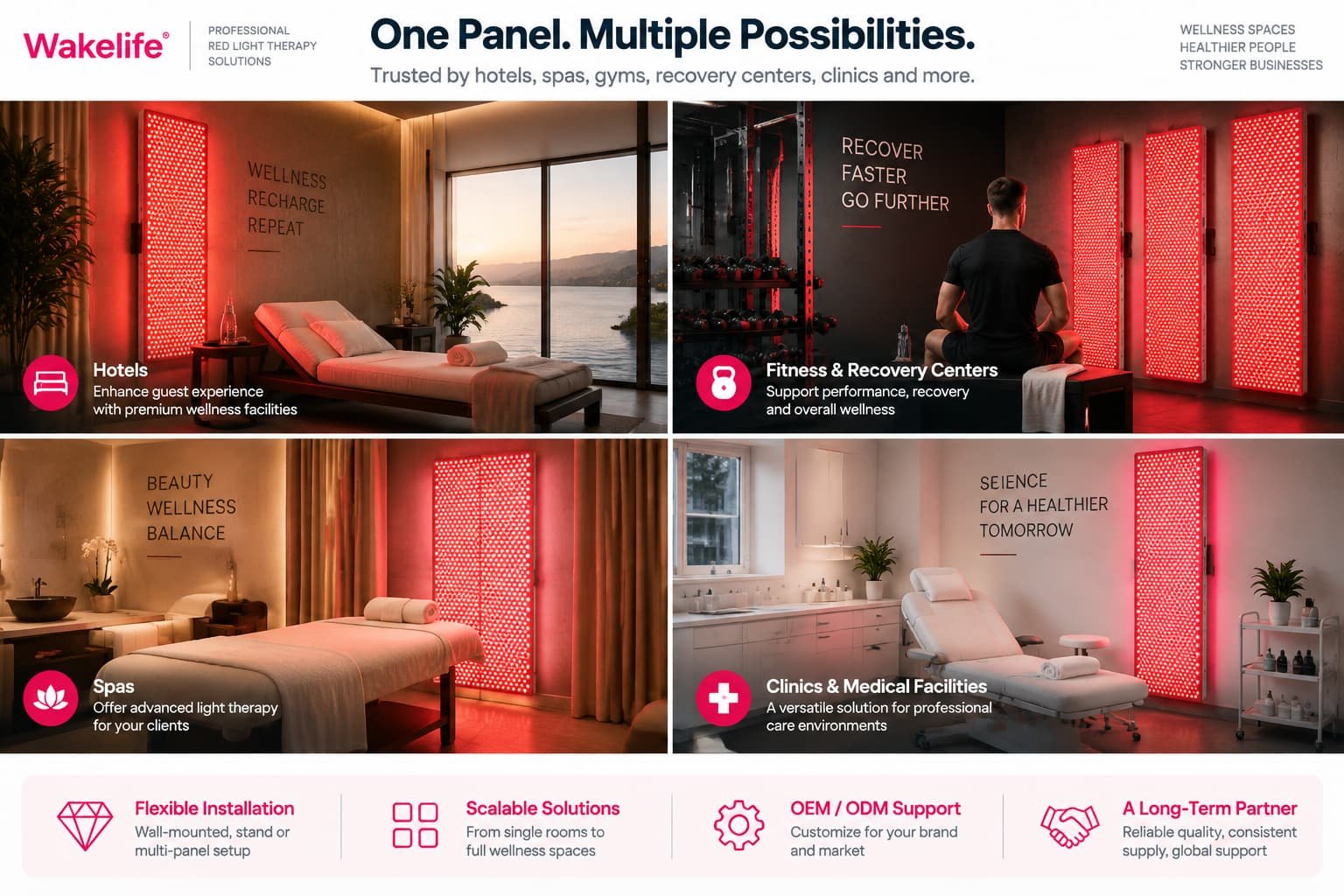
TL;DR (voor kopers) BK900 is een UVB-bruining voor het halve lichaam & lichtblootstellingspaneel - geen medisch apparaat. Er wordt geen diagnose gesteld, traktatie, genezing, of een ziekte voorkomen. 180 LED's. 9 golflengten, UVA-vrij. 7 modi. Gebouwd onder ISO 13485 + MDSAP in een FDA-geregistreerde faciliteit. Voor merken die de UVB-categorie al hebben gevalideerd en klaar zijn om premium te gaan – of voor studio's en wellnessruimtes die dekking van het halve lichaam nodig hebben met meetbare output en een eerlijke compliance-positionering.
1. Laten we duidelijk zijn over wat dit apparaat is – en wat niet
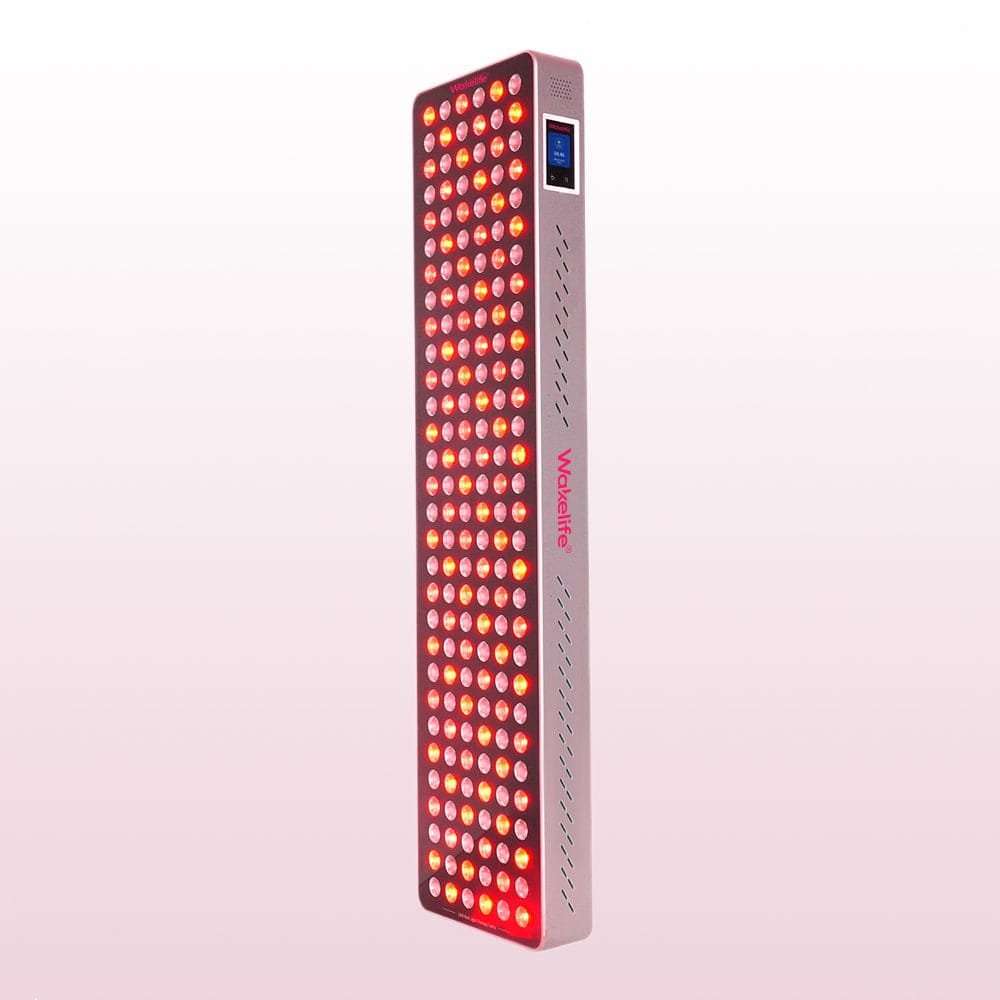
BK900 is een UVB-bruiner voor consumenten / lichtbelichtingspaneel. Er wordt geen diagnose gesteld, traktatie, genezing, of een ziekte voorkomen, en mag nooit op die manier op de markt worden gebracht.
De nalevingsstatus: de BK-serie is CE geslaagd, FCC, en RoHS-testen, het is vervaardigd onder ISO 13485 + MDSAP systemen in een FDA-geregistreerde faciliteit, En BK900 is opgenomen in de FDA-informatie over apparaten.
Eén onderscheid zullen we niet vervagen, en dat zou jij ook niet moeten doen: A apparaatlijst is registratie van het apparaat bij de FDA. Het is niet een FDA-‘goedkeuring’ of ‘goedkeuring’. De FDA zelf is expliciet op dit punt – zie Apparaatregistratie en -lijst En 510(k) Premarket-melding. Onze faciliteit heeft een aparte 510(k) goedkeuring (K250830), maar die goedkeuring behoort tot een specifiek LED-gezichtsmasker, niet tot BK900. U kunt dit zelf verifiëren in de FDA 510(k) database. We laten die twee niet samensmelten, en we raden u aan ze ook op uw eigen pagina's gescheiden te houden.
Waarom hiermee openen?? Omdat we kopers een opgeblazen specificatieblad op een DTC-winkel hebben zien plakken en een probleem met de naleving van het platform tegenkwamen. Wij zeggen liever één zin minder dan dat u aansprakelijk bent voor onze bewoordingen. Alles wat volgt gaat ervan uit dat je dit onderscheid hebt overgenomen.
Als je helemaal nieuw bent in de UVB-categorie - en het volledige beeld van IARC Group wilt 1 classificatie, 311nm klinische achtergrond, en de engineering-control-filosofie – we behandelen het diepgaand in de BK300-opschrift. Alles wat daar staat, geldt ook voor de BK900. Deze pagina richt zich op wat er anders is: stroom, dekking, en kanaalpasvorm.
2. Een halfbodypaneel dat praktisch blijft
Wanneer wellnessmerken een lichtblootstellingspaneel evalueren voor private-labelproductie, twee vragen komen meestal eerst: Is het gebouwd volgens een echte kwaliteitsnorm?? En Houdt het specificatieblad daadwerkelijk stand?? De BK900 is ontworpen met beide in gedachten.
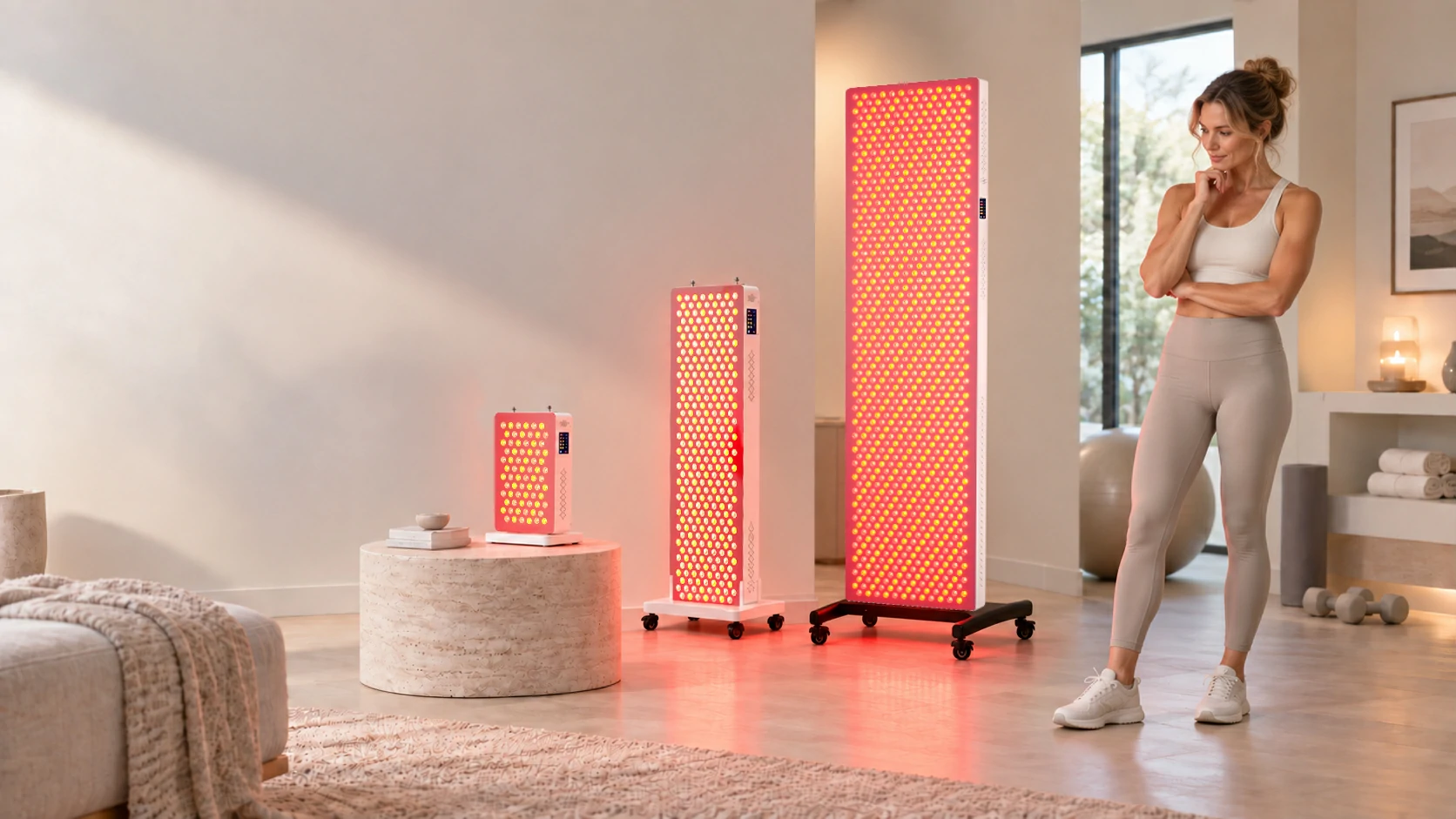
Bij 890 × 220 × 65 mm, de BK900 is gebouwd rond dekking over de halve lichaamslengte. Dankzij de lengte van 890 mm kunnen gebruikers de romp aanspreken, rug, of benen over een betekenisvolle overspanning, terwijl de breedte van 220 mm het paneel licht van gewicht houdt, eenvoudig te monteren, en eenvoudig te verzenden. De behuizing maakt gebruik van een voor- en achterkant van koudgewalst staal met een AL6063 aluminium frame — afgewerkt in helder geanodiseerd zilver, met aangepaste kleuropties beschikbaar voor OEM-partners.
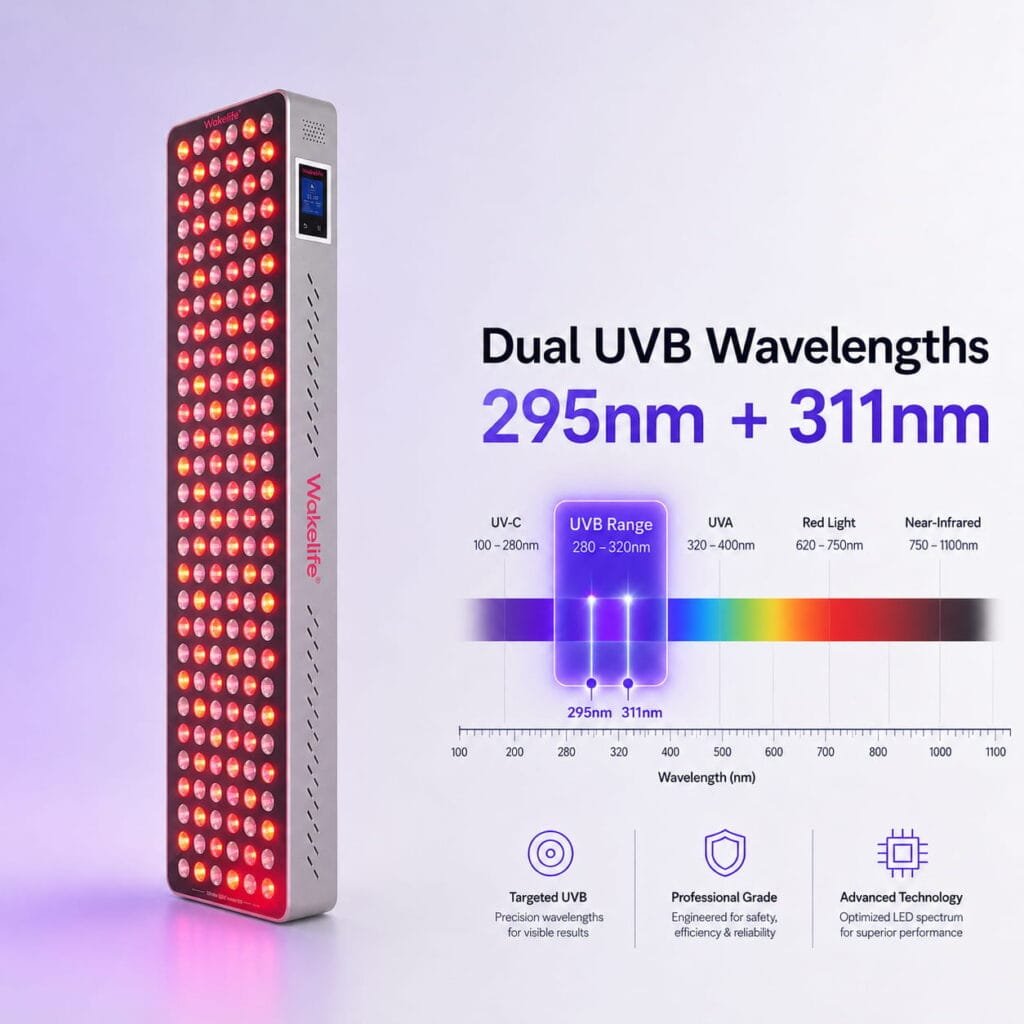
Achter de diffuser zitten 180 SMD 3535 LED's, het combineren van driekleurige chips met drie kernen naast chips met één enkele kern en één kern. Dankzij deze architectuur kan het apparaat negen verschillende golflengten leveren vanuit één enkel paneel, zonder dat dit ten koste gaat van de uitgangsdichtheid. Vier lichtcategorieën onder één behuizing:
- UVB (295nm + 311nm) — bruinings- en UVB-belichtingsmodi, geregeld door een ingebouwde afstandssensor
- Blauw-violet (415nm) — gerichte huidverzorgingsroutines
- Rood (630nm + 660nm) — Huidroutines op oppervlakteniveau
- Nir & EN (810nm + 830nm + 850nm + 1060nm) – dieper, herstelgerichte routines
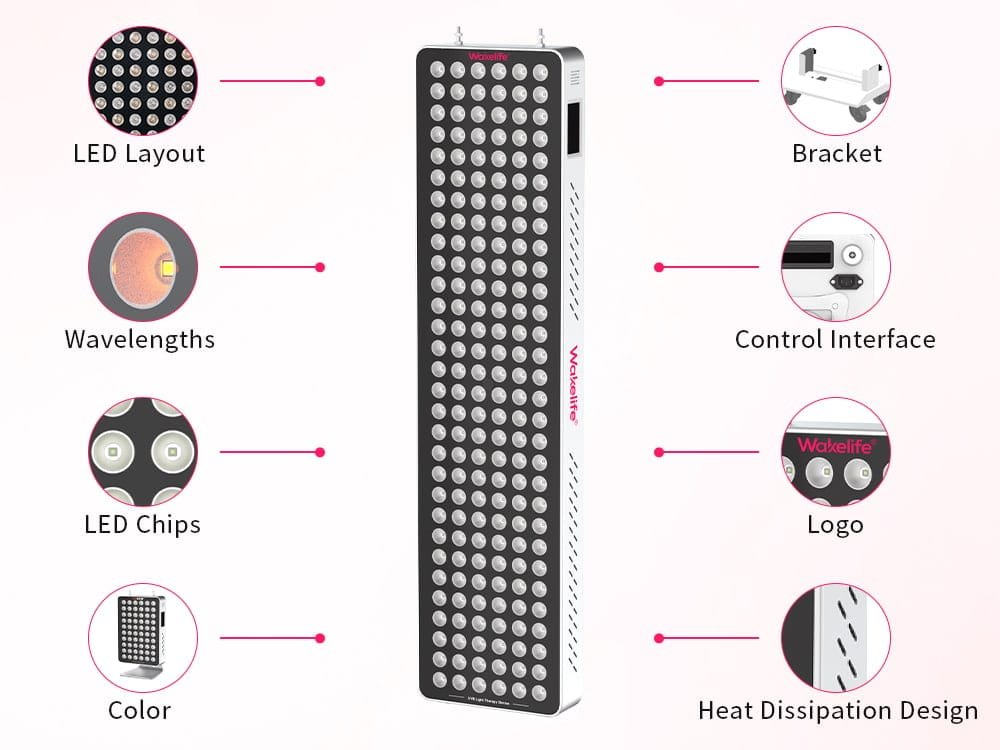
Uitgang is volledig instelbaar: helderheid loopt van 0–100%, pulsfrequentie 0–40 Hz, en de ingebouwde timer kan worden ingesteld 5 naar 20 notulen. Allemaal bestuurd via een 3.0″ TFT LCD-aanraakscherm. Het paneel accepteert 100–240 V AC bij 50/60 Hz en heeft een IP20-beschermingsgraad.
3. U verdient pas het recht om ‘gecontroleerd’ te zeggen nadat u eerlijk bent geweest over het risico
De meeste panelen vermijden UVB omdat, ongecontroleerd, het brandt – en chronische overmatige blootstelling brengt een reëel risico op huidkanker met zich mee. IARC (het kankeronderzoeksbureau van de WHO) classificeert UV-uitstralende bruiningsapparaten als Groep 1 kankerverwekkende stoffen — de categorie met het hoogste risico — gedocumenteerd in IARC-monografieën Deel 100D: Straling. De UV-straling van de WHO Q&A stelt dit duidelijk voor een algemeen publiek.
Onze logica: Risico’s worden niet weggenomen door vermijding, maar door technische controle. De lijn is altijd gecontroleerd versus. ongecontroleerd.
Hier is precies hoe BK900 het afdwingt:
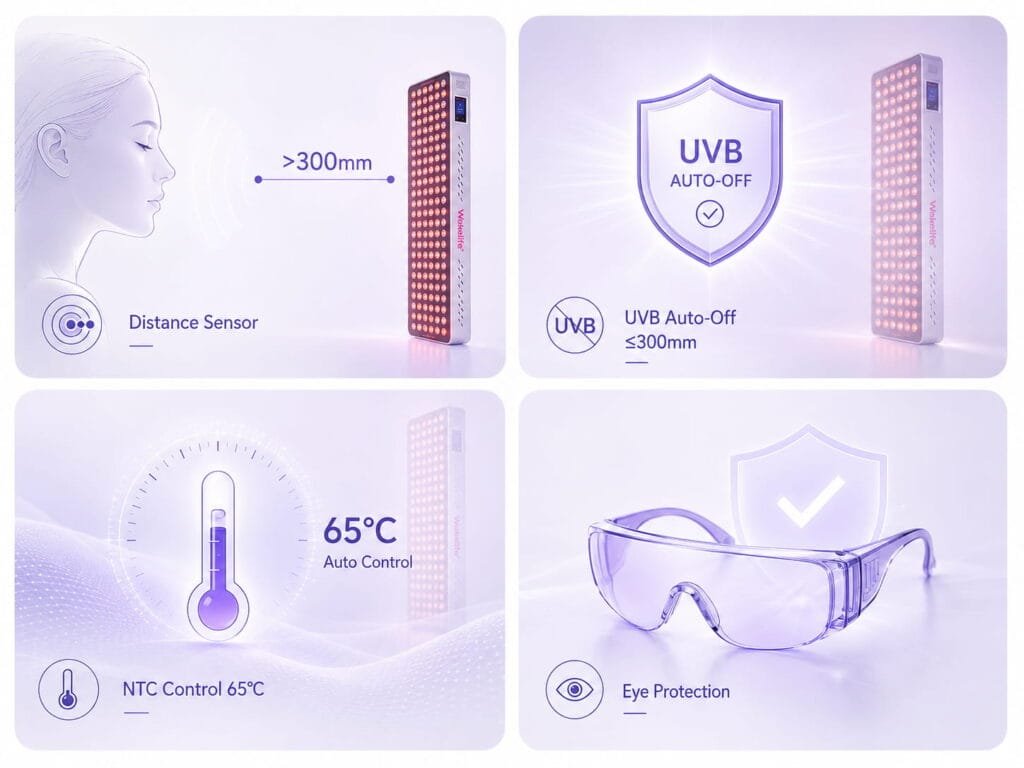
- Afstandssensor + automatische UVB-uitschakeling: UVB wordt alleen geactiveerd als de gebruiker zich daarbuiten bevindt 300mm (30cm). Als de gebruiker zich binnen die drempel beweegt, het UVB-kanaal snijdt fysiek af - geen waarschuwingslicht, een harde afsluiting.
- NTC-temperatuurregeling: boven 65°C, het apparaat vermindert automatisch het stroomverbruik – voordat het een veiligheidsgebeurtenis wordt.
- Inclusief veiligheidsbril — in overeenstemming met de fotobiologische veiligheidsprincipes zoals uiteengezet in ICNIRP-richtlijnen over de grenzen van blootstelling aan ultraviolette straling, de internationaal erkende, vrij toegankelijke referentie voor grenswaarden voor UV-blootstelling. Deze eis moet op de verpakking worden versterkt, in de gebruikershandleiding, en in al het onboardingmateriaal dat een merk voor eindgebruikers voorbereidt.
- Zoemer waarschuwing op onveilige werkafstand.
Dit is wat ‘techniek de controle draagt – niet de handleiding’ feitelijk betekent.
4. 9 Golflengten, UVA-vrij
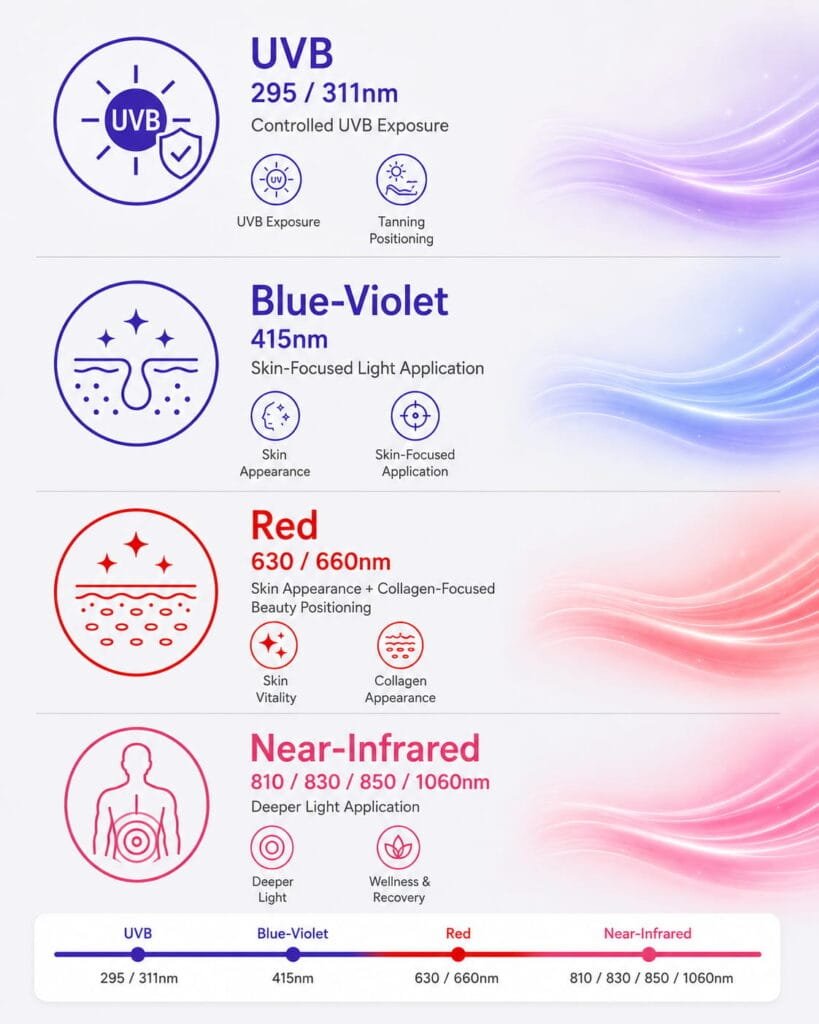
Het spectrum van BK900: 295/311nm (UVB), 415nm (blauwviolet), 630/660nm (rood), 810/830/850/1060nm (NIR/IR). Geen UVA – de band die het meest geassocieerd wordt met fotoveroudering en DNA-schade, zoals gedetailleerd door de UVA/UVB-uitleg van de Skin Cancer Foundation. “UVB-gedreven, UVA-vrij” is een schonere onderscheidende factor dan traditionele zonnebanken. Verdun het niet door UVA te impliceren.
De golflengten veranderen niet ten opzichte van BK300. Wat verandert, is met welke je leiding geeft. Op een premium halfbodypaneel, bruinen (UVB) en herstel van diep weefsel (Nir) worden de heldenverhalen, niet de ondersteunende cast.
5. Zeven modi, Eén display – met namen die eerlijk blijven
De BK900 biedt zeven selecteerbare modi via het ingebouwde 3,0-inch TFT LCD-aanraakscherm. De weergavenamen zijn vastgelegd op de apparaatinterface; Wat voor compliance van belang is, is de positioneringstaal die u in uw marketing gebruikt. Voor M4 “Afname” en M6 “Botgezondheid” in het bijzonder – namen die effecten kunnen impliceren waarvoor het apparaat niet is goedgekeurd – gebruiken de positioneringstaal, niet de weergavenaam.
M1 · Bruinen — 630/660 + 810/830/850/1060 + 295/311nm
Positionering: “UVB-bruiningsroutine.” UV-bruiningsmodus, werkt voorbij de werkafstandsdrempel van 300 mm die wordt opgelegd door de afstandssensor. Voorkomen: “veilig bruinen, nul risico”
M2 · Huidcollageen — 630/660 nm
Positionering: “Huidwelzijnsroutine.” Huidverzorgingsroutine bij rood licht. Voorkomen: “keert veroudering tegen”
M3 · Spierherstel — 810/830/850/1060 nm
Positionering: “Herstel- en lichaamswelzijnsroutine.” NIR-dominante modus voor routines na activiteit. Voorkomen: “behandelt spierblessures”
M4 · Verlagen — 630/660 + 295nm
Positionering: “Rustgevende lichte routine.” Rustgevende modus met lage intensiteit. Voorkomen: “vermindert ontsteking”
M5 · Acneverzorging — 630/660 + 415nm
Positionering: “Ondersteuning voor acnegevoelige huidverzorging.” Blauwviolet (415nm) gerichte lichte routine voor huidverzorging. Voorkomen: “behandelt acne”
M6 · Botgezondheid — 295/311nm
Positionering: “Routine voor blootstelling aan UVB-licht.” UVB-belichtingsmodus, werkt verder dan 300 mm werkafstand. Voorkomen: “ondersteunt de gezondheid van de botten”
M7 · Aangepast — Door de gebruiker geselecteerde golflengten, tijd, en pols
Positionering: “Flexibele OEM/ODM-instelling.” Operators kunnen hun eigen uitvoercombinatie configureren, pulsfrequentie, en timing – waardoor het panel aanpasbaar is voor verschillende merkpositioneringen en eindgebruikersroutines.
6. De instralingscijfers begrijpen - eerlijk gezegd
Instraling is waar veel panelen vaag worden. De cijfers van de BK900 zijn gemeten op vaste afstanden:
3 inch (~76 mm): 160–180 mW/cm² 9 inch (~229 mm): 60–80 mW/cm² 12 inch (~305 mm): 60–80 mW/cm²
Drie dingen die u moet weten om deze cijfers correct te kunnen lezen:
Eerst, het 7,5 cm-cijfer is een meetreferentie en geen aanbeveling voor UVB-gebruik. Omdat de afstandssensor UVB bij ≤300 mm afsnijdt, echte UVB-blootstelling vindt plaats bij een bereik van meer dan 30 cm, d.w.z., de 60–80 mW/cm²-zone. Als uw marketing ‘stand 3 centimeters verwijderd voor maximaal vermogen,Dat is in tegenspraak met de eigen veiligheidslogica van het apparaat. Vertel uw eindgebruikers de veilige gebruiksafstand, en de dosimetrie blijft eerlijk.
Seconde, de hogere output op meetafstand weerspiegelt nog steeds een reëel technisch verschil ten opzichte van de meetafstand. BK300. De 180 LED-array en het grotere oppervlak van de BK900 zorgen ervoor dat er meer fotonen worden afgeleverd over een halflichaamszone op veilige werkafstand. Voor een merkeigenaar, dit ondersteunt premiumprijzen met data – het is het verschil tussen “ons panel is krachtig” En “Ons paneel levert 60–80 mW/cm² op werkafstand – hier zijn de metingen.”
Derde, UVB-output is niet opgenomen in de bovenstaande bestralingscijfers. Deze waarden hebben betrekking op het gecombineerde rood + nabij-infrarood-uitvoer. UVB (295nm / 311nm) wordt alleen geactiveerd vanaf 300 mm, bestuurd door de ingebouwde afstandssensor. We scheiden deze omdat UVB-dosimetrie een ander gesprek is dan rode/NIR-uitvoer – en het samenvoegen ervan creëert compliance-risico’s stroomafwaarts.
7. Voor wie is de BK900 eigenlijk bedoeld?
De Studio of Wellnessruimte
U hebt een apparaat nodig dat een behandelkamer vult. Half-lichaamsdekking. Meetbare output waar uw personeel serviceprotocollen omheen kan bouwen. Veiligheidsarchitectuur die aansprakelijkheidsvragen beantwoordt: automatische uitschakeling van de afstandssensor, temperatuurregeling, beschermende brillen. Eén eenheid, zeven modi. Minder apparatuur om te beheren.
Je hebt een compact paneel gelanceerd. Het werkt. Nu vragen uw distributeurs om een premium SKU, iets dat ze tegen een hogere prijs op professionele accounts kunnen plaatsen. De BK900 past in uw bestaande supply chain zonder dat u een nieuwe leveranciersrelatie hoeft aan te gaan. Architectuur met dezelfde golflengte. Dezelfde productiefaciliteit. Hetzelfde compliancepakket. Alleen verpakt voor een ander niveau.
Het Premium Private Label-project
Je bouwt een merk rond professioneel bruinen en blootstelling aan licht. Je hebt een hero-product nodig: iets dat eruitziet en presteert als een vlaggenschip. Half-body-formaat. Aanraakscherm. Aangepaste gebruikersinterface via M7. Jouw logo, jouw kleur, uw golflengtevoorinstelling. Breng het op de markt als een apparaat van studiokwaliteit, gebouwd volgens uw specificaties.
Ik weet niet zeker of de BK900 de juiste pasvorm heeft? Als u de UVB-categorie voor de eerste keer test, hebben lagere MOQ en vrachtkosten nodig, of richten zich op thuisgebruikers in plaats van op professionele kanalen — BK300 is het instappunt. BK900 is waar je naar toe studeert zodra de categorie bewezen is.
8. Snelle specificatiereferentie
| Item | BK900 |
|---|---|
| Type | UVB-bruining van het halve lichaam & lichtbelichtingspaneel |
| Afmetingen | 890 × 220 × 65 mm |
| Dekking | Halve lichaamslengte (torso, rug, benen) |
| LED's | 180 pc's (SMD 3535, driekleurige drie-core + enkele kleur enkele kern) |
| Golflengten | 295, 311, 415, 630, 660, 810, 830, 850, 1060nm (UVA-vrij) |
| Modi | 6 voorinstelling + 1 aangepast |
| Weergave | 3.0″ TFT LCD-aanraakscherm |
| Helderheid / Puls / Timer | 0–100% / 0–40 Hz / 5–20 min |
| Bestraling | 160-180 @3in; 60–80 @9–12in (MW/cm²) — UVB niet inbegrepen; UVB wordt alleen geactiveerd vanaf 300 mm |
| Veiligheid | Afstandssensor (UVB automatische uitschakeling ≤300 mm), NTC ≤65°C, bril inbegrepen, zoemer |
| Huisvesting | Koudgewalst stalen deksel; AL6063 aluminium frame |
| Finish | Helder geanodiseerd zilver (aangepaste kleuren beschikbaar voor OEM) |
| Spanning / IP | 100–240 V wisselstroom, 50/60Hz / IP20 |
| Naleving | CE, FCC, ROHS; ISO 13485 + MDSAP; FDA-apparaat vermelding |
9. BK300 vs. BK900: Welke past bij jouw kanaal?
| BK300 (Compact) | BK900 (Halflichaam) | |
|---|---|---|
| LED's | 60 pc's | 180 pc's |
| Bestralingssterkte @3in | 130–150 mW/cm² | 160–180 mW/cm² |
| Bestralingssterkte @9–12in | 40–60 mW/cm² | 60–80 mW/cm² |
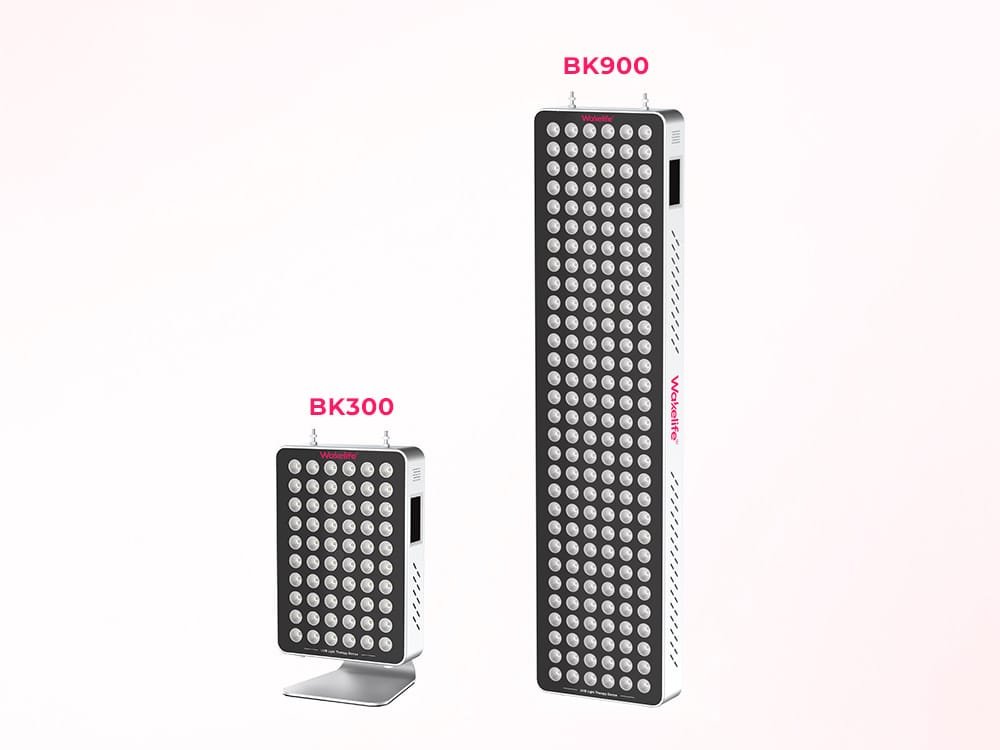
| Afmetingen | 320 × 220 × 65 mm | 890 × 220 × 65 mm |
| Beste pasvorm | Instapniveau, enkele zone, markt testen, prijsgevoelige kanalen | Professionele kanalen, studiogebruik, premium SKU's, gevestigde UVB-merken |
| Niet voor | Half-lichaamsdekking, positionering op studioniveau | Toegang tot de markt voor lage vrachten, vraag testen met een beperkt budget |
BK300 en BK900 zijn niet de enige beschikbare formaten. Kopers die ook een groter paneel met selecteerbare bedieningszones nodig hebben, kunnen dat vergelijk het complete assortiment UVB-panelen uit de BK-serie, inbegrepen BK1800.
10. Waarom de productiestandaard ertoe doet
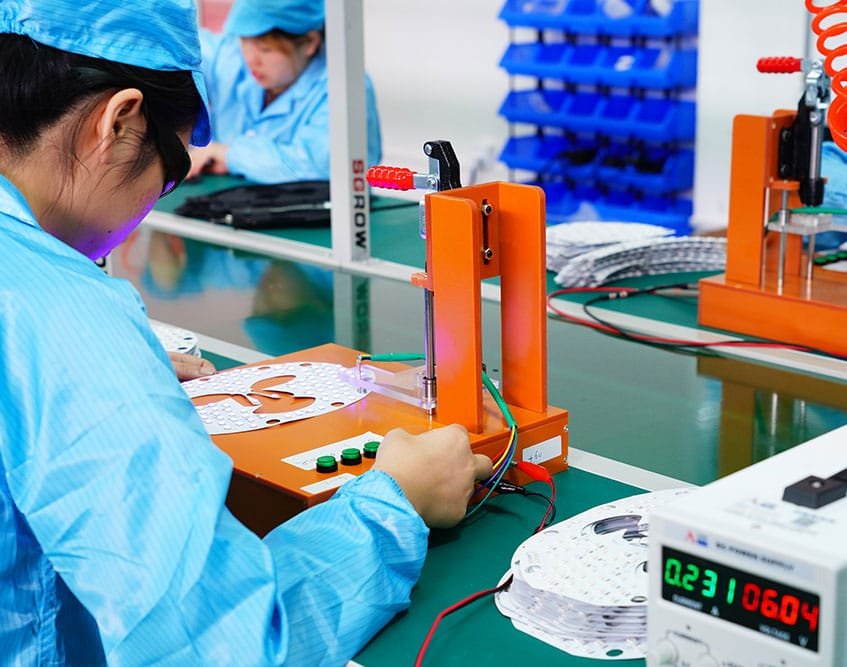
Er zijn veel leveranciers die een paneel kunnen verzenden. Er kunnen er minder worden verzonden die zijn gemaakt onder een systeem dat toezichthouders en serieuze particuliere kopers herkennen. De BK900 is geproduceerd onder een ISO 13485 kwaliteitsmanagementsysteem, in een voorziening dus FDA-geregistreerd en MDSAP-gecertificeerd, met het apparaat inbegrepen FDA-apparaatlijst.
Het is de moeite waard om precies te zijn over wat dat wel en niet betekent. De ISO 13485 / MDSAP-certificering en FDA-registratie beschrijven de kwaliteitssysteem en de faciliteit – de discipline, traceerbaarheid, en procescontrole achter hoe de BK900 is gebouwd. Ze zijn geen vervanging voor apparaatspecifieke goedkeuringen, en BK900 wordt niet op basis daarvan op de markt gebracht 510(k) goedkeuring. Voor OEM/ODM-partners, het praktische voordeel is eenvoudig: u koopt in bij een fabrikant wiens processen worden gecontroleerd volgens een erkende norm, wat due diligence vereist, documentatie, en downstream compliance is veel eenvoudiger te beheren.
Maatwerkopties bestrijken het volledige OEM/ODM-spectrum: logo, kleur, verpakking, touchscreen gebruikersinterface, app-integratie, en golflengteconfiguratie via de M7 Custom-modus.
11. Volgende stap voor kopers
Vertel ons drie dingen: uw doelgroep, de kanalen waarop u verkoopt (studio? welzijn? thuis?), en uw verwachte volume. Wij matchen het juiste BK-model, nalevingsrichtlijnen geven, en u een inzetbaar contentframework aanreiken. Wij reageren binnen 24 uren.
Lees Volgende
Referentielijst
- ONS. FDA — Apparaatregistratie en -lijst
- ONS. FDA — Premarket-melding 510(k)
- ONS. FDA — 510(k) Database met premarket-meldingen
- IARC — Monografieën Deel 100D: Straling (UV-bruiningsapparaten, Groep 1)
- WHO - UV-straling Q&A
- ICNIRP — Richtlijnen voor de grenzen van blootstelling aan ultraviolette straling
- Stichting Huidkanker — UV-straling (UVA/UVB)
- Amerikaanse Academie voor Dermatologie — Fototherapie overzicht
- Almutawa et al. — Werkzaamheid van gelokaliseerde fototherapie voor psoriasis, PMC3047947
- Brenner & Horen — Beschermende rol van melanine tegen UV-schade, PMC2671032
- NIH Bureau voor Voedingssupplementen — Vitamine D (Informatieblad voor gezondheidsprofessionals)