A fuller-looking “after” photo can make a laser cap feel like an easy choice. Before letting it influence your purchase, separate three questions: Are the pictures comparable? What caused the change? How much can this person’s result tell you about your own chances?
Photos taken under similar conditions can help show changes in appearance. One person’s before-and-after pair, by itself, cannot isolate the cap’s contribution or tell you how often other buyers see a similar result. Missing details leave a question unanswered; they do not automatically mean the pictures are fake.
1. Are you comparing the same view?
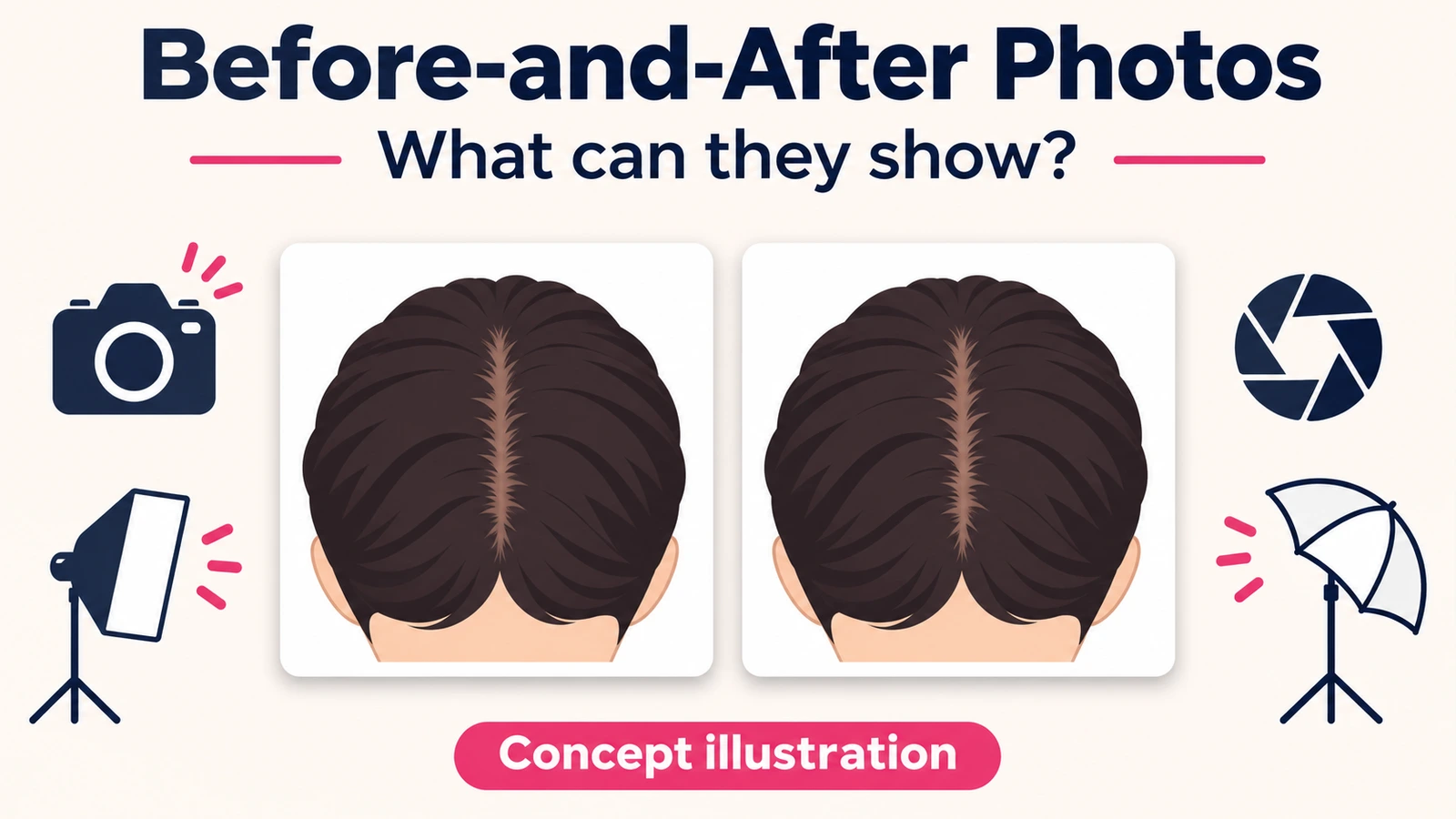
Start with what is visible. Is the scalp shown from the same angle? Is the head tilted differently? Are the parting and combing direction similar? Does the lighting make one image much brighter or cast different shadows?
These details matter because the comparison needs to show the same area under reasonably consistent conditions. Ashique and Kaliyadan’s clinical photography review emphasizes controlling head position, lighting, camera settings and hairstyle. The Institute of Medical Illustrators’ 2024 guide also addresses parting, camera distance and factors such as hairpieces that can complicate interpretation. These are photography principles, not evidence that any cap works.
Notice differences in hair length or styling too, and ask whether they were documented. You do not need a perfect studio setup to learn something from a photo. You do need enough consistency to distinguish a change in presentation from a change worth investigating.
An overall scalp photograph can show apparent coverage. It does not, on its own, support a claim that a specific number of new hairs appeared. Counting hairs in a defined area involves a separate measurement procedure, as the clinical photography review explains.
Fictional example A: fuller coverage, uncertain comparison
An invented seller page shows a bright, overhead “before” photo with a wide parting. In the “after” photo, the head is tilted, the hair is longer and brushed across the area, and the lighting is softer. The page gives no clear dates or account of what happened between the pictures.
Decision: pause using this pair as a reason to buy. The second picture looks fuller, but the pair does not let you confidently judge how much the underlying hair changed.
Ask for dated photos showing the same area with similar lighting, head position and parting, plus an explanation of the process between them. If those details are unavailable, keep the photo’s contribution to your decision small. There is no need to decide whether the seller intended to mislead.
2. What else changed between the pictures?
A more consistent pair answers the first question better. It still does not establish what caused the change.
Look for an account of the exact device used and any other hair-loss treatments started, continued or changed during the same period. A timeline that records several changes can document someone’s experience, but it cannot separate their individual contributions.
This is a study-design limitation: a person’s earlier appearance is not a comparison group showing what would have happened over the same period without the cap.
Fictional example B: clearer photos, mixed treatment history
A second invented page supplies dates, the cap model and a usage record. The photos show similar angles, lighting and parting. The customer also says they started another hair-loss treatment during the same period.
Decision: retain the pair as an appearance record, while leaving the cap’s individual contribution unresolved. The visible change is easier to assess than in example A. It still cannot tell you how much came from the cap.
The useful next step is to check controlled research for the relevant device and participant group. Changing or stopping treatment yourself would not resolve the limitations of this seller’s example.
A controlled study can illustrate the additional evidence to look for beyond a personal photo pair. One 24-week, randomized, double-blind study of the RAMACAP helmet enrolled 40 Thai adults with pattern hair loss; 36 completed it. Researchers combined standardized overall photographs, density and diameter measurements in a defined scalp area, and ratings by three dermatologists unaware of group assignment. A sham-device group provided a comparison, although the authors acknowledged its red LEDs were not a truly negative control. Suchonwanit et al., 2019.
The sample was small and long-term follow-up was lacking. The authors declared no conflicts of interest, but their institution co-developed the device with Thailand’s National Innovation Agency, which supported experimental materials. These are methods and limitations to examine, not validation of another product’s sales photos.
3. Who is missing from the gallery?
Even well-documented improvement in one person leaves a separate question: how representative is that person?
A gallery of several people who improved does not tell you how many people used the device in total, how many showed little or no change, or how many stopped providing follow-up information. Without that wider picture, you cannot calculate a typical buyer’s chance of getting the displayed result.
Ask how the examples were selected. If they came from a defined follow-up group, two useful questions are:
- “How many people were in that group, and how many had usable photos at the follow-up shown?”
- “Among those with follow-up photos, how many showed little or no improvement?”
If the gallery consists only of selected testimonials, it does not provide the group totals needed for this comparison. If a seller links a study, read beyond its most striking photos: look for the participant group, device, comparison group, measured outcomes and incomplete follow-up. Check whether that evidence actually applies to the product being sold.
Photos can be useful records within this larger evidence picture. Personal success stories cannot replace scientific evidence, a distinction also made in FDA consumer guidance.
Use the answer to make your next buying decision
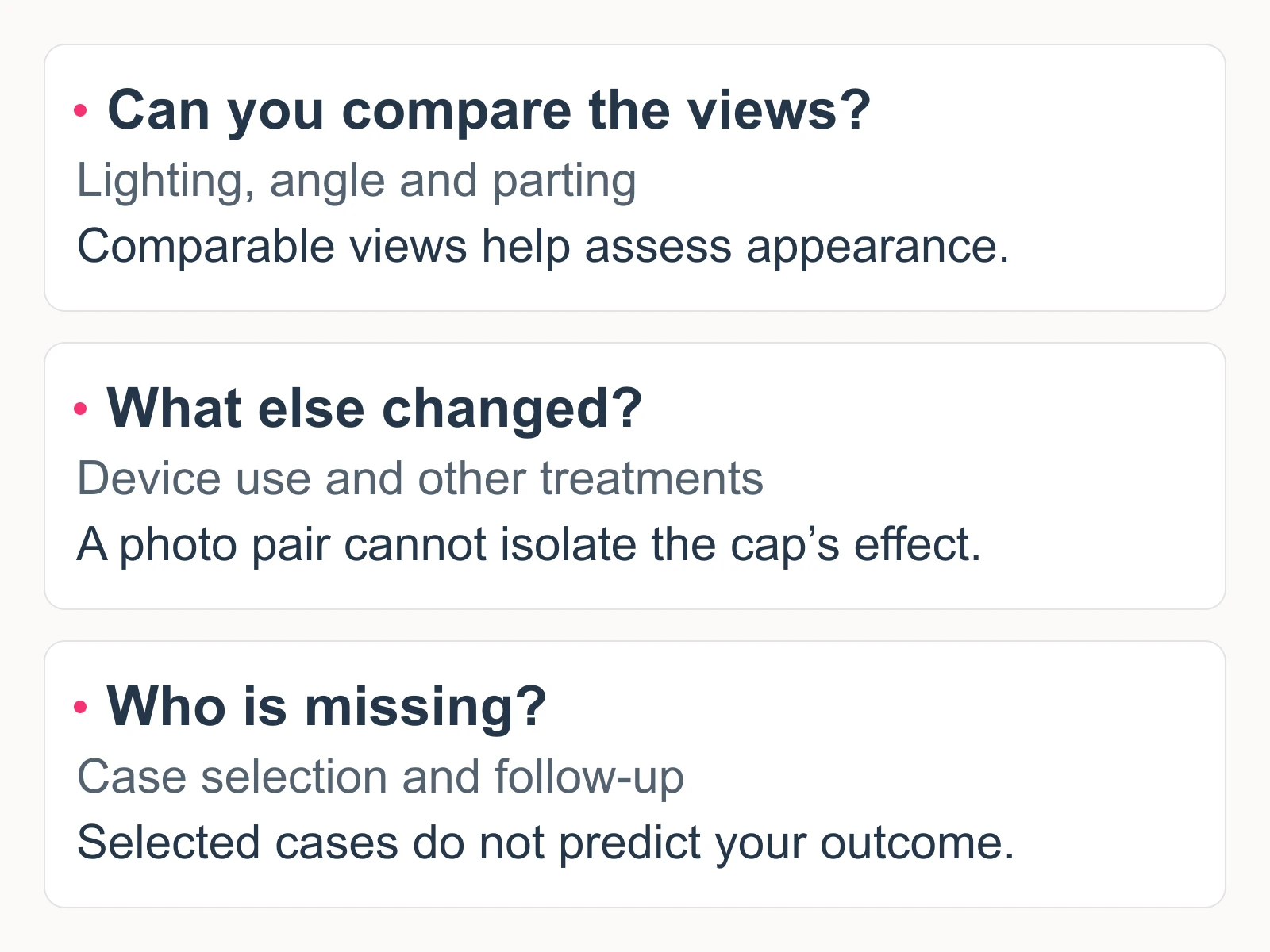
Choose the missing detail that would most affect your judgment and ask about it before paying. A useful answer should provide something you can inspect—a clearer photo sequence, a treatment history or relevant study results.
If the answer remains incomplete, treat that uncertainty as part of the purchase decision. You can continue comparing devices without treating the gallery as a prediction of your own outcome. Our guide to whether expensive laser hair-growth caps are worth it covers the wider price-and-value comparison.
If you already own a device, the hair-growth device results timeline guide addresses personal tracking. A sales gallery and your own progress record serve different decisions.
For brands and distributors
Explore Wakelife’s hair-growth device range for OEM/ODM projects to compare cap, helmet and comb platforms for your product line.
References
-
1
Ashique KT, Kaliyadan F. Clinical Photography for Trichology Practice: Tips and Tricks. International Journal of Trichology. 2011;3(1):7–13. Photography methods review.
-
2
Institute of Medical Illustrators. Hair Loss Photography: A Guide to Good Practice. Version 1.0, March 2024. Professional photography guidance.
-
3
Suchonwanit P, et al. Low-level laser therapy for the treatment of androgenetic alopecia in Thai men and women: a 24-week, randomized, double-blind, sham device-controlled trial. Lasers in Medical Science. 2019;34:1107–1114. Cited here for study methods.
-
4
U.S. Food and Drug Administration. 6 Tip-offs to Rip-offs: Don’t Fall for Health Fraud Scams. Consumer education.