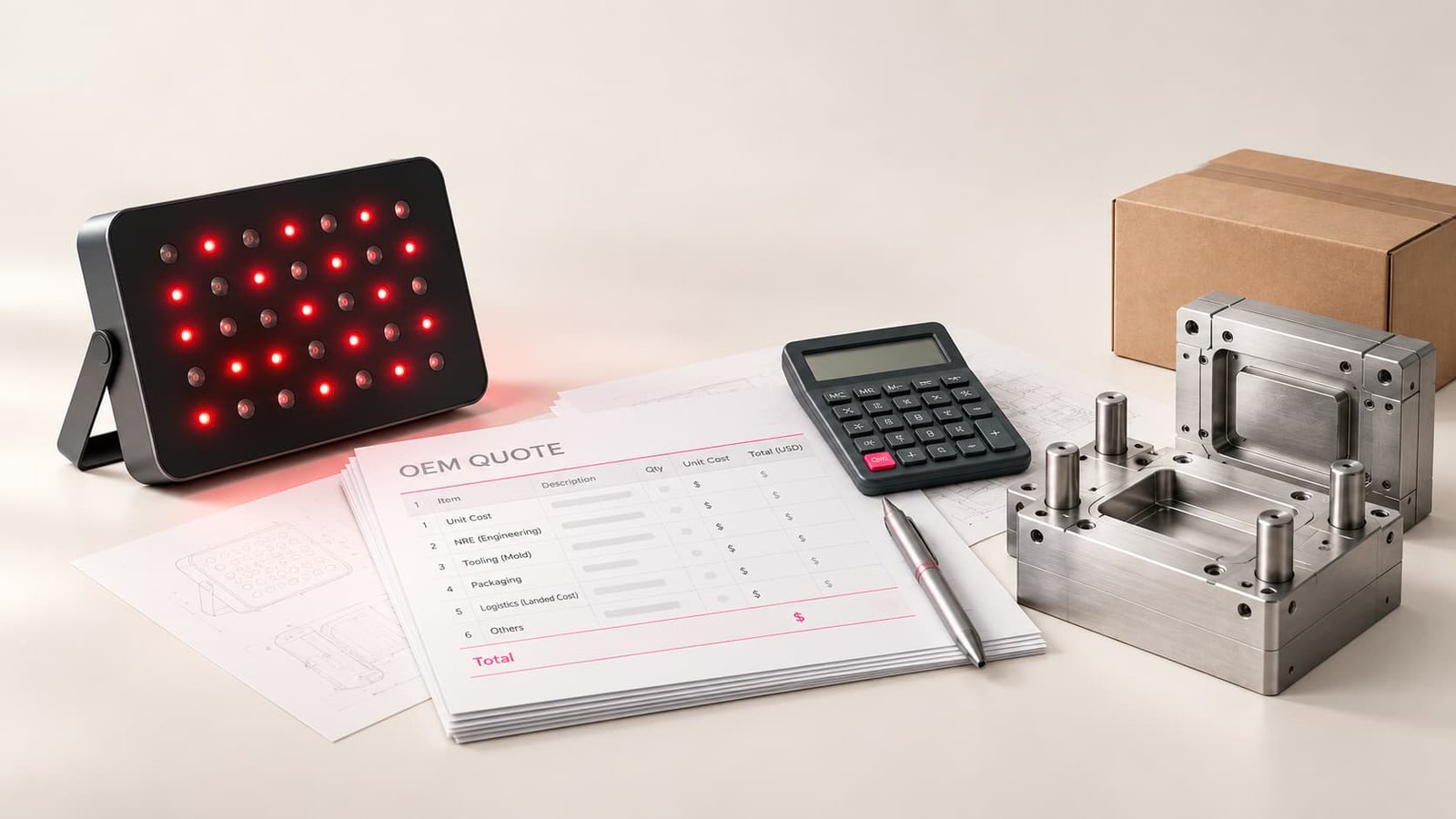
Moving from dropshipping to private label makes sense when one product has produced repeatable demand and your team is ready to take responsibility for the product experience around it. The decision is larger than adding a logo. It changes how you approve the device, fund inventory, manage packaging, plan fulfillment and support customers after delivery.
A cautious operating default for a first project is a staged transition: keep the current store operating only while its exact SKU, listing, instructions and fulfillment remain identifiable and supportable, then verify a separate private-label sample and prepare a limited first order. Switch the listing only after the product, packaging, documentation and fulfillment path are approved together.
This guide uses “hair-growth device” as a commercial category phrase for products such as scalp caps, helmets and combs. It does not establish that a particular device has an authorized hair-growth indication or that one product’s evidence applies to another.
Before the Seven Steps: Check Your Private-Label Readiness
You are ready to evaluate private label when your store can answer five questions with its own data and named owners. A viral week or a supplier’s sales screenshot is not enough.
| Readiness area | Evidence to review | Pause when |
|---|---|---|
| Demand | Orders by week, channel and country; repeatable conversion rather than one promotion | Sales depend on one short spike or cannot be separated by SKU |
| Product fit | Return reasons, support questions, reviews and the exact product customers received | You cannot identify the current device or explain recurring complaints |
| Cash and inventory | Funds available after advertising, refunds and operating costs; realistic stock exposure | The first order would remove the cash needed to keep the store operating |
| Brand ownership | A clear customer, positioning, product promise and owner for packaging and support | The plan is only to replace a generic logo with yours |
| Operations | Target markets, storage location, shipping route, warranty process and reorder owner | No one owns fulfillment, returns or replenishment |
There is no universal monthly-sales or MOQ threshold. Use your actual sales rate, the quoted minimum quantity, landed inventory cost, post-landing cost to serve, replenishment time and cash buffer to decide whether the first order is manageable.
Before the Seven Steps: Choose a Transition Model
Private label and fulfillment are separate decisions. A branded device may be shipped from your own warehouse, a third-party logistics provider or another agreed fulfillment arrangement. Whether a manufacturer can send individual orders must be confirmed separately; it should never be assumed from the words “private label.”
| Model | Best fit | Main control |
|---|---|---|
| Continue dropshipping while evaluating | Demand, cash or support data is incomplete, but the current SKU, configuration, listing, instructions and fulfillment remain identifiable and supportable | Keep collecting SKU-level sales, return and delivery data; keep the current product record intact |
| Hybrid transition | One SKU has repeatable demand and a traceable current configuration, while the wider catalog still uses dropshipping | Prevent the generic and branded versions from being mixed in listings, claims or fulfillment |
| Full private-label inventory | Demand is stable, the team can fund and store inventory, and the operating process is ready | Approve product, packaging, documentation, quality and replenishment as one system |
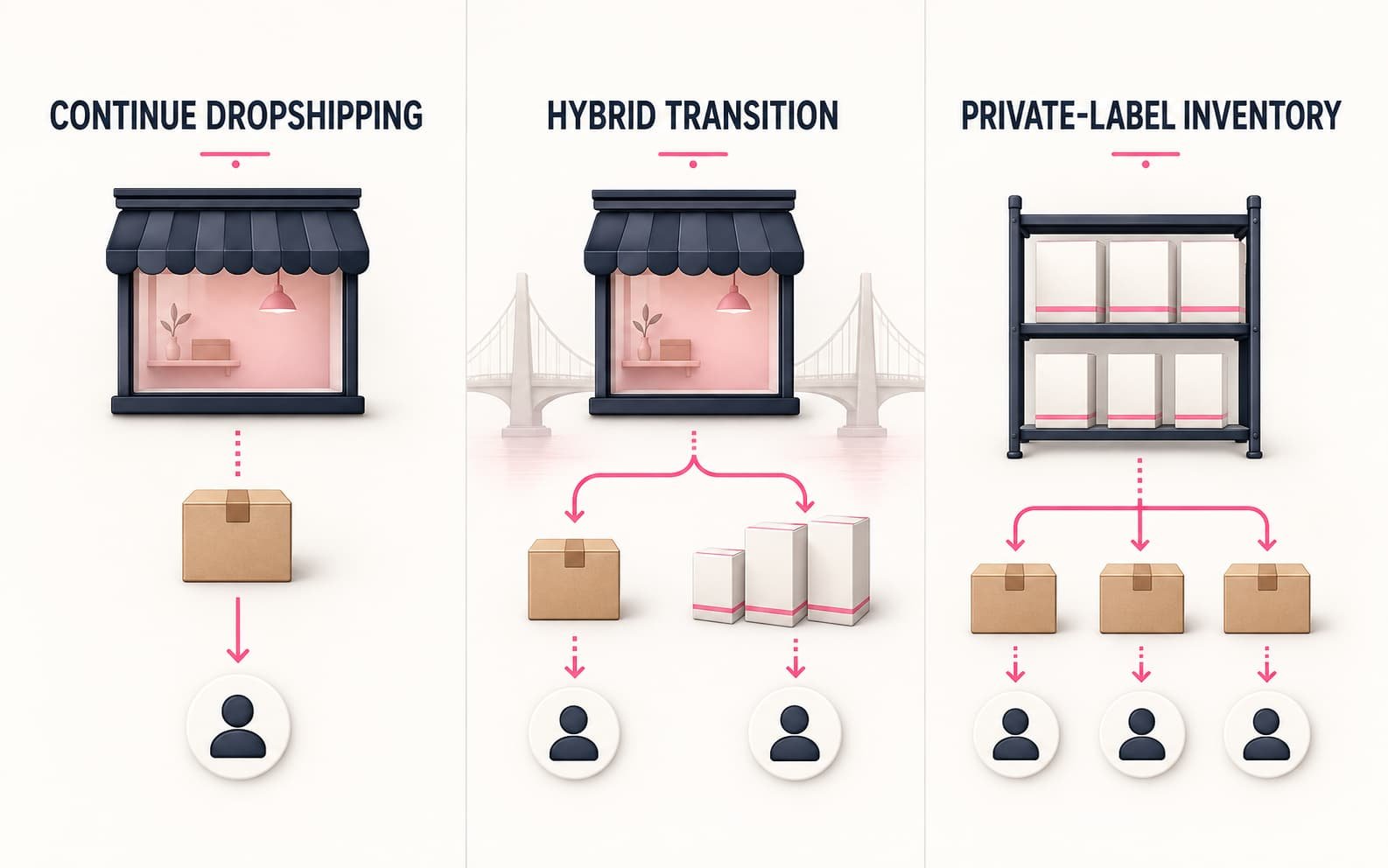
If the current product can remain accurately identified and supported, a hybrid transition is a cautious first option. It preserves current sales while the private-label version is being sampled and approved. It also lets the brand test its new packaging and support process before relying on a full inventory model. If you cannot map the current listing and instructions to the product customers actually receive, stop treating that route as a valid bridge and resolve the product mismatch first.
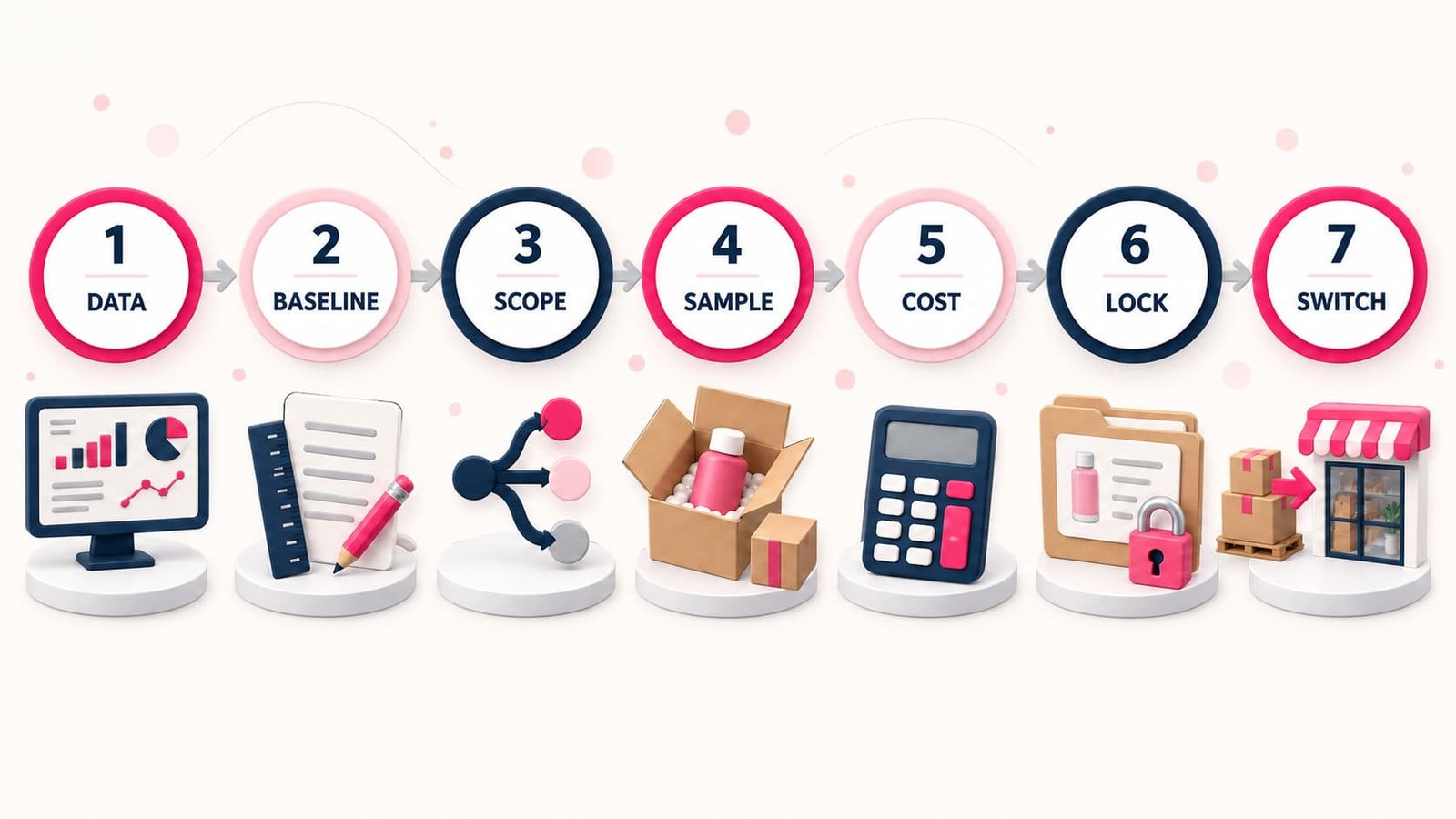
Step 1: Turn Store Data Into a Product Decision
Start with the SKU that has the clearest evidence, not the product with the most impressive supplier presentation.
Review:
- orders and conversion by week, country and channel;
- refunds, returns, chargebacks and delivery complaints;
- the questions customers ask before and after purchase;
- the product variant and accessories each customer actually received;
- which listing claims or images influenced the purchase; and
- whether demand remains when a discount or advertising campaign ends.
This review does not prove that the device works or that future demand is guaranteed. It tells you whether the store has a stable enough commercial problem to justify the next evaluation.
Write one product role before contacting a factory:
We want to evaluate a [comb/cap/helmet] as our first branded scalp-device SKU for [customer and channel]. The first sample must help us decide [the specific product, packaging and fulfillment questions].
If you have not chosen the form factor, compare the buying roles in Wakelife’s hair-growth device OEM/ODM guide before requesting prices.
Step 2: Identify the Exact Product You Are Replacing
Do not ask a new supplier to “make the same one” from a marketplace link. A listing may change suppliers, combine several variants or omit details that matter during sampling.
Create a current-product baseline:
| Baseline field | What to record |
|---|---|
| Physical product | Form factor, dimensions, weight, controls, accessories, charger or adapter, materials and color |
| User workflow | How the customer positions, operates, cleans, charges and stores the product |
| Packaging | Retail box, inserts, protective packing and the condition in which orders arrive |
| Customer-facing content | Product name, instructions, images, claims, warnings and support answers |
| Fulfillment | Ship-from location, delivery range, tracking, damaged-order handling and returns |
| Evidence available | Documents that name or map to the exact product rather than a similar listing |
The objective is not to copy an unknown device. It is to expose what your customers already expect, then decide what the private-label sample must preserve, improve or remove.
Step 3: Separate Brand Changes From Product Changes
For a first transition, an existing product platform is often easier to evaluate than a new engineering project. Wakelife’s private-label service starts with selected existing platforms and a defined scope for branding, packaging, instructions, samples and available documentation.
Classify every request before asking for a quote:
| Request | Likely project discussion |
|---|---|
| Logo, available color, branded box and manual | Private-label scope, subject to the selected model and process |
| Different accessory set or available configuration | Platform option that must be confirmed in the quotation and sample |
| New light configuration, controls, firmware, structure or intended use | Engineering and evidence-impact review; may move beyond standard private label |
| A new product designed around a concept | OEM/ODM development discussion |
The label used by the sales team matters less than the change list. Ask the supplier to identify which requests are standard, which need engineering review and which affect testing, documentation, price or timing.
Step 4: Approve the Sample as a System
A sample is useful only when you know what it represents. Record the model, configuration, accessories, software or firmware version where applicable, and whether the sample is neutral, logo-applied or built with production-intent packaging.
Compare the candidate sample against the current product:
- fit, comfort and use steps;
- controls, charging and accessories;
- build consistency and visible defects;
- packaging protection and unboxing sequence;
- instructions, warnings and support questions;
- product photographs and listing accuracy; and
- the exact documents available for the quoted configuration and target market.
If the validated SKU is a handheld comb, use the laser hair-growth comb sourcing guide to separate the comb’s user workflow from component specifications and exact-device verification.
Do not approve a sample because it looks close to the dropship product. Approve it against a written checklist, and record which differences require a decision before artwork or production begins.

Step 5: Calculate the First Order With Unit Cost and Sell-Through Time
The relevant number is not the factory unit price by itself. Keep landed inventory cost separate from post-landing fulfillment and support costs so the same expense is not counted twice. Use one currency, one proposed batch and the expected number of sellable units throughout the calculation.
| Cost layer | Include in the estimate |
|---|---|
| Landed inventory cost per sellable unit | Product and agreed branding; packaging and inserts; allocated inspection or required testing; inbound freight, duty and handling |
| Post-landing cost to serve each unit | Storage and pick-and-pack; outbound delivery and payment costs; documented damage, return and replacement allowance |
Add these two figures only after both use the same batch assumptions. Advertising, channel fees and other store overhead can then be modeled separately according to the brand’s own accounting method. These are planning estimates, not universal accounting definitions.
When comparing supplier quotations, require a named Incoterms® 2020 rule and a named place rather than writing only “FOB,” “CIF” or “DDP.” The International Chamber of Commerce explains that Incoterms® clarify the delivery tasks, costs and risks allocated between seller and buyer. They do not replace the product, payment, quality, warranty or other terms that still need to be written into the agreement.
Then calculate: expected sell-through months = first-order sellable units ÷ conservative monthly unit sales.
Use a conservative sales rate that excludes unusual spikes. Compare the result with the product’s reorder lead time, cash reserve and risk of listing or product changes. Taxes, duties and delivery costs depend on the destination and shipment terms, so obtain current quotes rather than copying a generic percentage from an article.
Step 6: Lock Packaging, Claims and Fulfillment Before Production
Three approvals must meet before a purchase order is treated as launch-ready.
Product approval: the approved sample and order specification refer to the same model and configuration.
Customer-facing approval: the box, label, manual, listing and support scripts describe that product consistently. Do not copy claims or instructions from the former dropship listing without checking the exact device, evidence and target market.
Fulfillment approval: the team knows where inventory will be held, who creates shipping labels, which countries can be served, how tracking is returned to the store, and who handles lost, damaged, returned and warranty units.
If you plan to sell into more than one country, keep a market-by-market list of the final product name, configuration, packaging, instructions, importer or responsible-party information where applicable, plus the final claims and the named reviewer responsible for market-specific sign-off. A general certificate list is not a substitute for checking the final private-label product and role.
Step 7: Switch the Store in Controlled Stages
Avoid an overnight change when the branded product, packaging and fulfillment path have not been tested together.
- Freeze the approved product, artwork, packaging and order specification.
- Receive and inspect the pilot inventory before changing the live listing.
- Create new photography and instructions from the approved branded product.
- Test order routing, tracking, damaged-order handling and returns.
- Separate remaining generic inventory from the branded SKU and assign the branded product’s own identifiers. If your channel uses GS1 identification, the GS1 GTIN Management Standard states that changing the primary brand shown on a trade item requires a new GTIN.
- Update customer-support scripts with the actual accessories, instructions and warranty route.
- Monitor early orders for defects, delivery variance, repeated questions and listing mismatch before increasing the next order.
Keep the old dropshipping route available only if the two products can be clearly separated. Sending a generic version to a customer who ordered the branded version breaks the product record, customer expectation and support process.
What Should You Put in the First RFQ?
Send a one-page brief that gives the manufacturer enough information to answer the transition problem.
- Store URL, company and current sales channels
- Target customer and countries
- Current product form and the exact problems you want to improve
- Preferred existing platform or form factor
- First-order quantity range for quotation, without treating it as a commitment
- Logo, color, packaging, manual and accessory requests
- Intended product name, use and planned claims
- Sample type and the decisions the sample must support
- Documents required for the exact quoted configuration and market
- Unit-price tiers and what each tier includes
- Packaging dimensions, master-carton data and shipping terms
- Production and replenishment timing assumptions
- Storage, bulk shipment or individual-order fulfillment requirements
- Inspection, defect, replacement, warranty and spare-part process
Ask the supplier to mark each answer as standard, optional, subject to review or unavailable. That is more useful than a quotation that hides assumptions behind one unit price.
What Is the Practical Next Step?
Do not begin with a large order or a new mold. Begin with a transition brief, a model-specific proposal and a sample plan.
If you are still choosing a form factor, first explore Wakelife’s LED and laser hair-growth device platforms. If your current SKU has repeatable demand and you can define the product, brand, market and fulfillment requirements, send Wakelife a private-label project request. Include the current product baseline and the RFQ fields above. Wakelife can then separate available platform options from requests that need engineering or additional review.
If those inputs are still unclear, continue collecting store and support data before committing inventory. The purpose of the first private-label step is to create control you can operate—not simply to place your logo on the next shipment.
Frequently Asked Questions
Can I keep dropshipping while developing a private-label version?
Yes, if the current SKU, configuration, listing, instructions and fulfillment remain identifiable and supportable. A hybrid transition can preserve current sales while you evaluate the branded sample, packaging and fulfillment process. Keep the generic and branded products separate in inventory, listings, claims and customer support.
Does private label mean the manufacturer will fulfill individual orders?
No. Product branding and order fulfillment are separate services. Ask who holds inventory, ships each order, provides tracking and handles returns. Any manufacturer-level fulfillment service must be confirmed in the written proposal.
How should I choose the first-order quantity?
Use conservative monthly sales, quoted MOQ, landed inventory cost, post-landing fulfillment and support costs, cash available after operating expenses, replenishment time and the risk of unsold inventory. There is no reliable universal quantity for every store or device.
Should the first branded version include hardware customization?
Usually, the first evaluation is easier when it begins with an existing platform and a controlled branding scope. Add engineering changes only when they solve a defined customer or channel problem and the team is ready to assess their cost, timing, testing and documentation impact.
External Sources Used
-
1
Shopify. What Is a Private Label? How Private Labels Work
The source is used for the general distinction between dropshipping and private label; the transition controls in this guide are specific to the B2B device-sourcing task. -
2
International Chamber of Commerce. Incoterms® Rules
Used for the scope of delivery tasks, costs and risks covered by Incoterms®. -
3
GS1. GTIN Management Standard: Primary Brand
Used for the product-identity implication of changing the primary brand when GS1 identification applies.