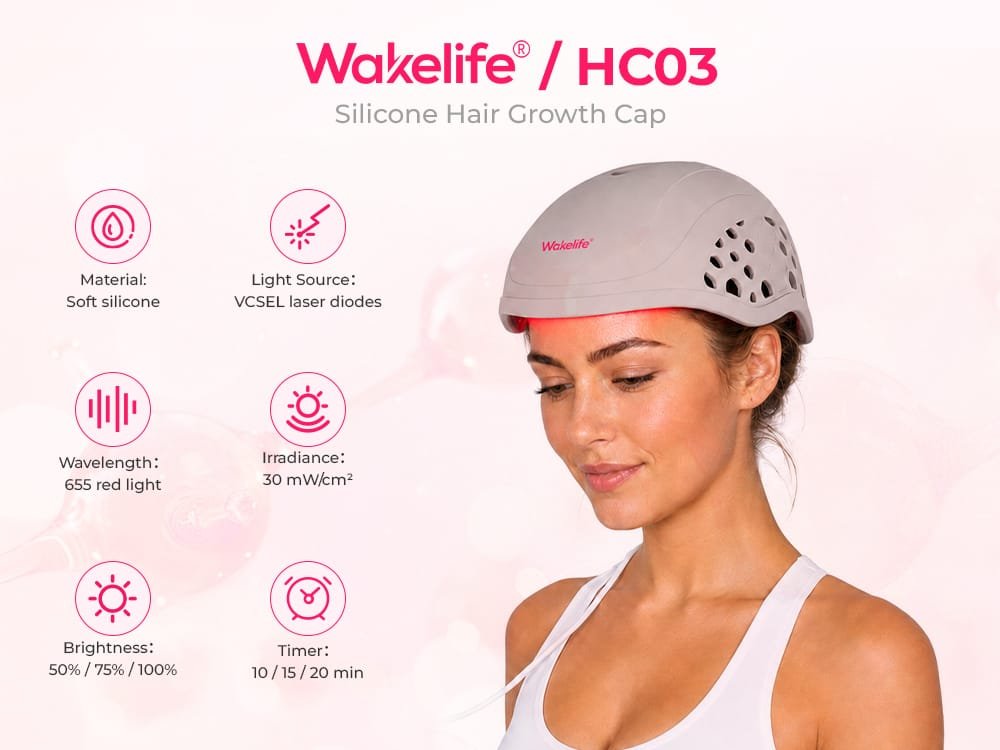
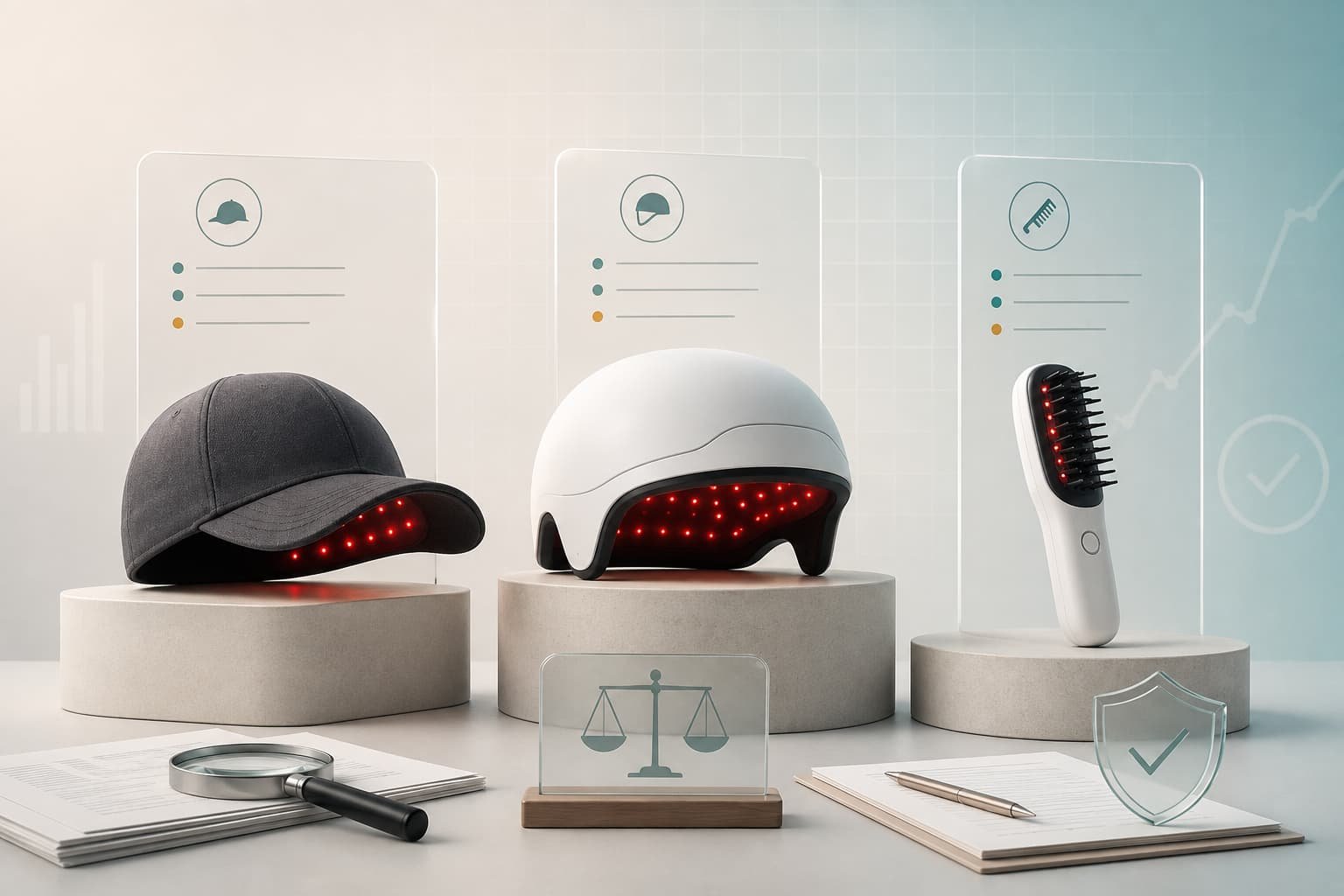
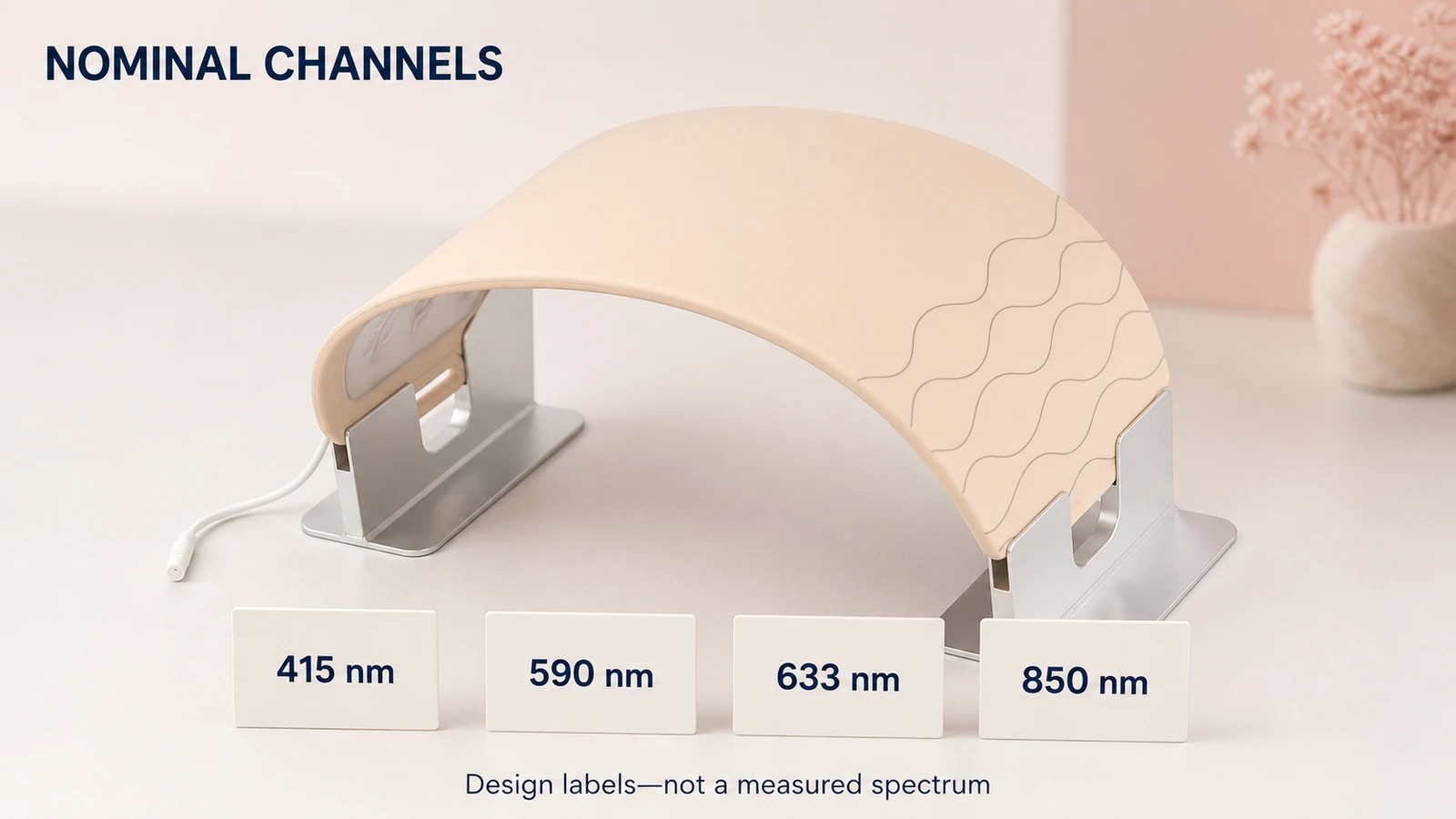
Do not qualify a red light therapy OEM by counting certificate logos. Verify who holds each record, which site and scope it covers, and whether any product-level authorization actually matches the device and claims you plan to sell.
ISO 13485, MDSAP and FDA 510(k) records do not prove the same thing. ISO 13485 concerns a quality management system. MDSAP concerns a regulatory audit of that system against stated criteria and scope. An FDA 510(k) is tied to a specific device submission and cleared intended use. A reliable OEM should be able to show how these layers connect without pretending that one replaces another.
B2B TL;DR
- Start with an entity-to-scope map, not a badge count. Record each certificate or authorization against its legal holder or applicant, audited site, stated scope, target product and the documented relationships between responsible parties.
- Verify ISO 13485 and MDSAP through the issuer or official program record. They are quality-system evidence, not blanket product approvals or automatic market access.
- Verify every FDA claim by K number. Check the applicant, device name, product code, named models and indications before deciding whether the record is relevant to your project.
- If a supplier relies on an existing 510(k) as authorization for your proposed product, an exact-device or intended-use mismatch is a stop signal. Otherwise, treat the record only as prior regulatory experience and assess the new pathway separately.
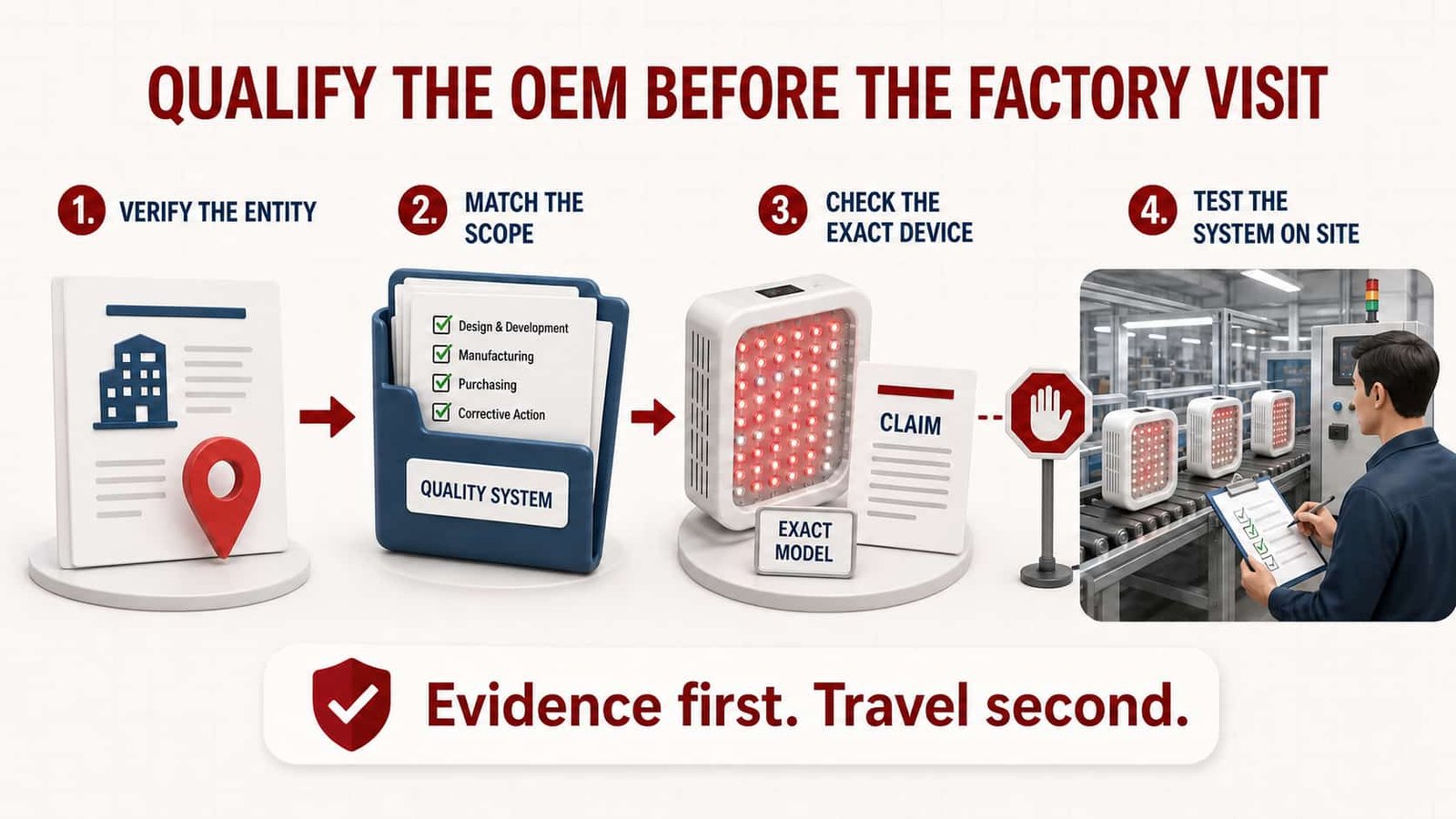
- Complete the minimum identity-and-scope review before committing significant sample, testing or travel costs. Then use the factory visit to test whether documented controls are visible in purchasing, production, testing, traceability, nonconformance handling and change control.
Why Should You Screen Regulatory Evidence Before Price?
Price becomes meaningful only after the supplier has passed the minimum evidence test.
A low quotation cannot compensate for an expired certificate, a different legal entity, a scope that excludes your product, or an FDA record that belongs to another device family. Those gaps can surface later as repeated testing, packaging rework, delayed market entry or a product that cannot support the claims your commercial plan assumed.
The first purpose of qualification is therefore not to find the “most certified” factory. It is to remove suppliers whose evidence cannot be connected to your exact project.
Use this sequence:
- Verify who owns the evidence.
- Verify which site and activities were audited.
- Verify which device family and claims a product-level record covers.
- Verify whether the factory can reproduce the required configuration under controlled production.
- Only then compare price, MOQ, lead time and customization.
What Do ISO 13485, MDSAP and FDA 510(k) Each Prove?
The fastest way to avoid misleading badge lists is to separate the three evidence layers.
| Evidence layer | What it can show | What it does not show | Minimum buyer check |
|---|---|---|---|
| ISO 13485 certificate | A named organization’s quality management system was assessed against ISO 13485 for a stated site, activity and scope | Product approval, clearance for a particular model, or automatic access to every market | Certificate number, legal name, physical site, standard, scope, issuer, issue/revision date, expiry and verification status |
| MDSAP certificate | A named medical-device organization’s QMS was audited by an MDSAP-authorized or recognized Auditing Organization against ISO 13485 and the applicable regulatory criteria listed on the certificate | A product marketing authorization, an FDA inspection, or proof that every MDSAP jurisdiction applies to every device | Certificate number, legal name, audited sites, Facility ID where shown, Auditing Organization, criteria, device/activity scope, limitations and validity |
| FDA 510(k) record | FDA found the submitted device substantially equivalent for the indications in the clearance record | FDA approval, a factory-wide certificate, clearance for unrelated models, or proof of compliance with every other FDA requirement | K number, applicant, device name, product code, regulation, decision, named models, indications and controlled device/labeling match |
The distinction became even more important when the FDA’s Quality Management System Regulation took effect on February 2, 2026. The QMSR incorporates ISO 13485:2016 by reference and adds FDA-specific requirements. The FDA’s QMSR FAQ states that FDA does not require an ISO 13485 certificate, that such a certificate does not exempt a manufacturer from FDA inspection, and that FDA inspections do not follow MDSAP audit procedures. An ISO 13485 certificate is relevant QMS evidence, but it is not automatic proof of full QMSR compliance.
Similarly, the FDA’s MDSAP overview describes MDSAP as a single regulatory audit that can satisfy relevant requirements of participating authorities. The word “relevant” matters: the applicable criteria, devices, sites and limitations must still be read from the certificate and project context.
MDSAP does not replace EU MDR conformity assessment or CE-marking requirements. The official MDSAP program overview lists the European Union as an Official Observer, not as one of the five Regulatory Authority Council members.
The first red flag: one badge is being used to answer a different question
Stop and ask for clarification if a supplier uses:
- ISO 13485 to claim that a particular product is approved;
- MDSAP to claim that a device can automatically be sold in every participating jurisdiction;
- an FDA establishment registration or device listing as if it were 510(k) clearance;
- one K number to cover every model made in the factory;
- a face-mask clearance to support a panel, belt, hair device or another product category.
Step 1: Can You Verify the Legal Manufacturer, Site and Scope?
Start with identity, not the certificate artwork.
For each ISO 13485 or MDSAP document, record:
- the complete legal manufacturer name;
- the physical manufacturing address;
- every audited site or sub-site shown;
- the certificate number;
- the issuing certification body or MDSAP Auditing Organization;
- the standard and regulatory criteria stated;
- the activities covered, such as design, manufacture or distribution;
- the device categories in scope;
- any exclusions, limitations or jurisdiction-specific conditions;
- the effective, revision and expiry dates;
- the official verification route.
This is not administrative detail. The current MDSAP Certification Document Requirements require the legal manufacturer name, audited physical addresses, certification criteria, device/activity scope, validity information and a verification method. They also require the scope to identify limitations where the criteria are not universally applicable.
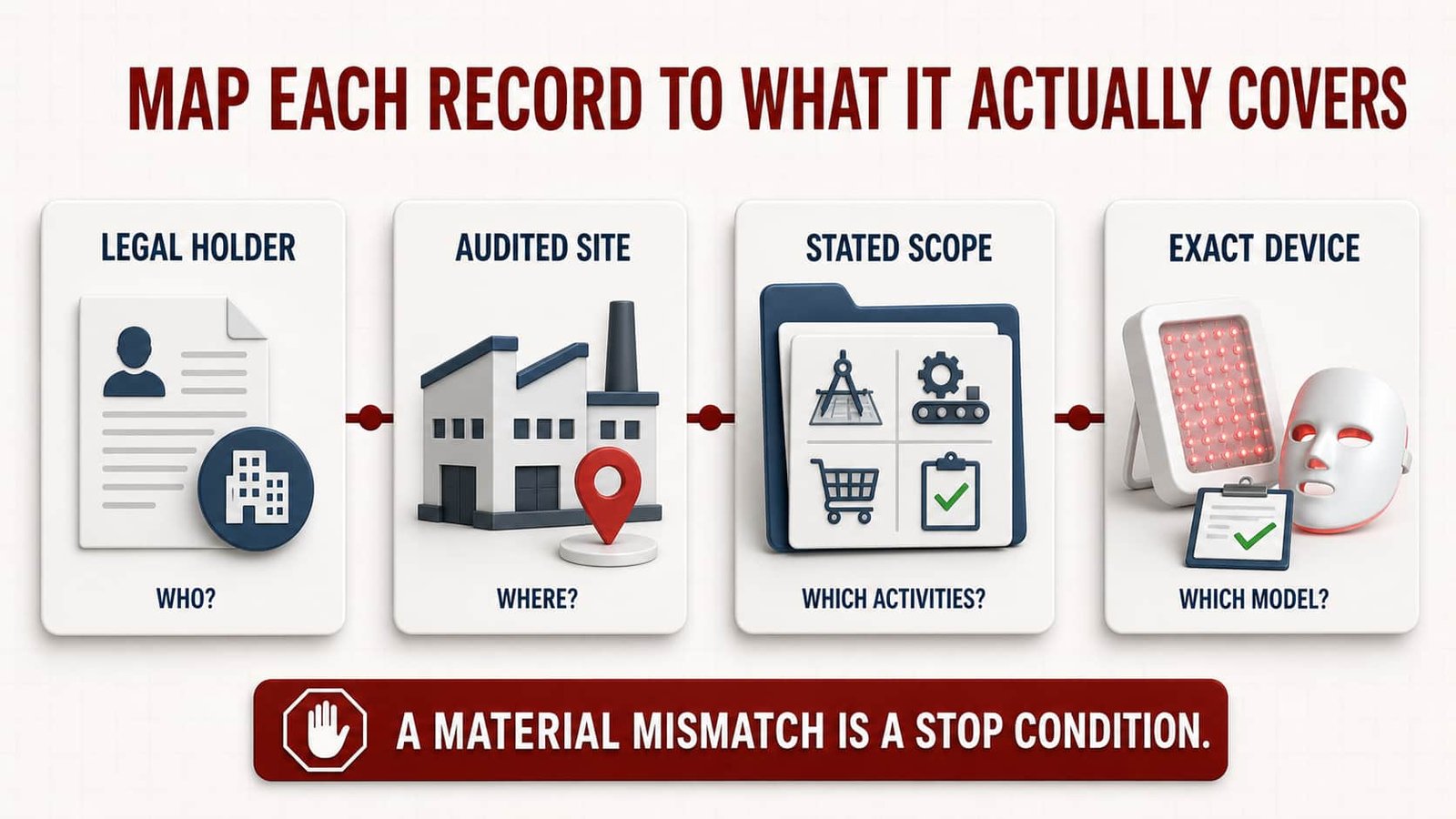
A practical entity-to-scope check
Use one line for each record:
| Record | Legal holder | Site | Activity scope | Device scope | Status | Project match |
|---|---|---|---|---|---|---|
| ISO 13485 | Verified / unresolved | Yes / conditional / no | ||||
| MDSAP | Verified / unresolved | Yes / conditional / no | ||||
| FDA 510(k) | Applicant address | Submission role | Named device/models | Verified / unresolved | Yes / conditional / no | |
| Product test report | Manufacturer and applicant | Sample identity | Tested configuration | Exact model/accessories | Verified / unresolved | Yes / conditional / no |
Do not “average out” an identity mismatch. Different entities are not automatically disqualifying, but their roles must be explicit. Identify the 510(k) owner or specification developer, legal manufacturer, contract manufacturer, certificate holder and sales entity where applicable. Then document which party controls design, production, labeling, complaints, change approval and post-market responsibilities.
Step 2: Does the FDA Record Match the Exact Device?
Search the FDA database yourself. A cropped letter, FDA logo or certificate-style graphic is not enough.
The FDA’s 510(k) overview explains that a 510(k) demonstrates substantial equivalence to a legally marketed predicate and clears the device for commercial distribution. It also notes that FDA does not typically conduct a pre-clearance facility inspection. A 510(k), therefore, is meaningful device evidence—but it is not proof that the whole factory or every product has been FDA-inspected and approved.
Check these fields:
- K number: Does the database record exist?
- Applicant or 510(k) owner: Does this party have legal authority over the submitted device? If it is different from the production factory, is the specification-developer or contract-manufacturer relationship documented?
- Device name: Is it the same product category you plan to buy?
- Product code and regulation: Do they align with the proposed intended use?
- Decision: Does the record show a substantially equivalent determination?
- Named models: Is the exact model included where the public record names models?
- Indications for use: Do the planned claims stay within the cleared scope?
- Configuration control: Do hardware, light modes, software, accessories, labeling and instructions still match the controlled device?
Under 21 CFR 807.97, a substantial-equivalence determination does not denote official FDA approval. The correct wording is FDA 510(k)-cleared, not FDA-approved.
When an exact-device mismatch is a stop condition
If a supplier or buyer intends to rely on an existing K number as market authorization for the proposed product, a mismatch in product format, intended use, named model or controlled configuration is a stop condition. Do not proceed on the basis of that clearance until the gap is resolved.
If the project instead expects a new submission or follows a different pathway, record the mismatch as a regulatory gap rather than an automatic supplier failure. The existing clearance may be treated as a signal of prior product-level regulatory execution, but the new pathway, responsibilities, evidence, timeline and budget still require separate assessment.
That distinction is especially important for red light therapy panels. A factory may have taken an LED mask through a 510(k) while its panels follow a different U.S. positioning or require a separate regulatory assessment. Do not transfer the mask’s K number to the panel.
Step 3: What Should You Request Before a Factory Visit?
A credible supplier should be able to organize an evidence pack around your selected product and market—not send a folder of unrelated certificates.
Request these items before booking travel:
| Request | What you are testing | Incomplete response |
|---|---|---|
| Current ISO 13485 and MDSAP certification documents | Holder, site, scope, criteria, limitations and validity | Logo, cropped image or certificate without verification route |
| Public regulatory-record map | K number or other authorization linked to applicant, device, models and claims | “FDA certified” with no number or exact-device explanation |
| Product and configuration sheet | Exact model, wavelengths/modes, output method, accessories, software and intended use | Generic catalog that cannot identify the proposed configuration |
| Product-specific test index | Which reports apply to which model, configuration and market | Test reports from a different model, adapter, material or configuration |
| Proposed customization/change list | Whether branding, hardware, firmware, accessories, instructions or claims will change | “All customization is covered” without documented assessment |
| Responsibility matrix | Who controls design, manufacture, labeling, complaints, vigilance and regulatory decisions | No named owner for post-market or change-control tasks |
| Open-gap list | Which evidence is complete, conditional, unavailable or still under review | A claim that every document is “available” without file names or status |
The best response is not necessarily the thickest folder. It is the one that shows the exact relationship between the selected model, controlled configuration, target market and available evidence.
Document availability and scope matter more than response speed. Confidential records may be redacted, reviewed under an NDA or reserved for on-site review. A supplier’s refusal to provide even a document index, identify the responsible owner or explain the review route is a stronger warning sign than a reasonable access-control process.
Copyable pre-audit request
Please provide a model-level evidence map for the proposed device. For each ISO 13485, MDSAP, FDA 510(k), safety, EMC, photobiological, optical-output or other test record, identify the legal holder or applicant, issuing body or laboratory, document number, exact model/configuration, applicable market, scope, current validity and any gap created by our requested customization or planned claims.
Step 4: Does the Quality System Reach the Production Line?
Steps 1–3 determine whether the supplier has earned a factory visit. Step 4 is the visit-stage checklist: it tests whether the documented system is visible in records and production decisions.
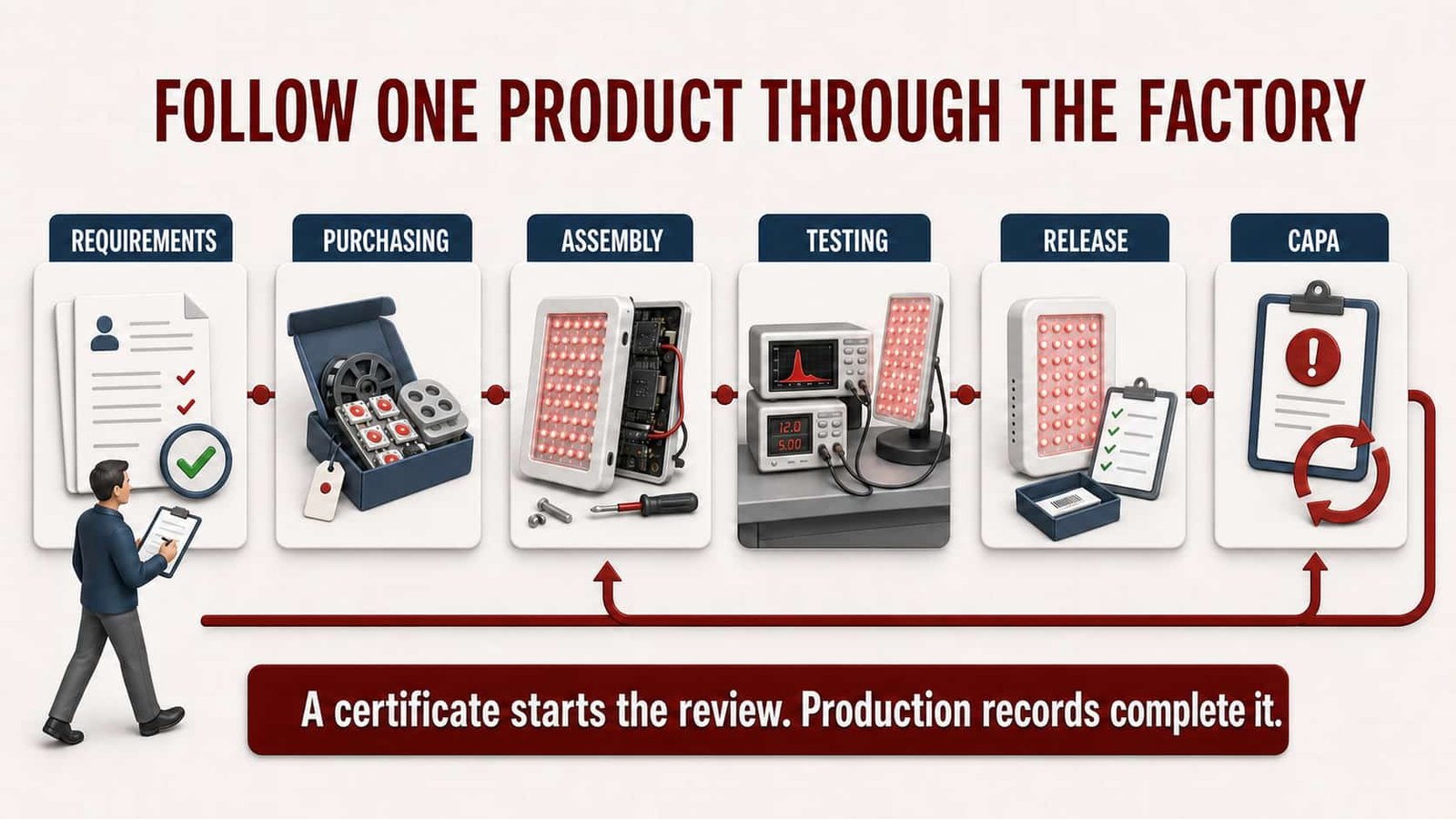
The current MDSAP Audit Approach follows primary processes for management, measurement/analysis/improvement, design and development, and production/service controls, with purchasing linked across those processes. Use the same logic during supplier qualification: follow one product from requirements to purchased components, production, verification, release and corrective action.
For a red light therapy device, examine:
1. Incoming materials and supplier control
- Are critical LEDs, optical components, power supplies, batteries, PCBs and skin-contact materials tied to approved specifications?
- How are critical suppliers selected, monitored and re-evaluated?
- What acceptance records show that incoming components met the defined requirements?
- What happens when a supplier or component changes?
2. Production and process control
- Does the current work instruction match the exact model and revision on the line?
- Are tools, fixtures, software versions and process parameters controlled?
- Are operators trained for the current operation?
- Are rework and concession decisions authorized and traceable?
3. Measurement and optical verification
- Which instruments measure wavelength, irradiance, electrical output and other release characteristics?
- Are instrument identification and calibration status visible?
- Are the test distance, geometry, mode, warm-up condition, sampling plan and pass/fail criteria defined?
- Can the supplier connect the marketing specification to the actual test method and production record?
4. Aging, final inspection and release
- If aging or burn-in is claimed, what does the step test, for how long and against which acceptance criteria?
- Is “100% testing” supported by a unit or batch record, or only stated in a sales presentation?
- Who authorizes final release, and what happens when a unit fails?
5. Traceability, nonconformance and CAPA
- Can one finished unit or batch be traced to critical material lots, production revision, test records and shipment?
- Are nonconforming units segregated and dispositioned with documented authority?
- Can the team show one closed corrective action from problem definition through root cause, implementation and effectiveness check?
- Does a corrective action or design change flow into the BOM, specifications, work instructions, validation and regulatory assessment?
Do not ask only whether the factory “has CAPA” or “has traceability.” Select one real record and follow it across departments. A usable system leaves connected evidence.
What good looks like on the floor
- Operators can explain the inspection or assembly step they are performing and point to the current instruction.
- Completed records contain product-specific data rather than blank templates or repeated placeholder values.
- Calibration labels on equipment agree with the instrument identification and calibration records.
- Quality personnel can explain nonconformance, release and change decisions without routing every technical question back to sales.
A Transparent Example: What Wakelife’s Public Records Cover
Commercial disclosure: Wakelife’s About page identifies Wakelife as the professional beauty division of Shenzhen Sungrow LED Technology Co., Ltd. That relationship is a company disclosure. The BSI and FDA records below independently verify the named legal entity’s certificates and device submission—not the brand relationship itself. We use our own records here to show how the qualification method works when the source documents and their limitations are public.
Quality-system layer
The BSI Client Directory profile for Shenzhen Sungrow LED Technology Co., Ltd. shows:
- ISO 13485 / EN ISO 13485 certificate MD 800872;
- MDSAP certificate MDSAP 800873;
- the same Shenzhen manufacturing address;
- a scope covering the design, manufacture and distribution of LED therapy lights for skin treatment and pain relief, and LED light therapy masks for wrinkles and mild-to-moderate acne;
- expiry on May 13, 2027.
This is verifiable QMS evidence for the named holder, site and stated scope. It is not a statement that every product in that scope has a market authorization.
Device-clearance layer
The FDA’s K250830 database record identifies the applicant as Shenzhen Sungrow LED Technology Co., Ltd. at the same Shenzhen site. It identifies the device as “LED Light Therapy Mask,” names 13 model designations and records a substantially equivalent decision dated June 9, 2025.
The K250830 clearance letter and Indications for Use list the named mask family and family-level indications for full-face wrinkles or mild-to-moderate inflammatory acne, depending on the stated light mode.
The public records therefore support this precise conclusion about the named legal entity:
Shenzhen Sungrow LED Technology Co., Ltd. has verifiable ISO 13485 and MDSAP quality-system certificates for a scope that includes LED therapy lights and LED masks, plus a device-specific FDA 510(k) clearance record for the 13 named LED mask models under K250830.
They do not support this broader claim:
Every Wakelife product—including red light therapy panels—is FDA-cleared.
Wakelife’s red light panels are not covered by K250830. For a panel project, we map the target market, intended use, planned claims and exact configuration separately. That limitation is not a weakness in the evidence. Stating it clearly is how a buyer can trust the parts that do apply.
Use This 12-Point OEM Qualification Scorecard
Use a two-stage decision: first apply the stop conditions, then record each remaining criterion as Pass, Flag, Fail or N/A. This avoids hiding a fatal mismatch inside a numerical total.
Stop conditions
Do not advance the supplier until it resolves any of these:
- the certificate or regulatory record cannot be independently verified;
- the legal-holder, applicant or manufacturing-site relationship is unexplained;
- the certificate scope excludes the required activity or device category;
- an existing K number is being relied on as authorization for the proposed product, but its device, intended use, named model or controlled configuration does not match;
- the supplier will not identify which reports apply to the exact configuration;
- a requested customization has no documented change or regulatory assessment.
Comparison record
Copy or adapt the blank template below. For each item, record the evidence reviewed and name the unresolved action. Use N/A only with a documented reason.
| Qualification item | Status | Evidence reviewed | Open action |
|---|---|---|---|
| Legal manufacturer, responsible-party and site relationship | Pass / Flag / Fail / N/A | ||
| ISO 13485 validity and scope | Pass / Flag / Fail / N/A | ||
| MDSAP validity, criteria and scope | Pass / Flag / Fail / N/A | ||
| Exact-device regulatory-record match, when required | Pass / Flag / Fail / N/A | ||
| Intended-use and claims fit | Pass / Flag / Fail / N/A | ||
| Target-market pathway and responsibilities | Pass / Flag / Fail / N/A | ||
| Test-report identity and configuration match | Pass / Flag / Fail / N/A | ||
| Supplier and incoming-material controls | Pass / Flag / Fail / N/A | ||
| Optical verification and calibration control | Pass / Flag / Fail / N/A | ||
| Batch or unit traceability | Pass / Flag / Fail / N/A | ||
| Change control, nonconformance and CAPA | Pass / Flag / Fail / N/A | ||
| Document quality and gap transparency | Pass / Flag / Fail / N/A |
Do not convert these statuses into a universal pass score. Any Fail tied to a stop condition blocks advancement until resolved. A Flag requires a named owner and next action; N/A requires a project-specific rationale. If your team needs weighted supplier ranking, set the weights for the specific device, market, claims and supply-chain role rather than adopting a universal formula.
What Should You Send for a Model-Level Evidence Review?
Send five inputs:
- target market or markets;
- product format and preferred model;
- planned consumer-facing claims and intended use;
- expected volume and customization scope;
- target launch date.
Wakelife will return a model-level evidence map showing:
- which public records and controlled files are relevant to the proposed configuration;
- which scopes or claims require clarification;
- which changes need documented technical or regulatory review;
- where separate testing, labeling work or a different regulatory pathway may be needed.
This review is not a promise of automatic market access. It is a way to expose the evidence boundary before quotation, tooling, packaging and launch commitments make changes expensive.
Include your target market, product format, planned claims, expected volume and launch date.
No purchase commitment is required at this stage; this is a qualification step, not a purchase order.
If your current project is a panel line, review Wakelife’s red light therapy panel OEM options before submitting the model and customization requirements. For a broader certification map, use the LED Therapy Device Certification Guide, the ISO 13485 vs MDSAP comparison and the FDA registration vs 510(k) guide.
Regulatory note: This guide is a supplier-qualification resource, not legal or regulatory advice. Requirements vary by market, device classification, intended use, claims, configuration and each party’s role. Confirm the applicable pathway with qualified regulatory professionals before commercialization.
References
- International Organization for Standardization. ISO 13485:2016—Medical devices—Quality management systems. Accessed July 27, 2026.
- U.S. Food and Drug Administration. Quality Management System Regulation. Effective February 2, 2026.
- U.S. Food and Drug Administration. Quality Management System Regulation—Frequently Asked Questions. Accessed July 27, 2026.
- U.S. Food and Drug Administration. Medical Device Single Audit Program. Updated December 18, 2025.
- Medical Device Single Audit Program. MDSAP Certification Document Requirements, MDSAP AU P0026.006. Version dated August 12, 2025.
- Medical Device Single Audit Program. Audit Approach, MDSAP AU P0002.010. Revision dated February 6, 2026.
- BSI. Client Directory Profile: Shenzhen Sungrow LED Technology Co., Ltd. Accessed July 27, 2026.
- U.S. Food and Drug Administration. 510(k) Premarket Notification K250830. Database page last updated July 20, 2026.
- U.S. Food and Drug Administration. K250830 Clearance Letter and Indications for Use. Decision dated June 9, 2025.
- U.S. Food and Drug Administration. Premarket Notification 510(k). Accessed July 27, 2026.
- Electronic Code of Federal Regulations. 21 CFR 807.97—Misbranding by Reference to Premarket Notification. Accessed July 27, 2026.
- Wakelife. About Wakelife. Company disclosure identifying Wakelife as the professional beauty division of Shenzhen Sungrow LED Technology Co., Ltd. Accessed July 27, 2026.
- Medical Device Single Audit Program. What is MDSAP? Accessed July 27, 2026.