Short answer: Check your device instructions first. For an LED mask designed for clean, dry skin, the practical order is: remove makeup and sunscreen, cleanse, pat dry, complete the device’s programmed session, then apply toner, serum, moisturizer, and daytime SPF. Do not assume every device follows the same protocol—an exact device guide should override any general routine.
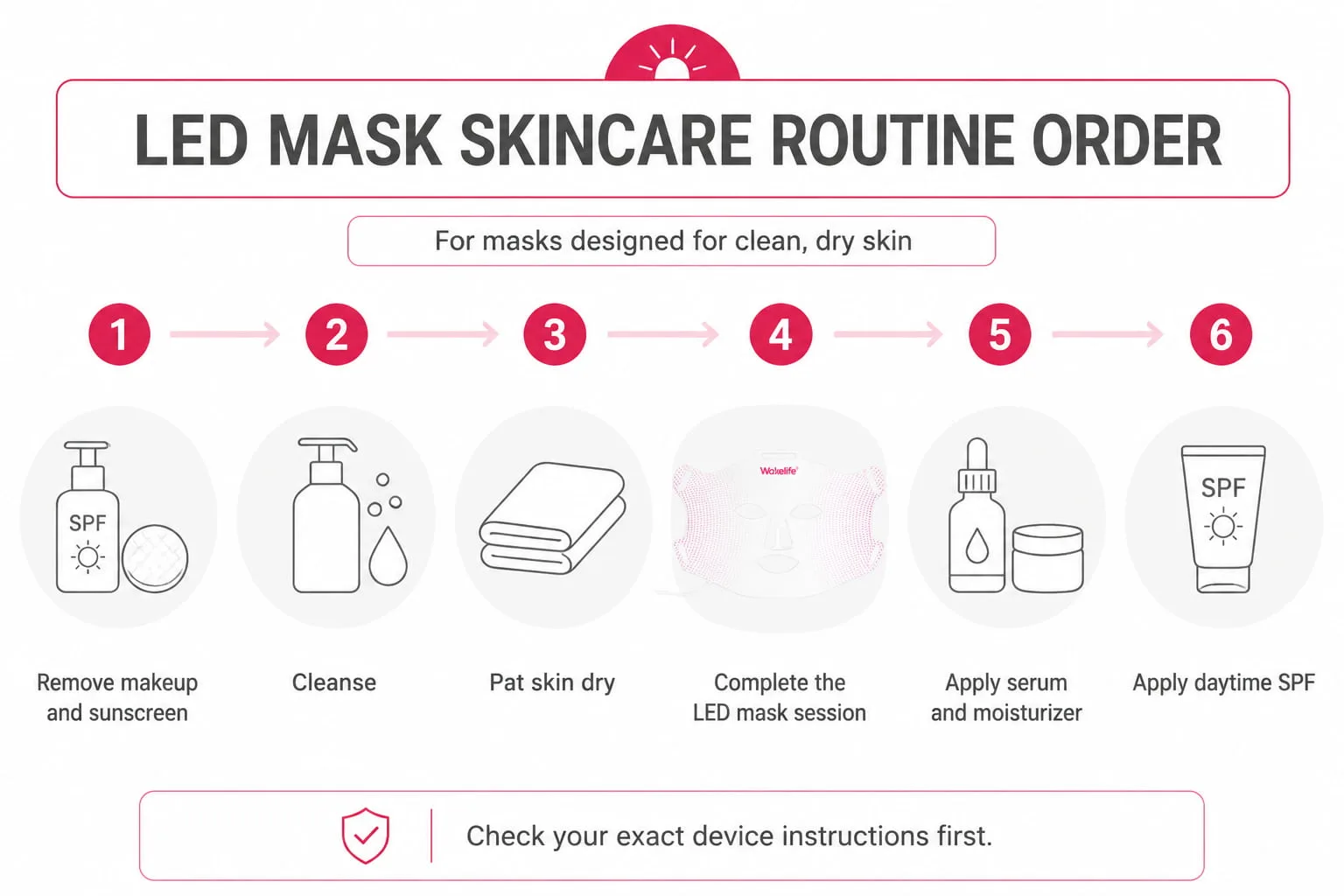
The Quick Routine Order
For a mask whose instructions specify clean, dry skin, use this sequence:
- Remove makeup and sunscreen.
- Cleanse your face.
- Pat your skin completely dry.
- Complete the LED session exactly as your device instructs.
- Continue with toner, serum, moisturizer, or other skincare.
- Finish with sunscreen during the day.
Your device instructions take priority. Some light-based systems are designed to work with a specific topical product. Do not copy another mask’s routine, treatment time, or warnings without checking your own user guide.
Should You Use an LED Mask Before or After Skincare?
If your mask is designed for clean, dry skin, use it after cleansing and before toner, serum, moisturizer, face oil, or SPF.
This is the most useful default because it follows the operating instructions used by many home LED masks. Cleveland Clinic’s treatment overview also advises starting LED light therapy with a clean, makeup-free face and notes that instructions vary by device.
The important distinction is between a practical default and a universal rule. Your routine should be based on the device you actually own—not on a generic claim that every cream or serum blocks a fixed amount of light.
Device-specific protocols demonstrate why this matters. Therabody instructs users of its TheraFace Mask to cleanse, dry, complete the mask session, and then apply skincare. Solawave gives the same order for its masks, but its multifunction skincare wand uses a designated activating serum before treatment because that device also uses galvanic current.
Those instructions apply to those specific products. They show why the exact device protocol—not a one-size-fits-all blog rule—must come first.
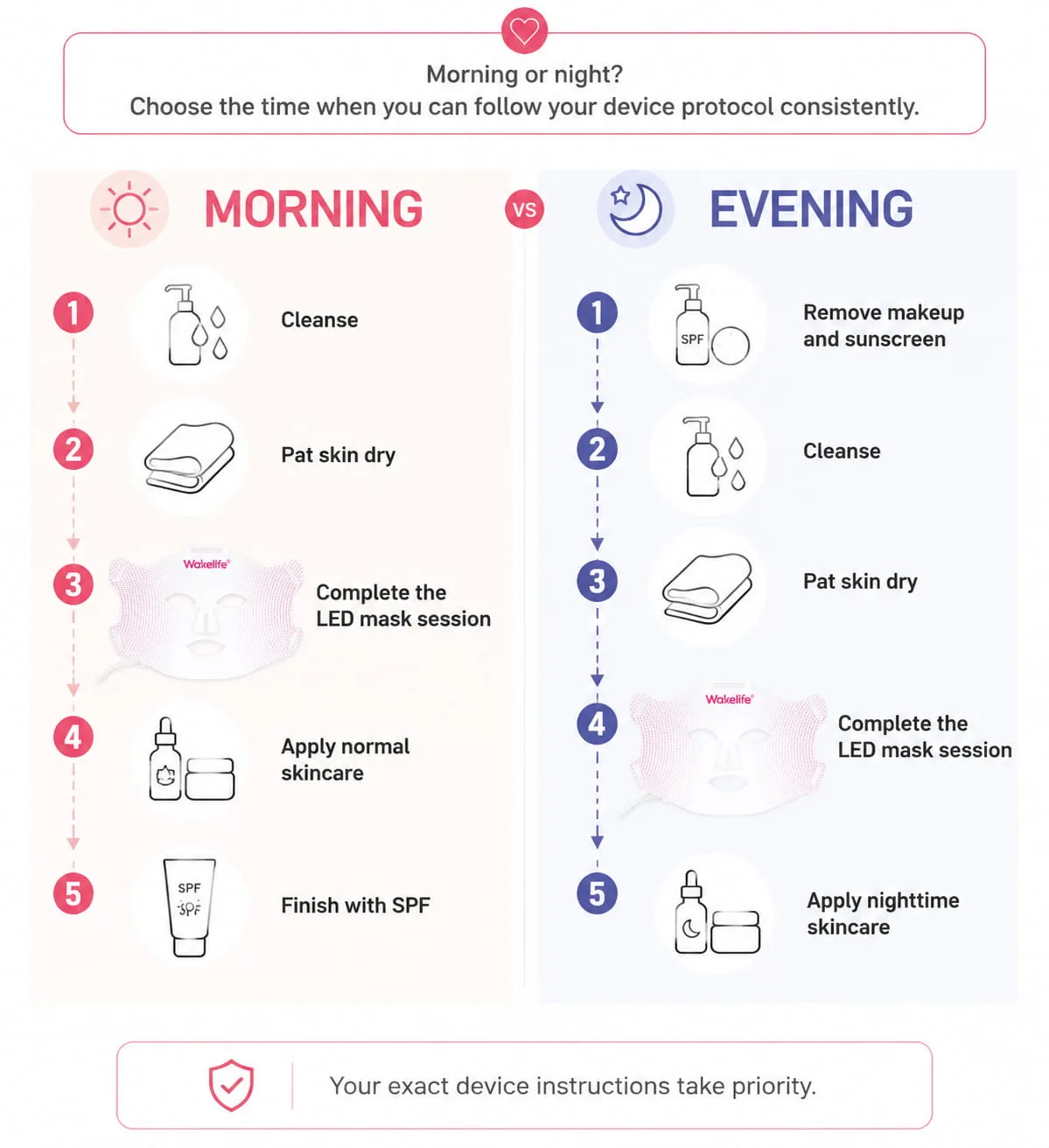
Where Does an LED Mask Fit in a Morning Routine?
In the morning, a clean-skin LED mask normally goes after cleansing and before leave-on skincare.
A simple morning sequence is:
- Remove any overnight residue and cleanse as needed. Follow the cleansing approach that works for your skin and the preparation steps in your device guide.
- Dry your face. If the guide says clean, dry skin, do not leave water or cleanser residue under the mask.
- Use the LED mask. Run only the programmed session or the treatment described in the manual.
- Apply your normal skincare. Continue with toner, serum, eye product, and moisturizer in the order that suits those products.
- Finish with SPF. Sunscreen remains the final step of a daytime skincare routine; this is ordinary sun protection, not evidence that LED treatment makes every user photosensitive.
If cleansing again in the morning makes your skin uncomfortable, do not solve the problem by placing an unapproved cream under the mask. Check whether your device allows a specific pre-treatment product, choose a different time of day, or ask the device provider for model-specific guidance.
Where Does It Fit in an Evening Routine?
In the evening, place a clean-skin LED mask after removing makeup and sunscreen, and before your leave-on nighttime products.
A practical evening sequence is:
- Remove makeup and sunscreen.
- Cleanse, then pat the skin dry.
- Complete the device’s prescribed LED session.
- Apply the leave-on products in your usual routine.
- Clean the device according to its own care instructions before storing it.
Evening use can be convenient because many people already cleanse thoroughly at that time. Convenience is not the same as stronger biological results. There is no need to claim that an LED mask works better at night simply because the skin has a nighttime rhythm.
What If You Already Applied Toner, Serum, or Moisturizer?
First check what your device requires. If it specifies clean, dry skin, follow the clean-skin protocol rather than guessing whether a product is compatible.
Use this decision table as a starting point—not as a replacement for the manual:
| What is already on your face? | For a clean, dry skin protocol | What to check |
|---|---|---|
| Makeup, tinted product, or sunscreen | Remove it, cleanse, and dry before the session | Device preparation steps |
| Toner or general serum | Use after the session unless the exact device protocol permits or requires it before | Product and device instructions |
| Moisturizer, cream, or face oil | Use after the session | Whether the device requires bare skin |
| Sheet mask, clay mask, or wash-off mask | Keep it as a separate step unless the device explicitly supports combined use | Heat, moisture, fit, and device-care instructions |
| A designated activating gel or serum supplied for the device | Follow the exact protocol | Whether the product is required for another function, such as galvanic current or microcurrent |
| Prescription topical or a product named in the device warnings | Do not improvise or stop medication on the basis of a blog | Device warning, prescriber, dermatologist, or pharmacist |
For product-specific questions, see our guide to using an LED mask with moisturizer or serum.
This approach also avoids an unhelpful shortcut: retinoids, Vitamin C, exfoliating acids, benzoyl peroxide, and prescription medicines are not one interchangeable group. A product can raise concerns because of irritation, a device-specific warning, an individual medical condition, or the way a combined system was tested. Those are different questions and should not be reduced to “all actives are photosensitizing.”
Is Morning or Night Better for an LED Mask?
There is no universal best time of day. Use the mask when you can follow its protocol consistently without rushing or layering products in the wrong order.
Morning may work well if you prefer to complete the session before serum, moisturizer, and SPF. Evening may be easier if removing makeup and sunscreen is already part of your nightly routine.
Choose based on three practical questions:
- When can you start with the skin condition required by the manual?
- When can you complete the entire programmed session?
- When are you most likely to use the device consistently and clean it afterward?
If your exact device instructions recommend a particular schedule, follow that schedule. Do not transfer timing advice from a three-minute mask, a longer programmed mask, a salon panel, or a multifunction wand to a different device.
When Should You Pause and Check the Manual or Ask a Professional?
A general routine guide is not enough when your question involves medication, a recent procedure, an eye condition, broken or inflamed skin, or an unexpected reaction.
Check the device warnings and seek qualified advice when appropriate if you:
- Take a medication or use a topical product listed in the device’s photosensitivity or contraindication warnings.
- Recently had a laser procedure, chemical peel, microneedling, injectable treatment, surgery, or another facial procedure.
- Have an active rash, open skin, unusual redness, pain, or irritation.
- Have an eye condition or cannot use the eye protection specified for the device.
- Are unsure whether the device’s intended use matches your skin concern.
Cleveland Clinic notes that LED light therapy is not appropriate for everyone and advises medical review for certain medications and health conditions. Do not stop prescribed medication to make an LED routine fit; ask the prescriber, dermatologist, or pharmacist how the device guidance applies to you.
How Long and How Often Should You Use It?
Use the session length and frequency specified for your exact device.
Treatment plans differ because devices can vary in wavelength, irradiance, distance from the skin, coverage, programmed modes, and intended use. A short session on one mask does not prove that another mask should be used for the same number of minutes.
Do not extend a session to “make up” for skipped use, stack multiple modes without instructions, or assume longer exposure must be better. If the manual is missing or unclear, ask the manufacturer for the current instructions for your exact model before using it.
A Routine That Is Simple Enough to Repeat
For most users, the best routine is the one that removes uncertainty:
- Identify the exact model—not just the brand or mask color.
- Read its preparation steps, programmed session, eye guidance, warnings, and cleaning instructions.
- If it requires clean, dry skin, use LED after cleansing and before leave-on skincare.
- Keep your normal post-session routine simple and comfortable.
- Recheck the guide before adding a strong active, a new device, or a post-procedure routine.
The goal is not to create the longest possible skincare routine. It is to place the LED mask where its own protocol says it belongs and make that sequence easy to follow.
If you are still choosing a device—or its documentation is too vague to apply this routine—use Wakelife’s six-point LED face mask selection guide to check the exact model, intended use, specifications, fit, and instructions.
Looking for a Consumer LED Mask?
If you are exploring a consumer mask designed around a clean, dry-skin routine, you can view the Solo Red Light LED Face Mask. Its current product guidance recommends using the mask on clean, dry skin and applying serum or moisturizer after the programmed session.
Commercial disclosure: Solo Red Light is an affiliated consumer retail brand. The link opens its separate online store, where purchases and customer support are handled. Always follow the instructions supplied with your exact device.
For Brands, Clinics, and Product Teams
Individual users should follow the instructions supplied for their exact device. For brands, clinics, and product teams, routine guidance becomes a product-design question: Does the mask fit comfortably after cleansing? Is the programmed session realistic? Are warnings and skincare instructions clear for the intended consumer?
If you are comparing LED mask platforms for a brand, clinic, or product program, explore Wakelife’s LED face mask range. For private-label development or protocol customization, review Wakelife’s LED device OEM and ODM capabilities.
Medical note: This article provides general consumer education, not medical advice. LED masks vary in intended use, regulatory status, output, and instructions. Follow the labeling for your exact device and seek qualified medical guidance for medications, medical conditions, recent procedures, or adverse reactions. See Wakelife’s Medical Disclaimer.
References
| No. | Official Source |
|---|---|
| 01 | Cleveland Clinic. LED Light Therapy: How It Works, Colors, Benefits & Risks. Accessed July 16, 2026. |
| 02 | Therabody. TheraFace Mask: Your Most Common Questions, Answered. Device-specific manufacturer instructions. Accessed July 16, 2026. |
| 03 | Solawave. How to Integrate Red Light Masks into Your Daily Skincare Routine for Best Results. Device-specific manufacturer instructions. Accessed July 16, 2026. |